

No wearable, no problem
How to Measure Recovery
Without a Fitness Tracker
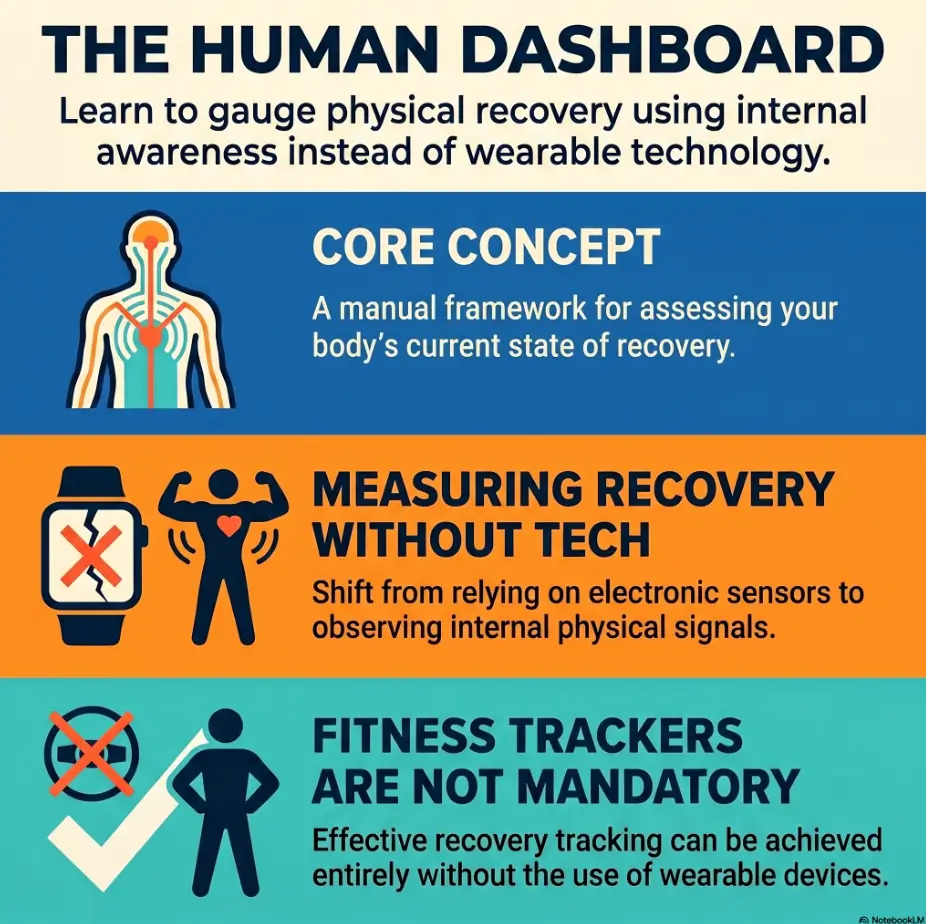
Recovery does not begin inside a watch. It begins in the small morning negotiations: whether your legs feel springy or sandbagged, whether coffee feels pleasant or medicinal, whether your warm-up opens like a window or sticks like an old drawer.
Fitness trackers can be useful, but they can also turn a normal human morning into a courtroom drama. A low sleep score appears, and suddenly your body feels guilty before breakfast. This guide gives you a calmer way to read recovery using sleep quality, mood, soreness, appetite, motivation, breathing, and the first few minutes of movement.
The goal is not to replace medical advice, coaching, or performance testing. The goal is to build a repeatable, no-device recovery habit that helps you decide when to train hard, when to train lighter, and when rest is the smartest workout on the calendar.
Train with less guesswork
Use body signals before your workout becomes a coin toss.
Spot fatigue earlier
Notice patterns before soreness, stress, or sleep debt gets loud.
Keep it simple
Build a five-minute scorecard you can use without gadgets.
🌙 Tiny signal, big decision: your body usually whispers before it yells. This article teaches you how to hear the whisper.
Snapshot: This guide is for busy adults, runners, lifters, weekend athletes, and wellness readers who want to measure recovery without buying a fitness tracker. You will learn how to read simple daily signals, build a no-tracker recovery scorecard, choose green/yellow/red training days, and know when symptoms deserve professional help instead of another workout.
Table of Contents
Safety First: When Recovery Signals Are Not Enough
This article is for general fitness education. It is not medical advice, diagnosis, physical therapy, nutrition counseling, or a substitute for care from a qualified clinician. Recovery self-checks can help you notice patterns, but they cannot rule out injury, illness, heart problems, heat illness, medication effects, or other conditions.
That boundary matters. A notebook score is helpful when you are deciding whether to run three miles or two. It is not enough when you have chest pain, faintness, unusual shortness of breath, a new neurological symptom, severe swelling, fever, or pain that feels sharp, one-sided, or worsening.
For readers managing chronic illness, post-surgery restrictions, pregnancy, a history of fainting, eating concerns, heart disease, major sleep problems, or persistent pain, use this guide as a conversation starter with a professional. Recovery is personal, and the safest plan is the one that respects your actual body, not an internet template wearing a tiny whistle.
Key takeaway: recovery tracking is a filter, not a diagnosis.
Use no-tracker recovery signals to make smarter training choices, not to explain away symptoms that feel severe, unusual, or medically concerning.
Why this topic needs a little caution
Fitness culture often treats discomfort as a character test. Sometimes discomfort is simply a normal training aftertaste. Other times, it is your body pulling the fire alarm. The hard part is that both can show up after a workout.
A practical recovery system should make you more honest, not more reckless. If your score says “yellow” but your knee feels stabbed when you walk downstairs, the knee wins. If your motivation is low but you also have feverish chills, this is not a grit moment. It is a rest-and-evaluate moment.
What this guide can help you do
This guide can help you notice ordinary under-recovery: poor sleep, heavy legs, unusual irritability, low appetite, lingering soreness, and a warm-up that feels suspiciously dramatic. It gives you a way to turn vague body feelings into a repeatable decision.
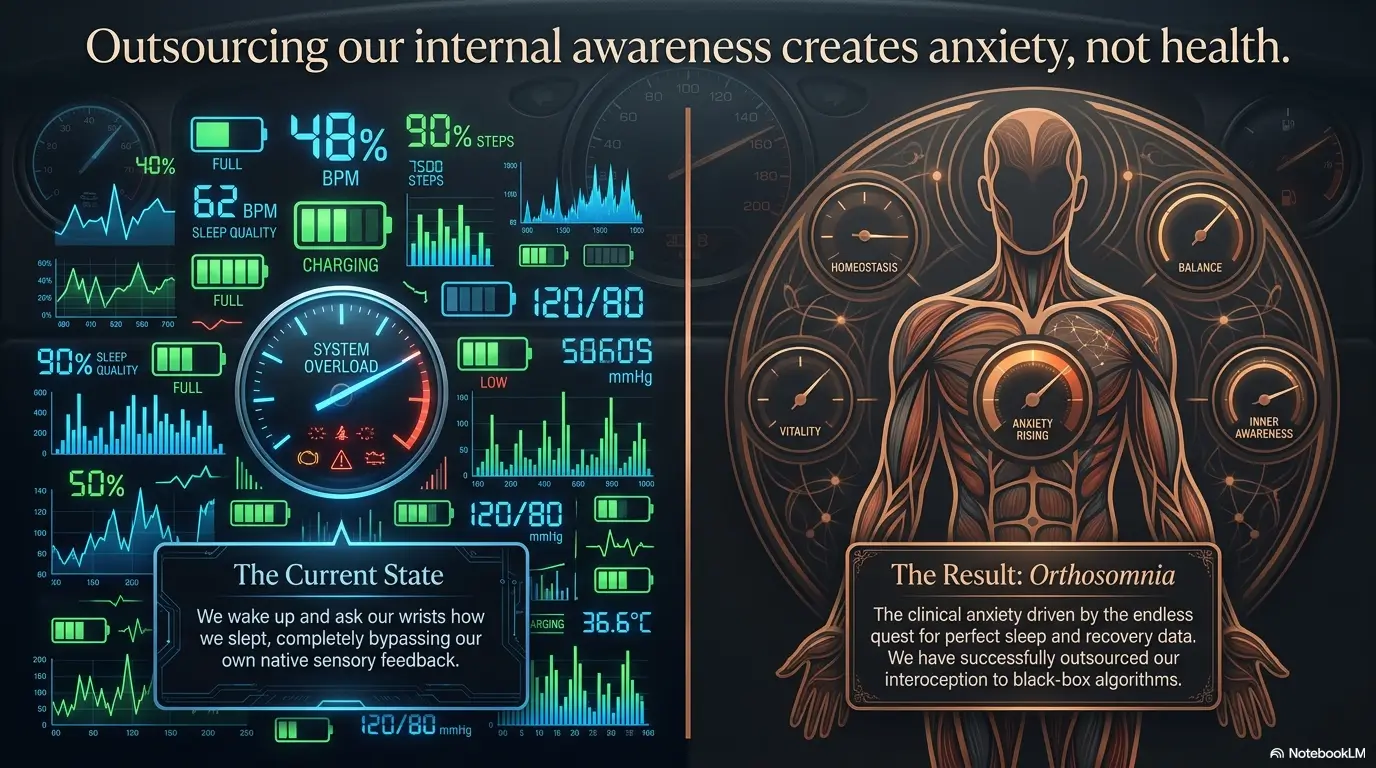
It can also help you reduce wearable anxiety. You do not need a readiness score to know that three nights of broken sleep, a stressful work deadline, and a heavy deadlift session might require a lighter training day.
What this guide cannot promise
No self-check can promise perfect accuracy. You may feel good and still be under-recovered. You may feel sluggish and still have a decent workout. Human bodies are not spreadsheets with sneakers.
The value comes from trend spotting. One rough morning is data confetti. Three or four rough mornings in a row are a pattern. Patterns deserve attention.
Recovery Signals Your Body Already Gives You
Recovery is not only about whether your muscles hurt. It is the combined story of your nervous system, sleep, mood, appetite, joints, stress, and readiness to move. You already receive these signals every day, but most people read them after the workout, when the damage has already RSVP’d.
The better approach is to check them before training. Think of it as looking at the weather before leaving the house. You may still go outside, but you will choose different shoes.
Morning energy is the first quiet clue
Morning energy is one of the easiest recovery signals because it arrives before excuses get dressed. Ask yourself: did I wake up feeling mostly restored, or did I feel like I was poured out of bed with a ladle?
You are not looking for cartoon-level enthusiasm. Many healthy adults wake up slowly. What matters is whether the morning feels unusually heavy compared with your normal baseline.
A runner who usually feels alert after breakfast but suddenly needs two coffees and a bargaining session to lace shoes may be seeing under-recovery. A lifter who normally enjoys training but feels flat, foggy, and oddly indifferent may need to reduce intensity.
Soreness matters, but only in context
Muscle soreness can mean you trained a muscle in a new way, increased volume, returned after time off, or did a lot of eccentric work. It does not automatically mean you are injured. It also does not automatically mean your workout was superior.
Context is the seasoning. Broad soreness in both quads after your first hill session in months is different from sharp pain under one kneecap that worsens as you walk. The first may call for easy movement. The second calls for caution.
Mood, focus, and irritability count too
Your muscles do not recover in a private room away from the rest of your life. Work stress, family stress, poor sleep, travel, alcohol, big deadlines, and emotional strain can all make training feel heavier.
Irritability is especially sneaky. If everything annoys you, your headphones feel tangled with moral insult, and the gym parking lot feels personally designed to test you, your recovery score may deserve a yellow flag.
The warm-up test: your body’s daily handshake
The warm-up is the most honest part of the workout. It happens before pride has a chance to decorate the room. Easy movement should begin to feel smoother after a few minutes.
If your first ten minutes feel stiff but gradually improve, you may be fine to continue at a moderate level. If movement gets worse, feels unusually heavy, or produces pain that changes your form, the plan should change.
Who This Method Fits, and Who Should Be Careful
No-tracker recovery checks work best for people who want practical feedback without turning fitness into a surveillance operation. They are ideal for recreational exercisers who need enough structure to make good decisions, but not so much data that a Tuesday jog becomes a research project.
This method is also useful if you already own a wearable but want to stop treating it as the boss of your body. A watch can offer useful clues. It should not get full voting rights over your common sense.
Good fit: recreational exercisers who want simple feedback
This approach works well for beginners, busy professionals, parents, casual runners, gym members, home-workout people, hikers, pickleball players, and anyone trying to stay consistent without obsessing.
For example, a budget-conscious beginner doing three strength workouts per week can use a scorecard to decide whether to add weight, keep the session easy, or take a walk instead. A runner training for a 10K can use it to avoid stacking hard sessions on poor-sleep days.
Good fit: people tired of wearable anxiety
Wearables can create a strange little loop: you check your score, the score worries you, the worry changes how you feel, and now you are no longer sure whether you are tired or just score-haunted.
A no-tracker system shifts attention back to lived signals. Did you sleep well? Do your joints feel normal? Does your warm-up improve? Are you emotionally steady enough to train well? These questions do not need Bluetooth.
Not ideal: anyone managing injury or medical restrictions
If you are recovering from surgery, dealing with chronic pain, returning after a major illness, managing heart concerns, or following physical therapy restrictions, your recovery plan should follow professional guidance. A scorecard can support that plan, but it should not replace it.
If pain is part of your training decision, it may help to keep a more formal symptom log and bring it to your clinician. For more detailed wording ideas, you may find this guide on how to describe pain to a doctor useful.
Not enough: athletes needing precise performance monitoring
Competitive athletes may need more than self-rating. Training load, heart rate, heart rate variability, lactate testing, power output, coaching feedback, bloodwork, or sport-specific performance markers may be relevant depending on the sport and level.
For most everyday exercisers, though, the problem is not a lack of advanced metrics. It is ignoring the obvious ones. The body sends postcards before it sends eviction notices.
The 5-Minute Recovery Check Before You Train
The best recovery system is the one you will actually repeat. A beautiful tracking sheet that takes twenty minutes becomes decorative guilt by Thursday. A five-minute check can become a habit.
Do the check at roughly the same time each day, ideally in the morning or before your workout. Rate five signals from 1 to 5: sleep quality, soreness or pain, mood, energy, and motivation. Then add one sentence in plain language.
Key takeaway: make the check small enough to survive real life.
Five signals, one score, one sentence. That is enough to spot trends without turning recovery into paperwork with gym shoes.
Rate sleep, soreness, mood, energy, and motivation
Use a simple scale. A 1 means “very poor.” A 3 means “acceptable but not great.” A 5 means “strong, normal, ready.” Do not overthink decimals. You are building a signal, not filing taxes.
| Signal | Score 1 | Score 3 | Score 5 |
|---|---|---|---|
| Sleep quality | Broken, short, unrested | Okay, not fully restored | Restful and steady |
| Soreness or pain | Sharp, limiting, or worsening | Manageable muscle soreness | Little to none |
| Mood | Irritable, anxious, flat | Neutral or mildly stressed | Calm and focused |
| Energy | Heavy and drained | Functional but not lively | Normal or strong |
| Motivation | Dread or avoidance | Willing but cautious | Eager or steady |
Add one sentence: “My body feels like…”
Numbers are useful, but language catches texture. Write one sentence after the scores: “My body feels like it needs a gentle start,” or “My legs feel fresh but my mind feels tired,” or “My left calf feels wrong.”
That sentence often becomes the most useful part of the record. It helps you separate whole-body fatigue from local pain, sleepiness from dread, and normal stiffness from something that deserves caution.
Use the score to choose hard, moderate, easy, or rest
Add the five scores. Your total will land between 5 and 25. This is not a medical scale. It is a personal traffic light.
| Total score | Color | Training choice | Example |
|---|---|---|---|
| 21–25 | Green | Train as planned | Intervals, heavier lifts, normal long run |
| 16–20 | Yellow | Reduce one variable | Less volume, lighter weight, shorter run |
| 10–15 | Orange | Keep it easy | Walk, mobility, easy technique work |
| 5–9 | Red | Rest or seek help if symptoms concern you | Sleep, gentle walk, professional guidance if needed |
Simple only works if you repeat it
A recovery scorecard is a compass, not fireworks. It will not feel dramatic on day one. Its value appears when you compare scores with how workouts actually felt.
After two weeks, you may notice that scores under 16 usually lead to sluggish runs. Or you may find that your soreness score matters less than sleep and mood. Your personal pattern is the treasure.
Sleep Quality Beats Sleep Guessing
Sleep is the recovery signal everyone mentions and many people track poorly. Hours in bed matter, but they do not tell the full story. Seven hours of restless, interrupted sleep may leave you less restored than six and a half calm hours.
Without a tracker, you can still ask useful questions: Did I fall asleep easily? Did I wake often? Did I wake earlier than planned? Did I feel restored after being upright for twenty minutes? Did I need more caffeine than usual to feel human-adjacent?
Track how restored you feel, not just hours in bed
The simplest sleep score is not “How many hours did I get?” It is “How restored do I feel?” Hours are the receipt. Restoration is the meal.
Give sleep a 1 if you woke exhausted, groggy, or repeatedly interrupted. Give it a 3 if it was adequate but not refreshing. Give it a 5 if you woke with steady energy and no sense of dragging yourself out of the night by the collar.
Watch for broken sleep, early waking, and heavy mornings
Broken sleep can signal stress, too much late caffeine, alcohol, pain, noisy environments, poor sleep timing, or training intensity that your body has not absorbed. Early waking can also show up during stressful periods, especially when your brain starts acting like an unpaid project manager at 4:17 a.m.
Heavy mornings matter when they repeat. If you wake up feeling unrested for several days, reduce training intensity before your body forces the issue.
One bad night is noise; three bad nights is a message
Do not redesign your entire fitness life after one rough night. Life happens. A neighbor’s dog becomes a saxophone. A child wakes. A deadline turns the brain into popcorn.
Three poor nights in a row deserve action. Lower intensity, shorten the session, skip the personal record attempt, and protect bedtime. Recovery often improves when you stop adding more stress to an already crowded shelf.
Soreness Is Not Always a Recovery Score
Soreness is persuasive because it is loud. It can make stairs feel like legal punishment and turn sitting down into a slow-motion negotiation. But loud is not the same as useful.
Some soreness is normal after new or harder training. Some soreness is a sign that you changed too much too fast. Some pain is not soreness at all. The skill is learning the difference without either panicking or pretending.
Normal muscle soreness feels broad and predictable
Normal delayed muscle soreness often feels broad, dull, and symmetrical. It usually appears after a new exercise, longer workout, heavier session, or return after a break. It may be tender, but it should not feel like a sharp warning light.
For example, both calves feeling tight after your first hill walk of the season is predictable. Both triceps feeling sore after returning to push-ups is also predictable. Predictable soreness can often handle easy movement, gentle range of motion, and time.
Sharp, one-sided, or worsening pain changes the story
Pain that is sharp, pinpoint, one-sided, swelling, associated with weakness, changing your gait, or getting worse during the warm-up deserves more caution. Do not bury it under motivational wallpaper.
If pain repeatedly changes how you move, your body may start compensating. A sore ankle becomes a cranky knee. A cranky knee invites the hip into the argument. Soon the whole meeting has gone off agenda.
Don’t treat soreness as proof of progress
Soreness is not a trophy. Many effective workouts create little soreness, especially when your program is consistent and well matched to your current ability.
If you chase soreness, you may constantly introduce too much novelty or intensity. That can make recovery harder to read because your body is always reacting to another surprise party it did not request.
Mini checklist: soreness or possible injury?
- Broad, dull, and expected after a new workout: usually normal soreness.
- Sharp, local, or one-sided: be more careful.
- Improves after easy movement: usually less concerning.
- Worsens during warm-up: stop or change the plan.
- Changes how you walk, lift, or breathe: do not push through.
Your Warm-Up Can Expose Hidden Fatigue
The warm-up is where theory meets ankles, hips, shoulders, lungs, and mood. Your plan may look glorious on paper, but the first ten minutes reveal whether today’s body agrees to the contract.
A good warm-up test does not need fancy drills. It needs attention. Start easier than you think you need to, then notice whether movement becomes smoother, stays awkward, or gets worse.
If easy movement feels unusually heavy, listen
Easy movement should not feel heroic. If your warm-up pace feels like a race pace, or an empty barbell feels unusually heavy, the body may be asking for a lower-demand day.
This does not mean you are weak. It means today’s readiness is lower. Training is a long conversation, not a one-day shouting contest.
Use the first 10 minutes as a decision point
Commit to a ten-minute check-in. For running, walk first, then jog easily. For lifting, move through warm-up sets slowly. For a fitness class, use the first round as information rather than proof that you must go full dragon.
At ten minutes, ask: Am I loosening up? Is my breathing reasonable? Is pain absent or decreasing? Is my coordination normal? If yes, continue. If no, adjust.
Discipline sometimes means backing off
Backing off can feel like failure if you only define discipline as more. Better athletes and long-term exercisers learn another version: discipline is doing the right amount for the body you brought today.
A yellow-day session is not wasted. It preserves consistency. It keeps the habit alive without turning fatigue into a bigger problem.
No-Tracker Recovery Decision Flow
1. Morning scan
Sleep, energy, mood, soreness, motivation.
2. Score it
Rate each signal 1–5. Add one body sentence.
3. Warm-up test
Use the first 10 minutes as a truth meter.
4. Choose the day
Green: normal. Yellow: reduce. Red: rest or get help.
Appetite, Cravings, and Thirst Can Reveal Stress
Food signals are imperfect, but they are worth noticing. Appetite can shift with training load, sleep, stress, illness, hydration, menstrual cycles, medication, heat, and under-fueling. This is why food clues should be read as part of the full picture, not as a solo judge with a tiny gavel.
If you are training harder but eating less, recovery may suffer. If you are sleeping poorly and craving fast energy, your body may be asking for fuel, rest, or both.
Low appetite after hard training may signal under-recovery
Some people feel less hungry immediately after intense exercise. That can be normal. But a repeated pattern of low appetite, poor sleep, heavy fatigue, and declining performance deserves attention.
For a busy adult training before work, the issue may be simple: a hard morning session, skipped breakfast, a stressful workday, and not enough evening food. By the next morning, the recovery tank is not empty because the workout was bad. It is empty because nobody refilled it.
Strong cravings can follow poor sleep or under-fueling
Cravings do not mean you lack discipline. They may mean you are tired, stressed, under-fueled, or trying to train on too little energy. Poor sleep can make quick energy feel more appealing because the brain wants an easier road.
Instead of judging the craving, ask what came before it. Was dinner light? Was the workout longer than usual? Did sleep fall apart? Did stress eat your lunch break like a raccoon in a pantry?
Hydration clues are useful, but not magic
Thirst, dry mouth, headache, unusually dark urine, and heavy sweating can all suggest hydration needs. But hydration is not the answer to every recovery problem. Sometimes you need food. Sometimes you need sleep. Sometimes you need less intensity.
Use hydration as one clue. If you are thirsty, overheated, and training in summer, take it seriously. If you are tired for two weeks, water alone is not a recovery plan.
Motivation Drops Before Performance Does
Low motivation is easy to mislabel as laziness. Sometimes it is. Sometimes it is your nervous system waving a small white flag while your workout plan pretends not to notice.
Motivation matters most when it changes suddenly or repeats with other signals. If training normally gives you satisfaction but now feels like a grim appointment with a staircase, check sleep, stress, soreness, food, and recent training load.
Training dread can be a fatigue signal, not laziness
There is a difference between “I do not feel like starting” and “My whole body recoils from this workout.” The first often improves after ten minutes. The second may signal accumulated fatigue.
Try the minimum start rule: put on shoes, begin the warm-up, and reassess after ten minutes. If energy rises and movement improves, continue. If dread becomes heaviness, pain, or poor coordination, choose a lower-demand session.
Irritability and brain fog belong in the recovery picture
Recovery includes the brain. If you feel foggy, unusually impatient, emotionally brittle, or unable to focus, your body may not be ready for complex, intense, or risky training.
This matters for lifters doing heavy technical lifts, runners doing speed sessions, cyclists riding in traffic, and anyone using equipment where poor focus increases risk. A foggy brain can turn a normal workout into a poor decision factory.
Are you avoiding training, or avoiding exhaustion?
This question is gold. If you are avoiding training because starting feels inconvenient, a small warm-up may help. If you are avoiding training because your body feels depleted, then the avoidance is information.
Be honest without being harsh. The body is not always a poet, but it is usually a reliable witness when you ask the right questions.
Short Story: The Run That Got Shorter and Better
Maya planned six miles before work. Her shoes were by the door, her playlist was ready, and her coffee had the grim confidence of a tiny general.
Then she did her recovery check. Sleep: 2. Soreness: 3. Mood: 2. Energy: 2. Motivation: 1. Her sentence was simple: “My body feels like it is walking through wet cement.”
She made a deal with herself: ten minutes easy. At ten minutes, her legs still felt dull and her breathing was oddly sharp. Instead of forcing six miles, she walked home, stretched lightly, and went to bed early that night.
Two days later, she ran five miles smoothly. The lesson was not that rest made her soft. The lesson was that one smart retreat protected the next good effort.
Key takeaway: motivation is data, not a moral verdict.
When motivation drops together with poor sleep, heavy legs, irritability, or a bad warm-up, treat it as a recovery signal.
Build a No-Tracker Recovery Scorecard
A scorecard turns “listen to your body” into something you can actually do. Without a structure, listening often becomes whatever your mood says at the loudest volume. With a scorecard, you create a small daily ritual that gathers evidence.
Start with five signals for two weeks. Keep the questions the same. Do not add seventeen categories on day three because you found a printable online that looks athletic and mildly intimidating.
Choose five signals and score each from 1 to 5
The easiest five are sleep quality, soreness or pain, mood, energy, and motivation. They are simple, quick, and relevant for most people.
If you want to personalize later, you can swap in appetite, resting breath, menstrual cycle notes, stress level, or warm-up quality. But begin with the basic five. A humble system used daily beats a perfect system abandoned under a pile of tabs.
Keep the same questions for two weeks
Consistency gives the score meaning. If Monday’s score uses sleep, soreness, and mood, but Tuesday’s score uses hydration, shoe vibes, and whether Mercury looked suspicious, your trend will be useless.
Use the same scale for at least fourteen days. After that, review which signals predicted your training quality best.
Use trends, not single-day drama
A single low score is not a disaster. It may simply mean life got loud. Trends are where the insight lives.
If your score drops after every hard lower-body session, you may need more spacing between leg days. If poor sleep consistently predicts bad workouts, bedtime may be your highest-return fitness habit. If motivation crashes every Sunday night, the issue may be Monday morning scheduling, not your character.
Tiny notebook, big signal
You can track this in a notebook, notes app, spreadsheet, habit tracker, or the back of a receipt if chaos is your stationery brand. The format matters less than repetition.
Here is a simple template you can copy.
No-Tracker Recovery Scorecard Template
- Date:
- Sleep quality, 1–5:
- Soreness or pain, 1–5:
- Mood, 1–5:
- Energy, 1–5:
- Motivation, 1–5:
- Total score:
- My body feels like:
- Training choice: green, yellow, orange, or red:
- How the workout actually felt:
Show me the nerdy details
Recovery is influenced by several overlapping systems: muscle tissue repair, nervous system fatigue, sleep pressure, energy availability, hydration, connective tissue tolerance, mood, stress hormones, and the immune system. No single body signal captures all of that.
This is why a combined score often works better than one favorite clue. Soreness may be low while sleep debt is high. Motivation may be normal while a tendon feels irritated. Appetite may be fine while coordination feels off during the warm-up.
The scorecard is not scientifically precise in the way lab testing can be. Its strength is ecological: it captures your real mornings, your real schedule, and your real training choices. Over time, it helps you compare subjective readiness with actual workout outcomes.
When to Seek Help or Stop
There is wisdom in adjusting a workout. There is also wisdom in stopping. The difference is important, especially when symptoms move beyond normal fatigue.
If you are unsure whether a symptom is serious, choose caution. Missing one workout is usually recoverable. Ignoring a warning sign can become a much longer story.
Stop exercising for red-flag symptoms
Stop the workout and seek appropriate medical help if you have chest pain or pressure, fainting, severe dizziness, unusual shortness of breath, irregular heartbeat, signs of heat illness, sudden weakness, confusion, severe headache, or pain after a fall or injury.
Also stop if pain is sharp, rapidly worsening, or changing how you move. A workout should not require you to negotiate with a joint like it is holding your weekend hostage.
Get professional guidance for persistent patterns
Repeated low recovery scores may mean your training load is too high, sleep is too poor, stress is too heavy, or fueling is inadequate. They may also point to illness, pain conditions, medication effects, or other issues.
If fatigue, pain, sleep disruption, or performance decline lasts more than a couple of weeks despite reducing training and improving recovery basics, talk with a healthcare professional or qualified coach. Bring your scorecard. It turns vague complaints into a useful timeline.
Use a pain timeline if symptoms keep returning
If pain appears in the same area again and again, write down when it started, what makes it better, what makes it worse, and how it affects daily tasks. This can help a clinician understand the pattern faster.
For a more structured approach, see this pain timeline guide before an orthopedic visit. Even if your issue is not orthopedic, the habit of describing timing and function clearly is useful.
Key takeaway: red flags outrank recovery scores.
If a symptom feels severe, unusual, or unsafe, stop. The bravest training choice may be the one that keeps tomorrow possible.
FAQ
Can I really measure recovery without a fitness tracker?
Yes, for everyday training decisions. You can use sleep quality, soreness, mood, energy, motivation, appetite, and warm-up quality to estimate readiness. It will not be as data-rich as a wearable, but it can be very practical when repeated consistently.
What is the easiest way to know if I recovered overnight?
Ask how restored you feel after being awake for twenty minutes. If you still feel unusually heavy, foggy, sore, or irritable, your recovery may be lower than usual.
Should I train if I still feel sore?
It depends on the soreness. Broad, mild muscle soreness may be fine with an easier session. Sharp, one-sided, worsening, or movement-changing pain should not be pushed through.
How do I know the difference between soreness and injury?
Soreness is usually broad, dull, and linked to a recent training change. Possible injury is more likely when pain is sharp, local, swelling, worsening, one-sided, or changes your form.
Is low motivation a real recovery signal?
Yes, especially when it appears with poor sleep, heavy legs, irritability, or declining performance. Low motivation is not always fatigue, but it belongs in the recovery picture.
How many bad recovery days should I allow before resting?
One bad day can be normal. Two or three low-score days in a row are a strong reason to reduce intensity, shorten workouts, or take a rest day.
Can walking count as recovery?
Yes, easy walking can be a useful recovery activity if it feels comfortable and does not worsen symptoms. Keep it gentle. Recovery walking should not secretly become a race with scenery.
What should I track if I only want one recovery habit?
Track one daily sentence: “My body feels like…” It is simple, fast, and often reveals whether you need hard training, easy movement, or rest.
Do a 7-Day Recovery Audit
The fastest way to make this useful is to start small today. For the next seven days, score five signals every morning: sleep quality, soreness or pain, mood, energy, and motivation. Add one sentence about how your body feels.
Then compare the score with how your workout actually felt. Did a low sleep score predict heavy legs? Did mood matter more than soreness? Did your warm-up reveal something your morning score missed?
At the end of the week, choose one recovery lever to improve: sleep, food, stress, or training load. Do not try to fix everything at once. Recovery improves best when you stop making it carry the whole piano upstairs.
15-minute next step
- Open a notes app or notebook.
- Write the five signals: sleep, soreness, mood, energy, motivation.
- Score each one from 1 to 5.
- Add the sentence: “My body feels like…”
- Choose today’s color: green, yellow, orange, or red.
Key takeaway: the best recovery tracker is the one you will use tomorrow.
A seven-day audit gives you enough pattern to act without turning your life into a dashboard.
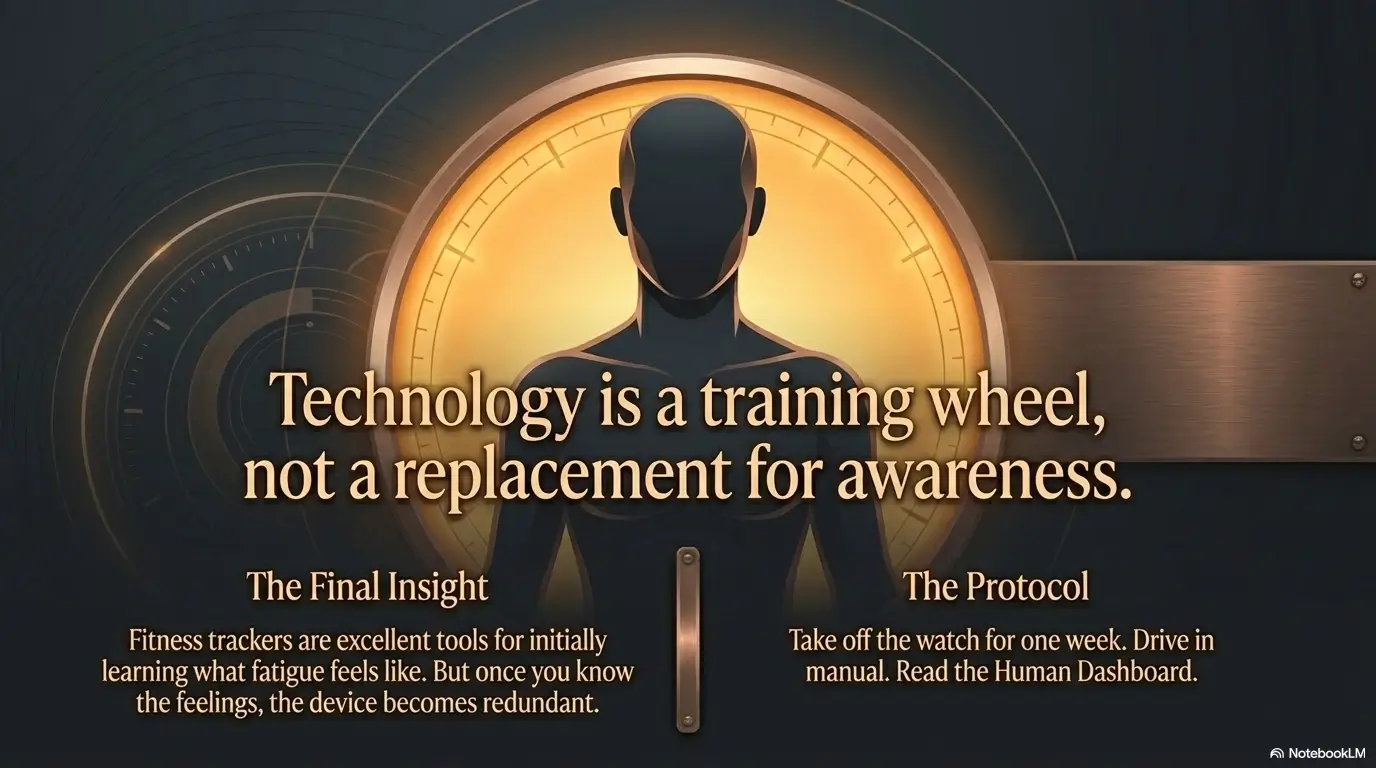
Recovery without a fitness tracker is not anti-technology. It is pro-attention. Devices can be helpful, but your body is already producing daily reports in sleep, mood, movement, appetite, soreness, and motivation.
Read those reports for one week. Train hard when the signs support it. Go lighter when the signs ask for respect. Rest when rest is the cleanest answer. That is not doing less. That is learning to spend effort where it actually pays.
Last reviewed: 2026-05