
Beyond “It Just Hurts”: How to Map Your Pain
A doctor asks, “Where does it hurt?” and suddenly your brain turns into a sock drawer after laundry day. You know the pain is real—it changed your morning, your sleep, your stairs, your patience, maybe even your appetite. But the words that come out are tiny: “It just hurts.”
“How to describe pain clearly is not about sounding dramatic, medical, or perfectly polished. It is about giving your clinician a usable map.”
Vague pain descriptions can delay the right next question, the right exam, or the right referral. Pain is your nervous system’s warning signal, but people experience it differently. A few precise words can help a clinician understand whether you are describing burning, pressure, cramping, tingling, stabbing, aching, or pain that moves, spreads, or disrupts function.
The Better Path — A Sentence with Traction
- ✓ Build one clear pain sentence before your visit.
- ✓ Use plain pain words without trying to diagnose yourself.
- ✓ Know when pain needs urgent care instead of better wording.
- ✓ Bring useful details without turning the appointment into a courtroom drama.
The Pain Map: Six Details Doctors Can Actually Use
A better pain description usually includes six things: location, feeling, intensity, timing, triggers, and function.
Try this: “My pain is in my lower-right back, feels like a sharp pull, started three days ago after lifting groceries, gets worse when I stand, improves a little with heat, and is keeping me from sleeping.” That sentence gives your clinician more than a number. It gives them a trail of breadcrumbs with sensible shoes.
Table of Contents
Pain Has a Vocabulary, and “Hurts” Is Only the Front Door
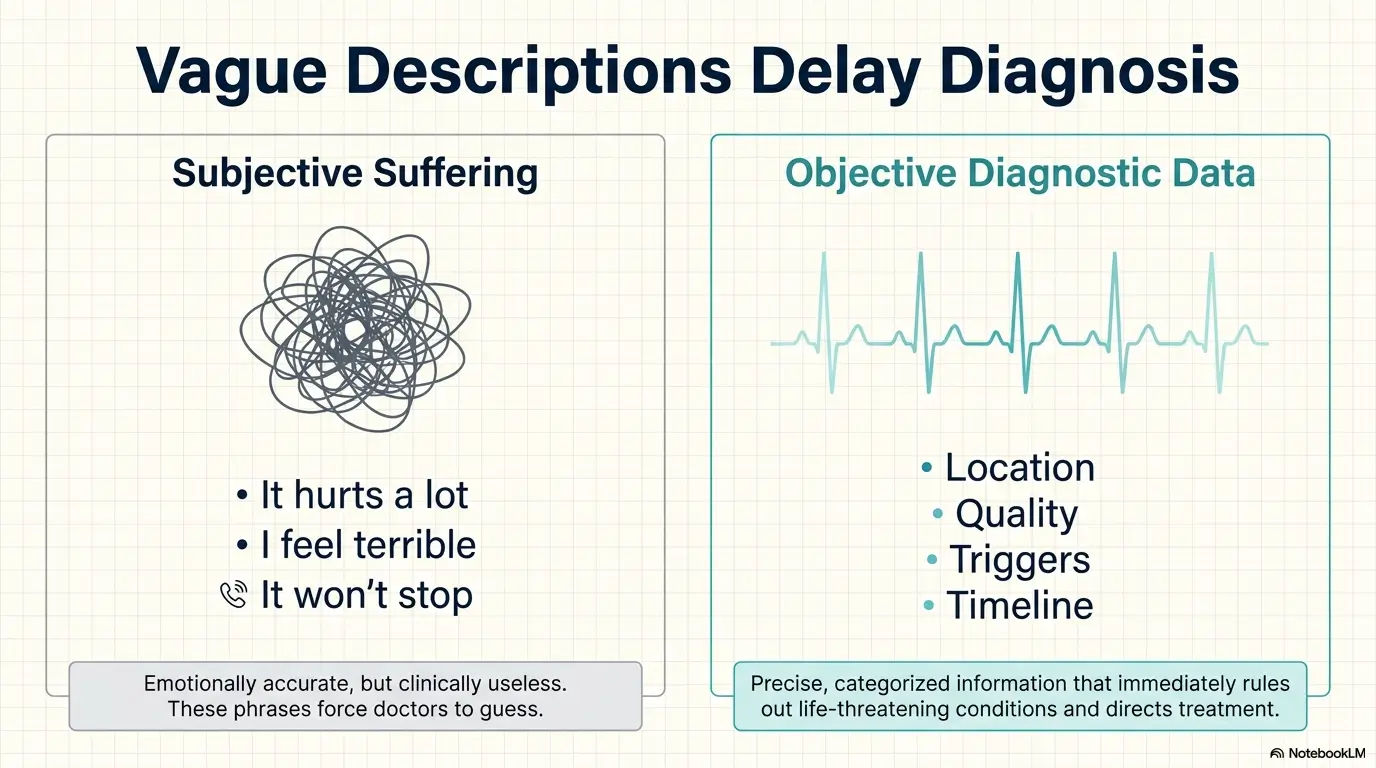
“It hurts” is emotionally true. Nobody should be scolded for saying it. Pain can flatten language. It can make a smart person feel like they are trying to describe weather from inside a closet.
But medically, “it hurts” is thin. It tells your clinician that something is wrong, but not much about where the story begins, how it behaves, or what it changes. Better wording does not replace an exam, imaging, lab work, or clinical judgment. It simply gives the conversation a cleaner first page.
Why vague pain descriptions leave doctors guessing
Clinicians listen for patterns. A burning sensation may raise different questions than a deep ache. Pain that travels down one leg may lead to different follow-up questions than pain that stays in one joint. Pain that appears after a fall is different from pain that slowly grows after weeks of desk work.
That does not mean you need to diagnose yourself. Please do not arrive announcing, “I have exactly three millimeters of doom in my lumbar architecture.” The internet has already done enough tap dancing in exam rooms.
Your job is simpler: describe what you feel and what you observe.
The six details that matter most
A useful pain description usually covers:
- Location: Where is it? Can you point to one spot?
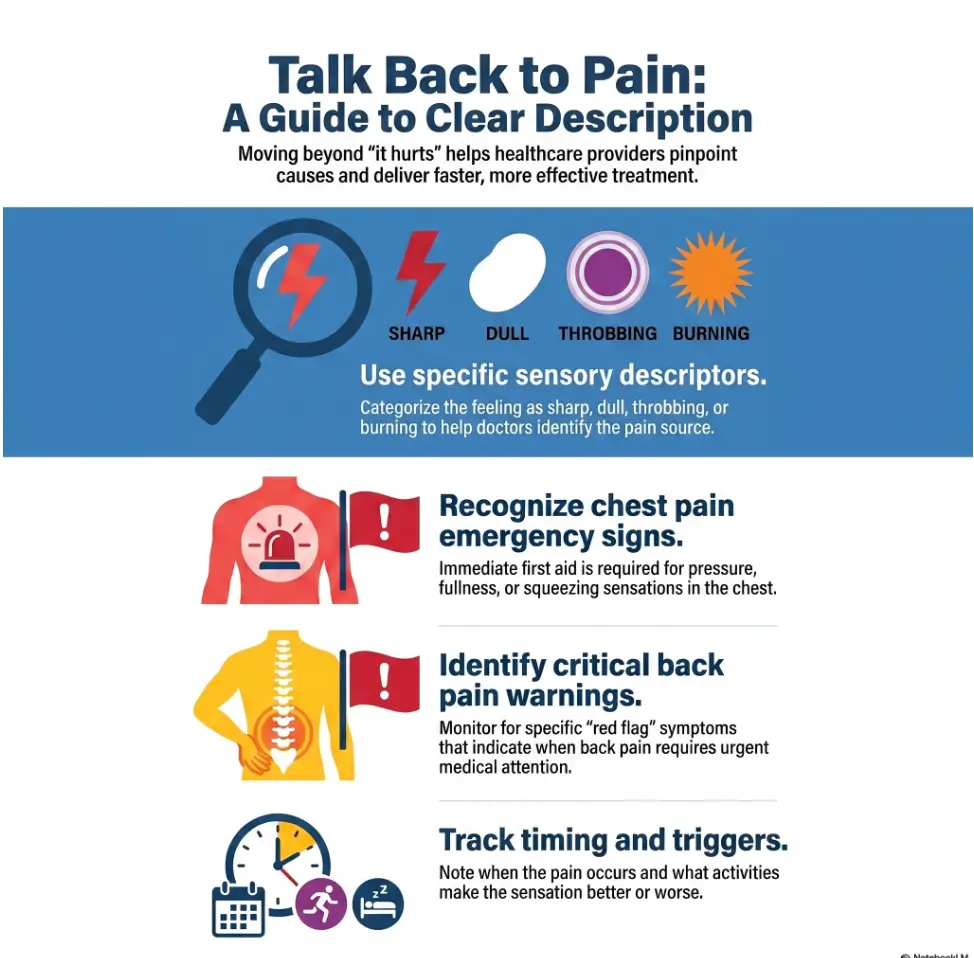
- Quality: What does it feel like: burning, stabbing, pressure, cramping, tingling?
- Intensity: How strong is it at rest, with movement, and at its worst?
- Timing: When did it start? Is it constant, sudden, on-and-off, or slow-building?
- Triggers and relief: What makes it worse or better?
- Function: What does it stop you from doing?
Those six details are practical because they fit inside a real appointment. They also fit inside a patient portal message, a phone note, or the back of an envelope you found in the car while wondering why every appointment begins with paperwork that appears to have reproduced overnight.
The tiny sentence formula
Use this line:
- Name the location before the intensity.
- Use one or two sensory words.
- Connect the pain to daily function.
Apply in 60 seconds: Fill in this line: “My pain is in ___, feels like ___, started ___, gets worse when ___, improves with ___, and affects ___.”
This is not a script for pretending to be calm. It is a script for being understood.
Start With Location, Not Drama
The first job is geography. Pain needs a pin on the map before it needs a volume knob.
Instead of “my leg hurts,” try “the outside of my right thigh hurts,” “the pain starts in my low back and moves into my calf,” or “the pain is behind my kneecap when I go downstairs.” Specific location helps your clinician ask sharper questions.
Point with one finger if you can
If the pain is small enough, point with one finger. That can be more useful than a long explanation.
Examples:
- “It is under my right ribs.”
- “It is behind my left knee.”
- “It is at the base of my thumb.”
- “It is on the outside of my hip, not deep in the groin.”
- “It is in the lower-right side of my back.”
For orthopedic pain, location can matter a lot. Hip, spine, knee, and nerve pain can overlap in confusing ways. If the pain is hard to place, say that too. For example: “I cannot tell if it begins in my hip or low back, but I feel it most when I stand from a chair.” Readers comparing hip and spine patterns may also find hip versus spine pain clues useful before preparing questions for a clinician.
Say whether it spreads
Pain that stays in one place and pain that travels can tell different stories.
Use words like:
- Stays: “It stays in one spot.”
- Spreads: “It spreads across my shoulder.”
- Shoots: “It shoots down my leg.”
- Wraps: “It wraps around my ribs.”
- Moves: “It started in my back, then moved into my calf.”
For leg symptoms, do not skip the route. “It goes down the back of my thigh to my foot” is more useful than “my leg hurts.” If the pain seems nerve-like, L4, L5, and S1 sciatica symptom patterns can help you understand why clinicians ask exactly where the pain travels.
Don’t skip “nearby” symptoms
Pain rarely walks into the room alone. It may bring numbness, swelling, warmth, weakness, stiffness, nausea, fever, dizziness, rash, or shortness of breath. Mention those nearby symptoms, even if they feel awkward or unrelated.
Try:
- “The knee is swollen and warm.”
- “My hand tingles when the wrist pain flares.”
- “The back pain comes with weakness in my foot.”
- “The chest pressure comes with shortness of breath.”
- “The abdominal pain comes with fever and vomiting.”
Nearby symptoms can change urgency. They can also change the exam. A clinician cannot connect dots they never receive.
Choose the Word That Feels Closest, Even If It Sounds Odd
Pain words are not poetry homework. They are labels for sensation. The goal is not elegance. The goal is useful approximation.
You can say, “It feels like a hot wire,” “like a deep bruise,” “like a tight band,” or “like an ice pick.” Your clinician has likely heard stranger things before lunch. Medical offices are where metaphors go to wear comfortable shoes.
Burning, stabbing, throbbing, aching, pressure
Here is a plain pain-word bank:
| Pain word | Plain meaning | Example sentence |
|---|---|---|
| Burning | Hot, raw, fiery, irritated | “My feet burn at night.” |
| Stabbing | Sharp, sudden, pointed | “I get a stabbing pain when I twist.” |
| Throbbing | Pulsing, beating, wave-like | “My knee throbs after stairs.” |
| Aching | Dull, sore, deep discomfort | “My shoulder aches after typing.” |
| Pressure | Heavy, squeezing, tight, compressed | “I feel pressure in my chest.” |
Notice that these words do not diagnose the cause. They simply sharpen the description.
Electric, tingling, cramping, tearing, tight
Some pain feels like sensation has crossed wires. “Electric,” “tingling,” “pins and needles,” or “shooting” may help describe nerve-like symptoms. If you are trying to sort out whether discomfort feels like muscle soreness or nerve irritation after therapy, nerve pain versus muscle soreness after physical therapy can give you language to bring into the visit.
Other words help in different situations:
- Cramping: squeezing, gripping, wave-like, often in muscles or abdomen.
- Tight: restricted, band-like, hard to move or expand.
- Tearing: a severe pulling or ripping sensation that should be taken seriously, especially when sudden or unusual.
- Heavy: weight-like discomfort, sometimes paired with fatigue or weakness.
- Sore: tender, bruised, or sensitive to touch.
Here’s what no one tells you…
Your pain description does not have to be “medically correct.” It needs to be honest and specific.
If “burning” is not quite right, say, “It is more like sunburn under the skin.” If “stabbing” sounds too dramatic, say, “It catches sharply when I move.” If the pain feels weird, say weird. Weird is data in a wrinkled coat.
Money Block: Pain Word Match Card
Use this when you cannot find the exact word.
| If it feels hot or raw | Try: burning, stinging, irritated |
| If it comes in pulses | Try: throbbing, pounding, wave-like |
| If it travels | Try: shooting, radiating, spreading |
| If it limits motion | Try: tight, catching, pulling |
Neutral action: Choose the closest two words and pair them with one activity that makes the pain appear.
Rate the Pain, But Don’t Let the Number Do All the Work
The 0-to-10 pain scale is useful, but it can be lonely. A number without context can mean very different things from one person to another.
One person’s 7 may mean “I cannot focus at work.” Another person’s 7 may mean “I am still making dinner, but I am using the counter like a docked ship uses a pier.” That difference matters.
Use the 0–10 scale with context
Try giving three numbers:
- At rest: “It is a 2 when I sit still.”
- With movement: “It becomes a 6 when I climb stairs.”
- At worst: “It reached an 8 last night and woke me up.”
This helps a clinician understand the pain pattern, not just the peak moment. It also protects you from accidentally minimizing pain because you happen to be sitting still in the exam room.
Compare it to your normal
This is especially important for chronic pain. If your usual pain is a 3, a flare to 8 is meaningful. If your baseline has shifted from “annoying but manageable” to “I plan my day around it,” say so.
Try:
- “My normal is a 3, but this week it has been a 7.”
- “The pain is not new, but the location changed.”
- “I usually walk the dog. Now I avoid the driveway.”
- “Medication used to last six hours. Now it wears off after two.”
For people with ongoing orthopedic pain, comparing baseline to flare can also support better conversations about conservative care, referrals, and next steps. The guide to orthopedic pain management offers a broader view of how clinicians may think through non-emergency pain options.
Say what the pain stops you from doing
Function often speaks louder than numbers.
Instead of only saying, “It is a 9,” add:
- “I could not stand long enough to shower.”
- “I woke up four times.”
- “I stopped driving after 15 minutes.”
- “I cannot lift my child without bracing.”
- “I skipped meals because chewing hurt.”
- Give a number at rest and during the painful activity.
- Compare today’s pain with your usual baseline.
- Name one daily task the pain disrupted.
Apply in 60 seconds: Write: “It is ___/10 at rest, ___/10 when I ___, and it stops me from ___.”
Timing Is the Clue Many People Forget
Timing is often the quiet clue hiding under the couch cushion. It can help separate a sudden change from a slow pattern, a flare from a new problem, or an injury from a mystery.
Do not worry if you cannot name the exact minute. Approximate honestly.
When did it start?
Useful timing phrases include:
- “This morning after getting out of bed.”
- “Three days ago after lifting a box.”
- “Two weeks after surgery.”
- “After starting a new exercise.”
- “Gradually over the last month.”
- “Suddenly, while I was resting.”
Sudden, severe, unusual pain deserves extra respect. So does pain after trauma, pain with fever, or pain paired with weakness, fainting, or breathing trouble. Better wording should never become a velvet curtain hiding an emergency.
Constant, on-and-off, sudden, slow-building
Use timing pattern words:
- Constant: always present, though it may rise and fall.
- Intermittent: comes and goes.
- Sudden: began quickly or sharply.
- Gradual: built over hours, days, weeks, or months.
- Predictable: appears with a specific activity or time of day.
- Night pain: wakes you or worsens when lying down.
For back and leg pain, timing with position can be especially useful: sitting, standing, walking, lying flat, bending forward, or getting out of a car. If driving is part of the pattern, lumbar support during driving may help you think through what changes when your spine and hips are stuck in one position.
The “pain diary” shortcut
A pain diary does not need to become a leather-bound epic. A few days of notes can be enough.
Money Block: Three-Day Pain Diary Mini Template
Use one line per flare.
| What to track | Example |
|---|---|
| Time | 7:30 a.m. |
| Activity | Got out of bed, walked to kitchen |
| Pain word and score | Sharp pull, 6/10 |
| Relief tried | Heat for 15 minutes, helped slightly |
| Function lost | Could not bend to put on socks |
Neutral action: Track three flares before your appointment and bring only the clearest pattern.
If the pain connects to sleep, note that too. Sleep is not a luxury detail. It is a functional measure with a pillowcase.
The Trigger Test: What Makes It Worse or Better?
Pain changes are useful. A symptom that worsens with stairs, meals, deep breathing, pressure, typing, coughing, or rest gives your clinician more to work with than pain floating in the air like an unclaimed balloon.
Movement, pressure, meals, breathing, stress
Scan these prompts:
- Does it worsen when you walk, sit, stand, bend, twist, reach, or climb stairs?
- Does pressing on the area reproduce it?
- Does it appear after meals, during bowel movements, or with urination?
- Does breathing deeply, coughing, or lying flat change it?
- Does stress, poor sleep, cold weather, or long screen time seem to amplify it?
Work and home routines matter. If your shoulder pain grows after mousing all day, say that. If your back pain appears after lifting warehouse bins, say that. If your knee protests only on stairs, the staircase has become a witness. Invite it into the story.
For work-related patterns, examples like warehouse worker knee pain, ergonomic mouse changes for shoulder pain, and wrist splints for typing pain can help you think about specific triggers before discussing care.
Rest, heat, ice, position, medicine
Relief matters too. Say what helped, how much, and for how long.
- “Ice helped for about 20 minutes.”
- “Heat made it feel looser, but the pain returned when I stood.”
- “Lying on my left side made it worse.”
- “An over-the-counter pain reliever lowered it from a 7 to a 4 for four hours.”
- “Stretching made the leg tingling worse.”
For muscle, joint, or post-activity pain, people often wonder about temperature. The comparison of heating pad versus ice wrap may help you describe what you tried and how your body responded, while still leaving treatment decisions to your clinician.
Don’t do this: hide what you already tried
Tell your clinician about home treatments, over-the-counter medicines, leftover prescriptions, supplements, alcohol use for pain relief, topical creams, braces, stretching routines, or devices. This is not confession hour under fluorescent lights. It is safety information.
Medication timing is especially important. Some combinations can be risky. Some medicines may mask symptoms. Some treatments may explain side effects. If you are not sure whether something matters, mention it briefly.
Show me the nerdy details
Pain descriptions help clinicians sort patterns, but they are not a diagnosis by themselves. Location, quality, timing, triggers, relief, and function are called subjective details because they come from the patient’s experience. Clinicians combine those details with objective findings such as physical exam results, strength testing, sensation checks, vital signs, labs, imaging, medication history, and red-flag screening. The most useful patient language is specific without pretending to be certain about the cause. “Burning pain down the outside of my leg after sitting” is usually more helpful than “I have nerve damage,” unless a clinician has already diagnosed it.
Function Matters: Pain Is Not Just a Feeling, It Is a Life Interruption
Pain is not only sensation. It is what disappears from your day.
The laundry basket waits. The dog walk shrinks. The desk chair becomes a negotiation. Sleep breaks into pieces. Someone asks how you are, and you say “fine” because explaining the whole thing feels like carrying a grand piano through a revolving door.
Sleep is evidence
If pain wakes you, delays sleep, forces position changes, or makes mornings worse, say it.
Examples:
- “I wake up every two hours.”
- “I can only sleep on my right side now.”
- “The pain is worse when I lie flat.”
- “I dread bedtime because I cannot get comfortable.”
Sleep details are especially useful for chronic pain, hip pain, shoulder pain, and post-surgical discomfort. For example, readers dealing with hip symptoms may find hip pain at night or side-sleeper hip pain relief helpful for organizing symptom notes before a visit.
Work, chores, parenting, exercise
Function examples make pain real without exaggeration:
- “I cannot type for more than 20 minutes.”
- “I avoid stairs unless someone is nearby.”
- “I stopped exercising because the pain shoots down my leg.”
- “I cannot carry groceries from the car.”
- “I need help putting on socks.”
Post-surgical and mobility-related pain often becomes clearest through basic tasks. A person recovering from hip surgery may not need dramatic language. “I cannot put on socks without twisting” is already useful, especially when paired with a resource like how to put on socks after hip surgery for practical setup ideas to discuss with the care team.
Let’s be honest…
Many people minimize pain because they do not want to sound difficult. They say “not too bad” while silently calculating whether they can make it from the parking lot to the waiting room without stopping.
Clear is not dramatic. Clear is generous. It saves everyone time.
Short Story: The Staircase That Finally Spoke
Marianne had told three people her knee “just hurt.” At the grocery store, she leaned on the cart. At home, she took the stairs sideways, one careful step at a time, as if negotiating with a suspicious cat. By the time she saw her clinician, she almost said “fine” again because the exam room chair felt safe. Instead, she opened a note on her phone:
“Right knee, throbbing under the kneecap, 3/10 sitting, 8/10 going downstairs, started after a weekend of yard work, ice helps for 20 minutes, and I have stopped carrying laundry.” The appointment changed immediately. Not because the sentence solved everything, but because it gave the clinician a usable starting point. The lesson is small and sturdy: when pain hides during the appointment, let yesterday’s staircase testify.
- Name the task you avoid.
- Say how long you can do it before pain rises.
- Share what changed from your normal routine.
Apply in 60 seconds: Write one sentence beginning, “Because of this pain, I cannot ___ like I normally do.”
Who This Is For, and Who Needs Faster Help
This guide is for communication, not diagnosis. It is most useful when you are preparing for a non-emergency appointment, follow-up visit, physical therapy session, pain clinic discussion, orthopedic visit, or patient portal message.
It is not a reason to wait through urgent symptoms.
This is for appointment prep
Use this framework when you are trying to describe:
- Chronic pain changes.
- A flare after activity.
- Joint, muscle, or nerve-like symptoms.
- Post-surgical discomfort that needs clarification.
- Pain that persists despite home care.
- Symptoms you keep forgetting to explain clearly.
If you are deciding which type of visit may fit a non-emergency orthopedic concern, telehealth versus in-person orthopedics, urgent care versus orthopedic clinic, and pain clinic versus orthopedist can help you frame your next step without pretending every ache belongs in the same room.
Not for “wait and see” emergencies
Some symptoms need urgent medical attention. Better wording is not enough for new or unusual chest pain, breathing trouble, sudden severe headache, stroke-like symptoms, severe pain after trauma, fainting, heavy bleeding, serious weakness, severe abdominal pain, or pain with high fever and stiff neck.
When pain is sudden, severe, or paired with frightening symptoms, do not spend the afternoon polishing your sentence. Call emergency services or seek urgent care based on the situation. The perfect adjective can wait in the hallway.
Caregivers can use this too
Caregivers often notice function before the patient names it.
Useful caregiver observations include:
- “They stopped using the stairs.”
- “They wake up and pace at night.”
- “They grimace when standing from a chair.”
- “They are eating less because chewing hurts.”
- “They seem confused after taking medication.”
Keep the tone respectful. The patient’s experience comes first. Caregiver notes should add observable detail, not take over the story like a microphone-hungry wedding toast.
Common Mistakes That Make Pain Harder to Understand
Pain is already tiring. The goal is not to become the perfect patient. The goal is to avoid a few common traps that make appointments less useful.
Mistake 1: Saying “fine” in the room and suffering later
Appointment adrenaline is real. The room is bright, the clinician is busy, and suddenly your pain behaves like a badly trained actor who refuses to appear on cue.
Bring a note from a real flare. Your phone note can speak for the version of you who was awake at 2:17 a.m. counting ceiling shadows.
Mistake 2: Only naming the body part
“Back pain” is a start. “Lower-right back pain that shoots into my calf when I stand longer than 10 minutes” is much better.
Compare:
- Thin: “My shoulder hurts.”
- Useful: “My right shoulder aches after laptop work and becomes sharp when I reach overhead.”
- Thin: “My knee hurts.”
- Useful: “My knee throbs under the kneecap after stairs and swells by evening.”
For persistent pain despite normal imaging, the wording matters even more. A “normal” result does not always mean the pain is imaginary. If that is your situation, normal X-ray but pain continues can help you prepare a calmer follow-up conversation.
Mistake 3: Forgetting medication details
Bring medication specifics:
- Name of the medicine or supplement.
- Dose, if you know it.
- Time taken.
- How much it helped.
- How long relief lasted.
- Side effects.
- Whether pain returns before the next dose.
This includes over-the-counter medicines. It also includes “just a topical cream,” because “just” is where safety details like to hide their little hats.
Mistake 4: Using worst-case language without details
Words like “unbearable” can be real. Use them if they are true. Then anchor them with function.
Try:
- “It felt unbearable, and I could not stand long enough to brush my teeth.”
- “It was the worst headache I have had, and it started suddenly.”
- “The chest pressure scared me because I was short of breath.”
Money Block: Appointment Prep Checklist
Answer yes or no before your visit.
- Can I point to the main pain location?
- Can I name one or two pain words?
- Do I know when it started or changed?
- Do I know what makes it worse?
- Do I know what helps, even briefly?
- Can I name one daily activity it affects?
- Do I have a medication list with dose and timing?
- Do I know whether there are red-flag symptoms?
Neutral action: If you answered “no” to more than two items, write a three-line symptom note before the appointment.
Where is it?
What kind of pain?
How strong?
When and how often?
What changes it?
What does it stop?
Use it: “My pain is in ___, feels like ___, is ___/10, started ___, changes when ___, and stops me from ___.”
When to Seek Help Instead of Searching for Better Words
This is the safety hinge of the article. Some pain should not be managed with better description, a diary, a heating pad, or patient patience wrapped in a cardigan.
If something feels severe, sudden, new, or frightening, trust the signal.
Call 911 for chest pain or breathing trouble
New or unusual chest pain, chest tightness, chest pressure, shortness of breath, or difficulty breathing can be urgent, especially for older adults or people with heart, lung, diabetes, blood pressure, or other medical conditions.
Do not try to decide from a blog whether chest pain is heartburn, anxiety, muscle strain, or something dangerous. Chest symptoms can overlap. Emergency evaluation exists because the body is not always tidy with its warning labels.
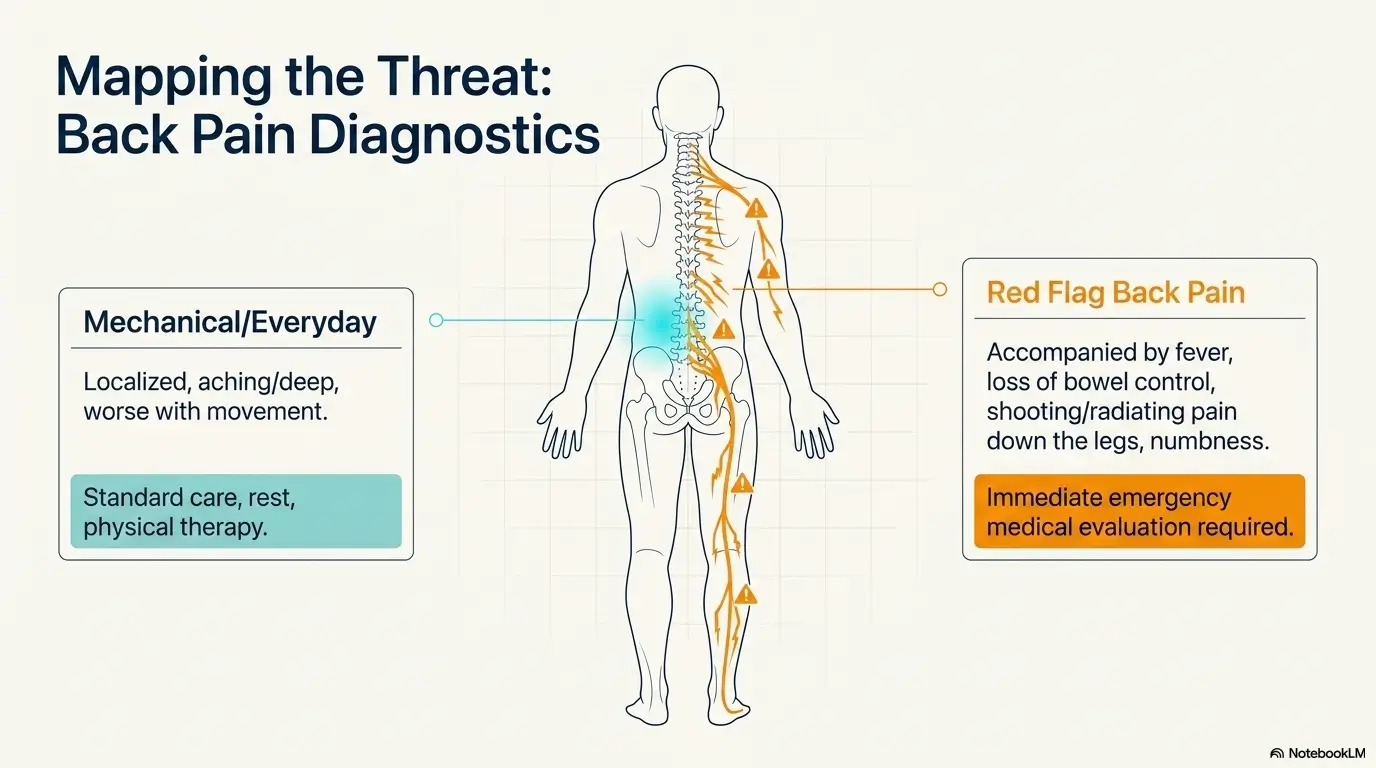
Get urgent care after trauma, fever, weakness, or new bladder/bowel problems
Back pain, neck pain, abdominal pain, severe headache, joint pain, or limb pain can become more urgent when paired with certain signs.
Seek timely medical care for pain with:
- Major fall, blow, crash, or injury.
- New weakness, numbness, or trouble walking.
- New bowel or bladder control problems.
- Fever, stiff neck, confusion, or serious weakness.
- Severe swelling, redness, warmth, or spreading skin changes.
- Sudden severe headache or neurological symptoms.
- Severe abdominal pain, persistent vomiting, or heavy bleeding.
For low back pain specifically, red flags matter. If you are trying to understand why certain back symptoms deserve faster attention, low back pain emergency signs and cauda equina syndrome red flags are worth reading before you decide to wait.
Pain that disrupts life deserves care
Not every important pain is an emergency. Some pain is slow, stubborn, and life-shrinking. It does not scream. It edits your calendar.
If pain continues despite reasonable self-care, disrupts sleep, changes walking, interferes with work, limits caregiving, or keeps returning, it deserves medical evaluation. You do not need to wait until your life has become tiny.
- Do not polish wording during emergency symptoms.
- Pair pain details with red-flag symptoms when present.
- Seek care when pain keeps shrinking normal life.
Apply in 60 seconds: Save a local urgent care number and know when to call emergency services instead.
A Simple Script for Your Next Appointment
The best pain script is short enough to say out loud and specific enough to guide the next question.
You can read it from your phone. You can hand it to the clinician. You can put it into the portal before the visit. Nobody gives bonus points for memorizing symptoms while sitting on crinkly exam paper.
The 30-second version
Use this:
“My pain is located ___ . It feels like ___ . It started ___ . It is usually ___ out of 10 and gets to ___ out of 10. It gets worse when ___ . It improves when ___ . It affects my ___ .”
Example:
“My pain is located in my lower-left back. It feels like a sharp pull with some tingling down my leg. It started last week after lifting a box. It is usually 3 out of 10 and gets to 7 out of 10 when I stand. It improves a little when I lie on my side. It affects driving and sleep.”
The chronic pain version
Chronic pain needs a baseline-and-change script.
“My baseline is ___ . This flare is different because ___ . The biggest change is ___ . My main goal is ___ .”
Example:
“My baseline knee pain is usually a 3. This flare is different because the swelling lasts into the next morning. The biggest change is that I cannot go downstairs normally. My main goal is to walk safely at work without making it worse.”
If you are stuck waiting for imaging, therapy, a referral, or a specialist, language can also help you document the pattern. Articles on orthopedic referral wait times, MRI referral for orthopedic pain, and what to say when physical therapy is not helping orthopedic pain can help organize the next conversation without turning frustration into static.
The caregiver version
Caregivers can use observable language:
“I’ve noticed they avoid ___ . They wake up ___ . They seem worse after ___ . They get relief from ___ .”
Example:
“I’ve noticed she avoids the stairs. She wakes up twice most nights. She seems worse after grocery shopping. She gets some relief from sitting with her leg elevated.”
Money Block: Visit-Type Decision Card
| Situation | Better next step | What to bring |
|---|---|---|
| Stable chronic pain, no red flags | Primary care, specialist follow-up, or therapy visit | Baseline, flare changes, function limits |
| Pain after minor activity, getting worse | Timely clinic visit | Trigger, location, swelling, what helps |
| Severe sudden pain or red flags | Urgent care or emergency care based on symptoms | Medication list, onset time, emergency symptoms |
Neutral action: Match your situation to the safest level of care, then use the script to explain the pain clearly.
FAQ
What words can I use instead of “it hurts”?
Use sensory words such as burning, stabbing, throbbing, aching, cramping, sharp, dull, tight, heavy, tingling, electric, shooting, pressure-like, sore, tender, or pulling. You can also use plain comparisons like “hot wire,” “deep bruise,” or “tight band” if they describe the feeling accurately.
How do I describe pain to a doctor clearly?
Describe where it is, what it feels like, how intense it is, when it started, what makes it better or worse, and how it affects daily life. A strong sentence is: “My pain is in ___, feels like ___, started ___, gets worse with ___, improves with ___, and stops me from ___.”
What if I cannot tell what kind of pain it is?
Say that honestly. Then describe what you can observe: location, timing, intensity, swelling, movement limits, sleep changes, nearby symptoms, or what makes it better or worse. “I cannot name the feeling, but it wakes me at night and gets worse when I bend” is still useful.
Should I use a 1–10 pain scale?
Yes, but do not let the number carry the whole suitcase. Pair the score with function. “It is an 8 and I cannot walk to the bathroom without stopping” is more useful than “It is an 8” alone.
How do I describe chronic pain without sounding repetitive?
Compare today’s pain to your baseline. Mention what changed: intensity, location, timing, sleep, mobility, medication response, triggers, or daily function. Try: “My usual is a 3, but this week it is a 7 and I can no longer climb stairs normally.”
What pain symptoms should not be ignored?
Do not ignore new or unusual chest pain, trouble breathing, sudden severe headache, stroke-like symptoms, fainting, severe abdominal pain, pain after major injury, heavy bleeding, high fever, new weakness, or new bowel or bladder control problems. Seek urgent or emergency care based on the symptom.
Can a pain diary help my appointment?
Yes. A short pain diary can show timing, triggers, relief, and function changes. Track only what helps: when it happened, what you were doing, pain score, pain word, what you tried, and what the pain stopped you from doing.
How much detail is too much?
Bring details, not a novel. Start with a 30-second summary, then offer your notes if the clinician wants more. The best details are specific, recent, and tied to function, medication response, or red flags.
Next Step: Write One Better Pain Sentence Before Your Visit
The opening problem was simple: pain can be real and still come out vague. “It just hurts” may be true, but it leaves too much work for the room to guess.
Now you have a better tool. Not a diagnosis. Not a dramatic monologue. A sentence.
Use the fill-in-the-blank line
“Today my pain is in ___, feels like ___, started ___, is ___/10, gets worse with ___, improves with ___, and is stopping me from ___.”
That line turns fog into a map. It gives your clinician a starting point. It gives you a little control in a moment that can feel slippery.
Bring the sentence, not a speech
Put it in a phone note. Print it. Send it through the patient portal. Bring a three-day pain diary if the pattern is hard to explain. Add medication timing if you have tried pain relievers, braces, heat, ice, exercise changes, or rest.
If your pain involves costs, referrals, imaging, or insurance friction, documentation can matter too. Depending on your situation, you may want to prepare with resources on orthopedic pain management with a high deductible, workers’ compensation pain documentation, or pain diary notes for long-term disability claims. Keep the focus honest: symptoms, function, timing, and care history.
One concrete action
Before your next appointment, take 15 minutes and write one pain sentence using location, feeling, timing, trigger, relief, and life impact. If you have red-flag symptoms, skip the writing exercise and seek urgent help.
- Use the six-part pain sentence.
- Include red flags when present.
- Bring notes so appointment adrenaline does not erase the details.
Apply in 60 seconds: Open your phone notes and write the first draft of your pain sentence now.
Last reviewed: 2026-05.
Tags: pain description, patient communication, chronic pain, appointment prep, medical red flags
Meta description: Learn how to describe pain clearly with better words, timing, triggers, function details, and red-flag safety tips.