
The Shopping Cart Sign: Real Relief, No Heroics
Five minutes. Ten minutes. Then the familiar leg burn—like someone quietly flipped a switch. My first real breakthrough wasn’t grit. It was a grocery-store lean: hands on a cart, breath steady, legs suddenly less “nope.”
If you live with that stop-watch feeling—upright walking triggers heaviness, tingling, or pain, but leaning forward buys you time—you’re not imagining it. Guessing your way through it can cost you the next day, not just the next block.
This post helps you use a rollator (or walker) safely to recreate that relief—without turning your shoulders, wrists, or balance into the new problem.
Here’s the part that changes everything:
- Fit the rollator so you hinge—not slump
- Pace with early resets so you don’t “pay back” tomorrow
- Spot red flags and safety mistakes before they bite
This is educational and based on lived experience plus general mobility principles—not medical advice. Lumbar spinal stenosis can involve nerve compression and fall risk. If you have worsening symptoms, new weakness, numbness in the “saddle” area, or bowel/bladder changes, seek urgent medical care. (If you want a plain-English checklist of low back pain emergency signs, keep that page bookmarked for calm-day reading.)
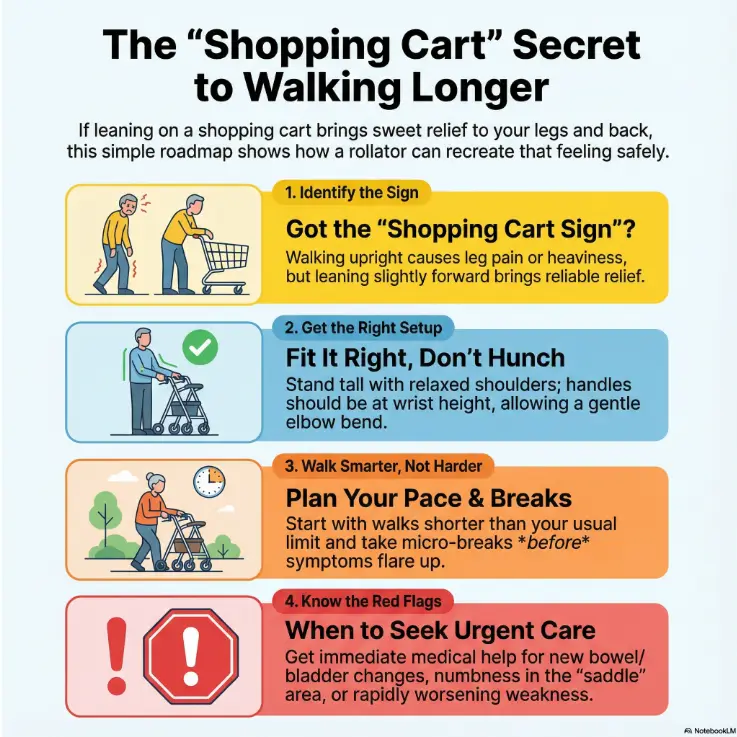
The “shopping cart sign” is when walking feels better if you lean forward (like pushing a cart). A rollator can mimic that posture and reduce symptom flare-ups for some people with lumbar spinal stenosis—but only if it’s fitted correctly and used safely. This guide walks you through setup, pacing, and the mistakes that can backfire, plus red flags and when to seek help.
Table of Contents
The “Shopping Cart Sign” Explained in Plain English
If you’ve ever found yourself “casually” drifting toward the cart corral just to borrow a little forward lean—congratulations, you’ve discovered the thing clinicians nickname the grocery-cart pattern. In everyday terms, it means: standing tall and walking can flare symptoms, but leaning forward can calm them down. That pattern is common in lumbar spinal stenosis with neurogenic claudication (a mouthful that basically means “nerves complain when you walk upright”).
Why leaning forward can feel like “more room” for nerves
Here’s the beginner-friendly version: posture changes the shape of spaces in your lower back. When you lean slightly forward, it can reduce pressure in a way that some people experience as less leg pain, less heaviness, or fewer “electric” zings. It’s not magic. It’s geometry—plus your nervous system’s very loud opinions.
- Look for repeatable relief, not a one-off “good day.”
- Use posture as a clue, not a diagnosis.
- Safety beats heroics every time.
Apply in 60 seconds: Next time you walk, gently hinge forward a few degrees (without rounding your back) and notice what changes in your legs.
What this doesn’t mean (no, it’s not a diagnosis by itself)
A shopping cart sign doesn’t “prove” stenosis. People lean forward for lots of reasons: hip tightness, balance issues, habit, even just a tired day. What it can do is give you a practical experiment: if forward-lean support improves walking tolerance, you’ve learned something useful to discuss with a clinician or physical therapist. (If you’re trying to separate “stenosis-like” walking limits from other common causes of leg symptoms, this guide on lumbar spinal stenosis vs herniated disc can help you frame the conversation.)
Curiosity gap: the one detail that decides whether this hack helps—or hurts
The make-or-break detail is how you “lean.” If you hinge lightly at the hips while staying tall through your chest, many people feel relief. If you collapse your chest and round hard through your mid-back, you can irritate different structures, strain shoulders, and turn a helpful tool into a slow-motion problem. We’ll fix that in the setup section—because I absolutely set mine wrong at first, and my shoulders still remember it.
Rollator vs Walker vs Cane: The Real-World Fit for Stenosis Walking
A mobility aid isn’t a moral verdict. It’s a tool—like a better pair of shoes or a brighter flashlight. The only “bad” device is the one that makes you less safe. If your goal is to walk longer with lumbar spinal stenosis without triggering a flare, the best option is the one that matches your symptom pattern and your balance reality.
Why a rollator often matches the “cart posture” better
A rollator gives you handles in front of you, a surface to steady your pace, and—often—a seat for planned breaks. For people whose symptoms ease with forward-lean support, that can be the difference between “I made it to the mailbox” and “I finished a loop.” My first meaningful win was 12 minutes without the usual leg heaviness. Not 30. But it was proof of concept.
When a standard walker is safer than a rollator
If you have significant balance issues, a standard walker (without free-rolling wheels) can be safer because it doesn’t want to glide away from you at the exact wrong moment. Rollators require brake skill. If you’re shaky, distracted, or dealing with dizziness, choose safety over convenience.
How to choose between 3-wheel and 4-wheel models (stability vs maneuvering)
In the real world: 4-wheel rollators tend to feel more stable, especially outdoors and on uneven sidewalks. 3-wheel rollators can be easier to steer in tight spaces, but stability varies and many don’t include a seat. If you’re buying for outdoor walking endurance (the “I want my life back” use case), stability usually wins.
- Rollator: You get consistent forward-lean relief, can manage brakes, and want planned breaks.
- Standard walker: Balance is the top concern; you need maximum control and minimum glide.
- Cane: You need light support but don’t get meaningful forward-lean relief.
Neutral next step: Try devices with a physical therapist or reputable medical supplier before you commit.
Setup That Makes or Breaks It: Rollator Height, Grip, and Posture
This section is where good intentions go to die. Because the rollator can help—then someone sets it too low, hunches like a question mark, and decides, “Welp, guess I’m broken.” You’re not broken. Your setup might be.
The 30-second height check you can do at home
- Stand inside/behind the rollator with your shoulders relaxed.
- Place your hands on the grips.
- Your elbows should have a gentle bend (not locked straight, not deeply bent).
- You should feel “supported” without shrugging your shoulders up to your ears.
The first time I adjusted mine, I went one notch higher than I thought I needed. Instant difference. My shoulders stopped feeling like they were doing the work my legs couldn’t.
The “too low = backfire” problem (and what it feels like)
Too low often creates a deep forward slump. Symptoms that can show up:
- Wrist pain or hand numbness from excessive weight through the palms
- Neck/upper back tightness from looking forward while slumped
- Shoulder fatigue that ends the walk before your legs do
- A weird “I feel worse after” payback, even if the walk felt okay
Let’s be honest… most people set it wrong the first day
I did. I set it too low because I thought “lower = more support.” What I built was a portable hunch. The fix was simple: raise it, lighten my grip, and let my legs do their share again. The goal is supported walking, not a rolling piece of furniture you drape yourself over.
Show me the nerdy details
Many stenosis walking limits behave like “posture + load tolerance.” A rollator can change trunk position, arm support, and confidence, which may alter how quickly symptoms build. Fit matters because handle height changes elbow angle, shoulder elevation, and how much bodyweight you unintentionally dump into your arms. If you feel wrist pain or shoulder burning early, your setup may be forcing upper-body compensation instead of sharing load across hips and legs.
The 30-Minute Walk Plan That Doesn’t Trigger a Payback Crash
The biggest trap is chasing the number. “Thirty minutes” sounds like a finish line. But for stenosis walking, the real win is: walk + recover without a flare that steals tomorrow. I didn’t get to 30 by pushing harder. I got there by getting boring.
The pacing rule: aim for “boringly easy” at first
If your current limit is 8–10 minutes before symptoms spike, your starting plan is not 10. It’s more like 6–7—with breaks planned like they’re part of the workout. My first week looked ridiculous on paper. In real life, it gave me my evenings back.
Micro-breaks that don’t feel like quitting (but prevent flare-ups)
- 20–40 seconds of standing tall with hands lightly on the grips
- A brief sit (if your rollator has a seat) before symptoms peak
- “Corner breaks” at predictable landmarks (mailbox, driveway, the third tree)
Tiny breaks feel silly—until you realize they’re the reason you can keep going.
Short Story: The day the parking lot became my track (120–180 words)…
I used to treat grocery trips like a stealth endurance test: park far, walk fast, pretend I wasn’t counting steps like a nervous accountant. One afternoon I was already cooked—legs heavy, low back tight—when I grabbed a cart “just to be polite” and keep up with the flow. Two aisles in, something shifted. My legs stopped shouting.
My breathing softened. I didn’t feel strong; I felt possible. In the parking lot afterward, I did the most glamorous thing imaginable: I paced between two faded lines like a lab rat with a mission. No heroics. No proving anything. Just information. That day didn’t cure me. It gave me a lever: forward support changed my tolerance. And once you find a lever, you stop arguing with the wall and start moving the furniture.
Curiosity gap: why your first 5 minutes predict your whole walk
If the first five minutes feel rushed, tight, or breathless, the rest of the walk usually goes the same way—just louder. If the first five feel calm and controlled, your nervous system tends to “allow” more. That’s not weakness. It’s threat math. Your body is always estimating: safe or not? (If your walking limit overlaps with classic radiating leg symptoms, it can help to sanity-check sciatica vs herniated disc patterns before you assume it’s “just” conditioning.)
Use this to pick a starting walk + break rhythm based on your current “symptom-onset” time.
Neutral next step: Try the plan for 2–3 walks, then adjust based on recovery (not ego).
Pain Signals vs Red Flags: What to Track While You Walk
If you’ve been dismissed with “just walk more,” this section is your quiet revenge—because you’re going to walk smarter. Tracking doesn’t have to be obsessive. It just has to be consistent.
A simple symptom log: distance, time, posture, and recovery window
- Time walked (total, plus longest continuous stretch)
- Symptom onset (minutes until legs start complaining)
- Posture (upright vs slight hinge vs slumped)
- Recovery window (back to baseline in 10 minutes? 2 hours? next day?)
My biggest “aha” wasn’t that I could walk longer. It was that I could walk longer and still cook dinner without feeling like my legs were made of wet sand.
What “good tired” vs “nerve angry” feels like
- Good tired: muscles feel worked; symptoms fade with rest; tomorrow isn’t stolen.
- Nerve angry: sharp, burning, or spreading numbness; symptoms escalate fast; recovery takes longer than expected.
Here’s what no one tells you… recovery time matters more than the walk
A 20-minute walk that costs you the next day is not a win. It’s a loan with a brutal interest rate. The goal is repeatable progress. The metric is how quickly you return to baseline.
If you want a plain-English overview of spinal stenosis symptoms and treatment options, Cleveland Clinic explains it clearly in patient-friendly language.
Common Mistakes That Quietly Make Stenosis Walking Worse
These mistakes don’t feel dramatic in the moment. That’s why they’re so effective at ruining your week. I’ve done most of them. I can say that with confidence because my body filed the paperwork.
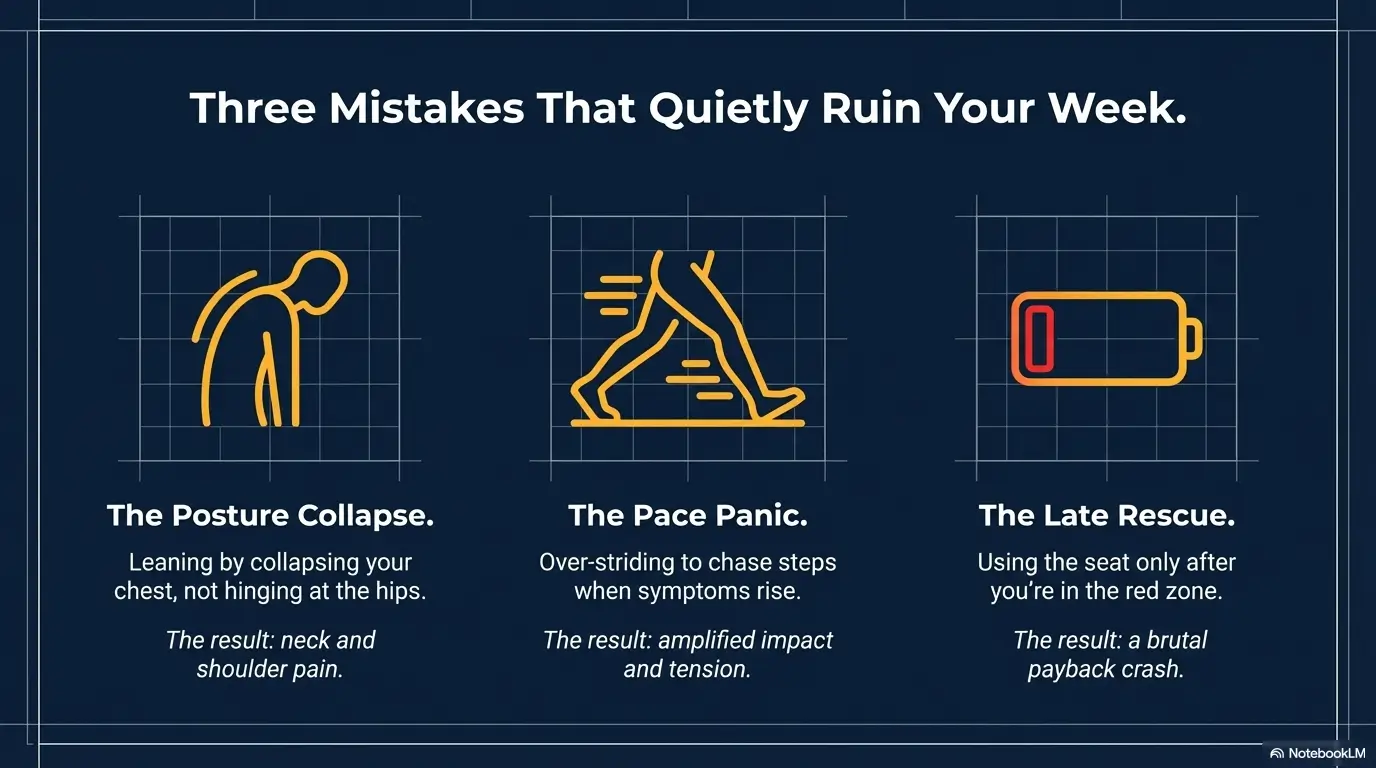
Mistake #1: “Leaning” by collapsing your chest (not hinging safely)
A helpful hinge feels like your hips fold slightly while your chest stays open. A harmful collapse feels like you’re folding your ribs into your lap. If you finish walking with neck tension, shoulder ache, and wrists on fire, you might be collapsing instead of hinging.
Mistake #2: Over-striding to chase steps (and paying for it later)
When symptoms scare us, we speed up. When we speed up, we often over-stride. Over-striding can amplify impact and tension—exactly what irritated nerves don’t enjoy. My fix was annoyingly simple: shorter steps, slower pace, softer landing. Less drama, more distance.
Mistake #3: Using the seat as a crutch instead of a strategy
A seat is a power tool when you use it early. It’s a rescue boat when you use it late. The sweet spot is sitting before symptoms spike, not after you’ve already pushed into the red zone.
- Hinge gently; don’t slump.
- Shorten your stride before symptoms rise.
- Use planned breaks like a strategy, not a surrender.
Apply in 60 seconds: On your next walk, lower your pace by one notch and shorten your step by 10%—then reassess symptoms at minute five.
Don’t Do This: Rollator Safety Errors That Increase Fall Risk
Rollators can increase confidence fast—which is lovely—until confidence outruns brake skills. I learned this on a slightly sloped sidewalk that looked harmless and absolutely was not.
Brakes, slopes, curbs, and wet floors (the “invisible” hazards)
- Practice squeeze brakes (slow down) and parking brakes (lock) until it’s automatic.
- On slopes, go slower than you think you need to—momentum is sneaky.
- At curbs, don’t “pop” the front wheels without training; ask a PT to show you safely.
- Wet floors turn small mistakes into big stories.
Why carrying bags on the handles can tip you
Hanging heavy bags on the handles changes the center of mass. Translation: the rollator can become tip-happy, especially when you turn. Use a proper bag attachment designed for the device, and keep the weight low and balanced.
When you should switch to a different device or ask for a gait check
If you’re gripping hard, leaning heavily, or repeatedly “catching” yourself, you might need a different device—or simply better fitting and training. Physical therapists teach gait and assistive device use for a reason. A 30-minute session can prevent a six-week setback. (If you’re weighing options, chiropractor vs physical therapy is a useful comparison—especially when your priority is gait mechanics, safety, and repeatable function.)
- Yes — You get predictable relief when leaning forward while walking.
- Yes — You can safely manage brakes and turns.
- No — You have frequent falls or severe dizziness (priority is stability + supervision).
- No — You have rapidly worsening weakness or new alarming symptoms (get evaluated first).
Neutral next step: If you’re unsure, ask for a PT gait assessment and device fitting.
Who This Is For / Not For
This is where we protect your time and your dignity. Some people do everything “right” and still don’t get relief from forward support. That doesn’t mean you failed. It means your body is giving different data.
Best fit: the “lean-forward relief” pattern + predictable symptom easing
You’re a strong candidate for this approach if:
- Symptoms build with standing/walking upright and ease with sitting or forward-lean support.
- Your main limiter is leg heaviness, tingling, or pain that behaves like a timer.
- You can focus enough to use brakes and navigate safely.
Not for: severe balance issues, frequent falls, or rapidly worsening weakness
If balance is the main issue, a rollator may be the wrong first tool. If symptoms are rapidly changing, you need medical evaluation more than “hacks.” Safety first. Always.
If you’re unsure: the 2-minute screening conversation to have with a clinician/PT
Try this script (seriously, copy it): “When I walk upright, symptoms start in about X minutes. When I lean forward (like a shopping cart), I can go longer. Can we evaluate whether this fits neurogenic claudication or another cause, and can you fit/train me on the safest device?”
When to Seek Help (Don’t Wait These Out)
A rollator is not a substitute for medical care when red flags show up. This is the part I wish someone had handed me on a calm day—so I wouldn’t have to Google it on a scary one.
Urgent: new bowel/bladder changes, saddle numbness, rapidly worsening weakness
If you experience bowel or bladder changes, numbness in the groin/saddle area, or rapidly worsening weakness, treat it as urgent. These can signal serious nerve compromise and need immediate evaluation. If you’re not sure what “urgent” looks like in plain language, review low back pain emergency signs before your next walk—so you’re not doing it in a panic later.
Same-week: progressive foot drop, repeated falls, severe night pain, fever + back pain
Progressive foot drop, repeated falls, severe night pain, or fever with significant back pain are not “push through it” situations. They’re “get checked” situations.
Ask about: physical therapy gait training, imaging, meds, injections, or surgical consult
Many people improve with a combination approach: targeted PT, symptom management, and (when appropriate) imaging-guided decisions. Your job isn’t to guess the perfect path alone. Your job is to show up with good data and get guided. If you’re building that plan, physical therapy for chronic low back pain is often the most practical starting point—because form, pacing, and safety are skills, not personality traits.
FAQ
Does a rollator help lumbar spinal stenosis more than a cane?
It can—especially if you get relief from leaning forward while walking. A cane provides point support, but it usually doesn’t recreate the forward-lean “cart” posture as reliably as a rollator. If balance is the primary issue, a different device may be safer.
Why does leaning forward reduce symptoms for some people?
For some people, slight forward flexion changes mechanics in a way that reduces symptom provocation during walking. It’s not a cure—it’s a position that may be more tolerable for your nervous system and anatomy.
Can using a rollator make my posture worse long-term?
If it’s set too low and you slump into it, it can reinforce poor posture and overload shoulders/wrists. If it’s fitted well and you walk with a gentle hip hinge (not a collapse), many people use it without “ruining” posture. A PT can help you keep the right form.
What rollator height is correct for back and leg symptoms?
A common starting point is handles at wrist level when you stand tall with relaxed shoulders, allowing a slight bend in your elbows. The “correct” height is the one that supports you without forcing a shrug or a slump.
Is a 3-wheel rollator safe for stenosis, or should I get 4-wheel?
Many people feel more stable with 4-wheel rollators, especially outdoors. Three-wheel models can be easier in tight indoor spaces. If your goal is longer outdoor walking and you’re managing fall risk, stability often matters more than maneuverability.
Will Medicare cover a rollator for spinal stenosis?
Medicare Part B covers walkers, including rollators, if you meet eligibility requirements and the device is medically necessary. Coverage can involve provider rules and cost-sharing. The simplest move is to check the official Medicare “Walkers” page and confirm supplier requirements.
What should I do if I get numbness or tingling mid-walk?
Treat it as a signal to reset early: slow down, take a short standing reset, or sit if you have a seat—before symptoms spike. If symptoms escalate rapidly, don’t “push through.” If numbness becomes severe, new, or persistent, get evaluated.
Can I walk every day with stenosis, or should I rest between days?
It depends on your recovery window. If you return to baseline quickly and symptoms don’t “spill” into the next day, frequent short walks can work well for some people. If you’re paying for it the next day, reduce intensity, shorten duration, and consider alternating days while you build tolerance.
What’s the best surface to walk on (treadmill vs sidewalk)?
Flat, predictable surfaces are often easier early on. Sidewalks add slopes, cracks, and distractions—sometimes great for real life, sometimes too much at first. Choose the surface that lets you practice safe posture and brake skills with the least risk.
When is it time to consider PT or surgery instead of “hacks”?
If symptoms are progressing, function is shrinking, or you’re seeing red flags (new weakness, falls, bowel/bladder changes), professional evaluation should move to the front. PT can help with gait training and device use; surgical decisions require a clinician’s assessment of imaging plus symptoms. If you’re heading toward that fork in the road, it helps to understand how lumbar spinal stenosis surgery is typically framed—and what “decompression” means in real-world terms.

Next Step: One Concrete Action (Do This Today)
If you do nothing else, do this one experiment—because it turns vague hope into usable data. And data is what gets you taken seriously (by clinicians and by your own nervous system).
Do a 10-minute “cart test” safely: try gentle forward-lean walking with support, then log symptoms + recovery
- Choose a flat, low-risk space (indoors or smooth sidewalk).
- Walk at a calm pace for 2–3 minutes.
- Add a gentle forward hinge (not a slump) for the next 2 minutes.
- Reset (stand tall or sit) for 30–60 seconds.
- Repeat until you reach 10 minutes total.
Log: symptom onset time, symptom intensity, and recovery time. My first cart test didn’t feel heroic. It felt quietly convincing.
If it helps: schedule a PT gait/fitting check or ask your clinician about a mobility device prescription
If forward support improves your walking tolerance, don’t stop at “cool trick.” That’s information you can use for a safer, more sustainable plan: fitting, brake training, pacing, and progression. And if you’re doing the bigger-life math alongside the symptom math, understanding chronic back pain costs can help you plan ahead instead of getting blindsided.
If it worsens: stop the experiment and get evaluated—don’t “push through” nerve pain
If symptoms spike, spread, or linger far longer than expected, don’t grind through it. That’s not “building grit.” That’s ignoring a warning light.
- Your typical symptom onset time (minutes) and what relieves it (sit vs lean).
- Your top safety concern (balance, speed control, outdoor terrain).
- Your must-haves: seat, weight capacity, brake style, folding needs for your car.
- Any clinician notes or PT recommendation (helpful for medical necessity conversations).
Neutral next step: Bring this list to a PT or supplier and test-fit before purchasing.
Closing the Loop: Your 15-Minute Next Move
Remember the open loop from the beginning—the detail that decides whether this hack helps or hurts? It wasn’t the brand. It wasn’t “stronger legs.” It was how you lean and how you pace. A rollator can be a bridge back to walking, but only if it doesn’t turn your shoulders into the new injury.
One more practical note: a University of Arizona Center on Aging handout covers walker selection and safety considerations in a simple, clinic-style format. If you want a quick safety refresh (especially about sitting, brakes, and fall risk), it’s a useful read.
Infographic: The Shopping Cart Sign → Rollator Walking Roadmap
Upright walking flares symptoms; forward support eases them.
Short intervals + early resets + symptom log.
Correct height, light grip, gentle hip hinge (not a slump).
Start under your limit; repeatable progress beats one big day.
If tomorrow is worse, adjust today’s dose.
New weakness, falls, bowel/bladder changes → urgent evaluation.
- Lean with a gentle hinge, not a collapse.
- Break early, before symptoms peak.
- Measure success by tomorrow, not just today.
Apply in 60 seconds: Set a timer for your first walk interval and stop at 70% of your usual symptom-onset time.
If you want to move within the next 15 minutes, do this: pick a safe flat route, do the 10-minute cart test, and write down symptom onset + recovery time. That’s your baseline. From there, the rollator becomes a tool—not a gamble. And if your next step includes imaging or a bigger care-plan decision, it helps to know what lumbar MRI cost on an HDHP can look like—so logistics don’t become the hidden barrier.
Last reviewed: 2025-12.