
Text Neck vs “Normal” Neck Pain: The 3 Symptoms That Suggest a Phone-Posture Problem — The Brutal Mistake I Kept Making
The Hidden Cost of “Just a Minute”
The most painful neck problem I ever had didn’t come from a crash or a gym fail—it came from a phone held low, hundreds of times a day. If your neck pain ramps up during scrolling and drags your shoulders forward, you’re not fragile. You’re simply overloaded in a very specific way.
Text Neck Reality Check
It’s not a disease you catch. It’s a repeatable loading pattern: forward head + chin jut + rounded shoulders + eyes down. Stretching at night doesn’t work if you repeat the cause all day.
No fluff. No posture-morality speeches. Just levers that move the needle.
Table of Contents
What “text neck” is and why it feels different
Text neck isn’t a diagnosis you “catch.” It’s a repeatable loading pattern: head drifting forward + chin poking out + shoulders rounding + eyes down at a small screen. Your neck becomes the quiet employee who never clocks out.
I used to blame my pillow, my stress, my “bad sleep.” Then I noticed the timing: the ache spiked after long phone sessions, not after workouts. That pattern matters because “normal” neck pain can come from a lot of places—sleep position, a one-off strain, arthritis, a sudden awkward lift. Text neck is different because it’s micro-dose damage: tiny strain, repeated 50–200 times a day, until your body starts protesting.
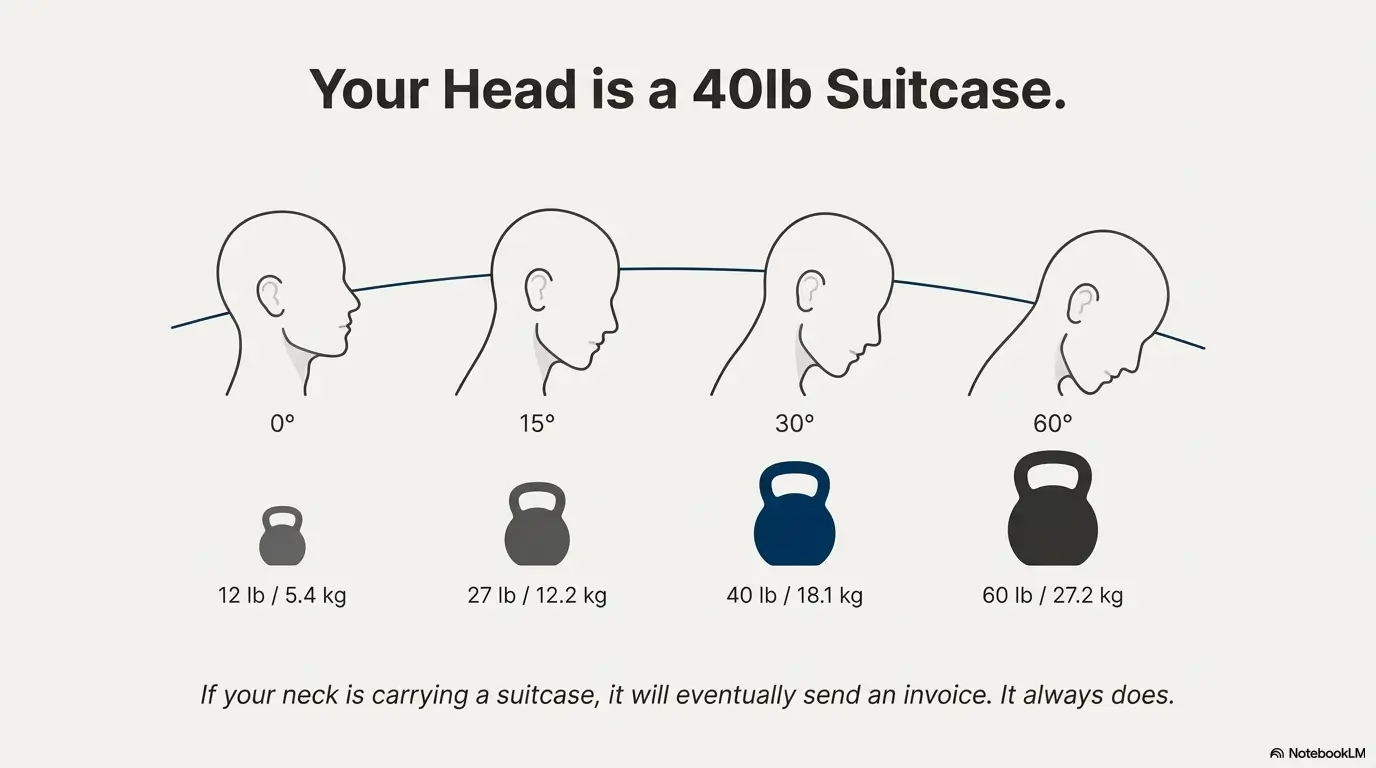
In late 2025, major clinical educators were still repeating the same core idea: the more your head tilts forward, the more load your neck has to manage. That’s not a trend. That’s physics with muscles.
- Text neck: pattern-driven, screen-timed, posture-linked.
- “Normal” neck pain: often event-driven, sleep-driven, or age/structure-driven.
- Good news: pattern problems usually respond well to pattern fixes—fast.
Quick reality check: If your pain is severe, progressive, or paired with numbness/weakness, skip the internet and get evaluated.
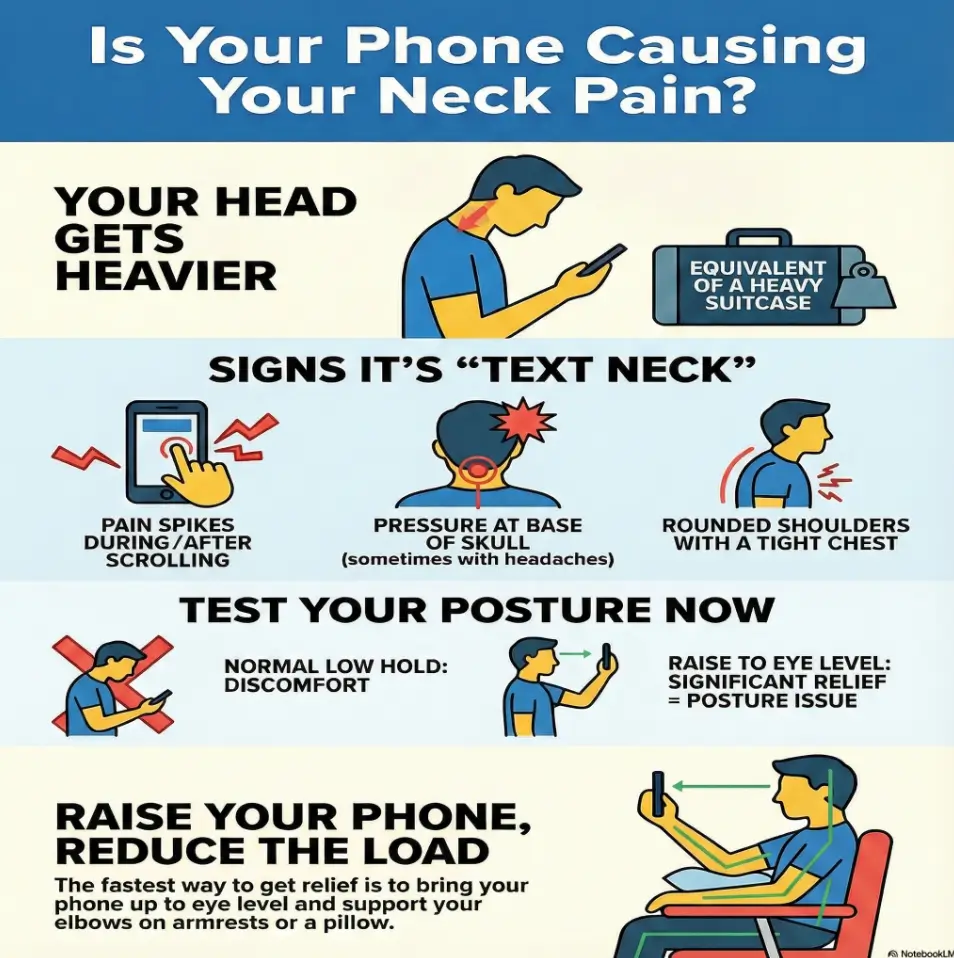
The 3 symptoms that suggest a phone-posture problem
Here are the three signals that most often scream “this is a phone-posture loop,” not random misfortune. None of them are mystical. They’re behavior fingerprints.
Symptom 1: The “screen-time spike” (pain rises during or after scrolling)
You feel fine-ish… then 15–30 minutes into phone time, your neck tightens. Or you stand up after a couch-scroll and feel like your head is suddenly heavier. This is classic load accumulation: small muscles at the base of the skull working overtime while your mid-back stays asleep.
Symptom 2: The “top-of-neck + headache combo” (suboccipital pressure)
Text neck often brings a specific kind of misery: pressure at the skull base, sometimes paired with tension headaches, jaw clenching, or eye fatigue. I used to call it “my email-headache,” because it arrived right after I “just checked one thing” on my phone.
Symptom 3: The “posture echo” (your shoulders and chest are in on it)
If the pain comes with rounded shoulders, tight chest, and a sense that your upper back won’t extend, that’s a posture chain, not a single sore spot. Your neck is paying for what your upper back refuses to do.
- Notice the 15–30 minute trigger window
- Track skull-base pressure vs side-of-neck soreness
- Check if shoulders/chest feel “involved”
Apply in 60 seconds: Raise your phone to eye level for 10 breaths and see if symptoms ease.
- Builds during phone use
- Skull-base pressure + tight traps
- Rounded shoulders, tight chest
- Improves with screen breaks
- Triggered by event (sleep, strain)
- Localized soreness, less timing-linked
- May improve with rest/heat
- Less tied to shoulder/chest posture
A 60-second self-test you can do right now
This is the test I wish I’d done a year earlier—before I bought the wrong pillow and told myself lies like, “I’m just getting older.” It takes 60 seconds. No equipment. No drama.
- Neutral reset (10 seconds): Stand tall. Let arms hang. Eyes forward. Breathe slowly.
- Phone posture simulation (20 seconds): Hold your phone low like you normally do. Don’t “correct” anything. Just be you.
- Fix the load (20 seconds): Raise the phone toward eye level. Slight chin tuck (like making a double chin—tiny, not aggressive). Relax shoulders down.
- Compare (10 seconds): Rate discomfort 0–10 in each position.
If the number drops by 2 points or more when you raise the phone and gently tuck your chin, that’s a loud clue: posture is a lever you can pull.
- Fast improvement suggests a load/position issue.
- No change suggests you may need a different angle: sleep, stress, joint irritation, nerve involvement, or something else.
- Worse with chin tuck can happen—don’t force it. Use a smaller tuck or get assessed.
My embarrassing confession: I failed this test for months because I never tried the “raise the phone” part. I kept stretching my neck while continuing the same posture that caused the pain. Genius.
What “normal” neck pain often looks like in real life
Let’s protect you from a common trap: labeling everything as text neck because you own a phone. Sometimes neck pain is… just neck pain.
“Normal” neck pain patterns often show up like this:
- Sleep-triggered: you wake up with a stiff side after a weird pillow angle.
- One-side strain: you carried a bag on one shoulder for an hour, then paid the tax.
- Acute crank: you turned your head fast, sneezed, or did a “small” movement that felt huge.
- Age/structure flare: arthritis or disc irritation can flare without phone timing.
Here’s the difference: these patterns are usually event-linked, not scroll-linked. They may respond to rest, heat, gentle mobility, and time—without needing you to change your phone habits.
That said, even “normal” neck pain gets worse if you feed it a daily diet of forward head posture. I learned this the hard way on a travel week: neck stiff from hotel pillows, then I spent 2 hours hunched over maps and messages. The pain wasn’t “from the phone” originally—but the phone made it stick around.
Money Block: Eligibility checklist (red flags) + next step
Before we talk exercises and ergonomics, here’s the boring-but-profitable step: avoid paying for the wrong thing. In healthcare terms, this is the “eligibility checklist” for self-management. It’s how you reduce surprise imaging, wasted visits, and out-of-pocket regret.
- No if you have weakness, numbness/tingling that’s spreading, loss of balance, fever, unexplained weight loss, or pain after major trauma.
- No if pain is severe and unrelenting, or wakes you nightly for multiple nights.
- Yes if pain is mild-to-moderate, timing-linked to screens, and improves with posture changes or movement.
- Yes if you can rotate your neck somewhat and symptoms aren’t rapidly worsening.
One-line next step: If “No,” get evaluated (urgent care or clinician). If “Yes,” run the 14-day rollout below.
Insurance note (because money is real): if you end up needing physical therapy, imaging, or specialist care, ask about deductible, copay, and whether prior authorization is required. That single question can save you 20–30 minutes of phone calls later.
- Self-fix is for stable, posture-linked pain
- Red flags deserve evaluation
- Ask about deductible and prior authorization early
Apply in 60 seconds: Write down your top 2 symptoms and the exact trigger (screen-time, sleep, strain).
Mini calculator: Neck-load estimator (angle → pressure)
This is not a medical device. It’s a behavior mirror. The point is to make posture visible, because invisible problems stay expensive.
A widely-cited 2014 biomechanics paper estimated that neck load rises as the head tilts forward. Newer clinical education in 2025 still echoes the same core message: angle matters. Use the slider, then adjust your phone height like an adult with bills to pay.
Show me the nerdy details
This slider uses anchor points commonly taught in posture education based on a well-known biomechanics estimate. It’s not measuring you. It’s showing the likely direction of load change as angle increases—useful for habit change, not diagnosis.
Micro-humor, because we need it: If your neck is carrying a suitcase, it will eventually send an invoice. It always does.
Decision card: Self-fix vs paid help (time/cost tradeoff, 2025)
This is where most people bleed time and money: they either DIY forever, or they pay too soon for the wrong service. Use this decision card like a grown-up filter.
- Pain is screen-timed and improves with breaks
- No red flags; symptoms stable
- You can commit 6 minutes/day to a routine
- You want to reduce out-of-pocket spend first
- Numbness/weakness, radiating arm pain, or worsening symptoms
- Sleep is wrecked for 3+ nights
- You’ve tried posture changes for 2 weeks with no improvement
- You need documentation for work/insurance
Neutral next step: Save this card and ask any provider for an itemized estimate before you commit.
- DIY is for stable, screen-timed pain
- Evaluation is for red flags or stalled progress
- Ask for itemized estimates
Apply in 60 seconds: Decide your lane (A or B) and write it down. That alone reduces dithering.
The fix stack: 7 changes that reduce load today
Most advice fails because it says “improve posture” like posture is a personality trait. Here’s the trusted-operator version: change the environment so good posture is the default.
1) Raise the phone (yes, it’s that simple)
If you only do one thing, do this. I raised my phone for 48 hours and felt the difference before any stretch “worked.”
2) Support your elbows
Unsupported arms pull your shoulders up and forward. Rest elbows on armrests or a pillow. Cheap fix, big return.
3) Use “chin tuck, then soften”
Tiny tuck, then relax. Don’t crank. I used to overdo this and feel worse—like I was trying to win posture.
4) Two-minute chest opener (doorway stretch)
Many people stretch the neck and ignore the chest. If your chest is tight, your neck compensates.
5) Upper-back extension (the missing link)
Text neck is often an upper-back problem in a neck costume. A rolled towel behind the mid-back for 60 seconds can feel like turning the lights back on.
6) Micro-break rule: 20 seconds every 10 minutes
This sounds annoying until you realize it prevents the “I’m ruined at night” outcome.
7) Rebuild strength (not just stretch)
Strengthen deep neck flexors and mid-back muscles. Stretching alone is like apologizing without changing your behavior. Your neck is unimpressed.
- Do today: raise phone + elbow support.
- Do this week: chest + upper-back work.
- Do for the long game: strength.
Short Story: The brutal mistake I kept making
Short Story: The brutal mistake I kept making (120–180 words)
I thought I was doing everything right. I bought the ergonomic pillow. I stretched my neck every morning for exactly 45 seconds—because that’s how long my patience lasted. I even watched a video where someone with perfect posture told me to “sit tall.” Meanwhile, my real life looked like this: I’d wake up, check messages with my phone in my lap, answer emails over coffee, then scroll “for five minutes” that became forty.
By lunch my neck felt like it had been quietly mugged. At night I’d stretch harder, like stretching could erase the day’s posture debt. The brutal mistake wasn’t that I wasn’t trying. It was that I kept doing recovery while repeating the same cause. The fix started when I raised my phone, supported my elbows, and treated posture like a system—not a moral goal.
Money Block: Fee/rate table (2025) + quote-prep list
This is not about chasing the cheapest option. It’s about avoiding the expensive pattern: paying for services that don’t change the load, while your phone habit keeps cashing checks against your neck.
| Service | 2025 range | Notes |
|---|---|---|
| Telehealth consult | $40–$100 | Often cheaper than in-person; ask if it counts toward deductible. |
| Physical therapy session | $75–$150 | Cash-pay varies; insurance may require prior authorization or referral. |
| Chiropractic visit | $60–$200+ | Ask what’s included (adjustment vs therapies) and the total plan cost. |
| X-ray | $100–$400+ per image | Imaging centers can be cheaper than hospital outpatient departments. |
| Cervical spine MRI | $400–$7,000 | Huge variation; ask for cash price and radiology fee details. |
Neutral next step: Save this table and confirm today’s cash price and your plan’s deductible before scheduling.
- Your insurance card (and whether you’ve met your deductible)
- Symptom notes: trigger, duration, 0–10 pain, any arm symptoms
- What you’ve tried (and what changed the pain by 1–2 points)
- Work setup details: laptop height, phone habits, commute time
- Ask clinics: “Do you bill time-based codes like therapeutic exercise or manual therapy, and what’s my expected out-of-pocket?”
Show me the nerdy details
Time-based rehab billing often uses 15-minute units. That’s one reason estimates can swing: the “per visit” charge may hide how many units are billed. You don’t need to memorize codes, but you should ask for an itemized estimate.
Keep it from coming back: a 14-day rollout
If you want results that survive your next busy week, don’t “fix everything.” Roll it out like a system upgrade. I’ve done this badly (all-in on day 1, quit by day 3) and well (one change at a time, keep it boring). Boring wins.
Days 1–3: Remove the biggest load
- Phone at eye level for the first 10 minutes of use each session
- Elbows supported whenever you’re scrolling
- 20-second break every 10 minutes
Days 4–7: Add mobility where it matters
- 2-minute chest opener
- 60-second upper-back extension (rolled towel)
- Gentle rotation: 5 reps each side
Days 8–14: Add strength (the “stays fixed” part)
- Chin-tuck holds: 5 reps of 5 seconds
- Scapular retraction: 2 sets of 8 reps
- Wall angels or band pull-aparts (light): 2 sets of 8
- Days 1–3: change phone position
- Days 4–7: open chest + wake upper back
- Days 8–14: strengthen the support system
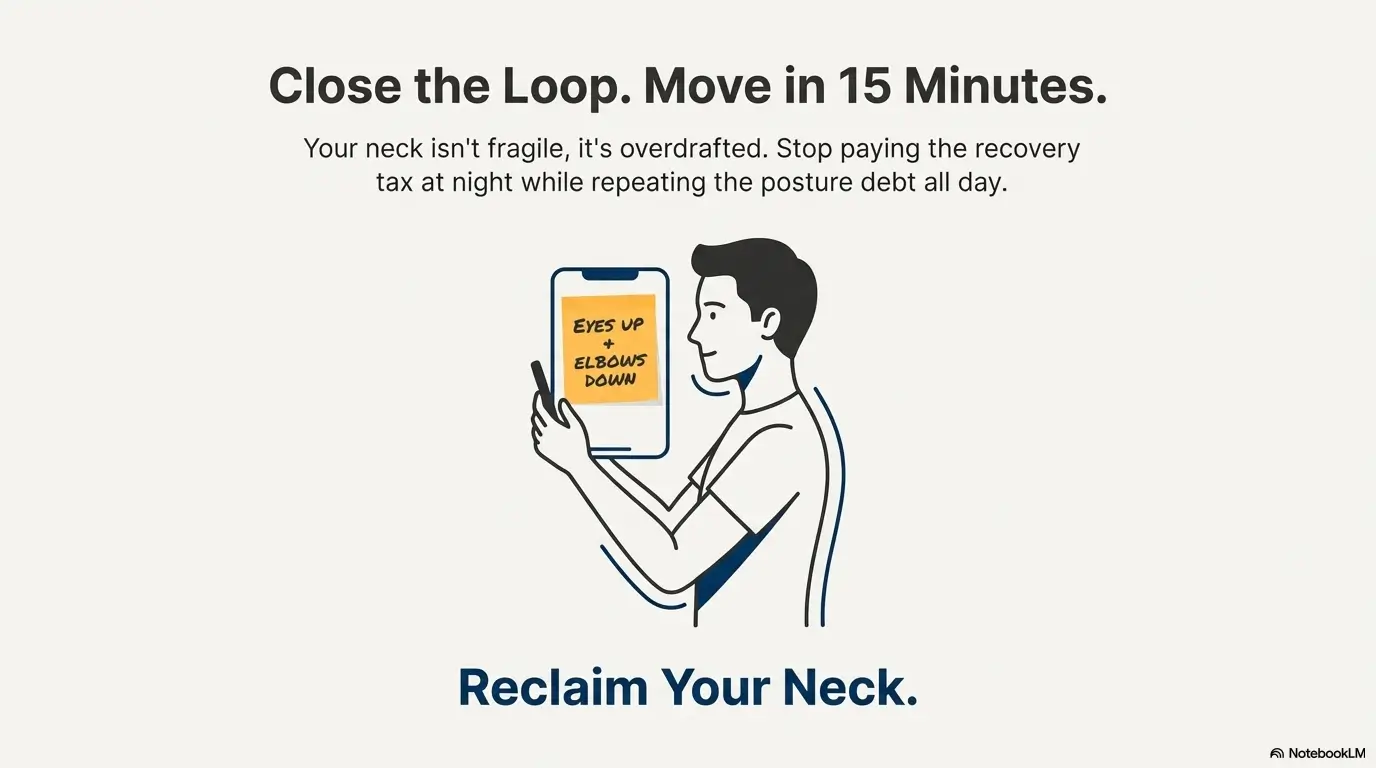
Apply in 60 seconds: Put a sticky note on your phone: “EYES UP + ELBOWS DOWN.”
Mini checkpoint: By day 7, you want either (1) a 2-point drop in discomfort during scrolling, or (2) fewer headaches, or (3) less end-of-day stiffness. If nothing changes, that’s useful data—time to get evaluated.
FAQ
1) Can text neck cause tingling in the arm or hand?
Tingling can happen if nerves are irritated, but it’s also a reason to be cautious. If tingling is new, worsening, or paired with weakness, get evaluated rather than assuming it’s “just posture.”
Apply in 60 seconds: Note where tingling travels (thumb vs pinky) and whether it changes with neck position.
2) How long does it take to feel better if it’s truly phone-posture related?
Some people feel a difference in 24–72 hours once they raise the phone and support elbows. More durable change usually takes 10–14 days with strength work.
Apply in 60 seconds: Commit to eye-level phone use for your next 3 scrolling sessions.
3) Do I need physical therapy, or can I fix this myself?
If symptoms are mild-to-moderate, screen-timed, and improving with posture changes, a two-week self-plan is reasonable. If you stall, PT can help you identify specific weak links and build a tailored program—often saving time long-term.
Apply in 60 seconds: Use the decision card above and pick A or B.
4) Will an MRI “prove” text neck?
Imaging shows structure, not habits. An MRI can be important for red flags or persistent nerve symptoms, but it won’t measure your daily posture pattern. Many people pay for imaging when they needed behavior change and strength work first.
Apply in 60 seconds: Ask any clinician what result would change the plan before scheduling imaging.
5) What’s the best pillow for text neck?
A pillow can reduce night irritation, but it won’t cancel daytime load. If your pain spikes with scrolling, the fastest “pillow upgrade” is raising the phone and supporting your arms.
Apply in 60 seconds: Do the 60-second self-test and see which position changes symptoms most.
6) My neck hurts even when I’m not on my phone—could it still be text neck?
Yes. Once muscles are sensitized, they can ache even outside the trigger. The diagnostic clue is whether symptoms reliably worsen with screen posture and ease with load changes.
Apply in 60 seconds: Track one day: log pain 0–10 before and after phone sessions.
Conclusion: close the loop and move in 15 minutes
Here’s what I finally admitted: my neck wasn’t “mysteriously fragile.” It was overdrafted. The brutal mistake I kept making was paying the recovery tax at night—stretching, massaging, wishing—while repeating the exact posture debt all day.
If you do one thing in the next 15 minutes, do this: raise your phone to eye level, support your elbows, and run the 60-second self-test once. Then pick the 14-day rollout. If symptoms don’t budge—or you have red flags—get evaluated and ask for an itemized estimate before you commit. That’s how you protect your body and your budget.
Last reviewed: 2025-12. I cross-checked current clinical education and public guidance from a major hospital education site, a peer-reviewed biomechanics paper, and a 2025 systematic review on smartphone overuse and neck pain.