
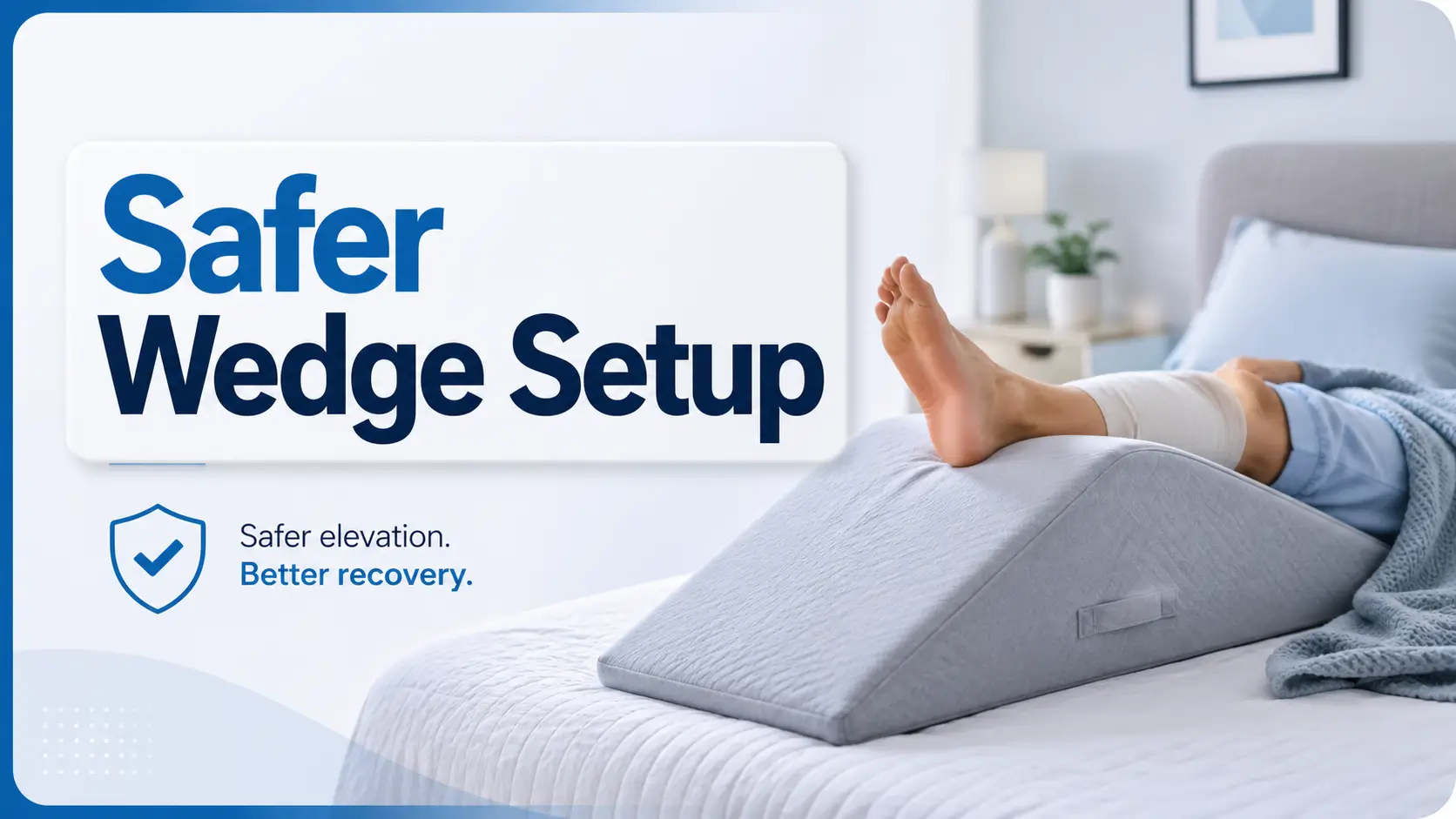
Beyond the Foam: Mastering Post-Surgical Elevation
Recovery sounded simple: elevate, rest, heal. But the first night reveals the reality: negotiating a single piece of foam with swelling, incision tenderness, pain medicine fog, and gravity. Many patients use a wedge based on product photos, not the specific needs of a healing joint.
Table of Contents

Fast Answer
A wedge pillow can support orthopedic pain management after surgery by helping with elevation, pressure relief, swelling control, and safer rest positioning, but it should match the surgery type and surgeon’s instructions. The goal is not “more height.” The goal is supported alignment, easier breathing, less strain during transfers, and fewer pain spikes. Pain after orthopedic surgery is expected, but worsening pain, fever, drainage, calf swelling, chest symptoms, or new numbness needs medical guidance.
- Use it to support the whole position, not just the painful spot.
- Match the setup to your surgery type and restrictions.
- Stop and ask for medical guidance if symptoms worsen or change suddenly.
Apply in 60 seconds: Before bed, ask: “Can I get out of this position safely without twisting, sliding, or panicking?”
Safety / Disclaimer: A Wedge Pillow Is Support, Not a Treatment Plan
Use This Guide Alongside Your Discharge Instructions
A wedge pillow can help you rest, elevate, and reduce awkward strain after surgery, but it should never replace your surgeon’s instructions, physical therapy plan, medication schedule, weight-bearing rules, brace instructions, or incision care guidance. Your discharge papers are not decorative paperwork. They are the map for the first stretch of recovery, when pain, swelling, anesthesia aftereffects, and new movement limits can overlap in confusing ways.
After orthopedic surgery, small details matter. A leg placed too low may swell more. A knee bent too long may feel comfortable at first but work against extension goals for certain recoveries. A hip positioned carelessly may violate precautions. A shoulder tucked into a clever-looking pillow nest may quietly pull against the very tissue that needs calm.
The wedge pillow should be treated like a supporting actor. It can make the scene easier, but it does not get to rewrite the script.
Ask Before Changing Position Rules
Some surgeries have strict positioning rules, especially hip, knee, shoulder, spine, ankle, or foot procedures. A pillow setup that helps one patient may stress another patient’s incision, joint angle, brace, splint, cast, or circulation. The safest framing is not, “Does this feel cozy?” It is, “Does this pillow position protect the repair?”
That distinction can save trouble. Comfort is useful, but comfort is not always proof of safety. A position can feel good for 10 minutes and still become a problem after 2 hours. It can reduce one pain and create another. It can help swelling while making it harder to exit the bed safely.
When in doubt, ask the surgeon, nurse, or physical therapist a direct question: “Where should the wedge support me, and where should it not?” That question is beautifully unglamorous, which is exactly why it works.
Pain Relief Should Still Be Multimodal
Orthopedic pain management often combines medications, non-medication methods, movement guidance, rest, swelling control, and practical home setup. A wedge pillow belongs in that larger system. It is not a magic ramp to painless sleep. It is one tool for making the body easier to manage while healing takes its slow, cellular walk.
The American Academy of Orthopaedic Surgeons explains that post-surgical pain is a natural part of healing and may be managed with different medication options depending on the patient and procedure. That does not mean every patient needs the same medicines, and it definitely does not mean the pillow should be used to “tough out” uncontrolled pain.
The best recovery setups are humble. They do not demand heroics. They reduce the number of tiny battles: getting into bed, keeping the limb supported, reaching water, using the bathroom, sleeping without sliding, waking without feeling like the body has been folded into a suitcase. For a broader home-recovery lens, readers may also find orthopedic pain management routines that connect pain control with daily function useful.
The Surgeon’s Instructions Win Every Tie
If this article says one thing and your surgeon’s instructions say another, follow your surgeon’s instructions. If a product page says a wedge is “perfect after surgery” but your physical therapist says not to use it under a certain joint, listen to the therapist. Product copy does not know your incision, your bone quality, your implant, your brace, your medication list, or your tendency to get dizzy at 3:16 a.m.
That may sound obvious, but recovery homes are full of well-meaning experiments. A spouse adds an extra pillow. A patient adjusts the wedge angle because the first position feels annoying. A family member moves the walker to make the room look tidy. The dog relocates to exactly the wrong patch of floor because dogs are furry chaos consultants.
Good recovery is often less about buying more things and more about removing friction from the few things that must happen safely every day.
Start Here: The Wedge Pillow’s Real Job After Surgery
Elevation Is Not Just “Put the Leg Up”
The useful question is not, “Is my leg high?” It is, “Is the operated area supported without creating a bend, twist, or pressure point my surgeon warned me about?” A wedge pillow should make the body quieter, not turn the bed into a foam obstacle course.
Elevation is sometimes described too casually, as if the limb were a loaf of bread being placed on a shelf. But post-surgical bodies are not shelves. They are tender systems with swelling, dressings, bruising, guarded muscles, and sometimes hardware, sutures, splints, braces, or casts. The height of the wedge matters less than the quality of support.
For a leg, that may mean broad support under the calf and lower leg rather than pressure jammed behind the knee. For a foot or ankle, it may mean lifting without digging into the heel. For a shoulder, it may mean reclining the torso while supporting the arm separately. For the back, it may mean neutral alignment rather than dramatic bending.
The Three Jobs: Support, Alignment, and Repeatability
A good post-surgery pillow setup should do three things: support the operated area, keep the body in safer alignment, and make the position easy to repeat at 2 a.m. when pain medicine, fatigue, and darkness turn simple movement into origami.
Support means the body is not hanging, sagging, or being held by one narrow pressure point. Alignment means the joints are not being forced into a position that violates the recovery plan. Repeatability means the patient or caregiver can recreate the setup without needing a flashlight, a tape measure, and the emotional stamina of a mountain guide.
Repeatability is underrated. A position that works only when the caregiver builds it perfectly is not truly reliable. It may be fine for afternoon rest, but nighttime has its own laws. At night, everything is harder: judgment is fuzzier, pain feels louder, and the bathroom suddenly seems located in another weather system.
The Quiet Win: Fewer Pain Spikes During Transitions
The wedge pillow is not only about sleep. It can help reduce the “transition pain” that happens when lying down, sitting up, turning, or shifting from bed to walker, crutches, or bathroom trips.
Many patients discover that stillness is not the only problem. The real dragon lives in transitions. It appears when the leg comes off the bed. It snaps when the shoulder shifts. It complains when the back moves from reclined to upright. It growls when a patient tries to stand before the body has caught up.
A wedge can help by reducing the distance between lying flat and sitting up, or by keeping a limb in a supported position before the next transfer. This does not eliminate pain, but it may reduce the jagged spike that makes patients avoid movement altogether. And avoidance can become its own trap if the care plan includes gentle walking, breathing, circulation work, or prescribed exercises.
Mini Infographic: The 3-Part Wedge Pillow Test
①
Support
Is the limb or torso held broadly, without one sharp pressure point?
②
Alignment
Does the position avoid twisting, unsafe bending, or incision pressure?
③
Repeatability
Can the patient rebuild the setup safely when tired or half-awake?
Who This Is For, and Who This Is Not For
For Patients Recovering From Orthopedic Surgery at Home
This guide fits people recovering from procedures such as knee surgery, hip surgery, foot or ankle surgery, shoulder surgery, spine-related orthopedic procedures, fracture repair, or joint replacement, as long as their care team allows wedge pillow positioning.
It is especially useful for the ordinary home recovery problems that rarely look dramatic but can dominate a day: swelling that builds by evening, sleep that fractures into small miserable pieces, a bed that suddenly feels too low, a couch that traps the patient like a polite marshmallow, and a room that was perfectly normal before surgery but now has the obstacle density of an antique shop.
Patients recovering at home need practical systems. Not perfect systems. Not showroom systems. Practical ones. The wedge pillow is part of that practical design when it makes rest safer and movement less punishing. If the home is filling up with cushions, rails, walkers, and “maybe we’ll need this” purchases, it can help to compare the wedge against orthopedic home care equipment that actually solves repeated recovery problems.
For Family Caregivers Managing Nighttime Pain and Swelling
This is also for spouses, adult children, friends, and distance caregivers who need a practical way to spot whether the pillow setup is helping or quietly creating new problems.
Caregivers often ask the most human question: “Are you okay?” Unfortunately, that question is too soft to catch the real answer. Many patients say “I’m fine” because they do not want to worry anyone, or because explaining pain at midnight requires a level of poetry nobody has left.
Better questions are functional: “Can you get up safely?” “Is the swelling better in the morning?” “Are you avoiding the bathroom because getting out of the wedge is too hard?” “Are you waking with new numbness?” These questions turn worry into useful observation.
Not For Unexplained Severe Pain or New Symptoms
This guide is not for deciding whether serious symptoms are “normal.” New shortness of breath, chest pain, severe calf swelling, incision drainage, fever, confusion, uncontrolled pain, or new weakness should not be solved with a pillow. They need medical direction.
A wedge pillow should never become a delay tactic. If the patient is getting worse, if the pain feels different in a frightening way, if the limb changes color or temperature, or if the incision looks concerning, the right move is not to order a taller wedge. The right move is to contact the surgical team, follow discharge instructions, or seek urgent help when symptoms suggest an emergency.
That boundary matters because post-surgical recovery includes normal discomfort, but it can also include complications. The challenge is that normal pain and concerning pain can sometimes wear similar coats at first glance. When the pattern changes, respect the change.
- Use it for support, elevation, and safer rest.
- Do not use it to explain away new or worsening symptoms.
- Caregivers should ask function questions, not just pain questions.
Apply in 60 seconds: Write down one sentence: “Call the care team if pain changes, swelling worsens, or new symptoms appear.” Put it near the bed.
Surgery Type Changes the Pillow Setup
Knee Surgery: Avoid the “Bent-Knee Trap”
After knee surgery, many patients want soft support under the knee because it feels relieving at first. The problem: depending on the procedure, too much bend can work against extension goals or create stiffness risk. This is why knee positioning should be discussed with the surgeon or physical therapist rather than guessed from comfort alone.
The common mistake is understandable. A slightly bent knee can feel protective, especially when the joint is swollen and touchy. The body whispers, “Let’s stay here.” But some knee recoveries require careful attention to straightening, range of motion, and avoiding prolonged positions that reinforce stiffness.
That does not mean every wedge is wrong after knee surgery. It means the support should be specific. Ask whether the wedge should support the whole leg, whether the calf should be supported, whether the heel should float, and whether anything should be placed directly behind the knee. The answer may change by procedure and recovery stage. Readers recovering from joint replacement may also want to compare these positioning concerns with knee replacement pain management strategies for swelling, sleep, and safe movement.
Hip Surgery: Respect the Angles
Hip precautions vary by procedure and surgical approach. A wedge pillow may help with comfort, but it must not encourage unsafe hip flexion, crossing, twisting, or rolling positions if those are restricted.
Hip recovery is where “almost comfortable” can get sneaky. The patient may slide slightly. The torso may curl. The knees may drift inward. A pillow that began as support becomes a quiet invitation to break a rule. This is why hip patients should ask about allowed sleeping positions, allowed recline, side sleeping, pillow placement between the knees, and how to avoid crossing or twisting.
For some patients, a back wedge may make resting easier. For others, the angle may be too steep or may make transfers harder. The goal is not to look like a recovery brochure. The goal is to protect the hip while making rest and safe movement possible. For more hip-specific sleep issues, see sleeping discomfort after hip replacement and what can make nights harder.
Foot and Ankle Surgery: Elevation Without Heel Pressure
For foot and ankle recovery, the key concern is often swelling and pressure. A wedge can help elevate, but the foot, heel, splint, boot, or cast should not be jammed into one hard contact point.
Foot and ankle patients often spend a lot of time thinking about elevation because swelling can be stubborn. But elevation that creates heel pressure is a bad bargain. The heel is not a doorstop. It has skin, circulation, and nerves, and it may complain loudly if forced into a narrow pressure zone for hours.
Ask whether the heel should be offloaded, whether the cast or boot can rest on the wedge, and how often the limb should be checked for skin pressure, color, temperature, or numbness. If the patient has diabetes, neuropathy, vascular disease, fragile skin, or reduced sensation, pressure checks become even more important.
Shoulder Surgery: The Recline Problem
For shoulder procedures, patients often sleep semi-upright. A back wedge may help, but the arm still needs the sling, support, and surgeon-approved position. The wedge is the stage. The shoulder plan is the script.
Shoulder recovery often turns sleep into a negotiation. Lying flat may tug, rolling may hurt, and the sling may feel like a medieval accessory with Velcro ambitions. A wedge can help by creating a reclined position that reduces the need to push up from completely flat.
But the arm should not dangle, drift backward, or slide out of the supported position. Many shoulder patients need support under the elbow or forearm, but the exact setup depends on the procedure. Ask the care team how the arm should rest, whether the sling stays on at night, and how to prevent the shoulder from being pulled by gravity. If the patient is unsure whether their device is meant for support or immobilization, understanding the difference between a shoulder immobilizer and a sling can make the conversation with the care team clearer.
Spine or Back-Related Orthopedic Surgery: Neutral Beats Dramatic
After spine-related surgery, the goal is usually controlled, neutral positioning and safe movement. A steep wedge that forces curling or twisting may be counterproductive unless specifically approved.
Back recovery often rewards boring positions. That is not a criticism. Boring can be magnificent after surgery. Neutral support, controlled transitions, and careful log-rolling instructions may matter more than finding the most luxurious recline angle.
If a wedge is used for spine-related recovery, ask whether it should support the upper back, the legs, or both. Ask how to enter and exit the position without twisting. A wedge that feels good but forces the patient to corkscrew out of bed is not a recovery aid. It is a foam prank wearing medical pajamas.
Show me the nerdy details
Positioning is not only about comfort. It changes joint angles, soft-tissue tension, pressure distribution, ease of circulation, and transfer mechanics. That is why two patients can buy the same wedge pillow and have completely different results. The procedure, incision location, precautions, brace, swelling pattern, and strength level all change what “good support” means.
The Best Wedge Angle Is the One You Can Keep Safely
More Height Is Not Always More Relief
A higher wedge can feel like progress, but too much height may pull on the low back, compress the hip crease, bend the knee, strain the neck, or make it harder to get out of bed safely.
This is one of the most common post-surgery buying traps. The product photo makes a tall wedge look more therapeutic, more serious, more hospital-adjacent. But the body does not grade recovery foam by ambition. A wedge that is too steep can create sliding, pressure, and awkward transfers.
For a back wedge, too much height may push the head forward or round the upper spine. For a leg wedge, too much height may make the pelvis tilt or the knee bend more than intended. For a foot or ankle wedge, too steep an angle may cause the leg to slide down and increase friction near dressings or skin.
The “Slide Test” Before You Sleep
If the body slides down the wedge every 20 minutes, the setup is not stable enough for real recovery. Sliding can increase friction, disturb incisions, twist joints, or make night bathroom trips riskier.
Try the slide test during the day. Get into the intended position. Rest there for several minutes. Notice whether the patient gradually scoots downward, whether the wedge shifts, whether the sheets bunch, and whether the patient has to tense the body to stay in place. A recovery position should not require constant muscular negotiation.
Small fixes may help: a less slippery cover, a flatter angle, a pillow at the feet only if allowed, a firmer mattress surface, or a different placement. But avoid building a complicated pillow dam. If the patient cannot exit safely, the setup is not a win.
Let’s Be Honest: Foam Can Become Furniture Clutter Fast
A wedge pillow that looks medically impressive but is too tall, too soft, too slippery, or too hard to move may become one more thing the patient has to fight. The right wedge should simplify the room.
Recovery spaces tend to accumulate objects. Pillows multiply. Water bottles migrate. Chargers become floor vines. Ice packs appear in mysterious damp towels. A wedge pillow should not add to the chaos. It should create a predictable resting station.
Before committing to a wedge setup, ask three practical questions: Can the patient place it or adjust it without unsafe bending? Can the caregiver move it without remaking the entire bed? Can the patient get out of bed without climbing over it? If not, the wedge may be technically useful but practically annoying.
- Test the position during daylight before using it overnight.
- Watch for sliding, neck strain, hip compression, and pressure points.
- Choose simplicity over pillow architecture.
Apply in 60 seconds: Sit in the setup for 5 minutes and check whether anything shifts, pulls, tingles, or feels trapped.

Wedge Pillow Placement: Where the Support Actually Belongs
Under the Back: Recline Without Neck Strain
A back wedge can help some patients rest upright, especially when lying flat worsens discomfort. This can be useful after shoulder surgery, some spine-related procedures, or when breathing, reflux, or getting up from flat position is difficult. But recline should not create neck strain or a folded posture.
The head and neck need support that keeps the chin from jutting forward. The shoulders should not be shrugged up toward the ears. The low back should not feel like it is being asked to bridge a canyon. If the patient feels pressure at the tailbone or slides downward repeatedly, the angle or surface may need adjustment.
A back wedge should make sitting up easier, not turn the patient into a human bookmark. Check whether the patient can reach essentials and stand safely from the position. A comfortable recline that is impossible to exit is not recovery design. It is upholstery with a plot twist.
Under the Legs: Elevate Without Creating a Sharp Bend
A leg wedge should distribute support instead of creating a single pressure ridge. The most useful setup usually supports a broad area rather than jamming one spot. But where that support belongs depends on the surgery.
For some recoveries, calf support may be appropriate. For others, direct pressure behind the knee may be discouraged. For foot and ankle recovery, heel awareness matters. For hip recovery, the height and angle may affect hip flexion or rotation. This is why “comfortable for five minutes” is not the same as safe overnight positioning.
Look for pressure marks, tingling, numbness, new aching, or skin redness that does not fade after pressure is removed. Patients with reduced sensation may not notice pressure soon enough, so caregivers should be more deliberate.
Beside the Body: Anti-Roll Support
Some patients need side support to prevent rolling, twisting, or collapsing into painful positions. A wedge beside the body can act like a gentle boundary. It should not feel like a restraint, and it should not block the patient from getting up safely.
Side support can be especially useful when a patient tends to roll toward the surgical side or when a caregiver wants a predictable nighttime position. But the boundary should be easy to understand by feel. If the patient wakes up confused and trapped, the setup is too complicated.
Place side supports only where the care team allows. Avoid pressure against incisions, drains, sensitive skin, or braces. A good side wedge says, “Here is the edge.” A bad one says, “Welcome to the pillow labyrinth.”
Between the Knees: Only If the Surgery Allows It
A small pillow between the knees may help some side sleepers, but after hip, knee, or spine procedures, side sleeping may have restrictions. The reader should be guided back to procedure-specific instructions.
For hip patients, the question may involve crossing, rotation, and safe sleep positions. For knee patients, it may involve alignment and pressure. For spine patients, it may involve neutral positioning and log-rolling technique. A between-knee pillow is not automatically safe just because it is common.
Ask directly: “Can I sleep on my side? If yes, which side? Should I use a pillow between my knees? How thick should it be? What position should I avoid?” Those questions turn vague comfort advice into usable recovery information. If the issue is hip pain rather than a strict post-op precaution, side sleeper hip pain relief strategies may offer a helpful comparison point.
Pain Management: Pair the Pillow With Timing, Not Hope
Use the Pillow Before Pain Peaks
The wedge works best when it is part of a planned routine: medication timing, ice or heat only if approved, bathroom trips, short walks, and rest periods. Waiting until pain is roaring makes every adjustment harder.
Many recovery mistakes happen because the patient waits until the body is already furious. Then every pillow shift feels dramatic. Every transfer feels like a negotiation with thunder. The wedge is more useful when placed before the pain spike, before swelling peaks, and before fatigue makes small decisions feel impossible.
A simple rhythm may help: use the bathroom before settling in, check the wedge position, place essentials within reach, confirm the walking aid is accessible, and then rest. This sequence is not fancy. It is effective precisely because it is boring enough to repeat.
Match Position Changes to Medication Windows
If medication causes drowsiness, dizziness, or slower reactions, the safest transfer window may not be the same as the strongest pain-relief window. This section is not about changing medication instructions. It is about noticing how the body behaves after medication and planning movement with safety in mind.
Some patients feel steadier before a sedating dose. Others move better once pain relief has begun. Some become lightheaded if they stand too quickly. Some underestimate how foggy they are because pain relief feels like competence. Caregivers should watch the actual transfer, not just ask whether the patient “feels okay.”
A wedge pillow that is safe at noon may be riskier after a nighttime medication dose if the patient has to climb out of it while drowsy. Keep the path clear. Keep the walker or crutches in the same place. Keep the light reachable. Recovery loves routine more than drama.
Don’t Chase Zero Pain
The post-surgery goal is usually manageable pain that allows breathing, sleep, safe movement, and prescribed exercises, not total numbness. Pain control can help recovery, but medication choices and dosing must follow the care plan.
Zero pain is a seductive idea. It sounds clean. It sounds like success. But after surgery, the more useful question is often functional: Can the patient sleep in blocks? Breathe deeply? Get to the bathroom safely? Do prescribed exercises? Walk the approved distance? Eat, hydrate, and rest without spiraling?
The wedge pillow should support those goals. If it reduces pain enough to help the patient move safely and sleep more steadily, it is doing useful work. If it simply helps the patient avoid every movement, it may be creating a quieter problem. For older adults, this balance is especially important because senior orthopedic pain management often depends on function, fall risk, sleep, and medication effects at the same time.
Short Story: The Night the Pillow Wasn’t the Problem
Short Story: A daughter once described her father’s recovery setup as “perfect except he still hated it.” The wedge was new, the sheets were clean, the water bottle was within reach, and the walker stood beside the bed like a dutiful metal stork. But every night he delayed going to the bathroom because getting out of the wedge felt too hard.
By morning, he was stiff, irritated, and more afraid of moving. The family kept adjusting the foam. Taller wedge. Lower wedge. Extra pillow. No pillow. The real fix was simpler: they rehearsed the bed-to-feet sequence in daylight, moved the lamp, placed the walker at the correct angle, and removed a blanket that caught his foot. The pillow had not failed. The exit route had.
- Set up the pillow before pain and fatigue peak.
- Plan bathroom trips and transfers around steadiness, not just pain relief.
- Measure success by function, sleep, and safety, not zero pain.
Apply in 60 seconds: Choose one nightly order: bathroom, wedge, water, phone, light, walking aid, rest.
Common Mistakes: The Pillow Setup That Looks Helpful but Isn’t
Mistake 1: Propping Only the Painful Spot
Supporting only the painful joint may leave the rest of the limb hanging, twisting, or pulling. Better positioning usually supports the whole chain around the surgery.
For example, after leg surgery, lifting only the foot may strain the knee or hip. Supporting only the knee may leave the heel pressed or the ankle unsupported. After shoulder surgery, propping only the hand while the elbow floats may pull on the shoulder. The body is not a set of isolated parts. It is a committee, and after surgery the committee is cranky.
Look at the whole line: hip to knee to ankle, shoulder to elbow to wrist, neck to upper back to low back. The wedge should reduce awkward forces across that line, not simply make the sore spot feel briefly noticed.
Mistake 2: Making the Bed Too Complicated
Five pillows, two blankets, a wedge, and a phone charger across the blanket can turn recovery into a nightly engineering exam. Simpler setups are safer when the patient is sleepy or using mobility aids.
Complicated setups often begin with kindness. Someone adds a pillow here, a folded towel there, a blanket roll near the ankle, a cushion behind the back. Suddenly the patient needs a diagram to go to sleep. Worse, the setup may shift overnight and become difficult to recreate.
Try to reduce the system to the fewest pieces that solve the main problem. One wedge. One small support pillow if needed. One clear path out of bed. One consistent location for essentials. If it feels like building a campsite every night, the recovery room is asking too much.
Mistake 3: Ignoring Skin Pressure
A wedge that presses on the heel, calf, tailbone, shoulder blade, or incision area can create new pain. Older adults and people with diabetes, neuropathy, circulation problems, or fragile skin need extra caution.
Pressure issues can be sneaky because they may begin as “just discomfort.” Then the patient shifts less because shifting hurts. Then the same spot receives more pressure. The cycle becomes a small domestic weather system: pressure, pain, avoidance, more pressure.
Check skin when allowed and appropriate. Look for redness, tenderness, warmth, numbness, tingling, or marks that linger. Never place the wedge in a way that rubs directly on an incision or traps moisture around a dressing.
Mistake 4: Using the Wedge to Avoid Movement Completely
Rest matters, but prescribed movement also matters. Many orthopedic recovery plans include surgeon- or therapist-approved exercises, short walks, ankle pumps, breathing work, or gradual activity to prevent stiffness and support recovery.
A wedge pillow can make rest easier, but it should not become a soft permission slip to avoid every movement. If the patient is skipping prescribed exercises because getting out of the wedge is too hard, the setup needs revision. If bathroom trips are being postponed because the pillow nest is too complicated, the room is not functioning.
Recovery is not a choice between “lie perfectly still” and “do too much.” The better path is paced movement: enough to follow the plan, not so much that the body sends a strongly worded letter by evening.
Mistake 5: Treating Worsening Pain as a Pillow Problem
If pain is escalating instead of gradually becoming more manageable, the answer may not be a new wedge angle. It may be swelling, infection, medication issues, a fall, a clot concern, or another complication.
Families often try to fix worsening pain with environmental tweaks because it feels actionable. Adjust the wedge. Add ice if allowed. Change the blanket. Reposition the leg. Those steps may help ordinary discomfort, but they should not delay medical advice when the pattern is wrong.
The key question is: “Is this pain behaving like expected recovery pain, or is it changing in a concerning direction?” If the patient is suddenly worse, newly weak, feverish, short of breath, confused, or showing wound changes, stop troubleshooting the foam and contact the appropriate medical help.
Don’t Do This: Red-Flag Pillow Habits After Surgery
Don’t Sleep in a Position You Cannot Exit Safely
A position that feels good while lying still can become dangerous if the patient cannot sit up, reach the walker, avoid weight-bearing mistakes, or get to the bathroom.
This is one of the most important wedge pillow rules because it addresses the real world, not the catalog photo. Recovery does not happen in a perfectly lit room with a smiling model and no urgent bladder. It happens when the house is dark, the medication has made the patient sleepy, the floor is cold, and the walking aid is two inches farther away than it should be.
Before sleeping in a wedge setup, rehearse getting out. If the patient needs to twist hard, push through the surgical area, slide dangerously, or reach across the body, change the setup. If a walker is part of the recovery plan, this is also where walker pain management for seniors at home becomes more than a mobility topic. It becomes a nighttime safety topic.
Don’t Place Pressure Directly on the Incision
The wedge should not rub, press, heat, trap moisture, or pull on the incision dressing. Incision changes such as redness, swelling, drainage, or worsening pain should be taken seriously.
Even soft foam can become a problem with enough time and pressure. If the wedge cover bunches near the incision or the body slides so the dressing rubs repeatedly, the setup needs adjustment. Keep bedding smooth. Avoid placing seams, straps, or blanket folds where they press into sensitive areas.
If the dressing instructions say to keep the area clean and dry, do not build a warm pillow cave that traps sweat and moisture. Comfort should not create a tiny greenhouse over the wound.
Don’t Mix Sedating Medication With a Fall-Prone Setup
Some post-surgical pain medications can cause drowsiness, constipation, nausea, dizziness, or slower reaction time. That matters because a wedge pillow changes how the patient gets out of bed.
If the patient feels sleepy or unsteady, the room setup should become simpler, not more elaborate. Keep the path clear. Avoid loose blankets around the feet. Keep the walking aid in the same place. Use a nightlight. Make sure the patient does not need to climb over the wedge, scoot across tangled bedding, or reach across the surgical side for essentials.
Falls after surgery can be especially costly because they can damage the repair, increase pain, or trigger a new injury. The wedge pillow should reduce fall risk, not add a soft obstacle course.
Don’t Let a Product Claim Overrule the Care Plan
Many wedge pillows are marketed for post-surgery use. That does not mean every wedge is appropriate for every surgery. A product may be well-made and still wrong for a specific patient.
Be cautious with phrases like “doctor recommended” when they are not tied to your doctor. Be cautious with “perfect for all surgery recovery,” because surgery recovery is not one category. Be cautious with photos showing positions that may violate your restrictions.
The best question is not, “Is this wedge popular?” It is, “Does this wedge help me follow my actual recovery plan?” Popularity is not a positioning protocol.
Nighttime Setup: Make the Bed a Recovery Station, Not a Maze
Keep the Wedge Repeatable by Feel
At night, the patient should not need perfect eyesight, full balance, or heroic patience to rebuild the pillow setup. Marking the wedge position, using consistent bedding, and keeping the path clear can reduce friction.
Repeatability can be as simple as placing the wedge against the headboard, aligning it with a sheet seam, or using the same pillow combination every night. Avoid changing the setup constantly unless there is a clear reason. The body is already learning a new routine. Do not make the bedroom audition for a new floor plan every evening.
If the patient has low vision, medication fog, or cognitive changes after anesthesia or pain medicines, consistency matters even more. The hand should know where the light is. The foot should know where the floor begins. The walker should not go wandering to a “tidier” place.
Put Essentials on the Non-Surgical Side, If Allowed
Phone, water, medications, glasses, call bell, walker, and light should be placed where the patient can reach them without twisting across the operated area.
This sounds small until the first night. A phone on the wrong side can require a shoulder patient to reach awkwardly. A water bottle too far away can make a hip patient twist. Glasses buried under a blanket can turn a bathroom trip into a blurry expedition. A charger cord crossing the bed can snag on the wedge or foot.
Create a bedside “home base.” Keep only what is needed. Use a tray, basket, or small table if helpful. Put medications wherever the care plan and household safety require, especially if children, pets, or confusion risk are present.
Here’s What No One Tells You: The Bathroom Trip Is the Real Test
A wedge pillow setup is only successful if the patient can safely leave it. The article should walk readers through a simple “bed to feet” rehearsal during daylight, with caregiver supervision if needed.
The bathroom trip tests everything: pain control, dizziness, lighting, wedge height, blanket placement, walking aid location, footwear, confidence, and patience. If that route fails, the pillow setup fails no matter how comfortable it feels at rest.
Practice during the day. Start from the wedge position. Sit up. Pause. Place feet safely. Stand using the approved aid. Walk the route if allowed. Return to bed. Notice where the process breaks down. Fix that point before night. If the bathroom itself is the risky part of the route, especially after hip surgery, showering after hip surgery without turning the bathroom into a hazard zone is worth reviewing before the first hard night arrives.
Keep the Floor Boring
Recovery floors should be dull. Dull is excellent. Remove loose rugs if they create trip risk. Keep pet beds, laundry baskets, cords, and decorative objects out of the route. Make sure footwear is stable and reachable.
There is no design award for a charming recovery room that tries to trip someone. The safest room may look plain for a few weeks. That is not failure. That is wisdom with furniture.
- Place essentials where they do not require twisting.
- Keep the walking aid consistently reachable.
- Rehearse the bathroom route before nighttime.
Apply in 60 seconds: Remove one trip hazard from the bed-to-bathroom path right now.
When to Seek Help: Symptoms a Pillow Should Never Be Asked to Fix
Call the Surgeon for Pain That Is Getting Worse, Not Better
Expected post-surgical pain should generally become more manageable over time. Pain that worsens, breaks through the plan, or arrives with new swelling, warmth, drainage, or fever deserves medical guidance.
Not every bad pain moment is an emergency, but patterns matter. A hard night after doing too much may be different from pain that intensifies without explanation. Pain that feels newly sharp, deep, hot, spreading, or paired with other symptoms should not be brushed aside.
When calling the care team, be specific. Say when the pain changed, where it is located, what it feels like, whether swelling changed, whether medication helped, whether there was a fall or twist, and whether the incision looks different. Specific information helps the team sort ordinary recovery from concern.
Seek Urgent Help for Chest, Breathing, or Clot-Like Symptoms
New chest pain, shortness of breath, fainting, coughing blood, sudden severe calf pain, or one-sided leg swelling can be urgent. Follow discharge paperwork and emergency guidance.
This is not the moment for pillow troubleshooting. It is not the moment to search for a better angle. It is not the moment to say, “Maybe I slept weird.” Chest symptoms, breathing symptoms, sudden severe calf symptoms, and fainting deserve immediate seriousness after surgery.
Post-surgical patients and caregivers should know in advance what number to call for urgent concerns, what symptoms require emergency services, and how to reach the surgical team after hours. Put that information near the bed, not buried in a folder under receipts and optimism. If the problem feels too serious for ordinary troubleshooting but not clearly suited to a routine visit, it may help to understand the difference between urgent care and an orthopedic clinic for post-injury or post-surgery concerns.
Watch for Infection Clues
MedlinePlus explains that complications after surgery can include infection, bleeding, anesthesia reactions, or accidental injury. Readers should call their surgical team for concerning wound changes, fever, chills, drainage, or feeling suddenly very unwell.
Infection clues may include increasing redness, warmth, swelling, worsening pain near the incision, pus-like drainage, fever, chills, or a general sense that the body has taken a wrong turn. The wedge pillow should not press on the incision or hide changes that need attention.
Caregivers should avoid becoming amateur wound detectives in a dramatic way. The goal is not to panic. The goal is to notice, document, and call when the discharge instructions say to call.
New Numbness, Weakness, or Color Change Is Not “Just Positioning”
If a limb becomes newly numb, weak, cold, pale, blue, or difficult to move, the patient should not simply adjust the wedge and wait.
Sometimes a position can cause temporary tingling if pressure is placed poorly. But after surgery, new neurological or circulation changes deserve caution. If symptoms resolve quickly after repositioning, still mention them to the care team if they recur or worry you. If symptoms persist, worsen, or appear with severe pain or color change, seek medical guidance promptly.
The body has only so many ways to send urgent mail. Numbness, weakness, temperature change, and color change are envelopes worth opening.
Caregiver Checklist: How to Know the Wedge Is Helping
Ask Function Questions, Not Just Pain Questions
Instead of asking, “Are you okay?” caregivers can ask: Did you sleep longer? Can you get out of bed safely? Is swelling better in the morning? Are you avoiding bathroom trips because movement hurts? Are medications making you unsteady?
Function questions give better information because they connect pain to daily life. A patient may say pain is “about the same,” but that phrase can hide a lot. About the same while sleeping better? About the same but walking less? About the same but skipping exercises? About the same but afraid to stand?
Try asking one question from each category: sleep, swelling, transfers, walking, bathroom, medication effects, and mood. Keep it gentle. The patient is recovering from surgery, not sitting for a courtroom deposition.
Check the Setup at Three Times
Morning shows swelling and stiffness. Afternoon shows fatigue and overuse. Night shows whether the setup is safe when the house is quiet and the body is least patient.
Morning check: Did the position hold? Any new numbness? Any pressure marks? Is swelling better, worse, or unchanged?
Afternoon check: Did activity make pain spike? Is the patient overusing the “good” side? Is the wedge helping rest breaks or becoming too annoying to use?
Night check: Can the patient get in and out safely? Are essentials reachable? Is the path clear? Is the wedge still in the right place after bedding shifts?
Photograph the Approved Setup
With the patient’s consent, a simple photo of the surgeon- or therapist-approved pillow position can help family members recreate it consistently.
This is especially useful when multiple caregivers rotate through the home. One person may interpret “elevate the leg” differently from another. A photo reduces guesswork. Add a short note: “Wedge under calf, heel checked, no pillow behind knee,” or whatever the care team recommends.
Do not photograph wounds unless the medical team asks or the patient wants documentation for a specific reason. The goal here is setup consistency, not turning recovery into a camera roll of medical anxiety.
Use the “Better, Same, Worse” Rule
Caregivers do not need to diagnose. They can track direction. Is sleep better, same, or worse? Is swelling better, same, or worse? Are transfers better, same, or worse? Is confidence better, same, or worse?
If the wedge makes one thing better but two things worse, adjust. For example, if swelling improves but the patient cannot get out of bed safely, the setup is incomplete. If pain improves but new heel pressure appears, the setup needs pressure relief. If sleep improves but morning stiffness becomes severe, ask the therapist whether the position is appropriate.
- Ask about sleep, swelling, transfers, bathroom trips, and walking.
- Check the setup morning, afternoon, and night.
- Use photos to recreate approved positioning consistently.
Apply in 60 seconds: Ask one better question tonight: “Can you get out of that position safely?”
Wedge Pillow Decision Card
This decision card is for practical sorting. It does not replace medical advice, but it can help patients and caregivers decide whether the current setup deserves a small adjustment, a care-team question, or immediate concern.
Decision Card: Keep, Adjust, or Call?
| What you notice | Likely next step | Why it matters |
|---|---|---|
| Comfort improves, no sliding, no numbness, easy exit | Keep the setup and monitor | The wedge is supporting rest without adding obvious risk |
| Patient slides, strains neck, or struggles to stand | Adjust angle, simplify bedding, rehearse transfer | A comfortable position is not enough if exit is unsafe |
| Heel, calf, tailbone, or incision pressure appears | Stop that pressure pattern and ask for guidance if unsure | Pressure can create new pain or skin problems |
| Pain worsens, swelling increases, fever or drainage appears | Call the surgical team | The issue may not be pillow positioning |
| Chest pain, shortness of breath, fainting, severe calf symptoms | Seek urgent help according to discharge instructions | These symptoms should not wait for home troubleshooting |
Neutral action line: Use the card to decide the next safe step before buying another pillow or changing the setup again.
When the Current Wedge Is Probably Fine
The current wedge may be fine if the patient can rest comfortably, maintain the approved position, avoid pressure points, reach essentials, and get out of bed safely. It should make the routine feel calmer within the limits of normal recovery pain.
Fine does not mean perfect. Recovery rarely feels perfect. Fine means the wedge is not creating new problems while doing a clear job.
When a Different Setup May Help
A different setup may help if the wedge is too steep, too soft, too slippery, too narrow, or too difficult to move. Sometimes the fix is not a new product but a better placement, a firmer surface, a less slippery cover, or fewer extra pillows.
Before replacing the wedge, identify the failure. Is it sliding? Pressure? Unsafe exit? Wrong height? Poor support? If you do not name the problem, the next purchase may simply be a more expensive version of the same confusion.
Mini Recovery Setup Calculator
This mini calculator is not a medical tool. It is a quick way to decide whether the current wedge pillow setup is simple enough for real life.
Mini Calculator: The 3-Number Setup Score
Give each item a score from 0 to 2.
- Exit safety: 0 = unsafe, 1 = awkward, 2 = easy and repeatable
- Pressure comfort: 0 = pressure or numbness, 1 = mild concern, 2 = no pressure problem
- Setup simplicity: 0 = too many pieces, 1 = manageable, 2 = simple
Total: 0–2 means the setup needs attention. 3–4 means it may need simplifying. 5–6 means it is more likely to be practical if it also follows medical instructions.
Neutral action line: Use the score to decide what to ask the surgeon or physical therapist, not to override their instructions.
Why Simplicity Counts
Simplicity matters because recovery does not happen only when everyone is alert. It happens during nighttime bathroom trips, medication fog, morning stiffness, and caregiver fatigue. A setup that earns a high score at noon but fails at midnight is not ready.
Simple setups reduce decision load. They also reduce caregiver conflict. Nobody wants to have a philosophical debate about pillow geometry at 2 a.m. while someone is trying not to cry in the hallway.
When the Score Should Trigger a Call
If the setup score is low because of pressure, new numbness, worsening pain, incision irritation, or unsafe transfers, do not keep experimenting endlessly. Ask the care team for specific positioning advice.
Bring details: surgery type, current wedge height if known, where the wedge is placed, what symptom appears, how long the patient stays in position, and what happens when they try to get out of bed. Specifics turn the call from vague worry into useful problem-solving.
Quote-Prep List Before Buying or Returning a Wedge
For readers comparing wedge pillows, adjustable beds, recliners, post-surgery cushions, or home medical equipment, the best purchase starts with the recovery problem, not the product category. A wedge pillow should solve a specific issue: leg elevation, back recline, safer transfers, shoulder comfort, swelling support, or repeatable rest.
Quote-Prep List: Gather This Before Comparing Options
- Surgery type and any movement restrictions
- Where support is needed: back, leg, side, arm, or foot
- Whether the patient slides on the current setup
- Any pressure spots, numbness, or skin concerns
- Bed height and ability to stand safely
- Caregiver availability at night
- Return policy, washable cover, firmness, and wedge dimensions
Neutral action line: Compare products only after you can name the recovery problem they must solve.
Product Features That Matter More Than Fancy Claims
Look for practical features: stable foam, washable cover, non-slippery surface, manageable weight, appropriate height, and a shape that supports the intended body area. If the wedge is difficult to move, too wide for the bed, or too slippery for the sheets, it may become a daily annoyance.
Do not be hypnotized by medical-looking photos. A wedge pillow does not become appropriate because the image includes a white background and a smiling person in socks. Ask whether the product fits the patient’s restrictions and room. If the purchase may involve braces, supports, or other recovery items, readers may also want to understand HSA-eligible braces and supports before assuming every comfort product belongs in the same reimbursement bucket.
When a Recliner or Adjustable Bed Enters the Conversation
Some patients consider sleeping in a recliner or using an adjustable bed after surgery. These options may help certain people, especially when getting up from flat is difficult, but they also come with transfer and positioning concerns.
A recliner can be useful if the patient can enter and exit safely and if the surgical area remains protected. But some recliners are low, deep, or hard to stand from. Adjustable beds can help with repeatable angles, but they still need safe positioning and clear transfer mechanics. Shoulder surgery patients, in particular, may want to compare a recliner versus bed setup after shoulder surgery before assuming upright sleep is automatically easier.
The principle stays the same: do not buy the biggest solution before identifying the hardest moment.
FAQ
Can I use a wedge pillow after orthopedic surgery?
Yes, if your surgeon or care team allows it for your specific surgery. The safest setup depends on the procedure, incision location, brace or cast, weight-bearing rules, and movement restrictions. Ask where the wedge should go, how high it should be, and which positions to avoid.
Is a wedge pillow better than regular pillows after surgery?
A wedge pillow may be more stable and repeatable than stacked pillows, but it is not automatically better. The best option is the one that supports alignment, reduces strain, and does not create pressure points. Stacked pillows can shift overnight, but a poorly chosen wedge can also slide, press, or trap the patient.
How high should my wedge pillow be after surgery?
There is no universal height. The right height depends on whether you are elevating a leg, reclining the torso, protecting a shoulder, or following hip, knee, spine, foot, or ankle precautions. More height is not always better. The safest angle is the one that supports the care plan and still allows safe exit from bed.
Can a wedge pillow reduce swelling after surgery?
Elevation may help with swelling for some orthopedic recoveries, especially when recommended by the care team. But swelling that is severe, one-sided, worsening, hot, red, or paired with calf pain needs medical attention. Do not assume that every swelling problem can be solved with more height.
Should I sleep with a wedge pillow all night?
Only if it remains comfortable, safe, and allowed by your discharge instructions. If you slide, twist, wake with new numbness, develop pressure spots, or cannot get out of bed safely, the setup needs adjustment. Test the position during the day before relying on it overnight.
Can I put a wedge pillow under my knee after knee surgery?
Do not assume. Some knee recoveries require careful attention to extension and positioning. Ask your surgeon or physical therapist exactly where support should go. A position that feels relieving for a few minutes may not be appropriate for long periods after certain knee procedures.
Is a wedge pillow safe after hip replacement?
It may be safe for some patients, but hip precautions vary. Avoid positions that violate your specific instructions about bending, crossing, twisting, or sleeping posture. Ask whether recline is allowed, whether side sleeping is allowed, and whether a pillow between the knees is recommended.
What should I do if the wedge pillow makes pain worse?
Stop using that position and contact your care team if pain is significant, worsening, or paired with swelling, numbness, incision changes, fever, or new mobility problems. If symptoms suggest an emergency, follow your discharge instructions or seek urgent help.
Can a wedge pillow help after shoulder surgery?
It may help some shoulder surgery patients rest in a semi-upright position, especially if lying flat is painful. However, the arm must still be supported according to the surgeon’s instructions. Ask whether the sling stays on during sleep and how the elbow, forearm, and hand should be positioned.
What is the biggest wedge pillow mistake after surgery?
The biggest mistake is judging the setup only by how it feels while lying still. A safe wedge setup must also allow the patient to get out of bed, reach essentials, avoid twisting, prevent pressure points, and follow procedure-specific restrictions.
Next Step: Do One Pillow Safety Rehearsal Before Bed
The 60-Second Recovery Setup Check
Before nighttime, place the wedge in the intended position and rehearse the full sequence once: lie down, rest, reach essentials, sit up, place feet safely, stand with the approved aid, and return to bed. If any step feels unstable, painful, or confusing, simplify the setup and ask the surgical team or physical therapist for positioning guidance.
This rehearsal closes the loop from the beginning of the article. The wedge pillow is not just for elevation. It is for the whole recovery moment: resting, reaching, sitting, standing, and returning safely. If the wedge helps only while the patient is motionless, it has solved only half the problem.
Use the rehearsal as a calm test, not a performance. The patient should not rush. The caregiver should watch for sliding, grimacing, unsafe reaching, twisting, dizziness, or foot placement problems. The goal is not to prove independence in one heroic attempt. The goal is to find the weak link before nighttime finds it for you.
The 15-Minute Caregiver Reset
Within the next 15 minutes, a caregiver can make the setup safer without buying anything. Clear the path. Place the light. Move the phone. Check the walker position. Smooth the blanket. Confirm that the wedge does not press on the incision or heel. Ask one better question: “Can you get out of this position safely?”
Small corrections matter because post-surgery recovery is built from repeated moments. One safer transfer. One better night. One less pain spike. One fewer reason to dread the bathroom trip.
Last reviewed: 2026-04.
Differentiation Map
| What competitors usually do | How this article avoids it |
|---|---|
| Treat wedge pillows as generic comfort products | Frames the wedge as a surgery-specific positioning tool |
| Focus only on “benefits” like elevation and sleep | Connects pillow use to transfers, medication timing, swelling, safety, and red flags |
| Give one-size-fits-all pillow angles | Separates knee, hip, foot/ankle, shoulder, and spine considerations |
| Ignore high-risk post-op symptoms | Includes a clear “When to seek help” section |
| Overpromise pain relief | Uses restrained language: support, alignment, comfort, and safer routines |
| Skip caregiver usefulness | Adds caregiver function checks and setup consistency |
| Make the article product-centered | Keeps the article patient-centered and recovery-centered |
| Use vague headings like “Tips” and “Benefits” | Uses specific, passage-ready headings with clear intent |
| Forget nighttime reality | Builds around 2 a.m. bathroom trips, medication fog, and repeatable setup |
| Treat pain as the only metric | Adds sleep, swelling, transfer safety, walking, and functional recovery signals |