

Tech Neck Pain From Phone-in-Bed: 9 Tiny Habits That Quietly Wrecked My Neck (and 9 Fixes That Worked)
The “free” habit that wrecked my neck wasn’t a workout or a wreck—it was 30–45 quiet minutes of phone-in-bed scrolling, night after night, in angles my spine never agreed to.
Tech Neck Pain From Phone-in-Bed is what happens when a soft pillow, a low screen, and long stillness team up: your head drifts forward, shoulders round, and your neck does sustained “support work” until morning shows up as base-of-skull stiffness, tight traps, or that stuck, foggy ache. (If you’re not sure whether this is truly tech-neck loading or something else, this quick comparison of text neck vs “normal” neck pain helps you sort the pattern.)
Keep guessing and you lose sleep quality, mornings, and momentum—sometimes for weeks.
This post helps you stop the damage loop with a bedtime system you can keep when you’re tired: a 60-second triage (so you don’t DIY red flags), the 9 tiny habits that quietly overload your neck, and 9 fixes built around screen height, elbow support, and micro-break rhythm—without buying your way into “better posture.”
I’m not coming from perfection. I tested these changes on stubborn nights when I still wanted to scroll—and tracked what actually calmed the next morning.
Small setup. Big relief.
No heroics.
Just better angles, fewer minutes, and a clean plan.
- Quick triage: fix tonight vs get checked
- The 12-minute “fix stack” that beats willpower
- The habits you’ll recognize the second you see them
Table of Contents
Why phone-in-bed tech neck hits harder than daytime scrolling
Daytime scrolling is annoying. Phone-in-bed scrolling is sneaky. Your body is trying to downshift into sleep, but your neck is being asked to do tiny, repetitive “support work” in a position you’d never choose on purpose.
In bed, the problem is rarely just “looking down.” It’s the combo: soft surfaces + unstable head support + long stillness. Your pillow compresses, your head drifts forward, your shoulders round, and your neck muscles do the quiet overtime that never gets a standing ovation.
I didn’t notice it until I did: I’d wake up with a stiff base-of-skull ache and think, “Did I sleep wrong?” Then I’d do the same thing the next night—because the brain loves a familiar mistake. The pattern wasn’t dramatic. It was 30–45 minutes of “just relaxing” that wasn’t relaxing at all.
- Bed is a trap for stillness: less movement means less relief.
- Soft support shifts: your neck loses the “neutral” it thought it had.
- Eyes drive posture: wherever your gaze goes, your head follows.
- Fatigue makes you bargain: “I’ll fix it tomorrow” becomes a lifestyle.
Show me the nerdy details
Your neck isn’t built for long isometric holding in a forward-drift position. In bed, small changes in pillow height, head rotation, and shoulder rounding can stack together. The result is local muscle fatigue, protective tightening, and irritated joints that feel “stuck” the next day. You don’t need a perfect spine; you need fewer minutes in the worst angles.
Humor check: if your phone is “helping you unwind,” but your neck is filing a formal complaint, you’re not unwinding—you’re negotiating with physics.
The 60-second triage: what you can fix tonight vs what needs care
Before we talk habits, we sort risk. This is not fear. This is time-saving. I wasted 20 minutes once doing gentle stretches when what I actually needed was to stop the bedtime posture that caused the flare in the first place.
- Some pain is “position pain” and responds fast
- Some pain is “nerve-ish” and needs a different approach
- Some pain has red flags—don’t DIY those
Apply in 60 seconds: Do the checklist below and pick one lane: fix tonight vs get checked.
Eligibility checklist (yes/no + next step)
Answer YES/NO:
- YES if you had a recent fall/impact or a sudden severe injury-type pain.
- YES if pain shoots into an arm with new numbness, weakness, or clumsy grip.
- YES if you have fever, unexplained weight loss, or severe headache with neck stiffness.
- YES if pain keeps worsening despite 7–14 days of reasonable self-care.
- NO if it’s mostly stiffness/ache that improves as you move and gets worse with scrolling positions.
Next step: If you checked any “YES,” prioritize medical evaluation. If you’re mostly “NO,” start with the fixes below for 3 nights and reassess.
Now the quick “operator test” I use: can you reduce your pain one notch by changing position within 60 seconds?
- If a simple head/arm reposition helps quickly, your pain is likely position-driven.
- If position barely changes it and symptoms radiate or feel electric, don’t brute-force stretches—this is where it helps to recognize patterns like neck and shoulder pain from laptop work (especially when shoulders, traps, and arms are part of the story).
Show me the nerdy details
Position-sensitive pain often involves overloaded muscles and irritated joints. Symptoms that radiate, feel sharp/electric, or come with weakness can involve nerve irritation or other issues and should be assessed appropriately. This article can’t diagnose you; it can help you stop feeding the problem with bedtime habits.
My small confession: I used to treat every neck flare like a puzzle I could solve at midnight. Turns out, sleep is not the time for heroics—sleep is the time for systems.
The 9 tiny habits (and the simple pattern hiding under them)
Here’s the pattern: angle + stillness + repetition. The habits below look harmless alone. Together, they quietly rack up minutes in your worst positions—then you wake up with “mystery pain” and blame your pillow like it betrayed you personally.
We’ll go through all 9 habits and the matching fix. Don’t try to do everything. Pick 3 fixes tonight and you’ll often feel a difference within 48 hours—not because you became disciplined, but because you stopped doing the one thing that kept re-injuring the same tissues.
Mini calculator: “How much neck overtime are you paying?”
Result: —
No storage. This is just a quick decision nudge.
Neutral close: Save your numbers and set a timer—then see how your morning feels after 3 nights.

Habits 1–3: the “angle problems” that quietly overload your neck
Habit 1: “Chin tucked into the phone”
I used to pull my chin down like I was protecting a secret. It felt cozy. My neck disagreed by morning.
Fix: Raise the screen, not your willpower. Put your phone on a pillow “shelf” or a simple stand so your eyes look forward, not down. Start with 2 inches higher than you think you need.
Habit 2: “One pillow becomes three”
Stacking pillows feels supportive—until your head is pushed forward and you wake up “folded.” I once added a third pillow and bought myself a 2-day stiffness hangover.
Fix: Use one supportive pillow, then support your arms (not your head) with a small cushion so your shoulders stop collapsing inward.
Habit 3: “Side-lying twist + phone in front”
This is the classic: you’re on your side, neck rotated, phone forward, shoulder rounded. It feels like rest. It’s a slow strain.
Fix: If you must side-lie, keep your phone in line with your chest (not forward), and put a pillow or rolled towel behind your upper back so you don’t collapse into a twist.
- Quick test: Can you align ear → shoulder within 10 seconds?
- Quick win: Support arms first; neck follows.
- Quick boundary: If you can’t keep it comfy, stop scrolling and switch to audio.
Small joke, real point: If your neck is doing yoga while you’re watching videos, that’s not relaxation—that’s a very quiet workout.
Habits 4–6: the “grip and gaze problems” that keep the ache alive
Habit 4: “Death grip + tiny screen”
When I was tired, my hands got tense. My shoulders followed. My neck paid the bill.
Fix: Loosen the grip by changing the tool: pop socket, ring holder, or a stand. Your goal is boring: no shrugging. If your shoulders creep up within 30 seconds, change position. (If this sounds suspiciously like your workday too, this guide on neck-and-shoulder pain from laptop work is the same story in different clothing.)
Habit 5: “Brightness up, face closer”
Low light makes you pull the phone closer without noticing. Closer phone usually means more neck rounding.
Fix: Increase font size and use night mode, then keep the phone farther away. Give yourself one rule: “Text gets bigger, phone stays higher.”
Habit 6: “Micro-pauses that never become breaks”
I used to think “I’m taking breaks” because I paused between clips. That’s not a break; that’s a loading screen.
Fix: Use a timer: 12 minutes on, 20 seconds off. During the 20 seconds, do one reset: gently roll shoulders back, look across the room, and breathe out slow.
- Change the tool (stand/grip)
- Change the text (bigger font)
- Change the rhythm (timer breaks)
Apply in 60 seconds: Turn on the timer now and raise the screen one pillow higher.
Neutral close: Save your timer setting and confirm your phone’s screen-time tools (iOS Screen Time / Android Digital Wellbeing) are enabled before you compare “good” vs “bad” nights.
Habits 7–9: the “sleep and stress problems” that make it stick
Habit 7: “Late-night scrolling = sleep debt posture”
When sleep is short, your muscles recover less. Then the same posture hurts more. I learned this after a 5-hour night turned a small ache into a loud one.
Fix: Create a hard switch: at a set time, phone becomes audio-only. Podcasts win because your eyes stop driving your neck.
Habit 8: “One-sided sleeping after scrolling”
I’d scroll on one side, then fall asleep stuck in the same twist. Morning-me felt betrayed by night-me.
Fix: Before sleep: two breaths + one reset roll. Roll onto your back for 30 seconds to neutralize, then choose your sleep side intentionally.
Habit 9: “Fixing pain with aggressive stretching at midnight”
I used to do dramatic neck stretches like I was wringing out a towel. It felt productive. It often made me sorer.
Fix: Use “gentle range” instead of force: small turns left/right, small nods, 5 reps each. If it increases sharp pain, stop and reassess.
- Rule of tired you: if you’re yawning, your posture is about to get weird.
- Rule of smart you: switch to audio before your neck complains.
- Rule of tomorrow you: a calmer neck is a better morning.
- Audio-only after your cutoff
- 30-second neutral reset before sleep
- Gentle range beats midnight hero stretching
Apply in 60 seconds: Set an “audio-only” cutoff for tonight and prep your podcast now.
The fix stack: 3 moves that beat willpower (in under 12 minutes)
If you do nothing else, do this stack. It’s built for the nights when you’re too tired to be inspirational. I’ve used it on evenings when I wanted comfort, not a self-improvement lecture.
Move 1 (2 minutes): Build a “screen shelf”
Make the phone higher without straining your arms. Use a pillow, folded blanket, or a stand. The goal is simple: eyes forward. If your chin is drifting down, the shelf is too low.
Move 2 (20 seconds): Support your arms
Arm weight pulls shoulders forward. Put a small cushion under your elbows. It’s silly how much this helps. It’s also why it works: it removes load.
Move 3 (30 seconds every 12 minutes): The reset
Roll shoulders gently back, look across the room, breathe out slow. That’s it. Your neck doesn’t need punishment; it needs interruptions.
Show me the nerdy details
This is about reducing sustained isometric demand. Supporting arms reduces shoulder rounding. Raising the screen reduces forward drift. Micro-breaks reduce continuous load and give tissues a chance to calm down. Small, consistent changes outperform occasional “perfect posture.”
Decision card: When A vs B (time/cost trade-off)
Choose A if… you want the fastest fix with zero shopping.
- Time: 3 minutes
- Cost: $0
- Setup: pillow shelf + arm cushion + timer
Choose B if… you keep sliding into bad angles even with A.
- Time: 10 minutes to set up once
- Cost: often $10–$120 depending on stand/wedge
- Setup: stable stand + wedge/back support to reduce slumping
Neutral next step: Try A for 3 nights. If you still “fold,” upgrade one piece (stand or wedge), not your entire life.
My lived-experience note: I tried to “sit up straight” in bed. I failed. I changed the setup instead—and it finally stuck.
Cost, coverage tiers, and when to get help in 2025
Most phone-in-bed tech neck improves with smarter setup and movement. But some cases need help—especially if symptoms persist beyond 2–4 weeks, disrupt sleep, or radiate into an arm.
Here’s a practical way to think about it: Tier 1 is self-care. Tier 2 is guided care (physical therapy, clinician assessment). Tier 3 is imaging/specialty care when red flags or persistent neurological symptoms appear.
Fee/rate table (budgeting frame, 2025)
| Next step (2025) | Time | Typical out-of-pocket range | Notes |
|---|---|---|---|
| Phone stand / grip aid | 5 minutes | $10–$40 | Stability reduces “death grip” shrugging |
| Wedge/back support | 10 minutes | $35–$120 | Useful if you keep collapsing into flexion |
| Primary care / telehealth check | 15–30 minutes | Varies by plan | Ask about red flags, referral, and next-step criteria |
| Physical therapy evaluation | 45–60 minutes | Copay/out-of-pocket varies | Coverage tiers depend on deductible and visit limits |
Neutral close: Save this table and confirm the current fee on the provider’s official page.
Quote-prep list (what to gather before comparing)
- Your symptom timeline: start date, worst days, and what triggers it
- Any radiation: arm numbness/tingling, weakness, headaches
- Your plan basics: deductible status, copay, referral requirements, visit limits
- Your goal: pain relief, sleep improvement, return to workouts, or work tolerance
Insurance language can feel like a second job. But a 3-minute prep list often saves you 20–30 minutes on the phone and reduces “surprise” out-of-pocket costs.
Entities you’ll hear in the real world (neutral): NHS guidance for self-care, Mayo Clinic-style “when to see a doctor” criteria, and hospital systems that publish patient education. Use them for decision clarity, not doomscrolling.
Quick regional notes: Korea, UK, and US readers
If you’re reading from South Korea, you’ll often have easier access to clinics and imaging than many countries, but you still want a plan: describe symptoms clearly, ask what would change management, and avoid paying for tests that won’t alter treatment. If your symptoms include arm weakness or persistent numbness, treat that as a “don’t wait” item.
If you’re in the UK, self-care plus clear thresholds for GP review can be a practical path: track triggers for 7–14 days so your appointment is about decisions, not vibes. If you’re in the US, coverage tiers can swing your out-of-pocket costs dramatically based on deductible status, copays, and referral rules—so it’s worth checking your plan’s requirements before booking multiple visits.
- Universal tip: Write down what makes it worse and what helps within 60 seconds.
- Universal question: “What would make you escalate care?”
- Universal boundary: If you have new weakness, don’t self-manage alone.
Short Story: The night I stopped bargaining with “one more minute”
Short Story: I was in bed with the lights off, phone glowing like a tiny lighthouse for bad decisions. My neck had that familiar tightness—nothing dramatic, just the start of a complaint. I told myself I’d stop after the next clip. Then the next. Then the next. Thirty minutes later, I tried to “fix it” with a stretch that felt brave and ended up feeling dumb. I rolled over, found a comfortable twist, and fell asleep like that—because tired brains love shortcuts.
The next morning I woke up with a stiff base-of-skull ache and an irrational desire to blame my mattress, my pillow, and possibly the concept of gravity. That was the moment I finally stopped negotiating with “one more minute.” I built a phone shelf, supported my elbows, set a timer for 12 minutes, and switched to audio after my cutoff. It wasn’t a transformation. It was a small system. And small systems are the only thing I can keep when I’m tired.
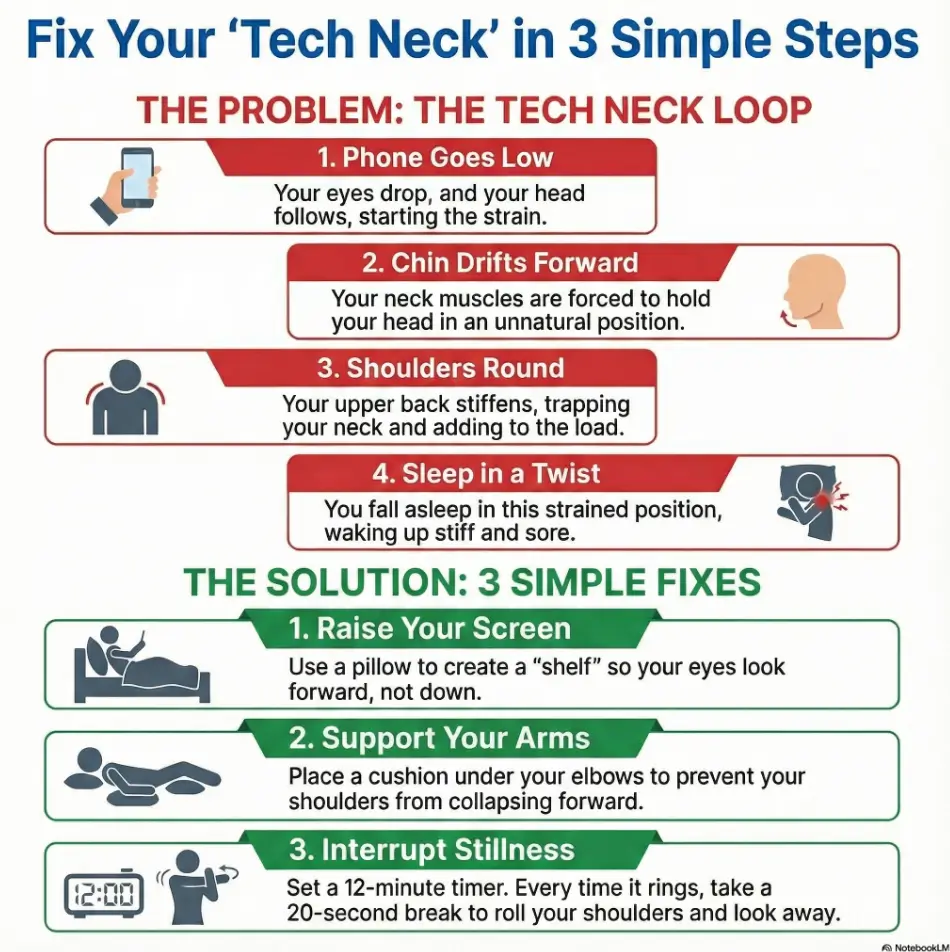
Infographic: the bedtime phone-to-neck chain reaction (and the breakpoints)
Bedtime Tech-Neck Loop: where it starts, how it grows, where to break it
1) Phone goes low
Eyes drop → head follows.
Breakpoint: raise the screen 2 inches.
2) Chin drifts forward
Neck muscles “hold” quietly.
Breakpoint: arm support reduces shoulder pull.
3) Shoulders round
Upper back stiffens, neck feels trapped.
Breakpoint: 20-second reset every 12 minutes.
4) Sleep happens in the twist
You wake up stiff and confused.
Breakpoint: 30-second neutral roll before sleep.
Operator tip: You don’t need perfect posture—just fewer minutes in the worst angles.
- Raise the phone
- Support the elbows
- Interrupt stillness
Apply in 60 seconds: Build the phone shelf and set your 12-minute timer now.

FAQ
1) How do I know if my neck pain is really from phone-in-bed scrolling?
If pain flares during or after bedtime scrolling, improves when you change position, and shows up as morning stiffness at the base of the skull or upper traps, it often has a strong posture/position component. Test it: raise the screen and support your elbows for 10 minutes. If symptoms ease, you’ve likely found a major trigger. (This deeper breakdown of how to tell text neck from “normal” neck pain can also help if you keep second-guessing the source.) 60-second action: run the triage checklist and try the phone shelf tonight.
2) Is it okay to use my phone in bed if I’m careful?
Yes—if “careful” means a setup, not a promise. The safest version is: screen higher, elbows supported, timer breaks, and audio-only after your cutoff. If you can’t keep the angles without effort, that’s a signal to change tools (stand/wedge) rather than argue with yourself at midnight. 60-second action: set a 12-minute timer and switch to audio when it rings.
3) What’s the fastest fix if I only do one thing?
Raise the phone so your eyes look forward, not down. It’s the highest-leverage change because it reduces the worst angle without asking you to “try harder.” Combine it with elbow support and you’ve removed two major drivers in under 2 minutes. 60-second action: build a pillow shelf and check that your chin isn’t dropping.
4) Do I need special pillows or a wedge?
Not always. Start with the $0 version for 3 nights. If you keep sliding into a flexed posture, then a wedge or firmer back support can be worth it—especially if it reduces wake-ups and morning stiffness. Think of it like a coverage tier: Tier 1 is free setup changes; Tier 2 is a small gear upgrade. 60-second action: try the decision card: A for 3 nights, then upgrade one piece if needed.
5) When should I see a clinician?
If pain persists beyond a couple of weeks despite sensible changes, worsens, radiates with numbness/weakness, or follows an injury, get assessed. You’re not “overreacting.” You’re protecting function. 60-second action: write a one-line symptom timeline and bring it to your appointment.
6) Can I do stretches to fix it?
Gentle movement can help, but stretching isn’t a permission slip to keep scrolling in bad positions. If you stretch and then repeat the same bedtime posture for 45 minutes, you’re undoing your own work. 60-second action: do 5 gentle turns each way, then fix the setup before you scroll again.
Conclusion: your 15-minute next step
Remember the hook: the “free” habit that cost you a morning. The good news is that the fix is usually not dramatic. It’s a small, repeatable bedtime system that makes the right posture the easy default.
Your next step is simple and honest: spend 15 minutes tonight building the setup that tired-you can keep. Do it in this order:
- 3 minutes: build the phone shelf (raise the screen)
- 2 minutes: support elbows (reduce shoulder pull)
- 1 minute: set a 12-minute timer
- 3 minutes: pick your audio-only cutoff
- 6 minutes: test for comfort, adjust once, then stop tinkering
If you track one thing, track this: “How did my neck feel 10 minutes after waking?” Run the experiment for 3 nights. If you’re clearly better, keep the system. If you’re not, escalate smartly: check red flags, consider guided care, and bring a short symptom timeline so your appointment is about decisions, not guessing. If you keep getting stuck on “is this actually tech neck?”, revisit the text neck vs normal neck pain symptom check and use it to decide your next move calmly.
Last reviewed: 2025-12; reviewed against patient-education guidance from Cleveland Clinic, NHS, and Mayo Clinic pages.