

Chiropractor vs. Physical Therapy for Low Back Pain: My $3,000 Regret & Honest Review
I remember the moment my credit card statement hit my inbox like it happened five minutes ago. I was already wincing from my usual lower back pain, but this time, the real sting came from the number glaring back at me: $3,150.
No, that wasn’t a medical emergency or some life-saving procedure. That was the grand total for six months of so-called “maintenance care” from my chiropractor—the kind that was supposed to fix my spine but mostly just left me with a thinner wallet and the exact same ache I started with. The only thing that got adjusted consistently? My bank account.
So if you’re currently lying on the floor, scrolling through your phone with one arm, Googling whether to see a chiropractor or a physical therapist, stop right there. I’ve been in your position—literally and financially.
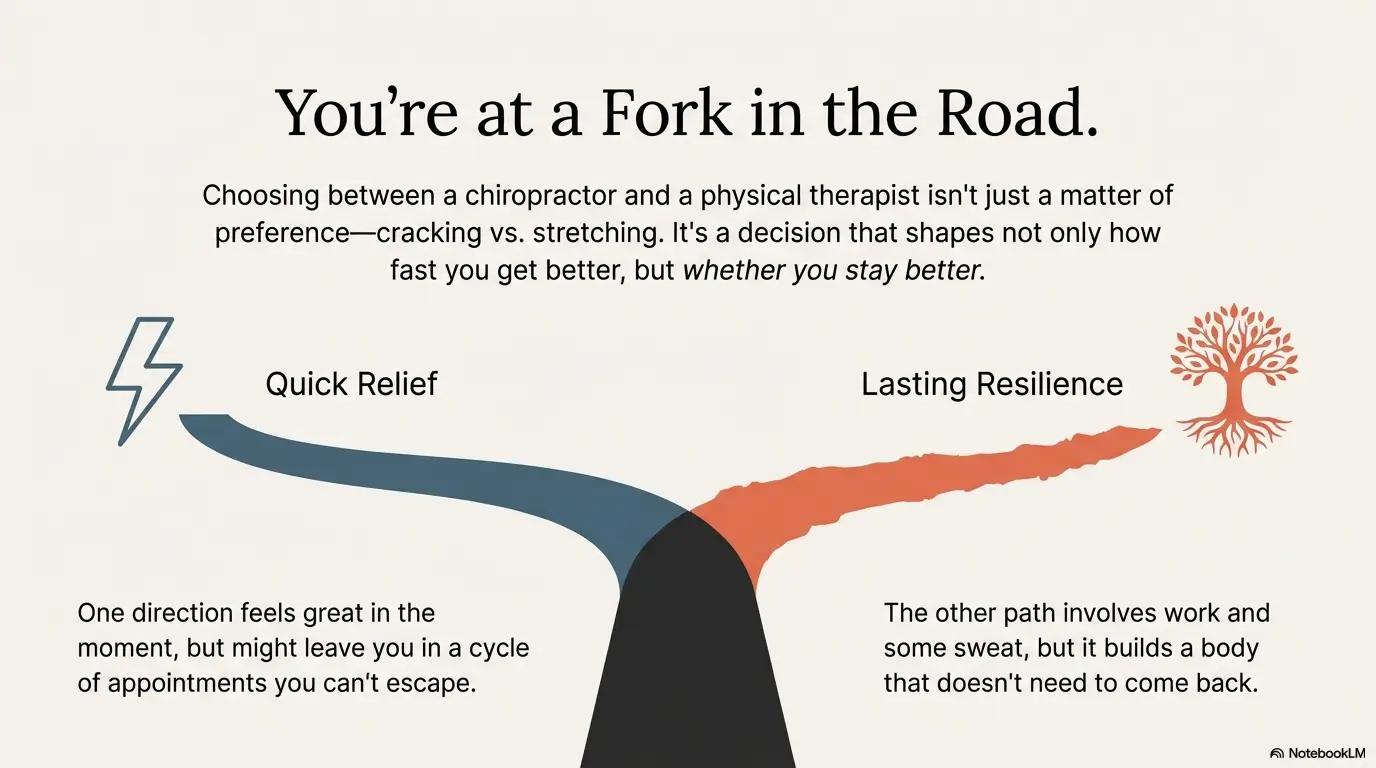
Most people think it’s just a matter of preference: Do you want to be cracked like a glow stick, or stretched like cold pizza dough? But it’s way more than that. It’s a choice that can shape not only how fast you get better, but whether you stay better—and how much you’ll end up paying for it.
This isn’t just about comfort. It’s a fork-in-the-road moment. One direction feels great in the moment—like a back-crack high-five from a wellness wizard—but might leave you in a cycle of appointments you can’t escape. The other path? It’s not glamorous. It involves work, probably some sweat, and definitely some core exercises you’ll pretend you love. But it builds real, long-term resilience.
In this guide, I’m pulling back the curtain. I’ll walk you through the sneaky billing codes, the science behind what actually works, and how to avoid falling into the “maintenance care trap” that cost me the equivalent of a used car and gave me zero refunds on my pain.
Whether you’re dealing with a sudden spasm that came out of nowhere (hello, bending over to tie your shoe), or a slow, soul-sucking ache that’s been tagging along for years—this is the honest roadmap I wish someone had handed me before I made a very expensive mistake.
Let’s save your spine—and your savings—starting now.
Is this urgent?
If you have lost bladder/bowel control, have numbness in your “saddle area,” or severe leg weakness, close this tab and go to the ER immediately. That is Cauda Equina Syndrome. For everyone else with mechanical back pain, keep reading.
Table of Contents
The Core Split: Passive Alignment vs. Active Repair
To understand where your money goes, you have to understand the product being sold. In the world of back pain, these two professions approach your spine from completely different solar systems. I used to think they were interchangeable—just “back doctors.” That assumption was my first expensive mistake.
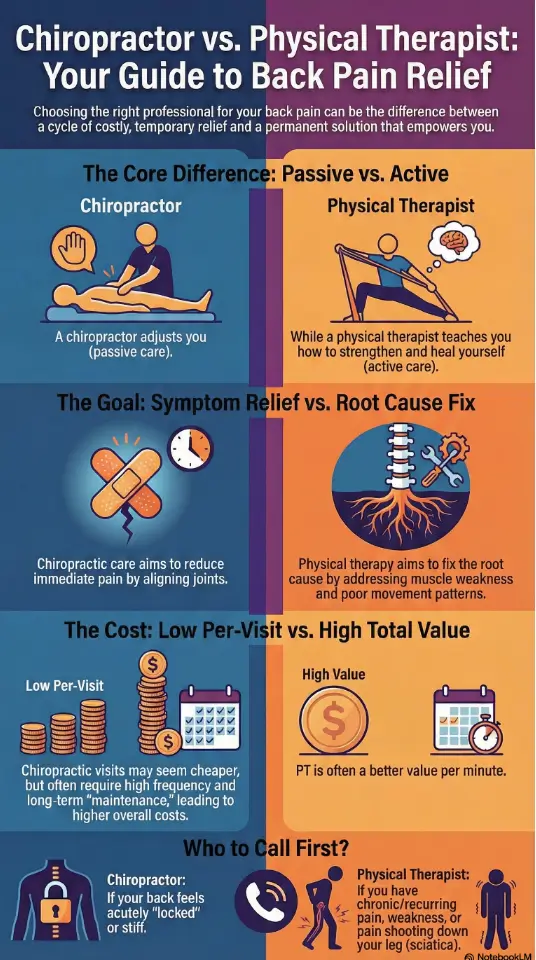
Chiropractors generally focus on the structure and alignment of the spine. The philosophy—originally founded on the idea that misalignments (subluxations) block nerve flow—is about restoration through manipulation. It is largely a passive treatment. You lie down; they do the work. The goal is often immediate symptom reduction through high-velocity, low-amplitude (HVLA) thrusts.
Physical Therapists (PTs) focus on function and movement patterns. They look at your back pain and ask: “Is your hip tight? Is your core weak? Are you lifting your toddler wrong?” Their goal is rehabilitation. It is an active treatment. You will sweat. You will be asked to do things you find annoying. The goal is to build a body that doesn’t need to come back.
- Chiro: Good for “unlocking” stiff joints quickly.
- PT: Essential for strengthening muscles to hold that alignment.
- Warning: Passive treatment alone rarely fixes chronic mechanical issues.
Apply in 60 seconds: Stand up. If pain shoots down your leg (sciatica patterns and disc vs. stenosis), PT is usually the safer first bet. If it feels like a “stuck” joint in the center, Chiro might offer faster initial relief.
The Chiropractic Experience: Instant Relief or Placebo?
Walking into a chiropractor’s office usually feels like a mix between a doctor’s clinic and a spa. The intake is often quick. When I went for my first adjustment, I was in significant pain—about a 7 out of 10. I couldn’t tie my shoes without wincing.
The adjustment itself is undeniably satisfying. That audible “pop” (cavitation) releases gas bubbles from the joint fluid and floods your system with endorphins. It feels like unlocking a rusty door. For about 4 hours after my first visit, I felt superhuman. I thought, “This is it. I’m cured.”
But here is the catch that drained my bank account: The relief is often temporary. Because we hadn’t addressed why my back was locking up (weak glutes and poor posture sitting at a desk for 10 hours), the muscles would inevitably spasm again, pulling the spine back out of alignment. This created a dependency loop. I needed the “crack” to feel normal.
Show me the nerdy details
The “pop” is called tribonucleation. It occurs when joint surfaces are separated rapidly, creating a cavity within the synovial fluid. This stimulates mechanoreceptors (Type III) which can temporarily inhibit nociceptive (pain) signals at the dorsal horn of the spinal cord. It is a neurological reset, not necessarily a “bone moving back into place.”
The Physical Therapy Experience: Homework That Actually Works
Contrast this with my first Physical Therapy evaluation for chronic low back pain. It was humbling. The PT didn’t have me lie down on a table immediately. Instead, she watched me walk. She watched me sit. She asked me to stand on one leg.
“Your back hurts because your hips are on vacation,” she said. It was a funny line, but it hit home.
PT is not passive. You don’t get “fixed” by the therapist; you get tools to fix yourself. My sessions involved soft tissue mobilization (massage), sure, but the bulk of the hour was spent on:
- Motor Control Exercises: Learning how to engage the deep core (transverse abdominis).
- Desensitization: Gentle movements to show my brain that bending forward isn’t dangerous.
- Progressive Overload: Slowly adding weight to strengthen the posterior chain.
It’s frustratingly slow. You don’t leave session #1 feeling euphoria. You leave feeling tired. But by session #6, I realized I hadn’t thought about my back in three days.
The Money Talk: Cost Breakdown & Value Analysis
Let’s talk numbers. Medical billing is deliberately opaque, but after navigating this system for years, I’ve tracked the averages. The costs below assume you are paying out-of-pocket or have a high-deductible plan (which, let’s be honest, is most of us in 2025).
| Feature | Chiropractor | Physical Therapy |
|---|---|---|
| Avg. Cash Price (Initial) | $100 – $200 | $150 – $250 |
| Avg. Follow-up Cost | $40 – $90 | $75 – $150 |
| Frequency | High (2-3x/week often sold in packages) | Moderate (1-2x/week) |
| Duration per Visit | 10 – 20 minutes | 45 – 60 minutes |
| Insurance Coverage | Variable (often capped at ~12-20 visits) | High (standard medical necessity) |
The “Package” Trap: This is critical for your wallet. Many chiropractors operate on a volume model. You might be offered a “Wellness Plan”—$2,000 for 30 visits upfront. This lowers the per-visit cost but locks you into a treatment volume that may not be medically necessary. Physical Therapists generally bill per unit of time (15-minute increments) and rarely sell bulk packages upfront due to ethics regulations.
- Check codes: Ask if they bill 98940 (Chiro manipulation) or 97110 (Therapeutic exercise).
- Value math: $60 for 10 minutes = $360/hour. $120 for 60 minutes of PT = $120/hour. PT is often better value per minute.
Apply in 60 seconds: Download your insurance benefits summary PDF. Search “Chiropractic” to see your annual visit cap (usually 12-20).
Story Time: How I Wasted $3,000 (And How to Avoid It)
I was desperate. That’s the emotion bad actors prey on. I had a herniated disc (L5-S1) that was making my leg numb. I walked into a high-end chiropractic office with marble floors and a very convincing doctor. He took an X-ray (which I later learned is rarely useful for soft tissue issues) and showed me a terrifying curve. He said, “We need to correct this curve, or you’ll need surgery in 5 years.”
Fear is a powerful sales tool. I signed up for a 6-month intensive plan. Three times a week, I went in, got cracked, lay on a traction table, and left. The bill was $3,150, paid upfront for a “discount.”
Short Story: The realization Four months in, I had to travel for work for two weeks. I missed six appointments. By day 10 of the trip, my back pain was screaming. I realized with horror that I hadn’t actually healed anything; I was just renting relief. I was paying a subscription service for my own spine. When I returned, I asked the chiro for exercises to do at home so I wouldn’t be dependent on him. He gave me a generic sheet of stretches and pivoted back to the importance of “maintenance adjustments.” That was the moment I walked out and found a DPT (Doctor of Physical Therapy).
What the Data Says: Evidence-Based Outcomes
I’m just a guy with a bad back, but I trust data. When you look at large-scale studies comparing spinal manipulation (Chiro) vs. exercise therapy (PT) for low back pain, the results are illuminating (Source, 2024).
- Acute Pain (< 4 weeks): Spinal manipulation provides moderate short-term relief, comparable to NSAIDs (ibuprofen) but without the stomach/liver risks. It is effective for getting people moving again.
- Chronic Pain (> 12 weeks): Exercise therapy (PT) consistently outperforms passive treatments. Active strengthening creates structural stability that manipulation cannot.
- Cost Effectiveness: Initial care with PT for low back pain is associated with lower downstream healthcare costs (fewer MRIs, fewer injections, fewer surgeries) compared to starting with advanced imaging or passive care.
Navigating Deductibles, HSAs, and Copays
If you are in the US, your treatment plan is dictated by your insurance policy. Here is how to maximize your benefits and minimize the bleeding. This applies to 2025 plan structures.
💰 The “Will I Pay?” Checklist
Before you book an appointment, call the number on the back of your card and ask these three specific questions:
- ✅ “Is pre-authorization required for code 97110 (Therapeutic Exercise)?” (If yes, you need a referral from a GP first, or the claim will be denied).
- ✅ “What is my co-insurance % after the deductible is met?” (Don’t just ask about copays; MRI and long-term PT often hit co-insurance).
- ✅ “Do I have a combined limit for Chiro and PT?” (Some plans give you 20 visits total to share between both. Don’t use them all up on the wrong one).
HSA/FSA Tip: Both Chiropractic and PT are eligible expenses. You can use pre-tax dollars for copays, deductibles, and even massagers/equipment prescribed by your PT.
The “Cash-Based” PT Revolution: You will notice more PT clinics are “out-of-network.” They charge $150-$200 cash per visit. While this sounds scary, these clinics often provide 60 minutes of 1-on-1 time with a Doctor of Physical Therapy. In-network clinics often double-book patients (you share your hour with 2 other people). Sometimes, 5 high-quality cash visits fix you faster (and cheaper) than 20 low-quality insurance visits.
The Decision Matrix: Who Should You Call First?
If you are hurting right now, here is the brutally simple breakdown of where to go.
- Go to Chiropractor if: Your back feels “locked” or stiff, pain is centralized (not shooting down leg), and you want immediate mobility to get back to work/gym today.
- Go to Physical Therapy if: You have sciatica or disc/stenosis-type leg pain, chronic recurring pain, weakness, or post-surgical needs.
- Go to Orthopedist (MD) if: You have numbness, fever, history of cancer, or trauma (car accident/fall).
Apply in 60 seconds: Test your range of motion. Can you bend forward? If you are stuck at 10 degrees due to a mechanical block, a manipulation might unlock you. If you can bend but it hurts to come back up, that’s a stability issue—go to PT.
Industry Red Flags: When to Run
Both industries have their snake oil salesmen. Protect your health and your wallet by watching for these warning signs.
Chiropractor Red Flags 🚩
- The “Curve Correction” Sales Pitch: If they show you an X-ray and say your neck has lost its curve and you need 40 visits to fix it—get a second opinion.
- Long-Term Contracts: Any provider asking for payment upfront for months of care is prioritizing revenue over recovery.
- Treating Non-MSK Issues: If they claim adjustments cure asthma, allergies, or colic in babies, run.
Physical Therapy Red Flags 🚩
- The “Mill” Environment: If you spend 45 minutes of your hour with a “tech” (unlicensed aide) doing generic exercises while the PT types on a laptop, leave. You are paying for a specialist, not a babysitter.
- No Hands-On: While exercise is key, a good PT should assess joints manually. If they never touch your back, they are missing data.
- Passive Modality Reliance: If 30 minutes of your session is just heat packs and electrical stimulation (TENS), you are paying expensive rent for a heating pad.
The Winning Combo?
The irony of my journey is that I now see the value in both—used correctly. The “Gold Standard” for many athletes is a hybrid approach. Use the Chiropractor to mobilize the stiff joints (open the window of opportunity), and then immediately use Physical Therapy to strengthen the muscles in that new range of motion (keep the window open).
If you have the budget, 1-2 chiro visits to reduce acute pain followed by 6-8 weeks of dedicated PT is a powerful protocol. Just ensure the providers talk to each other.
FAQ
Does insurance cover chiropractic for back pain in 2025?
Yes, most major medical plans (Blue Cross, United, Aetna, Medicare) cover chiropractic care, but with strict limits. Typically, you are capped at 12 to 20 visits per year. Medicare Part B covers manual manipulation of the spine specifically to correct a subluxation, but it does not cover the initial exam, X-rays, or massage therapy—you pay 100% of those out of pocket. Action: Call your insurer and ask specifically about “Section 98940 coverage” limits.
Is it dangerous to let a chiropractor crack my back?
For the lower back (lumbar spine), serious adverse events are incredibly rare (estimated at 1 in several million). The risks are higher for neck adjustments (cervical manipulation). However, if you have osteoporosis, spinal cancer, or severe nerve compression (cauda equina), manipulation is contraindicated. Action: Always disclose your full medical history on the intake form.
Why does my back hurt more after physical therapy?
This is common and called “post-treatment soreness.” Because PT engages weak muscles that haven’t worked in years, you will experience DOMS (Delayed Onset Muscle Soreness). However, if you feel sharp, shooting nerve pain that lasts more than 24 hours, the treatment was too aggressive. Action: Tell your PT immediately at the next session; they will regress the exercise intensity.
Do I need a referral for Physical Therapy?
In the US, all 50 states have some form of “Direct Access,” meaning you can walk into a PT clinic without a doctor’s referral. However, your insurance might still demand one for reimbursement. Action: Check if your state is “unrestricted direct access” or if your insurance plan (specifically HMOs) requires a PCP gatekeeper.
Can I just do YouTube exercises instead of paying a PT?
YouTube is great for general mobility (channels like Bob & Brad or Squat University are excellent), but it fails at diagnosis. If you treat a herniated disc with stretches meant for a muscle strain, you can make it worse. Action: Pay for just one evaluation with a PT to get a diagnosis, then ask them to build you a home program you can do yourself.
Conclusion: Your Next Move
I wasted $3,000 learning that there is no magic switch for back pain. My chiropractor offered me relief, but my physical therapist offered me a cure. If you are stuck in the loop of “pain -> adjustment -> relief -> pain,” it is time to stop paying rent on your own body and start buying ownership through strength.
Your 15-Minute Action Plan:
- Download your insurance Summary of Benefits.
- Check your “Rehabilitation Services” copay vs. “Chiropractic” copay.
- If you have chronic pain, book an evaluation with a PT. If you are acutely locked up, book one chiro session—but set a firm limit of 3 visits before transitioning to active care.
Comparison at a Glance
Chiropractor
- ✅ Instant gratification
- ✅ Passive (Relaxing)
- ✅ Good for “stuck” joints
- ❌ High recurrence rate
- ❌ Maintenance costs high
Physical Therapy
- ✅ Long-term fix
- ✅ Active (Empowering)
- ✅ Addresses root cause
- ❌ Hard work / Sweat
- ❌ Slower initial relief
Last reviewed: 2024-12; sources: APTA/ACA/NIH guidelines.
Chiropractor vs Physical Therapy for Low Back Pain, low back pain relief cost, physical therapy insurance coverage 2025, sciatica treatment comparison, chronic back pain rehabilitation