

Arriving at Surgery Less Depleted:
A Guide to Managing the Wait for Joint Replacement
“`
The hardest part of joint replacement is often not the surgery. It is the waiting, when a hip or knee can turn getting out of bed, reaching the bathroom, or standing in the kitchen into a small daily ambush.
Pain management for seniors is rarely about chasing a miracle. It is about protecting sleep, walking, transfers, and confidence without creating bigger problems through falls, overexertion, or medication guesswork.
“The goal is not to be heroic. The goal is to arrive at surgery less depleted and to make tomorrow’s ordinary tasks feel less punishing than today’s.”
This guide helps you find the safer middle. You will discover:
- Practical help for osteoarthritis pain
- Mobility aids that reduce daily strain
- Pacing movement without aggravating the joint
- Medication questions meant for your doctor, not a search bar
Function-first. Risk-aware. Grounded in reality.
“`Table of Contents
Why this page may feel more useful than the usual pain article:
| What many articles do | What this page does instead |
|---|---|
| Promise broad “arthritis relief” | Focus on safety, daily function, and getting to surgery in better shape |
| Treat all ages the same | Centers older adults, caregivers, fall risk, and medication trade-offs |
| Give generic pain tips | Targets the specific reality of waiting for hip or knee replacement |
| Make mobility aids feel like failure | Treat canes and walkers as tools that protect dignity and independence |
Safety / Disclaimer
This topic needs a steady hand. Pain management for older adults is not a dare, a supplement scavenger hunt, or a “just push through it” pep talk. The goal is safer function, not heroic suffering and not medication roulette. A lot of people waiting on surgery are also juggling blood thinners, blood pressure medicine, kidney concerns, stomach sensitivity, dizziness, or a recent fall. That changes the conversation.
The CDC’s pain guidance leans toward individualized care rather than one-size-fits-all escalation. In ordinary English, that means a plan should match the person, not the panic. A cane that looks unglamorous may be smarter than another week of near-falls. A topical option may be more appropriate than automatically taking more pills. A call to the surgeon may matter more than a new gadget with suspiciously cheerful reviews. For readers also worrying about what conservative care or pain visits may cost before surgery, orthopedic pain management with an HDHP can shape the questions worth asking early.
Use this article for questions, structure, and day-to-day triage. Do not use it to start, stop, combine, or increase medicines on your own. And if there is sudden inability to bear weight, fever, chest pain, shortness of breath, a fall, or rapidly worsening swelling, that is not “just the arthritis being dramatic.” That is a medical call, now.
Plain truth: Good orthopedic pain management while waiting is usually boring in the best possible way. It protects sleep, walking, transfers, and confidence without pretending to erase the joint problem.
Who this is for / not for
This is for readers who…
- Are older adults in the U.S. waiting for hip or knee replacement
- Need practical ways to get through the waiting period with less daily chaos
- Want better questions for an orthopedic surgeon, primary care doctor, or physical therapist
- Are trying to protect sleep, confidence, and mobility before surgery
This is not for readers who…
- Need emergency care for chest pain, shortness of breath, fever, a fall, or new inability to walk
- Want dosing advice tailored to a personal medication list
- Have pain from a new injury, possible infection, or something rapidly changing rather than known joint disease
A familiar scene: a daughter asks, “Should we just let Mom rest more?” and Mom, who hates fuss, says she is fine while gripping the counter like it owes her money. That is exactly the sort of moment this guide is for. Not because the internet can replace a clinician, but because waiting gets slippery when families confuse quietness with coping.
Eligibility checklist: This page is most useful if the answer is “yes” to at least two.
- Yes / No: Pain is interfering with walking, stairs, toileting, bathing, or sleep
- Yes / No: The joint problem is already known and surgery is being considered or scheduled
- Yes / No: You need a safer day-to-day plan, not a miracle promise
- Yes / No: A family member or caregiver is helping and wants clearer guardrails
Neutral next step: If two or more are “yes,” use the sections below to prepare one short conversation with your clinician this week.
Why the wait feels harder than people expect
Pain is not the only problem here
People often imagine the waiting period as one long pain issue. It is usually more crowded than that. Pain is there, yes, but so are sleep disruption, slower walking, smaller routines, wobblier confidence, and a rising fear of becoming “less ready” for surgery. The joint hurts, then the day shrinks around it. That second part is what catches people off guard.
The cruel little trick is that resting can help for an hour and hurt by the end of the week. Muscles around the joint weaken. Stairs feel steeper. Standing up from a low chair becomes a private wrestling match. A person may stop doing small tasks to “save the joint,” only to discover that the body has quietly become less resilient. Pain is noisy, but deconditioning is sneaky. It sneaks in wearing slippers.
The hidden cost of waiting
- Muscle loss around the painful joint
- Less trust in walking, turning, and getting up from chairs
- Greater dependence on railings, countertops, or another person’s arm
- Reduced daily movement that can make surgery recovery feel steeper later
There is also the emotional tax. When every outing requires strategy, people stop choosing joy. They skip the grocery aisle they once wandered, the church stairs they used to manage, the grandchild’s game with the miserable bleachers. Waiting then becomes more than waiting. It becomes a slow edit of the self.

Relief first, damage second: what good pain management really means here
Define success before you chase it
For seniors waiting on joint replacement, the most useful pain goal is rarely “no pain.” It is usually more practical and more humane than that. Good goals sound like this: less pain during transfers, fewer flare days, steadier walking to the bathroom at night, better sleep, and less fear around bathing, stairs, or getting into the car. Function is the scoreboard.
That mindset matters because it prevents the classic waiting-room trap: chasing anything that promises total relief, then ending up with more side effects, more disappointment, or more joint irritation. Some people keep measuring the day in pain points alone. A better question is, “Could I get through the day with less friction?” That changes what counts as a win.
Let’s be honest…
- “No pain” may not be realistic before the damaged joint is replaced
- “More medication” is not automatically better care
- “Doing nothing” can quietly make next month harder
- “Toughing it out” often costs more independence than people expect
A small but useful mental shift is to think like a builder rather than a gambler. Build a tolerable day. Build a better transfer out of bed. Build a calmer morning. Build a safer bathroom route. Relief arrives more reliably through these unglamorous improvements than through anything marketed with exploding stars and the word “advanced.”
- Measure success by transfers, walking, and sleep
- Expect fewer flare days rather than zero discomfort
- Favor repeatable habits over dramatic fixes
Apply in 60 seconds: Pick one daily activity you want to make easier this week, such as getting out of bed or reaching the bathroom at night.
Movement that calms instead of punishes the joint
Low-drama motion usually wins
This is where many readers get trapped between two bad options: doing too much and paying for it tomorrow, or doing too little and stiffening into a smaller life. The sweet spot is not inspirational. It is modest, repeatable, and often slightly annoying because it lacks cinematic flair. Short walks. Gentle range-of-motion work. Therapist-guided strengthening. Pool exercise if it is available and realistic. Nothing in that list will win a movie trailer voice-over, but these are the habits that tend to help older adults hold onto function.
The useful line is often “enough to maintain,” not “enough to conquer.” If a movement session leaves the joint shouting all evening or clearly worse the next morning, the dose was probably too high. If nothing happens at all because the person stopped moving entirely, that is a different problem wearing the same face. A knee or hip can hate a sudden burst of ambition. It often tolerates calmer consistency better.
Here’s what no one tells you…
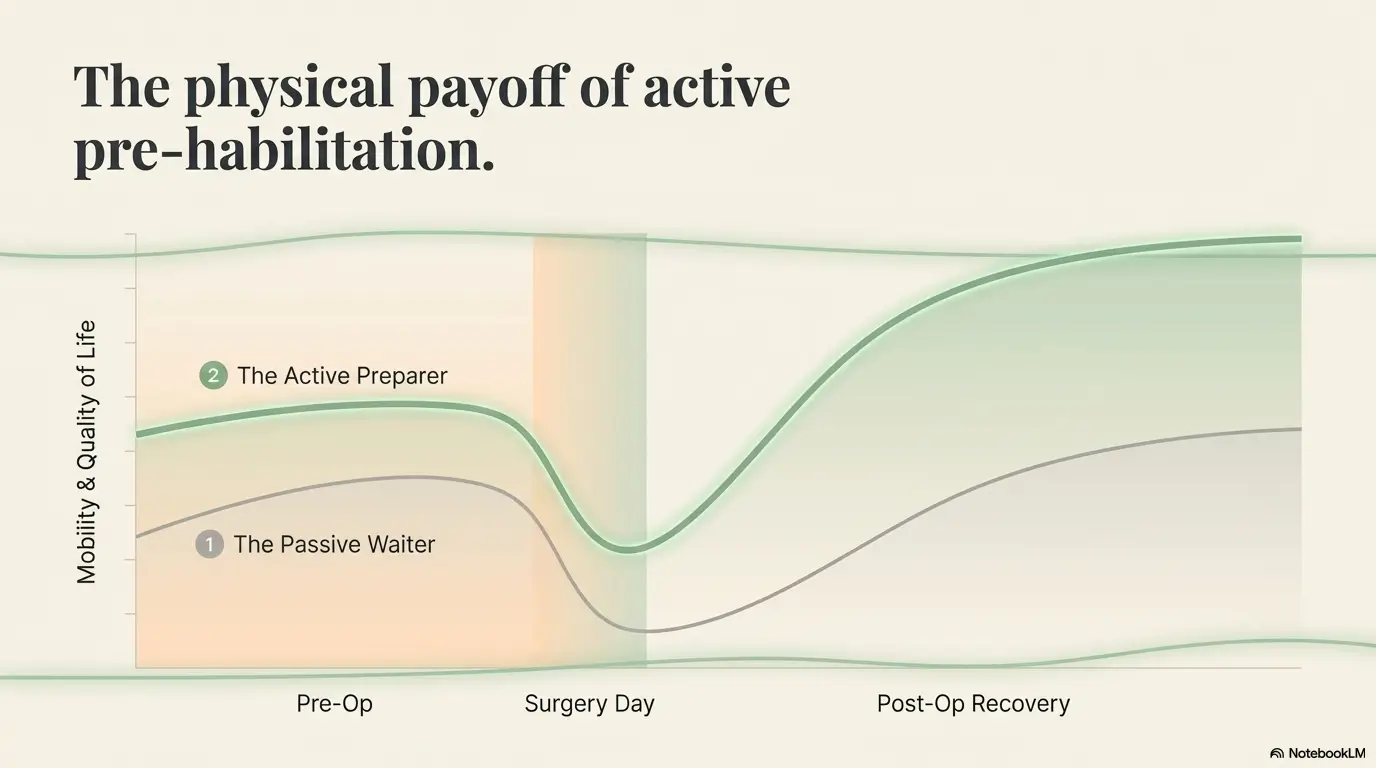
Many people rest because movement hurts, then hurt more because they rested. It feels unfair because it is unfair. The body is not always polite about explaining the difference between pain from an irritated joint and pain from a body that has gone too still. This is why a physical therapist can be valuable even when surgery is already scheduled. Prehab is not busywork. It is rehearsal for recovery. If the practical question is whether therapy sessions will be billed as a flat amount or a percentage, reading about physical therapy copay vs coinsurance can make those planning conversations less foggy.
Prehab matters more than it sounds
- It can help preserve leg strength before surgery
- It gives you safer patterns for standing, turning, and sitting
- It reduces the shock of postoperative rehab
- It can reveal which daily movements are needlessly aggravating the joint
Mini calculator: the 24-hour payback test
- Rate pain during activity from 0 to 10.
- Rate pain again that evening.
- Rate pain the next morning, plus note stiffness in minutes.
Interpretation: If the next morning is only slightly worse and settles quickly, the activity may be within range. If the next morning is clearly worse, stiffer, or changes walking, the dose may need to be reduced and discussed with a clinician or PT.
Neutral next step: Run this test for two common activities this week, such as a short walk and kitchen standing time.
Show me the nerdy details
For many painful joints, the aim is load management rather than total unloading. Gentle strengthening around the hip or knee can improve how force is distributed, while pacing reduces boom-and-bust cycles that create next-day payback. A physical therapist can help distinguish tolerable soreness from a movement dose that is simply too high.
Device decisions that buy back dignity
Cane, walker, brace: which tool earns its keep?
Mobility aids have a public-relations problem. People often see them as announcements of decline, when they are usually tools for preserving independence a little longer and a little more safely. I have watched this play out in countless family kitchens: someone refuses the walker because it “looks old,” then uses three walls and a countertop like a complicated pinball route. The pride is understandable. The physics are unimpressed.
A cane may help when one side hurts more and balance is still fairly steady. A walker may be the smarter option when pain is high, balance is uncertain, or fatigue turns short distances into risky ones. A brace may help some situations more than others, but it is not a magic hinge that cancels out a severely arthritic joint. What matters is whether the device reduces pain enough to improve walking quality and reduce fall risk. Readers trying to sort out whether a support item may qualify as a covered purchase can compare the bigger picture in this guide to orthopedic braces and supports that may be HSA eligible.
The real headline is energy conservation
- Save strength for bathing, meals, appointments, and sleep
- Reduce fall risk on bad days rather than waiting for a worse one
- Use support to preserve confidence, not to advertise defeat
- Make room for steadier, less panicked movement
Decision card: when A vs B
| Option | Usually fits when… | Time / cost trade-off |
|---|---|---|
| Cane | Pain is mostly one-sided and balance is fairly steady | Low hassle, but may be too little support on bad days |
| Walker | Pain, fatigue, or wobbliness are limiting safe walking | More visible and bulkier, often much steadier |
| Brace | A clinician thinks it may support a specific problem | Can help selected cases, can also disappoint if expectations are too high |
Neutral next step: Bring one question to your next visit: “Which device would most reduce fall risk for my worst part of the day?”
- A cane may be enough for lighter one-sided support
- A walker often protects energy and balance better on bad days
- Use the tool before instability becomes the new normal
Apply in 60 seconds: Identify the one daily trip that feels least safe, such as bed to bathroom, and ask whether a device could change that trip first.
Home friction audit: where pain gets multiplied
Room-by-room trouble spots
Most joint pain is not amplified by big dramatic moments. It is amplified by lousy geometry repeated 20 times a day. A bed that is too low. A toilet transfer with no hand support. Slippery bathroom flooring. A kitchen setup that makes someone stand too long because the coffee mugs live on the wrong shelf. This is why “home safety” can sound dull right up until it prevents the hardest part of the day.
One of the most revealing exercises is to follow the person through a normal morning, quietly and honestly. Not a special careful morning. A regular one. Where do they pause? Where do they brace with a hand? Where do they make that small face they pretend not to make? Those are the pain multipliers.
Tiny fixes, outsized payoff
- Grab bars and a shower seat in the bathroom
- Chair arms and firmer cushions for easier standing
- Frequently used kitchen items moved to waist level
- Clearer paths, better lighting, and safer footwear
At-home joint-pain infographic: Green, Yellow, Red
Green zone
Short walks, steady transfers, pain settles after activity, no major next-day payback.
Yellow zone
More stiffness, rougher nights, holding onto furniture more often, growing fear around stairs or bathing.
Red zone
Fall, fever, sudden swelling, dramatic pain change, new inability to bear weight, chest pain, or shortness of breath.
Home changes are not glamorous, but then again neither is getting trapped on a soft couch and having to launch yourself up like a malfunctioning catapult. The best home fix is often the one that removes one ugly little repeat problem from the day. When bed setup is part of the trouble, some households also find it helpful to think through the practical trade-offs in recliner vs bed recovery positioning, even though the surgery discussed there is different, because the larger question is the same: which sleeping arrangement reduces strain and makes night transfers safer?
Medication questions seniors should take to the doctor, not the search bar
Ask about the trade-offs, not just the label
This is the section where restraint matters most. Older adults do not just take a pain reliever. They take it inside a whole ecosystem of blood pressure pills, diabetes medication, blood thinners, kidney function, sleep problems, bowel habits, dizziness risk, and sometimes a history of stomach bleeding. That is why “What helps pain?” is too small a question. The better question is, “What helps pain without creating a bigger problem for me?”
Useful conversations include asking about topical versus oral options, how to time symptom relief around physical therapy or bedtime, and what side effects matter most for that specific person. Some people assume over-the-counter means harmless. It does not. Some assume prescription means stronger and therefore better. Also not necessarily true. The CDC’s pain guidance has pushed clinicians toward careful, patient-centered discussions for exactly this reason.
Red-flag medication framing to avoid
- “Can I just take more?”
- “It is over the counter, so it must be harmless”
- “I will use someone else’s prescription until surgery”
- “If one dose helped, doubling it should help more”
A practical visit question might sound like this: “My hardest time is getting out of bed and making it to lunch without flaring badly. What options are safest with my age, balance, and other medicines?” That gives the clinician something usable. It is grounded, specific, and much more helpful than “Everything hurts, what should I take?” If that conversation may also include injections, cost, or whether a visit is exploratory rather than procedural, it can help to review what a joint injection consultation may involve on the billing side before the appointment.
Show me the nerdy details
For older adults, the “best” pain option is often the one with the lowest downside for that person’s full medical picture. Topical treatments may avoid some systemic risk in selected cases, while oral medicines can interact with other conditions or medications. This is one reason surgeons, primary care clinicians, and pharmacists all matter in the waiting period.
- Ask about timing, trade-offs, and interactions
- Do not change doses or combine medicines on your own
- Specific daily patterns make clinician advice better
Apply in 60 seconds: Write down your worst pain window today, such as “bed to breakfast” or “after 7 p.m.,” so your next medication question is concrete.
Common mistakes
Mistake #1: Saving all movement for “good days”
Boom-and-bust activity is the classic trap. A person feels better one afternoon, tries to “make up” for lost time, overdoes it, then spends the next day or two paying interest. The week becomes a bad accordion: expand, collapse, repeat. Pain management usually works better when activity is steadier and smaller.
Mistake #2: Chasing total bed rest
Too much inactivity can increase stiffness, weakness, and fear of movement. Rest has a place, but full retreat can turn the waiting period into silent deconditioning. A body preparing for surgery benefits more from thoughtful pacing than from surrender.
Mistake #3: Treating sleep loss like a side issue
Bad sleep lowers pain tolerance, worsens mood, and makes the next day’s walking less confident. People often talk about sleep as if it were a luxury feature, like heated seats. It is closer to fuel. Low fuel changes everything.
Mistake #4: Waiting too long to use a mobility aid
Pride is expensive. Stability often protects independence rather than announcing its loss. Many readers wait until after a near-fall to try a cane or walker, when the better move would have been one week earlier.
- Steadier weeks usually beat heroic good days
- Too much bed rest can reduce surgical readiness
- Sleep problems deserve real attention
- Mobility aids are tools, not verdicts
Don’t do this while waiting for joint replacement
Don’t confuse “sore” with “safe”
A mild increase in soreness after activity is not the same thing as a sudden new problem. But people often blur those categories because both are unwelcome and both hurt. Sharp escalation, fever, obvious new swelling, or sudden walking failure deserves attention. Those are not just “one of those days.”
Don’t build your plan around miracle fixes
This is the part of the internet where every pillow, patch, brace, and supplement seems to have discovered the secret language of cartilage. Be suspicious. The more a product sounds like it is auditioning for a late-night infomercial, the less likely it is to solve a structurally damaged joint. Helpful tools exist. So does hype. The two are not married.
Also skip the informal borrowing economy of medicine. Do not take someone else’s leftover prescription because your cousin’s neighbor said it “worked wonders.” The waiting period is not the time to freelance your pharmacology.
- Notice what reliably flares pain
- Treat new red flags differently from familiar soreness
- Be skeptical of instant-reversal promises
Apply in 60 seconds: Pick one thing to stop this week, such as overlong standing or “testing” the joint on stairs when you already know it complains.
The sleep-pain loop nobody budgets for
Night pain changes everything downstream
The night shift is brutal. A sore hip or knee has a way of turning in bed from a thoughtless movement into a full committee meeting. The next morning then arrives with stiffness, irritability, slower walking, and a shorter fuse for exercise. People often say, “I can handle the pain, I just can’t sleep.” That is not a side note. It is the main plot for many households.
Night pain also creates a strange kind of fear. People start dreading bedtime because it means a new round of turning, repositioning, and negotiating with pillows. Then they sleep less, move less, and hurt more. It is a tidy little disaster loop.
Build a “better night” section into the plan
- Ask a clinician or PT about the safest positioning options for your joint
- Make getting in and out of bed less awkward and less low
- Reduce late-evening aggravators, such as unnecessary stairs or long kitchen standing
- Keep the night path to the bathroom clear, lit, and non-slippery
Short Story: A common waiting-room story goes like this. A man in his seventies can manage the day reasonably well, or so he says. He sits through lunch, he does a short walk, and he insists surgery can wait a bit longer. But at night the truth shows up. He sleeps in fragments, grips the mattress edge to turn, and reaches morning already depleted. By breakfast he is not just in pain. He is exhausted, impatient, and less steady. His daughter notices he is suddenly using tabletops to stand.
What helped was not a grand intervention. It was a calmer evening routine, a firmer bed edge, a clearer bathroom path, and a frank conversation with his care team about pain timing. None of it sounded glamorous. All of it made the next day less punishing. For readers trying to solve the sleep side of the equation more concretely, comparing bed setup issues with a guide like sleeping in a recliner versus a bed after surgery can help frame the practical trade-offs around height, leverage, and nighttime transfers.
Show me the nerdy details
Sleep loss amplifies pain perception, slows recovery from activity, and often makes balance and patience worse the next day. For older adults, nighttime bathroom trips add a second risk layer: sleepy decision-making plus painful movement plus poor lighting. That is why night setup is a safety issue, not mere comfort optimization.
When to seek help
Call the surgeon, PCP, or care team sooner if…
- Pain changes suddenly or dramatically
- There is fever, redness, or concerning swelling
- Walking ability drops fast
- A fall happens, even if nobody wants to make a fuss
- Medication seems to cause dizziness, confusion, stomach bleeding signs, or other side effects
Escalate now, not next week
Some symptoms deserve urgency rather than admirable patience. New inability to bear weight, chest pain, or shortness of breath are not problems to “watch for a few days.” Neither is a fall in an older adult waiting on surgery, even if the person stands up afterward and insists they are only embarrassed. Embarrassment is common. So is underreporting. Neither changes the need for care.
A sensible rule is this: familiar pain belongs in the pattern log; unfamiliar or dramatic change belongs in a phone call. That one sentence saves a lot of bad decision-making. When the goal is to reach surgery as safely and strongly as possible, early communication usually beats stoicism. And when pain location becomes murkier than expected, especially when readers are not sure whether the real culprit is the joint or the low back, a primer on hip pain versus spine pain can make the next clinical conversation sharper.
- Patterned pain can be logged and discussed
- New red flags deserve prompt contact
- A fall always changes the situation
Apply in 60 seconds: Put the surgeon’s office, PCP, and a family contact in one visible place so nobody is searching for numbers during a rough moment.
FAQ
Is walking good or bad for seniors waiting on knee replacement?
Usually, walking is helpful when it is paced and tolerable rather than heroic. Short, steady walking often supports function better than either total rest or one big burst of activity. The useful test is not whether the walk felt brave in the moment. It is whether the joint was only mildly annoyed later and not clearly worse the next morning.
What is the safest pain relief to ask about before joint replacement?
The safest question is not “What is strongest?” It is “What is safest for my age, balance, stomach, kidneys, other medicines, and hardest time of day?” For some people, a topical option or timing strategy may be more appropriate than simply adding or increasing pills. That decision belongs with a clinician who knows the full medical picture.
Should an older adult use a cane or walker before surgery?
Often, yes, if it reduces fall risk, pain, or energy drain. A cane may help when pain is mostly one-sided and balance is still fairly steady. A walker may be the more protective choice when walking feels wobbly, fatigue is high, or the person is starting to “furniture surf” through the house. The best mobility aid is the one that makes a risky part of the day safer.
Can physical therapy help even if surgery is already scheduled?
Yes, it often can. Prehab may help preserve strength, improve transfers, and prepare the body for postoperative recovery. It can also teach safer movement patterns now, which matters because many older adults are not failing from one big moment. They are being worn down by dozens of small awkward moments each day.
How do seniors sleep with hip or knee pain before replacement?
Usually by treating bedtime as a safety and pain-management problem, not just a comfort problem. Positioning, bed height, a clearer path to the bathroom, reduced late-evening aggravation, and a conversation with the care team about nighttime pain patterns can all matter. The aim is not a perfect night. It is a less punishing one.
When is joint pain “normal waiting pain” versus a reason to call the doctor?
Familiar, patterned pain that rises and falls with activity usually belongs in the tracking log. Sudden, dramatic change does not. New inability to bear weight, fever, big swelling, redness, a fall, chest pain, or shortness of breath should be treated as reasons to contact a clinician or seek urgent help.
Are topical pain relievers safer than oral pain medicine for older adults?
They can be a better fit for some people, but “safer” depends on the whole person and the product. Topicals may reduce some systemic concerns in selected cases, while oral medicines may pose more issues for some older adults because of stomach, kidney, bleeding, or interaction risks. That is exactly why this conversation belongs with a clinician or pharmacist.
How can family members help without making the senior less independent?
Focus on friction, not control. Improve the chair height, bathroom setup, lighting, clutter, and night path. Help track pain patterns. Offer a steadier routine rather than constant warnings. The most respectful kind of help often feels like good design, not supervision.
One safer next step before surgery
If you do only one thing after reading this, make it simple enough to survive a tired day. Create a one-page pain pattern log for the next 7 days with four columns: time of day / activity / pain spike / what helped. That single sheet often reveals more than a month of vague remembering. It shows whether the real villains are stairs, transfers, overlong standing, late-evening irritation, or the false confidence of “good days.”
In under 15 minutes, you can also do a micro home audit. Check the bed edge, the bathroom route, the chair that is hardest to rise from, and the trip that feels most unstable. Pick one fix, not seven. A firmer cushion. A clearer path. Better night lighting. A walker discussion. Pain care becomes more useful when it leaves the realm of general advice and enters one real hallway in one real home.
That is the curiosity loop from the beginning, closed honestly: the waiting period does not become manageable because someone discovers a secret trick. It becomes more manageable because the day gets less punishing, one friction point at a time. Not glamorous. Very effective. And if the financial side of imaging, visits, or self-pay choices is part of the stress cloud, readers often do better when they prepare those questions in parallel, whether through self-pay cash price range planning or a more specific estimate conversation after the surgeon visit.
Bring this to the next appointment:
- Your 7-day pain pattern log
- The hardest daily task, named plainly
- Any near-falls, actual falls, or new walking changes
- A list of current medicines, including over-the-counter products
Neutral next step: Put these four items together before your next call or visit so the conversation starts with facts instead of fog.
Last reviewed: 2026-03.