

Mastering the Ride: Post-Lumbar Fusion Travel
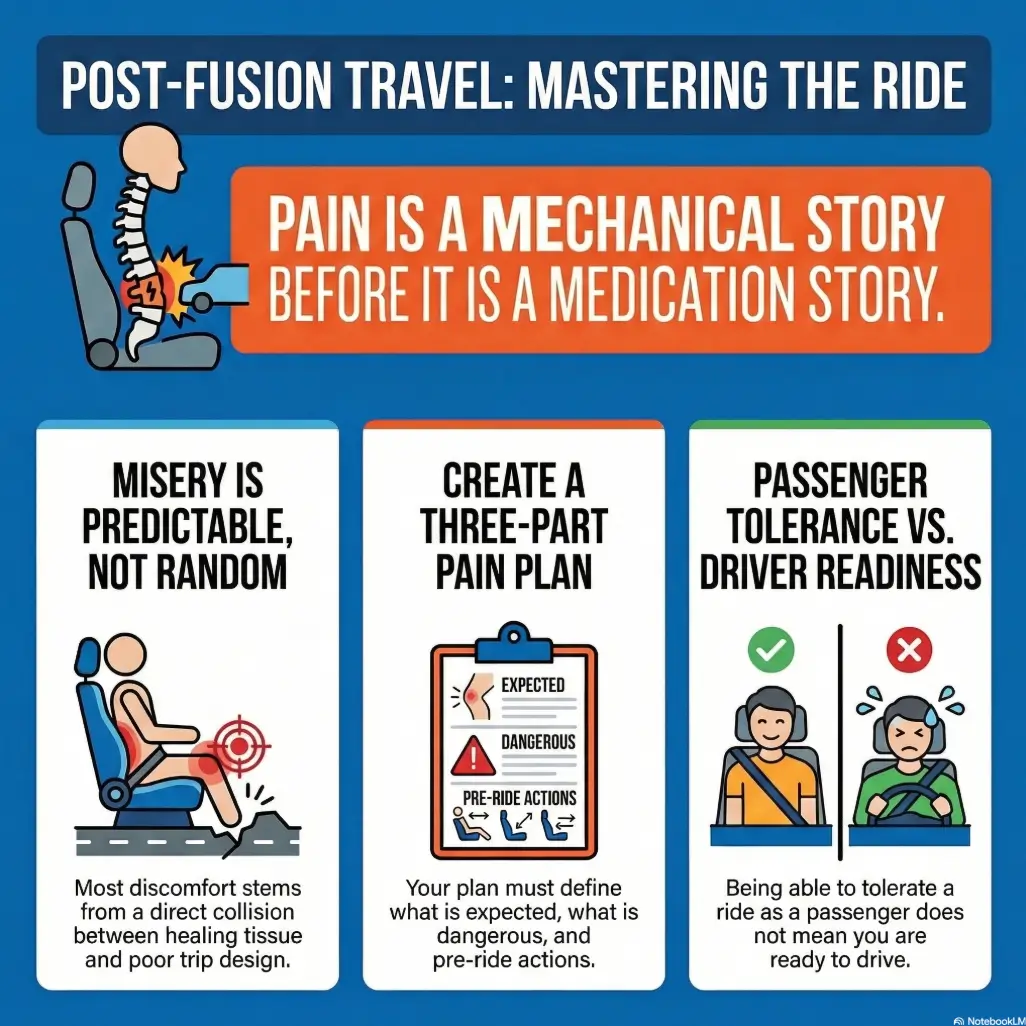
A lot of people expect the hard part of lumbar fusion to end in the operating room. Then the first car ride happens, and a ten-minute trip can feel longer than the week before it. Lumbar fusion car ride pain is rarely just about pain tolerance. More often, it is a collision between healing tissue, fixed sitting, road vibration, awkward seat angles, and one badly timed twist getting in or out.
That is what makes this phase so maddening. The ride may look short on paper, yet still leave you sore, shaky, or second-guessing whether something is wrong. Keep guessing, and a necessary trip to the pharmacy or surgeon’s office can turn into a setback you did not need.
This guide helps you make car travel after spinal fusion safer and more manageable by focusing on what actually changes the experience: sitting tolerance, seat setup, break timing, passenger habits, and warning signs.
The advice here follows the logic of real post-op guidance: shorter sitting windows, fewer twists, and smarter breaks. Because the car is not always the problem—sometimes it is the choreography. And choreography can be changed.
Table of Contents
Fast Answer
After lumbar fusion, car ride pain usually gets worse because the body dislikes five things at once: fixed sitting, road vibration, awkward seat angles, twisting during entry and exit, and staying in the car longer than your recovery stage can tolerate. The safest play is usually simple: follow your surgeon’s restrictions, keep rides short, set the seat before leaving, support a neutral posture, take movement breaks before pain spikes, and treat new weakness, fever, wound drainage, or loss of bowel or bladder control as urgent warning signs.
- Shorter is usually safer than tougher
- Breaks beat bravado
- Seat mechanics matter as much as mileage
Apply in 60 seconds: Before the next ride, decide the route, the seat setup, and the break point before the engine starts.
Safety / Disclaimer
This article is for education and recovery planning. It is not a diagnosis, not a substitute for your surgeon’s instructions, and definitely not permission to improvise around red-flag symptoms. Lumbar fusion recovery varies by level fused, surgical approach, use of hardware, bone quality, age, prior symptoms, and whether your surgeon wants a brace, stricter sitting limits, or a slower timeline.
MedlinePlus notes that recovery after laminectomy and fusion is longer than after simpler procedures, with bone healing taking at least several months and activity restrictions changing along the way. That is why two people can both say “I had back surgery” and still need very different car-travel advice.
If your surgeon says “no riding longer than X,” that instruction outranks generic internet advice every single time. Recovery is not a personality test. It is a biology project with deadlines you cannot bully.
When to Seek Help
Call your surgical team if pain is suddenly worse than your usual pattern
A familiar ache after sitting too long is one thing. A new surge of pain that feels sharper, more intense, or strangely different deserves a phone call. The important distinction is not simply “more pain” but a changed pattern. If the ride used to leave you stiff and now it leaves you feeling unstable, electrified, or unable to settle, do not shrug that off.
Seek urgent care for fever, wound drainage, new leg weakness, or numbness
These are the kinds of details that should stop the whole “maybe it’s fine” monologue. MedlinePlus specifically flags increasing redness, swelling, drainage, warmth at the incision, and concerning symptoms as reasons to contact the surgeon. If the situation is escalating quickly, it also helps to understand when low back pain crosses into emergency territory.
Treat loss of bowel or bladder control as an emergency
This is not a wait-and-see situation. It is the sort of symptom that belongs in the emergency category, full stop. If you need a clearer picture of why clinicians take this so seriously, review the warning signs associated with cauda equina syndrome red flags.
Do not “push through” pain that feels sharp, unstable, or neurologically different
There is a cultural habit of trying to be the easy patient, the low-maintenance passenger, the person who says, “No, no, I’m okay,” while sweating into a seatbelt. That instinct can backfire. Your job is not to be impressive. Your job is to heal.
Eligibility checklist: Is this a self-management problem or a medical call problem?
- Yes: Pain is familiar, improves with rest, and matches prior post-ride soreness
- Yes: No new weakness, fever, wound drainage, or loss of control symptoms
- No: Pain is suddenly severe, radiating differently, or paired with new neurologic signs
- No: You feel “something is wrong,” not just “this is uncomfortable”
Neutral next step: If any “No” box fits, call your surgical team before treating this like a routine seating problem.
Who This Is For / Not For
This is for you if short or necessary car rides are triggering lumbar fusion pain
Maybe the trip is ten minutes to the surgeon’s office. Maybe it is twenty minutes to the pharmacy and back. Maybe somebody promised it would be “super quick,” which is how some of the worst rides in human history begin. If the car itself seems to be the villain, this guide is for you.
This is for you if you want positioning, pacing, and comfort strategies without guessing
You do not need a miracle gadget cabinet. You need clear decisions about timing, seat angle, movement breaks, medication coordination, and what symptoms mean you should stop playing amateur detective.
This is not for you if you need emergency evaluation for red-flag symptoms
If this has moved beyond soreness into emergency territory, the correct strategy is urgent care, emergency care, or immediate contact with your surgical team.
This is not for you if your surgeon has given stricter travel restrictions than standard advice
Hospital discharge guides often recommend short trips, sitting limits, and gradual return. But your specific restriction may be tighter because your surgery was more extensive or your healing situation is more complicated. Surgeon-specific advice wins. Every time.
Car Ride Pain Starts Here: Why Sitting Feels Worse After Fusion
Vibration, fixed posture, and micro-jarring add up fast
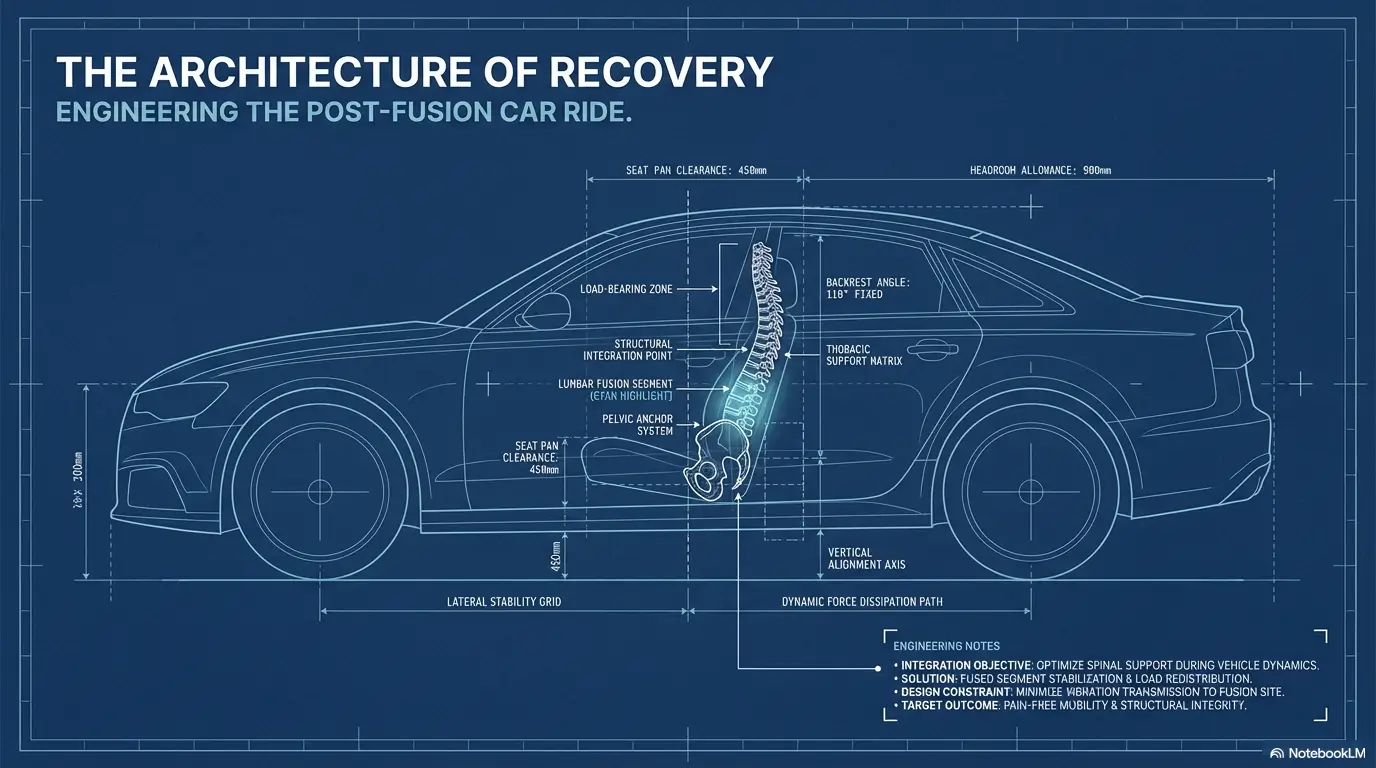
The body after lumbar fusion is not only healing the incision. It is dealing with muscular guarding, local inflammation, nerve irritability, altered movement patterns, and the practical fact that roads are rude. A car seat invites stillness, and stillness after surgery often stops being comfortable long before it looks dramatic. Tiny bumps, stop-and-go motion, and the low-grade buzz of the road can accumulate like interest on a bad loan.
I once watched a relative insist that the road was “fine” because it was newly paved. Five minutes later, every speed bump became a moral issue. Smooth roads help, yes. They do not erase sitting stress.
Getting in and out of the car may hurt more than the ride itself
Many patients focus on the travel time and underestimate the entrance choreography. The twist to grab the door, the fold into a low seat, the lurch to stand back up, the little reach toward a bag on the floorboard, all of it can provoke more discomfort than the drive itself.
Pain can come from muscles, nerves, incision sensitivity, or seat mechanics
This matters because each source behaves differently. Muscle guarding tends to build with time and poor position. Nerve-related symptoms may radiate or tingle. Incision sensitivity often protests against pressure or friction. Bad seat mechanics create a slow, grumpy pull through the pelvis and low back. You do not need a perfect diagnosis in the car, but it helps to notice the pattern. If you are trying to sort out that pattern, this breakdown of nerve pain versus muscle soreness can make the distinctions less foggy.
Here’s the trap most people miss: comfort and support are not the same thing
The softest setup is not always the best one. A deep bucket seat may feel plush for two minutes and then quietly pull your pelvis into a bad angle. Likewise, piling random cushions under you can create a throne worthy of an anxious raccoon while doing nothing good for spinal alignment. That is also why the tradeoff between a seat cushion and a lumbar roll is often more about mechanics than softness.
Show me the nerdy details
Several post-op spine instructions focus less on “perfect posture” as an abstract ideal and more on limiting prolonged sitting, avoiding bending and twisting, and changing position frequently. That is a clue. The issue is not just how you sit, but how long you stay trapped in one position and how much rotation, flexion, and vibration accumulate during the trip. MedlinePlus advises avoiding sitting longer than 20 to 30 minutes at one time after spine surgery, and Brigham and Women’s lumbar fusion instructions similarly limit sitting to 20 to 30 minute intervals to reduce muscular discomfort.
- Road vibration can matter
- Entry and exit can trigger flares
- Over-soft seats may worsen alignment
Apply in 60 seconds: Identify whether your pain spikes most during the ride, during bumps, or when getting in and out. That tells you where to intervene first.
Timing Changes Everything: When Car Travel Is Most Likely to Flare Pain
The first rides home are often the most revealing
Early rides often teach you more than the hospital discharge sheet. You find out whether the incision hates the seatbelt, whether the seat angle feels too tucked, whether the route is too bumpy, and whether ten minutes is actually your current maximum before the body starts sending invoices.
Morning stiffness and end-of-day fatigue create different pain patterns
Morning pain often feels like rust. Late-day pain often feels like the battery is gone and the muscles are muttering in protest. The same fifteen-minute ride can feel wildly different depending on the time of day. If a trip is optional, schedule it for the window when you usually feel least stiff and least fatigued.
Medication timing can change whether the same ride feels manageable or miserable
This is not a vote for self-directed chemistry experiments. It is a reminder to ask your care team whether an essential ride should be timed around prescribed medication or other approved comfort measures. Alberta aftercare guidance emphasizes taking medicines exactly as directed and changing position about every 30 minutes to reduce pain while healing.
Let’s be honest: a “quick errand” can still be too much
“Quick” is one of recovery’s most suspicious words. Quick can still mean parking, walking, waiting, sitting again, turning around, loading bags, and surviving a pothole symphony on the way home. What sounds tiny on paper may be large in spinal math.
Mini calculator: Is this ride too ambitious today?
Add these three numbers:
- Minutes sitting in the car
- Minutes waiting while seated elsewhere
- Minutes you expect to be upright but tired afterward
If the total is far beyond what you tolerated yesterday, scale down. A trip is not just drive time. It is the whole energy bill.
Neutral next step: Trim one variable today, such as route length, waiting time, or number of stops.
Seat Setup Before Speed: How to Make the Car Less Hostile
Start with neutral spine, not the most reclined position
Many people assume reclining farther is automatically kinder. Sometimes it is. Sometimes it simply shifts the problem. A modest recline that avoids slumping is often more useful than turning yourself into a folded beach chair. The goal is not ramrod stiffness. It is a neutral, supported posture that does not force the low back into strain.
Use small lumbar or towel support only if approved and comfortable
A small rolled towel or modest lumbar support may help some people maintain a better position. It should feel like guidance, not a brick. If it increases pressure at the incision or exaggerates the curve in a way that feels sharp or tiring, abandon the experiment. If you are comparing options, a piece on when lumbar support helps more than a seat cushion may help you think through the setup more clearly.
Adjust hip and knee angle to reduce pulling through the low back
Sometimes the fix is gloriously unglamorous. Raise the seat a bit. Slide it slightly forward or back. Change the knee angle. Place the feet so you are not bracing against the floorboard like a sailor in a storm. Tiny changes can calm the tug through the pelvis and lower spine.
Avoid twisting to reach bags, doors, chargers, or the glove box
The reach is the ambush. Not the sitting. Not the road. The reach. After spine surgery, the small automatic twist for a dropped phone or water bottle can be more provocative than the last ten minutes of travel.
Decision card: Lumbar support vs. no support
| Option | When it may help | When it may backfire |
|---|---|---|
| Small support | You slump easily and feel better with gentle support | It presses the incision or overarches the back |
| No extra support | The seat already keeps you neutral without pressure | You collapse into a rounded, fatiguing posture |
Neutral next step: Test your setup in the driveway for five minutes before committing to a real trip.
Entry and Exit Matter More Than You Think
Back in first, then pivot as one unit
This is the move many therapists and surgeons teach for a reason. Sit first with the hips close to the seat edge, then pivot the legs and torso together rather than twisting separately. Think “whole-body turn,” not “wring yourself into place.”
Use the log-roll principle when getting out of low seats
When exiting, move to the edge, pivot the legs together, and stand using the arms and legs instead of a twisting heave through the trunk. It is not glamorous, but neither is apologizing to your spine in a parking lot. The same body-mechanics logic shows up in advice on the log-roll technique for spine and nerve pain.
SUVs may be easier than sedans, but only if the step-in height is reasonable
Higher vehicles can spare you the deep fold into a low seat, but too-high entry can become its own awkward climb. The best car is usually the one that lets you enter without a squat-and-twist circus act. For lower vehicles, some of the practical ideas in this guide on getting in and out of a low car with less strain are surprisingly transferable.
Here’s what no one tells you: the parking lot may be the hardest part
The ride ends and everyone thinks the hard part is over. Then comes stepping out on uneven pavement, turning, waiting, shuffling, carrying, and trying not to look like you are negotiating with invisible bees. Build time for that part. It counts.
Short Story: The Seven-Minute Appointment That Became a Ninety-Minute Lesson
One patient I knew described her first post-fusion follow-up as “basically a quick in-and-out.” On paper, she was right. The clinic was twelve minutes away. The actual experience was a small opera. She sat while her spouse pulled the car around. She twisted to grab her phone. The parking space was slanted. The lobby chairs were too low. By the time she got home, she was convinced something terrible had happened.
What had happened, in reality, was simpler and sneakier. The car ride was only one slice of the stress. The entry, the waiting, the second sitting spell, and the tired exit were the real stack. The next visit went better because she changed four things: easier parking, a higher seat, less waiting, and a planned standing break before the ride home. Same body. Different choreography. Much less drama.
Pain Control Without Guesswork: What to Discuss With Your Care Team
Ask which pain pattern is expected versus concerning
This is one of the smartest questions you can ask: “What would you consider normal soreness after sitting, and what would make you want to hear from me?” That answer saves emotional energy and reduces both underreaction and panic.
Clarify how to time prescribed medication around essential rides
If the trip is medically necessary, ask whether it makes sense to time an approved medication schedule around it. Do not freestyle sedating medication decisions just because you are trying to survive a grocery-store run disguised as a mission.
Review whether ice, heat, or bracing is appropriate for your stage of recovery
Brigham and Women’s lumbar fusion instructions note that ice or warm compresses may help persistent soreness around graft sites or lower back pain, while Alberta guidance cautions against placing heat directly over the incision and against falling asleep on a heating pad. If your surgeon recommends a support, it may also be useful to understand how orthopedic braces and supports fit into recovery planning and cost questions.
Confirm what “too long in the car” means for your specific surgery
This phrase sounds obvious until three different people mean three different things. Some aftercare guides advise avoiding rides longer than 30 minutes at a time for 2 to 4 weeks and recommend frequent stop-and-walk breaks for longer necessary travel.
- Ask about medication timing
- Ask about ice, heat, or brace rules
- Ask for a maximum sitting or ride window
Apply in 60 seconds: Write down three questions for your next message or follow-up call instead of trying to remember them while uncomfortable.
Don’t Do This in the Passenger Seat
Do not sit through pain just to avoid “being difficult”
The body rarely gives bonus points for politeness. If you need the driver to stop so you can stand up, say it early. Not after thirty more minutes of silent regret.
Do not stack random cushions until your posture collapses
A small, purposeful support is one thing. A nest assembled in panic is another. More padding is not automatically more protection.
Do not mix sedating medication decisions with travel plans without medical guidance
Passenger travel may still require alertness for transfers, stairs, walking, and knowing whether symptoms are changing. Driving adds an even bigger safety issue. If a medication makes you sleepy, slow, or foggy, that matters.
Do not assume a smoother road cancels out prolonged sitting time
The absence of potholes is not the same as the presence of good recovery mechanics. Long stillness can be enough to stir pain even on a road that feels polished like a concert hall floor.
- Do this instead: Ask for one stop before you desperately need it
- Do this instead: Keep must-have items within easy reach
- Do this instead: Exit the car as a single, deliberate movement
- Do this instead: Treat the ride like part of recovery, not an interruption to recovery
Common Mistakes That Turn a Tolerable Ride Into a Pain Spiral
Waiting too long to change position
If your body tends to worsen at the twenty-minute mark, the correct stop point is not thirty-five. It is earlier than the cliff.
Taking the longest outing first because “it’s only one trip”
This is one of the classic traps. People avoid several short rides and then take one giant one, as though the spine will admire the efficiency.
Forgetting hydration, small breaks, and incision comfort
Dehydration, constipation from medication, poor sleep, and general fatigue can all lower your tolerance. Sometimes the painful ride is not just about the ride. It is the ride landing on a body that was already having a bad day.
Mistaking numbness or nerve pain for ordinary soreness
Dull muscular protest and altered neurologic symptoms are not always the same category. If something is new, stranger, or traveling in a new way, treat it with more respect. For some patients, reading about post-op sciatica rebound versus expected recovery symptoms helps reduce that awful guessing game.
Using a deep bucket seat that locks the pelvis into a bad angle
Seats can be treacherous in luxurious clothing. A seat that hugs you too much may also pin you into a posture your healing back does not enjoy.
Quote-prep list: What to gather before asking your care team for tailored travel advice
- How many minutes you can sit before pain rises
- Whether the pain is mostly back, leg, incision, or mixed
- Whether bumps, twisting, or entry/exit is the main trigger
- Any red-flag symptoms, even if brief
- Which seat setup helped or hurt
Neutral next step: Bring or message these details so your team can respond to a pattern, not a vague “car rides hurt.”
Distance Is Not the Only Variable: How to Plan Stops, Breaks, and Ride Length
A 20-minute ride can be worse than 40 minutes if there is constant stop-and-go motion
Traffic has a special talent for turning a modest outing into a spinal percussion piece. Repeated braking and starting can create more micro-jarring than a longer but smoother route.
Break frequency often matters more than total mileage
Both MedlinePlus and Alberta aftercare guidance emphasize frequent position changes and stopping to walk and stretch during longer necessary rides. That is a clue worth respecting. It suggests that interruption of stillness is a major part of pain control, not a minor extra.
Plan standing and walking breaks before pain peaks, not after
Do not wait for your body to file a formal complaint. Once pain spikes, the next hour can become harder than it needed to be.
Build recovery time after the ride instead of scheduling back-to-back errands
One purpose per trip is often smarter than turning recovery into a productivity pageant. A ride to the clinic plus a pharmacy stop plus a grocery detour plus “while we’re out” logic can end with you staring at the ceiling later, wondering why your back has joined a labor union.
Set the seat, gather essentials, and know your stop point.
Back in first, pivot as one unit, avoid twisting.
Keep posture neutral and stop before pain peaks.
Exit slowly, stand tall, and protect recovery time.
Passenger Today, Driver Later: The Return-to-Driving Question
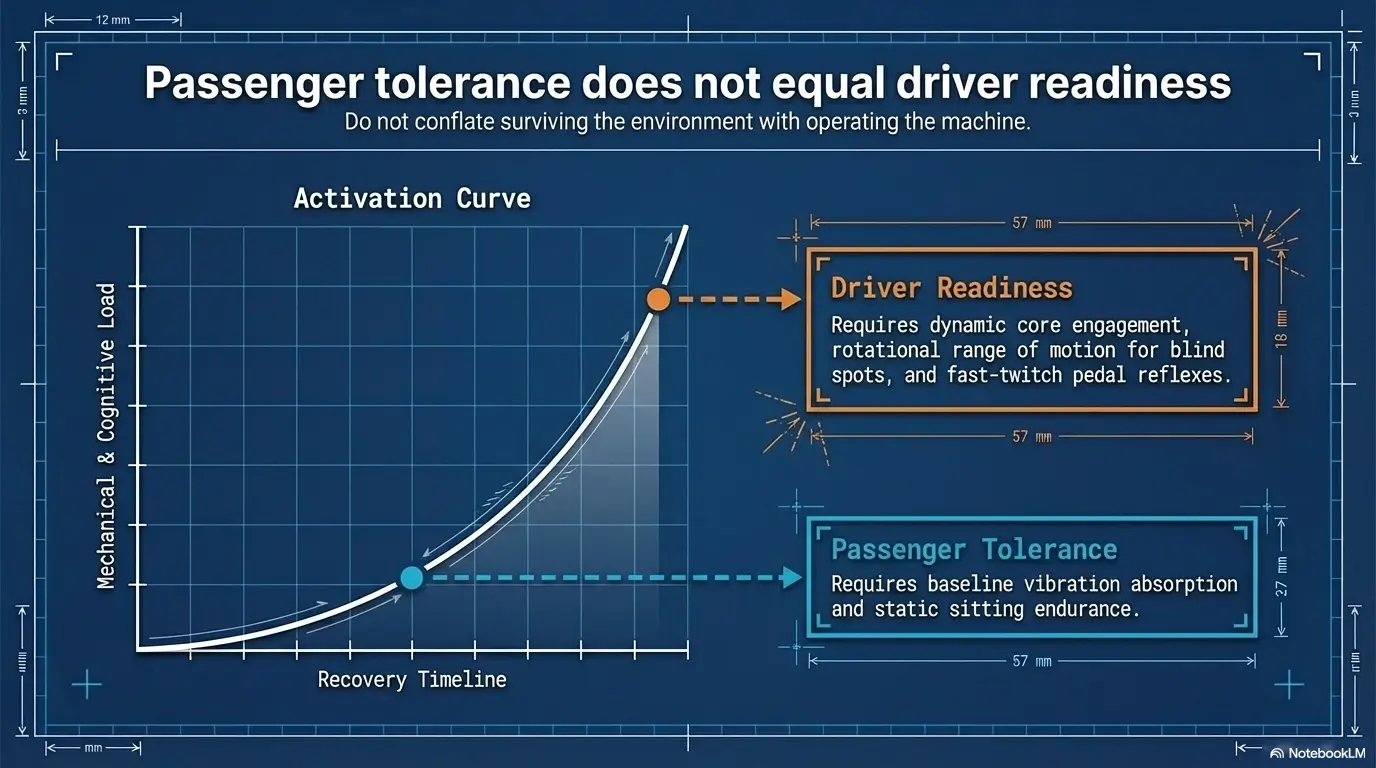
Riding as a passenger and driving are not the same physical demand
As a passenger, you still deal with sitting and vibration. As a driver, you add reaction time, scanning, foot control, emergency braking, and the temptation to twist. They are cousins, not twins.
Reaction time, twisting, and medication effects change the equation
General aftercare instructions commonly say no driving for a period after spine surgery, especially while using pain medication that can impair alertness. MedlinePlus says not to drive for the first two weeks after surgery and to take only short trips after that if the surgeon says it is okay. Alberta guidance says not to drive for 2 to 4 weeks or until your doctor says it is okay. Patients comparing recovery restrictions sometimes also find it useful to see how sitting and driving guidance differs after microdiscectomy versus other spine procedures.
Surgeon clearance matters more than confidence
You can feel subjectively “pretty good” and still not be ready to drive safely. Confidence is lovely. Safe control is better.
The real issue is not bravery, it is control
Can you brake hard? Can you turn without violating restrictions? Can you handle sudden pain while moving the vehicle? If the answer is uncertain, the answer is not yet.
- Driving adds reaction demands
- Sedating medication changes safety
- Clearance matters more than impatience
Apply in 60 seconds: Ask your surgeon’s office for their specific driving criteria instead of relying on a generic timeline.
What a Better Trip Looks Like: A Low-Drama Car Ride Routine
Dress for easy movement and incision comfort
Choose clothing that lets you pivot, stand, and sit without fighting seams, stiff waistbands, or bulky layers. Recovery is not the hour for denim heroism.
Set the seat before leaving, not after pain starts
A surprising number of rides begin with “We’ll adjust once we get going,” which is how small discomfort becomes a fully funded crisis.
Bring only what supports the ride: water, approved cushion, meds if instructed
The goal is not to pack for an expedition. It is to remove avoidable friction. Keep needed items within reach so you do not perform a twist-and-grab routine in traffic.
Plan one purpose per trip instead of turning recovery into a marathon
One appointment. One errand. One clear finish line. That is often the difference between “a bit sore” and “why did I do this to myself.”
Here is a practical routine many people tolerate better:
- Use the bathroom before leaving
- Set seat angle and support in the driveway
- Keep ride duration within your current tolerance window
- Stop before pain spikes if the ride must be longer
- Stand and walk briefly after arrival
- Leave recovery time after getting home
I have seen the biggest difference come not from a magical product but from a quieter philosophy: make the trip smaller than your ego wanted and kinder than your fear expected. That is usually the lane where healing does its best work.
FAQ
How long after lumbar fusion does riding in a car usually hurt?
It varies. Many people find early rides are uncomfortable because sitting tolerance is low and vibration adds irritation. General aftercare instructions often recommend short rides early on and gradual increases, but your exact timeline depends on your procedure and your surgeon’s restrictions.
Is it normal to have more back pain after a short car ride?
It can be normal to feel stiffer or more sore after a short ride, especially early in recovery. What matters is the pattern. If the discomfort settles with rest and resembles your usual post-op soreness, it is often less concerning than pain that is suddenly severe, neurologically different, or paired with fever or wound changes.
What seat position is usually easiest after lumbar fusion?
Usually the easiest position is a neutral, supported posture rather than an extreme recline or a deep slump. A small support may help some people, but too much padding or the wrong seat angle can make things worse.
Should I use ice before or after a car ride?
That depends on your surgeon’s instructions and your healing stage. Some hospital instructions note that ice or warm compresses may help soreness, while other guidance warns not to place heat directly over the incision. Ask what is appropriate for your specific stage.
When can I usually take longer car trips after fusion surgery?
Longer trips are usually introduced gradually, not all at once. Some aftercare guidance suggests avoiding rides longer than 30 minutes at a time for 2 to 4 weeks, with walking breaks if longer travel is unavoidable. Your surgeon may be stricter or more permissive depending on your case.
Can vibration from the road affect lumbar fusion pain?
Yes, many patients find bumps, stop-and-go motion, and vibration aggravate soreness or nerve irritation. It may not mean something dangerous is happening, but it is a real reason car rides can feel worse than a quiet chair at home.
Is passenger travel safer than driving during early recovery?
Usually yes, because driving adds reaction time, braking force, twisting, and medication-safety concerns. But passenger travel can still be difficult, so it should also be paced carefully.
What symptoms after a car ride suggest I should call my surgeon?
Call if pain is suddenly worse than your usual pattern, if you develop fever, wound drainage, new numbness, new weakness, or anything that feels neurologically different. Loss of bowel or bladder control is an emergency.
Next Step
Before your next ride, make one written car-plan: trip length, seat setup, break timing, and red-flag symptoms to watch for
The curiosity loop from the beginning closes here: the car is not always the enemy. Unplanned car travel is. What often feels like mysterious post-fusion suffering turns out to be a solvable stack of timing, posture, vibration, and overconfidence.
So give yourself a fifteen-minute reset before the next ride. Write down the purpose of the trip, your likely sitting limit, where you will stop if needed, what seat setup helped last time, and which symptoms mean you call rather than cope. This is not overthinking. It is recovery with the lights on.
Last reviewed: 2026-03.