
How Much Does Chronic Low Back Pain Really Cost per Year? 7 Shocking Bills I Didn’t See Coming (Medications, PT, Missed Work)
Chronic Low Back Pain Costs • Real-world yearly math
How Much Does Chronic Low Back Pain Really Cost per Year? 7 Shocking Bills I Didn’t See Coming
Chronic low back pain cost per year isn’t one dramatic invoice—it’s a slow, monthly pickpocket. The real shock is how “small” expenses quietly stack until you’re paying twice: once in dollars, once in lost time.
What this guide helps you do fast:
- See the 7 cost buckets that drive most yearly totals.
- Estimate your medications, PT, and missed work in minutes.
- Spot the “try-everything” habits that quietly inflate out-of-pocket spending.
Reality check: If you only count clinic bills, you’re likely missing the everyday costs that creep into your year.
Trust cue: This approach uses simple category tracking and a small estimator so you can make decisions without a spreadsheet spiral.
No fluff. No miracle timelines. Just the real yearly math and the smartest next step.
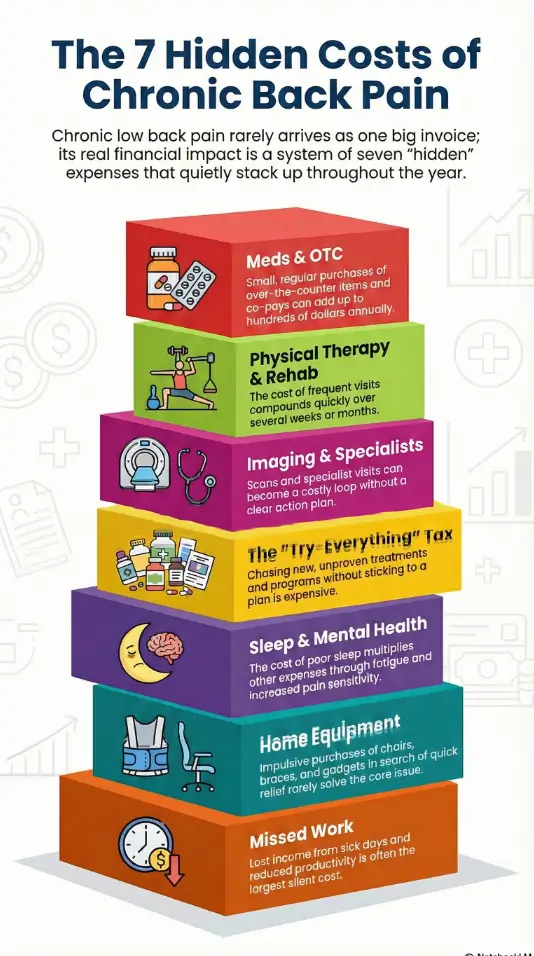
Table of Contents
The 7 bills that add up fast
Chronic low back pain rarely arrives as one dramatic invoice. It shows up like a subscription you didn’t remember signing—then quietly upgrades you to a premium plan.
When I finally added up a full year, the number wasn’t shocking because one line item was huge. It was shocking because seven categories kept multiplying each other. A flare-up triggered extra meds. Extra meds meant a follow-up visit. The visit led to imaging. Imaging led to specialist time. Specialist time led to more PT—or a new gadget promising to “fix everything in 10 minutes a day.”
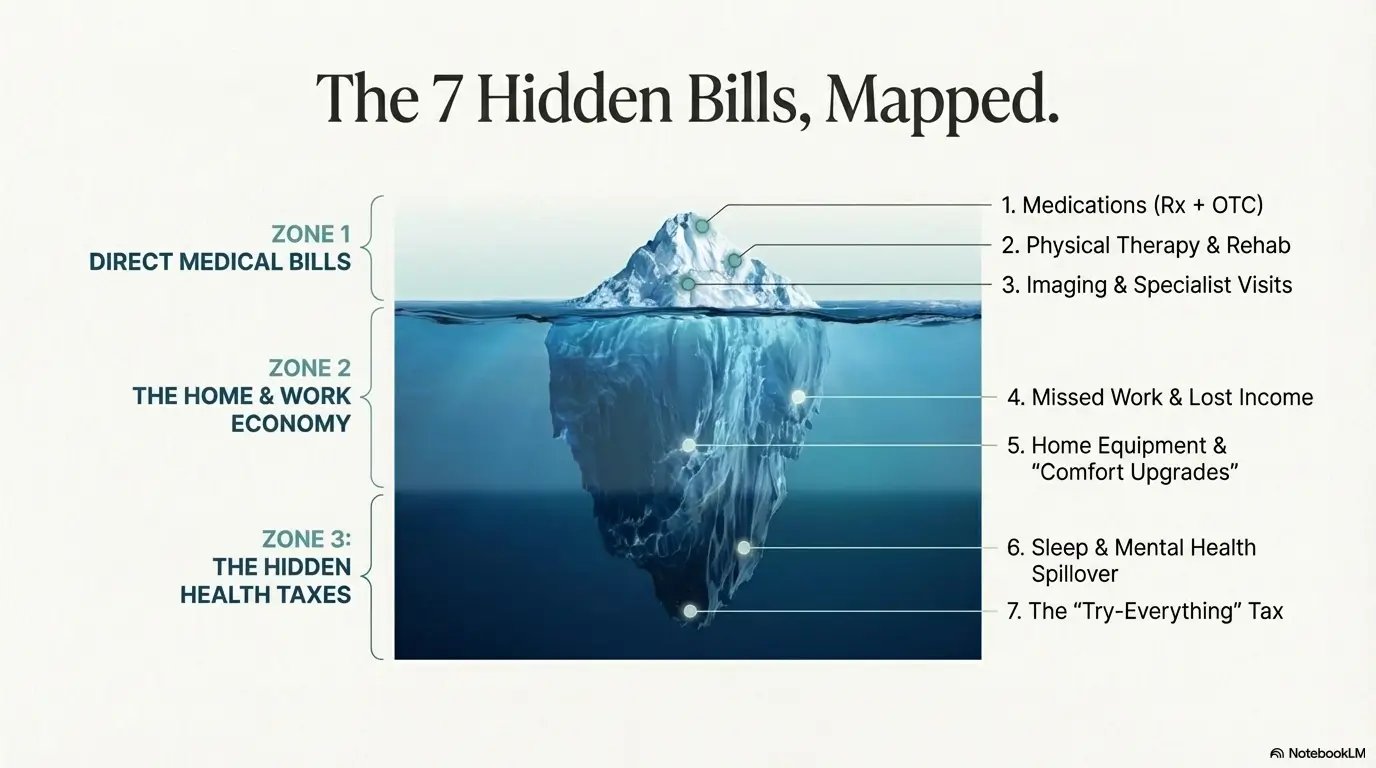
Here are the seven buckets that most people end up paying for:
- Medications (prescription + OTC)
- Physical therapy and rehab
- Imaging and specialist visits
- Missed work and reduced productivity
- Home equipment and “comfort upgrades”
- Sleep and mental health support
- The “try-everything” tax
Quick reality check: if you only track the clinic bills, you’re probably missing 25–50% of the story in everyday spending and lost time.
- Small expenses stack into big totals
- Time loss often rivals medical spending
- Tracking categories beats guessing
Apply in 60 seconds: Start a one-note list with these seven headings and log one week of spending.
Bill #1: Medications (and the one you forget to count)
Most people think of prescription meds first. I did too. Then I remembered the quiet second wallet: over-the-counter pain relievers, topical gels, heat patches, supplements, and the “I’ll just try this once” bottle that becomes a monthly habit.
A realistic annual medication pattern for chronic low back pain can include:
- Daily OTC anti-inflammatories or acetaminophen
- Intermittent muscle relaxants
- Occasional short-term stronger pain meds
- Topical creams and patches
Even if your prescription copay feels manageable, the OTC drift can add hundreds of dollars a year without you noticing. My most embarrassing discovery was paying for the same ingredient in two different products because one was labeled “sports recovery” and the other had a calming lavender vibe.
If you’re using NSAIDs regularly, it’s worth understanding the real-world safety and cost trade-offs of long-term NSAID use before you quietly build your budget around a pill routine that isn’t meant to be forever.
Show me the nerdy details
Medication spending often looks “flat” month to month until a flare-up. A simple way to model this is to track a baseline monthly spend and add a flare-up multiplier for 2–4 months per year. This protects your budget from optimistic denial.
Money Block: Quote-prep list for medication costs
- Your current monthly prescription copays
- Average weekly OTC spend
- How many flare-up months you had last year
- Your insurer’s prior authorization rules (if any) for newer options
Save this list and confirm your current coverage and copays on your insurer’s official page.
Bill #2: Physical therapy and the hidden math of visits
PT is one of the most sensible investments in back pain—until the calendar math sneaks up on you.
Two sessions a week doesn’t sound like much. But over 6–10 weeks, the cost becomes real. Then you add the follow-up round. Then you add a new therapist because your schedule changed. Suddenly you’ve paid for a small used car, but in 45-minute increments.
I’m a fan of good PT. I’m also a fan of not waking up in month eight thinking, “Wait, did I just finance my hamstrings?”
If you want a deeper breakdown of what a smart, modern plan can look like, this chronic low back pain PT roadmap can help you match visit frequency to realistic outcomes.
Money Block: A quick PT fee/visit table (example ranges)
| Pattern | Visits/year | Typical out-of-pocket range | Notes |
|---|---|---|---|
| Short focused course | 8–16 | $200–$1,200 | Often manageable with good home programming |
| Two multi-week courses | 20–36 | $600–$2,500 | Common for recurring flare-ups |
| Ongoing maintenance | 40–60 | $1,200–$4,000+ | Risk of financial fatigue without clear goals |
Download this pattern and confirm your current fee schedule on the provider’s official page.
Personal reality: the best PT plan I ever had was the one that gave me a graduation date and a home routine that didn’t require a PhD in resistance bands.
If you’re weighing providers, a clean comparison of chiropractor vs physical therapy for chronic back pain can help you avoid paying twice for the same basic outcome.
Bill #3: Imaging and specialist visits (when answers cost extra)
Imaging can be essential when red flags or neurologic symptoms appear. But in chronic, non-specific cases, it can also become a costly loop of “just to be sure.”
Common cost drivers include:
- Repeat X-rays or MRIs
- Multiple specialist opinions
- Injection consults
- Follow-up visits to interpret results
I once paid for a scan that basically told me my spine was aging like a normal human spine—just with better vocabulary. The lesson wasn’t “never image.” It was “image with a clear question and a clear next-step plan.”
When the symptom picture gets muddy, understanding the practical differences between lumbar spinal stenosis vs herniated disc can help you ask sharper questions that reduce both wasted appointments and emotional whiplash.
Decision card: When imaging makes financial sense
Choose A: Imaging now
- New weakness, numbness, or bowel/bladder changes
- Significant trauma or systemic illness signs
- Clear plan for how the result changes treatment
Choose B: Time-boxed conservative care first
- Stable symptoms without red flags
- Goal-based PT and self-management plan
- Reassess with your clinician in 4–6 weeks
Save this card and confirm the appropriate pathway with your clinician’s official guidance.
If you’re ever unsure whether you’ve crossed into urgent territory, keep a short reference to low back pain emergency warning signs so you don’t spend money hesitating in the wrong direction.
Bill #4: Missed work and the paycheck you never see
This is the bill people hate counting because it feels personal. But ignoring it doesn’t protect you—it just keeps you blind.
Missed work shows up as:
- Unpaid sick days
- Reduced hours
- Declined promotions or travel assignments
- “Present but not functioning” days
In my worst stretch, I wasn’t absent—I was there, just moving like a haunted coat rack. The productivity loss was real, even if no one wrote me a receipt.
If your hourly or daily rate is clear, this math is straightforward. If you’re salaried, look at the secondary impacts: missed opportunities, delayed projects, or switching roles to reduce physical load.
- Track missed days and “low-output” days
- Consider opportunity costs
- Use the number to guide smarter spending
Apply in 60 seconds: Multiply last month’s flare-up days by your daily value to create a baseline.
Bill #5: The at-home economy: braces, chairs, and mattress regret
Home spending is where chronic pain gets sneaky and emotional. You want relief right now, and Amazon is always open.
Common “comfort investments” include:
- Ergonomic chairs and seat cushions
- Standing desks or converters
- Braces, belts, and posture devices
- Heat pads, massage guns, TENS units
- Mattress swaps and pillow experiments
I’ve owned enough lumbar supports to start a small, financially irresponsible museum. Some were genuinely helpful. Others were expensive hope dressed in nylon.
The trick is to choose items that reinforce good movement rather than replace it. A chair that helps you change positions is more valuable than a gadget that promises to “lock you into perfect posture forever.”
If braces are on your shortlist, a quick read on back braces for lumbar stenosis and when they actually help can keep you from buying three versions of the same idea.
Short Story: The week I tried to buy my way out of pain (120–180 words)
Short Story: I once had a week where my back pain felt like it had hired a PR team. Every ad I saw was a miracle device “used by elite athletes” who, apparently, also shop at 2 a.m. in sweatpants. I bought a new cushion, a heated wrap, and a massage gun with the emotional intensity of someone adopting three rescue dogs in a single afternoon. The cushion was fine. The wrap was actually great.
The massage gun was a little too enthusiastic and briefly turned my glutes into a percussion instrument. The bigger surprise wasn’t the money—it was the realization that I was shopping for certainty. What finally helped was boring: a simple walking target, two core exercises I could do half-asleep, and a plan to reassess in two weeks. I didn’t need more gadgets. I needed a calmer strategy.
Bill #6: Sleep and mental health spillover
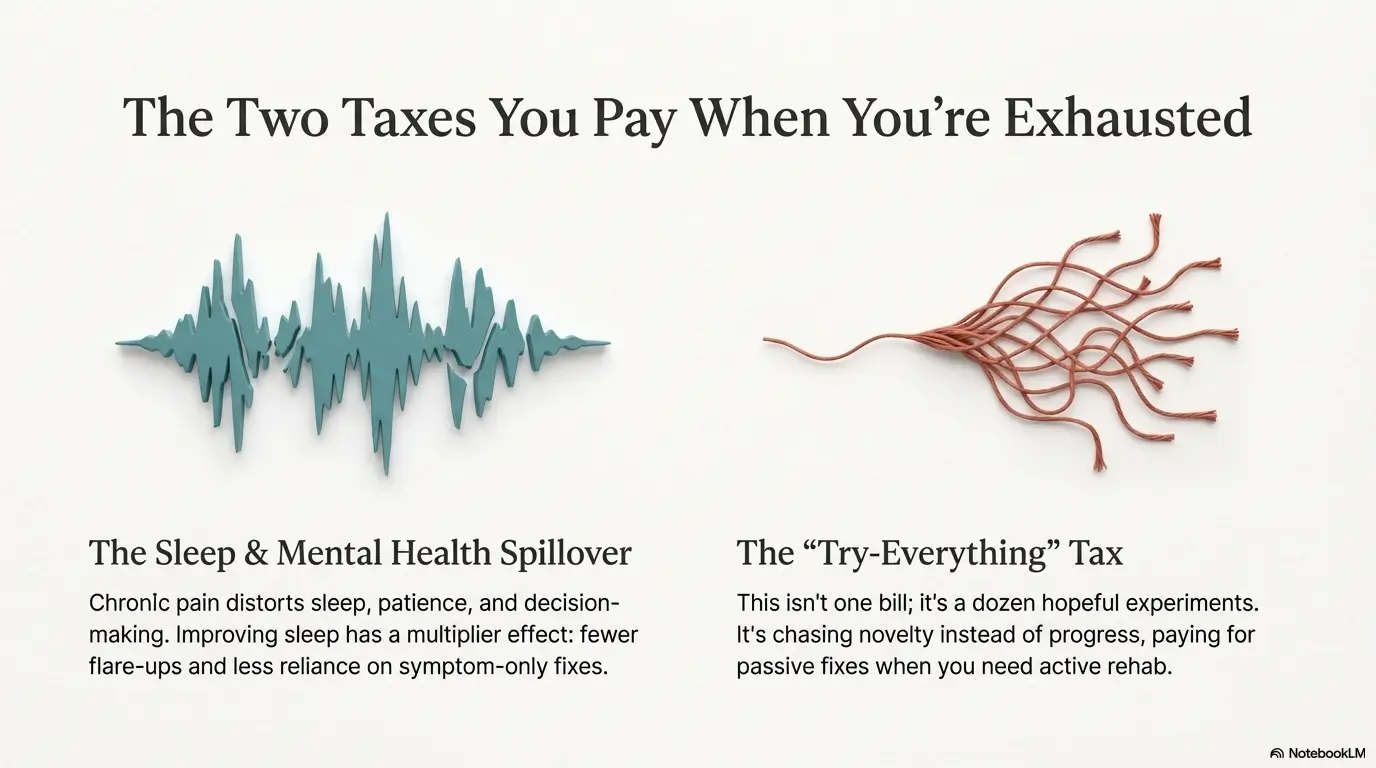
Chronic pain doesn’t just hurt your back. It can distort your sleep, your patience, and your decision-making.
This cost bucket can include:
- Sleep aids or consultations
- Therapy or coaching
- Mind-body programs
- Work performance impacts tied to fatigue
I used to treat sleep as a luxury add-on. Then I noticed the pattern: a bad sleep week made everything else more expensive—more meds, more missed workouts, more “maybe I need another test” spirals.
Show me the nerdy details
Sleep disruption can amplify pain sensitivity and reduce rehab adherence. From a cost perspective, improving sleep often has a multiplier effect: fewer flare-ups, lower reliance on symptom-only fixes, and better work consistency.
Bill #7: The “try-everything” tax (and how to stop paying it)
This is the bill no one sees coming because it’s not one bill—it’s a dozen hopeful experiments.
The try-everything tax looks like:
- Switching providers mid-plan without a clear reason
- Buying multiple programs that duplicate the same basics
- Chasing novelty instead of progress markers
- Paying for passive fixes when you need active rehab
My personal record was three different “final solutions” in one season. The only thing that was final was my credit card statement.
Money Block: Eligibility checklist for a new paid program
- Yes/No: Does it clearly define who it’s for and who should avoid it?
- Yes/No: Does it promise realistic timeframes instead of instant cures?
- Yes/No: Can you explain the mechanism in one sentence?
- Yes/No: Does it include a progression plan, not just a routine?
- Yes/No: Have you tried a consistent 2–4 week basic plan first?
If you answer “no” to two or more, pause and ask for a written outline before you pay. Save this checklist and confirm the program details on the provider’s official page.
A simple annual cost estimator you can use right now
To keep this practical, here’s a tiny calculator that estimates your yearly out-of-pocket pattern based on three levers. It won’t be perfect—but it’s much better than guessing from memory on a bad pain day.
Mini calculator: Estimate your annual costs
This estimator focuses on meds, PT, and missed work—often the biggest three drivers. Add home equipment and specialist costs separately if they apply.
Save this estimate and confirm your current copays and fee schedule on your insurer’s official page.
How to cut cost without gambling your recovery
Lowering your yearly cost isn’t about skipping care. It’s about buying the right care in the right order.
These strategies helped me stop paying for chaos:
- Time-box your experiments. Give a plan 2–4 weeks unless symptoms worsen or red flags appear.
- Ask for a written pathway. “If we do X, what decision does that enable?”
- Prioritize active care. Movement and rehab typically outlast passive fixes in value.
- Track one objective marker. Walking tolerance, sit-to-stand comfort, or sleep hours.
- Bring a “quote-prep” list before comparing coverage tiers or providers.
You can still use insurance language without getting swallowed by it. Ask about coverage tiers, deductibles, and out-of-pocket caps the same way you’d ask about ingredients on a label. Calm, specific, and with your year and plan in mind.
- Time-box treatments
- Measure one simple outcome
- Use written next steps
Apply in 60 seconds: Write one sentence: “If this isn’t better in 3 weeks, we do ___.”
U.S. cost notes (and how to adapt if you live elsewhere)
If you’re reading from the United States, your yearly total often hinges on insurance structure: your deductible, copays, and whether your plan requires prior authorization for extended PT or specialist care. Two people with identical pain can see dramatically different out-of-pocket bills based purely on plan design.
If you’re in the UK, Canada, Australia, or elsewhere with stronger public coverage, your direct medical costs may be lower—but the indirect costs (wait time, private top-ups, missed work, home equipment) can still add up. The same seven categories apply; the proportions simply shift.
Either way, the winning move is the same: track your personal pattern, then invest in the highest-return steps first.
Infographic: The yearly cost map at a glance
Chronic Low Back Pain: The 7-Bucket Year
1) Meds + OTC
Small monthly spend → big annual drift.
2) PT + rehab
Visit math compounds quickly.
3) Imaging + specialists
Best when tied to a clear decision.
4) Missed work
Often the largest silent cost.
5) Home equipment
Comfort upgrades can be smart—or impulsive.
6) Sleep + mental health
Improving sleep reduces several other bills.
7) The try-everything tax
Novelty is expensive without milestones.
Use it: Track these seven lines for 30 days to predict your year with surprising accuracy.
What a smart yearly plan looks like (without heroics)
Once you see the seven buckets, the goal becomes simple: shift spending from panic to plan.
A calm, cost-aware year often includes:
- One focused PT cycle with clear home progression
- Regular low-cost movement (walking, basic strength)
- Fewer emergency visits triggered by uncertainty
- A small, intentional budget for tools that truly help
I’m not pretending this is easy. Pain changes your brain’s math. But you don’t need perfect discipline—you need a repeatable structure.
Entities and coverage language to know (without getting lost)
If you’re navigating U.S. coverage, you may hear terms that sound like a foreign language spoken by very polite robots. The most common entities and frameworks you might encounter include Medicare, Medicaid, and large private carriers such as Blue Cross Blue Shield, UnitedHealthcare, and Aetna. The point isn’t brand loyalty—it’s understanding your plan rules.
Helpful phrases to ask about:
- Deductible and current year status
- Out-of-pocket maximum
- Prior authorization for extended PT or procedures
- Whether your plan has preferred networks for rehab
Eligibility first, quotes second—you’ll save 20–30 minutes by knowing your plan’s rules before you book a surprise bill.
- Ask about authorization early
- Confirm in-network rehab options
- Track your deductible status
Apply in 60 seconds: Write down your plan name, year, and the exact question: “How many PT visits are covered before authorization?”
The best places to spend your next $100
If money is tight, this is the section I wish I had earlier.
From a “return on pain reduction per dollar” perspective, these often outperform flashy fixes:
- A single high-quality PT evaluation focused on a home plan
- Simple walking shoes if your current pair is wrecked
- A reliable heat option you’ll actually use
- A modest upgrade that improves sleep posture
The goal isn’t to shop more. It’s to spend with intent and skip the impulse aisle of the internet.
A 15-minute next-step plan
If you only have a quarter-hour, you can still reduce both pain chaos and money chaos.
- Run the calculator above with your best estimates.
- Circle your top two cost buckets.
- Pick one measurable outcome for the next 2–3 weeks.
- Choose one active intervention and one low-risk comfort support.
- Write a time-box: “I reassess on ___.”
This is boring in the best way. Boring plans keep you from paying expensive panic taxes.
FAQ
1) What’s a realistic yearly cost range for chronic low back pain?
It varies widely by insurance, symptom severity, and how often you need hands-on care. Many people find the biggest drivers are medications, PT frequency, and lost work time. If your numbers feel foggy, use the mini estimator and then add a rough line for home equipment and specialist visits. Apply in 60 seconds: Estimate your monthly meds spend, multiply by 12, and add last year’s PT count.
2) Does physical therapy really save money long-term?
Often, yes—when it’s goal-based and paired with a simple home program. The cost risk comes from endless visits without a progression plan. Ask for a “graduation path” and milestones. Apply in 60 seconds: Ask your therapist to define your next measurable target and the expected number of visits.
3) When should I pay for imaging?
Imaging makes the most sense when you have new neurologic symptoms, red flags, or a clear decision that hinges on the result. For stable, non-specific pain, a time-boxed conservative plan is often the first move. Apply in 60 seconds: Write your question before the scan: “What treatment decision will this change?”
4) How do I stop the ‘try-everything’ spending spiral?
Create one short experiment rule: no new paid program until you’ve followed one basic plan consistently for 2–4 weeks. Novelty feels productive, but consistency is cheaper and usually more effective. Apply in 60 seconds: Set a reassessment date on your calendar and commit to one plan until then.
5) What if my insurance keeps denying PT or procedures?
Ask for the exact reason, whether prior authorization is required, and what documentation they need from your clinician. A short, written plan with measurable goals often helps. Apply in 60 seconds: Request a written summary from your provider that lists functional limits and improvement targets.
6) Is a standing desk worth it?
It can be—if it helps you change positions and reduces long sitting blocks. The best setups support movement variety. Apply in 60 seconds: Try a low-cost desk converter first before committing to a full upgrade.
Conclusion
The honest answer to “How much does chronic low back pain really cost per year?” is that the number isn’t just medical—it’s behavioral, logistical, and emotional. The seven bills I didn’t see coming weren’t a punishment. They were a map of where my strategy was missing.
You don’t need to become a full-time health economist to regain control. You just need a short list, a basic estimate, and one decision rule that prevents panic spending.
Your next 15-minute win: run the estimator, identify your top two cost buckets, and draft a time-boxed plan for the next 3 weeks. Then ask one clean question at your next appointment: “What’s the simplest path that reduces both my pain and my spending this quarter?”
If your situation is starting to edge toward procedures, it can help to understand the real-world fork between lumbar fusion vs decompression so you can ask cost-and-outcome questions early rather than late.
Last reviewed: 2025-12; sources: WHO low back pain fact sheet, CDC pain prevalence brief, VA/DoD guideline.