
Beyond the “Perfect” Pillow: Solving Sciatica While You Sleep
At 3:07 a.m., the pillow that felt “perfect” at bedtime can quietly flatten—and your pelvis goes right back to freelancing. That’s why most sciatica sleep advice fails: it treats pillows like magic objects instead of guardrails against one specific drift.
If you’re a side sleeper waking up with sciatica and hip pain, the real question in knee pillow vs. body pillow isn’t brand or price. It’s mechanism: are you getting flared by knee collapse and hip rotation, or by whole-body drift into a half-stomach twist?
This post gives you a proof-first way to choose—using a 60-second bed test with towels and regular pillows—so you buy the setup that actually changes your alignment and survives overnight compression.
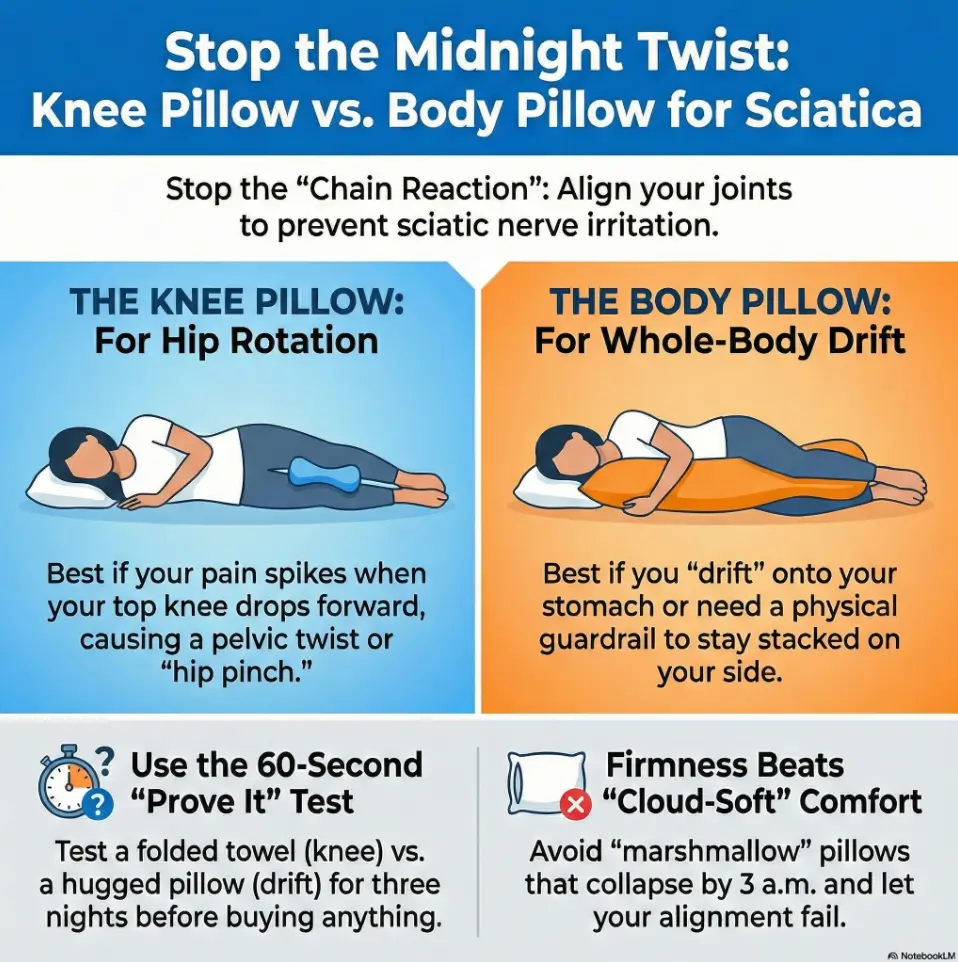
Fast Answer (snippet-ready): For most side sleepers with sciatica and hip pain, a knee pillow is the simplest fix: it keeps the top knee from collapsing inward and reduces pelvic twist. Choose a body pillow when you also need upper-body support (shoulder, ribcage, belly, or arm positioning) or you keep rolling forward at night. The best choice depends on one thing: whether your pain is driven more by hip rotation or whole-body drift.
Table of Contents
1) Quick pick guide: knee pillow or body pillow?
If you’re time-poor and purchase-intent (translation: you want to solve this before bedtime), here’s the honest shortcut: a knee pillow fixes leg alignment. a body pillow fixes you drifting into a twist.
Knee pillow wins if…
- Your pain spikes when your top knee drops forward or inward.
- You wake with a hip pinch (front/side) or that “low-back pull” feeling.
- You want a compact, low-fuss setup that stays put.
Body pillow wins if…
- You already hug a pillow or you roll forward into a half-stomach position.
- You need shoulder/upper-back comfort to stay on your side.
- You’re pregnant/postpartum or your torso weight shifts your alignment at night.
The “two-pillow” scenario (when both is smartest)
- Body pillow for arms/torso + small knee pillow for precise leg spacing.
Personal note: I used to think my issue was “my hips.” It wasn’t. It was my habit of rolling forward at 3 a.m. The night I blocked that roll, the “mysterious” morning pain got… less mysterious.
- Knee pillow = stops inward knee drop and pelvic twist.
- Body pillow = gives your arms/torso a “rail” so you don’t rotate forward.
- Both = when you need leg precision and upper-body stability.
Apply in 60 seconds: Tonight, pick one setup and test it for 3 nights before upgrading anything.
Neutral action line: Make the decision with a one-night test (Section 5) before you spend money.
2) The real culprit: hip rotation vs pelvic twist
Most “sciatica pillow advice” skips the real mechanism: your symptoms aren’t usually about the pillow. They’re about what the pillow prevents while you’re unconscious and floppy.
The alignment chain that triggers symptoms
Think of it like a chain reaction: knee angle → femur rotation → pelvis tilt → lumbar tension → sciatic irritation pattern. You don’t have to memorize anatomy—just accept that one joint drifting can yank the next one.
Simple self-check: “knee-drop” tells the story
Lie on your side in your usual position (yes, the messy one). Now gently lift your top knee an inch and let it fall. If it flops inward easily, you’re likely getting pulled into rotation all night. That’s when knee spacing usually pays off first.
What the pain location hints at (without pretending it’s a diagnosis)
- Outer hip (tender on the side, “bruise-y” vibe): often needs neutral hip and reduced pressure.
- Deep buttock/leg line (classic “sciatica-style” track): often needs less twist and a steadier pelvis.
Here’s the trustworthy, non-dramatic truth: major medical sources describe sciatica as pain that follows the path of the sciatic nerve down the leg, and orthopedic guidance emphasizes it’s a broad symptom label—often tied to nerve root compression from something like a herniated disk or stenosis. That matters because your pillow isn’t “treating a diagnosis.” It’s reducing the nightly mechanical aggravation. (If you’re sorting the bigger picture, it can help to understand sciatica vs. herniated disc so the “pillow solution” stays in its proper lane.)
Show me the nerdy details
Rotation is the sneaky villain. When your top thigh rotates inward (often because the knee drifts forward), your pelvis can follow, and your lumbar spine may respond with a small twist or arch. For some bodies, that’s enough to flare nerve sensitivity by morning—especially if you also have a softer mattress that lets the hip sink deeper than the ribcage.
Personal note: I once blamed my “bad back” for weeks until I realized my knee was basically trying to meet the mattress in front of me every night. My pelvis just… followed.
3) Knee pillow mechanics: what it fixes (and what it can’t)
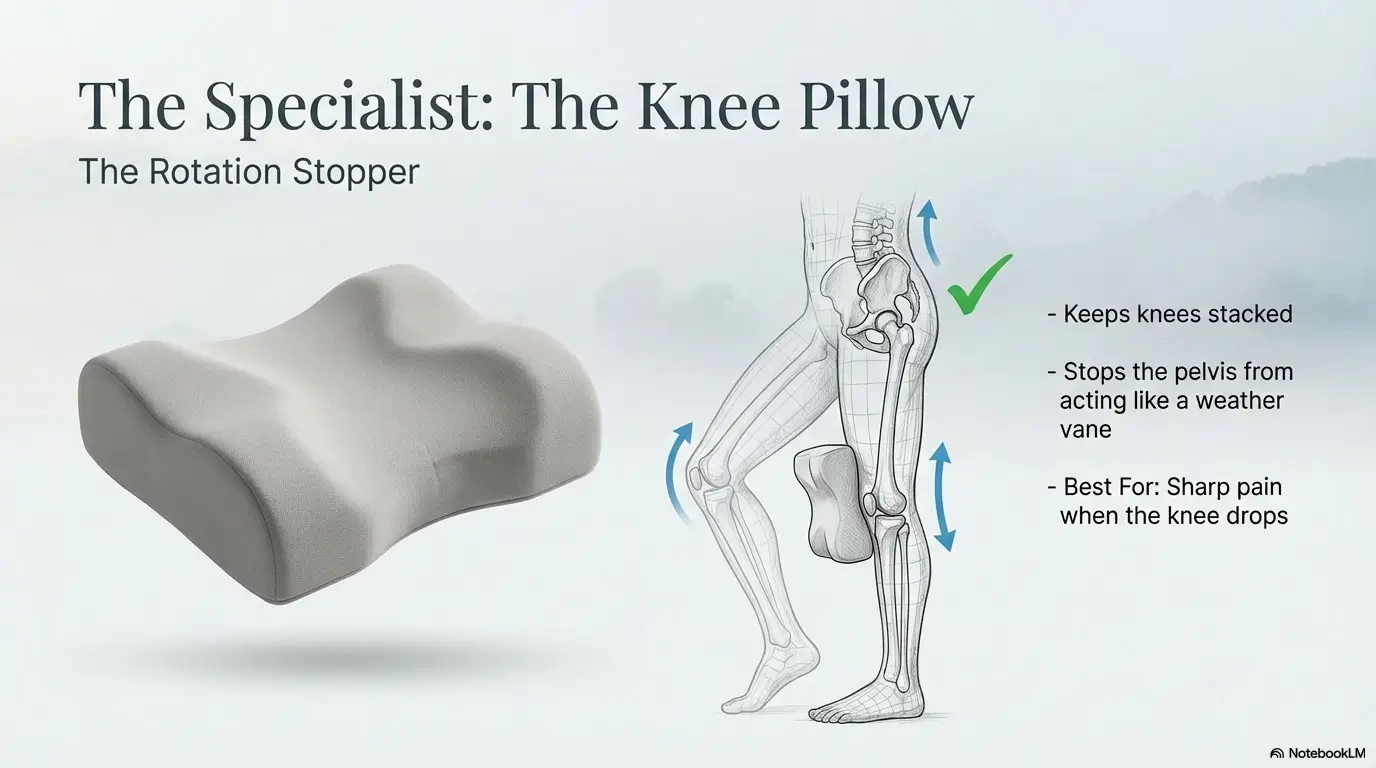
A knee pillow is a specialist. It doesn’t do everything—but what it does, it does cleanly: it keeps your legs from turning your pelvis into a weather vane.
What it stabilizes
- Keeps knees stacked
- Reduces inward collapse
- Steadies pelvic rotation (less twist = less “morning ache” for many people)
What it doesn’t solve
- Upper-body drift and forward roll
- Shoulder pinch or neck angle problems
- A mattress that caves like a hammock (we’ll talk about this, because yes, it matters)
Size + firmness: the “Goldilocks” spec for side sleepers
Knee pillow shopping fails for three predictable reasons:
- Too thick → hips widen, low back arches, front-hip gets cranky.
- Too thin → knee still drops, alignment fails quietly (you wake up confused).
- Too soft → compresses to nothing by 3 a.m. (the “it felt great at bedtime” trap).
Personal note: my worst night came from a knee pillow that felt luxurious—until it flattened. Morning pain wasn’t louder. It was simply… back.
Show me the nerdy details
Thickness isn’t about your height—it’s about the space your pelvis creates when you side-sleep. Wider hips can mean you need more spacing, but “more” isn’t always better. The goal is neutral stacking, not forced separation. If your pelvis feels like it’s being pried open, it probably is.
- If you feel low-back arching, the pillow is likely too thick.
- If your top knee still collapses forward, it’s likely too thin or too soft.
- Stability beats “cloud-soft” comfort at bedtime.
Apply in 60 seconds: Fold a towel to roughly 2–4 inches thick and test it—then adjust thickness up/down by one fold.
Neutral action line: Record your “best thickness” from the towel test before buying.
4) Body pillow mechanics: the “whole-body guardrail”
Body pillows work when your problem isn’t just your knees—it’s your whole body drifting. They give your arms and torso an address, so your hips stop freelancing.
Why body pillows feel magical for some people
- Gives arms a home → stops torso from twisting forward.
- Creates a stable “rail” for ribs and hips to stay stacked.
- Helps you stay in a true side position instead of sliding into a half-stomach compromise.
Shape options that matter (and who each one actually fits)
- Straight: simplest; best if you mainly need something to hug + leg contact.
- J-shaped: helpful if you want extra head/neck curve plus body support.
- U-shaped: popular for pregnancy or people who flip sides and want support both ways—but can be bulky and hot.
Here’s what no one tells you…
Many “sciatica wins” from body pillows are really anti-roll wins. You didn’t “cure” anything—you simply stopped rotating into the position that pokes the bear.
A recent Cleveland Clinic sleep-focused explainer specifically mentions using pillows strategically for sciatica comfort, including a pillow between the knees for hip alignment and a pillow behind the back to keep you from rolling—plus it calls out that regular pillows can work, and that body pillows can be useful because they stay in place. That’s the kind of advice that’s boring in the best way: practical, not mystical. (If you want a broader map of positions, see how to sleep with sciatica for the bigger setup picture.)
Show me the nerdy details
The body pillow “rail” works by changing your center of mass. When your top shoulder and arm have support, your torso doesn’t tip forward as easily. Less forward tip often means less hip rotation, because the pelvis tends to follow the ribcage. It’s a chain reaction—this time in your favor.
Personal note: I resisted body pillows because they felt “extra.” Then I used one for a week during a flare and realized it wasn’t extra—it was a physical reminder to stop doing the midnight twist. 💡 Read the official Knee Pillow vs Body Pillow for Sciatica (Side Sleepers With Hip Pain): What Actually Helps guidance
5) The 60-second bed test: choose with one night of proof
This is the part that saves you money and regret. Don’t buy first. Prove first. You can run both tests tonight with pillows you already own.
Test A: “Stacked knees” experiment (knee pillow trial)
- Use any firm pillow or folded towel between your knees.
- Aim for knees aligned and ankles not wildly separated.
- Notice: do you feel your pelvis “untwist” within 2–3 minutes?
Test B: “Anti-roll rail” experiment (body pillow trial)
- Hug a long pillow and place it from chest to knees.
- Add a small pillow behind your back if you keep tipping forward.
- Notice: do you stay side-locked instead of drifting forward?
Decision rule (easy)
- If Test A reduces pain more → knee pillow first.
- If Test B keeps you from rolling/twisting → body pillow first.
Personal note: The first time I ran this, I learned something embarrassing: my “hip pain” wasn’t from hip pressure alone—it was from waking up half-stomach like a confused croissant.
- Comfort at bedtime doesn’t count if it collapses by 3 a.m.
- Pick the setup that prevents your most common drift.
- One variable at a time makes the result trustworthy.
Apply in 60 seconds: Take a quick phone note tomorrow morning: pain score (0–10) + where it showed up.
Neutral action line: Run both tests once, then commit to the better one for 3 nights before buying.
6) Don’t buy this: pillow traps that backfire
Buying the wrong pillow doesn’t just waste money—it wastes sleep. Here are the common traps that quietly make alignment worse.
Trap 1: Too-thick knee pillow (creates hip spread)
Signs you went too thick:
- Low-back tightness in the morning
- Front-hip strain or groin discomfort
- A feeling like your pelvis is being pulled open
Trap 2: Ultra-soft body pillow (collapses into a twist)
Signs your body pillow is “a marshmallow with a cover”:
- You wake half-stomach with legs tangled
- Hip pain unchanged (or sneakily worse)
- Your shoulder falls forward because the pillow flattens
Trap 3: Wrong height “because it looked ergonomic”
Comfort marketing is not the same as alignment outcome. If the pillow forces your hips into a new position rather than supporting neutral, it’s not “ergonomic.” It’s just persuasive.
Personal note: I once bought a “designed by experts” pillow that made me feel like I was sleeping in a hip abduction machine. My body did not applaud.
- Too thick = new pain in new places.
- Too soft = your old twist returns after you fall asleep.
- “Ergonomic” should be proven by morning results, not product photos.
Apply in 60 seconds: If you wake with a new pain pattern, revert to a folded towel for two nights and retest thickness.
Neutral action line: If a pillow creates a new pain location, treat it as a mismatch, not a “break-in period.”
7) Common mistakes (and the fixes that actually stick)
You can do everything “right” and still lose if one small detail is off. These are the sticky fixes—the ones that survive real sleep.
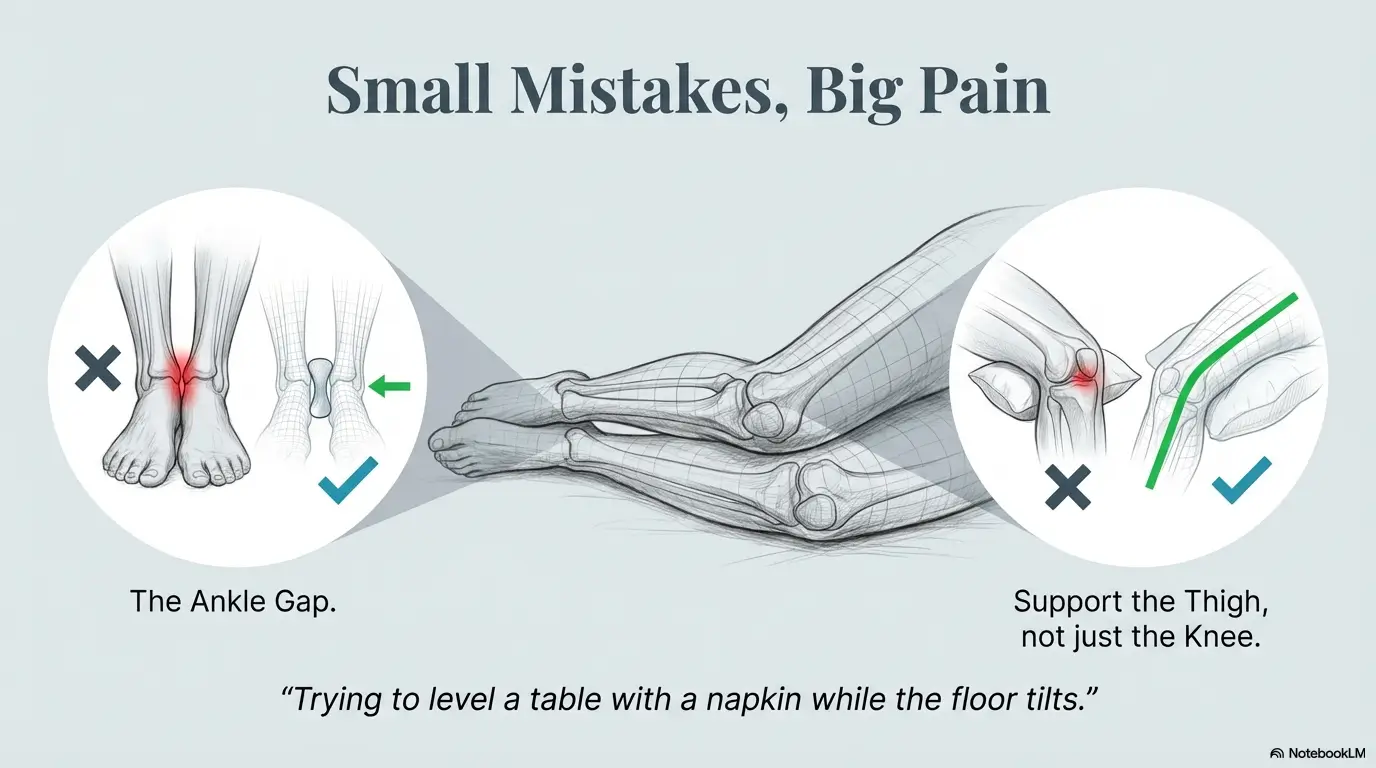
Mistake: only supporting the knees, ignoring ankles
If your knees are stacked but your ankles are in different zip codes, your femur can still rotate.
- Fix: Keep ankles roughly stacked too, or add a small ankle spacer (a rolled washcloth works).
Mistake: placing the knee pillow at the knees only
Many people place the pillow too low, so the thigh still rotates.
- Fix: Position it so it supports mid-thigh to knee for better femur control.
Mistake: hip pain from pressure, not alignment
Sometimes the hip just hurts because it’s taking load for hours. Alignment helps, but pressure relief may be the real lever.
- Fix: Consider a softer topper or a mattress adjustment; alignment can’t fully outvote pressure.
Let’s be honest…
If your mattress caves, you’re asking a pillow to do a foundation’s job. That’s like trying to level a table with a napkin while the floor tilts. (If you suspect this is the hidden culprit, start with mattress firmness for sciatica before you keep buying “better” pillows.)
Personal note: My biggest improvement came when I stopped treating pillows as “the solution” and started treating them as tools inside a system: mattress + pillow + habit.
Short Story: I once did the classic thing: bought a new pillow at 11 p.m. because the reviews promised “instant alignment.” It felt amazing for eight minutes. Then I fell asleep, rolled forward, and woke up at 4:12 a.m. with that familiar zing—like my body was sending a late invoice.
Instead of doom-scrolling, I tried something embarrassingly basic: I shoved a regular pillow behind my back as a “rail,” and I folded a towel between my knees. It wasn’t glamorous. It was just… stable. The next morning, the pain wasn’t gone, but it was quieter—and I realized what I’d been missing: my problem wasn’t only hip spacing. It was the nightly drift into a twist. The fix wasn’t buying a perfect object. It was preventing one specific motion.
8) Who this is for / not for
This article is about comfort + alignment support, not medical treatment. If that’s what you’re here for, you’re in the right place. If you need urgent care, I’ll be direct about that too.
For you if…
- Side sleeping is your default (or you’re trying to make it stick).
- You have sciatica-like symptoms plus hip pain that worsens with twisting.
- You want a simple, reversible setup before bigger changes.
Not for you if…
- Pain is severe, rapidly worsening, or comes with numbness/weakness that’s progressing.
- You have bowel or bladder control changes, or sudden significant leg weakness.
- You can’t tolerate side sleeping at all—you may need a different sleep position plan.
Major medical guidance commonly flags certain symptoms (like new weakness or bowel/bladder changes) as reasons to seek urgent evaluation. Pillows are great, but they’re not emergency tools. If you’re unsure where the line is, bookmark low back pain emergency signs so you’re not relying on late-night guesswork.
Personal note: I’m a big fan of “try the simple reversible thing first.” I’m also a big fan of not ignoring red flags because a product page said “relief.”
9) Buying specs that matter (not the hype)
If you’ve proven which pillow type works (Section 5), you’re ready to buy based on specs that predict success. This is where you avoid paying for fluff.
Knee pillow checklist
- Thickness: enough to prevent knee drop, not so much that your hips feel forced apart.
- Firmness: supportive foam that doesn’t flatten overnight.
- Shape: contoured can help it stay between knees; simple rectangular can work if it’s stable.
- Strap vs no strap: straps help restless sleepers; some people find straps annoying or too warm.
Body pillow checklist
- Length: shoulder-to-knee coverage minimum (so your torso and legs both get contact).
- Fill: supportive enough to resist collapse; adjustable fill is useful if you’re picky.
- Heat management: breathable cover + washable case matters more than “cooling” claims.
Budget tiers without regret
Honest ranges (because your goal is a better morning, not a luxury identity):
- Under $30: trial and learn (great for testing thickness/shape).
- Midrange: more consistent support and better durability.
- Premium: materials and longevity—worth it only if your test already proved the concept.
- Budget pillows are fine if they hold shape overnight.
- Midrange is the sweet spot if you’re replacing “collapsed support.”
- Premium only makes sense after your one-night test proves the setup works.
Apply in 60 seconds: Press the pillow with your palm for 10 seconds—if it rebounds slowly but fully, it’s more likely to stay supportive.
Neutral action line: Choose the tier based on how well your test setup worked, not on brand prestige. 💡 Read the official sciatica symptoms and causes guidance
FAQ
1) Is a knee pillow or body pillow better for sciatica when side sleeping?
If your main issue is your top knee collapsing forward/inward, start with a knee pillow. If you keep rolling forward (half-stomach) or your shoulders/arms need support to stay side-locked, a body pillow often works better. The fastest way to know is the one-night proof test in Section 5.
2) Where exactly should a knee pillow go for sciatica and hip pain?
Aim for contact from mid-thigh to knee, not just the kneecaps. That placement helps control femur rotation. Then check your ankles—if they drift far apart, add a small spacer or adjust thickness.
3) Can a body pillow make sciatica worse if it’s too soft?
Yes. If the pillow collapses, you can still rotate forward and twist your pelvis—sometimes even more because you think you’re “supported.” If you wake up half-stomach with tangled legs, your body pillow is likely too soft or too low-volume.
4) Should I put a pillow between my knees or my thighs?
For many side sleepers, between the thighs (mid-thigh down to the knees) controls rotation better than a small spacer only at the knees. The goal is to keep the whole top leg from rotating inward, not just to separate the knees.
5) What thickness knee pillow is best if my hips hurt on my side?
There’s no universal number because hip width, mattress firmness, and sleep posture differ. Use a folded towel first. If you feel your low back arch or your groin/front-hip strain, reduce thickness. If the knee still drops forward, add a fold or choose a firmer pillow.
6) Do I need a knee pillow if I already hug a body pillow?
Sometimes yes. A body pillow can stabilize your torso while your top leg still rotates inward. If you wake with hip pinch or feel your knees don’t stay stacked, adding a small knee spacer can be the missing piece.
7) Is it better to sleep with a pillow between knees and ankles too?
If your ankles drift far apart, yes—ankle support can reduce lower-leg rotation and help keep the entire leg aligned. You don’t need a second full pillow; a rolled washcloth can be enough.
8) Can sleeping on the “wrong side” worsen sciatica symptoms?
Some people feel better lying on the side opposite their pain, while others prefer the painful side because it reduces nerve tension for them. The key is not the “correct side” but whether your pelvis stays neutral and you avoid twisting into a forward roll.
9) What if hip pain is from pressure on the side—will a pillow help?
A pillow can reduce twisting and make pressure more tolerable, but it can’t fully solve a pressure problem if the mattress is too firm (or too soft in the wrong way). If the outer hip feels bruised, consider pressure relief (topper, mattress adjustment) alongside alignment.
10) How long should I test a new pillow setup before deciding?
Give it 3 nights if you’re making a single, controlled change. Night one can be “novelty,” and night two is often the real signal. If you get new, sharp pain or red-flag symptoms, stop and reassess rather than pushing through.
11) Next step: one concrete action
If you do nothing else, do this: run the 60-second bed test tonight, then commit to one setup for three nights. Not both. Not five variables. One.
Do this tonight
- Run Test A and Test B from Section 5 using pillows you already own.
- Pick the winner and set it up before you fall asleep.
- Tomorrow morning, jot down: pain score (0–10), where it showed up, and whether you rolled forward.
- Yes: You notice less twist, fewer wake-ups, or a lower pain score.
- Maybe: It feels good at bedtime but fails by morning (adjust thickness/firmness).
- No: New pain appears or symptoms worsen (revert and reassess).
Apply in 60 seconds: Take one photo of your setup before sleep so you can replicate the “good night” later.
Neutral action line: Treat your first three nights like a trial—collect quick notes and keep what works. (If your brain spirals into “what if it’s something worse,” you’re not alone—this is where cyberchondria and chronic pain can quietly steal your sleep.) 💡 Read the official low back pain sleep positioning guidance
Conclusion
Let’s close the loop from the beginning: the “rent” you pay to your mattress isn’t inevitable. But it’s also not solved by buying the prettiest pillow on the internet. It’s solved by stopping the one motion that keeps showing up at night: knee collapse or forward drift into a twist.
If your pain is mostly driven by hip rotation, a knee pillow is often the cleanest, simplest fix. If your body keeps wandering forward, a body pillow becomes a guardrail—and the guardrail is the point. Either way, your most powerful move is still the same: prove it tonight with the one-night test, then upgrade only the winning category. (And if your next question is “okay, what else should I do beyond pillows?”—start with physical therapy for sciatica as a grounded next-step framework.)
- Your top knee drops forward/inward.
- You wake with hip pinch or low-back pull.
- You want compact, consistent support.
- You roll forward into half-stomach.
- Your shoulders/arms need a “home.”
- You need a rail to stay side-locked.
- Body drift + knee collapse both show up.
- You need torso stability and leg precision.
- Your “best night” uses two supports.
Here’s your 15-minute next step: set up the winner, take a quick photo, and write one line tomorrow morning (“pain score + location + did I roll?”). That tiny log turns this from guesswork into a repeatable system.
Last reviewed: 2026-01.