

Fast Answer (snippet-ready):
If your sciatica is worst only in the morning, the first minutes after waking can be a sensitive window where stiffness + sudden standing ramps symptoms. A gentle 5-minute, in-bed nerve glide (“slider”) routine can reduce that “first-stand flare” by helping the nerve move smoothly—not by stretching hard. Keep reps low, range small, and stop if pain spikes, numbness increases, or symptoms travel farther down the leg.
The Morning Sciatica “Cruel Trick”: Winning Your First Ten Steps
Morning sciatica has a cruel little trick: you can wake up feeling almost normal—then the first attempt to stand turns your leg into an electric warning label. It’s not always that “movement is bad.” Often it’s the transition—overnight stiffness plus sudden load—hitting a sensitive system all at once.
Keep guessing and you pay for it in the same currency every morning: rushed steps, bracing, and a flare that can steal the first hour of your day.
This guide provides a five-minute “before you stand up” ramp you can do in bed—no equipment, no hero stretching—plus stop rules, a slider vs micro-range decision, and the roll-to-sit-to-stand technique that quietly triggers a lot of morning-only flares.
A sciatic nerve glide (often called a “slider”) is a gentle back-and-forth motion that helps the nerve move smoothly without hard end-range stretching; one end “gives” while the other “takes,” keeping tension low.
Built like a tiny experiment: small range, low reps, and a simple yes/no tracker (symptom travel).
Table of Contents
Safety / Disclaimer
This article is educational, not a diagnosis or a substitute for personal medical care. Sciatica is a symptom pattern—often nerve-root irritation—rather than a single “one-size” condition. Reputable medical references describe sciatica as leg symptoms (pain, tingling, numbness, weakness) related to sciatic nerve involvement. If you’re unsure what you’re dealing with, treat this routine as a gentle test, not a cure. (If you’re still sorting out what “counts” as sciatica, this comparison can help: sciatica vs herniated disc.)
Red-flag checklist (don’t DIY this part):
- New or worsening leg weakness (foot drop, knee buckling, can’t heel-raise)
- New numbness in the saddle area, or new bladder/bowel changes
- Severe pain after a fall/trauma, fever, unexplained weight loss, or cancer history
- Pain that is rapidly escalating day-to-day, or symptoms that keep traveling farther down the leg
Neutral next step: If any item fits, seek urgent evaluation rather than trying to “work through it.”
Stop rules (non-negotiable)
- Stop if pain spikes sharply, numbness increases, or symptoms “run” farther down the leg.
- Stop if you feel nerve-like burning/electric pain that ramps with each rep.
- Stop if the routine changes your symptoms for the worse for more than 30–60 minutes afterward.
“Gentle” definition: what you should feel vs shouldn’t
Gentle means easy motion and low effort. Think: “I could do this while listening to a sleepy podcast.” You might feel a mild, temporary stretch-like sensation or a light tingle that does not intensify. You should not feel sharp pain, escalating burning, or a “zip” that shoots farther down the leg. Many NHS-style exercise leaflets for nerve sliders emphasize that you should not feel pain during the movement—take that seriously.
Medical note: not a diagnosis; consider professional guidance if worsening
If you’re dealing with recurrent morning sciatica, consider a clinician or PT assessment—especially if the pattern is changing. Organizations like MedlinePlus, Mayo Clinic, and AAOS describe multiple causes (disc, bone changes, spinal narrowing, etc.), and management depends on what’s driving your symptoms. If you’re deciding between “try PT” vs “keep guessing,” this overview may help frame it: physical therapy for sciatica.
- Small range beats big range.
- Fewer reps beats more reps.
- Farther-down symptoms mean back off.
Apply in 60 seconds: Before you start, decide: “If anything gets worse, I stop. No bargaining.”
When to seek help
Here’s the honest truth: some problems are not “fixable” by a morning routine, and forcing it can turn a manageable flare into a multi-day setback. I learned this the hard way once—kept adding reps because it “sort of helped,” then spent the next two days walking like a folding chair. Let’s not do that.
Decision tree: urgent vs soon vs self-care
- Urgent evaluation: red flags (new weakness, bladder/bowel changes, saddle numbness, trauma, fever).
- Book-soon (days–weeks): symptoms persist beyond a few weeks, keep recurring, or gradually spread farther down the leg.
- Self-care window: morning flare that calms with gentle motion and does not worsen overall trend.
Neutral next step: If you’re on the fence, choose “book-soon.” It’s cheaper than guessing wrong.
Urgent red flags (ER/urgent evaluation)
Don’t wait if you have signs of significant nerve compromise or systemic illness. In plain terms: if you’re losing function, losing sensation in critical areas, or your body is sending broader alarm signals, this is not a “stretch it out” situation. If you’re unsure what qualifies as an emergency, keep this reference handy: low back pain emergency signs.
Book-soon signs (PT/clinician check-in)
- Morning-only becomes morning + daytime.
- Symptoms start traveling below the knee more often, or into the foot.
- You’re building a “life workaround” (avoiding stairs, avoiding sitting, avoiding driving) and it’s shrinking your world.
- You can’t find any position that reliably calms symptoms.
If you’re pregnant / post-surgery / have osteoporosis or new trauma (extra caution)
These contexts change your risk profile. If any apply, keep the routine ultra-gentle and treat professional guidance as the default.
Morning-only sciatica
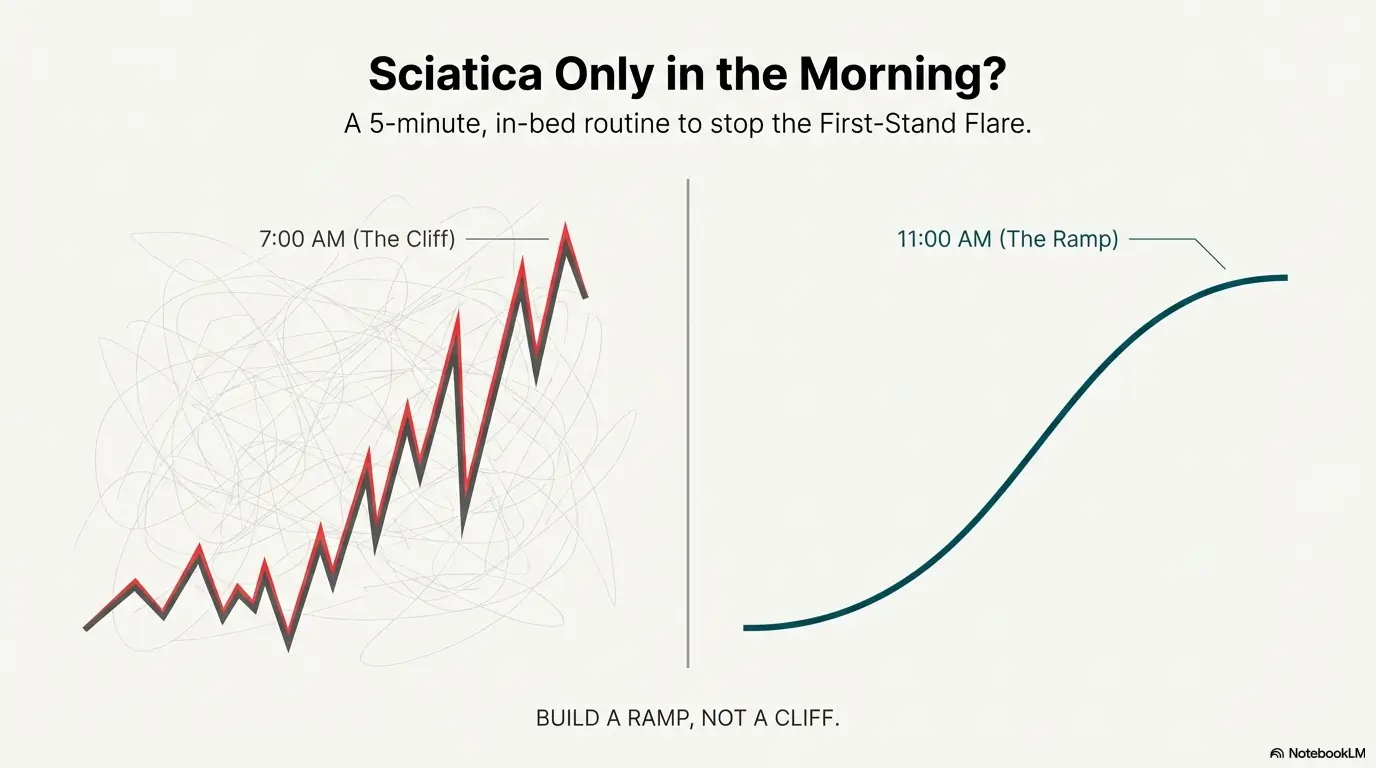
Morning-only sciatica often feels unfair because it’s timeboxed: you suffer, then you’re fine by noon. But that “fades later” detail is useful. It suggests your system may be sensitive to stiffness + sudden load, not simply “movement is bad.” Many people describe the trigger as the transition: bed → standing → first steps. (If you want a plain-English map of what sciatic nerve symptoms can feel like, start here: sciatica nerve pain.)
1-minute self-quiz: Which morning pattern are you?
- Sharp on standing: you’re okay lying down, then standing lights it up.
- Tingly on first steps: the first 10–30 steps feel electric or numb, then it warms down.
- Sit-to-stand trap: sitting is okay; standing from sitting is the trigger.
- Rolling clue: you woke at night after rolling and felt a zing.
Overnight stiffness + sudden load: the “first-stand flare” window
Overnight you’re still. Tissues can feel less “slippery,” and your nervous system may be more reactive when you load it suddenly. That’s why a tiny, controlled warm-up—done before you stand—can help. Not because it “fixes” anatomy in five minutes, but because it gives your system a calmer on-ramp.
Open loop: Why it fades by lunch (and why that’s actually useful)
If symptoms fade with gentle activity, your body is basically telling you, “I hate abrupt transitions, but I can tolerate movement when it’s graded.” That’s a training signal: keep the first 5–10 minutes of the day graded, and you may buy yourself a better morning.
The two common morning patterns: “sharp on standing” vs “tingly on first steps”
Sharp-on-standing often benefits from transition mechanics (how you move from lying to standing) plus very small-range sliders. Tingly-on-first-steps often benefits from small, rhythmic motion and avoiding aggressive stretching early.
Who this is for / not for
I’m going to be a little picky here—because the safest plan is the one that matches the right person. This routine is a tool for the “morning flare that improves” crowd. If your trend is worsening, your plan should change.
For
- Morning-only flare that improves with gentle movement
- Symptoms that calm as your day goes on
- You can walk it off within 10–30 minutes
- No red-flag symptoms
Not for
- Progressive weakness, worsening numbness, red flags
- Constant severe pain that’s escalating daily
- Symptoms that keep spreading farther down the leg
- New trauma, fever, or serious systemic symptoms
Best fit: morning flare that improves with gentle movement
If you’re the person who says, “It’s awful at 7:10 AM and weirdly tolerable by 11:30 AM,” you’re likely the best candidate for a graded morning script. I’ve seen this pattern in friends, readers, and in my own stubborn stretches of “why does my body reboot so slowly?”
Not a fit: escalating pain, progressive numbness/weakness, systemic symptoms
Don’t use this routine to negotiate with a serious problem. Use it as a gentle experiment only when your pattern is stable or improving.
If you’re unsure: the “try-once, track-once” rule (one morning only)
Do it once. Then track one metric: did symptoms travel farther down the leg afterward—yes or no? If yes, stop and reassess.
Before-you-stand choice
This is the part most “exercise list” articles skip: which version should you do today? Your morning nervous system is not a vending machine. Some days it’s calm. Some days it’s spicy. We match the input to the day.
Decision tree: Slider vs smaller range vs skip today
- Do the standard slider if symptoms are mild and don’t travel down the leg quickly.
- Do the sensitive-day micro-range if symptoms are sharper, or you feel “wired” and reactive.
- Skip today if you have red flags, strong worsening trend, or any movement immediately spikes symptoms.
Neutral next step: If you choose “micro-range,” you still win. Calm beats intensity.
Slider vs tensioner (plain English, not anatomy class)
A slider is like gently moving a cable through a sleeve: one end “gives” while the other end “takes,” so tension stays low. A tensioner (often taught later) increases tension along the nerve path. For morning-only sciatica, sliders are usually the safer starting bet. We’re going for smooth motion, not “deep stretch bragging rights.”
Symptom travel rule: “farther down = back off”
Here’s your guardrail: if symptoms travel farther down your leg during or after the routine, reduce range, reduce reps, or stop. In nerve-irritation patterns, “farther down” often means you pushed past today’s tolerance.
Let’s be honest—if you’re grimacing, it’s not rehab.
The goal is to finish the routine feeling more confident about standing up, not like you wrestled a bear at 7:06 AM. I’ve done the grimace version. It does not pay dividends.
Show me the nerdy details
In many PT frameworks, “neural mobilization” is dose-sensitive: range, speed, and repetition change how irritable tissues respond. Sliders typically aim to create movement without sustained end-range tension. For reactive mornings, that matters—because sustained tension can behave like a provocation test.
Eligibility checklist: Is today a “go” morning?
- Yes if: symptoms are stable, no red flags, and small motion doesn’t spike pain.
- Yes if: symptoms fade later in the day and you can walk normally after warming up.
- No if: new weakness, major numbness, bladder/bowel changes, or severe worsening.
Neutral next step: If you’re unsure, do the micro-range version for 60 seconds, then decide.
5-minute bed routine
Set a timer. Stay in bed. Keep your movements small. This is designed for the real world—sleepy brain, stiff body, and that one anxious thought: “What if standing up sets it off again?” (I’ve been there, bargaining with my mattress like it’s a therapist.)
Timer Script (5 minutes total)
- Minute 0–1: Downshift (breath + tiny pelvic clock)
- Minute 1–3: Sciatic nerve slider (Version A or B)
- Minute 3–4: Hip “space-maker” (no aggressive stretching)
- Minute 4–5: First-stand rehearsal (roll → sit → stand)
Minute 0–1: Downshift (breath + tiny pelvic clock)
Lie on your back with knees bent (or on your side if that’s kinder). Take 4 slow breaths. On the exhale, let your ribs soften—no bracing contest. Then do a tiny pelvic clock: gently tilt your pelvis toward 12 o’clock (flatten low back a little), then toward 6 o’clock (let it arch a little). Keep it small—think “coin under the tailbone,” not “gym movement.”
- Reps: 6–8 slow tilts
- Goal: turn down sensitivity, not stretch anything
Minute 1–3: Sciatic nerve slider (two versions)
Choose Version A (standard range) or Version B (sensitive-day micro-range). If you’re unsure, start with B. You can always earn your way to A.
Version A: standard range
Lie on your back. Bring one knee toward your chest just enough to be comfortable. Slowly extend that knee a little (you are not aiming for straight), while you gently point your toes away. Then bend the knee back in while you pull toes toward you lightly. The magic is in the smooth back-and-forth—not the end range.
- Reps: 6–10 per side (or only the symptomatic side)
- Pace: about 3–4 seconds per rep
- Rule: no pain spike, no symptom travel down the leg
Version B: sensitive-day micro-range
Same setup, but shrink the motion to a “micro” range. The knee barely moves. The ankle motion is tiny. If you can’t tell whether you’re doing enough, good—that’s usually the right dose on reactive mornings.
- Reps: 4–6 total (yes, total)
- Goal: finish feeling calmer, not stretched
Show me the nerdy details
A “slider” alternates joint positions to create movement along the nerve pathway without sustained end-range loading. In bed, the key variables you can control are range and speed. For morning irritability, a smaller range often reduces after-effects.
Minute 3–4: Hip “space-maker” (no aggressive stretching)
Pick one:
- Option 1 (gentle knee sway): knees bent, feet on bed, sway knees 4–6 inches side to side (small).
- Option 2 (supported figure-4 hover): ankle lightly on opposite knee, but don’t push—just hold 10–15 seconds, then release.
This is not the moment for deep piriformis stretching. Mornings punish hero moves. We’re buying “space” and calm, not range records.
Minute 4–5: First-stand rehearsal (roll → sit → stand)
Before you commit to gravity, practice the transition once slowly. (This sounds silly until you realize this is the exact moment that usually bites.)
Mini calculator: Pick today’s dose in 20 seconds
Input 1: Morning symptom intensity (0–10)
Input 2: Does the sensation reach below the knee? (Yes/No)
Input 3: Did last time cause “farther down” symptoms later? (Yes/No)
Output:
If intensity ≤4 and below-knee = No and last-time-worse = No → Version A (6–10 reps).
Otherwise → Version B (4–6 micro reps) or skip if symptoms spike.
Neutral next step: Write your inputs on a sticky note for 3 mornings. Patterns show up fast.
First-stand technique
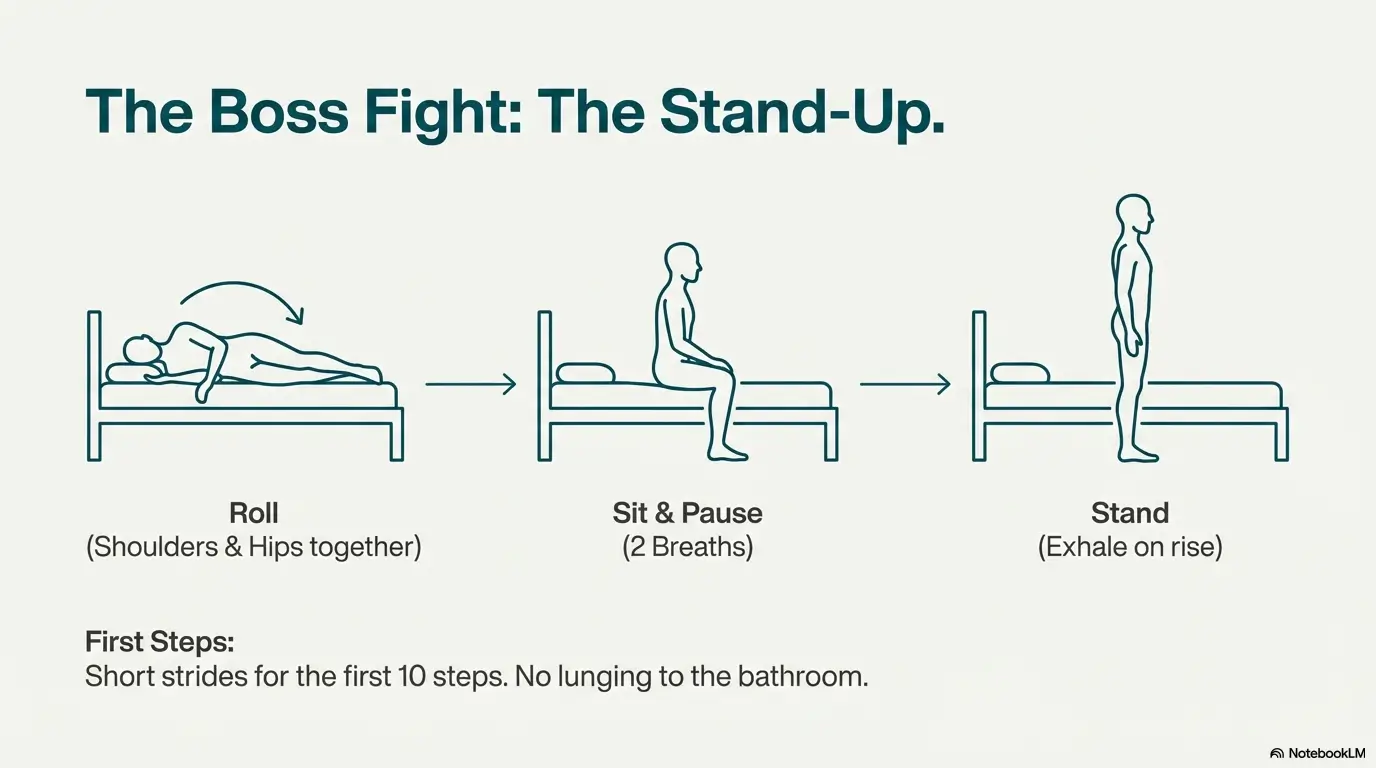
If your sciatica is “morning-only,” the stand-up transition is often the real boss fight. This section is your mechanics cheat code. I’m not trying to make you graceful. I’m trying to make you consistent.
3-step transition card (with pause points)
- Roll to your side (pause 2 breaths)
- Push to sitting (pause 2 breaths)
- Stand with exhale (first 10 steps: short stride)
Roll-to-side without twisting
Roll as a unit—shoulders and hips together—so you’re not wringing your low back like a towel. Pause on your side for two slow breaths. This is where many people rush and trigger the flare.
Sit-to-stand with exhale (reduce bracing)
When you stand, exhale as you rise. It helps reduce the instinct to brace hard. Think: “stand up like you’re holding a cup of coffee you don’t want to spill.” Smooth, not explosive.
First 10 steps: stride length and pace (tiny matters)
Take short steps for the first 10–20 steps. No lunging to the bathroom like it’s an Olympic event. (Yes, I have done the Olympic bathroom sprint. No, it did not end well.)
- Roll as one unit.
- Pause twice (side + sitting).
- Short steps for 10–20 strides.
Apply in 60 seconds: Put “PAUSE x2” on a note where you’ll see it the moment you wake.
Common mistakes
The classic traps are emotional, not technical: “If a little helps, more must help more,” and “If I stretch hard enough, I’ll force this problem to leave.” Morning-only sciatica tends to punish both.
Mistake #1: Turning a glide into a hamstring stretch
If you’re chasing a big hamstring stretch sensation, you’re probably tensioning the system, not sliding it. Back off the knee extension. Keep it soft. Remember: you’re warming up a sensitive cable, not lengthening a rope.
Mistake #2: Chasing reps instead of calm
More reps can turn a helpful input into a provocation. Especially on reactive mornings. A small set done consistently beats a big set that ruins your next day.
Mistake #3: Skipping the stand-up transition
Doing perfect glides, then popping up like a jack-in-the-box, is like warming up your car and then immediately red-lining the engine. Transition mechanics are part of the dose.
Mistake #4: Ignoring symptom travel after the routine
If symptoms move farther down the leg after the routine, treat that as data. Reduce range, reduce reps, or pause the routine and seek guidance.
Don’t do this first
The first 10 minutes after waking are not the time for deep stretches or big flexion demands. Many reputable orthopedic and clinical resources emphasize movement and graded activity over prolonged bed rest, but that doesn’t mean you should start your day with aggressive positions that spike symptoms.
Avoid list (first 10 minutes) + safer swaps
- Avoid: Long-held toe-touch hamstring stretch
Swap: micro-range sliders + short steps - Avoid: Aggressive knee-to-chest pulling
Swap: gentle pelvic clock + small knee sway - Avoid: Fast twisting “crack my back” rolls
Swap: roll as one unit + pause breathing
The 3 moves most likely to spike symptoms
In my inbox, the “I did this and got worse” stories usually involve (1) deep hamstring stretching, (2) forceful piriformis stretching, or (3) twisting under load—especially half-awake. If you love stretching, save it for later in the day when your system is warmer and less reactive.
Safer swaps that keep the same intention (without the flare)
Intention matters. If the intention is “reduce stiffness,” choose movement over long holds. If the intention is “calm the nerve,” choose sliders over “deep stretch.” If the intention is “get upright,” choose transition choreography over speed.
Here’s what no one tells you: mornings punish hero moves.
Your body isn’t lazy in the morning—it’s cautious. Treat it like you’re negotiating peace, not declaring war.
Sleep-position clues
Morning-only sciatica often has a “night” component. Not always, but often enough that it’s worth investigating. Your sleep position can quietly set up the morning flare by twisting the pelvis, loading the low back asymmetrically, or tightening the hip posture for hours. If you want the bigger framework first, start with how to sleep with sciatica.
Side sleepers: knee gap + pelvic twist problem
If you side-sleep with your top knee drifting forward and down, your pelvis can twist. A pillow between the knees (or a thicker one that fills the knee gap) can reduce that twist. I once thought my “cute curled side sleep” was harmless—until I realized my morning flare correlated perfectly with nights I woke up hugging the pillow like a life raft. If you’re tuning this setup, these two guides go deeper: side sleeping sciatica and knee pillow vs body pillow for sciatica.
Back sleepers: under-knee support without forcing flexion
For some back sleepers, a small pillow under the knees reduces strain and morning stiffness. The key is small, not “knees to chest all night.” You’re trying to reduce load, not lock yourself into a posture your body resents by dawn.
Open loop: The “2:47 AM rollover” clue (what it suggests)
If you wake after rolling and feel a zing, it suggests the transition itself—or the end position you landed in—may be provocative. That clue matters because it tells you the morning routine should prioritize calm transitions, not aggressive stretching. If nights are the real troublemaker, this deep-dive can help: side sleeper sciatica at night.
Show me the nerdy details
Sleep posture can influence how long tissues stay in certain joint positions. When you wake and load quickly, you’re moving from prolonged stillness to sudden demand. The “rollover zing” can be a sensitivity hint: transitions plus end-range positions might be the irritants, not movement itself.
Short Story: I once had a stretch of mornings where I was fine in bed and miserable the moment my feet hit the floor. I tried the obvious thing: stretching harder. It felt productive—like I was “doing something.” Then I noticed the pattern: the mornings I stretched hard, I moved like a cautious robot until lunchtime. The mornings I did almost nothing—just tiny motion, slow breathing, and a careful roll-to-stand—I walked normally within ten minutes. It offended my ego.
I wanted a dramatic fix, not a quiet one. But my body kept choosing the boring plan. That week taught me something I still use: my nervous system responds to tone, not toughness. If I start the day with calm signals, I get a calmer day back.
If it works… then fails tomorrow
This is common, and it doesn’t mean the routine is “wrong.” It usually means the dose or the day changed. Morning symptoms are sensitive to sleep position, stress, workload, and even how rushed you are. (Yes, your nervous system notices when you’re late.)
| Symptom | Likely meaning | Adjustment |
|---|---|---|
| Symptoms travel lower (calf/foot) | You likely exceeded tolerance today | Cut range by 50%, cut reps by 50%, slow pace; consider skipping next morning if it persists |
| Numbness increases | Stop-rule territory | Stop and seek guidance if it doesn’t quickly normalize |
| Worked yesterday, worse today | Day-to-day irritability shift | Use Version B micro-range + longer pauses; prioritize transition mechanics |
| “Good side” becomes the bad side | Compensation + posture shift | Reduce asymmetry: check sleep setup, walk short/slow early, and avoid one-sided stretching |
If symptoms travel lower (calf/foot): what to change first
Change range first (smaller). Then change reps (fewer). Then change speed (slower). And if you’re still worse, pause the routine and get a PT or clinician opinion. This is where an evidence-based PT resource can help you match movements to your specific pattern. If you’re weighing care paths, this comparison can help you ask better questions: chiropractor vs physical therapy.
If numbness increases: stop + reassess
Increasing numbness is not a “push through it” signal. Stop and reassess. If it’s new or worsening, seek evaluation.
Open loop: Why your “good side” can become the bad side
When one side hurts, you unconsciously shift your posture, your sleep position, and your walking pattern. That compensation can load the other side differently. The fix is rarely “stretch the new bad side harder.” It’s usually: reduce asymmetry and calm the transitions.
Quote-prep list: What to gather before comparing care options
- Your morning pattern (sharp on standing vs tingly on first steps)
- Whether symptoms go below the knee and how often
- What helps within 10 minutes (walking, heat, micro-movement)
- What clearly worsens it (twist, deep stretch, fast stand-up)
- Any red flags or function changes (weakness, numbness changes)
Neutral next step: Put these in your phone notes. You’ll answer faster and get better guidance.
FAQ
1) Is it normal for sciatica to hurt only in the morning?
It’s common for symptoms to be worst after prolonged stillness and improve after gentle movement. Morning-only patterns often point to a “stiffness + sudden load” sensitivity and a transition trigger. If the trend is worsening or symptoms are spreading, get evaluated.
2) What should I do before getting out of bed with sciatica?
Do a small, gentle warm-up: slow breaths, tiny pelvic motion, and low-range nerve sliders. Then rehearse the roll-to-sit-to-stand transition with pauses. The goal is to avoid going from stillness to full load instantly.
3) Can sciatic nerve glides make symptoms worse?
Yes—especially if you use big range, move too fast, or turn the glide into a deep stretch. Use small range, low reps, and stop if symptoms travel farther down the leg, pain spikes, or numbness increases.
4) How many reps should I do for morning sciatica nerve glides?
Start low: 4–6 micro reps on sensitive days, or 6–10 gentle reps on calmer mornings. If you feel worse afterward or symptoms travel farther down the leg, cut the dose or pause the routine.
5) Should I do nerve flossing every day or only when it hurts?
If mornings are consistently reactive, a small daily routine can help you keep transitions calm. If symptoms are intermittent, use it as a targeted tool. The key is not frequency—it’s whether your overall trend improves.
6) What’s the difference between a nerve glide and a hamstring stretch?
A hamstring stretch aims for tissue length and often uses end-range holds. A nerve glide aims for smooth nerve movement with low tension—usually rhythmic, small-range, and not held at the end.
7) If pain goes past my knee, does that change what I should do?
Below-knee symptoms can reflect greater nerve involvement. That doesn’t automatically mean panic—but it does mean you should be more conservative with range and reps, watch for worsening, and consider professional evaluation if it persists.
8) Heat or ice first thing in the morning—what’s safer?
Either can be appropriate depending on your response. If stiffness dominates, gentle warmth may feel better; if sharp irritation dominates, some people prefer cold. Keep sessions short and avoid skin injury. If you’re unsure, start with brief warmth plus gentle movement.
9) When should I see a physical therapist for morning sciatica?
If it keeps recurring, lasts beyond a few weeks, spreads farther down the leg, or limits function, a PT can help you identify triggers and build a graded plan. If red flags appear, seek urgent evaluation.
10) Can my sleeping position actually cause morning sciatica symptoms?
Sleep position can contribute by maintaining asymmetrical posture for hours. It may not be the sole cause, but it can be a meaningful amplifier. Simple pillow tweaks can reduce twist and make mornings easier.
Next step
The next step is not “do it perfectly forever.” The next step is make tomorrow morning easier with one simple setup and one simple metric.
One-line tracker (takes 10 seconds)
Tomorrow: Did symptoms travel farther down the leg after the routine? Yes / No
Tonight: set your pillow setup + save the routine
Side sleeper? Put the pillow where it prevents knee gap and pelvic twist. Back sleeper? Try a small under-knee support. Then save this page or write the 5-minute script on a note. The best routine is the one you can remember while sleepy.
Tomorrow morning: track one metric (symptom travel: yes/no)
If it’s “No” for three mornings, you’re on the right track. If it’s “Yes,” reduce range and reps—or pause and seek guidance.
Conclusion
Remember the curiosity loop from the beginning—why you can feel awful at 7:10 AM and okay by noon? That fade is your clue. Your system may not be “broken.” It may be transition-sensitive. When you treat the first five minutes like a ramp instead of a cliff, you often get a calmer day back.
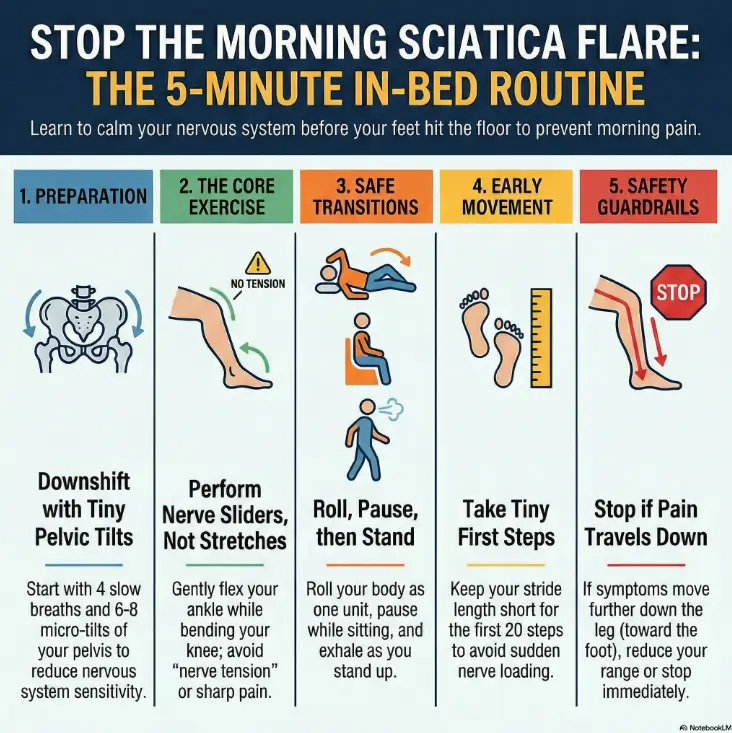
Infographic: The Morning Ramp (5 Steps)
4 breaths + tiny pelvic clock
Version A (6–10) or B (4–6 micro)
Small knee sway or supported hover
Roll → sit (pause) → stand (exhale)
Short stride for 10–20 steps
Stop rule: pain spike, increased numbness, or symptoms travel farther down the leg = back off.
Decision card: When A vs B (time/cost trade-off)
- Choose self-care + tracking if: symptoms are stable, fade with movement, and you can function normally after warming up.
- Choose PT/clinician check-in if: it recurs weekly, lasts beyond a few weeks, or spreads farther down the leg.
- Choose urgent evaluation if: new weakness, major numbness changes, bladder/bowel issues, trauma, fever, or severe escalation.
Neutral next step: Pick your lane today and write it down. Uncertainty is expensive.
If you want a 15-minute next step: do the routine tomorrow morning, track the symptom-travel “yes/no,” and adjust your sleep setup tonight. If three mornings in a row feel calmer, you’ve found a lever worth keeping. And if they don’t—good. You’ve collected clean data to bring to a professional who can help you aim more precisely.
Last reviewed: 2026-01-20