

End the Midnight Zap: A Geometry-Based Setup for Sciatica Relief
At 3:07 AM, it doesn’t feel like “back pain.” It feels like your leg hit an electric tripwire—and sleep is suddenly not a place you can negotiate.
We treat this like a geometry problem, not a grit problem. By establishing a neutral “lane” for your spine, we prevent the subtle pelvic twists that trigger the nervous system. (If you want the broader picture of what helps most people, start with this how to sleep with sciatica overview, then come back for the “lane” setup.)
This is a debugging loop for your sleep: a 60-second side A/B test with guardrails that work even when you’re not conscious enough to “do it right.”
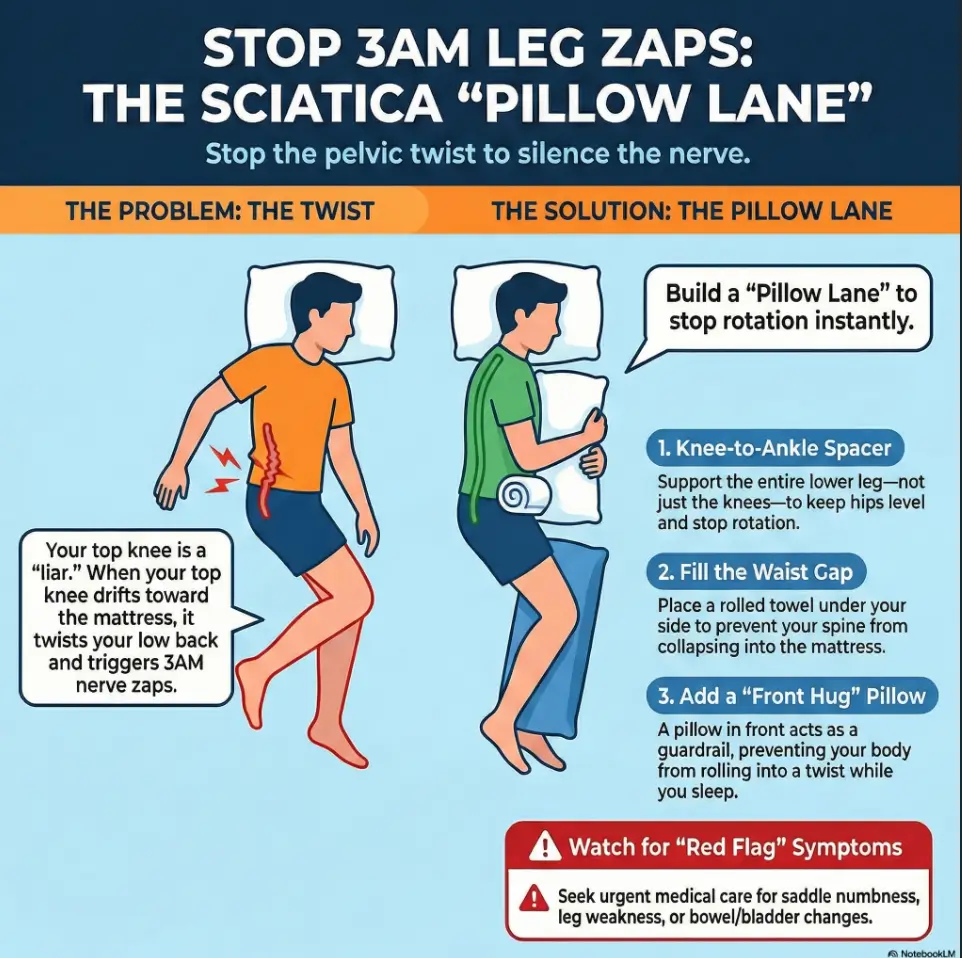
If side-sleeping triggers 3AM “leg zaps,” the goal is to stop your top leg from dragging your low back/pelvis into a twist. Build a simple pillow stack: (1) knee-to-ankle pillow to keep hips level, (2) small waist/low-back support to fill the side gap, and (3) optional front “hug pillow” to prevent rolling. Keep your spine neutral, not curled.
Table of Contents
1) Who this is for / not for
For you if…
- You’re a side sleeper and wake with shooting, tingling, or electric leg pain (especially if your pattern matches side sleeping sciatica triggers)
- Pain spikes after you roll, twist, or draw the top knee forward
- You want a pillow-based setup you can test tonight (no new equipment required)
I’ve been there: half-asleep, bargaining with a mattress like it’s customer service. “If I hold this position perfectly, maybe the nerve will chill.” Spoiler: your nervous system doesn’t reward willpower. It rewards geometry.
Not for you if…
If any of the following are true, skip pillow experiments and get urgent medical guidance:
- New weakness (especially worsening), foot drop, or your leg feels like it can’t “trust itself”
- Numbness in the groin/saddle area or around genitals/buttocks
- Bowel/bladder changes (retention, incontinence, trouble starting urine)
- Pain after recent fall/trauma, or accompanied by fever, unexplained weight loss, or cancer history
- Symptoms are rapidly worsening or you can’t bear weight
Major clinical references emphasize immediate evaluation for bowel/bladder control issues or sudden leg weakness with sciatica-like symptoms. (If you want a plain-language “what counts as urgent” checklist, see low back pain emergency warning signs.)
- Yes: Pain/tingle shoots down one leg, worse with twisting/rolling → try the stack tonight.
- Yes: Pillows help for a bit but you “escape” the setup at night → you need guardrails (Section 7).
- No: New bladder/bowel changes, saddle numbness, or rapidly worsening weakness → seek urgent care first.
Next step: If you’re in the “Yes” group, build the stack in Section 3 and run the 60-second A/B test in Section 4.
2) 3AM “leg zaps” decoded: the twist you don’t feel
Here’s the sneaky part: most side sleepers don’t wake up because they’re “on the wrong side.” They wake up because their body slowly drifts into a position that loads the low back and pelvis like a wrung towel. You don’t feel the twist building. You feel the nerve complaining once it’s had enough. (If you want a deeper explainer of what “nerve pain” can feel like, see sciatica nerve pain symptoms.)
The quiet culprit: pelvic rotation on your side
- Your top leg tends to slide forward.
- Your pelvis follows that leg into a subtle forward rotation.
- Your low back joins the party because it hates being left out.
It’s not that your spine needs to be stiff-straight like a board. It’s that your spine doesn’t love being straight up top and twisted down below. That mismatch is the midnight tax.
The second culprit: the waist gap and side-bend
Most mattresses create a side gap under your waist. If your waist hangs in space, you’ll side-bend a little. Not enough to look dramatic. Enough to irritate a nerve pathway that’s already cranky.
Supporting means filling the gap so your trunk stays neutral. Propping means jamming a thick pillow that forces you into a new bend. We’re doing the first one.
Show me the nerdy details
In plain mechanics: when the top femur drifts forward, the pelvis often follows into relative rotation. Add a waist gap and you get rotation + side-bend—two ingredients that can narrow space around irritated structures. You don’t need perfect anatomy labels to benefit; you just need to remove the twist and fill the gap.
Scannable check: If you wake up and your top knee is “visiting” the mattress in front of you, pelvic rotation is very likely part of your story.
3) The 3-piece pillow stack (knee → ankle → waist)
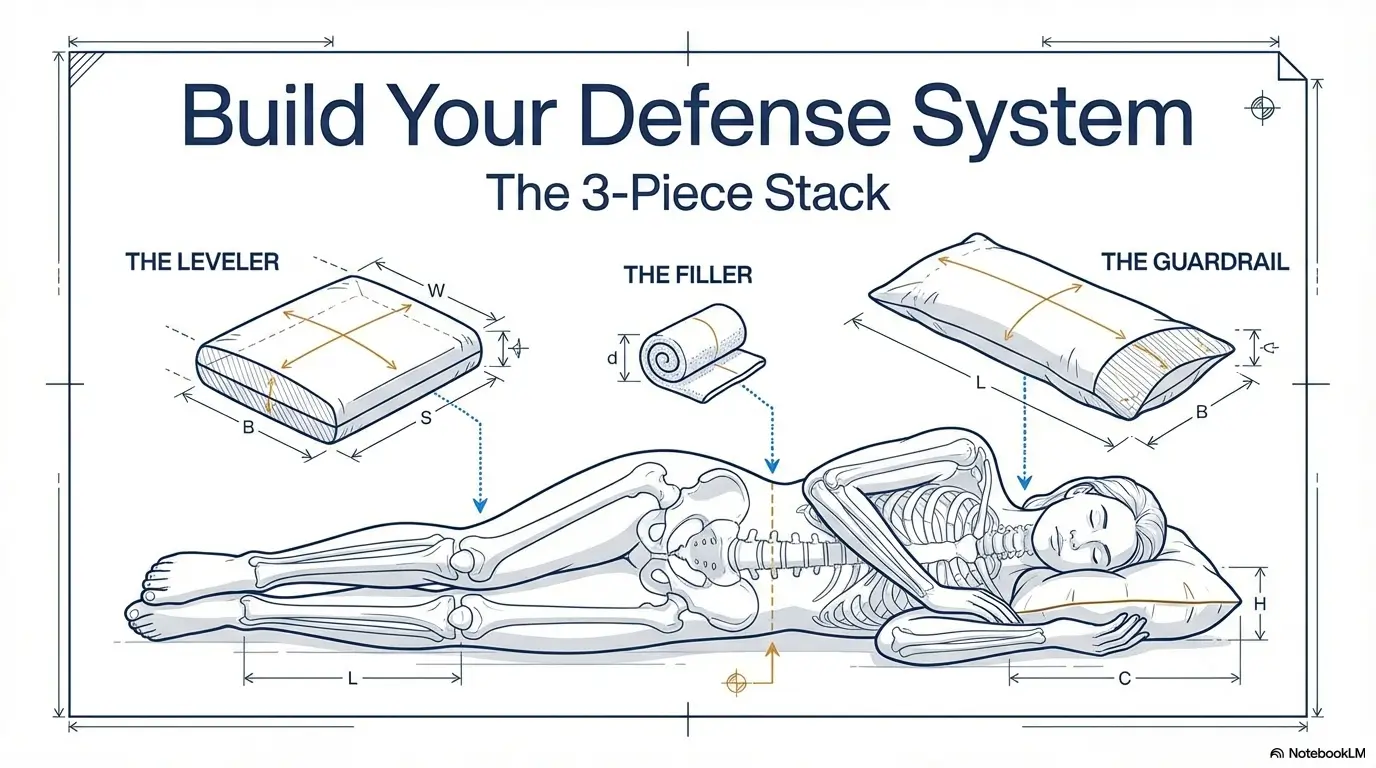
This is the heart of the fix: level hips, supported waist, and a simple anti-roll guardrail so your sleepy self can’t sabotage your careful setup.
Piece #1: Knee-to-ankle spacer (the “hip leveler”)
Where it goes: from knee down to ankle—yes, all the way. A pillow only between knees often leaves the lower leg free to rotate, which can quietly tug the hip along with it.
- Too thin: top knee falls forward, hips feel stacked at first but drift.
- Too thick: you feel “jacked open,” like your hips are being pried apart; you may wake with a pinched feeling in the low back.
My first attempt years ago was a sad, flat couch pillow between my knees. It lasted exactly one rollover. The nerve did not applaud my effort.
Piece #2: Waist/low-back roll (the “gap filler”)
Goal: fill the space under your waist so your trunk doesn’t collapse sideways. This often matters as much as the leg pillow.
- DIY: towel roll, folded tee, small lumbar pillow
- Placement options: slightly above the hip crest, at the waist, or a touch lower at the low back—choose the one that makes your spine feel “quiet.”
Piece #3: Front hug pillow (the “anti-roll guardrail”)
If you’re a restless roller (or you wake up half-twisted), a front pillow gives your top arm and top leg something to do besides dragging you forward.
- Helps if you roll frequently, if your shoulder gets cranky, or if you need “pregnancy-style” support without being pregnant.
- It reduces the reflex to twist by giving you a lane to stay in.
- Spacer: knee-to-ankle, not knees-only
- Waist roll: “fill,” don’t “prop”
- Hug pillow: your rollover insurance
Apply in 60 seconds: Lie on your side and slide a towel roll under your waist; if your low back feels instantly calmer, you’ve found a missing piece.
A quick visual map of what goes where. Use it like a checklist, not a vow.
- Hips stacked (top hip not rolled forward)
- Knees aligned (top knee not drifting toward the mattress)
- Waist supported (no hollow gap under your side)
- Spine neutral (not a tight fetal curl)
Pro tip: If you can breathe slowly without feeling “pulled,” you’re close.
Use your hand as a fast measuring tool:
- Lie on your side with knees slightly bent.
- Stack your hips (don’t let the top hip roll forward).
- Measure the gap from inner knee to inner knee with two fingers (about 1 inch), three fingers (~1.5 inches), or four fingers (~2 inches).
Output: Choose a spacer that compresses to roughly that gap. If you’re waking “pinched,” go thinner; if you’re waking twisted, go thicker or longer (extend to ankle).
Neutral action: Write “2-finger / 3-finger / 4-finger” in a note so tomorrow you can adjust one variable instead of guessing.
4) The “which side do I sleep on?” test (a 60-second experiment)
Forget loyalty to your favorite side for one night. Your body gets to vote.
Pick the side that calms symptoms—not the side you prefer
- Build the full stack (spacer + waist roll + hug pillow).
- Lie on Side A for 60 seconds. Slow breathe. Notice zaps, pulling, and how easy it is to relax.
- Switch to Side B for 60 seconds with the same stack.
What “better” means: less zap, less pull, less need to fidget, and easier breath. It’s not always “no pain.” It’s “my nervous system isn’t on high alert.”
The ankle clue most people miss
If your top foot points down or inward and sparks symptoms, your lower leg may be rotating even when your knee looks “fine.” Extend the spacer to the ankle, and make sure your ankle isn’t hanging off the pillow like a loose hinge.
- Test both sides with the same stack
- Use breath as a signal: easier breath often means less twist
- Don’t ignore the ankle; it’s a quiet rotation lever
Apply in 60 seconds: If one side feels 20% calmer, commit to that side tonight and “guardrail” it (Section 7).
5) Here’s the part no one tells you: your top knee is lying
The top knee is a charming liar. It can look peaceful while it quietly drifts forward and drags your pelvis with it.
Micro-check: “Is my top knee drifting forward?”
- Place your hand on your top knee.
- Slide it back until your thigh is stacked over the bottom thigh.
- Notice if the leg zap/pull changes even a little.
In my house, this is the moment I realize I’ve been “comfort curling” like a shrimp who pays rent. It feels cozy, but it often loads the low back in just the wrong way.
Let’s be honest…
If you wake up half-twisted, you don’t need more discipline. You need a guardrail. Sleep is not a place where willpower thrives. Sleep is where we drool, roll, and become unreliable narrators.
Quick scannable fix: If the knee keeps drifting, increase the spacer length (knee-to-ankle), and add the hug pillow so your whole top side has somewhere to “rest” without twisting.
6) Mattress + pillow physics (small tweaks, big nights)
Sometimes pillows aren’t failing—you’re just asking them to compensate for a mattress that’s doing something dramatic at the hips. The good news: you can diagnose this without buying anything tonight. (If you’re actively comparing options, this mattress firmness for sciatica guide helps you translate “too soft/too firm” into real symptoms.)
Too soft vs too firm: how to tell in one morning
- Too soft at the hips: you wake feeling twisted, waist roll gets crushed, low back feels “wrung out.”
- Too firm: you wake with pressure points (hip/shoulder), and you keep shifting to escape the pressure.
Temporary diagnostic hack: fold a blanket and place it under your hips (not your waist) for one night. If you wake up with fewer zaps, the mattress may be letting your pelvis sink unevenly.
Head pillow height affects your low back
This sounds unrelated until you feel it: neck tilt can rotate your ribcage, and ribcage rotation can invite low-back rotation. It’s a chain reaction—small at the neck, loud at the hip. (If you recognize “phone-in-bed posture” as your nightly ritual, you may also like tech neck pain from phone in bed—because the top of the chain matters.)
- If your head pillow is too high, your neck side-bends and your torso may follow.
- If it’s too low, you may curl and tuck your chin, which can encourage a fetal twist.
Show me the nerdy details
Think of your spine as a linked system. When the top link (neck/ribs) rotates and the bottom link (pelvis) rotates differently, the midsection often absorbs the mismatch. The goal isn’t “perfect posture.” It’s removing mismatches that trigger guarding.
Small, honest anecdote: The night I finally lowered my head pillow by about an inch, my hip stopped trying to “solve” the twist by rolling forward. I didn’t feel virtuous. I felt… quiet. That’s the metric.
7) Open loop: why the setup works… then fails at 2:47 AM
Let’s close the mystery: why does your pillow setup feel amazing at bedtime… and then betray you at 2–3 AM?
The rollover moment (your “failure point”)
Most people don’t fail because the stack is wrong. They fail because they roll, and the top leg leads the roll. The leg moves first, the pelvis follows, and your spine gets drafted into a twist without signing up.
That’s why your fix needs to be more than “between the knees.” It needs to create a lane you can’t easily escape.
The fix: build a “lane” you can’t escape
- Front hug pillow + knee-to-ankle spacer = your top leg can’t dive forward as easily.
- Add a thin pillow behind your back if you keep rolling backward into a half-supine twist.
- If you roll forward a lot, make the hug pillow bigger (body pillow works well) so your top shoulder and hip feel “held.”
Show me the nerdy details
In sleep, micro-arousals happen (small awakenings you don’t fully remember). That’s often when you shift positions. If your setup only works when you’re consciously aligned, it will fail during those shifts. Guardrails make alignment automatic during transitions.
Practical “lane” checklist (5 seconds): When you lie down, you should feel contact at three places: (1) between legs to the ankle, (2) under waist, (3) in front of your chest/arm. If you only feel one, you’re under-guardrailed.
8) Common mistakes (the ones that create more zaps)
You can do everything “right” and still accidentally build a twist machine. Here are the big traps.
Mistake #1: Pillow only between knees (ankles unsupported)
This often allows rotation below the knee. The lower leg drifts, the hip follows, and you wake up in the same argument with gravity.
Mistake #2: Forcing the top knee forward (fake comfort)
The fetal curl can feel safe, warm, and emotionally supportive—like a blanket that says “you tried.” But for some people it increases pelvic rotation and irritates symptoms.
Mistake #3: Over-stacking (turning support into side-bending)
Too-thick spacers and huge waist pillows can push you into a new bend. If you wake up with a pinched, stiff low back, try reducing thickness before you abandon the whole method.
Mistake #4: Ignoring the waist gap (the missing support)
If your waist is hanging, your spine is negotiating all night. Fill the gap. Don’t make your low back “earn” neutral.
- Knees-only support often misses ankle rotation
- Fetal curl can be “comfort” and still be a trigger
- Over-stacking can create a new bend
Apply in 60 seconds: If you wake pinched, remove thickness; if you wake twisted, add length (to the ankle) or guardrails.
9) Don’t do this at bedtime: 5 “helpful” habits that backfire
Bedtime is not the Olympics. Anything that irritates a sensitive nerve right before you lie down can turn into a 3AM problem.
Stretching aggressively right before sleep
End-range stretching (hamstring, piriformis, deep hip) can flare symptoms for some people. If you love stretching, do it earlier and keep it gentle—think “easy mobility,” not “prove you’re flexible.”
Sleeping with a heating pad all night (risk + rebound)
Heat can feel wonderful, but continuous overnight heat can be a burn risk and can mask positioning signals. A safer pattern many clinicians suggest is heat before bed for a short window, then off.
Chasing one perfect position
Perfection makes you tense. Tension makes you fidget. Fidgeting makes you twist. Instead: pick a repeatable stack and adjust one variable at a time.
Ignoring the rollover problem
If you keep waking twisted, “more knee pillow” is not the answer. Guardrails are.
Here’s what no one tells you…
The goal isn’t “zero movement.” It’s movement without twisting. Your body is allowed to roll. It just needs to roll inside a lane.
Scannable reset: If you wake up zapped, don’t stretch hard in the dark. Rebuild the lane: spacer to ankle, waist roll, hug pillow, and a thin pillow behind your back if needed. If your “zap” story also includes burning/tingling that behaves oddly (or shows up in feet independent of position), compare with burning nerve pain in feet at night so you’re not forcing every symptom into the same box.
10) When to seek help (and what to ask for)
Most sciatica-like symptoms aren’t emergencies, but some are. If your body is waving a big red flag, don’t negotiate with it at 3AM—get assessed.
Red flags that shouldn’t wait
- New or worsening weakness, foot drop
- Saddle numbness (numbness around groin/genitals/buttocks)
- Bowel/bladder changes (retention, incontinence, trouble starting)
- Severe, unrelenting pain, fever, or trauma-related onset
These warning signs are emphasized across major medical guidance for urgent evaluation when sciatica-like symptoms include bowel/bladder disturbance, saddle numbness, or sudden weakness.
Useful language for US clinics
If you decide to seek care, describing the pattern clearly can speed up the right next step:
- Distribution: “Pain/tingle shoots from low back/butt into the back of my thigh/calf/foot.”
- Triggers: “Worse when I roll or when my top knee drifts forward while side sleeping.”
- Night pattern: “Wakes me at 2–4 AM; feels electric/tingly; improves when I de-twist.”
- What helps: “Knee-to-ankle spacer and waist support reduces it temporarily.”
- What you’re worried about: “No bowel/bladder changes” (or if you have them, say so plainly and urgently).
- When it started + what changed (new chair, travel, lifting, fall)
- Exact wake times (yes, “2:47 AM” counts as useful data)
- What positions worsen vs relieve (side A vs side B)
- Any weakness, numbness pattern, or balance changes
- What you’ve tried (pillow stack, heat window, walking, meds if any—see back pain NSAID safety if you’re unsure what’s “safe” in general)
Neutral action: Put this in a note so you can describe it in 30 seconds, not 30 minutes. If you’re weighing next steps, these pages often help readers clarify the path: physical therapy for sciatica, sciatica vs herniated disc, and sciatica vs piriformis syndrome.
Real-world note: many people end up in a loop of “I slept weird, I’m fine, then I’m not.” Getting the pattern down on paper often turns a foggy complaint into a solvable problem.
FAQ
1) Why does sciatica feel worse at night when I’m on my side?
Night pain is often a positioning problem: your top leg can drift forward, your pelvis rotates, and your waist collapses into a side-bend. You don’t feel the twist building—you feel the nerve complaining when it reaches its limit. The stack works by preventing that drift and filling the waist gap so your spine stays neutral.
2) Is it better to sleep on the “pain side” or the “good side”?
Use the 60-second A/B test. Many people do better on the side opposite the pain, but your body’s response matters more than rules. Pick the side that reduces pulling, zaps, and guarding. If both sides are bad, focus on guardrails (hug pillow + behind-back pillow) because rollover drift may be the bigger trigger.
3) What pillow thickness is best between my legs for sciatica?
There isn’t one perfect thickness. You want “just enough” to keep hips level without prying them apart. A quick guide: measure your knee gap with fingers while hips are stacked, then choose a spacer that compresses to that size. If you wake pinched, go thinner. If you wake twisted, go longer (to the ankle) or add guardrails.
4) Should the pillow go between my knees only, or knees and ankles?
Knees-to-ankles is often better for side sleepers with 3AM zaps because it reduces lower-leg rotation that can tug the hip. If knees-only works for you, great. But if you keep waking twisted, extending the spacer to the ankle is one of the highest-leverage tweaks you can make.
5) Can a mattress topper actually help sciatica at night?
Sometimes. If your mattress is too firm and creates pressure points that make you roll constantly, a topper can reduce shifting. If it’s too soft at the hips, a topper can make sinking worse. Try the one-night diagnostic: a folded blanket under your hips. If that helps, you’re dealing with pelvic sink more than surface firmness.
6) Is sleeping in the fetal position bad for sciatica?
Not universally—but it can be a trigger if it pulls your top knee forward and rotates your pelvis. If fetal feels good and you wake calmer, keep it. If fetal feels cozy but you wake with zaps, try “neutral fetal”: knees slightly bent, spacer to ankle, and a hug pillow to stop forward drift.
7) Does heat or ice work better before bed for sciatica?
Different people respond differently. Heat can relax guarding, while ice can calm sharp inflammation-like irritation. The safe, practical approach: use a short window (10–20 minutes) before bed, then remove it. Don’t let temperature tools replace alignment tools—your pillow lane usually matters more.
8) Why do I get numbness/tingling only when I roll over?
Rolling changes rotation and pressure in a split second. If your top leg leads the roll, it can yank your pelvis forward and create the exact twist that triggers symptoms. That’s why guardrails (hug pillow + optional behind-back pillow) are often the missing fix.
9) What if pillows help for an hour, then the pain comes back?
That usually means your setup works in a still position but fails during transitions. Upgrade from “support” to “lane”: spacer to ankle, waist roll, hug pillow, and consider a thin pillow behind your back so you can’t roll into the half-twist position. Then adjust only one variable per night so you learn what actually helps.
10) When is nighttime sciatica an emergency?
If you have bowel/bladder changes, saddle numbness, or new/worsening leg weakness, treat it as urgent. Those symptoms are highlighted across major medical guidance as reasons for immediate evaluation with sciatica-like presentations.
12) Next step (one concrete action)
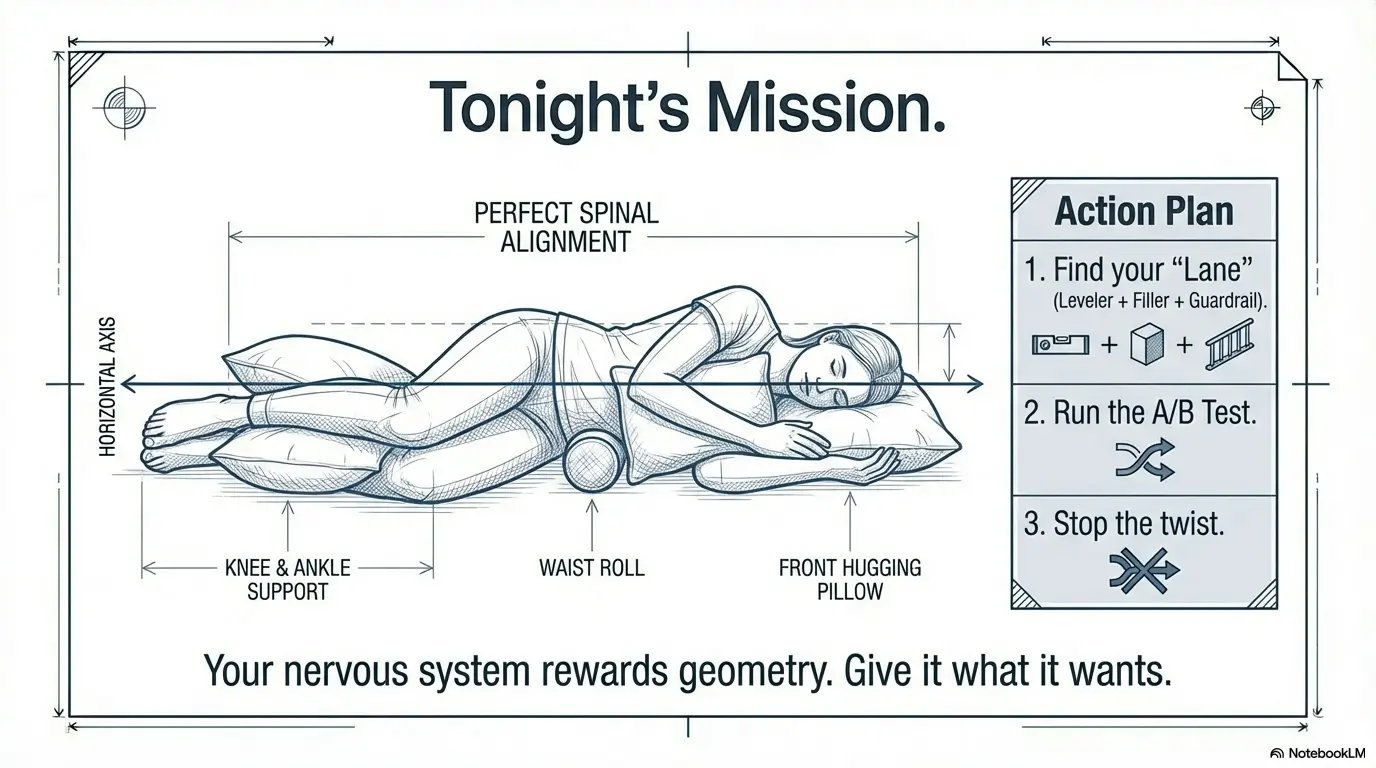
Do the “Tonight Stack Test”
- Build: knee-to-ankle spacer + waist roll + front hug pillow.
- Do the 60-second A/B side test and pick the calmer side.
- Set a 10-second phone note: side, spacer thickness, wake time, symptom intensity (0–10).
- Tomorrow morning, change one variable: spacer thickness or waist roll position—then repeat.
I know this sounds almost insultingly simple. But that’s the point: a repeatable setup beats a heroic midnight scramble.
- Pick the calmer side with an A/B test
- Lock in a lane so rollovers don’t undo progress
- Adjust one variable per night so you actually learn
Apply in 60 seconds: Write tomorrow’s “one change” now (thinner spacer / longer spacer / waist roll higher / add behind-back pillow). If you also want a daytime “stability baseline” that many people can tolerate, consider bookmarking McGill Big 3 in 10 minutes for later—separate session, not at 3AM.
Conclusion
Remember the open loop from the beginning—why it feels fine at bedtime but explodes at 2–3AM? It’s usually the rollover moment: your body quietly escapes alignment, your top leg leads the twist, and your nervous system reacts like a smoke alarm that’s tired of being polite.
The fix isn’t a perfect pose. It’s a lane: knee-to-ankle spacer to stop drift, waist support to remove the side gap, and a hug pillow (plus optional behind-back pillow) so your half-asleep self can’t accidentally rebuild the twist.
- You wake twisted even with a knee pillow
- You notice top knee/foot drifting forward
- Waist gap feels obvious on your mattress
Action: Add waist roll + extend spacer to ankle + hug pillow.
- You wake pinched or stiff in the low back
- Spacer feels like it pries hips apart
- Waist roll feels like it pushes you sideways
Action: Reduce thickness first; keep length and guardrails.
Neutral action: Decide which column you’re in and change only that variable tonight. If anxiety is making you “symptom-scan” all day, you might also appreciate cyberchondria and chronic pain—because fear can become its own amplifier.
If you want an operator-simple goal for the next 15 minutes: build the stack, run the A/B test, and set your note. That’s it. You’re not trying to become a new person by sunrise. You’re just trying to stop the twist that wakes the nerve. If desk days are part of your flare pattern, it also helps to audit your daytime inputs like standing desk sciatica triggers—because night pain often has a day-long prologue.
Last reviewed: 2026-01