

Solving Manual Driving Sciatica: Seat and Foot Tactics
Geometry vs. Toughness: Real solutions for the left-leg flare.
Sciatica when driving a manual often isn’t about toughness; it’s about geometry: seat distance, ankle tension, and the dead pedal habits that quietly keep your leg switched on. You don’t need a “heavy clutch” to flare—you just need fifty small holds in traffic and a foot that never truly rests.
What is Sciatica?
Nerve pain that runs from the low back or buttock down the leg as burning, tingling, numbness, or a sharp electric line. Repeated end-range clutch presses stack this sensitivity fast.
Calm the flare in minutes using two levers you can actually control:
- • The “Soft-Knee” Seat Test: Ensure a slight bend at full clutch travel to avoid nerve tension.
- • The Footrest Rule: Eliminate in-between tension by utilizing the dead pedal religiously.
- • Traffic Protocol: Stop the “hover” and allow the muscle to switch off between shifts.
Would you like me to create a symptom-timing log template to help you track exactly when your leg flares during your drive?
Table of Contents
Safety note: don’t DIY past red flags
This article is about car setup and driving habits—not diagnosing you over the internet. Sciatica-like pain can be common, and many cases improve with conservative care, but there are a few signals you should treat as “stop optimizing the seat, get evaluated.” Major medical sources (like Mayo Clinic) note that severe symptoms—especially significant weakness or bowel/bladder changes—need prompt medical attention. If you’re unsure whether you’re in “optimize” territory or “get checked now” territory, use this quick reference on when low back pain becomes an emergency.
- Go now / urgent evaluation: new or worsening leg weakness, foot drop, loss of bowel/bladder control, numbness in the groin/saddle area, severe pain that escalates quickly.
- Call a clinician soon: numbness spreading, pain waking you at night repeatedly, symptoms that steadily worsen week over week.
- Driving safety first: if pain or numbness affects pedal control, don’t “push through.” Arrange a ride or switch vehicles.
- Driving safely beats driving stubbornly.
- New weakness or saddle numbness is a “don’t wait” sign.
- Use this guide only when symptoms are stable and mild-to-moderate.
Apply in 60 seconds: Before your next drive, do a quick “pedal control check” in park—if your foot feels unreliable, don’t drive.

Sciatica basics: what it is (in 60 seconds)
“Sciatica” isn’t a diagnosis so much as a pattern: pain that follows the sciatic nerve pathway—often from the low back or pelvis—down the buttock and into the leg. You can feel burning, tingling, numbness, or a sharp “electric” line. Cleveland Clinic describes it as nerve pain from irritation/injury to the sciatic nerve, and MedlinePlus notes many cases improve with time and conservative care. If you want a plain-language refresher you can link readers to later, this explainer on sciatica nerve pain (what it is and why it acts “electric”) pairs well with the driving mechanics in this post.
Here’s the key point for manual drivers: a clutch can put you in the exact combination that sensitive nerves hate—hip flexion, ankle tension, and end-range pressing, repeated over and over in traffic.
- Common: one-sided buttock/leg symptoms, worse with prolonged sitting.
- Not always “back damage”: nerves can be cranky from posture, muscle tension, and mechanics—not just discs.
- What matters most here: timing—when symptoms spike (during press, at full press, hovering, or after the drive).
Manual-only trigger: why the clutch sets it off
If you can drive an automatic with minimal symptoms but a stick shift makes your left leg scream, that’s a strong hint: it’s not just “sitting.” It’s sitting while repeatedly moving one leg through the same stressed positions.
Think of clutch pain as a three-part loop:
- Hip angle: sitting compresses and loads tissues; too much hip flexion can increase nerve sensitivity.
- Ankle strategy: toe-pointing to reach the pedal adds tension you don’t notice until it stacks up.
- End-range press + hover: fully depressing the clutch and then “floating” your foot nearby keeps your leg in a semi-tensed state.
Open loop (we’ll answer it soon): why does it sometimes hurt after you press the clutch—not during?
Pattern interrupt: Let’s be honest… most flare-ups aren’t from pressing the pedal once. They’re from spending minutes hovering like your foot is auditioning for a suspense movie.
Quick self-check: Next time you’re in traffic, notice where your left foot lives. If it’s hovering, you’ve found a big chunk of the problem.
Short Story: You’re fifteen minutes into a commute that should be boring. A red light appears, then another. You press the clutch, shift, and—without thinking—keep your foot half-ready, hovering like a nervous bird on a wire. By the third light your left hamstring feels tight. By the sixth, the pain has a name again.
You start bargaining: “I’ll stretch later.” But later, the leg feels hot and wired. The twist is that nothing “happened” in a dramatic way. The drive wasn’t long. The pedal wasn’t heavy. What happened was small and repetitive: reach, press, hover, clench. The kind of loop your body tallies quietly until it cashes the check. The fix is also small and repetitive—just smarter geometry, repeated on purpose.
Show me the nerdy details
Many “sciatica-like” flares behave like a sensitivity problem: repeated end-range positions + sustained low-level muscle activation can amplify nerve irritation. That’s why tiny changes (seat distance, foot placement, reducing hover time) can outperform a big dramatic stretch routine—especially in stop-and-go driving.
Symptom pattern: is it sciatica or “driver’s leg” look-alikes?
Before you tune your seat like a race engineer, do a quick pattern check. We’re not diagnosing—just making sure you’re solving the right problem. If you’re stuck between “this is sciatica” and “this is something else,” these comparisons can help you sanity-check the pattern: sciatica vs piriformis syndrome, sciatica vs herniated disc, and the less-talked-about look-alike diabetic neuropathy vs sciatica.
Money Block: “Is this the clutch-geometry problem?” (Yes/No)
- Yes: pain is strongly left-sided and flares with clutch use.
- Yes: symptoms improve when you use an automatic or stop driving.
- Yes: stop-and-go makes it worse faster than highway cruising.
- No / caution: swelling, warmth, sudden severe calf pain, or unusual shortness of breath—seek medical care.
- No / caution: new weakness, saddle numbness, or bowel/bladder changes—urgent evaluation.
Neutral next step: If you checked mostly “Yes,” run the driveway test later in this article. If you hit any caution items, seek medical guidance first.
“Left-only” clutch flare vs constant symptoms
If you’re fine until you start working the clutch, and worse when you’re doing lots of shifts, the clutch is likely contributing. If symptoms are constant regardless of driving, the seat/habits may still matter, but you’ll want broader management.
Piriformis-style pattern (buttock-dominant, sitting sensitive)
Some people feel pain centered deep in the buttock that gets angry with sitting, even before it shoots down the leg. That pattern can overlap with nerve irritation and can be aggravated by a twisted pelvis or long sitting. The fix still starts with mechanics: reduce twist, reduce reach, reduce hover.
“Is it really nerve?” the one clue your seat gives away in 10 seconds
Here’s a surprisingly useful clue: if moving your seat one notch forward noticeably reduces symptoms, that points to a reach/end-range tension component. It doesn’t prove anything medically—لكن it tells you your driving geometry matters.
Open loop: Why does the second hour of driving hurt more than the first? We’ll answer that in the stop-and-go section.
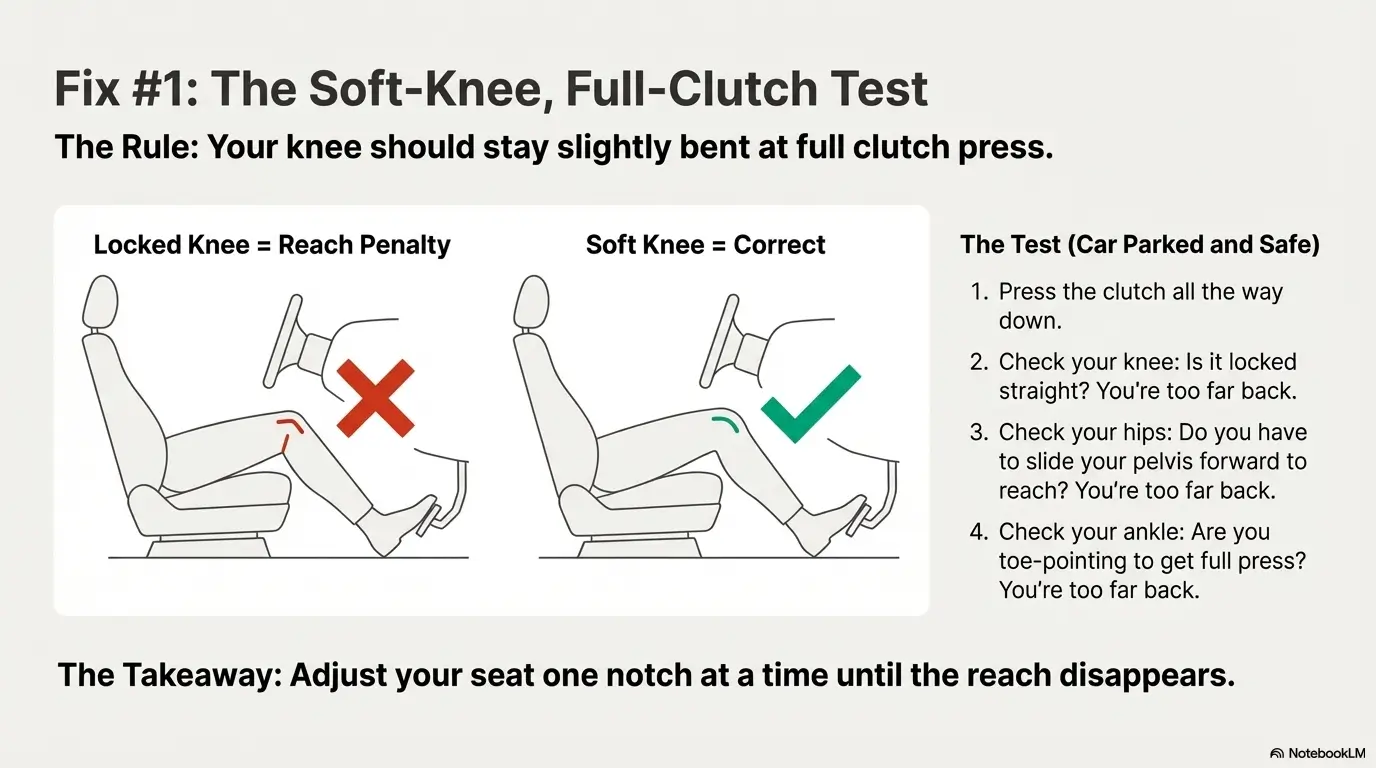
Seat distance rule: the soft-knee full-clutch test
This is the most practical fix in the whole article. It’s boring. It’s also the difference between “my leg flares every day” and “I can drive without thinking about my spine.”
Step 1: full clutch, knee still slightly bent (no pelvic slide)
With the car parked and safe, press the clutch all the way down. Your knee should be slightly bent—a “soft knee,” not locked out and not jammed into your chest. If you have to slide your hips forward, lift your heel, or twist your pelvis to get full press, you’re too far back.
Step 2: the “reach penalty” (toe-pointing = you’re too far)
If you find yourself toe-pointing (or your ankle is doing the whole job), you’re paying a reach penalty. Your body will pay it again at every light. Move the seat forward until you can press the clutch without your hip reaching and without your ankle straining.
Step 3: lock-in repeatability (mark the rail position)
If you share the car or your seat gets bumped, you’ll accidentally reintroduce the problem. A tiny piece of tape on the rail or a quick phone note (“Seat: 6 clicks forward from max back”) keeps your setup consistent.
- If you reach, you create nerve tension on repeat.
- Seat distance beats “better posture” 9 times out of 10.
- Consistency matters—mark your position.
Apply in 60 seconds: Move your seat one notch forward and re-test full clutch press. Stop when the reach disappears.
Show me the nerdy details
Why “soft knee” helps: a locked knee at end-range often comes with pelvic slide or toe-pointing, which can increase tension through the posterior chain. Keeping the knee slightly flexed tends to reduce end-range strain and makes the press more leg-driven instead of ankle-driven.
Dead pedal rule: where your left foot lives between shifts
The dead pedal (footrest) looks like a nothing-feature until you realize it’s the only place your left foot can truly rest without hovering. The rule is simple:
The rule: clutch or footrest—nothing in between
If you’re not clutching, your left foot lives on the dead pedal. Not on the floor. Not hovering. Not hooked under the pedal like you’re storing it for later. Those in-between positions keep your leg “on” all the time.
Heel support: why the floor is a trap
The floor often forces your leg to reach forward or outward, which quietly twists your pelvis. The dead pedal supports your heel so your ankle isn’t working overtime.
Open loop: why “resting” your foot can make pain worse
Because “resting” often means “holding tension in a weird position.” If your foot is hovering, your shin and hip stay slightly activated. Multiply that by 45 minutes and your nervous system starts protesting.
Money Block: Dead Pedal Quick Quiz (30 seconds)
- In traffic, my left foot is: on the footrest / hovering / on the floor.
- At red lights, I: hold clutch / neutral early (when safe) / mix randomly.
- After driving, my left leg feels: calm / tight / hot-wired.
Neutral next step: If you chose “hovering” or “floor,” commit to footrest-only between shifts for one commute and re-rate symptoms.
- Hovering keeps your leg “on.”
- Footrest + heel support reduces low-grade strain.
- A single commute is enough to test the effect.
Apply in 60 seconds: Say it out loud once: “Clutch or footrest.” Then do it.
Show me the nerdy details
Hovering creates sustained low-level activation in the hip flexors, shin, and stabilizers—often below your awareness. That steady “on” signal can amplify sensitivity. A supported heel on the footrest reduces that background load and can calm the system faster than stretching.
Clutch technique: press with your leg, not your ankle
Once your seat distance and foot placement are sane, technique becomes the icing. You’re not trying to drive like a robot. You’re trying to stop your ankle and hip from doing unnecessary extra work.
Heel-pivot method (stable heel, smooth press)
Lightly plant your heel (where possible) and let your knee/hip drive the press. If your heel can’t stay down comfortably, that’s usually a seat-distance or footrest issue—not a “you issue.”
Smooth is protective: no micro-pumps, no half-clutch hovering
Micro-pumps and long half-clutch holds keep you in the most demanding range. Aim for one continuous press, one clean shift, then foot back to the dead pedal.
Here’s what no one tells you… your jaw clench predicts your leg clench
If you catch yourself clenching your jaw or shoulders, your pelvis often tightens too. Do a simple reset: exhale, drop shoulders, then shift.
Micro-rule: “Press, shift, rest.” If your foot doesn’t return to rest, your nervous system never gets a break.
Show me the nerdy details
Technique matters most under fatigue: as you get tired, you default to ankle-only strategies and longer holds. Those habits increase end-range time and can amplify symptoms. Keeping presses smooth and brief reduces total exposure.
Stop-and-go protocol: red-light choices that save your left leg
Stop-and-go is where most manual drivers lose the war—because it’s not one clutch press. It’s fifty. And the second hour hurts more because your system has had time to stack the same stress repeatedly. This “exposure stacking” is the same reason prolonged sitting can flare you at work; if that’s part of your pattern too, this sit-stand schedule for a desk job with sciatica is a clean companion link for readers who need a day-to-day plan.
Neutral early (when safe) vs clutch held (when necessary)
When you’re stopped for more than a moment, many drivers do better shifting to neutral and releasing the clutch—when it’s safe for your situation. (Follow your local rules and always prioritize safe driving.) Holding the clutch down at every stop keeps your leg in sustained tension.
Micro-reset in 10 seconds (breath + tiny posture change)
- Exhale slowly for 6 seconds.
- Let your shoulders drop.
- Do a tiny pelvic tilt forward/back (small range, painless).
Curiosity gap answered: why the second hour hurts more
Because tissues and nerves don’t only react to “how hard” something is. They react to how long and how repetitive it is. Stop-and-go increases end-range time, hovering time, and clenching time. That’s why your setup can feel “fine” at minute 10 and awful at minute 55.
- Neutral early can reduce sustained tension (when safe).
- 10-second resets prevent the “stacking” effect.
- Stop-and-go hurts because repetition is sneaky.
Apply in 60 seconds: At the next long light, do one slow exhale and place your foot fully on the dead pedal.
Money Block: Decision Card — “Hold clutch” vs “Neutral early”
- You’re stopped for more than a brief moment.
- You can keep full attention on traffic and restart smoothly.
- Your leg flares with sustained clutch holds.
- You’re inching forward continuously.
- Safety requires immediate movement.
- You can’t safely shift to neutral in the moment.
Neutral next step: Pick one rule for your commute (e.g., “Neutral if stopped > 10 seconds when safe”) and track symptoms for one week.
Seat + wheel alignment: stop twisting your pelvis to reach
Sometimes the clutch isn’t the whole story. Sometimes your pelvis is quietly twisted because you’re reaching for the wheel or bracing against the seat in a weird way. Your body will tolerate that—until it doesn’t.
Wheel closer, reach less (reduce pelvic rotation)
If you reach forward, your pelvis often rotates and your low back loses stable contact with the seat. Bring the wheel closer (if adjustable) so your shoulders stay relaxed and your spine doesn’t “chase” the steering wheel.
Lumbar support: “low and modest,” not over-arched
A small rolled towel at the low back can help, but “more support” isn’t always better. The goal is gentle contact—not a dramatic arch that makes you feel like you’re posing for a posture poster. If you want a quick, no-equipment stability reset to pair with “low and modest” support, the McGill Big 3 in 10 minutes is a simple internal reference readers can run outside the car.
Cushion/wedge test: when it helps, when it backfires
A wedge can reduce hip flexion for some people. For others it raises the seat too much and changes pedal control. If you test a cushion, do it on a short, low-stakes drive first.
Operator tip: If your hips slide forward during driving, your lumbar support is too aggressive—or your seat is too reclined.
Common mistakes: the 7 habits that keep manual drivers stuck
This section is where most competitor articles get generic. We’re not doing generic. We’re doing the specific stuff that ruins your day while pretending to be “normal driving.”
Mistake 1: sitting too far back “for safety”
Yes, you want control. But too far back forces hip reach and toe-pointing. That’s not control—that’s a slow-motion flare.
Mistake 2: hovering your foot over the clutch
Hovering feels prepared. It’s actually constant tension. Put the foot on the dead pedal.
Mistake 3: toe-pointing to reach the pedal
If your ankle is doing hero work, your leg is quietly paying the bill. Move the seat closer.
Mistake 4: riding the clutch in slow traffic
Long half-clutch holds keep you in the most demanding range. When possible, aim for cleaner “press/shift/rest” cycles.
Mistake 5: twisting to reach the wheel/shifter
Twist equals asymmetry. Asymmetry plus repetition equals flare. Adjust wheel position and sit square.
Mistake 6: stretching aggressively right after driving
If nerves are sensitized, aggressive stretching can feel like it helps for 30 seconds and then bites back. Start with walking and gentle movement first. If you’re looking for a safer next layer beyond “seat tweaks,” consider linking readers to physical therapy for sciatica (what it targets and how it’s typically structured) so the step-up feels practical—not vague.
Mistake 7: ignoring worsening numbness/weakness
Progressive numbness or weakness is not a “try harder” moment. It’s a “get evaluated” moment.
- Fix seat distance first, then foot placement.
- Stop hovering (it’s not rest).
- Be strict about red flags (weakness/numbness changes).
Apply in 60 seconds: Pick one habit to delete today: hovering. Replace it with dead pedal every time.
FAQ
1) Why does my sciatica flare when I press the clutch?
Often it’s the combination of hip flexion, end-range pressing, and subtle ankle tension—plus the time spent hovering your foot near the pedal. Seat distance and the dead-pedal rule usually reduce symptoms faster than stretching alone.
2) How far should my seat be from the clutch pedal?
Far enough that you can fully depress the clutch without your knee collapsing inward, but close enough that your knee stays slightly bent at full press. If you toe-point or slide your hips forward to reach, you’re too far back.
3) Should my knee be straight when the clutch is fully down?
No. A locked knee usually means you’re reaching. Aim for a “soft knee” at full press to avoid end-range tension and pelvic shift.
4) Is it bad to hold the clutch in at red lights?
For many people with nerve-sensitive legs, sustained clutch holds can increase symptoms. When it’s safe and practical, shifting to neutral and releasing the clutch at longer stops can reduce cumulative tension.
5) Does using the dead pedal actually help sciatica?
It can. The footrest gives your left leg a true “off” position between shifts. If you currently hover or rest on the floor, switching to dead pedal only is a clean, low-risk experiment.
6) Can piriformis syndrome feel worse when driving stick shift?
Yes, deep buttock pain and sitting sensitivity can overlap with nerve-like symptoms, and driving posture can aggravate it. The same geometry fixes (less twist, less reach, more support) often help.
7) What seat cushion is best for sciatica while driving?
There isn’t one universal winner. A modest lumbar roll can help some people maintain stable contact. A wedge can reduce hip flexion for others. Test on short drives, and avoid anything that changes pedal control. If your bigger struggle is what happens later (night pain, sleep position flare), you may also want to link readers to mattress firmness for sciatica and how to sleep with sciatica so the “24-hour loop” makes sense.
8) Why does the pain hit after the drive, not during?
Repetition stacks. You may feel “fine” until your nervous system hits its threshold—often after sustained hovering, end-range pressing, or clenching in traffic. That timing strongly points to habit + exposure rather than a single motion.
9) When is leg numbness while driving an emergency?
If numbness affects pedal control, or if you have new significant weakness, saddle numbness, or bowel/bladder changes, seek urgent medical evaluation. Don’t keep driving and hope it fades mid-commute.
10) Do I need imaging (MRI) for sciatica?
Not always. Many cases improve with conservative care, and imaging is typically considered when severe symptoms, progressive neurological changes, or persistent symptoms suggest a need for further evaluation. A clinician can guide that decision based on your exam and history. If readers are cost-anxious and avoiding evaluation purely because of price uncertainty, this lumbar MRI cost on an HDHP page can be a helpful internal “next click” without pushing anyone into imaging.
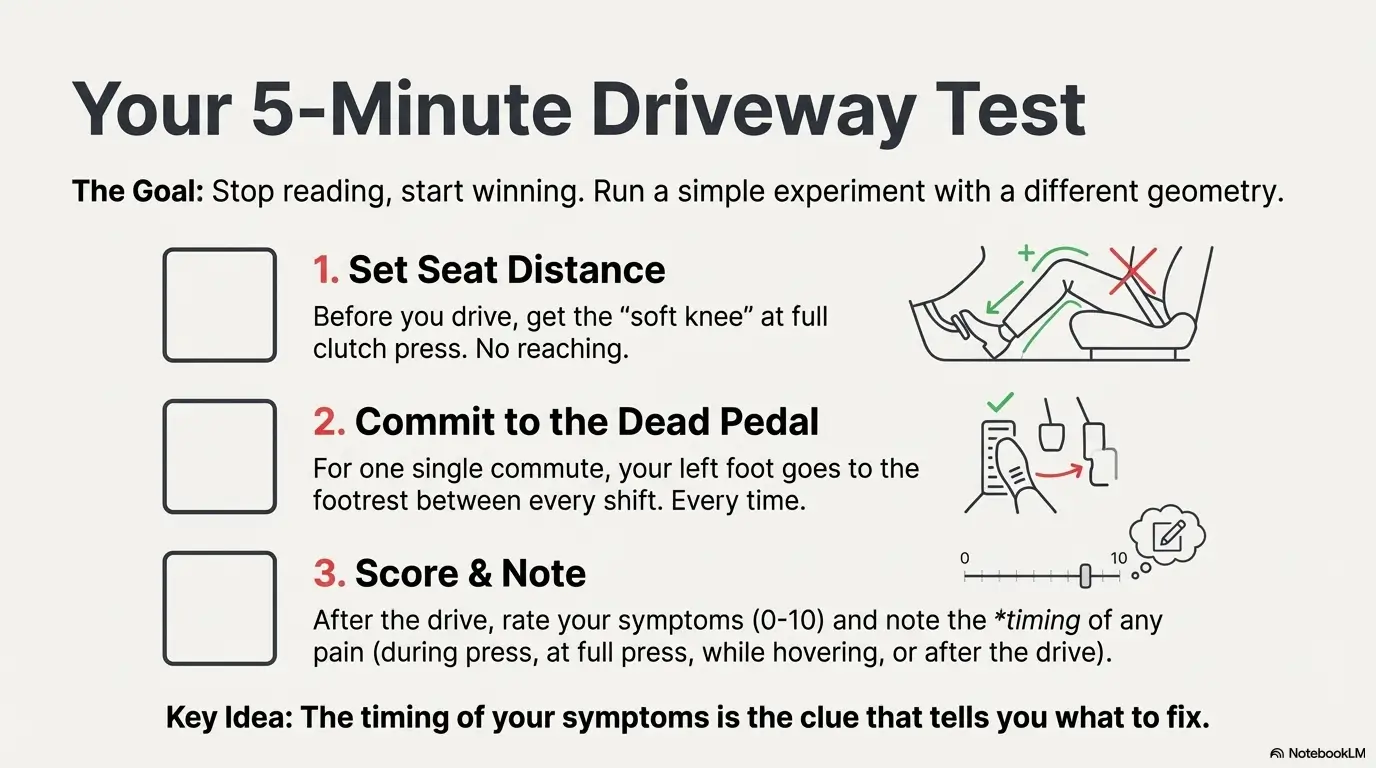
Next step: the 5-minute driveway test (one action)
This is the part where you stop reading and start winning. You’re going to run a simple experiment—same car, same route, different geometry.
Step 1: set seat distance (soft-knee at full clutch)
Press the clutch fully. Adjust until your knee stays slightly bent and your pelvis doesn’t slide. No toe-pointing. No reaching.
Step 2: commit to dead pedal rule for one commute
Between shifts, your left foot goes to the footrest. Every time. If you catch yourself hovering, reset without drama.
Step 3: score symptoms 0–10 + note timing
After the drive, rate symptoms and note the timing: during press, at full press, hovering, or after driving. Timing is the clue that tells you what to fix next. If you want to turn that into a cleaner tracking habit (especially if symptoms affect work or daily function), this pain diary template is a practical internal resource for documenting patterns without overthinking it.
Money Block: 60-second “Clutch Flare Risk” Mini Calculator
Answer three quick inputs. This is not medical diagnosis—just a self-check for geometry/habit exposure.
Score: —
Neutral next step: Whatever your score, run the driveway test once this week and write down the timing of symptoms. That’s your most useful data.
Conclusion: close the loop and keep your next commute calm
Remember the open loop from the beginning—why it can hurt after the clutch press, not during? Because your body keeps receipts. It doesn’t only react to a single press. It reacts to repetition, end-range time, and hovering tension. The good news is you can change those variables without changing your life.
Start small: seat one notch forward, foot on the dead pedal, and a simple “press, shift, rest” rhythm. Give it one commute. If symptoms settle, you’ve found your lever. If they don’t, your symptom timing still gave you useful information to share with a clinician.
And if your brain spirals into worst-case searches at 2 a.m. after a flare, it helps to name that pattern too—this piece on cyberchondria and chronic pain can be a calming internal “next click” that keeps readers grounded.
Infographic: The “Clutch-Leg Pain” Fix Map
Follow the arrows—top to bottom—until your symptoms calm.
Soft knee at full clutch press (no hip slide, no toe-pointing).
Clutch or footrest—nothing in between. Heel supported.
Reduce clutch-held time (neutral early when safe) + 10-second reset.
Bring wheel closer, keep lumbar “low and modest,” stop pelvic twist.
During press vs end-range vs hover vs after driving—then adjust.
Last reviewed: 2026-01.