
Clean Without the “Pain Invoice”
Sciatica-friendly bathroom cleaning isn’t about “better posture.” It’s about avoiding the invoice that arrives at dinner—when your bathroom looks fine, but your leg starts buzzing like a live wire.
The problem isn’t one dramatic bend. It’s the stack: hinge-and-reach at the sink, twist-and-scrub in the shower, then forty little “floor orbits” around the toilet base. Your nervous system keeps score long after you’ve put the brush away.
This post gives you a safer system: 10-minute cleaning sessions, kneeling alternatives, and a no-bend setup—using long-handle tools plus a “spray-and-wait” routine that replaces brute force with dwell time. If you’ve ever had the same “delayed flare” pattern from standing desk sciatica, you already understand the logic: the body often bills you later.
Dwell Time (contact time): The minutes a cleaner or disinfectant must stay wet on a surface to work effectively—so you can wipe with less scrubbing and fewer bent, braced reps.
Start by mapping your three trigger moves, then run one zone like a short, controlled mission—timer on, stop on purpose, and check your symptoms 2–6 hours later.
Table of Contents
1) Who this is for / not for
For you if…
- Bathroom chores trigger radiating leg pain, hip tightness, or that low-back “electric” flare.
- You want a repeatable 10-minute routine, not one exhausting “cleaning day.”
- You’re willing to change tools + setup (the boring stuff that actually matters).
Not for you if…
- You have new weakness, foot drop, loss of bowel/bladder control, fever, or severe unrelenting pain.
- Your clinician has you on strict no-bend/no-twist restrictions after a recent injury or surgery.
- You’re looking for a “just tough it out” approach. This is the opposite.
Real talk: sciatica-like pain isn’t a personality flaw. It’s a nervous system that remembers positions. One of my least glamorous memories is “just quickly wiping the tub” and then spending the evening bargaining with my own hamstring. That’s the point of this guide: less bargaining, more predictable outcomes.
- Short sessions beat heroic scrubbing.
- Tool length replaces spine bending.
- Delayed pain is the scoreboard that counts.
Apply in 60 seconds: Put a timer on your counter right now. Make “10 minutes” non-negotiable.
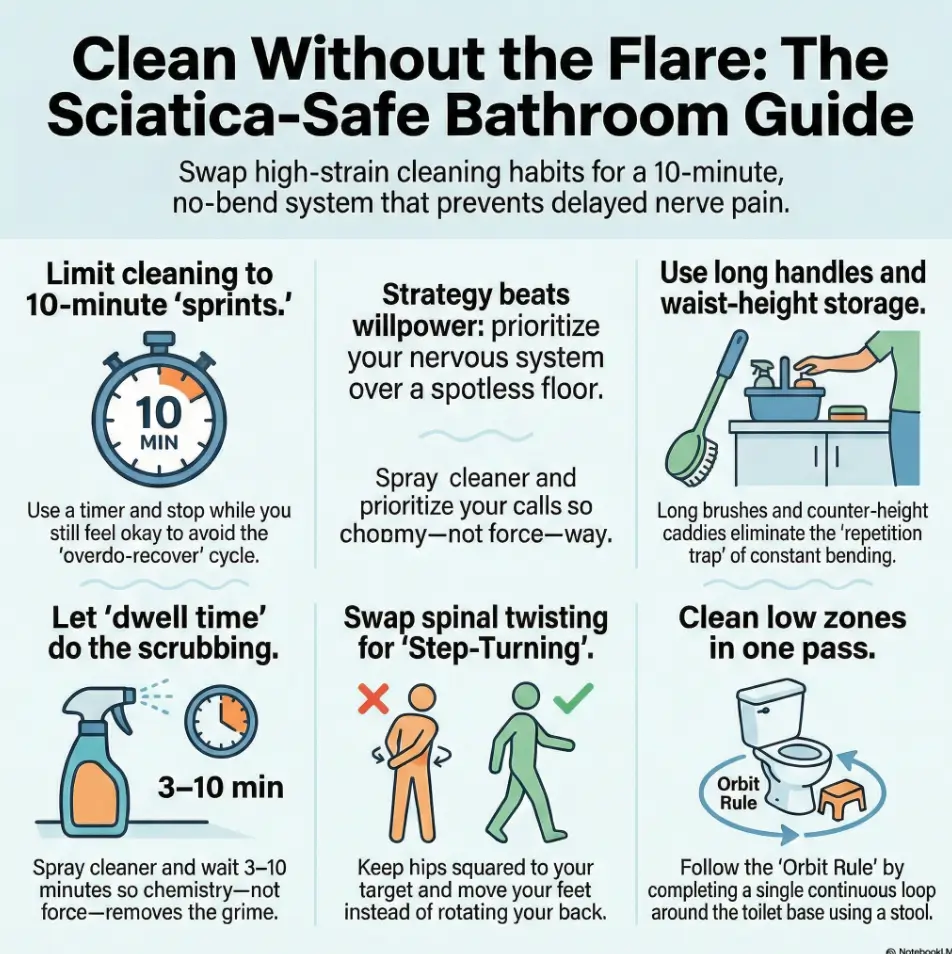
2) Trigger map first: the 3 bathroom moves that spike sciatica
Before we talk tools, we map triggers. Not because you need more “awareness”—because awareness lets you replace the one move that’s quietly lighting you up. Ergonomics guidance repeatedly calls out the usual suspects: awkward postures (bending, twisting, reaching) and staying in one position too long. That’s the bathroom, basically.
The “hinge + reach” combo (sink & counter wipe-downs)
- Why it bites: a long forward reach turns into a static hold. Your spine stabilizers work overtime.
- What it feels like: you’re fine while wiping… then the ache builds as soon as you stand tall.
- Swap: move your feet closer, raise the work (caddy at counter height), and use a microfiber on a short-handled squeegee so your arm does the reaching—not your back. If the sink is your daily trigger outside the bathroom too, borrow ideas from washing dishes with sciatica (same hinge + reach pattern, different room).
The “twist and scrub” trap (tub walls & shower corners)
- Why it bites: rotation under load, usually on a slippery base. Your body braces harder than you realize.
- Swap: square hips to the target and step-turn. If your feet don’t move, your spine will.
The “floor orbit” (toilet base, grout, around the trash can)
- Why it bites: repeated low bends plus position changes. It’s not “one bend,” it’s 40 micro-bends.
- Swap: choose one low-work posture (stool or half-kneel) and do a single continuous pass.
Tiny confession: I used to think “the floor is the problem.” It wasn’t. It was the constant re-aiming—down, up, twist, down, shuffle. The nervous system hates surprise. This whole article is about reducing surprise.
Money Block: Quick eligibility checklist (yes/no)
- Yes if pain reliably spikes with bending/twisting or shows up later the same day.
- Yes if you avoid cleaning because you fear the flare (totally rational).
- No if you have red-flag symptoms (new weakness, bowel/bladder changes)—get medical guidance first.
Neutral next step: If you checked “yes,” choose one trigger move above and replace it today.
3) The 10-minute rule: clean in sprints, not battles
Here’s the fastest win for sciatica-friendly bathroom cleaning: stop cleaning like you’re training for a gritty montage. Most flares happen because we stack too much time in one posture. Ten minutes sounds almost insulting—until you realize it’s a scheduling trick that protects your nervous system.
Build a 10-minute “minimum viable clean”
- Day 1: Toilet exterior + seat (no base/bolts).
- Day 2: Sink + faucet + mirror.
- Day 3: Shower quick pass (spray-and-wait, then light wipe).
- Day 4: Floor “paths only” (traffic lanes, not perfection). If floors are your repeat offender, you’ll want a dedicated strategy for mopping with sciatica that keeps low work short and tool-driven.
Recovery pacing that actually works
- Use a timer and stop while you still feel “okay.” That’s not quitting—that’s strategy.
- Every 2–3 minutes, do a 30–60 second upright reset: step back, breathe, shift weight.
- Alternate tasks: standing wipe → upright reset → tool-based scrub → reset.
Let’s be honest—pain shows up later
Judge success by how you feel 2–6 hours after, not during. If you’re good at powering through, you’re also good at missing the early warning signs. I once “felt great” finishing the whole bathroom—then took the stairs like a cautious crab that evening. Lesson learned: the body sends invoices after the cleaning party ends.
- Time cap beats willpower.
- Resets prevent static bracing.
- Zones create progress without punishment.
Apply in 60 seconds: Write your Day 1 zone on a sticky note: “Toilet exterior only.” Stick it to the mirror.
Money Block: 10-minute pacing mini calculator
Use this to keep sessions honest (and short).
- Input 1: Session length = 10 minutes
- Input 2: Reset breaks = 3 breaks × 45 seconds
- Input 3: Work blocks = remaining time ÷ 3
Output: You’ll work about 2–2.5 minutes at a time before an upright reset. That’s the sweet spot for many flare-prone backs.
Neutral next step: Set a repeating timer: 2 minutes work, 45 seconds reset. If you like structured pacing, you’ll also appreciate a dedicated sit-stand schedule for desk-job sciatica (same logic, different context).
4) No-bend setup: redesign the bathroom like a workstation
The bathroom is an ergonomics trap: small room, hard surfaces, awkward angles, and supplies stored where you have to bend to earn them. So we flip it. We make it behave like a workstation: tools at the right height, fewer trips, less bending, less twisting. Even OSHA ergonomics guidance emphasizes working near waist height to reduce awkward postures and using carts/conveyors when possible. You don’t need a conveyor belt (unless you want one—no judgment). You need smarter placement.
Counter-height “cleaning caddy” placement
- Keep sprays, wipes, brush, gloves at waist-to-chest height.
- If your only storage is under the sink, add a small caddy that lives on the counter during cleaning days.
- Rule: if you have to bend to get the cleaner, you’ll bend again to put it back. That’s two reps you didn’t budget for.
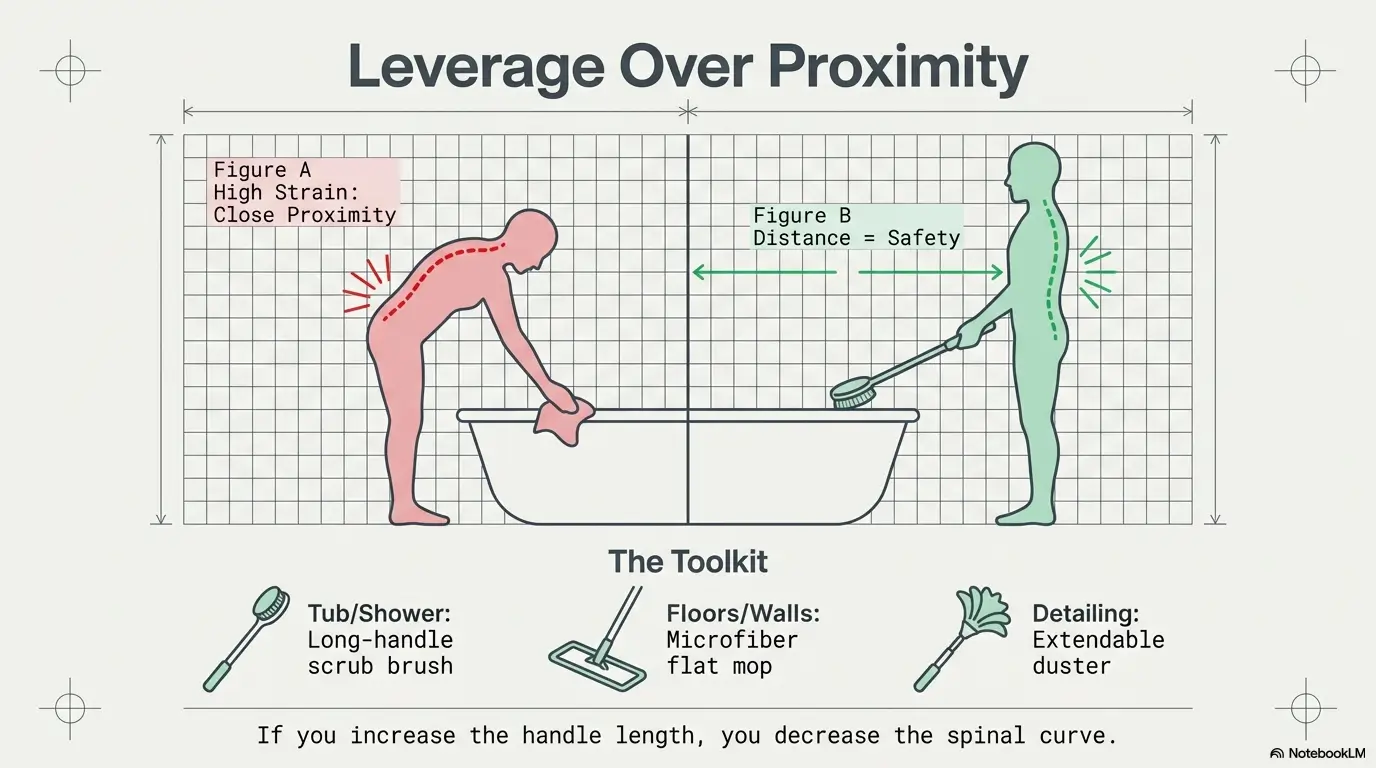
Long-handle toolkit (what to reach for)
- Long-handle scrub brush / tub brush
- Microfiber flat mop (floors and walls)
- Extendable duster (vents, shelves, light fixtures)
- Spray bottle for “apply-and-walk-away” dwell time
Slide, don’t lift: friction-friendly moves
- Use a small bin you push along the counter or floor instead of carrying one-handed.
- For heavier items (like big refill bottles), stage them once and decant into a smaller spray bottle.
- Keep towels on a hook at arm height—no digging through low drawers.
Show me the nerdy details
In ergonomics language, you’re reducing “awkward posture exposure” (bending/twisting), “static load” (holding positions), and “repetition” (extra trips). The bathroom punishes all three. A counter-height caddy reduces repetition. Long handles reduce bending. A pushable bin reduces asymmetrical carrying, which can provoke bracing and pelvic tilt—two common flare ingredients.
If “raise the work” is a concept you want to apply beyond the bathroom, see how a cutting board riser for sciatica uses the same workstation principle (height changes reduce hinge time).
My own “aha” moment was embarrassingly small: moving gloves and microfiber cloths from under the sink to a basket on the counter. That one change cut the number of bends in half. It wasn’t a miracle. It was math.
5) Kneeling alternatives: 5 ways to do “low work” without the flare
Low work is where sciatica-friendly bathroom cleaning usually breaks down. You either kneel, squat, or bend—and none feel great on a flare-prone day. The trick is to choose one alternative posture and keep it consistent for short bursts. Consistency reduces the “position roulette” that irritates nerves.
Option A: High stool + forward-facing angles (sink, tub edge)
- Keep hips higher than knees (generally more back-friendly than deep squats).
- Scoot with your feet instead of twisting your spine.
- Use the stool for tub-edge scrubbing with a long-handle brush—your arm does the work.
Option B: Supported half-kneel (one knee down, one foot planted)
- Use the tub edge or vanity as a support point.
- Switch sides every 60–90 seconds to avoid loading one hip.
- If your symptoms hate kneeling, skip this and go stool or standing-only.
Option C: The “golfer’s reach” for quick pickups (one hand on support)
- One hand stabilizes on the counter or vanity.
- The other hand does the reach while one leg extends back slightly—reduces spinal flexion.
Option D: Side-sit on a folded towel (short bursts only)
- Rotate your whole body—avoid twisting from the spine.
- Use this only for 30–60 second bursts (set a tiny timer if you tend to “get into it”).
Option E: Standing-only strategy (tools + dwell time)
- Let chemistry + time replace force.
- Long-handle tools make “standing-only” realistic, not aspirational.
Money Block: Decision card — Stool vs. Half-kneel vs. Standing-only
- If bending triggers symptoms quickly
- If you tolerate sitting better than kneeling
- If you want stability on wet floors
Trade-off: You must scoot/step-turn, not twist.
- If you need close access to the toilet base
- If one-knee-down feels okay in short bursts
- If you can switch sides often
Trade-off: Don’t camp here—time-box it.
- If kneeling/squatting is a guaranteed flare
- If you have long-handle tools
- If you can use dwell time
Trade-off: You’ll rely on “apply → wait → wipe,” not brute force.
Neutral next step: Pick one option and commit for 7 days—no switching mid-task unless pain demands it.
Personal note: my body loves the stool. It’s not stylish, but neither is hobbling. If you’re choosing between “feels silly” and “feels inflamed,” pick silly.
If shower work is the hardest part (slippery floor + awkward angles), you may also want a specific sciatica shower chair setup approach so “low work” becomes stable, time-boxed, and less twisty.
6) Spray-and-wait system: the low-effort chemistry that saves your back
Scrubbing is expensive. Not financially—physically. The secret lever is “dwell time” (also called contact time): you apply cleaner or disinfectant and let it sit long enough to work, then wipe with less force. Public health guidance explains that contact time is the period the surface should stay wet so the product can do its job; it’s often listed in the directions and safety info. Translation: if you spray and instantly wipe, you just added extra reps for no benefit.
Dwell time is the hidden lever (and why scrubbing backfires)
- Apply → wait → wipe. You reduce “force minutes,” the thing your back remembers.
- Waiting 3–10 minutes can feel slow, but it’s actually faster because you stop re-scrubbing the same spot.
- Use the wait time for an upright reset or a standing task (mirror, faucet, counter).
Sequence that cuts bending in half
- Start high: walls/fixtures first while you’re fresh and upright.
- End low once: edges/floor at the end so you don’t keep returning to low work.
- One low pass: treat low cleaning like a single “event,” not a recurring interruption.
Why “cleaner” isn’t cleaner
Over-spraying is the most common mistake I see in my own bad habits. More product = more wiping = more bends. Targeted application is kinder to your back and often just as effective. Use enough to keep the surface wet for the intended time—then stop. (Yes, this is me telling my past self to stop panic-spraying the shower like it’s on fire.)
Show me the nerdy details
Think of cleaning effort as a triangle: chemistry (product), time (dwell), and mechanical action (scrubbing). If you increase chemistry and time, you can decrease mechanical action. Sciatica-friendly systems intentionally shift the triangle away from mechanical action because that’s what amplifies bending, twisting, and bracing.
- Use time, not force.
- Work top-to-bottom once.
- Keep low work as a single final pass.
Apply in 60 seconds: Next time you spray the shower, set a 5-minute timer and walk away on purpose.
7) Toilet zone without regret: a sciatica-safe approach to the base & bolts
The toilet base is where good intentions go to die. It’s awkward, low, and it demands repositioning. The sciatica-safe move is to stop circling the toilet like you’re searching for Wi-Fi. You do one pass, with one posture, with one tool strategy.
The “orbit rule” (don’t circle the toilet repeatedly)
- Choose your posture (stool, supported half-kneel, or standing-only).
- Do one continuous pass: back → sides → front → floor edge.
- Then you’re done. No bonus laps.
Tool angles that reduce spinal twist
- Face the target. Move feet, not your spine.
- Use a long-handle detail brush or an angled scrubber so your wrist turns—not your torso.
- If you’re wiping, fold the cloth into quarters so you can flip to a clean face without re-bending for a new towel.
Here’s what no one tells you…
The toilet base isn’t hard because it’s dirty. It’s hard because you keep changing positions. Every position change is a mini load: down, twist, stand, shuffle, down again. Your sciatic nerve doesn’t care that your bathroom smells like lemon now.
Personal anecdote: I used to clean the base in “little moments” throughout the session. That was the worst. Now I treat it like a single mission: posture chosen, tools staged, one pass, done. My back stopped feeling like it was negotiating a hostage situation.
8) Common mistakes that make sciatica flare during cleaning
Most flare-ups aren’t caused by one dramatic movement. They’re caused by the boring stuff: extra reps, poor leverage, and staying stuck. Here are the mistakes that quietly stack load—and the fixes that actually change outcomes.
Mistake #1: One long session “to get it over with”
- Fix: 10-minute sessions + a stop-point list.
- Operator tip: Stop mid-clean if you have to. A half-cleaned sink is better than a three-day flare.
Mistake #2: Scrubbing harder instead of changing leverage
- Fix: long handle + dwell time + neutral spine.
- Reality check: “Harder” usually means “more bent.”
Mistake #3: Twisting while your feet stay planted
- Fix: step-turn; square hips to the work.
- Micro rule: if your shoulders turn, your feet follow.
Mistake #4: Working at the wrong height (too low / too far)
- Fix: raise tasks, bring tools closer, use a stool.
- Hack: pull the bath mat away so you can step closer without slipping.
Show me the nerdy details
Small improvements compound because cleaning is repetitive. If you eliminate 20 unnecessary bends per session, over 12 sessions you’ve avoided 240 bends. For flare-prone backs, repetition matters as much as intensity. This is why “setup” outperforms “motivation.”
Money Block: “Quote-prep” list for buying tools (so you don’t waste money)
- Your toughest zone (shower walls, grout line, toilet base, or floors).
- Your worst trigger move (hinge+reach, twist+scrub, floor orbit).
- Your preferred posture (stool, half-kneel, standing-only).
- Storage reality (counter caddy possible? under-sink only?).
- Grip comfort (thick handle vs thin handle; glove compatibility).
Neutral next step: Take one photo of your bathroom’s tightest corner. Buy tools that match that geometry.
A small, human truth: I used to buy “more powerful” products when I should have bought “longer handles.” The handle was the real upgrade. And if you tend to overload one hand (bucket, refills, tool bag), it helps to know a practical grocery bag weight limit for sciatica mindset—because asymmetrical carrying is a sneaky bracing trigger.
9) Don’t-do-this list: the 7 moves to avoid on flare-prone days
On good days, you can get away with things. On flare-prone days, you need a short blacklist. This list isn’t about fear—it’s about choosing the version of cleaning that doesn’t punish you later.
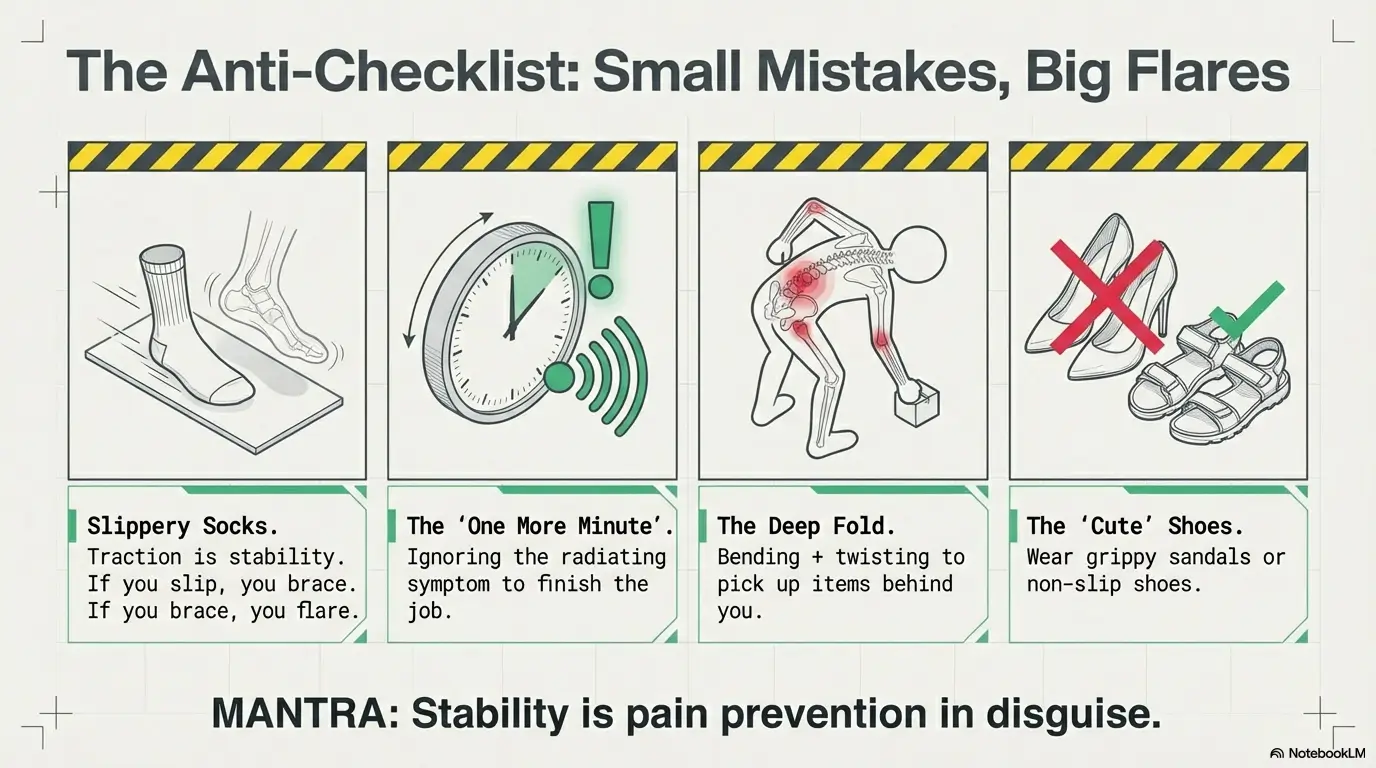
- Avoid: deep forward fold + reach (especially on wet floors).
- Avoid: kneeling with toes tucked under for long periods (it locks you in place and tempts twisting).
- Avoid: fast repetitive scrub strokes (small range, high load).
- Avoid: carrying heavy buckets one-handed (asymmetrical bracing is sneaky).
- Avoid: bending + twisting to pick up items behind you.
- Avoid: “one more minute” when symptoms start radiating.
- Avoid: slippery socks/shoes that force constant bracing.
One of my most ridiculous flare triggers was “cleaning in cute socks.” They were adorable. They were also a traction disaster. The moment your body feels unstable, it braces. Bracing plus twisting is a classic recipe for next-day regret.
- Grip the floor with safe footwear.
- Eliminate “surprise” slips and reaches.
- Stop when symptoms start traveling downward.
Apply in 60 seconds: Put one pair of non-slip shoes (or grippy sandals) by the bathroom door.
10) Curiosity gaps: small changes that feel “too easy” but work
Here’s the weird part: the changes that help most often feel too easy to be “real.” That’s because we’re trained to believe pain requires effort. But sciatica-friendly bathroom cleaning is mostly about removing friction—literal and figurative.
Open-loop #1: The two-towel trick for floors (reduce bending reps)
- Towel 1: lightly damp for picking up residue.
- Towel 2: dry pass—press with your foot and glide (less bending, more leverage).
- Bonus: you can do this standing with a hand on the counter for stability.
Open-loop #2: Why cleaning left-to-right can reduce pain
- A predictable pattern reduces awkward repositioning.
- Your body stops improvising (improvising = twisting).
- It also reduces rework because you stop forgetting what you already wiped.
Open-loop #3: The “park the tools” rule (and why it matters)
- Same storage spot = fewer extra bends across the week.
- Fewer “where did I put the brush?” moments = fewer frantic reaches.
- It’s boring. It works.
I’ll admit it: I used to treat cleaning like a scavenger hunt—cloth in one room, spray in another, gloves under the sink. My back hated that storyline. Now tools live in one place, and the bathroom stays “good enough” without drama.
+ 45-second upright resets
or standing-only tools
+ long-handle brush / flat mop
Less force, fewer reps
Goal: maintain “clean enough” with fewer bends, twists, and delayed flares.
FAQ
1) What is the best way to clean a bathroom if bending triggers sciatica?
Use 10-minute sessions and a no-bend tool setup: counter-height caddy, long-handle brush, and a flat mop for floors/walls. Pair it with spray-and-wait so you’re wiping, not grinding. The key is limiting total time in flexed postures and keeping low work to one final pass.
2) Is kneeling bad for sciatica, and what can I do instead?
Kneeling isn’t universally “bad,” but for many people it encourages twisting and staying stuck too long. Alternatives include a high stool, a supported half-kneel (time-boxed), the golfer’s reach with one hand on support, or a standing-only strategy with long-handle tools and dwell time. Choose one posture and keep it consistent.
3) What long-handle tools actually work for tubs and showers?
Look for a long-handle tub brush (so you can square up and step-turn), plus a microfiber flat mop that can handle walls and floors. The goal is leverage: your shoulders and arms move while your spine stays more neutral. If your grip gets tired, prioritize thicker, more comfortable handles.
4) How long should I wait after spraying cleaner before wiping to reduce scrubbing?
Follow the product directions and safety guidance for contact time. Public health guidance describes contact time (dwell time) as how long the surface should stay wet for the product to work. Practically, many people find 3–10 minutes is a useful window for bathroom soil—use the wait for an upright reset or a standing task.
5) Can a stool help with sciatica during cleaning, and what height is best?
A stool often helps because it reduces deep bending and lets you work forward-facing. A “good” height is one where your hips are slightly higher than your knees and you can scoot with your feet. If the stool forces you to hunch, it’s too low. If it feels unstable, it’s not the right one for wet-floor tasks.
6) How do I clean around the toilet base without twisting my back?
Use the orbit rule: pick one posture, then do one continuous pass (back → sides → front → floor edge). Face the target and step-turn; don’t plant your feet and twist. A long-handle detail brush or angled scrubber helps you reach without spinal rotation.
7) Why does sciatica pain show up hours after cleaning?
A common pattern is delayed irritation from cumulative exposure: repeated bending, twisting, and bracing adds load over time. Your nervous system may “hold it together” during the task, then flare later when tissues cool down or you finally stop moving. That’s why this guide treats 2–6 hours later as the real performance metric.
12) Next step: your “10-minute bathroom plan” for tomorrow
Tomorrow, you’re not “cleaning the bathroom.” You’re running a pilot. Ten minutes. One zone. One stop on purpose. This is how you teach your body that cleaning doesn’t automatically mean punishment.
Do this once (10 minutes total)
- Put a small caddy at counter height (spray, cloths, gloves).
- Set a timer for 10 minutes.
- Clean one zone only (toilet exterior or sink) using spray-and-wait.
- Stop on purpose, then note how you feel 2–6 hours later.
I know stopping early can feel irrational—especially if you grew up in the church of “finish what you started.” But the goal is repeatability. Your future self cares more about consistency than one sparkling day.
Short Story: I used to do bathroom cleaning like a dare. Saturday morning, coffee in one hand, scrub brush in the other—full send. I’d crouch at the tub, twist to reach the corner, stand to rinse, crouch again, and pretend the little electric twinge down my leg was “nothing.” Around lunchtime, I’d feel proud. Around dinnertime, I’d feel betrayed. One day I tried something that felt almost silly: ten minutes, timer on, one zone.
I sprayed the shower, set the bottle down, and walked away. I wiped the sink with my feet planted, step-turning like an awkward dancer. When the timer chimed, I stopped—mid-story. The bathroom wasn’t perfect, but my leg didn’t light up later. That’s when I realized: the goal isn’t to win cleaning. The goal is to keep living after it.
- One zone prevents position roulette.
- Stopping early prevents delayed flares.
- Tracking later symptoms makes progress measurable.
Apply in 60 seconds: Put your timer where you can’t “accidentally” ignore it.
If you want a tiny “reset routine” that fits the same 10-minute philosophy (especially after chores), you might like the McGill Big 3 in 10 minutes format—simple, time-boxed, and designed to avoid the overdo/overstretch trap.
Conclusion
Let’s close the loop from the beginning: why does this feel unfair? Because bathroom cleaning is a perfect storm of bending, twisting, and static bracing—then the nervous system sends the bill later. The fix isn’t a heroic spine. It’s a smarter system: 10-minute sessions, one posture choice for low work, long-handle leverage, and spray-and-wait time that replaces force.
If you want one trustworthy safety anchor: major medical guidance lists “get checked now” signs like sudden weakness/numbness in the leg or bowel/bladder control trouble. If anything like that is on your radar, pause the chore-optimization project and get medical guidance.
And if you want an operator’s “setup truth”: reducing awkward posture exposure often means bringing work closer to waist height and choosing push/slide strategies instead of awkward lifting. Treat your cleaning gear like a workstation kit, not a scavenger hunt.
Your next step—within 15 minutes—is simple: stage a counter-height caddy, set a timer, and do one zone tomorrow. If you’re feeling ambitious, pick the worst trigger move (hinge+reach, twist+scrub, or floor orbit) and replace it with one tool or one posture change. That’s the kind of “small” that compounds.
If the “invoice” reliably shows up at night, it’s worth pairing chore strategy with a calmer end-of-day plan—starting with how to sleep with sciatica so you’re not negotiating with nerve pain at 2 a.m.
Last reviewed: 2026-01.