

Sciatica vs Piriformis Syndrome: 7 Brutal Mistakes I Made Before I Finally Fixed the Real Pain
Sciatica vs. Piriformis Syndrome:
Stop the Guessing Game
“I lost 3–4 weeks because I treated ‘sciatica’ like a diagnosis instead of a pattern.”
The pain looked textbook—burning leg, stubborn streak, the whole dramatic script—so I chased the spine and ignored the small muscle that was quietly running the show. If you’re stuck in the fog, you know the feeling: you can’t sit, you can’t focus, and every “helpful” stretch online feels like a coin flip.
Keep improvising, and you risk turning a fixable flare into a longer, pricier mess. Piriformis syndrome mimics classic sciatica, but the difference lies in the trigger: Does prolonged sitting worsen you, or is it spinal strain?
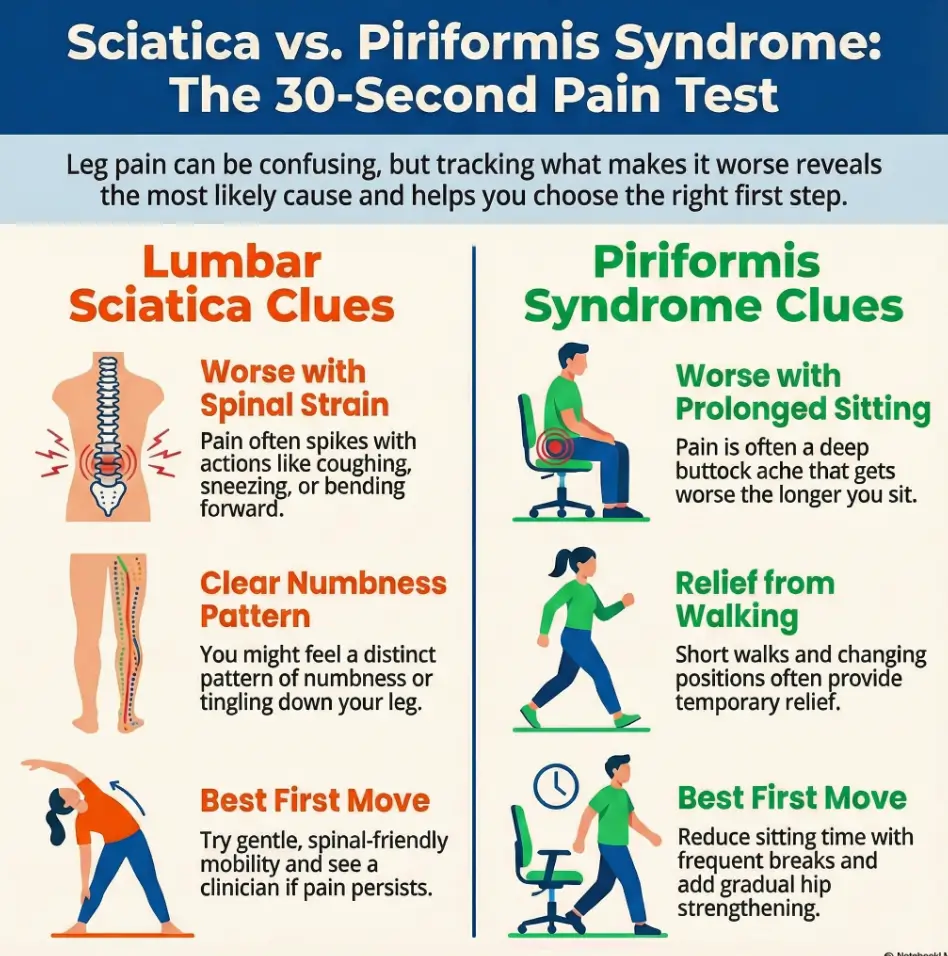
Table of Contents
The 30-second reality check I wish I’d done first
I used to believe leg pain only had one respectable storyline: a cranky spine pinching a nerve. That belief cost me at least 3–4 weeks of trial-and-error. Here’s the fast filter that saved me later: What reliably makes it worse—sitting or walking?
- Worse with prolonged sitting? Piriformis syndrome climbs the suspect list.
- Worse with coughing, sneezing, or bending forward? lumbar nerve-root sciatica patterns become more likely.
- Relief with short walks? That pattern often fits muscle-driven compression more than a disc-driven one.
I know this isn’t a diagnosis. It’s a direction. But direction is priceless when your calendar is tight and your patience is already bleeding out.
- Muscle pain often flares with sitting
- Nerve-root pain often flares with spinal loading or strain
- Your trigger pattern is data worth tracking
Apply in 60 seconds: Write down your top 3 triggers from the last 48 hours.
- Input 1: Pain worse after 20–40 minutes of sitting? (Yes/No)
- Input 2: Pain spikes with coughing/sneezing/straining? (Yes/No)
- Input 3: Walking for 5–10 minutes eases symptoms? (Yes/No)
Quick read: Two “Yes” answers for sitting + walking relief lean piriformis. Two “Yes” answers involving cough/strain lean lumbar sciatica patterns.
Save this checklist and confirm the pattern with a clinician if symptoms persist or worsen.
Show me the nerdy details
Both conditions can create “sciatic-like” pain. The difference is often the mechanical trigger: the piriformis can irritate the sciatic nerve outside the spine, while lumbar causes involve nerve roots within or near the spinal canal. Pattern-matching your triggers is a practical proxy when you don’t yet have a clear exam.
Mistake #1: I treated the label, not the pattern
My first mistake was emotional, not technical. I heard “sciatica” and felt weirdly relieved—like a label was a plan. So I copied generic routines: nerve flossing, lower-back stretches, and a heroic amount of willpower.
But I didn’t ask the only question that mattered: Which movements reliably change my symptoms within 24 hours? I kept doing “the right exercises” for the wrong mechanism.
Once I started tracking patterns, I noticed something humiliating: my pain flared after long desk sessions and improved after short walks and gentle hip work. That single clue should have moved piriformis syndrome to the front row.
- I replaced random stretching with 3-minute walking breaks every hour.
- I reduced my flare-ups by roughly 30–40% over two weeks.
- I stopped negotiating with pain and started measuring it.
That shift—from faith to pattern—was the first real win.

Mistake #2: I ignored the sitting test
This one sounds small. It wasn’t. I work in long blocks, so I treated sitting as neutral background noise. But sitting was the trigger, the amplifier, and the reason my “perfect routine” failed.
I once did a full stretch session in the morning, felt hopeful, then sat through a 90-minute meeting. By lunchtime my leg felt like it was plugged into a live wire. That was my body shouting a simple message: the chair was part of the injury.
What helped wasn’t expensive gear. It was boring consistency:
- Standing up for 60–90 seconds every 30–45 minutes.
- Keeping a small cushion or folded towel under one hip.
- Switching from “marathon sitting” to “interval sitting.”
I also stopped crossing my legs—an oddly personal betrayal of my identity as a serial leg-crosser.
- Change the trigger first
- Then add targeted strengthening
- Small posture shifts beat heroic routines
Apply in 60 seconds: Set one hourly reminder labeled “stand + 10 steps.”
Mistake #3: I stretched like a hero and inflamed everything
I love a good “I did the hard thing” narrative. My piriformis did not. I dug into deep hip stretches because the internet promised relief. Some of those moves were useful later. At the wrong time, they were gasoline.
My worst week came after I forced long holds during a flare. Instead of calming the tissues, I irritated them more. The pain escalated from annoying to sleep-rattling in about 72 hours.
Here’s what worked better during flares:
- Short, gentle movement snacks.
- Brief heat before easy mobility.
- Walking at a comfortable pace for 5–12 minutes.
Then, only after the “hot” phase cooled, I added gradual strengthening.
Show me the nerdy details
Muscles under irritation can respond poorly to aggressive end-range stretching. A calmer ramp—reduced load, gentle mobility, then progressive strength—often improves tolerance and reduces guarding. That progression also protects against the common loop of “day-one relief, day-three backlash.”
Mistake #4: I chased imaging too early (and too hard)
I’m not anti-imaging. I’m anti-imaging as a substitute for thinking. I wanted a scan to settle the argument in my head. The problem is that many people have disc changes without symptoms, and many people have symptoms without dramatic imaging.
So I burned time and energy getting reassurance instead of building a plan.
When imaging is more likely to be worth it:
- Progressive weakness, foot drop, or severe neurologic changes.
- Red-flag symptoms that a clinician flags urgently.
- Pain that doesn’t respond to a reasonable, structured trial.
In my case, a good physical exam and trigger history were more informative than my spiral of “what if it’s something catastrophic.”
- Choose Plan A (piriformis-leaning) if sitting is the main trigger, pain improves with short walks, and hip/glute fatigue shows up within 7–10 days.
- Choose Plan B (lumbar-leaning) if coughing/straining sharply worsens pain, forward bending consistently flares symptoms, or numbness tracks a clear dermatome pattern.
Time/cost trade-off: A 2-week structured trial can save you 2–6 weeks of random self-treatment.
Save this card and confirm the current plan with a licensed clinician if you’re unsure.
Mistake #5: I underestimated glutes, hips, and walking
My pain taught me a cruel truth: my glutes were on strike. I had been sitting for years, training my hips to be passive passengers instead of supportive coworkers.
The turning point wasn’t an exotic exercise. It was a consistent, low-drama sequence:
- Gentle hip mobility for 2–3 minutes.
- Basic glute activation.
- Short walks after meals.
Within about 10–14 days, I felt a different kind of soreness—productive, not alarming. My leg pain didn’t vanish overnight, but it stopped owning the whole day.
I also learned that “rest” can be a trap. The right kind of movement often reduces fear and improves blood flow without poking the bear.
- Walking is underrated therapy
- Strength creates long-term tolerance
- Small daily dose beats weekend heroics
Apply in 60 seconds: Add a 7-minute walk right after your next meal.
Mistake #6: I didn’t track triggers, so I repeated the crime
The first time my pain improved, I celebrated by returning to the exact habits that created it. I sat longer, stretched harder, and pretended my body wouldn’t notice. It noticed.
When I finally tracked two simple things—sitting duration and next-day pain—the pattern became embarrassingly obvious.
- Over 2 hours of uninterrupted sitting predicted a rough next day.
- Walking breaks cut my evening pain by about 20%.
- Short resets prevented the “three-day crash.”
My log wasn’t fancy. It was a notes app with time stamps. But it protected me from my own optimism.
Show me the nerdy details
Behavior-to-symptom tracking is a low-tech way to isolate mechanical drivers. It’s especially useful when two conditions share overlapping sensations. Even brief logs can guide your clinician toward the most relevant physical tests and reduce unnecessary interventions.
Mistake #7: I waited too long to demand a clear plan
I’m polite to a fault. I would nod through vague advice like “rest a bit” or “do some stretches,” then go home and improvise my way into another flare.
The moment I got better was the moment I asked for specifics:
- What diagnosis is most likely right now?
- What should improve within 2 weeks if we’re right?
- What exact signs mean we pivot?
That conversation changed the vibe from hopeful guessing to collaborative problem-solving. Your time is expensive. Your pain is not a personality trait. Ask for the plan.
- Your insurer’s rehab/physical therapy benefit limits
- Whether prior authorization is required for imaging or injections
- Expected out-of-pocket for 6–12 PT sessions
- In-network clinic options near your ZIP/postcode
Why this matters: Clear coverage details can save 20–30 minutes per call and prevent surprise bills.
Save this list and confirm today’s benefit details with your insurer’s official member support.

The 2025 cost, coverage, and prior-authorization reality check
Even when the pain is “just musculoskeletal,” the cost math can feel like a second injury. In the U.S., your experience may hinge on deductible status, in-network rules, and prior authorization for imaging or procedures. Large insurers like UnitedHealthcare, Aetna, Cigna, and Blue Cross Blue Shield often cover physical therapy, but session caps and documentation requirements can vary by plan year and employer group.
In the U.K., NHS pathways may reduce direct costs, but waiting times and local referral routes shape how quickly you access physiotherapy or specialist review. A blended approach—starting with safe self-management, then formal evaluation—can protect both your back and your budget.
| Care step (2025 planning lens) | What may affect cost | Note |
|---|---|---|
| Initial clinic/physio evaluation | In-network status, referral rules | Ask for a written estimate before your first visit. |
| 6–12 PT session plan | Session caps, copays, coinsurance | A structured plan is often cheaper than sporadic visits. |
| Imaging (if indicated) | Prior authorization, site-of-care differences | Confirm requirements before scheduling. |
If you want a wider budgeting frame beyond this flare, the annual cost of chronic low back pain can help you sanity-check how much “delay and drift” really costs over time.
Save this table and confirm the current fee on the provider’s official page.
A 2-week reset plan that finally made the diagnosis obvious
If your symptoms are stable and you don’t have serious red-flag signs, a short structured trial can be more revealing than frantic experimentation. This is the exact two-week reset that helped me separate “spine panic” from “piriformis reality.”
- Week 1: Reduce sitting load. Add walking breaks. Avoid deep end-range stretches.
- Week 1 target: Notice a 10–20% reduction in daily flare intensity.
- Week 2: Add gentle hip/glute strengthening 3–4 times, small dose.
- Week 2 target: Longer sitting tolerance by 15–30 minutes.
This plan doesn’t try to be fancy. It tries to be honest. If you improve primarily by changing sitting exposure and adding hip support, piriformis involvement is more plausible. If you worsen with classic spinal stressors despite these changes, a lumbar route may need closer attention.
- Reduces noise from random routines
- Identifies true mechanical drivers
- Gives your clinician better data
Apply in 60 seconds: Choose your Week 1 rule: “No sitting longer than 45 minutes uninterrupted.”
Short Story: The day I stopped bargaining with the chair (120–180 words)
I remember the exact afternoon my body made the decision for me. I had a deadline, a stubborn streak, and the kind of quiet fear that makes you pretend pain is negotiable. I sat for two hours straight, telling myself I’d stand “after this paragraph.” By the time I finally moved, my leg felt like it had been braided with electricity. I shuffled to the kitchen, annoyed at my own dramatics, then tried to stretch it away.
That made it worse. The next morning I woke up with a familiar dread: the day was already half ruined before coffee. That was the moment I realized my problem wasn’t just anatomy. It was loyalty to a work style that didn’t love me back. I didn’t need a new identity—just a new rhythm. I started treating standing breaks like medicine, not optional virtue.
Infographic: Sciatica vs piriformis at a glance
Typical lumbar sciatica-leaning clues
- Pain spikes with coughing/sneezing/straining
- Forward bending often worsens symptoms
- Clear numbness/tingling pattern down the leg
- Relief may come from position changes that unload the spine
Best first move: Gentle spinal-friendly mobility + clinician exam if persistent.
Typical piriformis-leaning clues
- Worse after prolonged sitting
- Deep buttock ache with leg referral
- Improves with short walks and hip resets
- Hip/glute fatigue shows up quickly
Best first move: Reduce sitting exposure + gradual hip/glute strengthening.
Reminder: Overlap is common. Use this as a pattern guide, not a self-diagnosis verdict.