

Most “core programs” don’t fail because you’re weak—they fail because they ask a reactive back to tolerate the wrong dose.
If your low back flares after “just a few reps,” you’re not lazy. You’re under-served by routines that reward burn, long holds, and messy form when what you need is controlled stiffness, calm breathing, and a plan that ends before your spine starts negotiating.
Keep guessing and you lose weeks to the same loop: a hopeful workout, a sore morning, and a quieter life built around avoidance.
The McGill Big 3 in 10 Minutes
This routine gives you a spine-sparing, no-crunch template you can run on a timer—plus the safety check, brace + breath cues, and the small form leaks that trigger flare-ups. It’s three stability drills—modified curl-up, side plank, and bird dog—designed to train endurance and control while keeping the spine in a neutral, low-irritation zone.
Table of Contents
- Stop before form breaks.
- Use calm breathing and steady tension.
- Track “same or better tomorrow,” not “how cooked I feel.”
Apply in 60 seconds: Set a 10-minute timer right now—then read the safety check before you start.
Safety-first check: “Is today a Big 3 day?”
If you’ve ever tried a “safe core routine” and somehow ended up negotiating with your heating pad at 2 a.m., I get it. I’ve been that person. One day you feel okay, you do a little extra because you’re excited… and the next morning your back sends a strongly worded email.
This section is your guardrail. The McGill Big 3 is designed to be low-irritation, but low risk isn’t zero risk. In the US, major health sources (including NIH’s MedlinePlus and the Mayo Clinic symptom guidance) consistently call out back-pain “red flags” like new weakness, numbness, and bowel/bladder changes as reasons to seek medical help quickly. That’s not drama—that’s basic safety—and it’s the same logic behind this low back pain emergency checklist for when symptoms aren’t “wait and see”.

Red flags: when to seek urgent care
- New bowel or bladder changes (retention or incontinence), or new “saddle” numbness.
- New or worsening leg weakness, foot drop, or a sudden loss of control.
- Fever with back pain, or back pain after a significant fall/accident.
- Unexplained weight loss alongside persistent back pain, especially with a cancer history.
One specific emergency pattern that clinicians take seriously is cauda equina syndrome—nerve compression that can involve severe symptoms like urinary retention or incontinence and leg weakness. Cleveland Clinic describes it as a medical emergency because delays can lead to permanent problems. If any of that sounds remotely like you, this is not a “try a routine” moment.
Yellow flags: when to scale down or get guidance (not “push through”)
- Pain is traveling below the knee with tingling that’s getting worse.
- Your back pain is changing fast, or you feel unstable when standing/walking.
- You can’t find any position that eases symptoms—even briefly.
- You’re in the first few weeks after a procedure or new diagnosis and haven’t been cleared.
The “same-or-better tomorrow” rule (your built-in safety metric)
Here’s the simplest rule I’ve ever found that actually protects real humans: if you’re not the same or better tomorrow, you did too much today. That might mean holds were too long, bracing was too intense, range-of-motion was too big, or you progressed too fast because you were feeling hopeful (a very charming mistake—I do it too).
Money Block: “Is this routine a good fit today?” (Eligibility checklist)
- YES if you can walk around the house, symptoms are stable, and you can find a comfortable neutral position.
- YES if pain is mostly local (low back/hip) and not rapidly worsening.
- NO if you have red-flag symptoms (bowel/bladder changes, new weakness, fever, major trauma).
- NO if symptoms are escalating quickly day-to-day or you feel unsafe moving.
Neutral next step: If you’re a “YES,” do the 10-minute timer plan. If you’re a “NO,” document symptoms and contact a clinician/PT.
Who this is for / not for (US reality check)
This routine is for time-poor people who want something they can actually repeat. The McGill Big 3 is a classic because it rewards consistency, not intensity. That’s perfect if your life is already loud.
Best fit: “desk back,” recurring stiffness, bending sensitivity
- You feel “fine” until you sit too long, then you stand up like a folding chair (if that’s you, you’ll also relate to this guide on desk job sciatica flare-ups and the little habits that set them off).
- You’re sensitive to bending/lifting, but walking is usually okay.
- You want a routine that doesn’t require equipment, outfits, or emotional speeches.
My own version of “desk back” showed up during a season when I was proud of two things: my productivity and my ability to ignore my body. The back pain was basically my nervous system filing a complaint with HR.
Not for (until cleared): new nerve symptoms, recent trauma, post-op restrictions
- New numbness/weakness, especially progressive symptoms.
- Back pain after a fall, car accident, or other significant trauma.
- Post-surgery or post-procedure restrictions (you need clearance).
Two questions to ask your PT/clinician (so you get a real answer)
- “What movements or positions should I avoid for now—and for how long?”
- “What’s a safe ‘green light’ version of stability work for my specific symptoms?”
One useful US-specific note: the American Physical Therapy Association explains that every US state offers some form of direct access to physical therapy (rules vary). Translation: in many places you can start with a PT evaluation sooner than you think—though insurance rules can still differ. If you’re weighing your next step, it helps to know what a first visit can look like in real terms, and what to expect from physical therapy for sciatica and nerve-related back pain when symptoms aren’t just “tight muscles.”
McGill Big 3 logic: stability, not “abs”
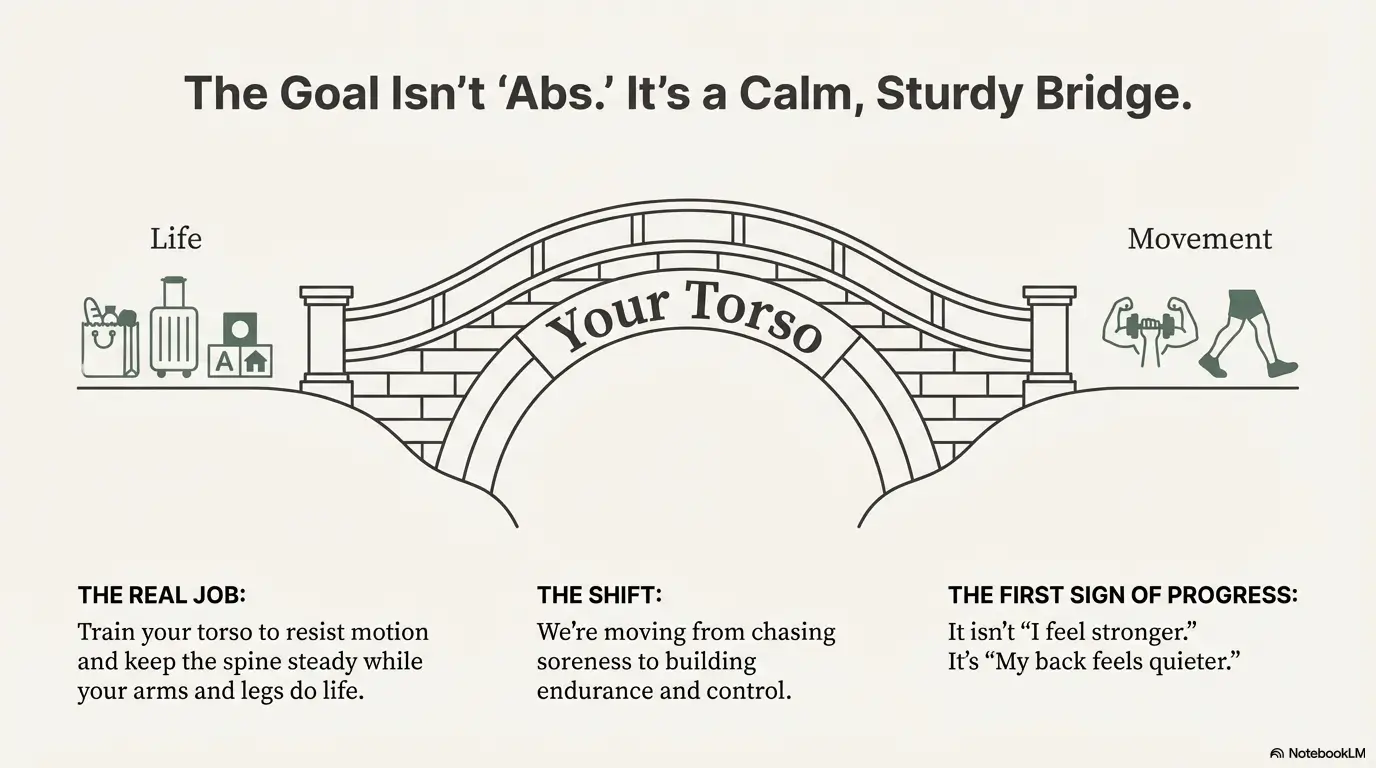
Let’s reframe the goal in one sentence: you’re training your torso to be a calm, sturdy bridge while your arms and legs do life. Groceries. Stairs. Kids. A suitcase you definitely overpacked. The Big 3 asks your core to resist motion and keep the spine steady, rather than repeatedly bending and twisting.
If you’ve been conditioned to chase soreness, this will feel almost suspiciously gentle at first. That’s the point. The routine is built around endurance and control—skills your back tends to appreciate.
The goal: endurance + control under low spinal irritation
- Endurance: can you hold stability long enough to get through real tasks?
- Control: can you keep ribs/hips aligned without “leaking” into your low back?
- Low irritation: can you train without poking the bear?
Open loop: Why doing less can feel better faster (and when it doesn’t)
Here’s the weird-but-true thing many beginners notice: the first improvement isn’t “I’m stronger.” It’s “my back feels quieter.” That can happen when you stop provoking sensitive tissues and start giving the nervous system a safer movement pattern.
But—and this matters—if your symptoms are driven by something that needs medical attention, “doing less” won’t fix it. That’s why we did the safety-first check. (We’ll close this loop fully in the conclusion with a 7-day proof plan.)
“Neutral spine” in plain English (what it looks like in your body)
Neutral spine doesn’t mean stiff like a statue. It means your spine stays in a comfortable middle zone—no big arch, no big rounding. Your ribs stack over your pelvis. Your breathing stays possible. If you can talk in short sentences, you’re probably bracing at the right intensity.
Short Story: The day I stopped “winning” workouts (120–180 words) …
Short Story: I used to treat core work like a character test. If I didn’t sweat, it “didn’t count.” One afternoon I did a long plank because an app told me to, then celebrated by picking up a heavy laundry basket with a twist—because apparently I was auditioning for a back spasm. The next morning I woke up already braced, like my body expected betrayal.
That’s when I tried the Big 3 with a timer and a rule: stop before form breaks. It felt almost too easy. No heroic suffering. But later that day, I realized I’d stood up from my chair without that familiar “careful, careful” ritual. Nothing magical happened. I just trained steadiness instead of strain. It was the first time I felt like my back and I were on the same team.
Money Block: Decision card (McGill Big 3 vs “generic core list”)
Choose McGill Big 3 if…
- You’re flare-prone and need low-irritation stability work.
- You want a repeatable 10-minute template.
- You care more about “tomorrow feels okay” than “today feels intense.”
Choose a broader program if…
- You’re cleared for strengthening and want full-body progressions.
- You need coaching for movement patterns (hinge, squat, carry).
- Your symptoms aren’t improving with basic stability and walking—especially if you suspect sciatica vs herniated disc patterns rather than “just stiffness.”
Neutral next step: Start with the 10-minute proof challenge, then decide if you need a bigger plan.
The 10-minute routine: exact timer plan (beginner)
This is the part people beg for—and then ignore because they keep scrolling for “the secret.” (The secret is doing the boring thing repeatedly. I’m sorry. I didn’t make the rules.)
Here’s a simple 10-minute timer flow. It’s built for the person who has a meeting in 12 minutes and still wants a back that behaves.
Minute-by-minute: warm-up reset → Big 3 circuit → cool-down reset
Infographic: Your 10-minute Big 3 map
0:00–1:30 Reset
Easy breathing, find neutral spine, gentle tension (no stretching contest).
1:30–8:30 Big 3 circuit
Curl-up → Side plank → Bird dog. Small sets, clean form, short rest.
8:30–10:00 Cool-down reset
Downshift breathing, stand tall, short walk if it feels good.
Beginner default (first 7 days):
- Modified curl-up: 3 sets of 5 reps, each rep a short hold (about 5–8 seconds).
- Side plank (knees bent): 3 holds per side (about 8–12 seconds each).
- Bird dog: 3 sets of 5 reps per side, slow and steady (each rep a short hold).
Yes, those holds look “too short.” That’s deliberate. You’re building endurance and control without turning your spine into a stress test.
The set/rep default that prevents flare-ups (quality > fatigue)
- Stop each set while you still look “clean.”
- Rest enough to regain calm breathing (usually 15–30 seconds).
- Keep tension moderate. You’re not trying to turn your face purple.
Open loop: The one timing change that helps when mornings are stiff
If mornings are your problem, the best “timing tweak” often isn’t more exercise—it’s shorter holds with more rest for the first week, then building seconds slowly. We’ll close this with a two-week progression you can follow without guessing.
- Short holds keep irritation low.
- Rest restores breathing and form.
- Consistency beats intensity for back stability.
Apply in 60 seconds: Screenshot the beginner default and run it exactly as written for 7 days.
Money Block: 10-minute “hold time” mini calculator (3 inputs, simple output)
This doesn’t diagnose you. It just helps you choose a safer starting hold based on how you feel today.
Suggested starting hold: 8–12 seconds (beginner default).
Neutral next step: Use the suggested hold time for 3–4 sessions, then reassess “same or better tomorrow.”
Brace + breath: the 3 cues that make Big 3 “back-friendly”
If the Big 3 has a “secret sauce,” it’s not the exercises. It’s the way you hold yourself while you do them. Most flare-ups come from the same small leaks: too much arching, too much bracing, or too much range.
360° brace without breath-holding (yes, you can breathe)
Think of bracing like firming up a cylinder: front, sides, and back—not just sucking in your belly. Your goal is steady tension you can maintain while breathing. If you can’t breathe, you’re not “extra safe.” You’re just adding pressure.
- Inhale quietly through the nose.
- Exhale like you’re fogging a mirror—then keep a little tension.
- Keep the jaw soft. (Clenched teeth are not a core strategy.)
Ribs-over-hips: the alignment shortcut
Most people lose neutral spine because the ribs flare up and the low back arches to “help.” Try this: exhale gently, feel ribs drop down, and stack them over your pelvis. You’re not flattening your back—you’re finding the middle.
Let’s be honest—if you rush the setup, you’re training compensation.
I used to treat “setup” as optional. Then I wondered why my back felt like it was doing the work. The setup is the work. Give it 10 seconds. Your spine will thank you in a way that feels suspiciously like silence.
Show me the nerdy details
Stability training is often about minimizing unwanted movement rather than maximizing range. When you brace moderately and keep ribs stacked over hips, you reduce “motion at the wrong segment.” That can lower irritation for some people while still training endurance. The goal isn’t rigidity—it’s controlled stiffness where you need it, paired with normal breathing.
One more evidence-based sanity check: NIH’s MedlinePlus guidance on acute low back pain notes that extended bed rest isn’t recommended for typical cases without serious warning signs, and staying as active as possible can help prevent deconditioning. That doesn’t mean “do anything.” It means “do something you can recover from.” This routine is designed to be that “something.”
- Brace like a cylinder, not a vacuum.
- Exhale to stack ribs over hips.
- Stop before you arch or twist to finish a rep.
Apply in 60 seconds: Practice one breath + brace cycle while standing before you get on the floor.
Modified curl-up: how to make it truly “not a crunch”
The modified curl-up is where most people accidentally “crunch,” then blame the exercise. We’re going to keep it small, controlled, and boring—in the best way.
Setup: leg position, hands, neck (the non-negotiables)
- One knee bent, one leg straight (many people find this helps comfort).
- Hands under the natural curve of your low back for feedback—not to force it flat.
- Neck long, chin gently tucked as if holding an orange under your jaw.
I used to lead with my neck—like a turtle with ambition. Don’t do that. Think “ribs move a little,” not “head yanks up.”
What you should feel vs. what’s a warning signal
- Good: firming in the front of the torso, steady breathing, no sharp back pain.
- Warning: sharp low back pain, pinching, or a feeling that you’re “jamming” into the floor.
Open loop: The tiny range-of-motion cue that changes everything
Here it is: lift only your head and shoulders a little—then freeze. If you’re rising high enough to impress someone across the room, you’re doing a different exercise. The goal is endurance in a safe range. We’ll come back in the progression section to show how you “level up” without turning this into a flexion marathon.
- Exhale gently, brace, lift slightly, hold 5–8 seconds.
- Lower with control. Don’t flop.
- Repeat for small reps, then rest.
Side plank: build lateral stability without shoulder regret
Side planks are underrated for back comfort because they train the “side wall” of the torso—often the missing piece for people who feel unstable when walking or standing. But if your shoulder hates it, you need options, not guilt.
Start here: knees-bent side plank (beginner default)
- Bottom knee bent, top leg straight or bent—choose comfort.
- Elbow under shoulder, forearm pointing forward.
- Lift hips just enough to form a straight line from shoulder to knee.
My first week doing this, I shook like a shopping cart with a wobbly wheel. It’s normal. Keep holds short.
Shoulder comfort fixes (position tweaks that matter)
- Bring your elbow slightly forward (often reduces shoulder pinch).
- Press the floor away gently—don’t “sink” into the shoulder.
- If elbows bother you, use a thick folded towel under the forearm.
Progressions that don’t spike symptoms (add time, then lever)
- Week 1: 8–12 second holds, knees bent.
- Week 2: 12–15 second holds, knees bent, cleaner line.
- Then: longer lever (top leg straight), then full side plank if tolerated.
Bird dog: stability without the “wobble show”
Bird dog is deceptively hard because it reveals how much your body wants to rotate, arch, and “cheat.” The mission is simple: move limbs while your torso stays calm.
The no-sway setup: pelvis, ribs, gaze
- Hands under shoulders, knees under hips.
- Exhale gently to stack ribs over pelvis.
- Imagine balancing a glass of water on your low back (no arching).
How far to reach (hint: not max range)
Reach long, not high. When people go for max range, they often crank into the low back and rotate the pelvis. Your best rep is the one that looks almost unimpressive.
Here’s what no one tells you—shaking isn’t always strength, sometimes it’s a strategy problem.
If you’re shaking, shorten the reach, reduce the hold, and slow down. Your nervous system is learning. Give it a simpler puzzle.
Micro-check: If your hip opens, your low back arches, or your shoulders shift, you’ve reached past your controllable range. Scale down and win the rep.
Common mistakes: flare-up traps (and fast fixes)
This is where you save yourself weeks of frustration. Most people don’t fail because they’re weak. They fail because they do the right thing with the wrong dose.
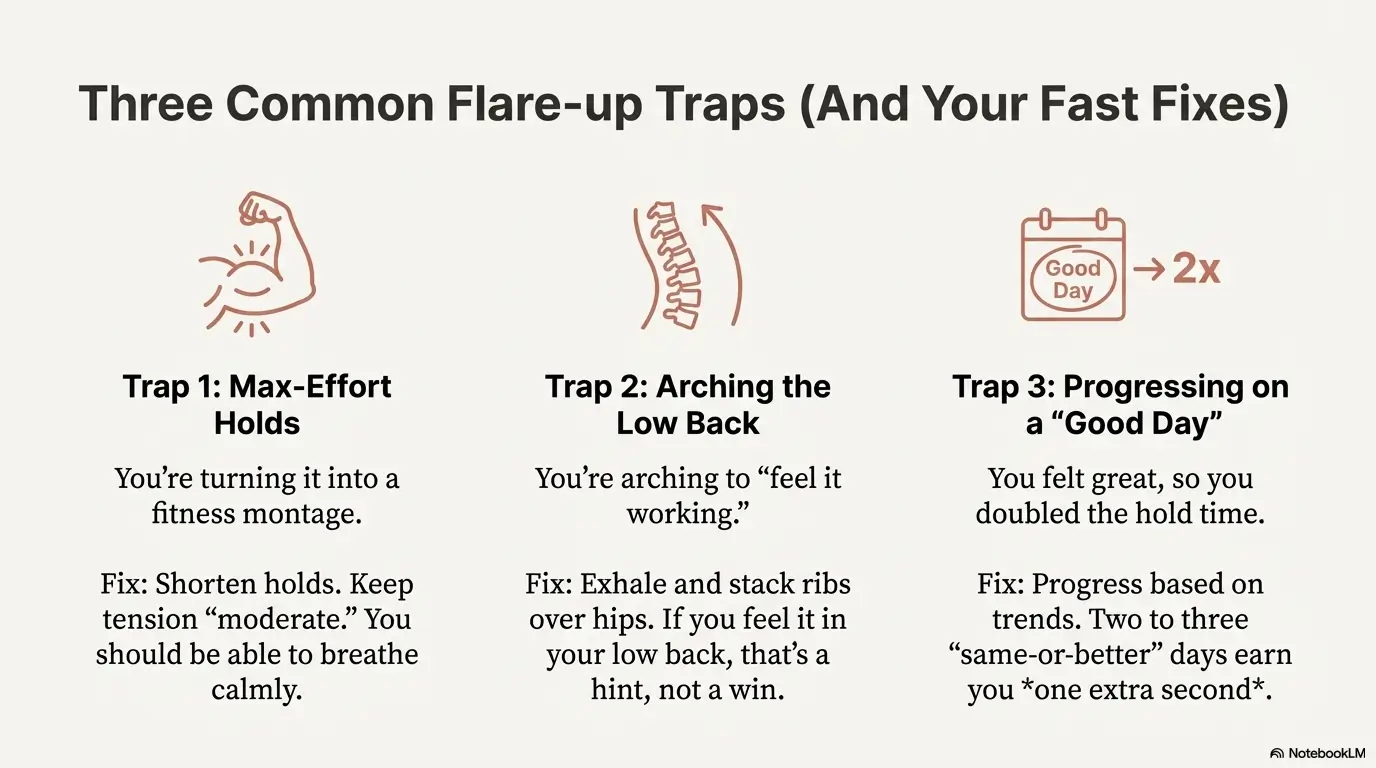
Mistake #1: turning holds into max-effort planks
Fix: Shorten holds, breathe, and keep tension at “moderate.” You’re building endurance, not auditioning for a fitness montage.
Mistake #2: arching the low back to “feel it working”
Fix: Exhale, stack ribs over hips, reduce range. If you “feel it” in the low back, that’s usually a hint, not a win.
Mistake #3: breath-holding and bracing too hard
Fix: Keep breathing. If you can’t speak a short sentence, your brace is too intense.
Mistake #4: progressing because you had one “good day”
Fix: Progress based on trends. Two to three “same-or-better tomorrow” days earn you an extra second—not a whole new level.
Don’t do this: the two “core upgrades” that often irritate sensitive backs
- High-rep flexion (“I’ll just do lots of sit-ups/crunches to strengthen my core.”)
- Max-range twisting when your symptoms are still reactive.
- Shorten holds first.
- Reduce range before you quit.
- Use “same-or-better tomorrow” as your progress gate.
Apply in 60 seconds: Pick one leak (arching, breath-holding, rushing) and fix only that on your next session.
Two-week progression: exactly how to level up (without guessing)
Here’s the promised close to the open loop: the best progression is boring, measured, and almost annoyingly slow. That’s why it works.
Frequency: 2–4 days/week (how to choose based on response)
- 2 days/week if you’re reactive or returning after a flare.
- 3 days/week if you’re stable and want steady momentum.
- 4 days/week only if you’re consistently “same or better tomorrow.”
ChoosePT (a consumer resource from the American Physical Therapy Association) emphasizes that prolonged bed rest and inactivity can make many back problems worse—and that movement-based care is often part of recommended treatment. Again: not “anything,” but “something smart.”
Progression rule: add seconds before adding difficulty
Use this ladder:
- Week 1: 5–12 second holds, short reps, moderate brace.
- Week 2: add 2–3 seconds per hold if you’re recovering well.
- Only after: progress lever length (side plank) or range (bird dog reach) cautiously.
When to shorten the routine (yes—shorter can be smarter)
If you’re stiff in the morning, stressed, sleep-deprived, or flare-prone, a 6–8 minute version often wins. Two clean sets per move can be better than three messy ones.
Money Block: If you’re considering PT (cost range + what to gather)
If you decide to see a physical therapist, being prepared saves time—and often money. (If you want a broader reality check beyond a single visit, this overview of chronic back pain costs in the US can help you plan without guesswork.)
| Year | Typical out-of-pocket range (US) | Notes |
|---|---|---|
| 2025 | $150–$300 | Varies by location and insurance; many plans reduce costs, while some preventive visits may not be covered. |
Quote-prep list (bring this to an eval):
- When symptoms started (approximate week/month is fine).
- Top 3 triggers (sitting, bending, lifting, walking, mornings).
- What helps (walking, heat, certain positions).
- Any red/yellow flags you noticed (numbness, weakness, bowel/bladder changes).
- Your 7-day “same-or-better tomorrow” notes (we’ll set this up below)—and if you like structured tracking, a simple pain diary template can make patterns easier to spot.
Neutral next step: Call one clinic and ask about direct access, insurance requirements, and first-visit pricing.
- Earn seconds with consistency.
- Keep “tomorrow” as your scoreboard.
- Shorter sessions still count if they’re clean.
Apply in 60 seconds: Commit to 3 sessions this week and track how you feel the next morning.
FAQ
Does the McGill Big 3 help sciatica?
It can help some people by improving torso stability and reducing “extra” movement that irritates symptoms, but sciatica has multiple causes. If pain is shooting down the leg with worsening numbness or weakness, prioritize evaluation. Use the Big 3 only if it’s tolerated and your symptoms are stable—and if you’re unsure what you’re actually dealing with, it’s worth reading a plain-English breakdown of sciatica nerve pain patterns (and why they behave the way they do).
Is the McGill Big 3 safe for a herniated disc?
Sometimes, yes—especially when done with short holds, moderate bracing, and a neutral spine. But disc-related symptoms can be sensitive to certain positions. If any movement increases leg symptoms, numbness, or weakness, scale down or stop and get guidance. If you want a clearer map of your options, this overview of herniated disc sciatica treatment can help you frame the “what now?” conversation.
Can I do McGill Big 3 with spinal stenosis?
Many people with stenosis tolerate stability work, but symptoms vary. Some feel better with slight forward flexion; others need careful positioning. Keep holds short, avoid painful ranges, and use the “same-or-better tomorrow” rule to guide dosage. If walking is the main limiter, you might also find practical comfort strategies like using a rollator for lumbar spinal stenosis (“shopping cart sign” walking) surprisingly relevant—because the body often tells the truth through what it tolerates.
How many reps or seconds should a beginner do?
Start small: short holds (about 5–12 seconds) and low reps (5 per set) with rest. The goal is clean form and calm breathing, not fatigue.
Should I do it every day or every other day?
Most beginners do well with 2–4 days per week depending on reactivity. If you’re flare-prone, every-other-day is often safer. If you’re stable and recovering well, 3 days per week is a sweet spot.
What if the modified curl-up hurts my back?
Reduce the lift height and shorten the hold. Keep hands under the low back for feedback (not flattening). If it still provokes symptoms, skip it temporarily and focus on side plank and bird dog until you get professional guidance.
Side planks hurt my shoulder—what can I do?
Try knees-bent side plank, bring the elbow slightly forward, and “press the floor away” gently. You can also reduce hold times and build gradually. If shoulder pain persists, pause and consult a clinician/PT.
How long until I notice less back pain?
Some people notice a calmer back within a week (mostly from improved control and reduced irritation), while strength and endurance trends build over 2–6 weeks. Track “same-or-better tomorrow” to see your real pattern.
Should I brace my core or “draw in” my belly button?
For this routine, think “brace” (360° tension) rather than aggressively drawing in. You want a supportive cylinder you can breathe inside, not a hollowed-out stomach you can’t sustain.
Can I combine this with walking or stretching?
Walking is often a great companion because it’s rhythmic and low-load for many people. Stretching can help some, but avoid aggressive stretching into pain. If you combine, do the Big 3 first, then walk for 5–15 minutes—and if walking itself is touchy, it can help to dial in basics like sciatica-friendly walking shoes that reduce flare triggers before you assume you “just can’t walk.”
Conclusion: your next 10 minutes
Let’s close the loop from the beginning: why can “doing less” feel better faster? Because stability work can reduce the frantic, protective bracing your body does when it doesn’t trust a movement. The Big 3 is a way of saying, gently and repeatedly, “We can do this safely.” Not by force. By repetition.
And if you’re reading this as a time-poor person who just wants a plan you can trust: your plan is not “work harder.” It’s “work cleaner.” Ten minutes. Short holds. Calm breath. Track tomorrow.
Next step (within 15 minutes): the 7-day 10-minute proof challenge
- Do the 10-minute timer plan 3 times in the next 7 days.
- Each time, write two numbers: pain now and pain tomorrow morning (and if mornings are brutal, your sleep setup matters—start with how to sleep with sciatica when your back is reactive).
- Write one trigger you noticed (sitting, bending, stress, sleep)—stress and insomnia count, and if that’s your loop, CBT-I for insomnia with chronic pain can be a surprisingly practical lever.
If your trend is “same or better tomorrow,” add 2–3 seconds to holds next week. If your trend is “worse tomorrow,” shorten holds, reduce range, and consider a PT evaluation—especially if symptoms are changing. And if the “worse tomorrow” pattern is tied to the bed itself, it’s worth checking mattress firmness for sciatica and even small position tweaks like side sleeping with sciatica without waking up wrecked.
Two practical, trustworthy resources to keep you grounded:
Last reviewed: 2025-12