

At 2 a.m., I spent 47 minutes doom-scrolling my MRI report like it was a courtroom transcript—then realized I was about to make a spine decision on pure adrenaline.
If you’re dealing with sciatica from a herniated disc, the modern problem isn’t “lack of options.” It’s too many options—PT plans that flare you, an epidural steroid injection (ESI) that sounds like a miracle, and microdiscectomy that feels like a cliff—while work, sleep, and walking tolerance quietly collapse.
Keep guessing, and you can lose weeks to the wrong next step: resting too long, rehabbing through untracked weakness, or chasing procedures that don’t match your nerve root pattern (like L5–S1).
This post gives you a calm, practical ladder so you can choose based on function, weakness, and weekly trend (not fear, not the scariest MRI phrase). It’s built from the same method I used after my own MRI: simple tracking (walking minutes, sleep, strength checks) plus a scenario matrix that makes the “next step” obvious.
Table of Contents
MRI isn’t the boss: the decision frame
I’m not anti-MRI. I’m anti-MRI-as-oracle.
After my scan, I treated the report like it was the whole story. But sciatica decisions work better when you treat imaging as one chapter—and your symptoms as the plot.
The 3 questions that beat the MRI report (function, weakness, time)
- Function: What can you do today that you couldn’t do 7 days ago—walk, sit, sleep?
- Weakness: Is strength stable, improving, or slipping (toe/heel walking, ankle strength)?
- Time: Are you trending better week-to-week, or stuck in the same pain loop?
Those three answers decide whether your best move is a rehab plan, a pain-bridge intervention, or a faster surgical conversation.
Who this is for / not for (fast filter)
This is for you if your MRI shows a lumbar disc herniation and you have classic leg symptoms (shooting pain, tingling, numbness) and you’re trying to choose between PT, an epidural injection, and microdiscectomy without losing months to confusion.
This is not for you if you have red-flag symptoms (bowel/bladder changes, saddle numbness, rapidly worsening weakness, fever with severe back pain). If that’s you, your “outline” is a phone call, not a blog post.
Open loop: Why “big herniation” can be the wrong villain
A “big” herniation can look terrifying—yet some people improve steadily with time and smart movement. A “smaller” one can still cause brutal nerve pain if it’s pressing in the wrong place. The scan is geometry; your body is biology. We’ll close this loop later with a scenario matrix that uses trend, not fear, as the deciding factor.
- Choose based on function, weakness, and weekly trend.
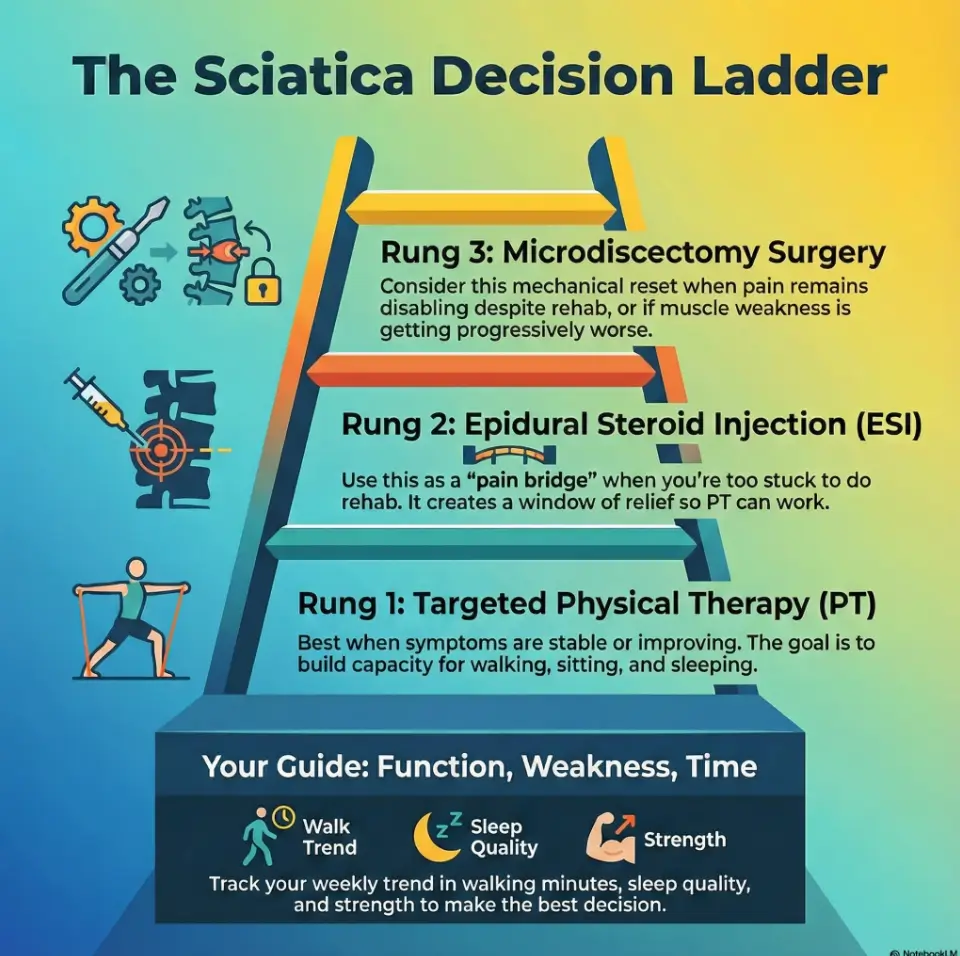
- Use PT for capacity, ESI for a pain bridge, surgery for persistent disability or progressing deficits.
- Don’t treat a report—treat a human timeline.
Apply in 60 seconds: Write down your walking minutes today and 7 days ago. That delta matters.
| Option | Best when… | What it gives you | Common trap |
|---|---|---|---|
| Targeted PT | Symptoms stable or slowly improving; you can walk some; weakness is not worsening | Capacity: walking, sitting, sleep, confidence | Stopping after week 1 because it flares |
| ESI | Pain blocks rehab; you’re stuck; you need a “bridge” to move again | Time window: pain down so PT can work | Using relief to stop moving |
| Microdiscectomy | Persistent disability; unacceptable pain despite time/rehab; or weakness progressing | Faster leg pain relief for many; a clear mechanical reset | Expecting it to fix fear, habits, or overall back health |
Neutral action: Circle the row that matches your current week, not your worst hour.
Pain vs weakness triage: don’t treat the wrong problem
Here’s a brutal lesson: pain is loud; weakness is quiet. Pain screams for immediate solutions. Weakness whispers that your nerve may be struggling—and that changes the urgency.
When I first tried to “self-triage,” I treated every flare like a catastrophe. The better question was simpler: Is my nerve failing, or is it irritated?
Walking tolerance, sleep collapse, and the “can I stand?” test
If you can’t stand long enough to brush your teeth, you don’t need a motivational speech—you need a plan that reduces nerve irritation and rebuilds tolerance. Track these three things for 7 days:
- Walking minutes before symptoms spike
- Sleep (hours and how many wake-ups)—and if nights are brutal, it helps to review side-sleeping positions for sciatica that reduce nerve irritation
- Position tolerance (sitting/standing time)
Strength signs that deserve faster escalation
Strength changes matter. If you’re tripping more, can’t heel-walk, can’t toe-walk, or the leg is getting weaker week-to-week, that’s not “just pain.” That’s a reason to speak with a clinician promptly.
Let’s be honest… pain feels like an emergency (but emergencies have rules)
I once spent 47 minutes at 2 a.m. Googling “how to tell if nerve is dying” while lying on the floor like a defeated houseplant. That’s the pain-brain talking. Your calmer self needs rules: red flags get urgent care; stable pain gets a structured ladder; improving pain gets patience and motion—and if you’re unsure where that line is, read a clear checklist on when low back pain is an emergency.
- Track walking minutes, sleep, and strength weekly.
- Escalate faster if weakness is worsening or function collapses.
- Don’t let a single flare rewrite your whole plan.
Apply in 60 seconds: Try heel-walking 10 steps and toe-walking 10 steps (safely, near a wall). Note any asymmetry.
PT that actually works: buy function, not perfect posture
“Try PT” can sound like a brush-off. But good PT for sciatica isn’t a generic stretching playlist. It’s a system for turning “I can’t” into “I can, a little more.”
My first PT session left me sore and suspicious. My second week left me walking farther. That’s when I learned the difference between pain-free and progress.
What PT is really trying to change (tolerance + nerve irritability)
PT aims to reduce the nerve’s sensitivity and increase your capacity—walking, sitting, bending, sleeping. If your plan is only “stretch your hamstrings,” it may miss the point. Many people need a mix of graded movement, symptom rules, and strengthening that doesn’t poke the nerve every session.
The 2–6 week progression most people never follow
- Week 1–2: Calm the nerve, restore basic walking tolerance, find positions that reduce symptoms
- Week 3–4: Build strength and endurance without provoking the leg
- Week 5–6: Reintroduce feared movements safely (lifting, sitting, longer car rides)
It’s not glamorous. It works because it’s consistent, not because it’s heroic.
Mistake #1: quitting PT because week 1 flared symptoms
Some flare can happen when you change load. The question isn’t “did it hurt?” The question is “did it settle within a reasonable window, and is the trend improving?” If every session leaves you wrecked for days, the dosing is wrong. That’s a fix—not a failure.
“It hurts too much to do PT” — the graded exposure workaround
When pain blocks everything, you don’t force full workouts. You build the smallest safe unit: a short walk, a gentle movement, a few minutes of a position that centralizes symptoms (your clinician can guide this). You climb by inches. Inches still count.
- Yes/No: My symptoms are stable (not rapidly worsening).
- Yes/No: I can walk at least 2–5 minutes total per day (even split into tiny chunks).
- Yes/No: I do not have new bowel/bladder changes or saddle numbness.
- Yes/No: Weakness is not suddenly getting worse.
- Yes/No: I can commit to 10–15 minutes daily of a simple home plan.
Neutral action: If you answered “No” to the red-flag items, contact a clinician before pushing activity.
- Progress is a weekly trend, not a daily mood.
- A flare means adjust the plan, not abandon it.
- Function (walking/sleep) is the scoreboard.
Apply in 60 seconds: Set a “minimum viable walk” (even 2 minutes) and do it today, then stop.
ESI basics: what it can (and can’t) do
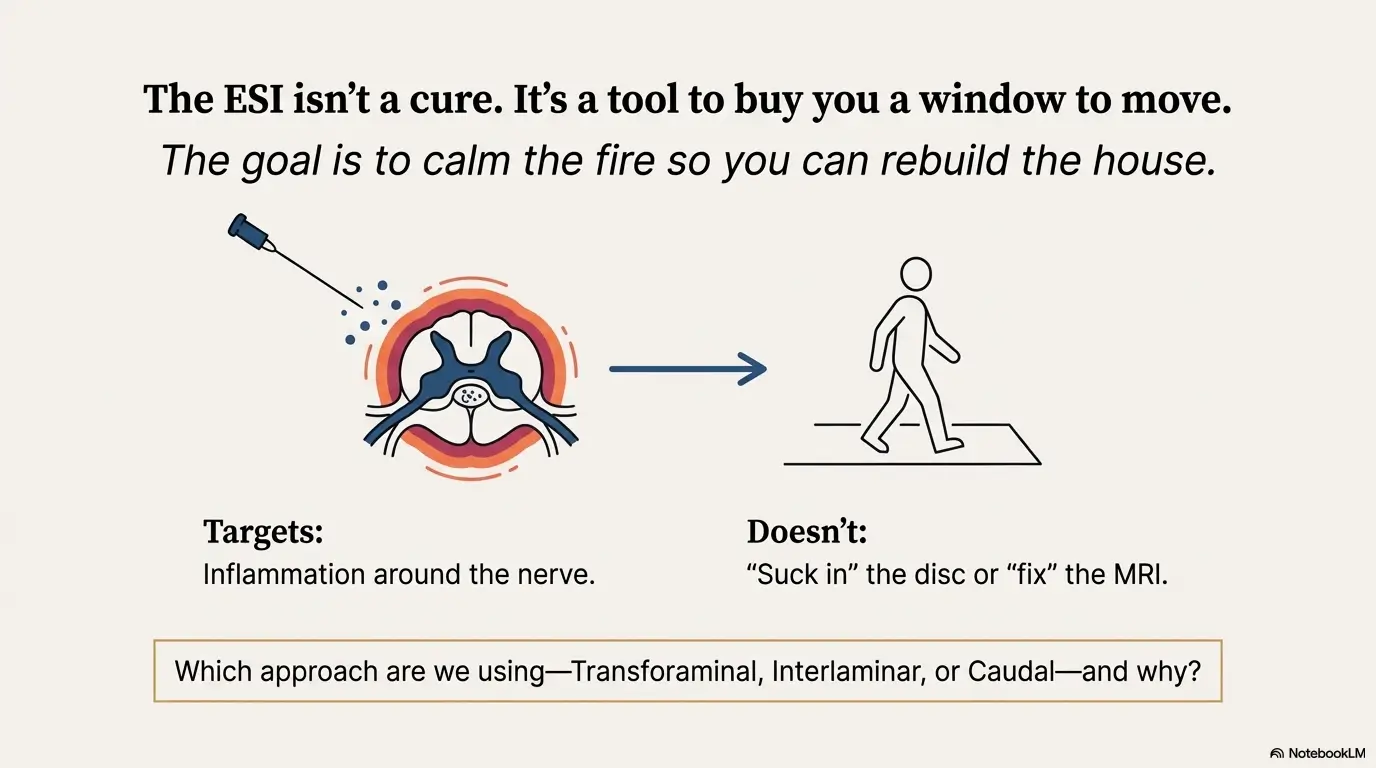
An epidural steroid injection lives in the messy middle: not surgery, not “nothing,” not a cure. It’s a tool—often a very useful one—when pain blocks the thing that actually helps long-term: movement.
Major medical institutions like Cleveland Clinic and Johns Hopkins describe ESIs as a way to deliver medication near irritated nerves to reduce inflammation and pain. That’s the right mental model: calm the fire so you can rebuild the house.
What an epidural targets (nerve irritation) vs what it doesn’t (the disc itself)
The steroid is aimed at inflammation around nerve roots. It doesn’t magically “suck in” a disc. It may reduce symptoms enough that you can sleep, walk, and actually participate in PT. If you expect it to “fix the MRI,” you’ll be disappointed. If you expect it to buy a window, you’re thinking like an operator.
When it starts working and how long relief can last (realistic ranges)
Some people feel changes quickly; others notice relief over days. Duration varies: for some, it’s brief; for others, it’s long enough to restart life. The honest takeaway is this: ESIs are unpredictable in duration, but they can be very predictable as a strategy—because the strategy is “use relief to move.”
Open loop: Why some “perfectly placed” injections still flop
Because “perfect placement” doesn’t guarantee “perfect match.” If the pain generator isn’t the targeted level, if the approach isn’t optimal, if your nervous system is sensitized, or if the plan after the shot is rest-only, results can disappoint. We’ll close this loop in the approach and troubleshooting sections—specifically, what to ask about approach and what to do in the first 72 hours.
Show me the nerdy details
Clinicians often choose an ESI approach based on anatomy, symptom pattern, and which nerve root seems involved. “Targeting” can vary by approach, and the medication spread can differ. That’s why two people can both “get an epidural” and have very different experiences.
ESI approach choice: transforaminal vs interlaminar vs caudal
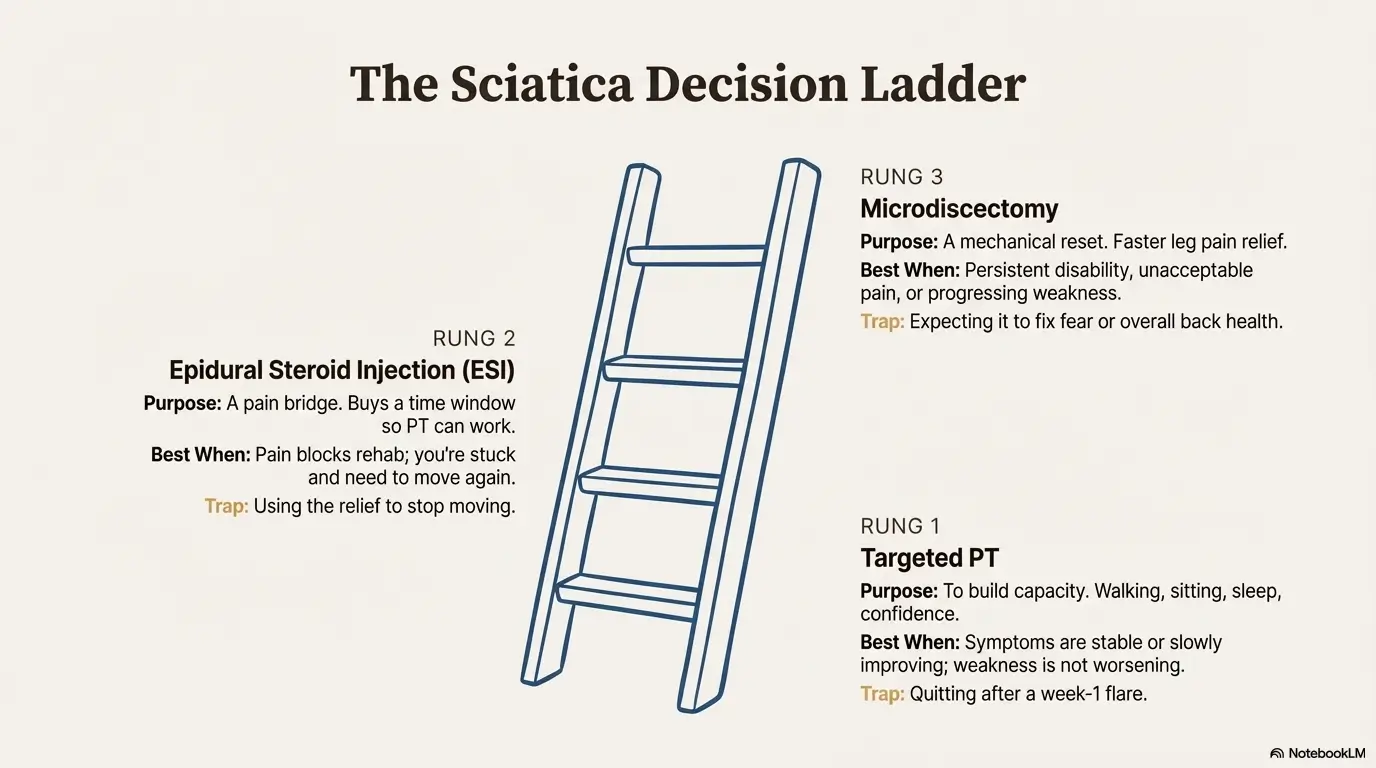
Not all epidurals are the same. If you remember one thing, remember this: “epidural” is a category, not a single procedure. Clinics like Pain & Spine Specialists explain common approaches as transforaminal, interlaminar, and caudal—each describing how the medication is delivered. If you want a plain-English breakdown before you consent, read transforaminal vs interlaminar epidural injections and what “approach” actually changes.
You don’t need to become a spine nerd overnight. But you do need enough clarity to ask one confident question: Which approach are we using, and why?
The three approaches (what “more targeted” actually means)
- Transforaminal: often described as more targeted toward a specific nerve root
- Interlaminar: medication delivered into the epidural space from the back, potentially spreading more broadly
- Caudal: delivered from lower in the spine area, sometimes used when other routes aren’t ideal
Your clinician will choose based on anatomy, symptoms, and safety considerations.
Interlaminar vs transforaminal: when “blanket” vs “laser” matters
If symptoms strongly suggest one nerve root, “more targeted” can make sense. If symptoms are broader, or anatomy suggests another route, a different approach may be chosen. The key is not to self-prescribe the approach. The key is to understand the logic so you can spot when the plan feels generic—and if you want a sciatica-specific comparison, see TFESI vs interlaminar ESI for sciatica.
Open loop: The tiny wording detail in your notes that reveals the approach used
Many after-visit summaries include the approach name or abbreviations that hint at it. If you’ve ever left a clinic thinking, “What exactly did they do?”—this is how you decode it. We’ll close this loop in the insurance/coverage section where documentation language affects prior authorization and repeat approvals.
Show me the nerdy details
Approach selection can involve imaging findings, the suspected nerve root level, prior surgeries, and clinician preference. Even when the same medication is used, the delivery path can change how it spreads—one reason outcomes vary person-to-person.
ESI safety and limits: the risks people forget to plan around
Most people ask, “Will it hurt?” A better question is: What are the normal after-effects, and what would be abnormal?
Major institutions like Johns Hopkins and Cleveland Clinic describe risks and side effects ranging from common, temporary reactions to rare complications. Also, many reputable sources note limits on how frequently steroid injections are typically given—because steroid exposure has tradeoffs.
Common side effects vs rare complications (what’s normal vs not)
It’s common to have temporary soreness at the injection site or short-term symptom fluctuations. Less common issues can occur, and your clinician should review them clearly. Your job is not to memorize every risk; your job is to understand the threshold for calling.
- Usually normal: mild soreness, transient symptom changes, a “weird day” or two
- Call your clinician: severe headache after the procedure, signs of infection, new/worsening weakness, or anything that feels sharply “not you”
Repeat limits and steroid exposure: what “too often” means in practice
Mayo Clinic’s general cortisone shot guidance highlights that repeated steroid injections can have side effects and that clinicians limit frequency. Translation: even if a shot helps, your long-term plan can’t be “shots forever.” It has to be “shots as a bridge to function.”
Mistake #2: using an injection as permission to stop moving
This one hurts to admit: I fantasized about the injection as a “reset button,” then pictured myself resting for two weeks “to let it work.” That’s the opposite of the goal. If relief shows up, your next move is gentle activity and rehab—because that’s what converts relief into durability.
- Know what “normal” feels like after an ESI.
- Ask about repeat limits and what success looks like.
- Use relief to move, not to hibernate.
Apply in 60 seconds: Write down the exact symptoms you want the ESI to improve (sleep, walking minutes, sitting time).
Show me the nerdy details
Some clinicians track outcomes by function metrics (walking tolerance, return to work tasks) rather than pain score alone. That approach tends to create better downstream decisions because it shows whether the intervention changed your life, not just your number.
Procedure reality: prep, day-of, and aftercare
If you’ve never had an injection like this, uncertainty is half the discomfort. The other half is the reality that your brain will replay every sensation afterward and ask, “Is this normal?”
This section is about reducing that mental noise.
Prep checklist (meds, diabetes, imaging, ride home)
- Bring a list of medications and allergies.
- Ask about blood thinners or diabetes considerations (your clinician will advise based on your situation). If you’re also juggling pain meds, keep NSAID safety for back pain on your radar.
- Bring relevant imaging reports if requested.
- Arrange a ride if the clinic recommends it.
Practical note: write your questions down before you arrive. Pain makes memory unreliable.
During the procedure (imaging guidance, steps, what you’ll feel)
Many ESIs are performed with imaging guidance so the clinician can place medication in the intended area. You may feel pressure, brief discomfort, or a “strange zing” sensation. The goal is not to be a hero. The goal is to communicate clearly if something feels sharply wrong.
After the procedure: what to do in the first 72 hours
This is where people accidentally waste the opportunity. If you feel better, do not sprint into a “catch up on life” marathon. Think: gentle movement, simple walking, basic PT-friendly work, and avoiding sudden heavy lifting. If you feel the same, don’t assume failure on day one—some effects are not immediate. Your clinician’s instructions should guide the specifics.
Microdiscectomy clarity: the fast off-ramp (with tradeoffs)
Microdiscectomy is the option that sounds like relief—because it can be. It’s also the option people fear—because it feels permanent. Both reactions are human.
If PT is your capacity builder and ESI is your pain bridge, microdiscectomy is the mechanical reset: removing the disc material that’s irritating the nerve in a way that’s hard to out-wait.
When microdiscectomy rises on the ladder (weakness, persistent disability, mismatch risk)
Microdiscectomy tends to enter the conversation when:
- Function is severely limited for weeks despite a solid conservative plan
- Pain remains unacceptable and blocks daily life
- Weakness is present or worsening
Clinicians weigh symptoms, physical exam, and imaging alignment. The “match” matters.
Recovery expectations: leg pain vs numbness vs confidence
People often talk about pain relief. Fewer talk about the emotional recovery: trusting your body again. Leg pain may improve quickly for many; numbness can be slower. Confidence is its own rehab project.
Here’s what no one tells you… relief can be real—and your fear can stay
I used to imagine a clean split: “before surgery = suffering, after surgery = normal.” Real life is messier. Even with improvement, your nervous system can stay jumpy. That doesn’t mean surgery “failed.” It means you still need a plan—walking, gradual load, and mental permission to move again.
The decision ladder by scenario: PT vs ESI vs microdiscectomy
This is where we close the big open loop: the scan isn’t the villain; the mismatch is. The best choice is the one that matches your scenario.
Think of this as a matrix—because time-poor readers need decision clarity, not a lecture.
If you can walk: the 2–6 week PT-first playbook
- Start with daily walking in tiny, repeatable chunks (2–10 minutes, depending on your baseline).
- Build sitting tolerance with structured breaks (a timer helps). If you’re battling desk-job sciatica flare-ups, this one change can stop the “sit → spike → spiral” cycle.
- Do a PT-guided home plan that respects symptom rules. If you’re debating options, compare chiropractor vs physical therapy for back and leg pain using the lens that matters here: function and trend.
Goal: more function each week, even if pain isn’t gone yet.
If pain blocks rehab: ESI as a function-bridge (what to do during the window)
If pain keeps you from walking, sleeping, or doing basic rehab, an ESI may create a temporary window. The question becomes: What will you do with that window?
- Schedule PT within days, not weeks, if possible.
- Use relief to restore movement—walking, gentle strengthening, tolerable positions.
- Avoid the “I feel good, so I’ll do everything” trap.
If weakness progresses: when microdiscectomy becomes time-sensitive
If strength is declining, clinicians often shift priorities. The goal becomes nerve protection and function preservation, not “wait and see.” This is where you want a direct discussion with a spine specialist (orthopedic spine or neurosurgery, depending on your local system).
What to track weekly (walking minutes, sleep, pain map, strength checkpoints)
Here’s the operator move: track the same metrics weekly so your decisions are based on trend, not vibes.
- Walking minutes: your “before symptoms spike” time
- Sleep: hours + wake-ups
- Pain map: where it goes (back-only vs down-the-leg)
- Strength checks: heel walk, toe walk, single-leg calf raises (as safely tolerated)
| Your scenario | Best next move | What to watch | Decision trigger |
|---|---|---|---|
| Desk job, can walk 5–15 min, symptoms stable | PT-first + daily walking | Sitting tolerance, sleep | No improvement by week 3–4 |
| Can’t sleep, walking < 2–3 min, pain blocks rehab | Consider ESI as bridge + PT scheduled | Relief window conversion to activity | Relief but no function change |
| Labor job, repeated flares, fear of lifting | PT with graded load + work modifications | Strength endurance, movement fear | Weakness appears or worsens |
| Progressive weakness/foot drop or severe persistent disability | Discuss surgery promptly (microdiscectomy) | Strength trend, falls, gait changes | Any worsening weakness |
Neutral action: Pick the row that matches your current week and follow it for 7 days, then reassess.
- PT builds capacity when you can participate.
- ESI can buy a window when pain blocks rehab.
- Surgery enters sooner when weakness progresses or disability persists.
Apply in 60 seconds: Decide what “success” means for you this week: +10 walking minutes, or +2 hours sleep, or safer sitting.
Insurance & coverage friction: avoid surprise delays
In the US, healthcare decisions aren’t just clinical—they’re logistical. Prior authorization, documentation, and scheduling reality can quietly decide your timeline if you don’t plan for it.
Insurers (including Medicare via CMS and many private plans) often care about what you’ve tried, what your exam shows, and whether symptoms and imaging align. Some plans publish medical policies (Premera is one example) that spell out criteria in dense language. You don’t need to read all of it. You do need to speak the language well enough to avoid delays.
The coverage lens: criteria, coding, and evidence reviews (what policy docs look like)
Policy documents often include sections like criteria, coding, and evidence review. Translation: the insurer wants to know (1) the medical reason, (2) what’s being billed, and (3) whether it matches their rules. That’s why clean documentation from PT and your clinician can matter.
What to ask the scheduler’s office (approach, imaging guidance, prior auth)
- “Will this require prior authorization with my plan?”
- “Which ESI approach is planned, and will imaging guidance be used?”
- “What documentation do you need from PT or my referring clinician?”
- “If I don’t improve, what’s the next step and timeline?”
Paperwork that speeds decisions (PT notes, neuro findings, imaging match)
Bring your symptom log. Bring your PT summary (if you have it). Bring the MRI report. The goal is not to overwhelm anyone with paper. The goal is to reduce back-and-forth that burns weeks.
- Imaging report summary (MRI date, level mentioned)
- Symptom duration and weekly trend (better/same/worse)
- Functional limits (walking minutes, sleep, work tasks affected)
- PT notes or home plan attempts (what helped, what flared)
- Any neuro findings noted (weakness, reflex changes)
- Medication list and relevant conditions (e.g., diabetes) to discuss safety
Neutral action: Put these in one note on your phone so you can answer questions in under 2 minutes.
- Prior auth delays are common—prepare documentation early.
- Ask about approach and logistics up front.
- Bring trend data (function) to every visit.
Apply in 60 seconds: Draft a one-sentence summary: “In the last 7 days, my walking increased/decreased from X to Y minutes.”
Show me the nerdy details
Some insurers require documentation of conservative management before approving procedures. This can include PT attempts or clinician notes about functional impact and neurologic findings. Asking early can prevent the “we need one more form” loop.
Common mistakes: how sciatica gets stuck for months
If you’ve been in pain long enough, you’ve probably tried “everything.” The problem is that “everything” often includes several things that feel helpful in the moment but stall recovery long-term.
These are the mistakes I see repeatedly in real life—friends, family, and yes, me—because they’re emotionally logical, not clinically smart.
The “lay down until it’s gone” loop (and why it backfires)
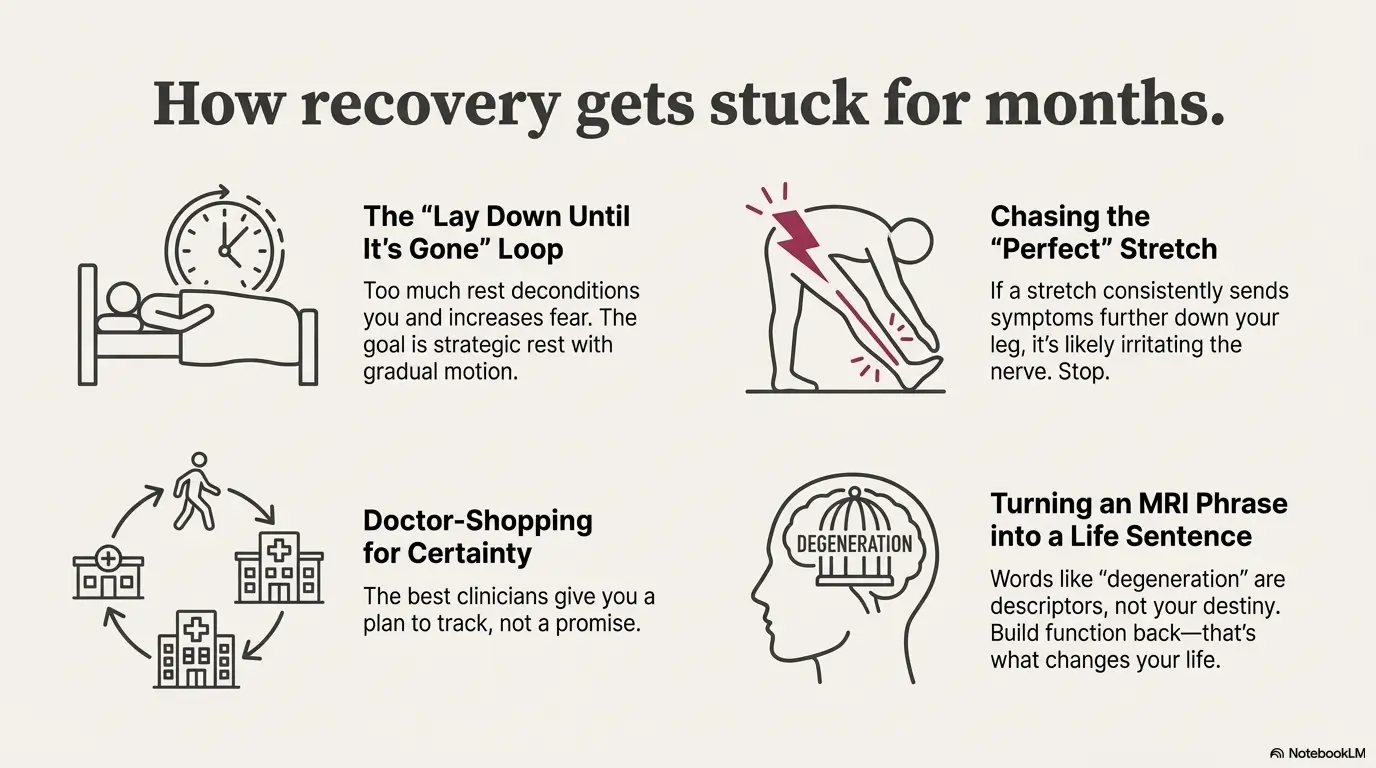
Rest is a tool. Permanent rest is a trap. Too much inactivity can decrease tolerance, increase fear, and make normal movement feel dangerous. The goal is strategic rest with gradual motion, not a full stop.
Chasing the perfect stretch that irritates the nerve
Some stretches feel satisfying while the nerve is irritated—until the next hour (or night) proves otherwise. If a stretch consistently pushes symptoms further down the leg, treat that as information and adjust. “More stretch” is not always “more recovery.”
Doctor-shopping for certainty instead of building a plan
It’s tempting to keep searching for the clinician who will promise certainty. But the best clinicians often say something less dramatic and more useful: “Here’s the plan. Here’s what we track. Here’s what changes the plan.” That’s what you want.
Turning an MRI phrase into a life sentence
Words like “degeneration” or “bulge” can feel like a permanent label. They’re not. They’re descriptors. Your job is not to argue with language—it’s to build function back. Function is the thing that changes your life, not the adjective on page two.
Also: not every leg symptom is the same beast. If your pattern is weird, shifting, or doesn’t match the typical nerve story, compare sciatica vs piriformis syndrome and consider whether a non-disc driver is being ignored.
When to seek help: the short list you don’t negotiate
Most sciatica is not an emergency. Some sciatica absolutely is. The goal is not fear. The goal is clarity—and a simple guide on low back pain emergency warning signs can prevent dangerous delays.
Same-day / ER red flags
- New bowel or bladder control changes
- Saddle numbness (numbness in the groin/saddle area)
- Rapidly worsening weakness or foot drop
- Fever with severe back pain, or feeling very ill with back symptoms
- Severe unrelenting pain with concerning systemic signs (your clinician can guide)
Call your clinician soon if: plateau + disabling pain, new weakness, falls
If you’re stuck—no improvement for weeks—and daily life is shrinking (sleep collapsing, walking minimal, work impossible), that’s a reason for a proactive reassessment. If you have new weakness or falls, don’t wait it out alone.
The appointment script: “Here’s my trend, here’s what I’ve tried, here’s what I need”
Bring a simple summary:
- “In the last 7 days, my walking minutes went from X to Y.”
- “My sleep is ___ hours with ___ wake-ups.”
- “Weakness is stable / improving / worse. Here’s what I can’t do now.”
- “I’ve tried PT / home plan / meds (as applicable). Here’s what helped.”
Clinicians make better decisions with clean information. You don’t need drama. You need data.
FAQ
It varies, but many people improve over weeks with a structured plan. The most useful lens is weekly trend: if walking and sleep are improving, conservative care often makes sense. If you want a clearer timeline for decision-making, see how long to wait with herniated disc sciatica before escalating.
Not necessarily. Imaging findings are common and don’t automatically dictate treatment. Decisions usually weigh symptom severity, physical exam, function, and time. Surgery becomes more relevant when disability persists despite good conservative care or when weakness progresses—especially when the story fits classic sciatica vs herniated disc patterns.
Often, PT is the foundation because it builds durable function. An ESI may be considered earlier when pain blocks rehab, sleep, or basic movement. A useful framing: PT builds the engine; ESI can reduce friction so the engine can run.
There isn’t a single number that fits everyone. If you’re improving week-to-week, you may stay conservative longer. If you have persistent disabling pain with no trend improvement, or worsening weakness, it’s reasonable to discuss next steps sooner with a specialist.
Some people notice changes quickly; others over days. Duration varies widely. The practical approach is to plan as if you’ll get a limited window: schedule PT and set a small movement goal so any relief translates into function.
Clinicians often limit frequency due to steroid exposure and risk considerations, but the exact number depends on your case and clinician judgment. If repeat injections are discussed, ask: “What’s the plan to reduce my need for the next one?”
Avoid anything that reliably worsens symptoms down the leg, especially repeated heavy lifting or positions that spike pain sharply. Also avoid the two extremes: total bed rest for weeks, or “I feel better so I’ll do everything.” Aim for graded, trackable progress.
It can. That’s why the long-term plan matters: rebuild strength, restore tolerance, and reduce fear-based avoidance. Relief is the start of the rehab story, not the end.
Conclusion: your next best step in 15 minutes
Let’s close the biggest loop from the beginning: the “big herniation” isn’t automatically your villain. The villain is the mismatch—choosing a step that doesn’t fit your week, your function, and your nerve status.
If you’re time-poor and purchase-intent (meaning you want a decision, not a philosophy), here’s the clean truth: PT builds capacity, ESI can buy a window, and microdiscectomy can be the right off-ramp when disability persists or weakness worsens. Your job is to choose the rung that helps you move forward safely.
Use this to plan small, realistic increases. This is not medical advice—just a math helper for gradual goals.
Result will appear here.
Neutral action: Pick a tiny increase you can repeat. Consistency beats intensity.
Your next step (do this today): Start a 7-day sciatica log. Track walking minutes, sleep, a simple pain map (where it travels), and one strength check (heel-walk or toe-walk near a wall). Bring it to PT or your clinician. You’ll be amazed how quickly “I’m suffering” becomes “Here’s my trend,” and how much faster decisions get. If walking is your main therapy, set yourself up with basics that don’t sabotage you—starting with sciatica-friendly walking shoes that make daily consistency easier.
Last reviewed: 2025-12-20.