
Safety / Disclaimer: Educational information only—not medical advice or a diagnosis. If you think you may be having a medical emergency, call 911 (US). If you have thoughts of self-harm, call/text 988 (US Suicide & Crisis Lifeline). Seek urgent care for chest pain, trouble breathing, fainting, severe sudden headache, one-sided weakness/numbness, new confusion, sudden vision/speech changes, or new bowel/bladder changes.
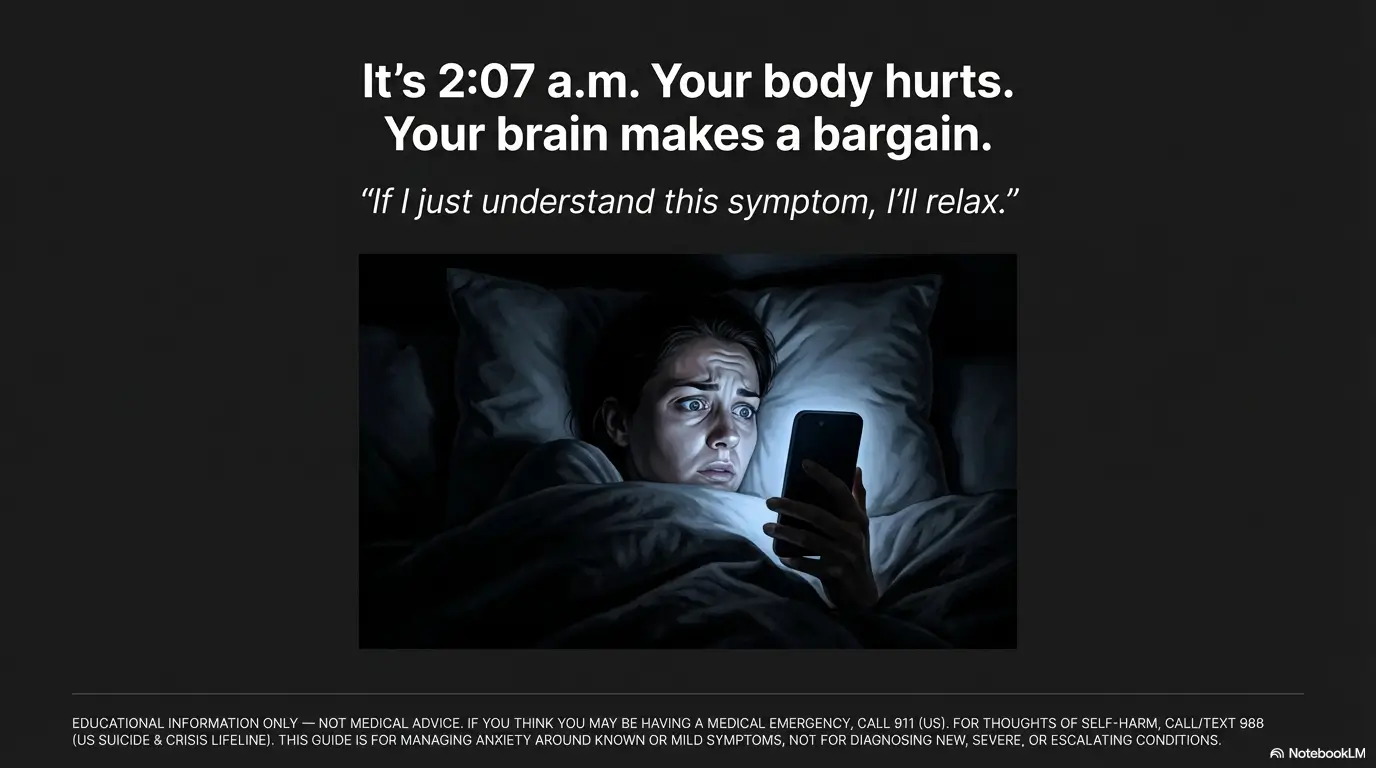
At 2:07 a.m., a harmless muscle twitch can turn into a full documentary: three tabs open, pulse climbing, sleep gone—not because the symptom changed, but because your nervous system did.
If you live with chronic pain, cyberchondria hits harder. Fatigue narrows your thinking, symptom-checking becomes compulsive, and Google rewards worst-case headlines—so “top result” starts to feel like “most likely.”
Keep guessing in the dark and you pay the uncertainty tax: more alarm, more body tension, less sleep, louder pain tomorrow.
Cyberchondria (sometimes called “health anxiety online”) is the loop where searching for reassurance briefly soothes fear—then trains your brain to search again. It’s not a character flaw. It’s conditioning.
This post gives you a safer sequence you can run when you’re tired: a red-flag filter that ends debates, a 90-second interrupt to downshift panic physiology, and a clinician-ready symptom note that turns dread into usable data (the same kind of structure you’d use in a pain diary for disability paperwork—clean, dated, and actionable).
I’m not here to diagnose you. I’m here to give you a method that stops feeding the spiral. Read this like a checklist. Save it for nighttime. Use it once—before you search again.
Table of Contents
2 A.M. spiral: why pain + Google feel fused
Night makes pain louder because the room gets quieter. Add fatigue, and your brain becomes less nuanced and more “scan for threat.” That’s why the same sensation can feel manageable at noon and catastrophic at 2 a.m.
Quick confession: I’ve turned a normal muscle twitch into a full medical documentary with three tabs and a racing heart. The symptom didn’t change. My nervous system did.
- Less distraction → more symptom focus.
- More fear → narrower interpretation.
- More searching → more arousal.
Apply in 60 seconds: Say: “This is a threat scan,” then switch to the red-flag filter.
Pain at night: less noise, more signal amplification
If you’re already sensitized by chronic pain, nighttime attention can amplify every sensation. This is why the first goal is often downshifting, not “finding the perfect explanation.” If sleep is repeatedly getting hijacked, it may help to borrow tools from CBT-I for insomnia with chronic pain—not as a cure, but as a way to stop night from becoming the arena.
Uncertainty tax: your brain tries to “buy certainty” with searching
Cyberchondria is often responsibility disguised as panic: “If I check hard enough, I’ll prevent something.” But searches don’t include your baseline, your triggers, or your trend.
Curiosity gap: The one question Google can’t answer (but your body can)
The real question is: “Do I need immediate care, or do I need my nervous system to settle so I can sleep?” You’ll answer that with structure.
Red-flag filter: when to stop reading and get help
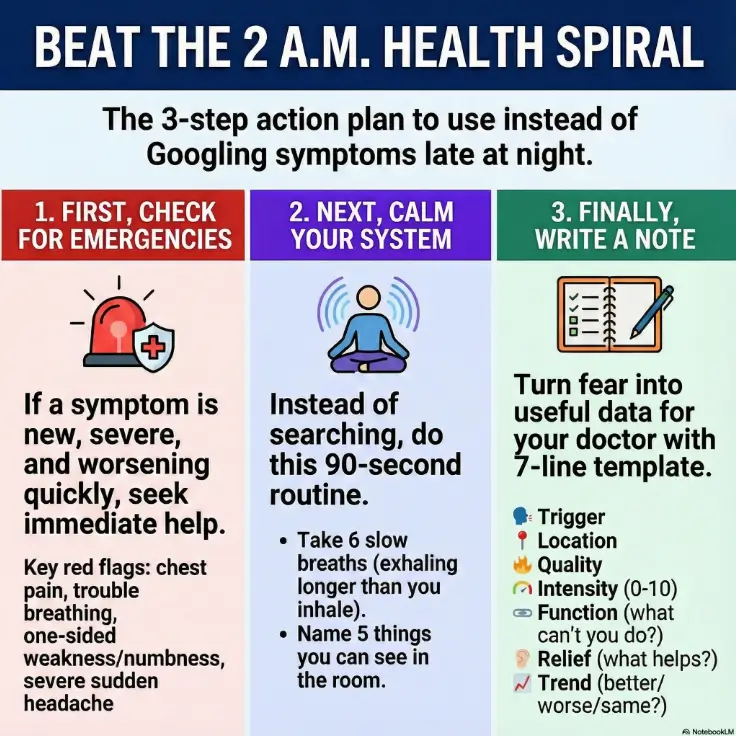
This is a safety tool, not a diagnosis tool. It exists to reduce risk and stop 2 a.m. debates. If a symptom is new, severe, and escalating quickly, treat it differently than your usual flare pattern.
“Go now” symptoms (simple, non-diagnostic triage language)
- Chest pain/pressure, especially with sweating, nausea, or pain spreading to arm/jaw
- Trouble breathing, bluish lips, or severe shortness of breath
- Fainting, sudden collapse, or you can’t stay awake
- One-sided weakness/numbness, facial droop, or new trouble speaking
- Severe sudden headache unlike your usual pattern
- New bowel/bladder changes with severe back pain or new leg weakness (if you’re dealing with back symptoms, treat this as an urgent low back pain emergency)
“Call today” symptoms vs “track for appointment” symptoms
Call today if a symptom is new, persistent, or blocks basic function (walking, hydration, breathing, or sleep for multiple nights). Track for appointment when symptoms match your established pattern and are stable or improving.
When you’re unsure: choosing the safer option
“I’m not sure how urgent this is” is a valid reason to contact a clinician, telehealth, or triage line. Uncertainty doesn’t belong to Google.
- New + severe + rapidly worsening → seek real-time help.
- Known patterns → use calming + tracking.
- Unsure → ask a professional, not a search engine.
Apply in 60 seconds: Screenshot this list so you can stop rereading scary pages.
Pain ≠ danger: a cleaner interpretation that respects chronic pain
Chronic pain can be loud even when nothing is “breaking.” That doesn’t erase your pain—it explains why intensity alone is a messy guide to urgency. Cyberchondria thrives when we treat volume as proof of danger.
Intensity isn’t the best predictor—pattern is
Pattern means triggers, duration, what helps, and what “off-pattern” looks like. That’s the context the internet never has. (This is also why “which condition is it?” searches—like sciatica vs herniated disc—can be useful in daylight for question-generation, but rough at 2 a.m. when your nervous system is already loud.)
The 3 data points clinicians actually use: onset, trend, function
- Onset: what changed before this started?
- Trend: better/worse/same over 24–48 hours?
- Function: what can’t you do today that you could do yesterday?
Curiosity gap: Why your scariest symptom can be the least informative
Fear loves dramatic sensations. But the most useful detail is often boring: newness, duration, and progression. Write those down first.
Cyberchondria drivers: the “thinking rules” behind searching
Cyberchondria isn’t only searching—it’s the rule behind it. “If I don’t check, I’m irresponsible.” “If I worry enough, I’ll prevent disaster.” These rules sound responsible. They also keep you awake.
Reassurance seeking vs problem-solving: same action, different outcome
Problem-solving ends with a plan. Reassurance seeking ends with another search. If your “research” never produces a next step besides more reading, that’s your answer.
Metacognitive beliefs: “If I worry/search, I’ll stay safe” (and why it backfires)
Brief relief from checking teaches the brain to check again. That’s conditioning, not character failure.
Show me the nerdy details
One reason the loop sticks: discomfort rises → you search → discomfort drops briefly. That drop reinforces searching. To weaken the loop, change the first response: red-flag filter first, then calming, then a plan.
Curiosity gap: The “one more search” feeling—what it’s actually signaling
Usually it’s not the symptom. It’s your brain trying to eliminate uncertainty. A plan does that better than a search.
Search-result traps: why worst-case feels likely
Search engines are not designed for nervous systems in alarm mode. They rank for relevance and engagement, not for “how calm you’ll feel afterward.” Your brain reads “top result” as “most likely.” That’s the trap.
Headline math: rare conditions are sticky, not probable
Rare, scary outcomes get attention, so they stay visible. Visibility creates the illusion of probability.
Context collapse: symptoms without duration/meds/baseline
Without timeline and baseline, symptom words can “fit” too many stories. That’s how fear wins.
Let’s be honest—2 A.M. searching isn’t “research.” It’s triage with no tools.
Daylight research can be helpful. Nighttime searching is usually fuel.
Common mistakes: 7 moves that feed the spiral
Smart people spiral too. Especially when they’re tired.
Mistake #1: searching without a time window (new vs chronic vs flare)
Timeline is everything. Give your brain the timeline or it will fill the gap with catastrophe.
Mistake #2: “just one more search” (variable reward loop)
Unpredictable reassurance keeps you checking. That’s why it can feel compulsive.
Mistake #3: switching plans daily (no feedback, no trust)
If you change tactics every time you feel afraid, you never learn what helps. Consistency teaches safety.
Mistake #4: using forums as diagnosis (instead of question generation)
Use communities for support, not midnight certainty.
Here’s what no one tells you: reassurance can become a dependency.
Replace “check” with “structure” and the dependency weakens over time.
- Timeline beats symptom words.
- Consistency beats frantic switching.
- Structure beats reassurance chasing.
Apply in 60 seconds: Pick one rule you’ll follow for 7 nights (not forever—just 7).
Search budget plan: use the internet without getting used by it
A search budget is a compromise: you get information, but you don’t pay with your sleep. You’re not banning curiosity—you’re containing it.
MedlinePlus (from the U.S. National Library of Medicine) is a solid example of a plain-language health library; use sources like that more often than “doom pages.” If your symptoms are pain-related, it also helps to keep one “baseline explainer” bookmarked (for example, a plain-language overview of physical therapy for sciatica—not because everything is sciatica, but because calm, step-by-step sources reduce the urge to chase extremes).
One daily window (daytime only): timer + single question
Choose a 15-minute window in daylight. One question. When the timer ends, stop—even if you feel unfinished.
Safe query swaps: from “what disease is this?” → “what should I ask my doctor?”
- Swap “what is this symptom” for “what should I monitor, and what questions should I ask?”
- Add “when to seek urgent care” to pull results toward action.
Source guardrails: .gov, major institutions, and plain-language health libraries
Prefer sources that explain next steps and thresholds. Avoid anything designed to scare you into clicks.
Curiosity gap: The wording that lowers panic (and raises usefulness)
Try: “what to monitor for 48 hours”. It turns anxiety into a time-limited plan.
- Daytime
- Timer on
- Question-focused
- Nighttime
- Urgent/doom-y
- Already searched once
Neutral next action: Choose one lane and stay there for 20 minutes before switching.
90-second interrupt: what to do instead of searching
This is what you do when your thumb hovers over the search bar. The goal isn’t certainty. The goal is lowering arousal so you can think again.
Step 1 (body): downshift alarm breathing + grounding
- Exhale longer than you inhale for 6 slow breaths.
- Name 5 things you see, 4 you feel, 3 you hear.
Step 2 (brain): label the loop (“threat scan” vs “problem solve”)
Say: “I’m scanning for danger because I’m uncomfortable.” A label turns a thought into information.
Step 3 (environment): remove trigger (phone distance, grayscale, blocker)
Put the phone across the room. If that’s too hard, put it under your pillowcase. Friction is a kindness. (If your nighttime spiral often starts after long desk hours, it’s worth tightening the daytime inputs too—small ergonomic tweaks, like a better sit-stand schedule for a desk job with sciatica, can reduce the “why does everything flare at night?” feeling.)
Rate each 0–10. This is not a diagnosis—just a quick self-check.
Score: —
Neutral next action: Follow the suggestion once before you change tactics.
Clinician-ready note: the 7-line template that beats doomscrolling
This is where you turn fear into usable data. Clinicians need patterns. Your brain needs a next step that isn’t Googling.
The 7 lines: trigger, location, quality, intensity, function, relief, trend
- Trigger: what changed before it started?
- Location: where is it exactly?
- Quality: aching/burning/stabbing (pick 1–2)
- Intensity: 0–10
- Function: what can’t you do?
- Relief: what helps (heat, rest, meds, movement)?
- Trend: better/worse/same over 24–48 hours
How to describe pain without getting dismissed (neutral + functional)
Lead with function. “I can’t stand more than 5 minutes” is clearer than “I’m terrified.” You can still mention fear—just don’t let it be the only data. (If you want a more formal, dated version of this habit, adapt the same structure used in an ERISA LTD pain diary: timeline + function + consistency.)
What to ask for: evaluation plan, “watch-for” thresholds, follow-up timing
- “What signs mean urgent care vs waiting?”
- “What should I monitor for the next 48 hours?”
- “If this persists, what’s the next step and timeline?”
- Timeline + function are clinician-friendly.
- Trends reduce “what if” over time.
- A plan beats a pile of tabs.
Apply in 60 seconds: Open Notes and write the 7 lines with today’s date.
Short Story: (120–180 words) I had a flare that woke me up three nights in a row. Night one: I searched until my eyes were gritty and my heart felt fast. Night two: I swore “no Googling,” then did it anyway, because fear negotiates. Night three: I wrote the 7-line note, set a boundary (“no searches until 9 a.m. unless a red flag appears”), and did six slow exhales with my hand on my ribs.
The pain didn’t vanish. But something else did: the sense that I had to solve everything right now. By morning, I had data instead of dread—a trigger, a trend, and a plan to call if things changed. The next night wasn’t perfect, but it was quieter. That’s the win I’m after.
Who this is for / not for
Because this is health content, scope matters.
For you if: chronic pain + nighttime searching + reassurance spirals
- You recognize flare patterns and have a baseline.
- Your fear spikes mostly at night, when you’re alone or tired.
- Searching reliably makes you feel worse.
Not for you if: new red-flag symptoms, unstable conditions, rapidly worsening changes
If your symptoms are new, severe, or escalating quickly, skip this article and seek real-time care.
If you’re unsure: pick the safer option
If you don’t know which lane you’re in, you’re allowed to ask a professional. “Unsure” is a valid clinical statement.
- Symptoms match my usual pattern (or are mild and stable).
- No “go now” red flags from the filter.
- I can breathe normally and stay oriented.
- I can write a 7-line note for follow-up.
Neutral next action: If any item is “no,” choose care-now instead of searching.
Next step: one concrete action you can do today
Willpower is a terrible night nurse. Systems win when you’re tired. Pick one action that takes under 15 minutes—not because it fixes everything, but because it changes tonight.
Set a No-Search Night Rule (exceptions = red-flag filter)
Write it: “No searches after bedtime. If I’m scared, I use the filter. If no red flags, I do the 90-second interrupt and write a note.”
Put the symptom note on your home screen (friction beats willpower)
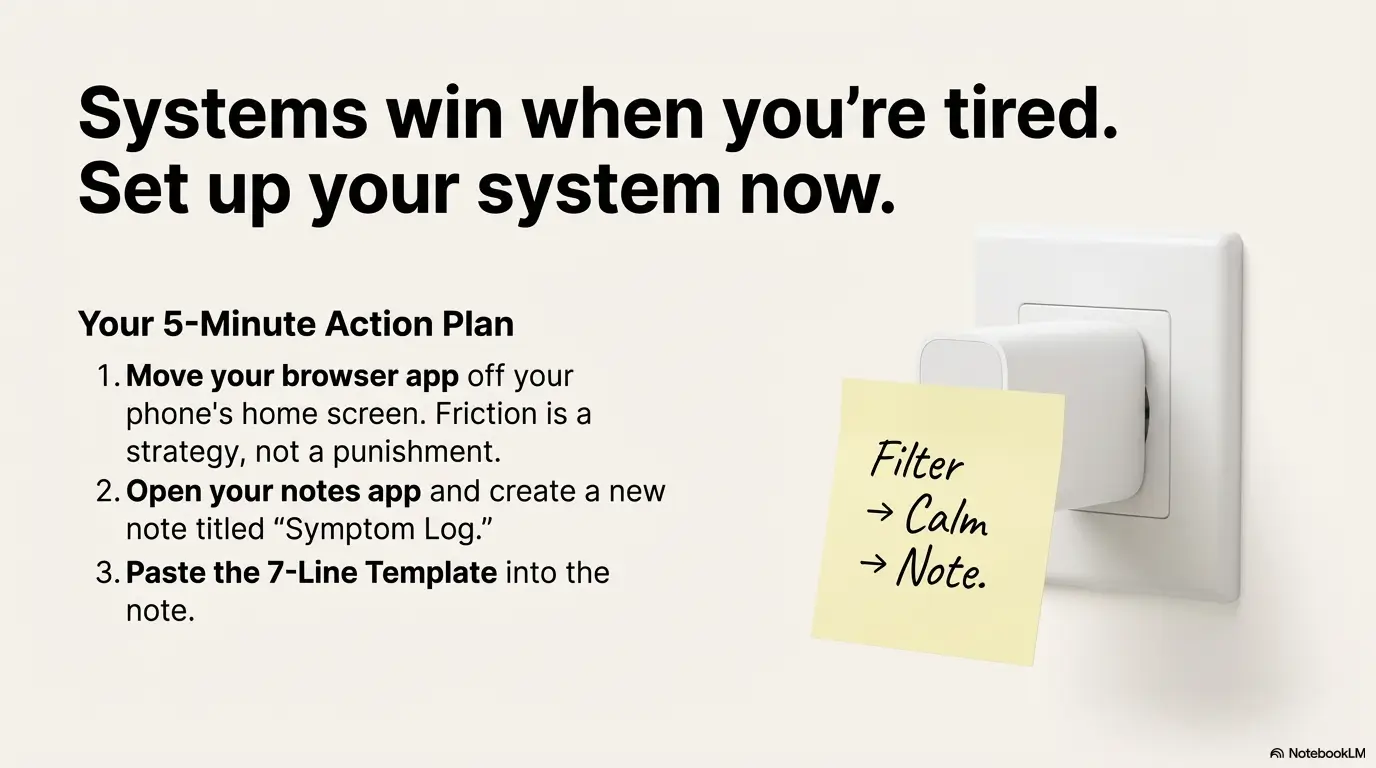
Make Notes easy and browsers harder. Move the browser off your home screen. Place a reminder on your charger: “Filter → Calm → Note.”
Choose one boring calming routine (consistency > intensity)
- Heat pack + 6 long exhales
- One gentle stretch you already know is safe (if you’re dealing with back/leg symptoms, keep it within what you’ve learned is safe—especially if you’ve had recurring desk-job sciatica flare-ups)
- Audio you’ve heard before (novelty can keep you alert)
- Rules beat debates at 2 A.M.
- Friction is a strategy, not a punishment.
- Plans calm you more reliably than facts.
Apply in 60 seconds: Move your browser off your home screen.
FAQ
Is cyberchondria the same as health anxiety?
They overlap. Health anxiety is the fear; cyberchondria is the searching pattern that amplifies it.
Can anxiety make chronic pain feel worse (even if pain is real)?
Yes. Anxiety can increase muscle tension, disrupt sleep, and narrow attention onto sensation—without making the pain “fake.”
How do I know when pain is “urgent” vs a chronic flare?
Use the red-flag filter. New + severe + rapidly worsening deserves real-time care. Known patterns deserve calming + tracking. If unsure, choose the safer option.
What should I track for my doctor instead of Googling?
Use the 7-line note: trigger, location, quality, intensity, function, relief, trend. One clean note beats 30 tabs.
Should I avoid all online health information completely?
Not necessarily. Use a search budget: daytime only, timer on, question-focused, credible sources. Nighttime is for calming and planning. If sleep is a major trigger, pairing that boundary with a practical sleep plan (for example, how to sleep with sciatica strategies, or even basics like mattress firmness for sciatica and side-sleeping adjustments) can make the “no-search” rule easier to keep.
What if I Google because doctors have dismissed me before?
Being dismissed hurts. The 7-line note helps because it leads with function and trend—details clinicians can act on.
What’s a realistic plan if I relapse and search again?
Skip the shame. Return to the sequence: filter → 90-second interrupt → 7-line note → daytime search window.
Closing the loop: The question Google can’t answer—“Do I need immediate care, or do I need my nervous system to settle?”—gets answered by structure. Filter for safety, interrupt the alarm, then write the note so daylight has a plan.
If you have 15 minutes right now: move your browser off your home screen and create a blank “Symptom Note.” You don’t have to win everything tonight. You just have to stop feeding the spiral.
Last reviewed: 2026-01