

Laundry vs. Sciatica: The Boring-on-Purpose System
Laundry shouldn’t cost you the rest of your night. Don’t let carrying laundry up stairs turn into that sharp, electric “hot-wire” down the leg.
Keep doing it the old way and you pay in the quiet currency: a flare that steals sleep, walking tolerance, and the next day’s mood. If sleep is already fragile, you’ll likely care about the difference between a “mildly annoyed” night and the kind of night that forces you to figure out how to sleep with sciatica at 2 a.m.—and maybe even rethink mattress firmness for sciatica or a calm reset like CBT-I for insomnia with chronic pain.
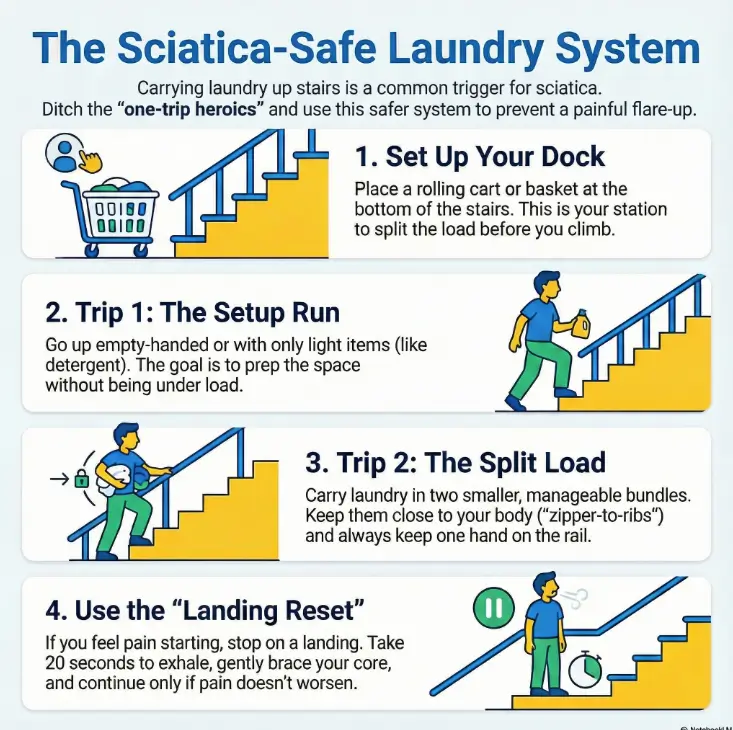
This system uses a rolling cart, the Two-Trip Rule, and a 20-second Landing Reset to stop the “rush → twist → spike” loop. Move laundry with one hand on the handrail, the load close to your ribs, and your spine out of the surprise-rotation business.
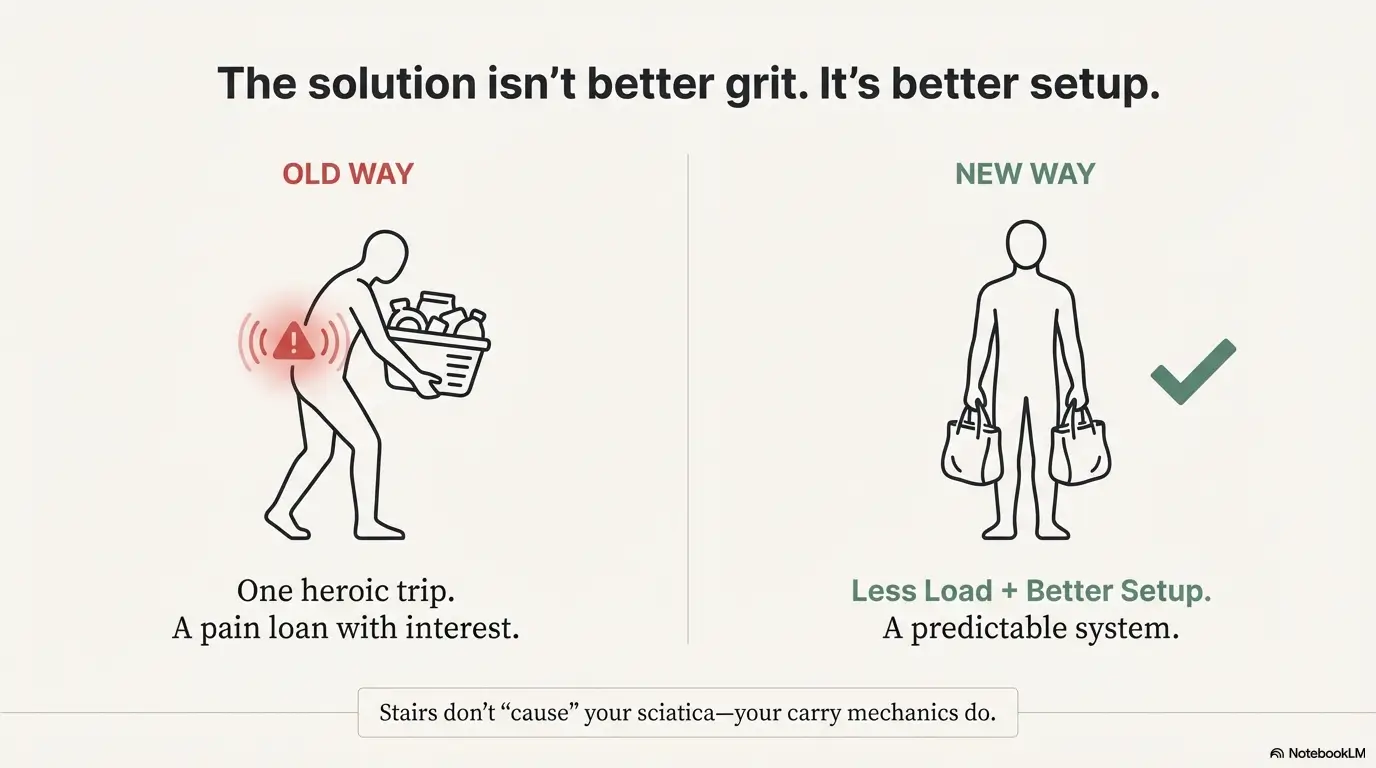
For sciatica, the safest laundry-on-stairs strategy is less load + better setup, not “better grit.” Stage a rolling cart at the bottom of the stairs, then use the Two-Trip Rule: Trip 1 carries light essentials; Trip 2 moves the laundry split into two smaller bundles. Keep the load close, use the rail, and take a 20-second Landing Reset if pain spikes.
Educational information only—not medical advice. Stop if symptoms worsen. Seek urgent care now for new bowel/bladder changes, saddle numbness, rapidly worsening leg weakness, fever, or severe unrelenting pain.
Table of Contents
Laundry + stairs: why sciatica flares here first
Stairs are honest. They don’t care if you’re “being careful.” They care about physics: the angle of your hips, how far the load sits from your body, and whether you twist because the basket bumps your thigh.
Sciatica is nerve pain—often linked to irritation or compression around the lower back that can send symptoms down the leg. If you want a plain-English map of what that pattern is, start with what sciatica nerve pain feels like (and why it travels). MedlinePlus and the American Academy of Orthopaedic Surgeons explain that sciatica is typically a symptom pattern, commonly associated with issues like a herniated disk.
If you’re sorting causes in your head, it may help to compare sciatica vs. herniated disc and then look at a practical overview of herniated disc sciatica treatment options. That matters here because stairs + laundry quietly stack the deck: load, twist, and hurry—exactly what your nerve complains about.
- Load: A hamper is awkward, not just heavy.
- Twist: Doorframes, railings, and “one more step” turns make you rotate under tension.
- Hurry: You speed up because you want it over. (Same.)
Open loop: the one pre-stair change that reduces pain before any gear: you fix the load before you touch the staircase. Not at the first step. Not at the landing. Before.
- Distance-from-body matters more than weight.
- Twisting under load is a flare multiplier.
- Hurrying makes both worse.
Apply in 60 seconds: Split your laundry into two smaller bundles at the bottom. If you can’t split it, it’s too big.
Personal confession: my worst laundry flare didn’t happen on a “big cleaning day.” It happened on a tiny load—because I carried it like a trophy (arm out, hip hiked, chin clenched) while I tried to beat my own impatience. The stairs won.
Two-Trip Rule: the simplest system that holds up
The Two-Trip Rule is not glamorous. It won’t get applause. It will, however, get you through laundry day without bargaining with your sciatic nerve. And if your day is already full of sitting, commuting, or desk hours, pairing this with a sit–stand schedule for desk job sciatica can reduce the “everything piled up” feeling that makes you rush the stairs.
Trip 1: the “setup run” (light + hands free)
Trip 1 is about removing future friction. You carry only what makes Trip 2 safer:
- Detergent pod bag / small bottle
- Dryer sheet box (or nothing—honestly, nothing is fine)
- A lightweight empty bag for splitting
- Your phone (for a 20-second timer at the landing)
If you have a laundry room upstairs, Trip 1 might just be “go upstairs empty-handed and prep the space.” The point is the same: your hands—and your attention—are not already taxed when you do the real carry.
Trip 2: the “payload run” (split load, no heroics)
Trip 2 is where people try to be legendary. Please don’t. Split the load into two smaller bundles that you can keep close to your body. A soft bag often behaves better than a rigid hamper because it hugs your torso instead of forcing your elbows out.
Let’s be honest… the flare starts with “I’ll do it in one.”
“One trip” feels efficient. It’s not. It’s a pain loan with interest. And the interest rate is your weekend plans.
Rule of thumb: If you catch yourself holding your breath while lifting the bundle, your body is telling you it’s too much.
Money Block: “Is this safe for me today?” eligibility checklist
Answer yes/no. If you hit a “no,” you downshift (split more, outsource, or pause).
- Can I put one hand on the rail the entire time? (Yes/No)
- Can I lift the bundle without twisting my torso? (Yes/No)
- Can I climb one flight without symptoms escalating from “annoying” to “electric”? (Yes/No)
- Is the staircase clear and dry (no socks-on-wood surprises)? (Yes/No)
- Do I have a landing/reset plan if symptoms spike? (Yes/No)
Neutral next action: If any answer is “No,” shrink the load or change the route before you climb.
The first time you commit to Two Trips, it feels slower. By the third time, it feels like you discovered a cheat code: less bracing, less flaring, less “I should’ve known better.”
Short Story: I used to do laundry like I was trying to win an invisible race. One trip, always. Basket pressed against my hip, shoulder hiked, jaw set. Halfway up the stairs, my leg would start that buzzing numbness, and I’d speed up—because somehow speeding up felt safer than stopping. It wasn’t. The day I finally tried two trips, I felt ridiculous… until I didn’t.
Trip 1 was almost insulting (a tiny bag and my phone). Trip 2 was split into two soft bundles that sat close to my ribs. At the landing, I paused, exhaled, and didn’t argue with my body. It took an extra minute. What I got back was the whole evening—no ice packs, no limping, no “why did I do that?” spiral.
Rolling cart staging: the setup that works with stairs (not against them)
Let’s say this clearly: a rolling cart is not for rolling up stairs. A rolling cart is for eliminating the long, annoying carry to the stairs— and for making load-splitting automatic. If you’re comparing wheeled support options (especially when walking tolerance is limited), you might also find it helpful to see how a rollator for lumbar spinal stenosis is typically evaluated—because the practical “control” factors (handle height, stability, wheels that don’t snag) overlap with what makes a laundry cart feel safe.
Bottom-of-stairs “dock”: where the cart lives
Your cart’s “home” is the bottom of the staircase, parked like a little valet. Laundry comes out of the dryer (or out of your bedroom) and goes into the cart. Then you split from the cart into two bundles. That’s the workflow. That’s the whole magic.
Cart feature that matters most (hint: it’s not max weight)
Weight ratings are easy marketing. What matters for sciatica is control:
- Handle height that lets you walk upright (not bent forward)
- Stability (wide enough base that it doesn’t tip when you turn)
- Wheel diameter that doesn’t snag on thresholds or rugs
- Brakes or a “park” feel (even if it’s just a stable stance)
The open loop from earlier: that one pre-stair change? It’s this cart dock + split routine. You take decision-making out of the pain moment. You don’t “see how it feels” on step one. You decide at the dock.
Container pairing: soft bags + rigid basket (when each wins)
If you want the best of both worlds, use the cart to hold a rigid basket, then split into soft bags for the stairs.
- Rigid basket wins for loading/unloading and staying open.
- Soft bag wins for stairs because it hugs your body and reduces twisting.
Money Block: Decision card — cart vs backpack vs basket
Neutral next action: Pick one setup for the next 7 days—consistency beats perfection.
Tiny anecdote: I once bought a “high capacity” basket that looked like it could transport a small giraffe. It was the worst thing I’ve ever carried on stairs. It forced my arms out and made me twist to clear corners. I donated it with a polite apology.
One-hand rail rule: designing the carry around safety
If sciatica is part of your life, falls risk is part of the conversation—especially on stairs. One hand on the rail isn’t “extra cautious.” It’s an intelligent constraint. You build your carry around it.
What to carry when the rail is non-negotiable
- Soft, compact bundle that stays close to your ribs
- Bag with a short handle (so the load doesn’t swing)
- Nothing wide that bumps the rail or doorframe and forces a twist
The grip problem: why damp laundry changes everything
Damp fabric is slippery. Slippery grip causes micro-adjustments. Micro-adjustments happen mid-step. Mid-step adjustments are where people twist, brace, and flare.
If you’re moving laundry right out of the washer, use a bag that gives you a stable hold, and commit to the landing reset if you feel symptoms ramping. This isn’t drama. It’s smart operations.
Show me the nerdy details
Why “one-hand rail” changes everything: your nervous system cares about stability. With one hand anchored, you reduce sway and surprise corrections. Surprise corrections are where bending/twisting show up without permission. The goal is fewer unplanned spine movements under load.
Quick self-check: If your bundle forces your elbow out or your shoulder up, it’s too awkward for stairs today.
Landing Reset: a 20-second flare circuit-breaker
Here’s the part no one teaches because it sounds too small: a short, structured pause can prevent a long flare. The Landing Reset is your “circuit breaker.” You’re not stopping because you’re weak. You’re stopping because you’re strategic.
Step sequence: stop, set feet, exhale, brace, continue
- Stop on the landing (both feet flat).
- Set the bundle down if you can do it without bending; otherwise keep it close.
- Exhale slowly for 4–6 seconds (your shoulders should drop).
- Brace gently as if you’re about to cough (not a full crunch, not a workout).
- Continue only if symptoms don’t escalate.
Here’s what no one tells you… resting is a technique, not a collapse.
The moment you feel the nerve “talking,” your instinct is to finish fast. But speed adds twist. Twist adds symptoms. Symptoms add speed. You see the loop. The Landing Reset breaks it.
- Stop before symptoms snowball.
- Exhale to downshift tension.
- Continue only if the pain isn’t escalating.
Apply in 60 seconds: Set a phone timer once, and reuse it every laundry day.
I used to treat stopping as “losing momentum.” Now I treat it like checking mirrors before changing lanes. Same trip. Fewer regrets.
Carry mechanics: the 15-second “zipper-to-ribs” checklist
You don’t need perfect form. You need repeatable cues. The goal is simple: keep the bundle close and keep your spine from twisting under load.
Keep it close: “zipper-to-ribs” positioning
- Bundle touches your torso (not hovering away from it).
- Elbows down (not winged out).
- Shoulders level (no “one shoulder carries the day”).
No twisting: pivot like you’re holding soup
If you were holding a bowl of soup, you wouldn’t twist your spine and hope the soup cooperates. You’d pivot your feet. Do that.
Micro-rule: If you need to turn, turn your feet first. Your torso follows.
Money Block: Mini “Split the Load” calculator (quick & non-medical)
This isn’t a medical limit. It’s a practical tool to stop accidental overloading.
Neutral next action: Use the recommendation to pre-split at the cart dock before climbing.
Small lived-experience note: I used to obsess about “proper lifting.” What helped more was the humble “keep it close” cue. When the basket stayed near my ribs, my leg complained less—almost annoyingly predictably.
Common mistakes: the “quiet sabotage” list (laundry edition)
These mistakes are sneaky because they look responsible. They are the kinds of things you do while telling yourself, “I’m being careful.”
Mistake #1: the overloaded hamper “because it’s faster”
Overloading is rarely about weight alone. It’s about awkwardness. Awkwardness pushes the load away from your body. And distance is leverage.
Mistake #2: adjusting mid-step (fix it at the landing)
If you need to re-grip, that’s a landing job. Not a mid-stair job. Mid-stair adjustments create twisting and bracing—two ingredients sciatica loves to punish.
Mistake #3: twisting to clear a doorframe or basket corner
This is where the “pivot like soup” rule earns its rent. Turn your feet. Then your torso.
- Fix: make bundles smaller so they don’t collide with the environment.
- Fix: pick a bag shape that’s narrow and flexible.
- Fix: clear the path before you lift.
I once tried to squeeze a wide basket through a half-open door with my hip. My hip won. My nerve did not.
Don’t do this: 6 moves that feel helpful and backfire
This is the loss-prevention section. If you only skim one part, skim this. These moves create the “I was fine, then suddenly I wasn’t” moment.
The side-carry (hip hike) that lights up the leg
Side-carrying makes you hike one hip and tilt your trunk. It’s a classic “compensation” pattern and a classic flare trigger.
The lean-forward pull by a single handle
Leaning forward looks efficient. It’s also a great way to load your back and irritate symptoms. If you must use a handle, shorten it so the load stays close.
The speed-run (rushing changes mechanics)
Rushing makes you skip the rail, skip the pivot, skip the landing reset—then act surprised when your leg complains.
Bonus backfires (quick hits)
- Socks on stairs: no traction, no thanks.
- Carrying while multitasking: laundry + phone + rushing = chaos.
- “I’ll stretch it out on the stair”: stairs are not a stretching studio.
- Avoid side-carrying and hip hiking.
- Don’t lean-pull a heavy bundle.
- Slow down at the landing, not in the middle of a step.
Apply in 60 seconds: Put shoes on and clear the first 6 steps before you lift anything.
Micro-movement that helps: walking and gentle activity (laundry-adjacent)
Most reputable medical education around sciatica emphasizes that staying gently active is often preferable to long bed rest—because stiffness and fear tend to make things worse. The trick is dosage: short, calm movement that doesn’t escalate symptoms.
Short walks vs bed rest: the middle path that’s usually recommended
Think “two minutes of easy walking” rather than “5,000 steps or bust.” After laundry, a short walk around the house can help your body decompress—if it doesn’t spike symptoms. If it does, you back off. No moral judgment. Just feedback.
If walking is part of your daily “keep it calm” plan, supportive footwear can matter more than people admit—see sciatica-friendly walking shoes for the practical factors that reduce irritation during short walks.
Open loop: the small posture cue that makes walking feel different
Here it is: shorten your stride and keep your ribcage stacked over your pelvis. Not rigid. Not military. Just “tall and easy.” Many people flare when they overstride and arch. Shorter steps reduce tugging and let the hips do their job.
- Walk at a pace where you can breathe through your nose.
- Stop if symptoms ramp up (not if they merely exist).
- Do a second mini-walk later instead of one long one.
Personal note: walking never fixed my laundry problem. But a two-minute stroll after I put the basket down made me feel like my nervous system stopped yelling in all caps. And if walking isn’t your thing during a flare, some people tolerate gentle cycling better—especially when comparing recumbent vs upright bike for sciatica.
Targeted stretches: 4 options (and when not to stretch)
Stretches are popular because they’re simple and feel proactive. But sciatica can be picky: certain positions (especially deep bending and twisting) can aggravate symptoms for some people. So we’ll keep this gentle and guarded.
Figure-4 stretch (gentle version)
Lie on your back, cross ankle over knee, and bring the legs toward you only as far as comfortable. Stop before you feel nerve zing.
Pigeon pose (supported version)
If pigeon is intense, don’t force it. Use pillows, keep it shallow, and prioritize calm breathing. This is not the Olympics.
Standing hamstring stretch (with the big warning)
If bending forward reliably spikes symptoms, skip hamstring stretching for now. If you do it, keep the knee soft and your spine long—no “reach for the toes” drama.
Seated spinal twist (often provocative—use caution)
Twists can feel good for some people and aggravating for others. If twisting is one of your flare triggers (it often is during laundry), this is a “maybe later” move.
Rule: Stretching should make symptoms calmer within minutes—not louder. If it makes them louder, it’s not your stretch right now. If you want an alternative that’s more “stability” than “stretch,” some readers do better with short, repeatable core work like McGill Big 3 in 10 minutes—kept gentle, consistent, and non-heroic.
Who this is for / not for: a quick fit check
This article is built for time-poor, purchase-intent readers—people who don’t want a lecture, they want a plan that works on a normal day. If your day is dominated by sitting and flare cycles, you may also recognize the pattern described in desk job sciatica flare-ups.
Best fit: stable stairs + mild–moderate sciatica + repeatable routine
- You can use the handrail reliably.
- Your symptoms flare with carrying, but you can still climb with control.
- You want a system you can repeat (not a one-time “perfect form” moment).
Not a fit: falls risk, progressive weakness, unsafe stairs, severe spikes
- You feel unstable on stairs or have had near-falls.
- Your leg is getting weaker, not just painful.
- Your staircase is cluttered, steep, poorly lit, or slippery—and you can’t fix that quickly.
If you’re not a fit today, that’s not failure. That’s information. Your “best move” may be outsourcing, relocating the laundry setup temporarily, or asking for help without apologizing for it.
Money Block: “Before you buy a cart” quote-prep list
If you’re price-comparing carts or bags, gather these first so you don’t buy twice.
- Stair width (narrow stairs hate wide baskets)
- Distance to stairs (how far you roll before you carry)
- Landing size (can you safely pause and set down?)
- Doorframe pinch points (where twisting happens)
- Handle height preference (upright vs bent-over)
Neutral next action: Measure one pinch point today—then shop based on your house, not the product photo.
When to seek help: red flags + the “what to say” script
Most sciatica improves with conservative care, but some symptoms shouldn’t be watched at home. If you’re unsure, err on the side of safety. Cleveland Clinic and other major institutions emphasize that certain changes—especially bowel/bladder symptoms or rapidly worsening weakness—need urgent attention. If you want a clear “don’t second-guess this” checklist, see low back pain emergency red flags.
Urgent red flags to treat as non-negotiable
- New bowel or bladder control problems
- Saddle numbness (numbness in the groin area)
- Rapidly worsening leg weakness
- Fever with back pain, or severe unrelenting pain
The script: “stairs + load + timing + leg symptoms” (copy/paste)
If you make an appointment, this is the language that helps clinicians connect your daily life to the symptoms:
“My symptoms flare when I carry laundry up stairs. The pain/numbness starts in my (low back/buttock) and travels to my (thigh/calf/foot). It worsens after (X minutes) or after carrying about (rough weight). The positions that trigger it most are bending, twisting, and climbing. I can/can’t use the handrail. My main concern is (weakness, numbness, sleep disruption, walking tolerance).”
- Urgent symptoms deserve urgent evaluation.
- Clear descriptions help clinicians help you faster.
- Your daily triggers are valuable clinical data.
Apply in 60 seconds: Write your symptom pattern in one paragraph and save it to your phone.
FAQ
Is a backpack laundry bag better than a basket for sciatica?
Often, yes—because a backpack keeps the load close and frees your hands (especially helpful if the rail is non-negotiable). The trade-off is control: you still need to avoid twisting to get it on/off. If a backpack makes you overfill, it becomes a sneaky overload. Keep it small.
How heavy is “too heavy” when you have sciatica?
There isn’t one universal number. “Too heavy” is when the load forces you to brace, hold your breath, twist, or rush. Use the mini split calculator as a practical stopgap, and adjust based on how your symptoms respond over the next 24 hours. If you’re trying to rebuild capacity safely, guidance like physical therapy for sciatica can be a better long-term strategy than guessing.
Do rolling carts help if you still have stairs?
Yes—if you use the cart to reduce the carry to the stairs and to make splitting easy. Don’t expect it to solve the staircase itself. Think of the cart as a “dock” for building smaller, stair-friendly bundles.
What’s the safest way to carry laundry down stairs with sciatica?
Down stairs requires even more stability. Keep one hand on the rail, keep the bundle close, and go slower than you want to. If your view of the steps is blocked, the load is too big. Split it or switch to a smaller bag.
Should I avoid stairs entirely during a flare?
Not always—but you should avoid the behaviors that escalate symptoms (overloading, twisting, rushing). If stairs consistently worsen symptoms or you feel unstable, it may be smarter to temporarily change the setup (smaller loads, help from someone else, or relocating laundry tasks to one floor).
What if I have to keep one hand on the rail?
Build around it: use smaller soft bundles, consider a backpack-style bag, and rely on the cart dock to pre-split. One-hand rail isn’t a limitation—it’s a safety upgrade.
Can bending to move laundry in/out of the washer make sciatica worse?
It can. Bending and twisting are common triggers. Try a staggered stance (one foot slightly forward), hinge at the hips with a long spine, and move the basket closer so you’re not reaching. If you can, do smaller loads so you’re not wrestling wet weight.
What do I do if my leg goes numb halfway up?
Stop at the landing and do the 20-second reset. If numbness is new, rapidly worsening, or accompanied by weakness, treat that seriously and seek care. At minimum, downshift your plan—smaller bundles, more trips, more rail time.
If you’re trying to rule out look-alikes, it can help to compare patterns like diabetic neuropathy vs sciatica (especially if symptoms are bilateral, stocking-like, or tied to blood sugar history).
Next step: the 10-minute “Tonight Setup”
This is the part that actually changes your week. Not a lecture. A setup.
Do this now: dock the cart, pre-split the load, pick a landing reset cue
- Create the cart dock at the bottom of the stairs (even if it’s just a sturdy spot on the floor).
- Add two empty bags (so splitting is automatic).
- Clear the first 6 steps and turn on a light (future you says thanks).
- Pick your landing reset cue: “Stop. Exhale. Stack. Continue.”
- Commit to Two Trips for the next 7 days—no exceptions, no hero runs.
Track one metric: “flare minutes after laundry” for 7 days
Don’t overtrack. Just one number. If your flare time drops—even by 10 minutes—that’s a win you can build on.
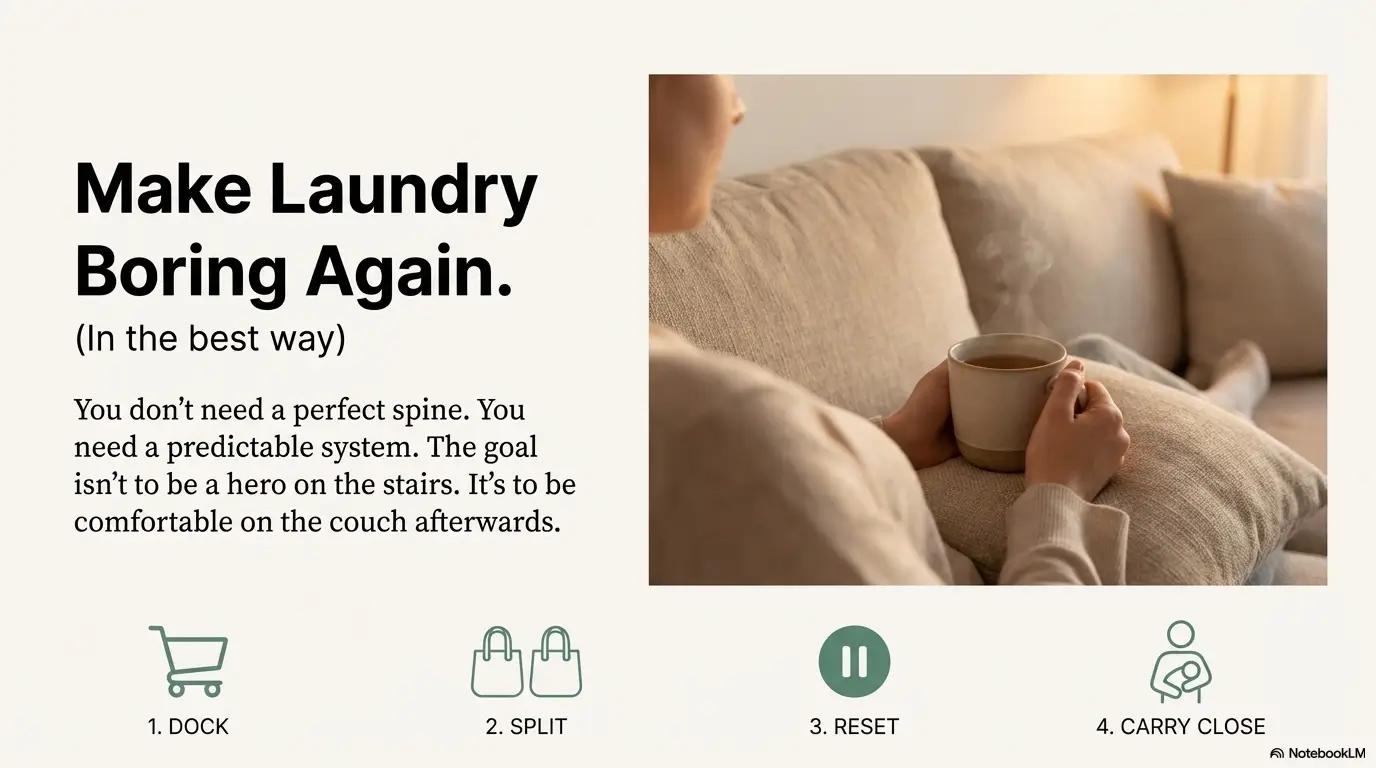
- Dock at the bottom.
- Split before the stairs.
- Reset at the landing.
Apply in 60 seconds: Put two empty bags in your cart dock right now—so tomorrow’s split is effortless.
Wrap-up: make laundry boring again (in the best way)
Remember the open loops?
- The pre-stair change that reduces pain: dock and split before the staircase.
- The cart feature that matters more than max weight: control (handle height, stability, wheels that don’t snag).
- The walking cue that changes how it feels: shorter steps with a calm, stacked posture.
You don’t need a perfect spine. You need a predictable system. That’s the difference between “laundry ruins me” and “laundry is annoying, but survivable.” And survivable is a beautiful starting point.
Load laundry here → split here → decide here.
Essentials only. Hands calm. Rail ready.
Two smaller bundles. Zipper-to-ribs. Pivot like soup.
Stop → exhale → gentle brace → continue if stable.
1–2 minutes easy movement if symptoms don’t escalate.
If you do one thing in the next 15 minutes, do this: create the cart dock (or a “dock spot”), place two empty bags there, and commit to Two Trips for a week. Then watch what your body tells you. You’re not guessing anymore—you’re running a calm experiment.
Last reviewed: 2026-01-01