

How to Get In and Out of Low Cars with Sciatica Pain
Four seconds is all it takes to turn a “quick hop out” into tomorrow’s sciatica flare—the one-leg-in, yank-and-twist move your low sedan quietly dares you to do.
If getting in and out of a Civic/Corolla-style seat is the moment your nerve “zings,” it’s usually not about flexibility or grit. It’s the transition: half-sitting, half-standing, spine rotating while your hips are still trapped in the bucket seat—classic sciatica nerve pain behavior when torque sneaks in.
Keep guessing and you don’t just lose comfort—you lose mornings, errands, commutes, and the confidence to drive without bracing for impact.
This guide shows a repeatable, low-drama method for how to get in and out of a low car with sciatica: a no-twist exit, a sit-first entry, and a simple seat setup that makes both easier—often with nothing more than door-frame balance support and a firm seat cushion for height.
It’s built from lived, practical reps: slow, consistent, and “no pivot until tall.”
Table of Contents
Who this is for / not for
This guide is for you if you can drive (or ride) but the entry/exit moment is the problem—especially in low sedans like a Honda Civic, Toyota Corolla, Camry, or an Accord-style seat that sits you down like you’re being politely lowered into a canoe.
Best fit: “low seat + sharp nerve zing” situations
- You drive or ride in a low sedan with bucket-ish seats and a tight footwell.
- Your pain spikes when you twist to stand or you do the “one-leg-in, yank, rotate” move.
- You can stand and walk, but the transition from seated-to-standing is the flare trigger.
Quick personal truth: I used to hop out of my old compact like a cheerful spring. Then my back taught me manners. The day I stopped twisting while half-seated was the day my “tomorrow pain” stopped ambushing me.
Not for: symptoms that shouldn’t be “worked around”
- New or worsening weakness (like your foot not doing what you tell it), numbness spreading, or pain that doesn’t change with position—especially anything that resembles low back pain red flags that need urgent attention.
- Recent injury/accident, fever, unexplained weight loss, or loss of bowel/bladder control.
- If driving itself feels unsafe today (braking, turning, checking blind spots).
Gentle safety note: This is movement coaching, not medical care. If you’re unsure whether your symptoms are safe to self-manage, get medical advice—especially if anything is new, escalating, or scary.
- Don’t twist while weight-bearing.
- Make the seat “higher” and the exit “wider.”
- Keep the method consistent, even on good days.
Apply in 60 seconds: Next time you park, open the door fully and rehearse one slow exit without pivoting until you’re upright.
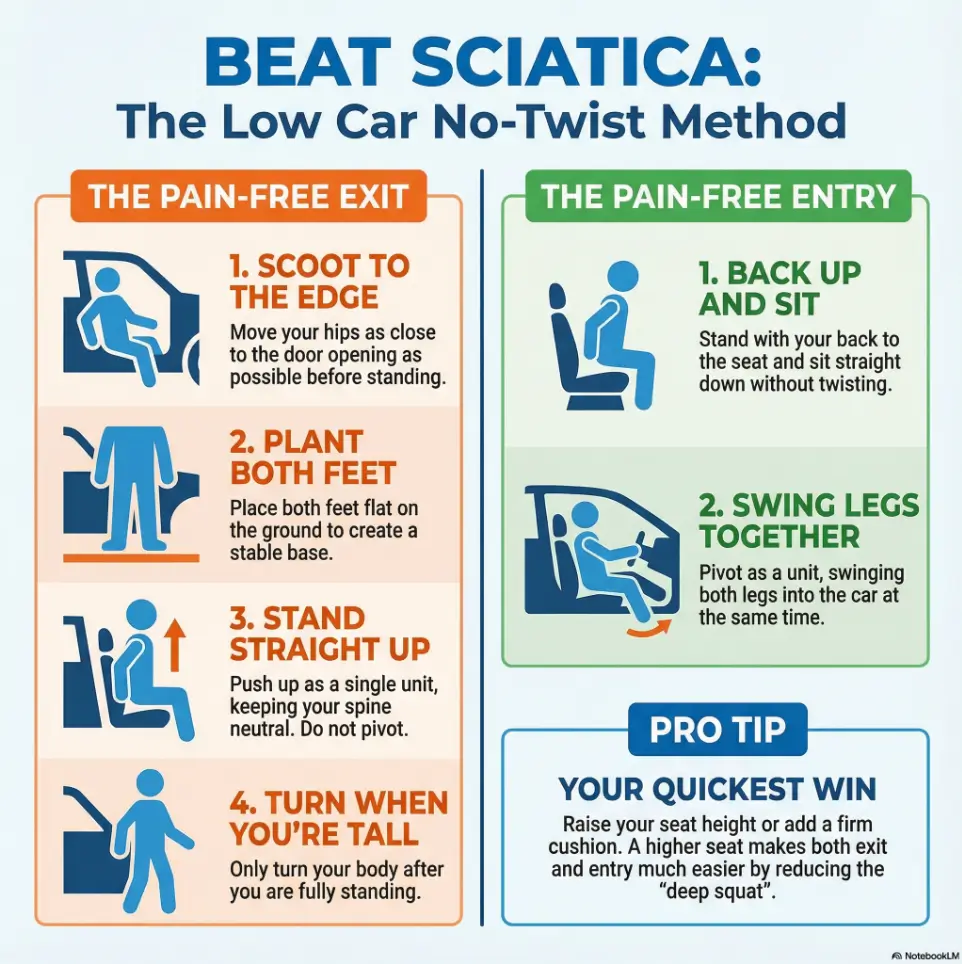
The No-Twist Exit in 30 seconds (your “one clean rep”)
The goal is not elegance. The goal is no twisting under load. Picture your spine and hips as a single unit for the exit. You can rotate once you’re standing—just not while you’re half-sitting, half-standing, and your nerve is caught in the crossfire.
Step-by-step: exit without the last-second twist
- Unbuckle early, before you start rising.
- Scoot to the edge so your hips are closer to the door opening.
- Feet set: both feet flat. Slightly staggered is fine (whatever feels stable).
- Nose over toes: a small forward lean, spine neutral, no dramatic rounding.
- Stand as one unit—no pivot until you’re fully upright.
- Turn your whole body only after you’re standing.
Two small numbers that matter here: give yourself 3 seconds to scoot, and aim for 0 twists until you’re tall. That’s it. That’s the whole “program.”
Micro-check: you did it right if…
- You didn’t rotate your trunk while your hips were still “stuck” in the seat.
- The first 3 steps felt slower, but the “zing” didn’t spike.
- You stood up once—no half-stand, panic-pause, sit back down.
Let’s be honest… your car is the problem (not your willpower)
Low seats force deep hip bend plus awkward torque. That combo is basically a prank your Civic/Corolla plays on you daily. Your job isn’t to “push through.” Your job is to remove torque.
- Unbuckle before movement.
- Feet set before standing.
- Turn only when standing.
Apply in 60 seconds: Say it out loud once: “No pivot until tall.” Then do one slow rep.
- Yes if your pain spikes when twisting or standing up from the seat.
- Yes if you can stand/walk once you’re up.
- No if you have new weakness, numbness spreading fast, or driving feels unsafe today.
- No if you can’t stand without severe pain or you’re worried about red flags.
Next step: If you’re in the “yes” group, do 3 practice exits on a flat surface—slow, no twist, no rushing.
The No-Twist Entry in reverse (sit first, legs second)
Most flares happen because entry turns into a wrestling match: one leg goes in, your torso rotates, your pelvis fights the seat edge, and your nerve gets a front-row seat. The fix is boring and perfect: sit first. Legs second. Buckle last.
The entry sequence that protects your nerve
- Back up until you feel the seat behind your knees.
- Sit straight down (no half-squat twist).
- Pivot with both legs together into the footwell (think “log roll,” but seated).
- Settle, then buckle last.
The “two-leg swing” that prevents the surprise flare
- Move legs as a pair. If one leg feels heavy, you can guide it with your hands or a simple strap.
- Avoid the one-leg-in + twist-to-pull combo (it feels efficient; it often costs you later).
Small lived-experience note: I used to “save time” by sliding in sideways and rotating mid-air. It saved maybe 4 seconds. It also stole the next morning—especially when my sleep with sciatica turned into a nightly negotiation. I’ll take the 4 seconds.
Show me the nerdy details
Twisting while flexed (bent) can be harder on irritated structures because rotation stacks on top of compression. When you keep your trunk and pelvis moving together, you reduce rotational shear. This is why “sit first, legs together” often feels oddly calming—mechanically, it’s simpler and more predictable.
Set your Civic/Corolla seat like a “launch pad” (before you even open the door)
If the seat is too low, the exit becomes a deep squat. If the seat is too reclined, the exit becomes a “sit-up + squat.” Either way, your sciatica gets invited to the show. So we make the seat help you, even if it’s a basic sedan with limited adjustments.
The 3 adjustments that matter more than stretching
- Seat position: slide back enough to reduce knee jam, but not so far you have to reach for pedals or wheel.
- Seatback angle: slightly more upright than you think (too reclined = harder rise).
- Seat height (if adjustable): higher is usually kinder for standing up.
Curiosity gap: the tiny change that can cut your pain spike in half
If you remember one thing: raise the seat height (or add a firm cushion). When you don’t have to “climb out,” your body stops recruiting weird compensation moves.
Headrest + steering wheel: stop forcing the forward reach
If you’re leaning forward to hold the wheel, your low back is doing extra work the whole drive. Bring the wheel closer if possible. If not, bring your seat slightly forward while keeping a comfortable knee angle. This is less about comfort and more about not showing up to the exit already irritated—especially if you’re managing symptoms that overlap with sciatica vs. herniated disc patterns.
- Higher seat = easier stand.
- More upright seatback = less “sit-up” effort.
- Closer wheel = less forward strain.
Apply in 60 seconds: Before your next drive, adjust the seatback one notch more upright and note whether standing feels smoother.
This is not medical. It’s a practical way to decide what to change first.
Score: —
Apply in 60 seconds: If your score is high, change one thing first: add a firm cushion or raise the seat, then practice one slow exit.
Door, feet, and hips: the 3 contact points that keep the nerve calm
Here’s the secret nobody wants to hear: your exit is often ruined by the environment, not your body. Tight parking spaces, uneven pavement, and the door that doesn’t open wide enough—those are the villains. We’re going to beat them with three contact points: door, feet, and hips.
Foot placement for low sedans (not SUVs)
- Place feet under knees (or slightly back) to avoid the “deadlift-from-a-bucket-seat” feeling.
- Use both feet. One-foot push-offs invite twisting.
- Give yourself 2 seconds to plant. Rushed feet = messy spine.
Door frame support: what’s safe vs what backfires
- Safe: light hand contact on the door frame or seat edge for balance.
- Backfires: yanking yourself up with one arm while rotating your trunk.
Here’s what no one tells you about parking angles…
If you can choose, park so the door opens wide. It’s not vanity. It’s leverage. When the exit is cramped, your body tries to “escape” by twisting. A wide door gives you time to stay square.
Pattern interrupt: The best sciatica tool might be… the parking spot you pick. I’ve absolutely walked an extra 40 steps for a spot that lets the door open all the way—and, yes, I started caring more about sciatica-friendly walking shoes the day I decided “more steps” was the smarter trade.
Short Story: Last winter, I parked in a “perfect” spot—close to the entrance, tight on both sides, the kind that makes you feel like a parking wizard. The moment I opened the door, I realized I’d created a little exit trap. I tried the old move: half-stand, twist, pull. My back answered with a sharp reminder that convenience has a price tag.
So I sat back down, breathed for five seconds, and did the unglamorous reset—scoot to the edge, both feet planted, stand straight up like I was practicing in a physical therapy session for sciatica. No twist until tall. It wasn’t pretty, but it worked. I got out without the flare, walked the short distance, and felt quietly proud in a way that surprised me. Not because I’m tough—because I was finally patient enough to do it right.
Common mistakes: the “one last twist” that ruins a good exit
Most people do 90% of the exit correctly and then sabotage the last part. It’s like putting a lid on the jar and then kicking the jar off the counter. Let’s name the mistakes so you stop paying for them tomorrow.
Mistake #1: standing while your hips are still rotated
If your knees point out the door but your chest rotates first, you’re loading the nerve. Fix: keep your chest and hips moving together. Your body turns after you’re standing, not during the stand.
Mistake #2: the “half-stand pause” (where the pain spikes)
Pausing halfway increases strain. Fix: commit to one smooth stand. If you can’t, that’s a clue the seat is too low or your setup needs a tweak—not a cue to twist harder.
Mistake #3: buckling/unbuckling at the wrong time
Unbuckle before you scoot. Buckle after you’re fully seated and settled. The belt can trap you into a twisted micro-position that your body hates.
- Stand first, turn second.
- Don’t pause halfway.
- Unbuckle early, buckle late.
Apply in 60 seconds: On your next exit, whisper “stand, then turn” as you move. It sounds silly. It works.
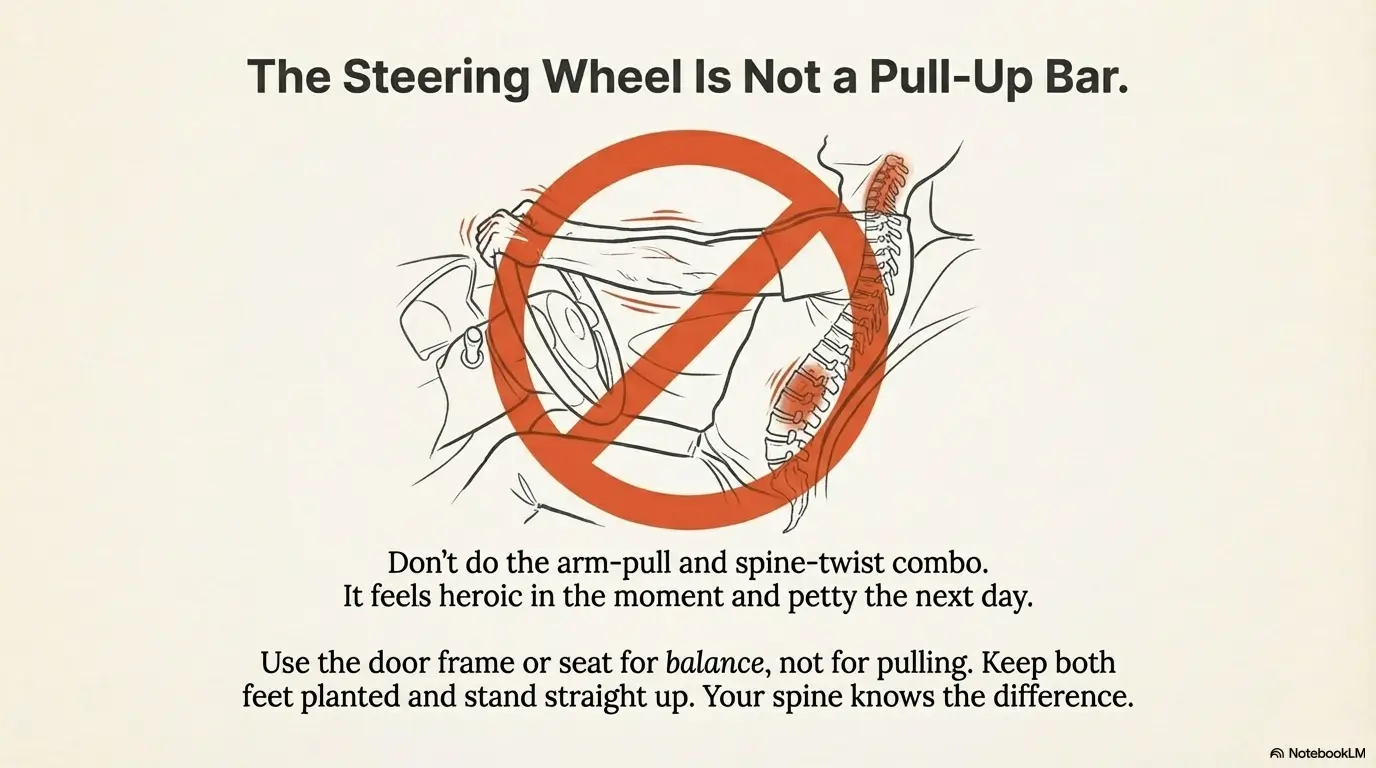
Don’t do this: the arm-pull + spine-twist combo (it feels helpful—until tomorrow)
This is the move that feels heroic in the moment and petty the next day: grabbing the steering wheel and hauling yourself up while rotating. It’s common, especially in low cars where you feel like you’re climbing out of a bathtub.
The move to avoid
- Steering wheel grab + one foot planted + twisting your trunk to “free” your hips.
What to do instead (same support, no torque)
- Hand on seat edge or door frame for balance, not pulling.
- Feet planted, then stand straight up.
- If you need more help, raise the seat (firm cushion) rather than increasing arm pull.
Light humor, because we need it: the steering wheel is not a pull-up bar. It’s a steering wheel. Your spine knows the difference, even if your brain is trying to get you to work on time.
“But my seat is really low”: modifications that actually help (and what’s a waste)
If your seat is truly low, the method still works—but you’ll get better results when you reduce the “deep squat” demand. Think of it as lowering the difficulty setting before you play the level.
Low-cost upgrades that often work
- Firm seat cushion (adds height, reduces deep hip flexion)—think “stable firmness,” the same logic behind mattress firmness for sciatica.
- Portable grab handle/assist strap (for balance, not pulling).
- Lumbar support to reduce slumping during drives.
I’ve tried the “soft pillow solution.” It felt cozy for about 10 minutes and then collapsed like a tired soufflé. A firmer cushion was less romantic and far more effective.
Curiosity gap: the one accessory people buy—and then stop using
Swivel cushions can help some people, but if it slides, changes your posture, or makes you feel unstable, it can backfire. The goal is less rotation under load—not a spinning carnival ride in a tight footwell.
What to skip (loss prevention)
- Soft, squishy cushions that sink (they lower you again).
- Anything that forces awkward rotation to “find the sweet spot.”
- Overcomplicated gadgets that make you rush because you’re annoyed.
- Choose a firm height cushion if standing up is the main problem (low seat, deep squat feeling). Usually the best first move.
- Consider a swivel cushion only if you can stand fine but rotation is the main trigger—and only if it stays stable in your seat.
- Skip both if your symptoms are escalating fast or you have red flags. Technique + medical advice beats accessories.
Apply in 60 seconds: If you buy one thing first, make it height and firmness—not spin.
- Unbuckle early
- Scoot to seat edge
- Feet planted (both)
- Nose over toes
- Stand as one unit
- Turn only when tall
- Back up to seat
- Sit straight down
- Legs swing together
- Settle
- Buckle last
Quick win: Raise the seat (or add a firm cushion) so both maps get easier instantly.
Driver vs passenger: same method, different traps
Same body, same car, different traps. The driver side adds pedals, steering wheel reach, and the subtle pressure of “I need to go.” The passenger side adds the illusion that more space means you can relax your form. Both can mess with your sciatica if you let them.
Driver side: steering wheel and pedals change everything
- Watch the reach: overreaching can irritate you before you even exit.
- Consistency wins: rushed driver exits cause the exact twist you’re trying to avoid.
- Reality check: if braking/accelerating hurts, driving itself may be the problem today.
One of my sneaky triggers was the “lean forward to grab stuff” habit—phone, keys, bag. That forward slump is like pre-loading a spring. Now I pause for 5 seconds, collect myself, and then move.
Passenger side: “more space” can still go wrong
- People relax and twist more—use the same sit-first / legs-together rule.
- If the passenger seat is lower than the driver seat (it often is), treat it like the “hard mode” seat.
When to seek help (and when driving isn’t the move today)
Technique is great. It’s not magic. If your symptoms are changing fast, or your leg won’t reliably do what you ask, you need more than a cleaner exit. Major medical institutions like Cleveland Clinic and MedlinePlus describe sciatica as nerve-related pain that can travel down the leg—if your function is changing, that matters. If you’re trying to sort out what’s “true sciatica” versus something else, comparisons like sciatica vs piriformis syndrome can also help you describe symptoms more clearly.
Red flags: stop and get medical advice
- New weakness (including foot drop), numbness that’s worsening, or severe unrelenting pain.
- Loss of bowel or bladder control.
- Symptoms after a major fall, crash, or other trauma.
“Today is not a driving day” signs
- You can’t safely brake/accelerate without pain spikes.
- You need to brace hard just to sit upright.
- You’re distracted by pain enough that you’d be a risk in traffic.
What to track for your clinician (quick, useful notes)
- Which motion triggers it (twist vs stand vs leg lift).
- Which side, what distance/time driving, and what position helps.
- Any new numbness, weakness, or changes in function.
Practical note: It’s okay to choose a ride, a break, or a different seat today. That’s not “giving in.” That’s being a competent operator of your own body.
FAQ
How do I get out of a low car with sciatica without twisting?
Use the No-Twist sequence: unbuckle, scoot to the edge, plant both feet, then stand up as one unit. Don’t pivot until you’re fully upright. If the seat is very low, add a firm cushion or raise seat height if your car allows it.
What’s the best way to get into a Civic/Corolla seat when my leg pain flares?
Sit first, then bring both legs in together. Back up to the seat, sit straight down (no half-squat twist), then swing both legs as a pair into the footwell. Buckle after you’re settled.
Should I put both legs out first or stand first?
If you’re exiting, get both feet planted before you stand. Most people flare when they stand with one foot planted and rotate their torso. Feet first gives you a stable base so you can stand without twisting.
Does a seat cushion help sciatica when getting in and out of a car?
Often, yes—if it’s firm enough to add height without sinking. A soft cushion can feel nice initially but still leaves you “low,” which makes the exit harder. Height and stability usually matter more than softness.
Why does sciatica spike right when I stand up from the seat?
Standing from a low seat demands deep hip bend plus effort. If you add rotation during that effort, the body can react sharply. A higher seat, a more upright seatback, and a no-twist stand often reduce the spike.
Is it better to recline the seat to reduce pain?
Usually not for exits. A reclined seat can make you do a mini sit-up before you can stand, which increases strain. A slightly more upright seatback often makes the transition smoother.
What if my pain is worse on the driver side?
Driver-side traps include reaching for the wheel, bracing for pedals, and rushed exits. Bring the wheel closer if possible, avoid slumping forward during the drive, and use the exact same no-twist exit method every time—even when you feel “fine.” If your day-to-day pattern includes sitting for long stretches, it can help to understand desk-job sciatica flare-ups and how they set you up to exit already irritated.
Can a swivel cushion make sciatica worse?
It can if it slides, changes your posture, or makes you feel unstable. If you try one, make sure it stays put and doesn’t force you into awkward positions. Many people do better starting with a firm height cushion first.
How can I exit a car when the door can’t open wide?
Slow down and simplify: scoot to the edge, plant both feet, and stand straight up without pivoting. If the door angle forces rotation, consider repositioning the car next time or choosing parking spots with more space—your body often pays for cramped exits.
When should I stop driving and see a doctor for sciatica?
If you have new weakness, worsening numbness, severe pain that doesn’t change with position, bowel/bladder changes, or if driving feels unsafe (braking/accelerating hurts or distracts you), seek medical advice promptly. If you’re unsure whether you’re in “urgent” territory, use this low back pain emergency guide as a reality check.
Next step (one concrete action)
You don’t need a new life. You need a single default routine that your body can trust. Close the loop from the hook—the “last three seconds” don’t have to be your downfall. You can make them predictable.
Do one “practice rep” today—pain-free, not rushed
- Park somewhere flat, open the door wide, and do 3 slow No-Twist exits plus 3 sit-first entries.
- Afterward, set one default seat tweak: raise height or add a firm cushion so every exit starts easier.
- Pick a phrase you’ll use every time: “No pivot until tall.”
Neutral action line (because we’re keeping this clean and honest): If this helps, keep it in your routine for a week. If it doesn’t help or symptoms worsen, stop experimenting and get medical guidance. If the rest of your day is a sitting marathon, a simple sit/stand schedule for desk-job sciatica can make the next exit feel less like “hard mode.”
Last reviewed: 2026-01.