

Small Mechanics, Big Outcomes: The Recumbent Bike Guide for Sciatica
One seat click can be the difference between a calm 12-minute ride and a nerve flare that steals the next 24 hours.
In a recumbent bike setup for sciatica, the small details—seat distance, knee angle, foot pressure, and pacing—matter more than grit. Most people don’t fail because they’re weak; they fail because the bike is “almost right.”
That’s exactly where symptoms hide: hip rocking that looks harmless, toe-reaching that fakes a good fit, and resistance bumps that feel fine now and hurt tomorrow. Keep guessing, and you risk turning gentle cardio into a repeat irritation loop.
This guide helps you set a practical 25–35° knee angle, read your body’s error signals early, and progress without triggering setbacks. The method is conservative on purpose: one-variable changes, next-day symptom checks, and clear red-flag stop rules.
Stop negotiating with pain. Start building steady tolerance.
Table of Contents
Start Here in 60 Seconds: Is This Setup Even Right for Your Pain?
Who this is for / not for
This guide is for adults with sciatica-like back/leg pain who want a safer, home-based recumbent bike setup routine. It’s especially useful when walking tolerance is limited, impact feels irritating, or upright biking causes too much trunk tension. If you’re deciding between bike types, this quick comparison of recumbent vs upright bike for sciatica can help frame expectations. It is not for emergency neurologic symptoms, acute trauma, fever-related spinal pain, or rapidly worsening weakness.
I once tried to “out-stubborn” a flare with a longer ride. Terrible strategy. The body doesn’t negotiate with ego; it negotiates with load, pacing, and mechanics. This setup respects that reality.
Pain map check: back-only ache vs leg-radiating nerve pain
Before touching the seat lever, do a 20-second pain map:
- Back-only ache: often more tolerant to gradual volume increases.
- Leg-radiating symptoms: can be more sensitive to fit errors and intensity spikes.
- Tingling/numbness pattern: track whether it centralizes (moves upward) or peripheralizes (moves farther down leg).
Why this matters: the same resistance can feel “fine” in the back but provoke nerve irritation in the leg an hour later. That delayed signal is important data, not failure. If you’re unsure what pain pattern you’re dealing with, review the differences between hamstring stretch discomfort and nerve pain.
Quick “today or not today” readiness screen
Use this simple readiness check:
- Resting pain today ≤4/10
- No new weakness since yesterday
- You can sit and breathe comfortably for 2 minutes
- You can commit to easy effort (not “fitness proving”)
If all yes, proceed. If no, choose a shorter session or skip riding and reset tomorrow. Missing one session is strategy; forcing a bad day is often expensive.
- Map pain location first.
- Respect day-to-day variability.
- Treat symptom drift as setup feedback.
Apply in 60 seconds: Rate pain now, then note whether symptoms stay stable or spread during the first 3 minutes.
Nail Seat Distance First: The 25–35° Knee-Angle Method
The exact pedal position to measure (where most people get it wrong)
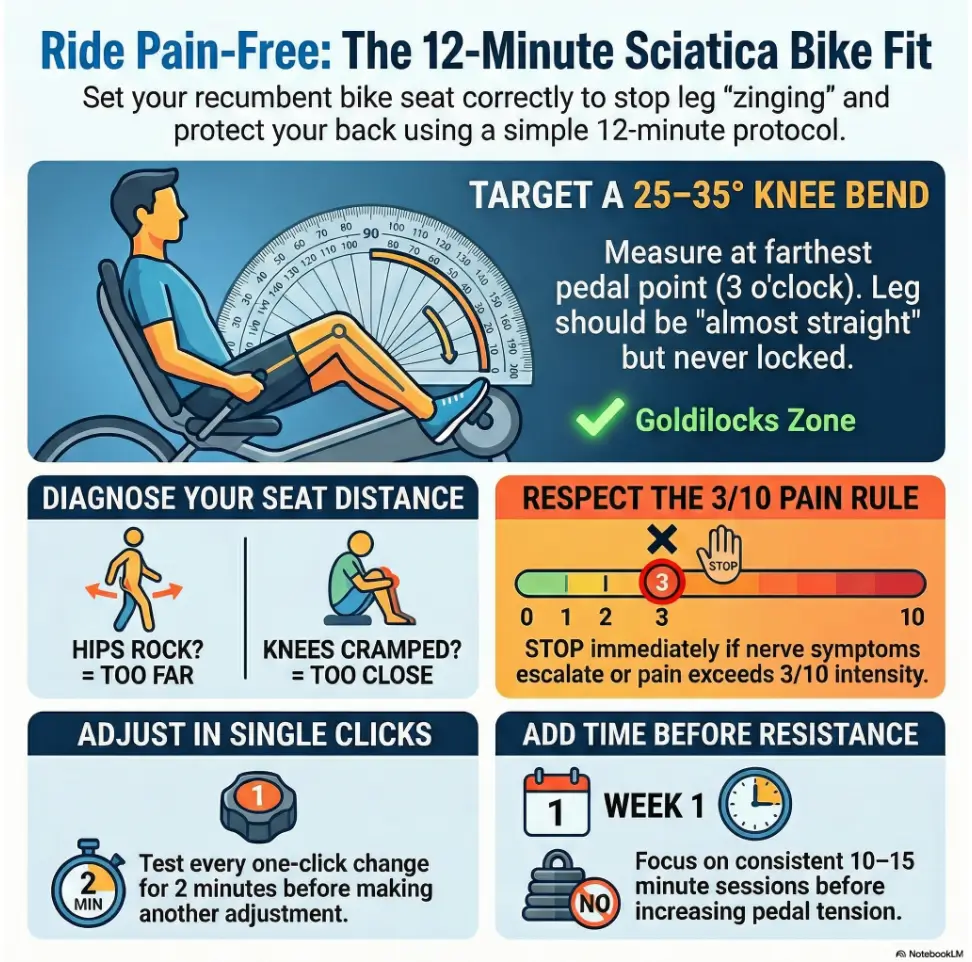
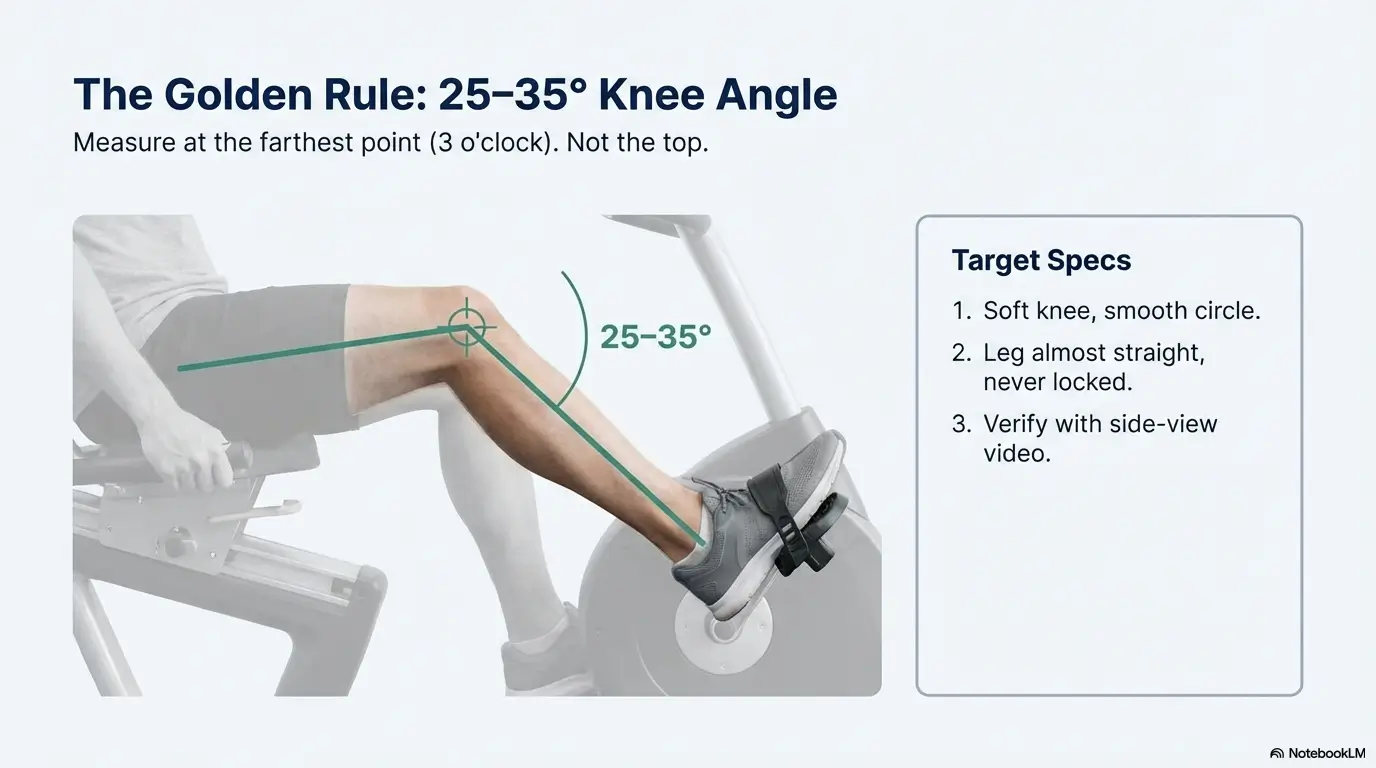
Measure at the farthest pedal point in your stroke—where your working leg is most extended. On most recumbents, that’s roughly when the pedal is forward (around 3 o’clock relative to crank orientation), not at the top. If you measure the wrong point, your “perfect angle” can be off by a mile and your knees will file a complaint by minute six.
Seat distance is your first lever because it controls joint range and tissue tension every single revolution.
How to eyeball 25–35° without fancy tools
Start with this sequence:
- Set resistance very low.
- Slide seat until leg is almost straight at the far point.
- Back off one small click closer.
- Pedal 2 minutes at easy effort.
- Check: no lockout, no toe-reaching, no pelvic rocking.
Think “soft knee, smooth circle.” If your knee snaps straight, you’re likely too far. If your knee stays deeply bent and cramped, too close.
If you have a phone, use this 30-second angle check workflow
You do not need expensive fit software. A quick phone side video works:
- Prop phone at hip height, side view.
- Pedal at easy cadence for 20–30 seconds.
- Pause at farthest extension frame.
- Visually estimate knee bend in the 25–35° range.
Repeat after any seat change. One click can shift angle more than you think, especially if your shoes or foot position change.
Show me the nerdy details
Knee angle targets are practical ranges, not sacred numbers. Day-to-day tolerance varies with sleep, symptom irritability, cadence, and total load. Aim for repeatability first: same seat notch, similar cadence, and stable symptom response across 2–3 sessions.
Money Block: Quick Eligibility Checklist (Yes/No)
- Yes/No: Can you pedal easy for 3 minutes without symptom escalation?
- Yes/No: Can you maintain smooth spin without hip rocking?
- Yes/No: Can you keep pain ≤3/10 during and 12–24 hours after?
Next step: If all yes, increase time by 2–3 minutes before touching resistance.
Don’t Chase Comfort Too Early: Lock in Baseline Before Tweaks
Baseline pass: 3 minutes easy spin, no hero effort
Your first pass is diagnostic, not training. Ride easy for 3 minutes, almost conversational breathing, low resistance. The goal is to observe how your body responds before you start “fixing” everything at once. Early over-correction is the fastest road to confusion.
I learned this the hard way: I once changed seat distance, recline, shoe pressure, and resistance in one session. I felt like a scientist. I collected chaos.
Track 3 signals only: knee pressure, hip rocking, sciatic zing
Use only three signals:
- Knee pressure: front-knee discomfort often means too close or too much load.
- Hip rocking: often means too far or toe-reaching.
- Sciatic zing: brief twinge may happen; escalating radiating symptoms are a stop cue.
Three signals are enough. More variables = less clarity.
Let’s be honest… first settings rarely feel perfect
Expect “pretty good” before “perfect.” Fit is iterative. The win is a setup that is stable across multiple sessions, not a one-day miracle. If your symptoms are irritable, your ideal seat may shift slightly week to week. That’s not failure; that’s honest physiology.
- Run a 3-minute diagnostic first.
- Track only three body signals.
- Change one variable at a time.
Apply in 60 seconds: Create a notes template now: date, seat notch, cadence feel, symptoms during and next morning.
Too Far vs Too Close: The Error Patterns Your Body Shows Immediately
Seat too far: hamstring tug, toe reach, pelvic rocking
Classic “too far” pattern:
- You point toes to reach the pedal.
- Hamstring tension creeps up early.
- Hips rock side-to-side on every stroke.
This can fake a good knee angle if your ankle compensates. It looks okay on paper and feels lousy in tissue reality. If your lower back braces to stabilize that rocking, symptoms often spike after the session—not always during it.
Seat too close: front-knee load, quad burn, cramped stroke
Classic “too close” pattern:
- Knees stay too bent through the cycle.
- Front-knee pressure rises quickly.
- Quad burn appears early at low resistance.
Too close can feel “safer” at first because you’re not reaching. But cramped range can overload the front knee and increase fatigue, which then degrades posture.
One-click correction ladder (no big jumps)
Use this ladder:
- Identify dominant error pattern (too far or too close).
- Change seat by one click only.
- Ride 2 minutes easy and reassess 3 signals.
- Repeat once if needed.
Two clicks max per session is a useful ceiling for irritable symptoms. Bigger jumps can solve one issue and create three more.
Money Block: Decision Card (When A vs B)
When A: If hips rock and toes reach, move seat closer one click.
When B: If knees stay cramped and front knee loads, move seat farther one click.
Time/cost trade-off: 60 seconds of adjustment often saves 24 hours of irritation.
Neutral action: Test each change for 2 minutes before deciding.
Open Loop Most Riders Miss: Foot Position Changes Knee Angle
Mid-foot vs forefoot pressure and why your numbers drift
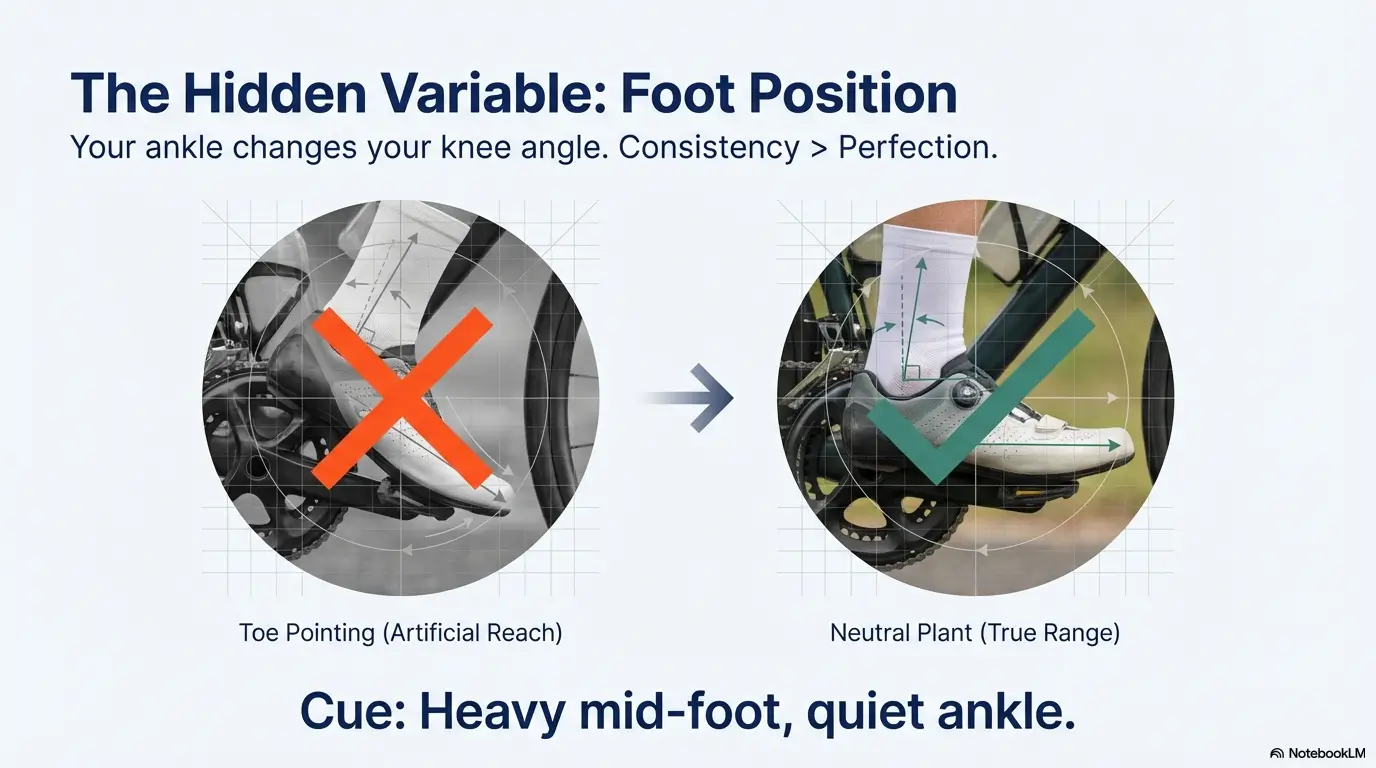
Move pressure toward forefoot and your ankle may point more, effectively lengthening reach. Shift toward mid-foot and extension demands can feel lower. Same seat notch, different joint story. That’s why your “great setup” can suddenly feel wrong when you change shoes.
Ankle “pointing” can fake a good fit while irritating tissues
Pointing the ankle can make knee extension look tidy while driving tension into calf/hamstring chains. If you notice toe-pointing, treat it as a compensation flag. You want smooth circles, not ballet under duress.
Neutral foot cue for repeatable setup
Use this cue: “Heavy through mid-foot, ankle quiet.” Don’t freeze the ankle rigidly; just avoid dramatic pointing. Repeat the same cue every ride so your angle check means the same thing each time.
Show me the nerdy details
In closed and semi-closed kinetic chains, distal joint behavior (foot/ankle) changes proximal loading. On a recumbent bike, small ankle strategy changes can alter perceived knee extension and posterior-chain tension. Standardize shoe type and foot cue when troubleshooting fit.
Pain Guardrails: How Hard, How Long, How Often (Week 1)
Intensity ceiling for sciatic flare prevention
Week 1 is about calm consistency. Keep intensity easy to light-moderate. You should be able to speak in short sentences. If breathing gets choppy or you brace your trunk, you are likely overshooting.
A familiar mistake: using resistance to “feel like it counts.” For irritable nerve symptoms, smooth movement tolerance often matters more than force production early on.
10–15 minute starter protocol + rest-day logic
Starter protocol:
- Day 1: 10 minutes easy
- Day 2: rest or gentle mobility
- Day 3: 12 minutes easy
- Day 4: rest
- Day 5: 12–15 minutes easy
Yes, it looks conservative. Conservative is underrated when symptoms are reactive.
Progression rule: add time before resistance
Progress in this order:
- Consistency of symptoms for 3 sessions
- Add 2–3 minutes
- Only then consider tiny resistance increase
If symptoms flare next morning, reduce the last change first. Never change duration and resistance in the same step during week 1.
- Start at 10–15 minutes.
- Add time before load.
- Judge success by next-day response.
Apply in 60 seconds: Write your week plan now with exact minutes, then commit to holding resistance steady.
Common Mistakes That Quietly Prolong Sciatica
Mistake #1: Measuring angle once, then never rechecking
Seat bolts slip, shoes change, habits drift. Recheck quickly every few sessions. A 20-second video check can prevent a week of guesswork.
Mistake #2: Increasing resistance before symptom stability
Early resistance jumps are a classic trigger. If you want confidence fast, earn it with repeatable easy sessions first. Capacity is built, not declared.
Mistake #3: Ignoring post-ride symptom lag (next-morning clue)
Many riders judge success only during exercise. Nerve tissue often votes later. Your next-morning status is a critical metric. I keep it simple: “better, same, worse.” If “worse” appears twice in a week, something in setup or dose needs to come down.
Money Block: Mini Load Calculator
Inputs (3): minutes ridden, average pain during ride (0–10), next-morning change (+/0/-).
Output rule: If minutes increased and next-morning is worse, revert to previous duration for 2 sessions. If stable for 3 sessions, add 2 minutes.
Neutral action: Use one small adjustment, then reassess after 24 hours.
“My Knee Angle Is Right, But I Still Hurt” — What to Troubleshoot Next
Recline angle and lumbar support interaction
Even with correct knee angle, seatback geometry can irritate symptoms. Too upright may increase compressive bracing; too reclined may encourage slumping depending on the rider and bike. Find a position where you can keep neutral ribcage and pelvis without clenching.
A tiny lumbar support tweak—rolled towel, modest pad, or seat adjustment—can change endurance more than one more click on seat distance.
Cadence too low = hidden spinal bracing
Grinding at low cadence can increase trunk bracing demand. In early phases, a smoother, slightly quicker spin at low resistance often feels better than “strength mode.” Think fluid circles, not hill simulation.
Here’s what no one tells you… smooth spin often beats “strength mode” early on
When symptoms are active, the goal isn’t max output; it’s repeatable non-irritating motion. If you finish with less fear and similar or lower symptoms next day, that’s progress—even if your workout app looks unimpressed. Pairing rides with low-irritation core control, such as a dead bug routine for sciatica, can improve movement confidence between sessions.
- Check recline and lumbar support.
- Avoid grinding cadence.
- Optimize for smoothness, not strain.
Apply in 60 seconds: On your next ride, lower resistance one step and focus on quiet trunk + smooth circles for 3 minutes.
Infographic: Your 12-Minute Sciatica-Friendly Recumbent Setup Flow
Baseline easy spin
Track 3 signals
One-click seat tweak
Re-test at easy effort
Foot cue: mid-foot, quiet ankle
Check hip stability
Lock settings
Write next-day symptom note
Success marker: pain stable or improved during ride and next morning.
Red-Flag Symptoms: When to Stop Riding and Seek Help
Urgent signs (weakness, numbness progression, bowel/bladder changes)
Stop riding and seek urgent medical evaluation if you develop new or worsening leg weakness, progressive numbness (especially saddle-area numbness), or bowel/bladder changes. Those symptoms can indicate serious neurologic compression and need prompt assessment. If you’re uncertain whether your symptoms are urgent, use this low back pain emergency checklist as a quick screening reference.
Non-urgent but important: pain lasting >4 weeks despite modification
If you’ve adjusted fit, reduced load, and still have persistent or worsening symptoms beyond about four weeks, schedule a clinician visit. Persistent symptoms deserve a clearer diagnosis and plan. “Pushing through” is rarely the winning move here.
What to bring to your clinician (fit notes that speed diagnosis)
Bring your notes:
- Seat position changes by date
- Ride duration and perceived effort
- During-ride and next-morning symptoms
- Any weakness or numbness progression
Clinicians can make faster decisions with clean trend data. You don’t need fancy graphs—just honest, consistent notes.
Money Block: Clinician Visit Prep List
- Symptom timeline (start date, flare dates, current pattern)
- What improves/worsens symptoms (walking, sitting, biking)
- Your recumbent fit notes and progression attempts
- Medication and prior therapy history
Neutral action: Bring this list to reduce trial-and-error time in care planning.
Next Step: Do This 12-Minute Setup Session Today
Minute 0–3: seat-distance baseline
Set resistance low. Ride easy. Observe knee pressure, hip rocking, and sciatic zing. Don’t fix yet—just read.
Minute 4–8: one-click adjustments + symptom check
Make one click change based on error pattern:
- Rocking/toe reach → one click closer
- Cramped/front-knee load → one click farther
Retest for 2 minutes. Repeat once if needed. Stop at two total clicks.
Minute 9–12: save your “best-fit” notes for repeatability
Lock your settings and document:
- Seat notch/position
- Recline setting
- Foot cue used
- Ride duration and symptom response
This closes the loop from the opening problem: random discomfort becomes a repeatable protocol you can trust. The point isn’t to win one workout. The point is to build a body that stops fearing movement.
FAQ
Is 25–35° knee angle valid for recumbent bikes too?
Yes, it’s a practical starting range for many riders on recumbents. It helps avoid full lockout while reducing excessive bend. Treat it as a working range, then refine by symptom response and movement quality.
Should I set seat distance with heel-on-pedal or normal pedaling foot?
Use normal pedaling foot for final setup. Heel methods can be a rough starting trick, but your real mechanics happen with your usual foot pressure and ankle behavior.
Can a recumbent bike worsen sciatica?
It can if load is too high, setup is off, or progression is too fast. With low resistance, proper seat distance, and symptom-guided pacing, many people tolerate recumbent biking well.
What resistance level is safest during a flare?
Usually very low to low. Keep effort conversational and prioritize smooth cadence. During active flare phases, add time before increasing resistance.
Is numbness after riding normal?
Mild transient odd sensations can occur, but persistent or worsening numbness is not a “push through” sign. If numbness progresses or is paired with weakness, stop and seek medical evaluation promptly.
Should I bike daily or every other day?
Every other day is often easier early on because it gives you a clean next-day signal. Daily can work later if symptoms stay stable. On non-ride days, gentle mobility such as morning sciatic nerve glides may help maintain tolerance without adding much load.
What cadence is best when sciatic pain is active?
A smooth, non-grinding cadence at low resistance usually works better than slow-forceful pedaling. The right cadence is the one that keeps your trunk relaxed and symptoms stable.
Which is better for sciatica: upright bike or recumbent?
It depends on symptom pattern and posture tolerance. Many riders with back/leg irritability prefer recumbent support early on, but individual response should guide choice.
How long before I should feel improvement?
Some riders notice reduced irritation within 1–2 weeks of consistent, conservative riding and fit correction. If there’s no improvement or clear worsening after several weeks, seek clinical evaluation. If walking still flares symptoms outside bike sessions, this guide on sciatica pain when walking can help identify daily-load triggers.
Do I need imaging before exercising?
Not always. Many cases begin with conservative care and monitoring. Imaging is usually considered when red-flag symptoms appear, deficits progress, or symptoms persist despite appropriate modification.
Last reviewed: 2026-02.