

Workplace recovery guide
How to Ask for Temporary Remote Work After Orthopedic Surgery
Without Making It Awkward
After orthopedic surgery, the hardest part is not always the incision, the brace, or the awkward shuffle from sofa to bathroom. Sometimes it is the small cold knot in your stomach when you realize you need to ask work for help, but you do not want your private medical life poured onto a conference table like loose change.
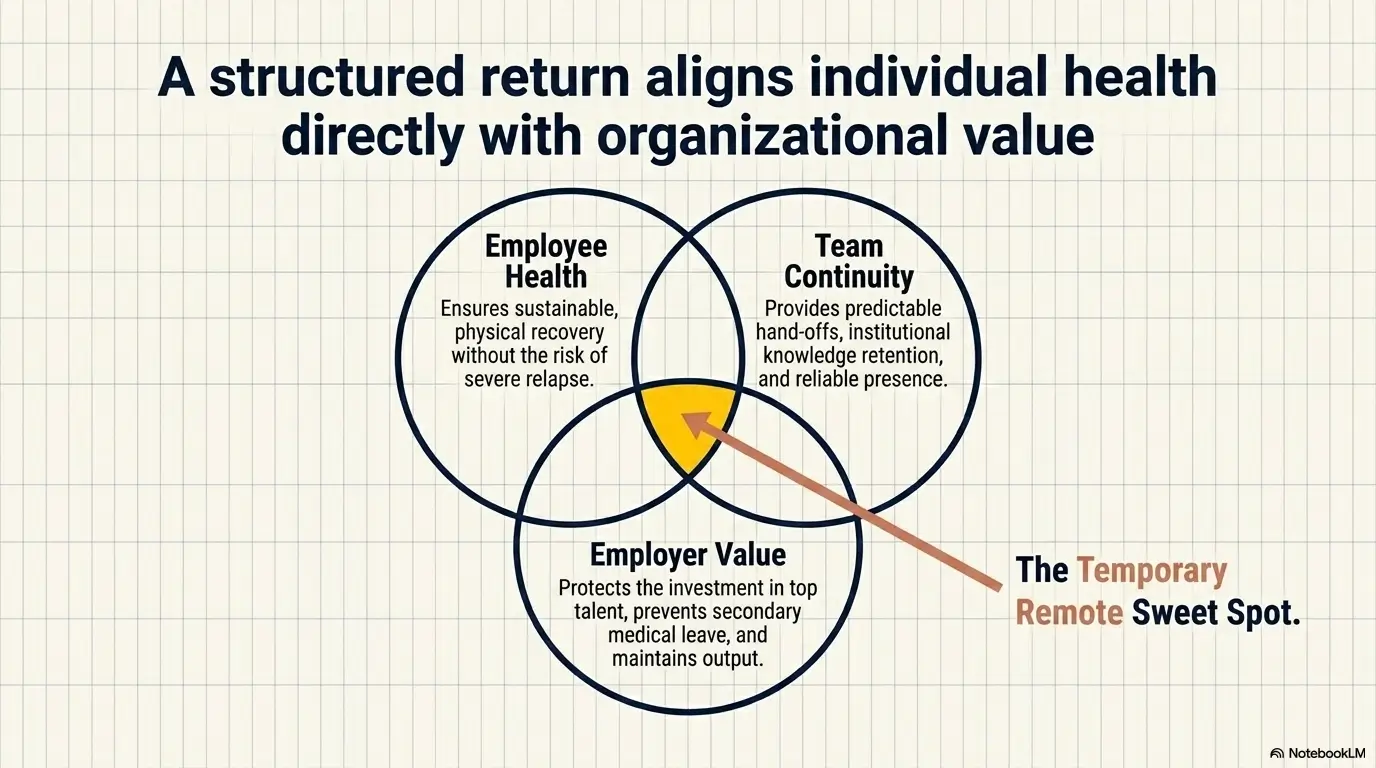
The good news: a temporary remote work request does not have to be dramatic. It works best when it is calm, specific, time-limited, and focused on job duties. You are not asking your manager to become your surgeon, your therapist, or your household logistics coordinator. You are asking for a short practical bridge between recovery and reliable work.
This guide gives you the language, timing, documentation strategy, and HR-safe boundaries to make that request with steadier hands. Think of it as a clean little workplace splint: supportive, not showy, and designed to help you heal while keeping the work moving.
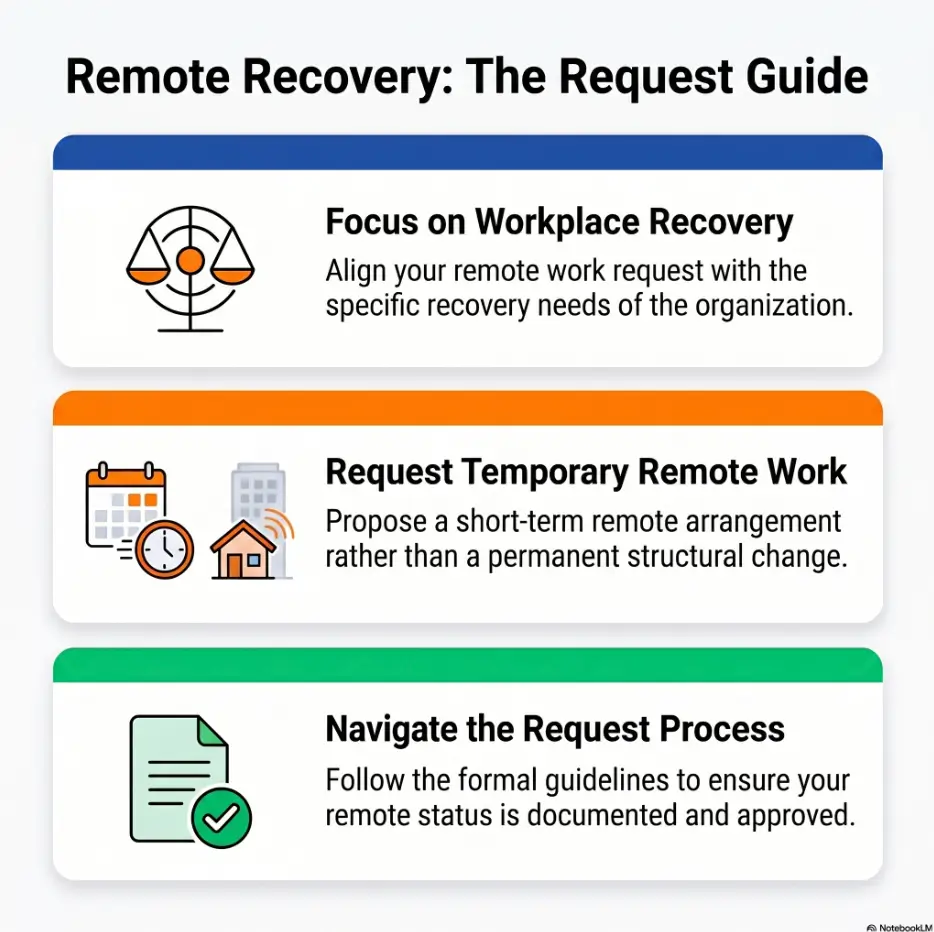
Say less, clearly
Share work limits, dates, and coverage. Keep private medical details private.
Make approval easier
Offer a practical plan for meetings, duties, tools, updates, and review dates.
Protect your recovery
Use your surgeon’s restrictions as the guardrails, not your guilt or optimism.
🦴 Bottom line: you do not need to prove pain. You need to propose a safe, temporary, workable plan.
Snapshot: This article is for US employees recovering from orthopedic surgery who can still perform desk-based or partly remote duties, but cannot safely commute or work fully on-site for a short period. You will learn how to frame the request, what to ask your doctor for, how ADA, FMLA, PTO, and HR processes can overlap, and how to write a three-sentence version today.
Table of Contents
Safety / Disclaimer
This guide is for general US workplace education. It is not legal, medical, HR, or insurance advice. Orthopedic surgery recovery can vary wildly depending on the procedure, anesthesia, complications, pain medication, mobility limits, job duties, state law, employer size, union agreements, and company policy.
Follow your surgeon’s restrictions first. If work expectations conflict with your medical instructions, do not “tough it out” for the sake of one heroic Tuesday. Recovery is not a workplace performance sport.
If you believe your rights are being ignored, if you feel pressured to work against medical restrictions, or if your job may be at risk, speak with HR, a qualified employment attorney, your state labor agency, or an appropriate federal resource.
Key takeaway
- Ask for work adjustments based on functional limits, not graphic medical details.
- Use your doctor’s restrictions as the foundation.
- When health, employment, or legal risk rises, get professional help early.
Apply in 60 seconds: Write down the one work problem surgery creates: commuting, stairs, sitting, lifting, typing, or schedule disruption.
Start With the Real Ask, Not the Whole Medical Story
The first instinct after surgery is often to explain everything. The date, the joint, the screws, the swelling, the strange chair you now trust more than most people. That is human. It is not always useful at work.
A strong temporary remote work request begins with the work problem. You are not asking your manager to judge your pain. You are showing how a short remote arrangement will let you keep performing your job while respecting recovery limits.
What Your Manager Actually Needs to Know
Most managers need four things: what changes, how long it may last, how work will be covered, and whether HR needs to be involved. They usually do not need the surgical play-by-play.
Useful information might sound like this: “I have temporary mobility restrictions after surgery and cannot safely commute for two weeks, but I can perform my core desk duties remotely during normal business hours.” That sentence gives a manager a map. It avoids turning the conversation into a medical documentary.
Workplace requests are often approved faster when they are operational. Managers may care about your well-being, but they also have calendars, clients, deadlines, and other employees asking where the file lives. Help them see the path.
Keep the Diagnosis Smaller Than the Plan
Your diagnosis can be brief. Your plan should be clear. That balance protects your privacy and makes the request easier to evaluate.
For example, “knee surgery” or “orthopedic surgery” may be enough in the first conversation. The stronger part of the message is the limitation: no driving, limited walking, no stairs, weight-bearing restrictions, brace use, pain medication that affects commuting safety, or follow-up appointments that make a standard office day unrealistic.
One employee recovering from shoulder surgery may need remote work because typing is fine but commuting with a sling is risky. Another recovering from ankle surgery may be able to attend meetings, write reports, and answer emails, but cannot manage parking lots, stairs, and office hallways on crutches. The issue is not the drama of the procedure. It is the mismatch between recovery and the work setting.
Here’s What No One Tells You
A remote work request often succeeds less because of sympathy and more because the employee makes the path easy to approve. Sympathy is a candle. A plan is a flashlight.
That does not mean you should sound cold or robotic. You can be warm, grateful, and clear. The trick is to avoid making your manager guess what you need, how long it will last, or whether your work will disappear into the soft fog of recovery.
| Weak request | Stronger request | Why it works better |
|---|---|---|
| “I had surgery and need to work from home.” | “I have temporary post-op mobility restrictions and would like to work remotely from June 10 through June 24, with a review on June 21.” | It gives a time frame and a review point. |
| “I am in a lot of pain.” | “My doctor has restricted driving and stair use during early recovery.” | It focuses on functional limits. |
| “I will do my best.” | “I can continue handling client emails, reporting, team meetings, and documentation remotely.” | It shows which duties remain covered. |
Who This Is For, And Who Needs a Different Route
Temporary remote work is not a magic key for every job. It is a practical tool when the essential duties can still be done away from the workplace. The cleaner you are about this distinction, the less awkward the conversation becomes.
Good Fit: Desk Work With Temporary Physical Limits
Remote work may fit employees whose essential duties are mostly computer, phone, writing, analysis, scheduling, design, customer support, documentation, or meetings. Many office roles can function remotely for a short period when expectations are written down.
Common examples include analysts, project managers, editors, accountants, customer success workers, HR staff, administrative professionals, software workers, insurance claims processors, legal support staff, and many education or nonprofit administrative roles.
If your main barrier is commuting after knee replacement, you may also find it useful to review practical recovery planning for commuting after knee replacement. A remote work request becomes stronger when you can explain the specific commute barrier without turning the email into a weather report from your kneecap.
Not a Fit: Jobs Where Presence Is an Essential Function
Some jobs require physical presence. Remote work may not be realistic when the core role involves patient care, machinery, site supervision, hands-on service, driving, lab work, security, child supervision, food service, warehouse duties, retail floor coverage, facility maintenance, or physical customer support.
That does not mean you have no options. It means the right request may be different. You might ask for modified duties, temporary reassignment, seated tasks, reduced lifting, a closer parking space, changed hours, intermittent leave, or a short medical leave period.
The phrase “essential job functions” matters. If a duty truly must be done on-site, remote work may not solve the business problem. But a different accommodation or leave plan might.
The Gray Zone: Hybrid Duties and Partial Coverage
Many jobs live in the gray zone. A supervisor might need to be on-site twice a week but can handle reports and planning remotely. A teacher may need classroom presence but can do curriculum work, grading, and parent communication from home during a short recovery window. A healthcare administrator may not be able to round on-site but can manage schedules, claims, or documentation remotely.
In gray-zone roles, do not ask as if the answer must be all or nothing. Suggest a mix: three remote days, two short on-site days, a temporary physical task handoff, or a phased return after your surgeon clears more activity.
Eligibility checklist: Is remote work a reasonable request to explore?
- You can complete most essential duties with a computer, phone, and secure access.
- Your restriction is temporary and tied to recovery.
- You can name the duties that will still get done.
- You can suggest a start date, end date, and review date.
- You understand which tasks may need coverage, reassignment, or leave.
Ask Before Surgery If You Can
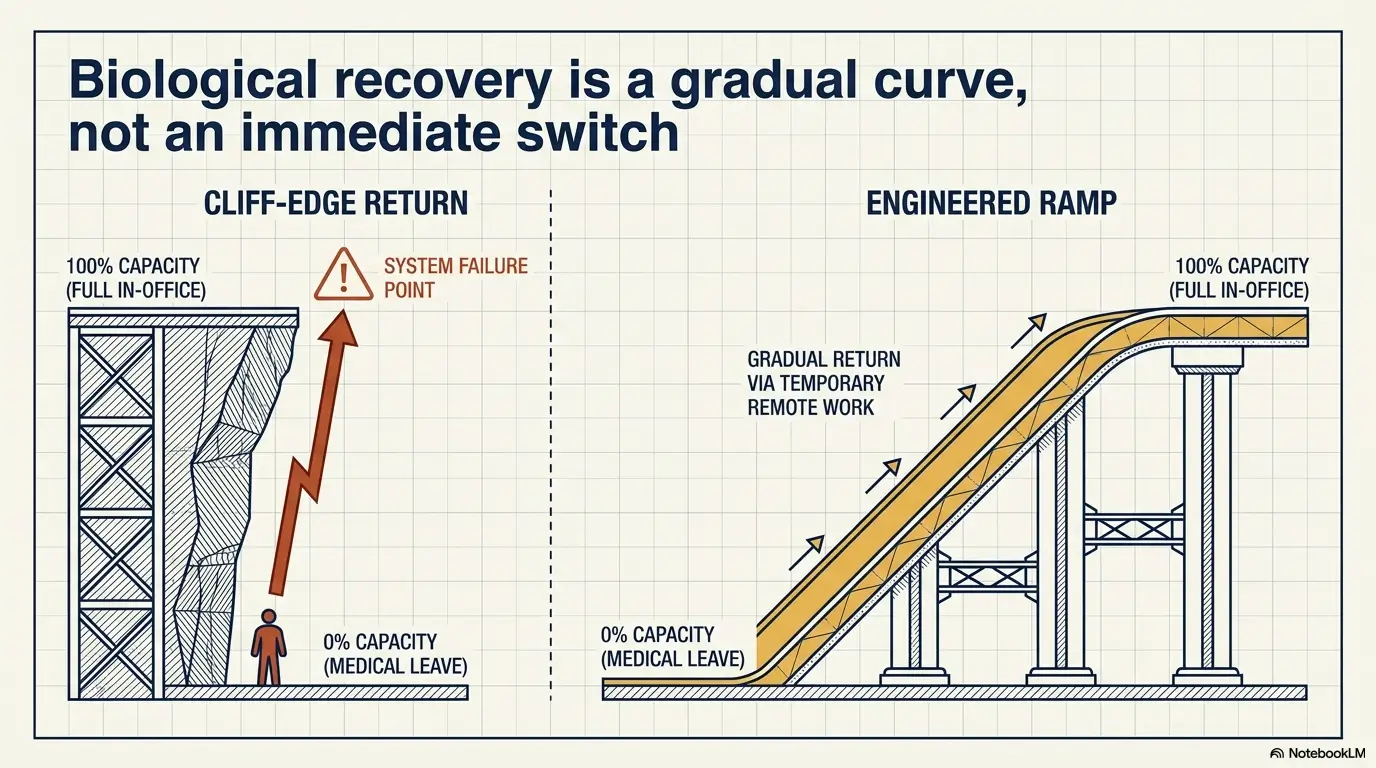
The best time to ask is usually before the pain peaks, before the pharmacy bag appears on your kitchen counter, and before your brain decides that one email reply deserves a two-hour nap. Planning early gives everyone more room to breathe.
The Best Timing Window
Start the conversation once you know the surgery date, the expected recovery restrictions, and the rough timeline. You do not need perfect certainty. You need enough information to propose a first version.
For many planned orthopedic procedures, that may be two to four weeks before surgery. For a smaller procedure, one to two weeks may be enough. For a major joint replacement or spine surgery, earlier planning may be wise because equipment, leave forms, backup coverage, and return-to-work notes can take time.
A simple early message can say, “I have surgery scheduled on July 8. My surgeon expects temporary restrictions that may affect commuting and office attendance. I would like to discuss a short remote work plan for early recovery and confirm what documentation HR needs.”
When Last-Minute Is Still Reasonable
Not every surgery is planned with neat calendar squares. Falls happen. Complications happen. A surgeon may change restrictions after seeing how recovery begins. Life, that unruly intern, does not always submit forms on time.
If the request is last-minute, say so calmly. Name what changed and propose the next practical step. “My post-op instructions were updated today, and I am not cleared to drive this week. I can work remotely during normal hours and would like to confirm the best way to document this with HR.”
Last-minute does not have to mean messy. It does mean your message should be extra clear.
Do Not Wait for Monday Morning Chaos
A request made after missed meetings, late replies, and sudden absences can be misunderstood as a performance problem. The medical reason may be real, but the workplace pattern may already look confusing.
If you are already struggling, send a short reset message. “I want to flag that recovery is affecting my ability to commute safely. I can continue my desk duties from home and would like to formalize a temporary arrangement so expectations are clear.”
That one sentence turns fog into a file folder. Not glamorous, but very useful.
Build a Yes-Easy Remote Work Proposal
A yes-easy proposal answers the questions your manager is already thinking but may not say out loud. Will clients be covered? Will meetings happen? Will deadlines drift? Who handles the physical tasks? When does this end?
The more your proposal answers those questions, the less it feels like a favor and the more it feels like a temporary operating plan.
Include Dates, Duties, Tools, and Communication Rhythm
Your remote work plan should include five basic parts: dates, schedule, duties, communication, and coverage. You do not need a 14-page memo wearing a tiny necktie. A half-page email can be enough.
Start with dates. “From August 5 through August 23, with a review on August 20.” Then add schedule. “I can be available remotely from 9 a.m. to 4 p.m., with flexibility for follow-up appointments.”
Then list duties. “I can continue client follow-up, weekly reporting, invoice review, team meetings, and documentation.” Finally, name coverage. “I may need help with mail pickup and in-office file scanning on Tuesdays.”
Offer a Review Point Instead of an Open-Ended Promise
Employers often get nervous when a request feels open-ended. A review point softens that worry. It says, “This is temporary, and we will check whether it is still working.”
A review date can be simple: “Let’s revisit after two weeks,” or “I can provide an updated note after my post-op appointment.” This gives your manager a handrail. It also protects you from overpromising if recovery is slower than expected.
If your surgeon cannot predict the exact recovery length, do not invent certainty. Use a reasonable window and a reassessment point.
Make the Work Visible
Remote work anxiety often comes from invisibility. Your manager cannot casually see you at your desk, so make progress visible in a low-friction way.
Offer a weekly status note, shared task tracker, project dashboard, calendar visibility, or standing check-in. Keep it light. Nobody needs a daily productivity opera.
For orthopedic recovery, also think about your physical setup. A desk chair that worked before surgery may not work after hip, spine, or knee procedures. This guide on office chair height after hip surgery may help you think through the home office piece before you promise full days at a bad chair.
The Temporary Remote Work Request Framework
1. Limit
Name the work-related restriction.
2. Dates
Give start, end, and review points.
3. Duties
Show what remains covered.
4. Rhythm
Set meetings and updates.
5. Proof
Ask what documentation is needed.
Say Less, But Say It Clearly
There is a quiet art to the workplace medical request. Too little information sounds vague. Too much information invites opinions, advice, and sometimes the kind of office folklore that begins with, “My cousin had that surgery and was fine in three days.”
Your goal is a clean boundary: enough detail to support the work request, not enough to turn your recovery into a group project.
A Calm Script for Your Manager
Here is a simple manager message you can adapt:
Manager script
Hi [Manager Name], I have an upcoming orthopedic surgery on [date] and expect temporary recovery restrictions that will affect commuting and on-site work.
I would like to request temporary remote work from [start date] to [end date], with a review point on [review date]. During that period, I can continue handling [duties], attend meetings remotely, and send a weekly status update so priorities stay visible.
Please let me know whether you would like me to coordinate documentation through HR or follow another internal process.
This script is brief, but it does several jobs. It names the situation, gives dates, explains work coverage, offers a review point, and invites the proper process. No dramatic violins required.
A More Formal Script for HR
HR language can be a little more formal because HR may need to document the request. This does not mean you need to sound like a statute wearing shoes. Just be precise.
HR script
Hello [HR Name], I am requesting a temporary work adjustment related to my medical recovery after orthopedic surgery. My current restriction affects safe commuting and on-site work during the early recovery period.
I am requesting temporary remote work from [date] to [date], with reassessment after my follow-up appointment on [date]. I believe I can perform my essential desk-based duties remotely, including [duties].
Please let me know what documentation or forms are required and whether this should be handled as a temporary accommodation, leave-related request, or another internal process.
Let’s Be Honest About Oversharing
Oversharing can feel like proof. It can also make the conversation harder. The more medical detail you give informally, the more room there is for confusion, judgment, or unhelpful advice.
A better boundary is: “I am happy to provide appropriate documentation through HR.” That sentence is polite and firm. It keeps the medical gate where it belongs.
If coworkers ask questions, you can say, “I am recovering well and working with HR on the return plan.” That is enough. You do not owe the break room a surgical briefing.
Key takeaway
- Use work-related limits, not medical confessions.
- Send different versions to your manager and HR if needed.
- Keep coworker explanations short and calm.
Apply in 60 seconds: Replace “I am in terrible pain” with one functional phrase, such as “I am not cleared to drive during early recovery.”
Documentation: What to Ask Your Doctor For
A useful doctor’s note is not a biography of your joint. It is a practical description of what you can and cannot do at work during recovery.
Before your appointment, write down the work barriers you expect: commuting, stairs, long sitting, lifting, carrying, typing, driving, medication effects, or follow-up visits. Bring that list. Doctors are skilled, but they are not mind readers with ergonomic clipboards.
Restrictions Matter More Than Graphic Details
Helpful notes often include functional restrictions such as no driving, limited walking, no stairs, no lifting over a certain weight, no prolonged standing, need for brace use, limited use of one arm, or medication side effects that affect safe travel.
If typing or sitting is affected, ask the provider to be specific. “May alternate sitting and standing as tolerated” is more useful than “recovering from surgery.” “No driving while taking prescribed pain medication” is clearer than “needs rest.”
If you are trying to keep work moving, the note can also say what you can do, if the provider is comfortable stating it. For example: “May perform sedentary duties remotely during recovery.” That phrase can help HR understand the shape of the request.
Ask for a Time Range, Not a Crystal Ball
Recovery is an estimate, not a train schedule. Ask your doctor for a time range and a reassessment plan. That is more realistic than pretending your body will obey a calendar invite.
A good note might say restrictions are expected for two to four weeks, with reassessment after the post-op visit. This gives your employer structure while leaving room for medical reality.
If the first note expires but you still have restrictions, contact the medical office before the deadline. Updated documentation is much easier than trying to explain a gap after the fact.
Keep Copies of Everything
Save doctor notes, HR forms, emails, approvals, denial messages, updated restrictions, and return-to-work instructions. Keep them in a folder with clear file names. Your future self will send you a thank-you card made of pure relief.
Documentation matters because memory gets slippery. A manager may change. HR may ask for dates. Your doctor may update restrictions. A clear paper trail protects everyone from vague recollection and accidental confusion.
Common Mistakes That Make a Reasonable Request Harder to Approve
Many remote work requests fail not because the employee is unreasonable, but because the message arrives blurry. The employer sees need, but not structure. That blur creates friction.
Mistake 1: Asking Without Explaining Work Coverage
“Can I work from home after surgery?” is understandable, but thin. It leaves the employer to imagine what happens to calls, deadlines, files, client needs, signatures, equipment, and meetings.
Add a coverage plan. List the duties you can handle remotely and the few tasks that may need temporary help. If one physical task is the issue, name it instead of letting the entire job look impossible.
Mistake 2: Sounding Permanent When the Need Is Temporary
If your request has no end date or review point, your employer may hear “indefinite remote work.” That may not be what you mean.
Use temporary language: “during early recovery,” “until my post-op review,” “for three weeks,” or “with reassessment on [date].” This keeps the request tied to the medical recovery period.
Mistake 3: Telling Coworkers More Than HR
Casual oversharing can distort the message before the formal request lands. By the time HR hears about it, the story may have grown antlers.
Tell the people who need to know, in the right order. A manager may need scheduling details. HR may need documentation. Coworkers may only need coverage details and a polite boundary.
Mistake 4: Ignoring Essential Job Functions
Remote work is stronger when you understand which duties can be done from home and which cannot. If you ignore essential on-site functions, your request may look disconnected from business reality.
Instead, separate the work into three buckets: remote-ready duties, temporarily covered duties, and duties that may require leave or reassignment. That kind of thinking makes you look prepared, not demanding.
| Task bucket | Examples | Possible request |
|---|---|---|
| Remote-ready | Email, reports, calls, data entry, planning, documentation | Temporary remote work during normal hours |
| Needs coverage | Mail pickup, scanning paper files, on-site signatures, equipment checks | Temporary coworker backup or weekly on-site support |
| May need leave | Physical care, driving route, machinery, heavy lifting, direct site supervision | Medical leave, modified duty, or phased return |
ADA, FMLA, PTO, and Remote Work: Know the Lanes
Workplace recovery planning can feel like a drawer full of tangled charging cords. ADA, FMLA, PTO, sick time, company policy, and state law may all appear in the same conversation, but they are not the same thing.
You do not need to become a lawyer to ask for help. But knowing the lanes helps you ask cleaner questions.
Remote Work May Be an Accommodation, But Not Always
In some situations, remote work may be considered as a reasonable accommodation when it helps an employee perform essential job functions. Whether it is reasonable depends on the role, duties, security needs, supervision needs, equipment, duration, and whether on-site presence is essential.
That means the strongest request does not simply say, “I need remote work.” It says, “Here is how I can perform the essential duties remotely for a temporary recovery period.”
If you have a history of remote work in the same role, mention it briefly. If your team already uses remote systems, say so. If your role has never been remote, your coverage plan needs to be more detailed.
FMLA Is Leave, Not a Remote-Work Guarantee
The Family and Medical Leave Act can provide job-protected leave for eligible employees of covered employers when qualifying medical reasons apply. But FMLA is leave. It is not the same as remote work.
Sometimes the two are discussed together. For example, you may need one week of leave immediately after surgery, then two weeks of temporary remote work, then a phased return to the office. Or you may need intermittent leave for follow-up appointments while otherwise working remotely.
Ask HR which process applies. A good question is: “Should this be handled through accommodation, medical leave, PTO, or a combination?” That question is clean and practical.
PTO Can Fill Gaps, But It Should Not Hide Medical Restrictions
PTO can be useful for surgery day, follow-up appointments, bad recovery days, or the first stretch when work is not realistic. But scattered PTO should not become a camouflage tarp over ongoing medical restrictions.
If you cannot safely commute for three weeks, pretending it is just a few random vacation days may create more confusion. Formalizing the issue can protect both your recovery and your work record.
If your surgery involves spine, hip, knee, shoulder, ankle, or wrist recovery, the home setup may also matter. For example, someone returning to laptop work after shoulder surgery may need to think about typing posture, mouse position, and rest breaks. A related guide on choosing an ergonomic mouse for shoulder pain can help with that practical layer.
Show me the nerdy details
A workplace medical request is usually strongest when it separates three concepts: medical condition, functional limitation, and workplace adjustment. The medical condition is the general health situation, such as orthopedic surgery. The functional limitation is what affects work, such as no driving, no stairs, limited sitting, limited typing, or no lifting. The workplace adjustment is the proposed solution, such as temporary remote work, modified hours, equipment, leave, or task reassignment.
This distinction matters because employers generally evaluate whether the employee can perform essential job functions with or without reasonable adjustments. A request that jumps straight from diagnosis to demand may feel incomplete. A request that shows limitation plus work plan is easier to assess.
If Your Manager Says No, Do Not Panic Yet
A first “no” is not always the final answer. Sometimes it means your manager is worried about coverage, security, customer service, precedent, equipment, or not knowing the HR process. Stay calm long enough to find the real obstacle.
Ask What Part of the Request Creates a Problem
Instead of arguing immediately, ask a diagnostic question: “Could you help me understand which part of the remote arrangement creates the concern?” This turns a wall into a door with a handle.
The answer may reveal a fix. If the issue is customer coverage, you can offer core hours. If it is access to paper files, you can suggest weekly scanning support. If it is security, IT may need to confirm VPN and device rules. If it is essential on-site duties, you may need a different accommodation or leave option.
Offer Alternatives Before the Conversation Freezes
If full remote work is not possible, propose alternatives. Hybrid work may be easier to approve. Modified hours may let you avoid crowded commuting times. Temporary task changes may cover the physical parts of the job while you recover.
Other options include a closer parking space, reduced walking route, virtual meeting attendance, ergonomic equipment, no stair requirement, temporary lifting restriction, shorter shifts, seated duties, intermittent leave, or a phased return.
For home recovery logistics, your ability to work may depend on basic setup. Bedroom lighting, safe movement paths, and reachable supplies are not luxury details after surgery. If your recovery space is part of the issue, this guide to bedroom lighting setup after joint surgery may help you reduce avoidable strain before work resumes.
Get the Decision in Writing
After any decision, send a polite written recap. This is not hostile. It is housekeeping with a spine.
You might write: “Thank you for discussing my temporary recovery request. My understanding is that remote work from June 10 through June 24 is approved, with a review on June 21. I will send weekly status updates and coordinate office scanning with Alex.”
If the request is denied, recap that too: “My understanding is that full remote work is not approved because of [reason]. I would like to discuss alternatives with HR, including hybrid work, modified duties, or leave options.”
Key takeaway
- A denial may be about logistics, not your worth.
- Ask what part of the request creates the problem.
- Confirm approvals, denials, and alternatives in writing.
Apply in 60 seconds: Write one fallback option: hybrid schedule, modified hours, task reassignment, or short leave.
When to Seek Help or Stop
Most temporary remote work requests are ordinary workplace planning. But sometimes the stakes rise. When your health, job security, or legal rights feel shaky, do not try to solve everything with one more carefully worded email.
Call Your Surgeon If Work Conflicts With Restrictions
Contact your medical provider if your job demands could worsen recovery, increase fall risk, interfere with pain medication safety, violate post-op instructions, or force unsafe commuting. “I can probably manage” is not a medical plan.
Ask direct questions: Can I drive? Can I climb stairs? How long may I sit? Can I type for long periods? Can I safely commute while taking this medication? Should I elevate the leg during the day? These questions help translate recovery into work terms.
Contact HR If the Process Feels Confusing or Inconsistent
HR can clarify forms, documentation standards, leave coordination, privacy rules, accommodation procedures, and who should receive medical notes. If your manager is supportive but unsure, HR may be the person who turns goodwill into process.
Keep your tone practical. “I want to follow the correct process and make sure expectations are documented” is usually better than “Nobody knows what they are doing.” Even if the second sentence feels tempting in your bones.
Consider Outside Guidance If You Feel Pressured or Retaliated Against
Seek outside guidance if you are punished for making a medical request, pressured to violate restrictions, denied a process without explanation, mocked for needing recovery support, or treated differently after asking for help.
Depending on your situation, resources may include an employment attorney, state labor agency, worker advocacy organization, the Equal Employment Opportunity Commission, or the Department of Labor. Keep written records and dates. Details matter when the air gets legal.
Short Story: The Quiet Request That Worked
Maya had ankle surgery on a Friday and planned to be “basically fine” by Monday. By Sunday evening, the crutches had become small metal truth-tellers. Her apartment felt longer than usual. The office parking garage, with its stairs and impatient doors, seemed almost theatrical.
Her first draft to her manager was three paragraphs of apology. Then she deleted most of it.
She wrote: “I’m under temporary mobility restrictions and not cleared for safe commuting this week. I can handle reports, client replies, and team meetings remotely. Could we set a one-week remote plan and review after my post-op appointment?”
Her manager approved it in twelve minutes and asked HR what form was needed. Maya learned the lesson she wished she had known sooner: the request did not need to sound dramatic to be taken seriously. It needed to be usable.
Risk scorecard: pause and get help if any box is checked
- Your employer asks you to ignore written medical restrictions.
- You are told not to contact HR about a medical work limitation.
- You feel pressured to drive while restricted or medicated.
- Your job status changes soon after you request help.
- Your doctor says the work demand could compromise recovery.
FAQ
Can I ask to work from home after orthopedic surgery?
Yes. You can ask, especially if your job can be performed remotely and your request is tied to temporary medical restrictions. The strongest request explains the work limitation, proposed dates, duties you can still handle, and any documentation HR may need.
Do I have to tell my boss what surgery I had?
Usually, your manager needs work-related limitations more than private medical details. HR may request documentation through the proper process, but your casual workplace explanation can stay brief and focused on function.
How long should I request temporary remote work after surgery?
Use your surgeon’s estimated recovery timeline and add a review date. For example, request two weeks with reassessment after your post-op appointment instead of guessing an exact return date with heroic confidence.
Can my employer deny remote work after surgery?
An employer may deny a specific remote work request if it does not allow essential job functions to be performed or creates serious operational issues. Depending on the situation, the employer may still need to discuss reasonable alternatives.
Should I ask HR or my manager first?
Follow your workplace process. In many workplaces, the cleanest path is to alert your manager about the practical schedule issue and ask HR what documentation or accommodation process applies.
What if I cannot commute but can still work?
That is exactly the kind of situation where temporary remote work may be worth discussing. Explain the commute barrier, such as no driving, stairs, crutches, pain medication, or limited walking, and show how duties can continue from home.
Can I request hybrid work instead of fully remote work?
Yes. Hybrid work can be easier to approve when some duties require in-person presence. You might request remote work on high-pain or no-driving days and short on-site periods for essential tasks.
What should my doctor’s note say?
A useful note should focus on functional restrictions, expected duration, and reassessment timing. It may mention limits such as no driving, no stairs, reduced lifting, limited standing, medication effects, or ability to perform sedentary duties remotely.
Next Step: Write the Three-Sentence Version Today
The request does not have to begin as a perfect email. Start with three sentences. They are enough to move the conversation out of your head and into a practical shape.
Sentence one states the situation: “I have an upcoming orthopedic surgery and expect temporary work restrictions during recovery.” Sentence two names the request: “I would like to request temporary remote work from [date] to [date], with a review point on [date].” Sentence three shows coverage: “I can continue handling [duties] remotely and will coordinate [meetings, updates, coverage] to keep work moving.”
That is the whole seed. From there, you can add documentation, HR process questions, and any task coverage details. But do not wait until the email feels flawless. Surgery already brings enough waiting rooms.
Key takeaway
- Your best first step is not a legal lecture or a medical essay.
- Write three practical sentences: situation, request, coverage.
- Then ask HR what process and documentation they need.
Apply in 60 seconds: Copy the three-sentence template and fill in dates, duties, and review point.
Three-sentence template
I have an upcoming orthopedic surgery and expect temporary work restrictions during recovery.
I would like to request temporary remote work from [date] to [date], with a review point on [date].
I can continue handling [duties] remotely and will coordinate [meetings, updates, coverage] to keep work moving.
If you have fifteen minutes today, do this: open a blank email, paste those three sentences, and fill in the brackets. Do not send it yet if you still need doctor dates or HR forms. Just make the first draft real. A clear request is a small bridge, and after surgery, small bridges matter.
Last reviewed: 2026-05