
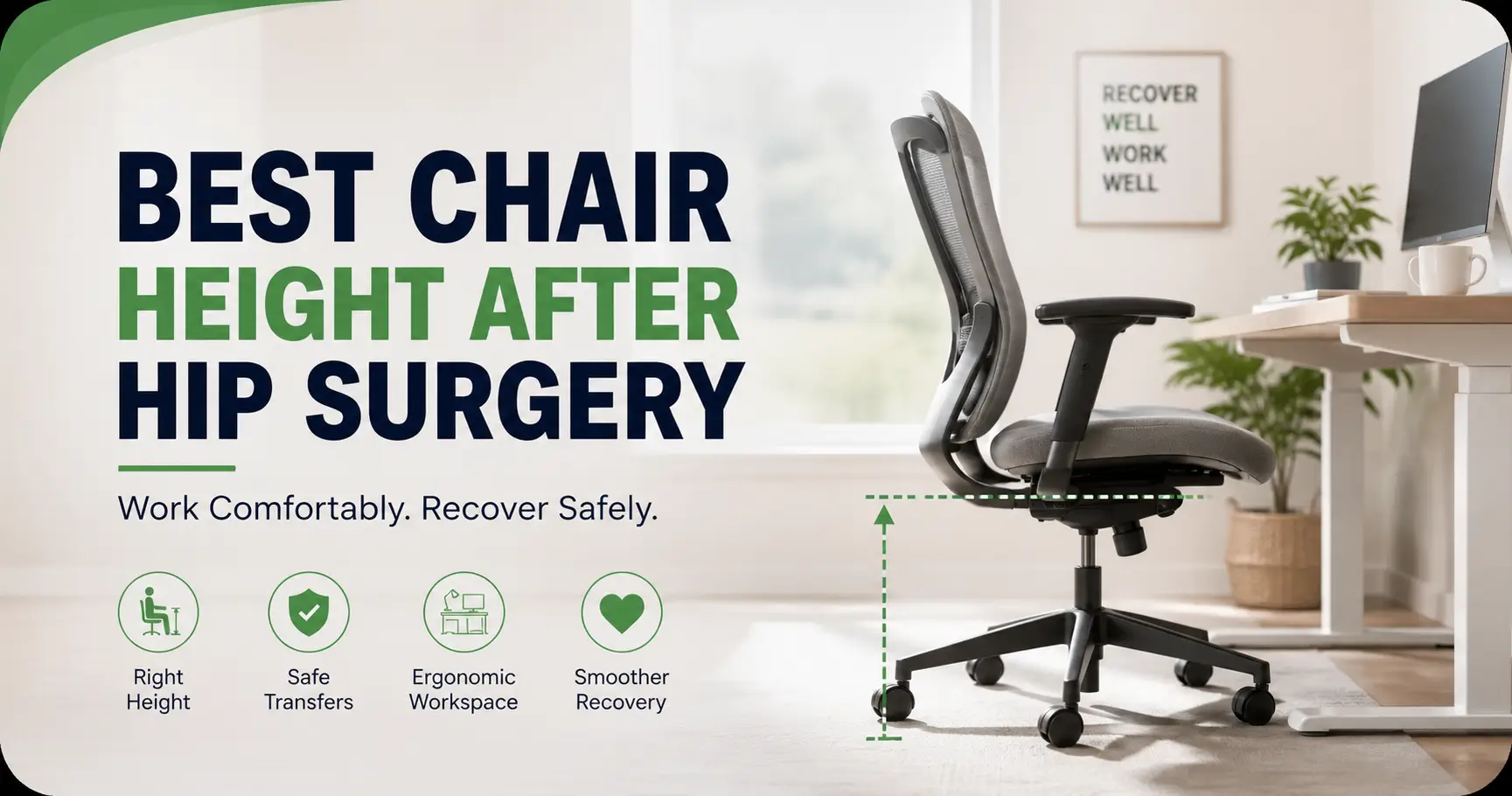
Setting Up Your WFH Chair After Hip Surgery
The wrong chair can turn a calm work-from-home morning into a tiny obstacle course: one low seat, one awkward reach for the mouse, one unplanned twist toward the printer, and suddenly your hip feels like it has filed a complaint with management. Office chair height after hip surgery is not just an ergonomics detail. It is part of your recovery setup, especially if your surgeon or physical therapist gave you hip precautions.
The practical rule is simple: your chair should usually let your knees stay lower than your hips, your feet rest flat or supported, and your hands use stable armrests when you sit and stand. Low, soft, rolling, or deeply reclining chairs can make transfers harder and may increase bending, twisting, wobbling, or fall risk.
Good news: you do not need a luxury chair shaped like a spaceship. You need a measured setup, a safer transfer path, and a desk that comes to you instead of making you chase it.
Start here. Measure once. Adjust gently. Let your care team overrule the internet every time.
What You Will Learn
- Set your seat height without breaking common hip precautions.
- Check whether wheels, cushions, and armrests help or hurt.
- Build a desk layout that reduces reaching, twisting, and long sitting.
- Know when to ask your surgeon, physical therapist, or occupational therapist for help.
Safer Sitting Snapshot
The chair is safe only if the transfer is safe. A higher seat matters, but it is not the whole story. Your chair should feel firm, stable, predictable, and easy to exit without rocking forward or twisting. Think of it less as furniture and more as a quiet recovery tool with armrests.
- Seat: firm, high enough, not slippery.
- Feet: flat on the floor or firmly supported.
- Knees: typically lower than hips when precautions apply.
- Arms: able to push from stable armrests, not the rolling desk.
- Desk: arranged so your hands do not need to chase chargers, files, or coffee.
Table of Contents
Safety First: Your Surgical Rules Come First
This guide is educational and cannot replace medical advice. Hip surgery recovery instructions vary by procedure, surgical approach, implant type, bone quality, balance, pain level, and your surgeon’s protocol. A total hip replacement, hip fracture repair, labral repair, and revision surgery may all come with different rules.
If your discharge paperwork says something different from this guide, follow your paperwork. If your physical therapist or occupational therapist adjusted your chair in person, that hands-on instruction outranks any general article. The internet is useful, but it has never watched you stand up while holding a walker in a sleepy kitchen at 7:12 a.m.
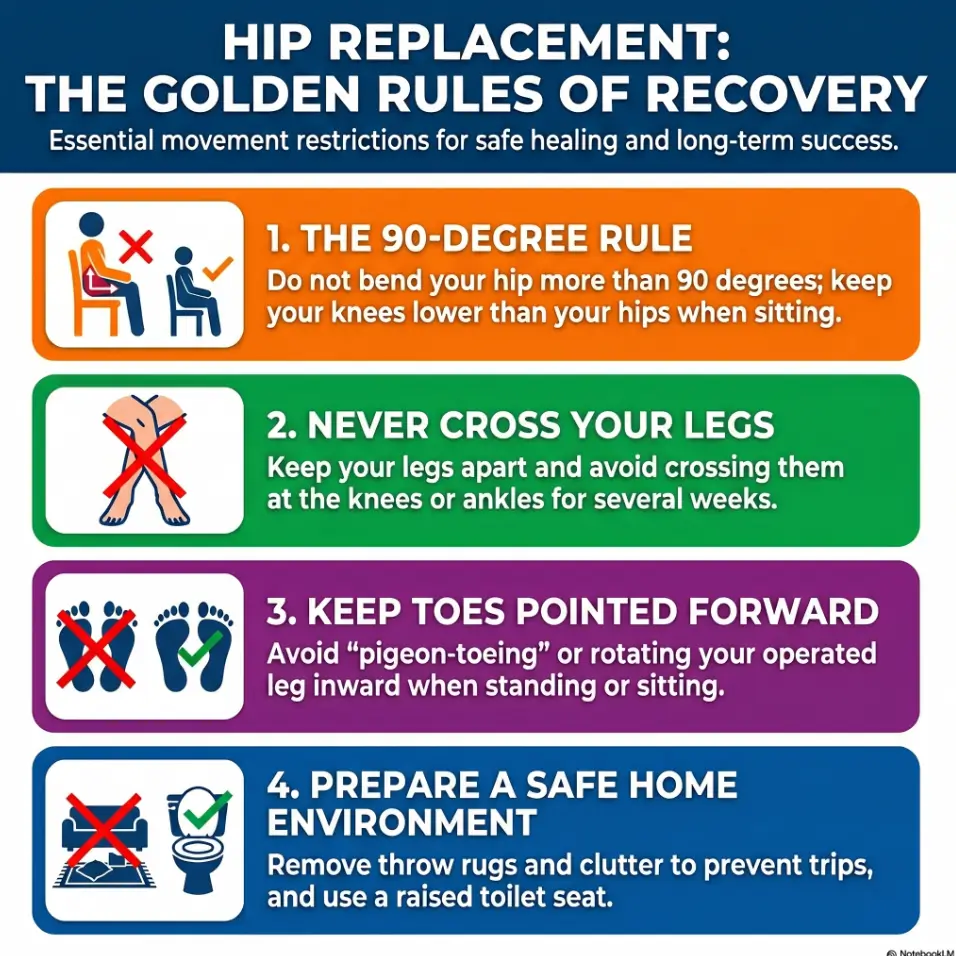
Many common hip replacement precautions warn against bending the hip beyond 90 degrees, crossing the legs, twisting, and sitting in low soft chairs. These are especially common after certain posterior-approach hip replacements, though not every patient gets the same restrictions.
- Use this guide as a home setup framework, not a medical clearance.
- Ask before changing chair height if you have unclear precautions.
- Do not ignore new pain, wobbling, dizziness, or weakness.
Apply in 60 seconds: Put your discharge instructions next to your desk before adjusting the chair.
The Chair Height Rule That Matters Most
The most useful rule is not “buy an ergonomic chair.” It is this: when you sit, your knees should usually be lower than your hips if hip precautions apply. That small angle check does a lot of work. It helps limit deep hip flexion, makes standing easier, and reduces the temptation to rock forward like a tired pelican trying to leave a dock.
Knees lower than hips, not “whatever feels comfy”
Comfort is important, but after hip surgery, comfort can be a trickster. A soft chair may feel kind for the first five minutes, then slowly pull your hips down, lift your knees up, and make standing feel like climbing out of wet sand.
A safer chair usually lets you sit with:
- hips slightly higher than knees, when advised by your care team;
- feet flat on the floor or on a stable foot support;
- back supported without slumping into a deep recline;
- armrests available for controlled sitting and standing;
- no need to twist to reach your keyboard, phone, or water.
Why low chairs can force risky hip bending
When a chair is too low, your hips drop below your knees. To stand, you often have to lean far forward, shift weight, push hard, and sometimes twist. That combination can violate common precautions and increase fall risk.
The problem gets worse when the chair is soft. A cushioned seat may compress under body weight, so a chair that looked tall enough becomes too low once you sit. The chair smiles politely, then steals two inches. Rude furniture behavior.
The 90-degree issue, explained without the anatomy fog
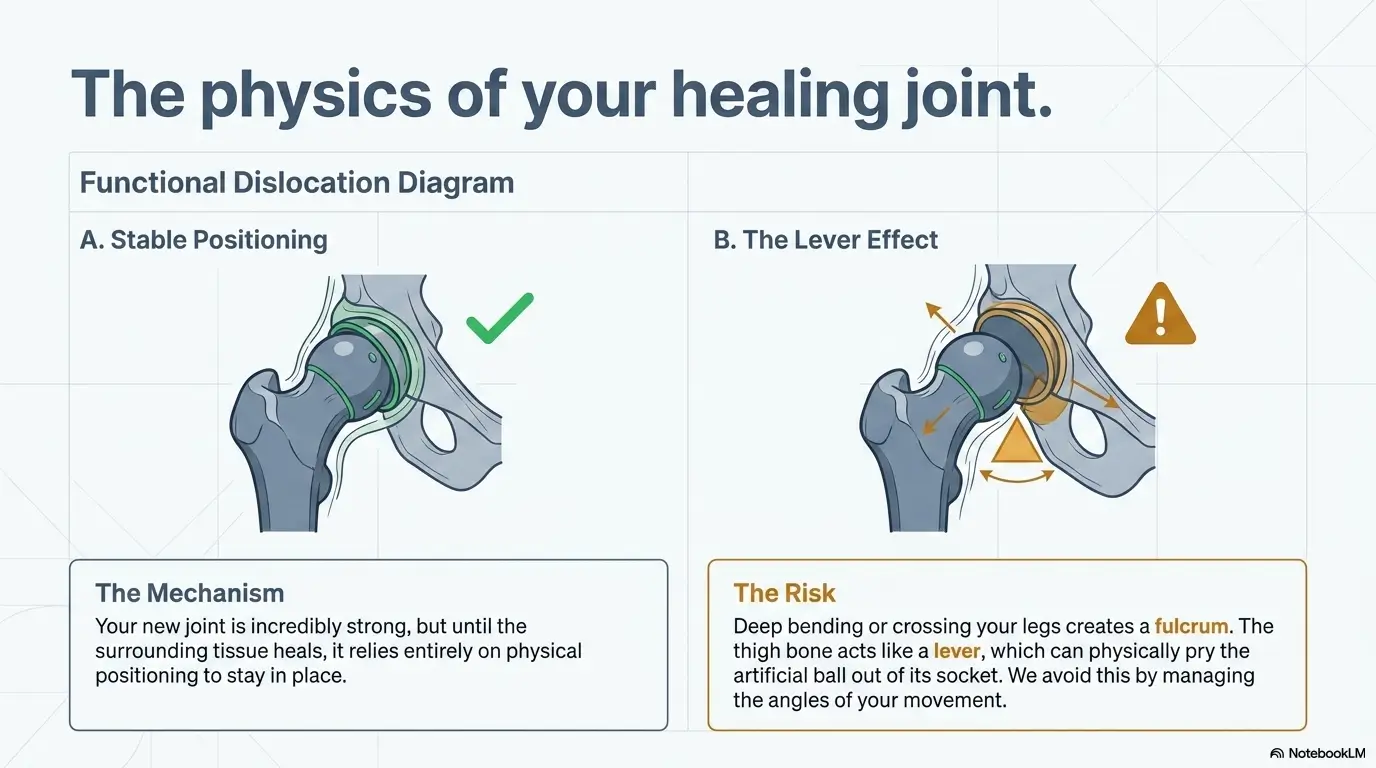
Hip flexion is the motion of bringing your thigh closer to your torso. Sitting in a very low chair increases hip flexion. Many hip replacement instructions advise avoiding hip flexion greater than 90 degrees during early recovery, especially when posterior hip precautions are prescribed.
You do not need a protractor at your desk. The simple visual is enough for many patients: if your knees are higher than your hips, the chair is probably too low for early recovery unless your clinician specifically cleared it.
Show me the nerdy details
Chair height affects the hip angle, the knee angle, and the force needed to stand. A higher, firmer seat usually reduces the amount of forward trunk lean needed during sit-to-stand. Less forward lean may help some patients stay within common hip precautions. The exact safe angle depends on surgical approach, restrictions, pain, strength, balance, and assistive device use. That is why a physical therapist or occupational therapist can be so valuable: they can watch the transfer instead of guessing from furniture measurements alone.
Hips sit higher than knees when precautions apply.
No sinking, sliding, or soft sofa effect.
Both hands can push evenly to stand.
Feet rest flat or on a non-slip support.
Daily items stay between waist and shoulder height.
Who This Is For, and Who Should Not Use Generic Advice
This guide is for people trying to make a desk chair safer during recovery, not for people trying to “push through” symptoms. After hip surgery, the humble office chair becomes part throne, part test station, part negotiation table with gravity.
For people recovering from hip replacement, hip repair, or hip fracture surgery
You may benefit from this guide if you are recovering from a hip replacement, hip fracture repair, hip pinning, hip revision, or another hip procedure and your care team has allowed sitting at a desk. The details may differ, but the home setup questions are often similar: How high is the chair? Is it firm? Can I stand without wobbling? Can I work without twisting?
If you are also dealing with sleep discomfort, your chair may be only one part of the recovery puzzle. A supportive sleep setup can matter too, and many readers pair this with a practical guide to sleeping discomfort after hip replacement when pain and positioning start competing for the same midnight microphone.
For caregivers setting up a home office corner
Caregivers often see hazards before the patient does. A charger on the floor, a low printer shelf, a rolling chair on a smooth floor, a throw rug with villain energy. These are easy to miss until someone tries to sit down with a walker nearby.
A good caregiver setup does not need to look clinical. It needs to be boring in the best way: stable, repeatable, and easy to use when the patient is tired.
Not for patients with unclear precautions, severe pain, dizziness, or new weakness
Generic chair advice is not enough if you have severe pain, new weakness, numbness, dizziness, faintness, sudden swelling, fever, wound concerns, or a sense that the hip “shifted.” It is also not enough if you do not know whether you have posterior, anterior, or other specific precautions.
When symptoms change, your first job is not to optimize your keyboard tray. It is to contact your surgical team.
When your surgeon’s rules outrank every internet checklist
Some patients are told to avoid low chairs for a set period. Others are given fewer restrictions, especially after certain surgical approaches or newer protocols. Some are told to use raised toilet seats, reachers, sock aids, walkers, or specific transfer techniques.
Write your rules down. Tape them to the desk if needed. The chair can adapt. Your healing hip should not have to improvise.
Money Block: Quick Eligibility Checklist
Use this chair guide today if most answers are “yes.”
- Yes / No: Your surgeon or therapist has allowed sitting in a chair.
- Yes / No: You understand your current hip precautions.
- Yes / No: You can stand with your assistive device as instructed.
- Yes / No: You have a firm chair with stable armrests available.
- Yes / No: You can stop and ask for help if the transfer feels unsafe.
Neutral action: If any answer is “no,” ask your care team or caregiver before using the chair for desk work.
Measure Your Office Chair Like a Recovery Tool
Most office chair advice starts with screen height and lumbar support. After hip surgery, start lower: the seat. A beautiful monitor setup cannot rescue a chair that traps you in a low, squishy bowl.
Start with seat height, not backrest angle
Raise the chair until your hips sit higher than your knees when your feet are planted. If the chair cannot go high enough, consider a different chair, a firm cushion approved by your therapist, or a stable chair with arms. Do not stack random pillows. We will discuss the pancake tower problem shortly, because it deserves its own tiny courtroom.
If you are choosing other recovery equipment for the home, a broader orthopedic home care equipment checklist can help you think beyond the chair: raised toilet seats, shower chairs, reachers, walkers, and safer daily routines.
Check your knee position before checking your desk
Sit back gently. Put both feet down. Look from the side or ask someone to take a quick photo from hip level. Your knees should not be higher than your hips when precautions apply.
If your feet dangle after raising the chair, do not ignore that. Dangling feet can make you feel unstable and may increase pressure behind the thighs. A stable, non-slip foot support may help, but only if it does not lift your knees too high.
Use armrests as part of the transfer, not decoration
Armrests should be sturdy enough to help you lower and stand in a controlled way. They should not wobble, slide, or force your shoulders up into your ears. If your chair has soft, low, or flimsy arms, it may look like an office chair but behave like a stage prop.
Pattern interrupt: your “perfect ergonomic chair” may be too low
Many premium ergonomic chairs are designed for long computer work, not early post-op transfers. Deep seat pans, flexible backs, rolling bases, and soft cushions can be wonderful later and annoying now.
During early recovery, the winner may be a firm dining chair with arms, a stable high-back chair, or an office chair with locked wheels and a raised seat. Glamour is optional. Predictability is the star.
Money Block: 3-Input Chair Height Mini Calculator
Use this as a rough setup note, not a medical measurement. Your therapist’s in-person check is better.
Neutral action: Use the result only as a starting point, then confirm with the side-view knee-to-hip check.
The Sit-to-Stand Test: Your Chair’s Quiet Truth Serum
A chair can look safe until you try to stand. The sit-to-stand test tells the truth quickly. It shows whether the chair height, armrests, wheels, floor surface, and your current strength are working together or arguing in committee.
Can you stand without rocking forward?
Sit once with your usual assistive device nearby. Place your surgical leg as instructed by your therapist. Use the armrests, not the desk edge. Try to stand slowly.
If you need to rock forward several times, the chair may be too low, too soft, too deep, or too unstable. Rocking can increase forward bending and make your balance less predictable.
Can both feet stay planted?
Your feet should be secure. If the chair is high enough for your hip but too high for your feet, a stable footrest may help. The footrest should not slide, wobble, or lift your knees above your hips.
A cardboard box is not a footrest. It is a future blooper reel with medical paperwork attached.
Does the chair roll away when you push up?
Rolling chairs are convenient before surgery and suspicious afterward. If the chair moves when you sit or stand, lock the wheels if possible. If the wheels do not lock, place the chair against a wall only if your therapist approves and the transfer remains safe. Better yet, use a stable non-rolling chair during the earliest recovery phase.
The “three-second wobble” you should not ignore
After standing, pause for three seconds before walking. If you wobble, feel lightheaded, or need to grab nearby furniture, stop. Your chair setup may need adjustment, or your body may need a slower return to desk work.
This is especially important if you are juggling pain medication, sleep loss, anemia, blood pressure changes, or general post-op fatigue. Healing is not lazy. It is a full-time construction site with poor signage.
Short Story: The Chair That Looked Fine
Martin had a handsome office chair: black mesh, shiny arms, five smooth wheels, the kind of chair that looks productive even when nobody is in it. Three days after coming home from hip surgery, he tried to answer email from it. Sitting down went fine. Standing up did not. The chair rolled back a few inches, his hands grabbed the desk, and his coffee performed a small tragic ballet across the keyboard.
Nothing dramatic happened to his hip, thankfully, but the lesson landed. His daughter swapped in a firm dining chair with arms, raised the laptop on books, moved the charger to the desktop, and placed the walker in the same spot every time. The new setup looked less executive and more sensible. That was the point. Recovery furniture does not need charisma. It needs manners.
- Test sitting and standing before working.
- Use armrests and your prescribed assistive device.
- Pause after standing before walking away.
Apply in 60 seconds: Do one slow sit-to-stand test with a caregiver nearby if you are early in recovery.
Office Chair Features That Help After Hip Surgery
After hip surgery, the best chair features are rarely dramatic. They are the quiet, dependable ones: firmness, height, arms, stability, and a seat that does not swallow you like a couch with unfinished business.
Firm seat cushion: boring, useful, heroic
A firm seat helps prevent sinking. That matters because sinking lowers your hips and can make your knees higher. A firm cushion can sometimes help raise a chair, but it must be stable, non-slip, and approved for your situation.
If you are also using pillows for bed or couch positioning, remember that different tools solve different problems. A guide to using a wedge pillow after surgery may help for resting positions, but a wedge is not automatically safe as a desk-chair booster.
Stable armrests for controlled lowering and standing
Good armrests let you lower yourself gradually instead of dropping into the chair. They also help you stand without pulling on the desk. Armrests should be high enough to use without shrugging, wide enough to press evenly, and firmly attached.
Locking wheels or a non-rolling chair for early recovery
If your chair has wheels, check whether they lock. Many do not. A rolling chair can shift during the exact moment you need stability most. For early recovery, a non-rolling chair with arms may be safer than a fancy task chair.
Straight back support without deep reclining
A modestly upright back can help you avoid slouching and deep hip flexion. Deep reclining may feel relaxing, but it can make getting out harder. The more you recline, the more complicated the exit can become.
Seat depth that does not pull you into a slouch-cave
If the seat is too deep, you may slide forward, tuck your pelvis, or lean to one side. A chair that supports your back while letting your knees bend comfortably over the front edge is usually easier to manage.
Money Block: Decision Card, Office Chair vs. Firm Armchair
| Option | Better When | Watch Out For |
|---|---|---|
| Adjustable office chair | It raises high enough, has stable arms, and wheels can lock. | Rolling, deep seat pans, soft cushions, swivel twisting. |
| Firm chair with arms | Early recovery, safer transfers, simple home setup. | May need desk or monitor height changes. |
Neutral action: Choose the chair that makes sitting and standing safer, not the one that looks most office-like.
Don’t Do This: Chair Adjustments That Look Smart but Backfire
The danger zone after hip surgery is full of ideas that look clever at first glance. A pillow stack. A quick twist. A rolling chair “just for a minute.” A printer on the floor because it has always lived there, like a dusty little office goblin.
Don’t stack slippery pillows like a pancake tower
Soft pillows compress. Slippery pillows shift. A tall stack can tilt, slide, or make your pelvis unstable. If you need extra height, ask whether a firm, non-slip cushion or a different chair is better.
Don’t use a deep recliner as your “work chair”
Recliners can be useful for some recoveries, but they are not automatically safe for desk work. Deep seats may increase hip bending when you sit down or stand up. Footrests can encourage awkward leg positions. Exiting a recliner can require more effort than expected.
If you are comparing recovery seating after a different procedure, the trade-offs are not identical. For example, shoulder recovery may raise different concerns, which is why a separate guide on recliner versus bed after shoulder surgery should not be borrowed wholesale for hip precautions.
Don’t sit with knees higher than hips
This is the big visual warning. If your knees are higher than your hips, you may be bending more than advised. Raise the chair, change the chair, or ask your therapist for options.
Don’t twist from the chair to grab chargers, files, or coffee
Twisting is sneaky because it feels small. You turn toward the side table, reach behind you for a cable, or rotate toward the printer. After surgery, those small motions matter more. Arrange the desk so frequently used items are in front of you and within easy reach.
Let’s be honest: the floor printer is now a villain
Printers, bins, backpacks, power strips, and file boxes often live on the floor. During hip recovery, the floor becomes a costly neighborhood. Use a waist-height shelf, a side table, or a caregiver assist for anything low.
Desk Setup After Hip Surgery: Fix the Workspace Around the Chair
Once your chair is safer, adjust the desk around it. Many people do the opposite. They lower the chair to match the desk, then accidentally create a risky hip angle. After hip surgery, the chair sets the terms. The desk must negotiate.
Raise the monitor before lowering the chair
If the higher chair makes your screen feel low, raise the monitor or laptop. Use a laptop stand, books, or a stable riser. Keep the top third of the screen near eye level if comfortable, but avoid slumping or leaning forward to see.
If neck or shoulder strain joins the party, your workstation may need a broader reset. A practical guide to neck pain from laptop work can help you separate hip-safe chair height from screen and keyboard problems.
Bring keyboard and mouse within easy reach
Your keyboard and mouse should sit close enough that you do not lean, twist, or reach across your body. Elbows should rest near your sides. If your shoulders creep upward, the desk may be too high after you raise the chair.
For readers already dealing with upper-body strain, an ergonomic mouse for shoulder pain can help reduce reach and grip stress, but it should not require you to twist from the hip to use it.
Keep daily items between waist and shoulder height
Place phone, water, medication list, notebook, charger, tissues, and remote work tools between waist and shoulder height. Keep them in front or slightly to the side, not behind you.
A good rule: if reaching for the item would make your torso rotate, move the item. Your desk should feel like a cockpit, not a scavenger hunt.
Use a footrest only if it does not lift knees too high
A footrest can help if the chair is raised and your feet do not reach the floor. But a tall footrest can lift your knees and undo the hip-safe angle. Use a low, firm, non-slip support and check the side view again.
The “no reaching across your body” desk layout
Set items based on the hand that uses them. Mouse on the mouse side. Phone near the hand that answers it. Water in front. Trash bin high enough or close enough that you do not bend. If you need to turn, turn your whole body with small steps after standing, not by twisting in the chair.
- Lift the screen instead of dropping the chair.
- Keep tools in front of you.
- Use foot support only if knees stay lower than hips.
Apply in 60 seconds: Move your charger, phone, and water bottle to the front half of the desk.
Common Mistakes That Make Sitting Riskier
The most common mistakes are not dramatic. They are ordinary things done at the wrong height, for too long, or while tired. Recovery has a way of turning normal habits into little traps with office supplies nearby.
Mistake 1: choosing comfort over safe height
A soft seat may feel soothing, but if it lowers your hips below your knees, it may not be the best early recovery choice. Comfort should support safety, not compete with it.
Mistake 2: sitting too long without movement breaks
Even a well-set chair is not a permission slip to sit for hours. Follow your care team’s guidance about movement, walking, exercises, and rest. Many patients are encouraged to move early after hip replacement, but the right amount depends on the person.
Remote workers with orthopedic pain often need a pacing plan, not heroic chair endurance. The ideas in orthopedic pain management for remote workers may help you plan shorter work blocks, better breaks, and less “I accidentally sat through three meetings” regret.
Mistake 3: forgetting the chair transfer technique
Your therapist may teach a specific sequence: back up until you feel the chair, slide the surgical leg forward, reach for armrests, lower slowly, and avoid twisting. Use that sequence every time. Familiarity is safety’s quieter cousin.
Mistake 4: assuming all hip surgeries have the same precautions
Some patients have strict posterior precautions. Some do not. Some have fracture-related limits, weight-bearing restrictions, or balance concerns. Ask what applies to your surgery, not what applied to your neighbor’s cousin who was golfing in four weeks and telling everyone about it.
Mistake 5: returning to a low car seat and a low office chair on the same day
Car transfers can be demanding. A low office chair can be demanding. Doing both in one day may be too much early on. If you are transitioning back to commuting or appointments, think about the whole day’s sitting load.
For another daily transfer problem, the same safety-first thinking applies to dressing. Many hip patients find that learning how to put on socks after hip surgery reduces bending and early-morning frustration.
Money Block: Quote-Prep List for an Occupational Therapist or Equipment Supplier
Before asking about a chair, cushion, or riser, gather these details.
- Your surgery type and date.
- Your current hip precautions, if any.
- Your knee height from floor while wearing usual shoes.
- Current chair seat height before and after sitting.
- Whether the chair rolls, swivels, reclines, or has armrests.
- A side photo of your seated knee-to-hip position.
- Any dizziness, wobbling, pain spikes, or transfer trouble.
Neutral action: Bring this list to your next therapy visit or message your care team with the measurements.
How Long Should You Use a Higher Chair?
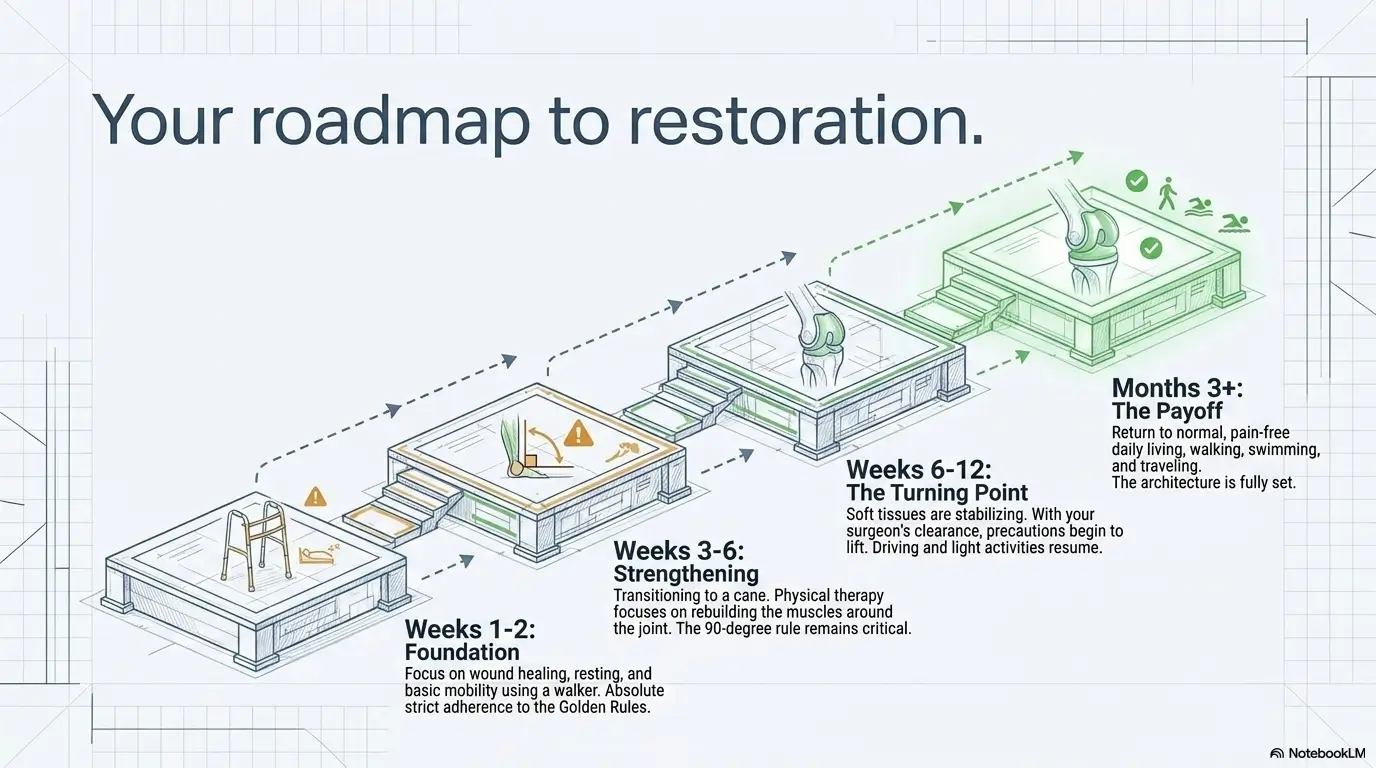
The honest answer: long enough for your surgeon or therapist to clear a lower setup. Many patients hear timeframes such as several weeks, but recovery rules are not universal. Your procedure, approach, healing, strength, and fall risk all matter.
Early recovery is usually the strictest phase
The first weeks after surgery often come with the clearest limits: avoid low seats, use assistive devices, keep essentials nearby, and practice safe transfers. This is when a higher, firmer chair can be most helpful.
Why “six weeks” is common but not universal
Six weeks appears often in hip recovery conversations because many early tissue-healing and follow-up milestones cluster around that time. But it is not a magic spell. Some people need longer restrictions. Some have different instructions from day one.
If you are managing pain while waiting for joint care or dealing with broader orthopedic issues, a guide on joint replacement pain management can help frame questions for your clinician without guessing at timelines.
What changes after your follow-up appointment
At follow-up, your care team may adjust precautions, exercises, walking goals, medication plans, and return-to-work advice. This is a good time to ask specifically: “Can I lower my office chair?” and “Can I use a rolling chair now?”
The difference between “allowed” and “comfortable”
Being cleared to sit lower does not mean every low chair will feel good. Strength, stiffness, swelling, fear of movement, and fatigue may still affect transfers. Progress can be real and uneven at the same time. Recovery is not a straight hallway. It is more like a house with several light switches in odd places.
- Do not use a calendar milestone as your only guide.
- Ask about chair height at follow-up visits.
- Keep safer options available even after restrictions loosen.
Apply in 60 seconds: Add “Can I lower my office chair yet?” to your appointment question list.
When to Seek Help Before Sitting at a Desk
Desk work can wait. A concerning symptom cannot. The chair audit is useful, but it is not a substitute for medical review when something feels wrong.
Call your surgical team for sudden hip pain, popping, shortening, or loss of function
Contact your surgeon or care team promptly if you feel a sudden pop, sharp new hip pain, new inability to bear weight, a leg that appears shortened or oddly rotated, or a major change in function. These symptoms need medical guidance, not chair tinkering.
Ask a physical therapist if standing up feels unstable
If you wobble, need to grab furniture, or cannot stand without rocking forward, ask your physical therapist to review your transfer. The issue may be chair height, strength, assistive device placement, medication timing, or a combination.
Ask an occupational therapist to check home chair height
Occupational therapists are especially helpful for home setups. They can look at chairs, toilets, showers, bed height, dressing tools, workstations, and reach zones. If your home feels like a maze of small hazards, an OT can turn the maze into a map.
Get urgent help after a fall, suspected dislocation, chest pain, or shortness of breath
Seek urgent care or emergency help after a fall with hip pain, suspected dislocation, chest pain, shortness of breath, fainting, severe calf swelling, or other symptoms your discharge paperwork flags as urgent. Do not try to “chair adjust” your way through red flags.
FAQ
What is the best office chair height after hip replacement?
The best office chair height is usually high enough that your knees stay lower than your hips, your feet are supported, and you can sit and stand without rocking, twisting, or sinking. Your surgeon or physical therapist may give a more specific rule based on your surgery and precautions.
Should my knees be higher or lower than my hips after hip surgery?
When hip precautions apply, knees are commonly kept lower than hips to reduce deep hip bending. This is especially important for patients told to avoid hip flexion beyond 90 degrees. Always follow your own discharge instructions.
Can I sit in a rolling office chair after hip surgery?
Sometimes, but a rolling chair can move during sitting or standing. Early in recovery, many people do better with a stable non-rolling chair with firm arms. If you use a rolling chair, lock the wheels if possible and ask your therapist whether it is appropriate.
Is it safe to use a cushion to raise my office chair?
A firm, non-slip cushion may help some people, but soft or slippery pillows can shift and create instability. Do not stack pillows like a wobbly breakfast tower. Ask your therapist whether a cushion, chair riser, or different chair is safer.
How long should I avoid low chairs after hip surgery?
Many patients avoid low chairs during the early recovery period, but the exact timeline varies. Some instructions mention several weeks, while others depend on surgical approach, healing, and follow-up findings. Ask your surgeon when lower chairs are safe for you.
Can I work from home at a desk after hip replacement?
Many people return to desk tasks gradually, but timing depends on pain, medication, mobility, fatigue, and surgeon instructions. Start with short sessions, use a safe chair setup, keep items within reach, and take movement breaks as advised.
Are recliners safe after hip surgery?
Recliners are not automatically safe or unsafe. Some are too low, too soft, or hard to exit. Others may be acceptable if your care team approves them. The key is whether you can sit, rest, and stand without breaking precautions or losing balance.
What chair is best for hip surgery recovery?
A commonly recommended recovery chair is firm, stable, high enough to keep knees lower than hips, and equipped with two sturdy arms. It should not roll away, sink deeply, or require twisting to exit.
Can a footrest help after hip surgery?
A low, stable footrest can help if your feet do not reach the floor after raising the chair. However, it should not lift your knees higher than your hips. Recheck your side position after adding one.
Should I ask for a workplace accommodation for chair height?
If you are returning to an office, ask your clinician whether you need temporary work restrictions or accommodations. You may need a higher chair, stable armrests, reduced sitting blocks, remote work, closer parking, or a safer workstation. For documentation questions, an appointment checklist can help you prepare, especially if you are using an orthopedic appointment checklist to organize symptoms and work needs.
Next Step: Do the 5-Minute Chair Audit Today
The chair that looked harmless in the introduction was not really harmless. It was unmeasured. That is the whole trick. After hip surgery, safety often lives in plain sight: the seat height, the armrests, the printer location, the footrest, the moment you stand and wait before taking a step.
Sit once, stand once, measure what happens
Use your prescribed transfer technique. Sit slowly. Stand slowly. Notice whether you rock, twist, grab the desk, lose balance, or feel pain. The test takes less than a minute and tells you more than a product description ever will.
Photograph your knee-to-hip position from the side
Ask a caregiver to take a side photo while you sit upright with feet supported. Check whether your knees are lower than your hips if that is part of your precautions. Bring the photo to therapy if you are unsure.
Move one risky item closer before your next work session
Choose one item from the danger zone: charger, printer paper, medication list, water, phone, notebook, trash bin. Move it between waist and shoulder height. Tiny changes are how a safer home office gets built.
Write one question for your physical therapist or surgeon
Ask one specific question: “Is this chair height safe for me?” “Can I use a rolling chair?” “How long should I avoid low seats?” “Do I still need knees lower than hips?” Specific questions get better answers.
- Check knees lower than hips when precautions apply.
- Prioritize firm seats, stable arms, and controlled standing.
- Rearrange the desk so you do not twist or reach.
Apply in 60 seconds: Take one side-view chair photo and save it for your next therapy question.
A safer sitting setup is not glamorous, and that is its charm. It reduces guessing. It makes the day more predictable. It gives your healing hip fewer surprises and your working brain a little more room to breathe.
Within the next 15 minutes, do one thing: sit in your work chair with your usual shoes on, check whether your knees are lower than your hips, then move one floor-level item to waist height. Small, practical, slightly boring. Perfect.
Last reviewed: 2026-05.
Tags: hip surgery recovery, office chair height, hip replacement precautions, home office ergonomics, orthopedic recovery
Meta description: Set safer office chair height after hip surgery with knee-to-hip checks, transfer tips, desk setup, and red flags.