
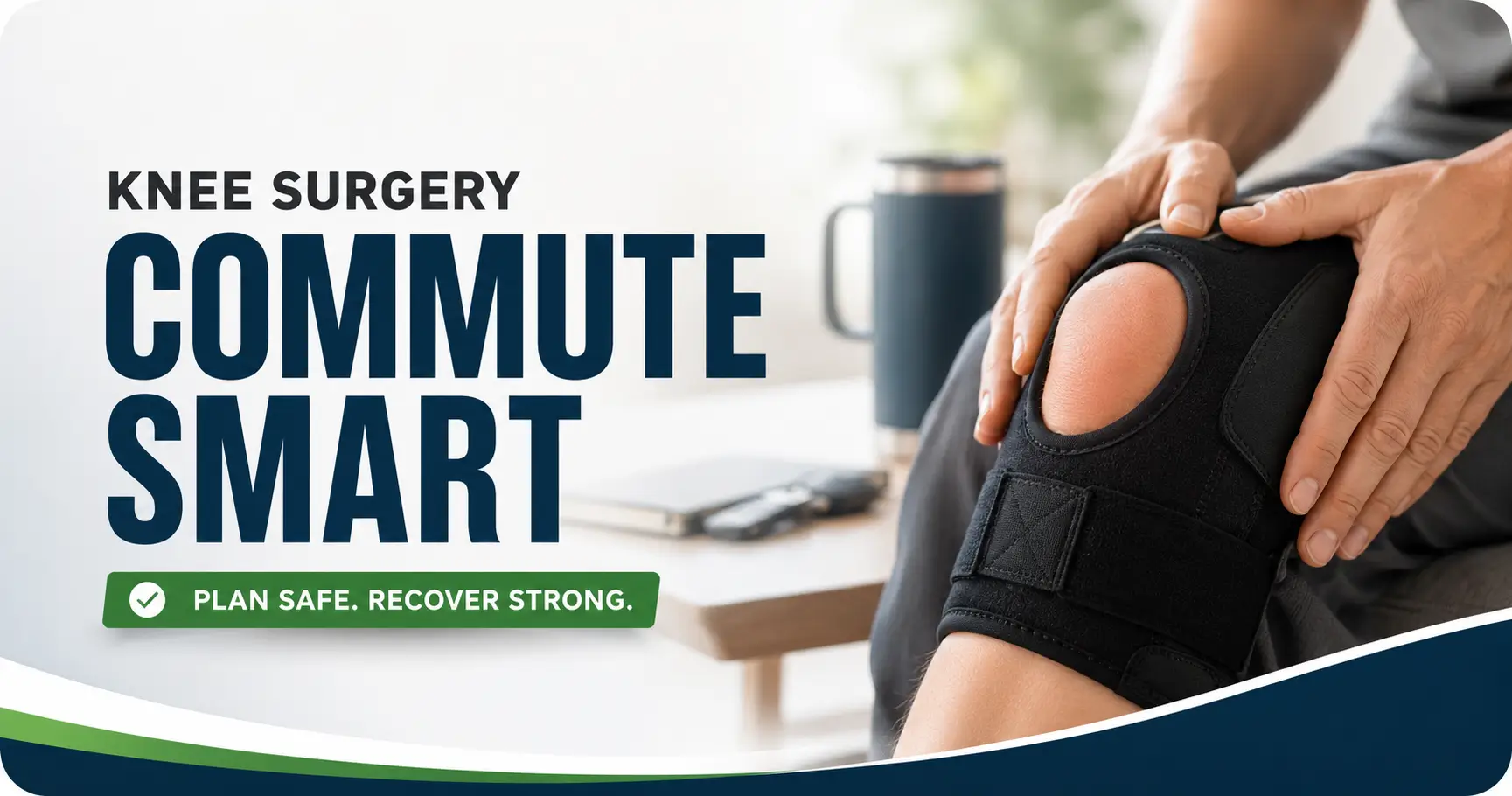
Mastering the Post-Surgery Journey
The first commute after knee replacement can feel oddly ordinary until it is not. A parking lot that used to be background noise becomes a small obstacle course. A laptop bag feels heavier. A long red light becomes a test of patience, swelling, and whether your knee is quietly filing a complaint.
Commuting after knee replacement is not just about getting to work. It is about driving clearance, pain medication, reaction time, swelling control, stairs, parking distance, public transportation, bathroom access, and how much energy you still need after the workday ends.
Guessing can cost you. Not always dramatically, but in the slow, annoying ways: more swelling, a rougher evening, missed physical therapy, a nervous drive home, or a workday that turns into an endurance sport nobody signed up for.
This guide helps you build a safer, calmer commute plan before you return. It uses practical recovery logic, common orthopedic guidance, and the kind of real-world friction that rarely fits neatly on a discharge sheet.
Make the commute smaller.
Let your knee vote.
Your First Commute Is a Recovery System
A safe return to commuting after knee replacement usually depends on four gates: medical clearance, safe movement, manageable swelling, and a realistic workday. The brake pedal, the office stairs, the afternoon pain curve, and the trip home all matter.
Best early goal: prove you can complete a short, low-stakes trip without a major pain or swelling penalty later that day.
Table of Contents

Safety First: Medical Clearance Comes Before Momentum
This article is for general education only, not medical advice. Knee replacement recovery varies widely by surgical technique, health history, pain control, strength, balance, home setup, job demands, and complications. Always follow your surgeon’s discharge instructions, medication rules, physical therapy plan, and driving restrictions.
Do not drive while taking narcotic pain medication, if your reaction time feels slowed, or if you cannot brake firmly and confidently. The American Academy of Orthopaedic Surgeons notes that return to normal activities and work depends on recovery progress and job demands, and your doctor should guide the timing.
There is no gold medal for returning to the office before your knee is ready. There is only a swollen leg, a tired face in the elevator mirror, and possibly a very dramatic negotiation with your couch at 6 p.m.
- Ask about driving, stairs, walking distance, and medication timing.
- Do not use pain relief as proof that your knee is ready.
- Plan for the trip home, not only the morning arrival.
Apply in 60 seconds: Write “surgeon clearance, medication, brake test, swelling plan” on one note and bring it to your next visit.
The Real Question: Can You Commute Without Paying for It Later?
Commuting is a recovery test, not a calendar date
Many people ask, “How many weeks after knee replacement can I commute?” That is understandable. Weeks feel measurable. Recovery, however, is a little more orchestral. Pain, swelling, sleep, strength, confidence, medications, and the shape of your workday all play different instruments.
A better question is: can you complete the commute and still function safely afterward?
For a desk worker, the commute may be harder than the job itself. For a caregiver or manager, the workday may require surprise walking, standing conversations, and “just a quick trip downstairs” moments that are never quick after surgery.
Why “I can walk around the house” is not the same as “I can handle Monday traffic”
Walking from bedroom to kitchen is controlled. Commuting is not. Commuting adds timing pressure, uneven pavement, curbs, traffic, bags, elevators, people moving around you, and the psychological spice rack known as “running late.”
At home, you can sit down when your knee whispers. At work, your knee may have to wait until the meeting ends, the elevator arrives, or someone stops telling a story in the doorway.
If your home recovery setup is still evolving, review your knee replacement apartment setup before layering on a commute. The safer your morning launch pad is, the less energy you burn before leaving.
The three-part commute test: pain, swelling, and stamina
A commute is reasonable only if it passes three tests:
- Pain: Can you manage the trip without sharp, escalating, or distracting pain?
- Swelling: Does your knee stay within a manageable range by the evening?
- Stamina: Can you still walk, think, eat, do therapy, and get home safely?
Notice that “I survived it” is not on the list. Survival is a poor planning metric. Houseplants survive in bad corners. We can aim higher.
Money Block: The 3-Gate Commute Readiness Checklist
Use this before your first work commute. A “no” does not mean failure. It means your plan needs one more quiet draft.
| Readiness gate | Yes or no? | Next step |
|---|---|---|
| Surgeon or care team has cleared the activity level | Yes / No | Ask directly before commuting. |
| You can get in and out of your vehicle or transit route safely | Yes / No | Practice during a quiet time. |
| You have a plan for swelling, rest, and the ride home | Yes / No | Build breaks into the day. |
Neutral action line: If any answer is “no,” change one part of the commute before testing the whole route.
Who This Is For, and Who Should Pause
Good fit: office workers, hybrid employees, short-distance commuters, and caregivers planning ahead
This guide is especially useful if you are returning to an office, clinic, school, store, agency, coworking space, or family caregiving routine after total knee replacement. It also fits people who work hybrid schedules and want to choose the least punishing first day back.
Caregivers can use it too. Sometimes the patient is not the one pushing too fast. Sometimes the schedule is. A printed plan can be a gentle referee when everyone is trying to be brave.
Not for: symptoms that need medical attention
Pause the commute plan and contact your care team if you have new calf pain, chest pain, shortness of breath, fever, wound drainage, sudden swelling, major redness, fainting, or new trouble walking. Those are not “Monday problems.” They are medical problems.
If your pain has been hard to control, it may help to compare your current plan with broader knee replacement pain management strategies and discuss changes with your surgeon or physical therapist.
Let’s be honest: the commute can become the hardest part of the workday
Work can be predictable. Commutes often are not. A closed parking garage, broken elevator, full train, late rideshare, wet lobby floor, or unexpected meeting across campus can turn a normal day into a knee opera with too many acts.
The goal is not to fear the commute. The goal is to remove avoidable surprises. Recovery likes fewer surprises. Knees are not fond of plot twists.
Driving After Knee Replacement: The Brake Pedal Is the Boss
Right knee vs. left knee: why the surgery side matters
Driving after knee replacement depends heavily on which knee was replaced, whether you drive an automatic or manual vehicle, your reaction time, your strength, and your medication use. A right knee replacement often requires more caution for automatic cars because the right leg controls the accelerator and brake.
A left knee replacement may be less involved for some automatic-transmission drivers, but it is not automatically simple. Getting in and out of the vehicle, sitting with the knee bent, managing swelling, and handling emergency braking still matter.
If car sitting itself is uncomfortable, the planning logic overlaps with lumbar support cushion for driving decisions: comfort tools should support safe posture without interfering with control of the vehicle.
Pain medication, reaction time, and why “feeling okay” is not enough
Narcotic pain medication can impair driving. So can poor sleep, severe pain, stiffness, slow reaction time, and anxiety. “I feel okay sitting still” is not the same as “I can respond quickly when a child runs after a ball or traffic stops suddenly.”
Your surgeon may give specific restrictions. Follow them. If instructions are unclear, ask. The steering wheel is not a place for creative interpretation.
Ask your surgeon these driving-clearance questions before touching the keys
- Am I medically cleared to drive based on my surgery side and progress?
- Which medications make driving unsafe?
- How should I test braking before driving on roads?
- How long can I sit with my knee bent before taking a break?
- Should I avoid highways or long drives at first?
- What symptoms mean I should stop driving and call your office?
The parking-lot practice test: getting in, braking, turning, and getting out safely
Before your first real commute, practice in a quiet, flat parking lot with another adult nearby if possible. Test the basics: getting in, adjusting the seat, moving between pedals, braking firmly, turning, parking, and getting out.
Do not test your first emergency brake in actual traffic. That is not confidence. That is rolling a tiny thundercloud into rush hour.
Show me the nerdy details
Driving after knee replacement is not only about knee bending. Safe driving requires enough joint range, muscle control, pain control, attention, and reaction speed to move from accelerator to brake quickly. Studies often look at brake response time, but real-world safety also includes medication effects, fatigue, vehicle height, seat position, traffic density, and whether the driver can tolerate sitting without distraction. That is why surgeon clearance and a practical parking-lot test both matter.
- Medication can matter as much as knee motion.
- Right-side surgery often needs extra caution for braking.
- A quiet practice session is smarter than a heroic first commute.
Apply in 60 seconds: Add “Can I safely brake?” to the top of your driving questions for your surgeon.
Don’t Rush the First Commute: Build a Soft Reentry Week
Start with one short trip before your first work commute
Your first trip should not be a full workday with traffic, meetings, lunch logistics, and a long walk to the building. Start smaller. Try a short ride as a passenger, a brief drive if cleared, or a low-stakes outing where you can leave early.
The point is to gather data. How does your knee feel during the ride? How does it feel two hours later? How does it feel that night? Recovery often sends the invoice after dinner.
Plan a half-day or hybrid day before a full office day
If your employer allows it, try a half-day in person or a hybrid day first. Many people underestimate the energy cost of being “on” after surgery. A cheerful hallway conversation can be lovely, but five of them in a row may drain the battery.
A phased return also helps you protect physical therapy appointments. If your calendar turns into a crowded drawer, PT is often the first thing that gets shoved to the back. That is rarely a good trade.
The “one errand rule” for testing real-world stamina
Before commuting to work, try the one errand rule: choose one small destination, one clear task, and one planned rest afterward. No bonus errands. No “since we’re already out” spiral. That phrase has defeated many recovering knees.
Short Story: The Monday That Started on Friday
Marianne thought she was being careful. She had her surgeon’s clearance, a short office day, and a spouse ready to drive her home if needed. The mistake was not the commute itself. It was the weekend before. On Friday, she tested the route: car door, parking lot, elevator, desk chair, bathroom walk, and back. It took 38 minutes.
Her knee felt stiff but calm. That evening, swelling rose a little, then settled with rest and elevation. So on Monday, she changed two things. She wore easier shoes and asked security about a closer entrance. The workday was still tiring, but it did not become a recovery setback. Her lesson was beautifully unglamorous: the first commute should not be the first rehearsal. A test trip turns fear into information.
Money Block: Soft Reentry Decision Card
| Choose this | When it fits | Trade-off |
|---|---|---|
| Half-day in office | You need face time but fatigue is still high. | Less stamina risk, but may require schedule approval. |
| Hybrid return | Your work can be split between home and office. | Better recovery pacing, but requires clear communication. |
| Passenger ride first | You are not cleared to drive or feel uncertain. | Safer, but depends on another person or paid ride. |
Neutral action line: Pick the smallest version that lets you learn without forcing a full-day recovery bet.
Your Commute Map: Find the Hidden Knee Traps Before They Find You
Parking distance: the quiet villain of post-surgery mornings
Parking is easy to forget because it feels like a detail. After knee replacement, it can become the main event. A far parking spot adds walking, weather exposure, curbs, traffic crossings, and fatigue before work even begins.
Ask about temporary accessible parking, a closer lot, a drop-off zone, or a short-term permit if appropriate. Your doctor’s office or employer may have paperwork guidance. Do not assume the standard employee lot is harmless just because it was fine before surgery.
Stairs, curbs, ramps, elevators, and slick lobby floors
Map the path from car or transit stop to desk. Count stairs. Identify ramps. Check if elevators are reliable. Notice whether the lobby floor becomes slick when wet. One small curb at 8 a.m. can become a mountain goat documentary when your knee is stiff.
If stairs are unavoidable, ask your physical therapist how to manage them safely with your current strength and assistive device. If you are using a brace or support for stairs, compare it with guidance like hinged knee brace for stairs and confirm what is appropriate for your stage of healing.
Public transit realities: standing, crowds, sudden stops, and long platforms
Public transportation can work, but it needs planning. Crowded buses and trains create balance challenges. Sudden stops can force fast reactions. Long platforms may add more walking than expected. Transfers can turn a simple route into a scavenger hunt with knees.
Choose fewer transfers, predictable elevators, off-peak times, and routes where you can sit. A slower route with fewer surprises may be safer than a faster one that demands agility.
Here’s what no one tells you: the return trip may be harder than the morning trip
The morning commute gets all the attention. The return trip deserves more respect. By late afternoon, swelling may be higher, muscles may be tired, and patience may have moved to a different zip code.
Plan the ride home as if your knee will be 25 percent less cooperative than it was in the morning. That assumption may save you from overcommitting.
The 4-Part Commute Safety Map
Driving, medication, stairs, walking, and assistive device instructions.
Parking, curbs, elevators, floors, platforms, transfers, and weather.
Meetings, standing, walking, sitting time, bathroom access, and breaks.
Fatigue, swelling, backup ride, pain control, and evening recovery.

Pain and Swelling Strategy: Pack for the Knee You’ll Have at 4 P.M.
Why swelling often builds during the day
After knee replacement, swelling can build with sitting, standing, walking, heat, long rides, and too much activity. The knee may feel acceptable in the morning and cranky by late afternoon. This does not always mean something is wrong, but it does mean your plan must account for the daily curve.
Think of swelling like a slow-loading progress bar. The bar may look calm at 9 a.m. and fully dramatic by 4 p.m.
Compression, elevation breaks, and icing plans to discuss with your care team
Ask your care team whether compression, elevation breaks, or ice are appropriate for your stage of recovery. Some people benefit from a planned midday rest with the leg supported. Others need to adjust sitting time, movement breaks, or medication timing.
If you are comparing hot and cold options for discomfort, review the practical differences in heating pad vs ice wrap, then ask your clinician which fits your post-surgical instructions. After surgery, assumptions can be expensive.
Shoes, bags, and clothing that do not turn your commute into a small circus
Wear stable, easy shoes with good traction. Avoid slippery soles, difficult laces, and pants that fight with swelling, dressings, or compression garments. If socks remain hard to manage, the mechanics are similar to other post-surgery dressing challenges, such as how to put on socks after hip surgery.
Use a rolling bag, backpack, or crossbody bag only if it does not disturb balance or overload the surgical side. A heavy laptop bag can turn every step into a tiny tug-of-war.
- Swelling often rises as activity accumulates.
- Comfort tools should match your surgeon’s instructions.
- Light bags and stable shoes reduce avoidable strain.
Apply in 60 seconds: Put your commute shoes, bag, medication list, and swelling plan in one visible place tonight.
Common Mistakes: The Commute Choices That Backfire
Mistake 1: returning on the busiest office day of the week
If Tuesday is meeting-palooza and the parking lot becomes a gladiator arena by 8:15, do not choose Tuesday as your comeback day if you have options. Pick the quietest day. Recovery loves boring logistics.
Mistake 2: assuming a desk job means an easy recovery day
Desk work can still be demanding. Sitting too long can increase stiffness. Walking to meetings can add steps. Bathroom trips may take longer. A single “quick” coffee walk can become the day’s surprise hike.
If you work at a computer, your knee is not the only joint in the room. Desk setup matters too. People who develop compensation habits may also benefit from reviewing orthopedic pain management for remote workers or wrist splint for typing pain if hand or wrist discomfort joins the party.
Mistake 3: parking far away to “get steps in”
Walking is often part of recovery, but the commute is not always the best place to chase steps. Planned, controlled walking is different from rushing across an uneven lot while carrying a bag and worrying about being late.
Mistake 4: carrying a heavy laptop bag on the surgical side
Carrying weight can alter your gait and balance. It may also pull your body into awkward positions. Use a lighter setup, rolling bag, or office duplicate items when possible. If you can leave chargers, shoes, or basic supplies at work, do it.
Mistake 5: skipping medication timing because the morning feels manageable
Do not improvise with medication timing without medical guidance. Pain that is mild at breakfast can become louder after stairs, sitting, and walking. Follow your prescribed plan and ask your clinician how to time medication around commuting and therapy.
Money Block: First-Week Commute Risk Score
Give each item 0, 1, or 2 points. Zero means low friction. Two means high friction.
| Commute factor | 0 points | 2 points |
|---|---|---|
| Walking distance | Short and flat | Long, uneven, or rushed |
| Stairs or curbs | Avoidable | Frequent or required |
| Sitting time | Easy breaks | Long ride plus long meetings |
| Backup ride | Confirmed | None |
Neutral action line: If your score feels high, reduce one friction point before your first full commute.
Work Setup Before You Return: Make the Office Knee-Friendly
Ask for temporary parking, elevator access, or a closer workspace
Temporary accommodations can be practical and modest. You might ask for closer parking, elevator access, a workspace near the restroom, permission to attend some meetings by video, or flexibility for physical therapy appointments.
Many employers would rather adjust a schedule than have an employee return too aggressively and need more time away. The key is to ask early and be specific.
Build a sit-stand rhythm that does not punish your knee
After knee replacement, both too much sitting and too much standing can be uncomfortable. Ask your physical therapist for a safe movement rhythm. For some people, a short walk or position change every 30 to 60 minutes helps. For others, the timing differs.
If you already use ergonomic equipment for other pain issues, review whether your setup still fits. A chair, footrest, cushion, or desk height that worked before surgery may not be ideal now. Related planning in ergonomic chair vs standing desk can help you think through workday posture without turning your desk into a gadget museum.
Keep physical therapy appointments visible on your work calendar
PT is not an optional decoration. It is part of the recovery architecture. Block the time clearly. Include travel time. Give yourself a buffer afterward if therapy leaves you tired.
If work keeps swallowing rehab time, the commute may be the wrong problem. The full schedule may need redesign.
The small accommodation email that saves a large amount of pain
Keep the email simple. You do not need to share every medical detail. State that you are returning after knee surgery and request temporary adjustments for safety and recovery.
Sample wording:
Hello [Name], I am planning my return after knee replacement surgery and would like to request temporary support for a safer transition. For the first few weeks, it would help to have closer parking or drop-off access, flexibility for physical therapy appointments, and the option to reduce long walks between meetings when possible. I can provide any required documentation through the appropriate process. Thank you.
If your workplace requires formal documentation for pain-related accommodations, you may find the structure in ADA accommodation letter for back pain useful as a general template concept, though your clinician should tailor any note to your actual knee recovery needs.
- Ask for specific, temporary supports.
- Protect physical therapy time from meeting creep.
- Make the workday shorter before making the commute harder.
Apply in 60 seconds: Draft one sentence asking for closer parking, fewer long walks, or a hybrid first week.
Public Transportation After Knee Replacement: Plan Like a Chess Player
Choose routes with fewer transfers, even if they look slower
Transit apps often reward speed. Your knee may reward simplicity. A route with one bus and a seat may be better than a faster route with two transfers, stairs, and a sprint between platforms.
Look for elevators, benches, predictable schedules, and routes that avoid crowded transfer points. If your transit system has accessibility information, check it before the first trip. Then check again the morning of travel if elevator status can change.
Avoid rush hour until your balance and stamina are reliable
Crowds add bumping, standing, sudden stops, and social pressure. No one wants to explain fresh knee surgery to a stranger while clinging to a pole on a moving train.
If possible, commute later, earlier, or on quieter days. Even a 30-minute shift can change the whole texture of the trip.
What to do if you cannot get a seat
Have a plan before you board. Stand near a stable support. Avoid twisting. Keep your bag light and close. If balance feels uncertain, get off and wait for a less crowded vehicle rather than proving a point to the transit gods.
Some riders choose a visible cane during early recovery because it communicates “please give me space” without a speech. Use assistive devices only as recommended by your care team.
Backup ride plan: taxi, rideshare, coworker, family, or medical transport
Your backup ride should be real, not imaginary. Save phone numbers. Confirm payment methods. Know the pickup area. If a family member is on call, agree on what “I need a ride” means before the day begins.
A backup plan is not pessimism. It is a handrail for uncertainty.
Commuting Costs: Budget for Recovery, Not Just Gas
Temporary rideshare costs vs. risking an unsafe drive
Paying for rideshare or taxis may feel irritating, especially when surgery has already brought bills, copays, and household changes. But compare that cost with the risk of driving too soon, missing work after a flare, or needing extra help because the commute overloaded recovery.
Sometimes the cheaper option is the one that keeps you out of trouble.
Parking upgrades, mobility aids, and delivery fees
Recovery costs can hide in plain sight: closer parking, grocery delivery, meal delivery, a rolling bag, compression items if prescribed, or a temporary mobility aid. Some items may be reimbursable through certain health spending accounts if they meet plan rules, but you should confirm details with your plan administrator.
If you are comparing support items, orthopedic home care equipment can help you think through what is useful at home versus what is just clutter with a handle.
When unpaid time, PTO, or remote work may be cheaper than pushing too soon
One extra remote day may save more than it appears. It may protect therapy, reduce swelling, prevent a pain spike, and give you a cleaner return the following week.
If you have a high-deductible plan, surgical follow-up costs, PT visits, and equipment choices can stack quickly. General planning around orthopedic pain management with a high deductible may help you ask sharper cost questions before making recovery purchases.
Money Block: Recovery Commute Cost Map
| Cost area | Possible expense | Question to ask |
|---|---|---|
| Transportation | Rideshare, taxi, parking upgrade | Is this cheaper than an unsafe or exhausting drive? |
| Work flexibility | PTO, unpaid hours, remote setup | Would one shorter week prevent a longer setback? |
| Recovery supplies | Rolling bag, ice supplies, prescribed supports | Is this recommended, reimbursable, or unnecessary? |
Neutral action line: List the top three costs and compare them with the cost of returning too fast.
When to Seek Help: Red Flags That Should Interrupt the Plan
Call your surgeon for sudden worsening pain, major swelling, wound drainage, fever, or new mobility loss
Some discomfort, stiffness, and swelling can be part of recovery, but sudden changes deserve attention. Call your surgeon or care team if pain sharply worsens, swelling becomes severe, the incision drains, fever develops, redness spreads, or you suddenly lose mobility.
Do not commute through symptoms that feel new, sharp, or frightening. Work can wait. Your knee is the project manager now, wearing a tiny hard hat.
Seek urgent care for chest pain, shortness of breath, fainting, or signs of a possible blood clot
Chest pain, shortness of breath, fainting, coughing blood, or signs of a possible blood clot require urgent medical attention. Possible clot symptoms may include new calf pain, tenderness, warmth, redness, or swelling, especially if one leg changes suddenly.
The CDC provides public education on blood clots, including warning signs and the importance of prompt care. Your surgical team may also give specific clot-prevention instructions after joint replacement.
Do not “commute through” symptoms that feel new, sharp, or scary
There is a difference between normal effort and warning signs. If you are unsure, call. The goal is not to become anxious about every sensation. The goal is to avoid ignoring the kind that matters.
If symptoms are hard to interpret, use a simple pain log. Track time, activity, swelling, medication, walking distance, and what helped. A good note can turn a foggy appointment into a useful one.
For broader medical decision timing, you may also compare care options such as urgent care vs orthopedic clinic, but urgent symptoms should be handled immediately according to emergency guidance.
- Sudden swelling, fever, drainage, or new mobility loss should be reported.
- Chest pain, fainting, or shortness of breath needs urgent attention.
- New calf pain or warmth should not be brushed aside.
Apply in 60 seconds: Save your surgeon’s office number and nearest urgent care location in your phone before returning to work.
FAQ
How soon can I commute after knee replacement?
There is no single safe timeline for everyone. Some people can manage short, supported trips within weeks, while others need more time because of pain, swelling, medication use, job demands, driving restrictions, or complications. Ask your surgeon or physical therapist to review your specific commute before returning.
When can I drive to work after knee replacement?
You should drive only after your surgeon clears you, you are off medications that impair driving, and you can brake, steer, enter, exit, and react safely. Right knee surgery often requires special caution because that leg controls braking in most automatic cars.
Can I take public transportation after knee replacement?
Possibly, but plan carefully. Choose routes with fewer transfers, elevators, seating options, and lower crowding. Avoid rush hour at first if balance or stamina is uncertain. Have a backup ride in case swelling, fatigue, or crowding makes the return trip unsafe.
Is it safe to go back to an office job after knee replacement?
Office work may be safer than physically demanding work, but it is not automatically easy. Sitting too long, walking to meetings, stairs, parking distance, and fatigue can still create problems. A phased return, hybrid schedule, or temporary accommodations may help.
How long should my first commute be after surgery?
Your first test trip should be short, predictable, and low stakes. Ideally, it should let you practice the route without needing to complete a full workday. Track pain and swelling later that day, not only during the trip.
What should I bring when commuting after knee replacement?
Bring your medication list, phone, charger, water, stable shoes, light bag, any recommended assistive device, and supplies your care team approves for swelling management. If icing, compression, or elevation is part of your plan, confirm how to use them safely at work.
Can I climb stairs at work after knee replacement?
Many patients practice stairs during recovery, but readiness depends on strength, balance, pain, range of motion, and clinician guidance. Ask your physical therapist how many stairs are reasonable and whether you should use a railing, cane, or elevator temporarily.
Should I ask my employer for temporary accommodations?
Yes, if accommodations would make your return safer. Common requests include closer parking, elevator access, a temporary workspace near the restroom, hybrid work, reduced walking between meetings, and flexibility for physical therapy appointments.
Next Step: Build Your One-Page Commute Recovery Plan
Write down your route, walking distance, stairs, parking, backup ride, and rest points
The safest commute plan is simple enough to fit on one page. Write down the route, transportation method, parking location, walking distance, stairs, elevators, rest points, bathroom access, work schedule, medication considerations, and backup ride.
Do not keep this plan in your head. A healing brain already has enough tabs open.
Ask your surgeon or physical therapist to review the plan
Bring the plan to your surgeon, physical therapist, or care team. Ask what seems reasonable, what should wait, and which warning signs should change the plan. Their answer may be more useful when they can see the actual route, not just hear “I’m going back to work.”
Choose one low-stakes test trip before your first workday
Before your first full commute, complete one rehearsal. Keep it small. Avoid rush hour. Do not stack errands. Notice how the knee feels during the trip, two hours later, and that evening.
If the test trip goes well, you have evidence. If it does not, you have information before the stakes are higher. Either way, you win something more useful than optimism.
Your 15-Minute Commute Plan
- Write your exact route from door to desk.
- Circle every walking stretch, stair, curb, and waiting point.
- Add your swelling plan and backup ride.
- Choose one test trip before the real workday.
- Ask your care team to review anything uncertain.
The first commute after knee replacement is not a test of toughness. It is a test of design. When you plan the drive, the walk, the building, the workday, the swelling curve, and the ride home, Monday becomes less of a cliff and more of a bridge.
Your concrete next step: spend 15 minutes today writing your one-page commute recovery plan. Then send one practical accommodation request or bring the plan to your next physical therapy visit.
Last reviewed: 2026-05.