

Preparing for Your First Spine Specialist Visit
The worst moment to remember your symptoms is while sitting on crinkly exam-table paper with five minutes left and your brain suddenly turns into oatmeal. If you are preparing for a first spine specialist visit, what to write down before seeing a spine doctor is not busywork. It is the bridge between “my back hurts” and a clearer, safer conversation about neck pain, low-back pain, sciatica, numbness, weakness, imaging, medication, and next steps.
Guessing costs time. Forgetting red flags can cost more. A vague visit may lead to repeat appointments, delayed referrals, unnecessary tests, or a plan that sounds sensible in the room but collapses by Wednesday afternoon.
This guide helps you build a one-page spine visit note that is short enough to use, detailed enough to matter, and calm enough to bring into a high-stress appointment.
The method is simple: symptoms, timeline, function, treatments, records, questions.
Start here. Keep it practical. Put the scary symptoms at the top.
The 10-Minute Spine Visit Quick Plan
Your goal is not to diagnose yourself. Your goal is to give the doctor a clean starting point: where the pain is, when it started, what changed, what you tried, what makes daily life harder, and which symptoms might be urgent.
- Write one opening sentence: what changed and why you booked the visit.
- Map the pain path: spine, arm, hand, hip, leg, foot, or toes.
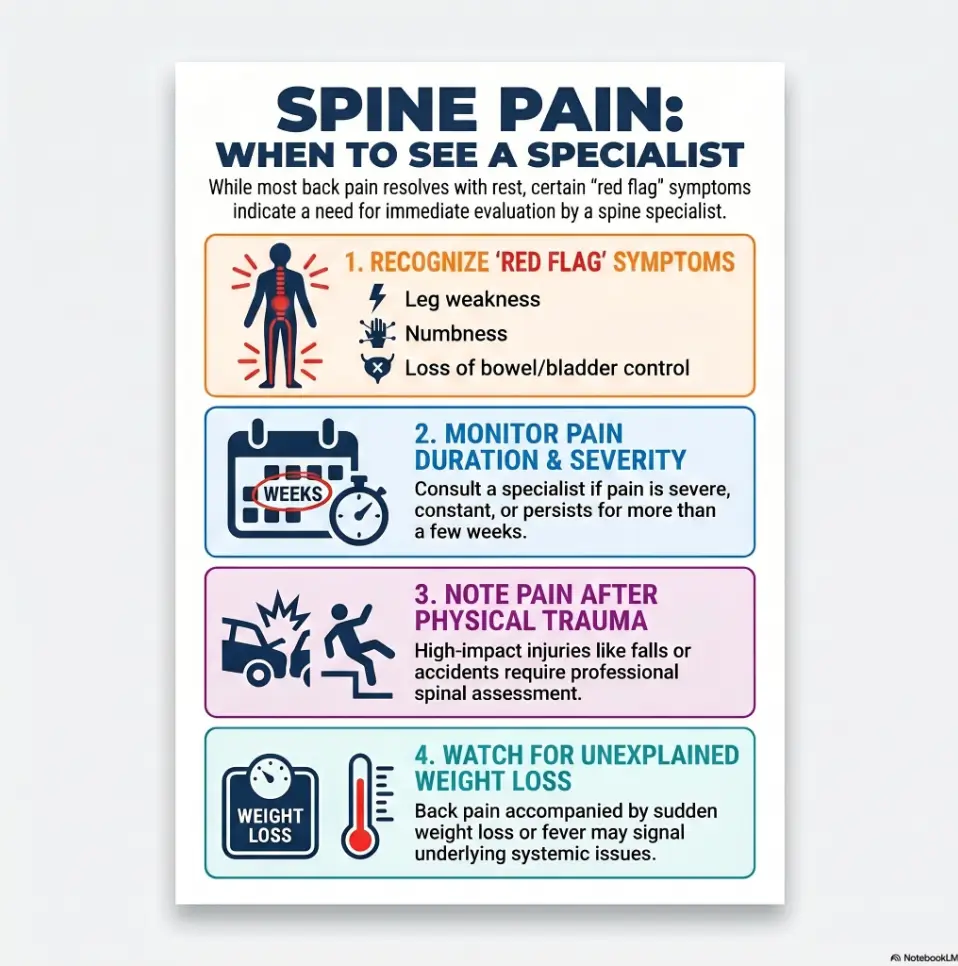
- List safety symptoms first: weakness, bladder or bowel changes, fever, trauma, balance trouble, or unexplained weight loss.
- Bring records: imaging reports, actual image access, medication lists, prior procedures, and treatment notes.
Table of Contents
Safety Disclaimer: When Notes Are Not Enough
This article is general education for appointment preparation. It is not a diagnosis, treatment plan, or personal medical advice. A spine doctor needs your history, physical exam, and sometimes imaging or nerve testing to make a safe plan.
Seek urgent medical care now if back or neck pain comes with new or worsening arm or leg weakness, loss of bladder or bowel control, numbness in the groin or saddle area, fever, unexplained weight loss, major trauma, severe constant night pain, or trouble walking. Mayo Clinic and AAOS both advise prompt evaluation for several of these warning signs, especially trauma, fever, bladder or bowel changes, and weakness.
If you are unsure whether a symptom is urgent, call your clinician’s office, an urgent care center, or emergency services. A checklist is useful. It is not a moat around danger.
- New weakness deserves immediate attention.
- Bladder or bowel changes should not wait for a routine visit.
- Fever, trauma, cancer history, and unexplained weight loss change the risk picture.
Apply in 60 seconds: Write “urgent symptoms” at the top of your page and mark yes or no beside each red flag.
The One-Page Spine Snapshot Your Doctor Actually Needs
A spine visit is part medical interview, part detective story, part speed round. The doctor is trying to understand whether your symptoms sound like muscle strain, joint irritation, disc-related nerve pain, spinal stenosis, cervical radiculopathy, inflammatory pain, post-surgical change, or something more urgent.
Your job is to hand over the first page of the mystery without burying the plot in a haystack of memory lint.
Start with the “where, when, how bad” triangle
Use three plain lines:
- Where: low back, neck, mid-back, right buttock, left calf, both hands, one foot, or another exact area.
- When: date or approximate week symptoms began.
- How bad: best, average, and worst pain from 0 to 10.
“Low-back pain, started three weeks ago after lifting boxes, average 5/10, worst 8/10 after sitting” gives the doctor more to work with than “my back is killing me.” The second phrase is emotionally true. The first is clinically useful.
Separate neck, mid-back, low-back, arm, and leg symptoms
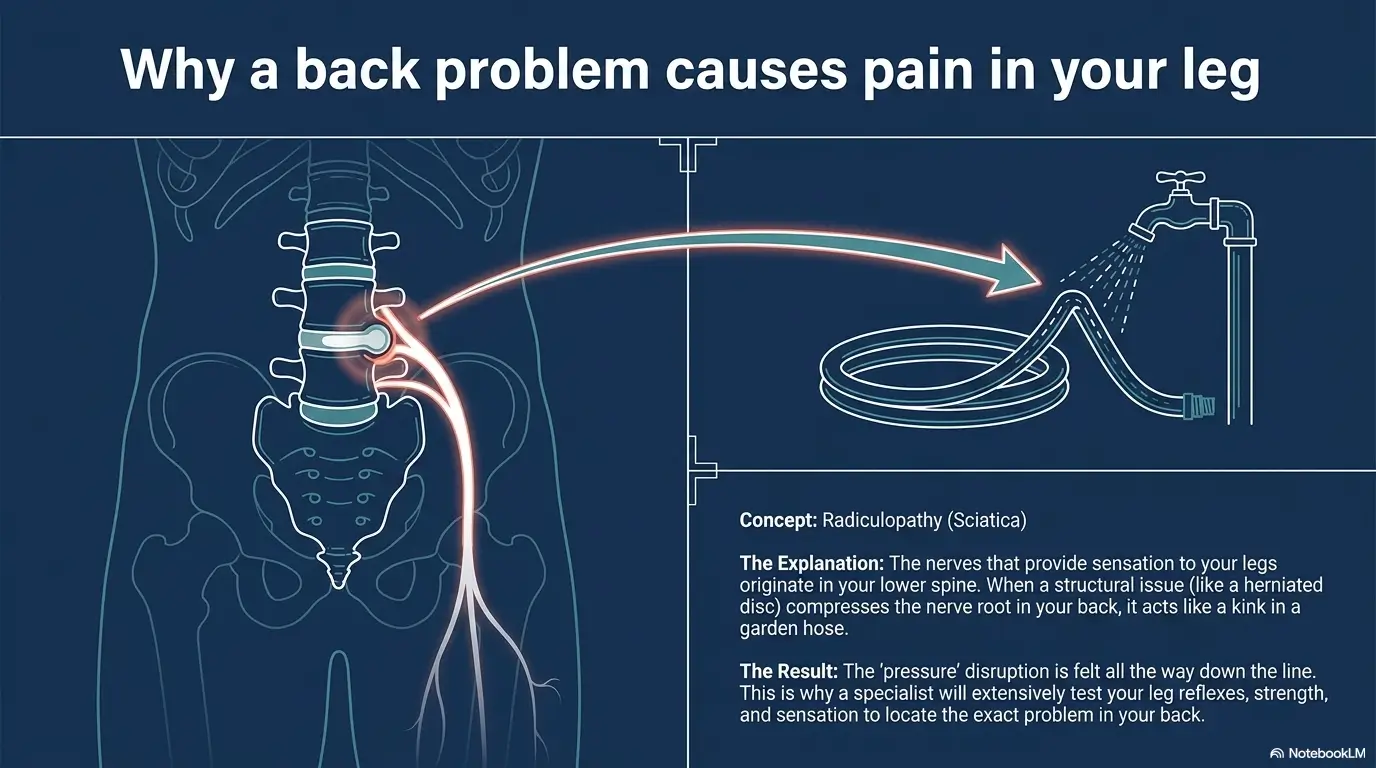
Spine symptoms can overlap in confusing ways. Neck issues may travel into the shoulder, arm, hand, or fingers. Low-back issues may travel into the buttock, thigh, calf, foot, or toes. Hip arthritis can imitate spine pain. Peripheral neuropathy can be mistaken for sciatica. The body does not always label the wires politely.
Give each symptom its own address. If your low back aches but your right foot tingles, write both. If your neck hurts but your hand feels clumsy, write both. If your knee hurts and your leg pain starts in the buttock, that distinction matters.
For a broader approach to symptom preparation, you may also find an orthopedic appointment checklist helpful before the visit.
Write the sentence you want the doctor to understand first
Before your appointment, write one sentence that begins with “The main thing I need help with is…”
Examples:
- “The main thing I need help with is right leg pain that starts after eight minutes of walking.”
- “The main thing I need help with is neck pain with numbness in my thumb and index finger.”
- “The main thing I need help with is figuring out whether my weakness is urgent.”
This sentence is your compass. When the visit begins to roam into insurance forms, old injuries, and the strange chair in the corner, bring it back to that line.
Money Block: One-Page Spine Snapshot Checklist
Use yes/no answers where possible. This keeps the page readable when your appointment brain starts juggling flaming pinecones.
- Pain location written down? Yes / No. Next step: mark the exact body areas.
- Start date or trigger listed? Yes / No. Next step: write the closest date you remember.
- Pain score included? Yes / No. Next step: write best, average, and worst.
- Arm or leg symptoms separated? Yes / No. Next step: give each symptom its own line.
- Top three questions written? Yes / No. Next step: circle the question you must not forget.
Neutral action line: Print it, save it on your phone, or write it by hand, whichever you will actually bring.
Pain Mapping: Don’t Just Say “My Back Hurts”
“Back pain” is a large umbrella. It covers everything from a weekend lifting mistake to nerve compression, arthritis, stenosis, muscle spasm, fracture risk, inflammatory problems, and post-surgical changes. A useful pain map narrows the fog.
Mark the exact pain path
Write whether the pain stays in the spine or travels. Traveling pain can be especially important when it follows a nerve-like path.
Use this format:
- Starts: low back, neck, buttock, shoulder, hip, or another area.
- Travels to: thigh, calf, foot, toes, arm, hand, fingers, or nowhere.
- Side: left, right, both, or changes sides.
- Stops at: knee, ankle, big toe, pinky toe, thumb, ring finger, or another landmark.
If symptoms run down the leg, related guides on L4, L5, and S1 sciatica patterns and hip vs spine pain may help you describe the pattern more clearly without trying to self-diagnose.
Name the pain texture
Doctors often ask whether pain is sharp, dull, burning, electric, aching, cramping, pressure-like, shooting, stabbing, numb, heavy, or pins-and-needles. Those words are not poetry garnish. They can help separate muscle pain from nerve-like symptoms, joint pain, or vascular-style heaviness.
Try this sentence:
“The pain feels like ______, and the numbness feels like ______.”
That simple separation is useful because pain and numbness may not follow the same timeline.
Here’s what no one tells you…
The weird sensation matters. Buzzing, cold water feelings, crawling sensations, foot slapping, toe dragging, or hand clumsiness may feel too odd to mention. Mention them anyway.
One patient may say, “My calf feels tight.” Another may say, “My foot hits the floor louder.” The second detail might point attention toward strength, gait, or nerve function. The doctor still has to examine you, but your note can aim the flashlight.
Neck, mid-back, low back, hip, shoulder, buttock, arm, leg, hand, or foot.
Does it stay put, radiate, shoot, spread, or switch sides?
Burning, electric, aching, numb, heavy, cramping, tingling, or weak.
Walking, sitting, driving, stairs, sleep, work, lifting, or balance.
Timeline and Red Flags: The Details That Change Urgency
The first day matters. So does the day symptoms changed. Spine doctors listen for patterns: sudden onset after trauma, gradual worsening, pain that spreads, symptoms after sitting, symptoms relieved by leaning forward, night pain, fever, and neurologic changes.
Write down the trigger, even if it seems boring
Triggers are often ordinary. Lifting laundry. Driving four hours. Coughing hard. Sleeping on a different mattress. Starting pickleball. Shoveling snow. Sitting through a long flight. Twisting while carrying groceries. The mundane details are sometimes where the plot hides.
Write:
- What you were doing when symptoms started.
- Whether pain began suddenly or gradually.
- Whether you heard or felt a pop.
- Whether symptoms began after a fall, car crash, or sports injury.
If you have already been tracking pain over time, compare your note with a pain timeline before an orthopedic visit so you can bring dates instead of a foggy “sometime last month.”
Track whether symptoms are improving, stuck, or spreading
A stable ache and a spreading nerve symptom tell different stories. Write whether each symptom is improving, unchanged, worsening, or traveling farther.
Examples:
- “Back pain improved from 8/10 to 4/10, but foot numbness is new.”
- “Leg pain used to stop at the knee; now it reaches the outside of the foot.”
- “Neck pain is tolerable, but my grip feels weaker.”
That last sentence should rise to the top of the visit. Weakness is not a decorative detail.
Red flags belong at the top
Write “red flags” on the first page and mark whether you have any of these:
- New or worsening arm or leg weakness.
- Foot drop, hand clumsiness, grip trouble, or leg buckling.
- Loss of bladder or bowel control.
- Numbness in the groin, inner thighs, or saddle area.
- Fever, chills, or recent infection.
- Unexplained weight loss.
- History of cancer.
- Major trauma, fall, or car crash.
- Severe constant night pain.
- Trouble walking or balance changes.
AAOS, Mayo Clinic, and other major medical references consistently treat several of these as reasons to seek prompt medical evaluation, especially weakness, bladder or bowel changes, fever, trauma, and progressive neurologic symptoms.
Show me the nerdy details
Spine clinicians often sort symptoms into mechanical patterns, nerve-related patterns, and systemic warning patterns. Mechanical pain may change with position, load, or movement. Nerve-related symptoms may include radiating pain, numbness, tingling, reflex changes, or weakness. Systemic warning patterns include fever, unexplained weight loss, cancer history, infection risk, major trauma, or bladder and bowel changes. Imaging can be helpful when the history and exam suggest a specific concern, but many low-back pain cases do not need immediate imaging. The National Institute of Neurological Disorders and Stroke notes that imaging tests are not needed in most cases, though they may be ordered to rule out specific causes such as tumors or spinal stenosis.
Function Notes: What Your Spine Pain Is Stealing
Doctors do not only need to know what hurts. They need to know what pain prevents. Function is where symptoms meet real life: stairs, sleep, work, driving, caregiving, walking, sitting, lifting, and getting dressed.
List the activities you can’t do normally
Use concrete limits:
- Walking distance or time before symptoms start.
- Sitting tolerance before pain spreads.
- Standing time before leg heaviness begins.
- Sleep interruption frequency.
- Driving limit before numbness appears.
- Stair difficulty, balance concerns, or leg buckling.
- Lifting limit at home or work.
“I can walk eight minutes before right calf pain starts” is much stronger than “walking is awful.” Both are true. One helps the clinician measure change.
The small losses count
Putting on socks, carrying groceries, turning in bed, stepping into a tub, looking over your shoulder while driving, or standing in line at the pharmacy can be the difference between coping and quietly unraveling.
Those details also help the doctor recommend a plan that fits your life. A treatment plan that ignores your stairs, commute, desk setup, or caregiving duties is a paper umbrella in a thunderstorm.
For a deeper way to measure daily limitations, use a functional pain assessment before your appointment.
Short Story: The Eight-Minute Walk
Marian arrived with a folder thick enough to make the receptionist blink. It had reports, old X-rays, medication bottles photographed from three angles, and three pages of symptoms. But the most useful line was written in blue pen at the top: “I can walk eight minutes before my right leg burns and I have to sit.”
Her doctor asked where the pain traveled, what happened when she leaned on a grocery cart, and whether sitting relieved it. Suddenly the visit had shape. Not because Marian had solved the case, but because she had brought a measurable pattern. Later, when treatment began, that eight-minute limit became a ruler. Ten minutes mattered. Fifteen mattered. A quieter night mattered. The lesson is simple: your pain story does not need to be dramatic. It needs a few honest numbers.
Money Block: Function Scorecard
| Activity | Your number | Why it helps |
|---|---|---|
| Walking | Minutes or blocks | Shows stamina, leg symptoms, and progress. |
| Sitting | Minutes before pain changes | Useful for disc, nerve, work, and driving discussions. |
| Standing | Minutes before symptoms start | Can help explain stenosis-like or posture-related patterns. |
| Sleep | Wake-ups per night | Shows severity and recovery burden. |
Neutral action line: Fill in only the rows that apply, then bring the table or copy the numbers into your note.
Treatment History: Bring the Receipts, Not the Novel
A spine doctor wants to know what you tried, how long you tried it, and what happened. The goal is not to prove you suffered correctly. It is to avoid repeating what failed, refine what partly helped, and spot treatments that were stopped because of side effects or wrong timing.
Write what you tried and what happened
Include:
- Physical therapy or home exercises.
- Chiropractic care, massage, acupuncture, or manual therapy.
- Heat, ice, braces, cushions, TENS units, or activity changes.
- Medications, including over-the-counter pain relievers.
- Injections, prior procedures, or surgery.
- Rest, walking programs, stretching, or strengthening.
Do not write “nothing worked” unless nothing truly changed. Better: “Ice helped for 20 minutes. Ibuprofen helped pain but upset my stomach. PT improved back pain 30%, but leg numbness continued.” That is the breadcrumb trail.
If you are stuck between heat and cold for symptom relief, a heating pad vs ice wrap comparison can help you describe what you tried without overselling either option.
Include dates, dose, duration, and results
Use this simple format:
- Treatment: physical therapy.
- When: March to April.
- How often: twice weekly for six weeks.
- Result: back pain improved, leg symptoms unchanged.
- Side effects: none, or list them clearly.
For medications, write the name, dose, how often you take it, whether it helps, and any side effects. This is especially important for NSAIDs, opioids, muscle relaxers, steroids, sleep aids, nerve pain medications, and blood thinners.
Don’t turn the visit into a courtroom drama
If you have a workplace injury, car crash, disability claim, or workers’ compensation case, facts still matter. Keep the medical note clean: date, mechanism, symptoms, treatment, current limits. Save legal arguments for the right professional.
If documentation is part of your situation, workers’ comp settlement documentation may help you separate appointment facts from claim paperwork.
Medication and Medical History: The Quiet Deal-Breakers
Some details do not sound spine-related until they change the plan. Blood thinners affect procedure decisions. Diabetes can affect steroid discussions. Osteoporosis can change fracture concerns. Cancer history can change the urgency of imaging. Long-term steroid use can change bone risk. Pregnancy changes medication and imaging choices.
Bring a current medication and supplement list
Include prescription medications, over-the-counter drugs, vitamins, herbal supplements, topical creams, patches, and anything you take “only sometimes.” Occasional still counts. The body does not file paperwork only on weekdays.
Write:
- Name of each medication or supplement.
- Dose.
- How often you take it.
- Why you take it.
- Whether it helps or causes side effects.
For NSAID safety questions, especially if you have kidney disease, stomach ulcers, blood pressure issues, blood thinner use, or heart concerns, review your clinician’s guidance. You can also use back pain NSAID safety considerations as a preparation prompt for questions.
Write down allergies and bad reactions
Allergies and adverse reactions are not the same, but both matter. Write rash, hives, breathing trouble, swelling, nausea, dizziness, stomach bleeding, confusion, severe sleepiness, or prior anesthesia problems.
Do not simply write “allergic to pain meds” unless you know the drug name. If you do not know it, write what happened and when. That gives the care team something safer to work with.
Add the conditions that change spine care
List major medical history, especially:
- Cancer history.
- Osteoporosis or fracture history.
- Diabetes.
- Immune suppression.
- Recent infection.
- Pregnancy.
- Prior spine surgery.
- Long-term steroid use.
- Blood thinner use.
- Bring prescription and over-the-counter medication names.
- List supplements because some may affect bleeding or sedation risk.
- Write side effects in plain language.
Apply in 60 seconds: Take a clear phone photo of every medication bottle and supplement label before the visit.
Imaging and Test Records: Don’t Rely on “They Sent It”
Few appointment phrases contain more chaos than “they should have sent it.” Sometimes they did. Sometimes they sent the report but not the images. Sometimes the portal is down. Sometimes the disc is from 2017 and the laptop no longer has a disc drive, because technology enjoys slapstick.
Bring reports and image access when possible
For MRI, CT, X-ray, EMG, nerve conduction study, bone density scan, injection records, and operative reports, write:
- Where the test was done.
- Date of the test.
- Body part tested.
- Whether you have the report.
- Whether the doctor can access the actual images.
A radiology report is useful, but the actual images may matter. Spine specialists often want to see the images themselves, especially when symptoms and the written report do not match neatly.
Pattern interrupt: the report is not the whole movie
The report is a summary. The images are the film. The exam is the live performance. A good spine visit often compares all three.
That matters because imaging findings can appear in people without pain, and pain can be severe even when imaging looks less dramatic than expected. NINDS notes that imaging is not needed in most low-back pain cases, though it can be ordered to rule out specific causes when clinically appropriate.
If your concern is whether MRI findings explain your symptoms, MRI pain mismatch may help you prepare calmer questions. If you are comparing imaging types, sciatica MRI vs X-ray can clarify why one test may answer a different question than another.
Cost and insurance notes belong in the folder too
If you have a high-deductible health plan, prior authorization requirement, out-of-network concern, or imaging denial, write it down. Doctors do not control every insurance decision, but the office may need documentation, exam findings, prior treatment history, or a specific order to support the request.
For cost preparation, review lumbar MRI cost on an HDHP, failed conservative care for MRI approval, and MRI referral for orthopedic pain before assuming the first order is the final answer.
Money Block: Records-to-Bring Decision Card
| Record type | Bring if… | Why it matters |
|---|---|---|
| MRI or CT images | You had spine imaging before. | The specialist may need more than the report summary. |
| X-ray report | You had recent injury, arthritis evaluation, or alignment concerns. | Can reduce duplicate testing and show prior findings. |
| EMG or nerve test | You had numbness, weakness, or nerve symptoms evaluated. | May help compare spine nerve issues with peripheral nerve problems. |
| Operative report | You had prior spine surgery. | Shows what was done, where, and how anatomy may have changed. |
Neutral action line: Call the imaging center before the visit and ask how your doctor can access the actual images.
Work, Lifestyle, and Home Setup: The Context That Explains the Flare
Spine pain lives in your calendar, your chair, your car, your mattress, your stairs, and your job description. A plan that ignores those things may sound polished but fail in the wild.
Describe your work posture and physical demands
Write a few lines about your workday:
- Hours sitting, standing, driving, or lifting.
- Desk setup, laptop use, monitor height, chair support, and keyboard placement.
- Repetitive bending, twisting, carrying, pushing, or pulling.
- Shift length and break schedule.
- Whether symptoms affect job safety.
For office-related spine strain, guides on neck pain from laptop work, keyboard and mouse placement for desk-job sciatica, and lumbar support cushions for driving may help you describe the setting that keeps provoking symptoms.
Note sleep, exercise, stress, and caregiving duties
Doctors do not need your entire biography, but they do need the constraints that shape your care plan. Write whether you sleep poorly, care for someone else, climb stairs at home, drive long distances, live alone, work a physical job, or cannot take sedating medications.
That context matters. A brace, medication, injection, therapy plan, or surgical recovery discussion changes when the patient is a night-shift nurse, warehouse worker, remote worker, caregiver, single parent, or long-distance commuter.
Include legal or workplace context carefully
If the pain began at work or after a crash, write dates and facts plainly:
- Date of injury.
- What happened.
- Symptoms that began immediately.
- Symptoms that appeared later.
- Work restrictions already given.
- Forms or documentation the office needs to know about.
For job accommodations, ADA accommodation letter wording for back pain and doctor note wording for sciatica accommodations can help you prepare questions without turning the medical visit into a paperwork avalanche.
Common Mistakes That Make Spine Visits Less Useful
A good spine appointment does not require perfection. It does reward clarity. These are the common traps that turn a useful visit into a shrug wearing a lab coat.
Mistake 1: bringing pain, but not patterns
Pain matters. Patterns make pain interpretable. Tell the doctor what positions, activities, and times of day change the symptom.
Helpful pattern notes include:
- Pain worse after sitting.
- Leg symptoms worse with walking and better with sitting.
- Neck pain worse after laptop work.
- Symptoms worse in the morning.
- Pain that wakes you at night.
Mistake 2: hiding medication use or side effects
People sometimes underreport pain pills, sleep aids, cannabis use, supplements, or leftover medications because they feel judged. Bring the facts anyway. Safety beats embarrassment every time.
This is especially important with blood thinners, sedating medications, opioids, muscle relaxers, NSAIDs, steroids, and supplements that may affect bleeding or sedation. Your doctor is not there to hand out morality stickers. They need the medication map.
Mistake 3: asking for an MRI before explaining the story
It is natural to want imaging. Pain makes the mind crave proof. But a spine doctor usually needs history and exam first to decide what imaging is appropriate, what body area to image, whether contrast is needed, and whether the results will change treatment.
If imaging has been denied or delayed, the solution may be better documentation of red flags, neurologic findings, failed conservative care, or function limits. It may also be a different first step. That is frustrating, yes. It is also why your one-page note matters.
- Write what makes symptoms better or worse.
- Separate pain, numbness, weakness, and function limits.
- Bring treatment details instead of broad conclusions.
Apply in 60 seconds: Add the phrase “worse with / better with” under each symptom.
Who This Is For, and Who Should Not Wait
This guide is for routine or soon-upcoming visits with a spine specialist, orthopedic spine surgeon, neurosurgeon, physiatrist, pain-management doctor, primary care clinician, or second-opinion provider.
This is for first visits, second opinions, and “I forgot everything in the room” people
It is especially helpful if you have:
- Back or neck pain that has not improved as expected.
- Arm or leg symptoms that may involve nerves.
- Confusing imaging results.
- Prior treatment that partly helped or failed.
- A second opinion scheduled.
- An insurance or referral process that requires documentation.
If your situation involves a second opinion or access issue, what to do after being denied a second opinion for orthopedic pain may help you organize next steps.
This is not for emergencies
Do not use a checklist to delay urgent evaluation. New weakness, bladder or bowel changes, saddle numbness, fever with spine pain, major trauma, or severe progressive neurologic symptoms require prompt medical attention.
If your symptoms feel urgent and you are debating where to go, compare your situation with low back pain emergency warning signs and urgent care vs orthopedic clinic decision points. When in doubt, choose safety.
This is also not a self-diagnosis worksheet
The goal is cleaner communication, not turning yourself into a midnight radiologist with tea and panic. Your note should help the clinician ask better questions, perform a focused exam, and decide the safest next step.
Questions to Ask Before You Leave the Room
The end of a medical visit is a tiny weather system. Papers appear. The door opens. Your carefully planned questions scatter like receipts in wind. Write them before you go in.
Ask what diagnosis is most likely and what else is being ruled out
Try:
- “What diagnosis best fits my symptoms and exam today?”
- “What are you trying to rule out?”
- “What findings would change the plan?”
This helps you understand the reasoning without pretending every spine term is obvious. It also makes the visit feel less like you were handed a mysterious Latin sandwich.
Ask what should improve, by when, and what would change the plan
A useful plan has a clock. Ask:
- “What should improve first?”
- “How long should I try this step before checking back?”
- “What symptoms should make me call sooner?”
- “What would make imaging, injection, surgery referral, or nerve testing more likely?”
If injections are part of the discussion, you may want to review nerve root block vs epidural steroid injection, TFESI vs interlaminar ESI for sciatica, or epidural steroid injection relief timelines so your questions stay precise.
Ask what symptoms should trigger urgent care
Before you leave, ask for two lists:
- Call the office if: symptoms change, side effects appear, pain spreads, or function worsens.
- Go now if: weakness, bladder or bowel changes, saddle numbness, fever, major trauma, or severe neurologic symptoms occur.
Those lists reduce the 2 a.m. ceiling-stare debate. Your future self deserves that mercy.
Money Block: Appointment Question Tier Map
| Tier | Question type | Example |
|---|---|---|
| Tier 1 | Safety | “What symptoms mean I should seek urgent care?” |
| Tier 2 | Diagnosis | “What is most likely causing my symptoms?” |
| Tier 3 | Next step | “What should I try first, and for how long?” |
| Tier 4 | Escalation | “What would make imaging, injection, or surgery referral appropriate?” |
| Tier 5 | Cost and logistics | “Will insurance need prior authorization or treatment documentation?” |
Neutral action line: Choose one question from each tier and put a star beside your top three.
Next Step: Build Your 10-Minute Spine Visit Note
You do not need a binder worthy of a federal archive. You need one calm page. Here is the format.
Use four headings tonight
Write these headings on paper or in your phone:
- Symptoms: where, pain path, sensation, pain score, weakness or numbness.
- Timeline: start date, trigger, improving or worsening, flare patterns.
- What I’ve Tried: treatments, dates, dose, duration, results, side effects.
- Top Questions: diagnosis, safety, next step, timing, cost or insurance concerns.
That is enough to begin. If you add records, medication list, and imaging access, you have a strong appointment packet.
Keep it to one page
A tight note is kinder to everyone’s brain, including yours. If you have a long history, put the summary on page one and attach records behind it. The first page should be readable in under two minutes.
If you are anxious about forgetting the right words, how to describe pain to a doctor can help you turn sensations into plain, useful language.
Bring one honest goal
Your goal can be practical:
- “I want to sleep through the night.”
- “I want to walk 20 minutes without leg pain.”
- “I need to know whether this weakness is dangerous.”
- “I need a plan that works with my job.”
- “I need to understand when imaging makes sense.”
That goal helps the doctor shape a plan around your life, not a generic spine diagram.
FAQ
What should I bring to a spine doctor appointment?
Bring a one-page symptom note, current medication and supplement list, allergy list, prior imaging reports, access to actual MRI or CT images when available, surgery history, injection records, physical therapy notes, insurance information, and your top three questions.
Should I write down my pain level before seeing a spine specialist?
Yes. Write your best, average, and worst pain scores from 0 to 10. Also write what changes the pain, such as sitting, standing, walking, bending, coughing, sleeping, driving, stairs, or lifting. Pain numbers are more useful when paired with patterns.
Do I need an MRI before seeing a spine doctor?
Not always. Many spine visits begin with history and a physical exam. Imaging may be ordered if symptoms, red flags, neurologic findings, prior treatment history, or surgical planning make it appropriate. NINDS notes that imaging tests are not needed in most low-back pain cases.
What symptoms should I tell a spine doctor first?
Tell the doctor first about new or worsening weakness, numbness, tingling, pain spreading into arms or legs, balance problems, trouble walking, bladder or bowel changes, saddle numbness, fever, major trauma, unexplained weight loss, cancer history, or severe night pain.
How do I describe nerve pain to a doctor?
Use concrete words such as burning, electric, shooting, tingling, numb, weak, heavy, cold, buzzing, or pins-and-needles. Describe where it starts, where it travels, which side it affects, and whether it reaches the hand, fingers, foot, or toes.
Should I bring old X-rays or MRI reports?
Yes. Bring both reports and access to the actual images when possible. A spine specialist may want to compare your symptoms, exam, and images rather than relying only on the written radiology summary.
What questions should I ask a spine doctor?
Ask what diagnosis is most likely, what else is being ruled out, what symptoms require urgent care, what treatment options fit your case, what should improve first, how long to try the plan, and what would change the next step.
Can a spine doctor help if my pain comes and goes?
Yes. Intermittent pain can still show useful patterns. Write what triggers the pain, how long flares last, what relieves them, whether symptoms travel, and whether numbness, weakness, or function limits appear during flares.
Should I mention anxiety about my spine symptoms?
Yes. Anxiety, poor sleep, and fear of movement can affect pain, recovery, and decision-making. Mentioning them does not make the pain “all in your head.” It helps the clinician understand the full burden and choose a plan you can follow.
Conclusion: Walk In With a Map, Not a Fog Machine
The appointment-room blank is real. Pain, worry, paperwork, and medical language can turn even a prepared person into a blinking cursor. That is why the one-page spine note works. It gives your visit a map: symptoms, timeline, red flags, function, treatments, records, medications, and questions.
You do not need to solve your spine problem before seeing the doctor. You need to bring the right clues in the right order. Put urgent symptoms first. Use numbers where you can. Bring imaging access, not just hope. Ask what should improve, by when, and what should make you call sooner.
Your next 15-minute step: open a note on your phone and create four headings: “Symptoms,” “Timeline,” “What I’ve Tried,” and “Top Questions.” Add three honest lines under each. That small page may make the visit calmer, safer, and far more useful.
Last reviewed: 2026-05.