
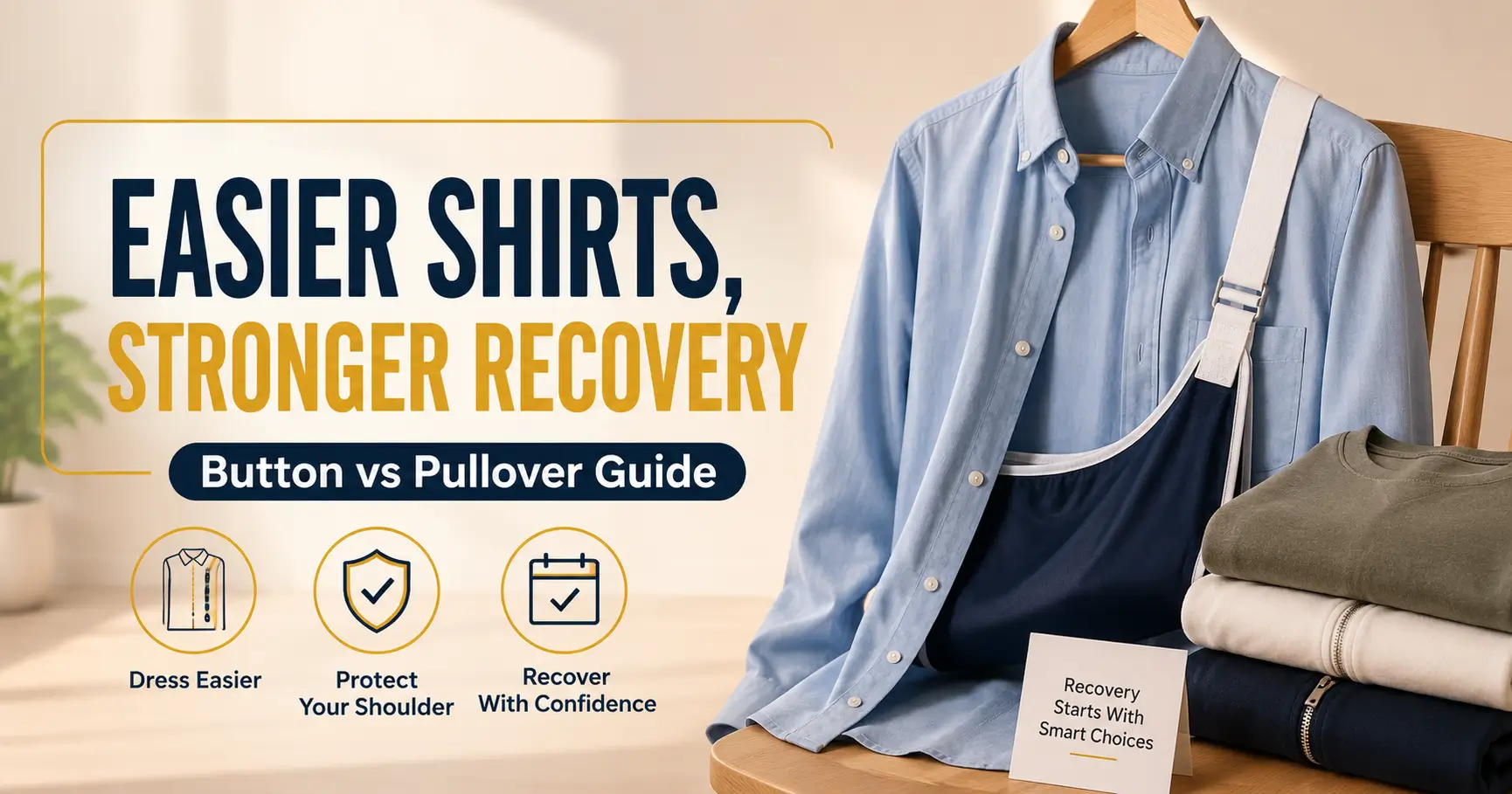
Shoulder surgery recovery clothing guide
Getting Dressed After Shoulder Surgery:
Button Shirts vs Pullover Shirts
After shoulder surgery, getting dressed can feel oddly high-stakes. A shirt that seemed harmless yesterday can become a fabric maze today, especially when your arm is in a sling, your incision feels tender, and every small tug sends a little weather report through your shoulder.
For most people recovering from rotator cuff repair, shoulder replacement, labrum repair, or similar procedures, button-front shirts usually beat pullover shirts in the early days. Not because buttons are glamorous, frankly they are tiny little bureaucrats, but because front-opening clothing helps you avoid overhead motion before your shoulder is ready.
This guide walks you through what to wear home, how to put on a shirt with one arm in a sling, when pullovers may be realistic again, what caregivers should know, and which clothing upgrades are worth considering before spending money.
Choose smarter
Compare button shirts, zip-ups, snaps, pullovers, and adaptive clothing without guessing.
Move less
Learn a safer dressing order that reduces lifting, twisting, and fabric wrestling.
Prep calmly
Build a three-shirt recovery kit before surgery day turns your closet into a riddle.
The goal is simple: protect the shoulder, preserve dignity, and make the morning feel less like an escape room. 🧥
Snapshot
This article is for post-op shoulder patients, caregivers, and family members preparing for the first days after surgery. You will learn why front-opening shirts usually work best early on, how to dress around a sling, what to avoid with pullovers, and how to build a simple recovery clothing setup without wasting money.
Table of Contents
Before You Act: What This Clothing Guide Can and Cannot Do
Clothing after shoulder surgery is practical, but it is still connected to medical recovery. Your surgeon, nurse, or physical therapist may give specific instructions about sling use, incision care, showering, dressing changes, and shoulder movement. Those instructions come first.
This article can help you choose easier shirts, plan a safer dressing routine, avoid common clothing mistakes, and prepare your home closet before surgery. It cannot tell you when your repaired tendon, replaced joint, labrum, incision, or shoulder capsule is ready for a specific motion.
Before you switch from button shirts to pullover shirts, confirm your allowed shoulder movements. Ask what you may do actively, what must be assisted, and what should be avoided until a later recovery phase.
Key takeaway
A shirt is not just a shirt after shoulder surgery. It can either protect your movement limits or quietly tempt you into lifting, twisting, reaching, and tugging before your shoulder is ready.
For general patient education, official orthopedic and medical resources can help you understand recovery basics. Use them as background reading, not as a replacement for your own care team’s plan.
Why Your Shirt Choice Matters More Than You Think
Dressing is not “just getting dressed” after shoulder surgery
Before surgery, getting dressed is automatic. Arm in, arm out, shirt over head, done. After shoulder surgery, the same routine can become a choreography problem with pain, swelling, sling straps, and movement restrictions all auditioning for lead role.
The tricky part is that dressing asks your shoulder to do several things at once. You may reach behind you, rotate your arm, raise the elbow, shrug, lean, or pull fabric across your back. Even when the motion seems small, the shoulder may disagree with great dramatic timing.
This is why front-opening shirts are so useful early on. They let the shirt come to you instead of forcing your shoulder to chase the shirt.
The hidden problem: overhead motion before your shoulder is ready
Many pullover shirts require overhead movement. Even loose T-shirts can ask you to raise your arm, thread your elbow through a sleeve, tilt your head, and pull fabric down behind your back. That sequence may be too much in the first days or weeks after surgery.
Overhead dressing is especially awkward when your operated arm is in a sling or immobilizer. You may accidentally use the surgical shoulder to help, even when you meant to keep it relaxed. The body is sneaky that way. It recruits help from wherever it can find it.
A button-front or snap-front shirt changes the task. You can place the shirt around the operated arm first, then use your non-surgical arm to bring the rest of the shirt around your body.
Why pain, swelling, and sling use change the clothing equation
Post-op shoulders often come with swelling, dressings, bandages, bulky sling straps, and tender skin near the neck or underarm. A shirt that technically fits may still feel wrong because it rubs, bunches, or catches around the incision area.
Think less “Can I get this on?” and more “Can I get this on without negotiating with pain for twenty minutes?” That second question is the one your future self will thank you for asking.
Quick self-check
- Can you put the shirt on without raising the operated arm?
- Can you remove it without pulling fabric behind your back?
- Can it fit over bandages and under or around sling straps?
- Can a caregiver help without lifting your surgical arm?
Button Shirts Win the First Week for One Quiet Reason
Front openings reduce shoulder lifting
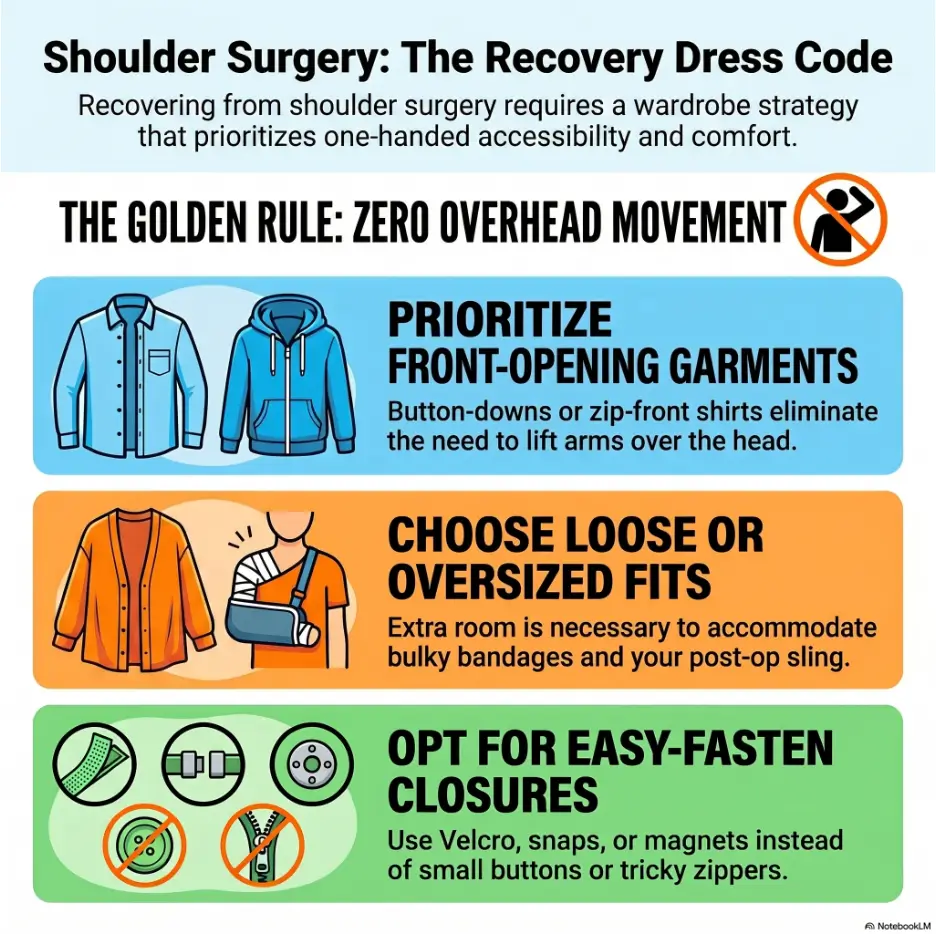
The best early recovery clothing usually opens in the front. Button-down shirts, snap-front shirts, soft zip-front tops, pajama shirts, and loose flannels all give you access without asking your shoulder to climb overhead.
That matters most during the first week, when pain medication timing, sleep disruption, swelling, and sling adjustment can make even simple tasks feel foggy. The less problem-solving your shirt requires, the better.
A front-opening shirt also lets you dress without fully removing support for long. You can loosen or adjust the sling, put the shirt on carefully, then secure the sling again according to your care team’s instructions.
Loose sleeves make the operated arm easier to guide
Loose sleeves are not a fashion compromise. They are recovery engineering with fabric. A wide sleeve lets the operated arm slide in with less elbow wrestling and less fabric drag.
Look for armholes that feel generous, seams that are soft, and fabric that does not cling. Cotton blends, soft jersey, broken-in flannel, and pajama-style tops often work well. Stiff dress shirts can work too, but only if they are roomy enough and not scratchy around the collar or incision area.
One useful test before surgery: put the shirt on using only your non-dominant hand for most of the work. If you get annoyed in thirty seconds while healthy, your post-op self may write a strongly worded letter to your closet.
Buttons, snaps, and zippers: which closure is easiest?
Buttons are common and easy to find, but tiny buttons can be irritating if your hand is weak, swollen, numb, or less coordinated after surgery. Snaps can be easier because they require less finger precision. Zippers can be excellent if the zipper pull is large and the garment is not tight.
For the first week, closures matter less than access. A shirt that hangs open comfortably while you guide the operated arm into the sleeve is usually more useful than a perfect-looking shirt with fussy buttons.
| Closure type | Best for | Possible drawback | Recovery-friendly tip |
|---|---|---|---|
| Buttons | Easy, common, affordable shirts | Tiny buttons can be hard one-handed | Choose larger buttons and soft fabric |
| Snaps | Limited hand strength or caregiver help | Some snaps pull open too easily | Test snaps before surgery day |
| Zippers | Layering and appointment days | Zipper can catch or feel stiff | Choose a large pull and relaxed fit |
| Magnets | Adaptive clothing and easier closure | Not always appropriate for every medical situation | Ask your care team if you have implanted devices or concerns |
For related planning around sling comfort, you may also find this guide useful: shoulder immobilizer vs sling.
Pullover Shirts Are Not Evil, But Timing Matters
When pullovers may be too much too soon
Pullover shirts are not forbidden forever. They are simply often a poor first-week choice after shoulder surgery. The problem is timing, not morality. Your favorite hoodie has not betrayed you. It is just waiting for its cue.
Early after surgery, a pullover may require the exact movements you were told to avoid: lifting the arm, reaching backward, twisting the shoulder, or pulling fabric down with force. If your movement restrictions are strict, a pullover can turn a normal morning into an accidental range-of-motion experiment.
Some people can return to loose pullovers earlier than others, especially if their surgery was less restrictive. Others need to wait longer. The safest answer is not a calendar date. It is permission based on your procedure and recovery plan.
Why stretchy fabric can still betray you
Stretchy fabric sounds forgiving, but it can create a trap. A tight athletic top may stretch enough to go on, yet still cling to your shoulder, underarm, or bandage. Taking it off can be worse than putting it on.
The hardest part of a pullover is often removal. Pulling fabric up your back and over your head may require more shoulder motion than expected. If you feel stuck, stop. Ask for help rather than forcing the shirt off in a panic spiral of cotton and regret.
Here’s what no one tells you: the neckline matters
A wide neckline can make a pullover easier because it reduces how much you need to lift or twist. A narrow crew neck can be harder because it may catch around your head, collar, or sling strap.
When your care team says pullovers are reasonable again, start with something oversized, soft, and wide-necked. Avoid tight compression tops, slim hoodies, fitted sweaters, and anything with a stiff collar until dressing feels predictable.
Key takeaway
A pullover is usually a later-stage convenience, not a first-week test of courage. Your shoulder does not give bonus points for fabric bravery.
The Safest Dressing Order: Operated Arm First, Good Arm Last
Start with the surgical side while the shirt is open
For front-opening shirts, the common recovery-friendly sequence is simple: put the operated arm in first, then the non-surgical arm. This reduces the need to pull the surgical arm backward or across the body.
Lay the open shirt across your lap or a bed. Guide the sleeve toward the operated arm rather than moving the arm toward the sleeve. Your non-surgical hand does most of the work. The surgical arm stays relaxed, supported, and as still as your instructions require.
If you have a caregiver, they should move the fabric, not your shoulder. This distinction is small but important.
Use your non-surgical arm to guide fabric, not force movement
Your non-surgical arm becomes the stage manager. It gathers fabric, pulls the shirt around your back, fastens closures, and checks sling straps. The operated arm is not the star performer yet. It is more like a valuable violin resting in its case.
Move slowly enough to notice resistance. Resistance may feel like pulling, pinching, tightness, or a sudden urge to hold your breath. Those are signs to pause and reposition.
Undressing reverses the order: good arm first, surgical arm last
When taking the shirt off, reverse the order. Remove the non-surgical arm first. Then slide the shirt gently off the operated side while keeping the surgical arm supported and calm.
This matters because undressing is when people get impatient. The day is over, pain may be higher, and the shirt suddenly feels like it has formed an alliance with the sling. Slow wins.
- Putting on: surgical arm first, non-surgical arm last.
- Taking off: non-surgical arm first, surgical arm last.
- Caregiver rule: guide fabric, not the operated shoulder.
- Pain rule: stop before you need to grit your teeth.
The shoulder-safe dressing flow
1. Confirm
Know your movement limits and sling rules.
2. Open
Choose a front-opening shirt when possible.
3. Sleeve
Guide fabric onto the operated arm first.
4. Secure
Settle the shirt, then adjust the sling.
5. Recheck
Look for rubbing, pulling, swelling, or numbness.
Best Shirt Features After Shoulder Surgery
Oversized but not sloppy: the sweet spot
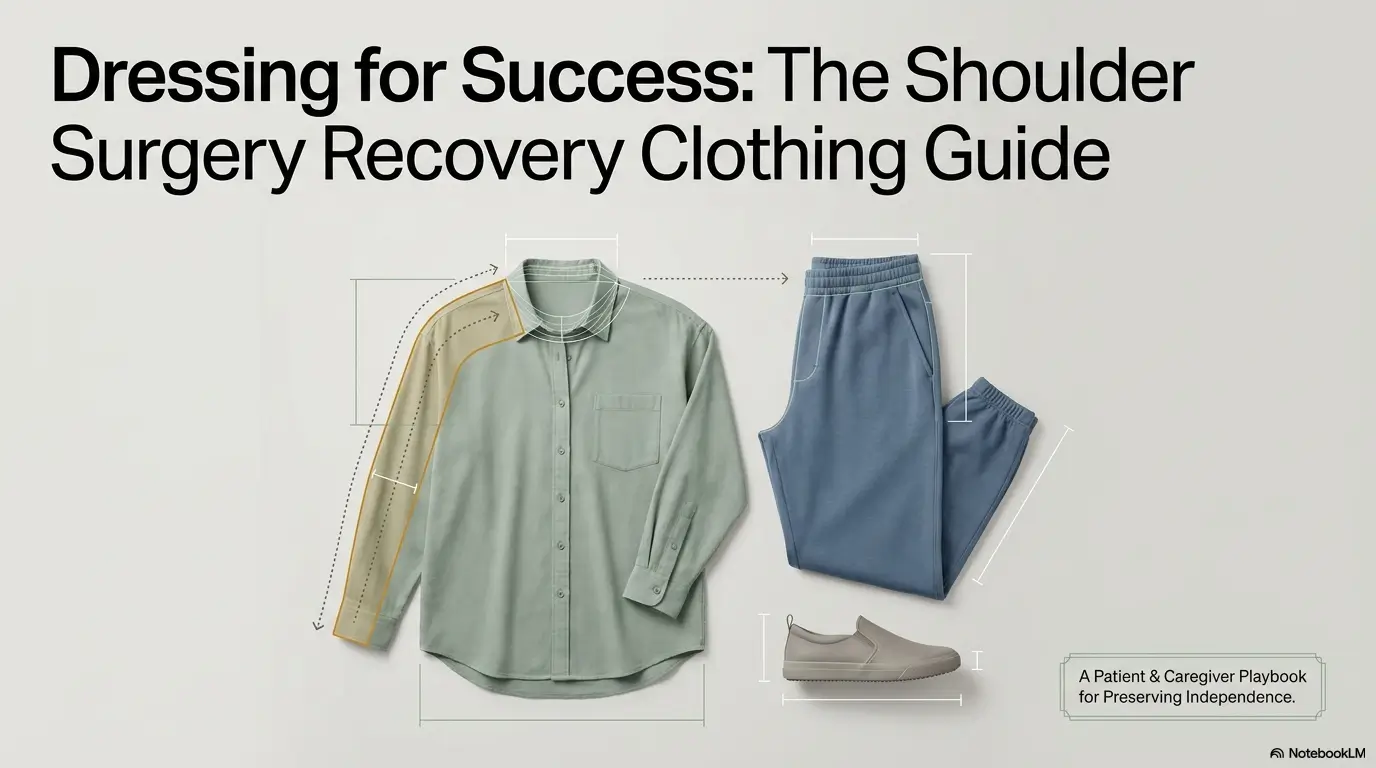
The best shirt after shoulder surgery is usually one or two sizes looser than your usual fitted top, but not so enormous that it bunches under the sling or catches on furniture.
You want room for bandages, swelling, sling straps, and limited motion. You do not want a fabric tent that twists around your torso and makes the sling sit unevenly.
Budget-conscious readers can often use what they already own: an old button-down, pajama top, soft flannel, or loose zip-front sweatshirt. There is no need to buy a recovery wardrobe fit for a luxury spa unless that genuinely makes your life easier.
Wide armholes and soft seams reduce tugging
Wide armholes help the sleeve slide over the operated arm without dragging. Soft seams matter because sling straps and swelling can make the skin more sensitive than usual.
Run your hand inside the sleeve before surgery. If the seam feels rough now, it may feel louder after surgery. Recovery turns small annoyances into percussion instruments.
Short sleeves vs long sleeves: which is easier?
Short sleeves are often easier because there is less fabric to guide over the arm. They also make it easier to check swelling, adjust the sling, and avoid sleeve bunching.
Long sleeves can still work, especially in cold weather, but choose loose cuffs. Tight cuffs can make dressing harder and may be annoying if your hand or wrist is puffy. If warmth is the goal, a soft front-opening layer over a short-sleeve shirt may be easier than one thick long-sleeve pullover.
Adaptive shirts: useful upgrade or overkill?
Adaptive shirts are designed for easier dressing. Many use snaps, magnets, side openings, shoulder openings, or Velcro-style closures. They can be helpful if you live alone, have limited hand strength, have a caregiver helping daily, or expect a longer sling period.
For a short recovery window, adaptive clothing may be unnecessary if you already have loose front-opening shirts. For shoulder replacement recovery, complex repairs, older adults, or anyone with arthritis in the hands, adaptive tops can be worth comparing.
Key takeaway
The best post-op shirt is not the fanciest one. It is the one you can put on slowly, remove safely, fit around the sling, and tolerate for several hours.
Dressing With a Sling Without Turning the Morning Into a Puzzle Box
Put the shirt on before fully securing the sling
Many people find it easier to put the shirt on while the sling is loosened or temporarily managed according to their post-op instructions. Then the sling can be secured after the shirt is settled.
Do not improvise if your care team told you to keep the sling on continuously or avoid certain positions. Ask before surgery how to dress with the sling, especially for the first 48 hours. That one question can save a morning of hallway opera.
For more setup help, this related guide on bathroom setup after shoulder surgery can pair well with your clothing plan.
Keep sling straps flat and reachable
Sling straps can twist, rub the neck, or hide under clothing. After dressing, check that straps are flat and that the hand, wrist, and elbow feel supported. Your sling should not feel like a medieval necklace.
If a strap rubs, ask your care team whether padding is appropriate. Do not change the sling’s support position without guidance, especially if you were fitted with an immobilizer or abduction pillow.
Avoid thick layers under sling straps
Thick sweaters, bulky hoodies, and heavy jackets can interfere with sling fit. If you need warmth, consider thin layers, a front-opening cardigan, a wrap, or a coat draped carefully over the shoulders without forcing the operated arm into a sleeve.
Appointment days deserve special planning. Choose a shirt that allows access to the incision or shoulder area if your clinician needs to examine it. A loose button shirt is usually friendlier than a tight pullover in a chilly waiting room.
Caregiver Tips: Help Without Pulling the Shoulder
Support the fabric, not the arm
Caregivers often want to be helpful, which is lovely. The danger is helping too directly. Pulling the arm, lifting the elbow, or tugging the sleeve can cause pain or move the shoulder in a way the patient was told to avoid.
The safer approach is to handle the shirt, not the shoulder. Hold the sleeve open. Gather fabric. Bring the garment around the patient’s back. Let the patient guide the pace and stop when something feels wrong.
Ask before adjusting sleeves, straps, or collars
After surgery, people can feel vulnerable while dressing. A simple “Do you want help with the sleeve or the collar?” preserves dignity and prevents surprise movement.
This matters for spouses, adult children, friends, and paid caregivers. Efficient help is not always gentle help. Gentle help is the better currency here.
Watch for pain signals that sound like “I’m fine”
Some patients do not want to admit dressing hurts. They may say “I’m fine” while holding their breath, gripping the chair, or freezing mid-motion. Watch the body language.
If pain spikes, pause. Reposition the shirt. Ask whether they want a break. Dressing is not a race, and nobody wins a trophy for getting a sleeve on during a grimace.
Caregiver mini-script
“I’m going to hold the sleeve open. You tell me when to stop. I’ll move the fabric, not your shoulder.”
That sentence sounds simple. In the first week after surgery, it can feel like a small bowl of soup placed carefully into someone’s hands.
Short Story: The shirt that was almost fine
Mark laid out his favorite gray T-shirt the night before surgery. It was soft, familiar, and technically loose. He thought, “This will be fine.”
The next afternoon, standing beside the bed with his arm in a sling, “fine” became a wrestling match. The sleeve caught. The neckline twisted. His wife froze because she did not want to hurt him, and he tried to laugh because asking for help felt stranger than the pain.
They stopped, breathed, and switched to an old snap-front pajama shirt. The room changed. No heroics. No tugging. Just fabric opening where it needed to open.
The lesson was not that T-shirts are bad. It was that the first few days after shoulder surgery reward boring preparation. The right shirt does not make recovery glamorous. It simply removes one unnecessary battle.
Button Shirts vs Pullovers vs Adaptive Tops: Which Is Worth It?
Most patients do not need a huge clothing budget for shoulder surgery recovery. A small, practical setup usually works better than buying too many specialty items. The right choice depends on your surgery type, sling duration, hand strength, caregiver support, climate, and comfort preferences.
Use this comparison as a decision tool, not a shopping commandment carved into stone.
| Option | Best use | Budget level | Pros | Watch out for |
|---|---|---|---|---|
| Loose button-front shirt | First week, home recovery, appointments | Low to moderate | Easy access, common, works with sling | Tiny buttons and stiff collars can annoy |
| Snap-front pajama top | Early recovery, sleepwear, limited hand strength | Low to moderate | Fast closure, soft, relaxed fit | Some snaps gap or pop open |
| Zip-front hoodie or jacket | Cool weather and clinic visits | Low to moderate | Easy layering, front access | Bulky fabric may interfere with sling |
| Oversized pullover | Later recovery after movement is cleared | Low | Comfortable once safe, familiar | May require overhead motion and twisting |
| Adaptive shoulder-opening shirt | Longer recovery, older adults, caregiver dressing | Moderate to higher | Designed for limited mobility | May be unnecessary for short-term use |
Good, Better, Best recovery clothing setup
Here is a practical way to think about cost. Start with the least expensive option that meets your movement restrictions and comfort needs. Upgrade only when the simpler setup creates daily friction.
| Setup | What to include | Who it suits | Why it works |
|---|---|---|---|
| Good | Two loose button shirts you already own | Budget-conscious patients with help nearby | Low cost, simple, enough for many first-week needs |
| Better | Two button shirts plus one soft zip-front layer | Most post-op patients attending follow-ups | Adds warmth and clinic-day flexibility |
| Best | Front-opening shirts plus one adaptive top | Longer sling use, limited hand strength, living alone | Reduces caregiver strain and daily dressing frustration |
Free vs paid options: when buying more helps
A free option is enough when you already own loose, soft, front-opening shirts and have someone who can help during the first few days. Borrowing a roomy flannel from a family member may be more useful than buying a specialty garment you will wear twice.
Paid options may be worth considering if you live alone, have both shoulder and hand problems, dislike asking for dressing help, or need to look reasonably polished for appointments or video calls. Adaptive clothing can also help caregivers who are nervous about moving the surgical arm.
Before buying, check return policies, fabric softness, closure type, sleeve width, and whether the garment can go in the washer and dryer. Recovery clothing should not demand delicate handwashing. It should have the emotional range of a good towel: useful, washable, and quietly loyal.
Show me the nerdy details
Why front-opening shirts usually win biomechanically
A pullover can require shoulder flexion, abduction, internal or external rotation, and trunk twisting, depending on how the person puts it on. After surgery, those motions may be restricted, painful, or not yet safe without guidance.
A front-opening shirt lets the operated arm stay closer to the body while the non-surgical hand manages the fabric. This can reduce accidental active movement of the surgical shoulder.
The practical win is not perfection. It is fewer surprise motions. Fewer surprises usually means less pain, less anxiety, and fewer moments where the patient accidentally tests a repair while half-dressed.
Common Mistakes That Make Dressing Hurt More
Mistake 1: choosing a shirt that “almost” fits
The phrase “almost fits” is dangerous after shoulder surgery. Almost fits means the sleeve may catch. Almost fits means the collar may rub. Almost fits means you may compensate with a movement your shoulder does not appreciate.
Choose clothing that works on your worst morning, not your most optimistic one. Pain, poor sleep, and swelling can make your range of easy motion smaller than expected.
Mistake 2: pulling fabric behind your back
Pulling fabric behind your back can create shoulder extension and rotation. That may be restricted after some procedures. Even if it is allowed later, it can be uncomfortable early.
Instead, bring the shirt around your body with the non-surgical hand or ask a caregiver to guide the fabric. Keep the operated arm relaxed and close to the body unless instructed otherwise.
Mistake 3: rushing because it feels embarrassing to need help
Needing help with a shirt can feel oddly personal. It is one of those small post-op moments that can bruise pride more than expected. But rushing because you feel embarrassed is a poor trade.
Let dressing take longer. Sit down. Breathe. Use the chair, bed, or caregiver support. Pride is a terrible dressing assistant and tends to quit right when the sleeve gets stuck.
Don’t test your range of motion in the mirror
There is a temptation to check progress while dressing. You raise the elbow a little. You rotate a little. You wonder if you can do more than yesterday. Please do not turn your closet into a physical therapy exam room.
Do the exercises your care team prescribed, at the pace they gave you. Dressing should be a daily task, not a secret workout.
Mistake checklist
- Avoid tight pullovers in the first days unless your care team says they are safe.
- Avoid fitted sleeves, narrow cuffs, stiff collars, and scratchy seams.
- Avoid tugging the operated arm through fabric.
- Avoid thick layers that change sling fit.
- Avoid rushing because you feel awkward asking for help.
If dressing suddenly becomes much more painful, or if swelling, numbness, drainage, warmth, fever, or sling fit changes concern you, contact your surgical team. It is better to ask a slightly boring question early than to ignore a useful warning sign.
FAQ
Is a button shirt better after shoulder surgery?
Usually, yes, especially in the first week. A loose button-front shirt reduces the need to lift the operated arm overhead or pull fabric behind your back. Snap-front and zip-front tops can work just as well if they are soft and roomy.
What kind of shirt should I wear home from shoulder surgery?
Wear a loose front-opening shirt, such as a button-down, snap-front pajama top, or zip-front layer. Choose something soft with wide sleeves that can fit around bandages and sling straps. Avoid tight pullovers for the ride home unless your surgical team specifically says they are fine.
Can I wear a pullover hoodie after shoulder surgery?
A pullover hoodie is often difficult too early because it may require overhead movement, twisting, and pulling. A zip-front hoodie is usually easier. Ask your surgeon or physical therapist when pullovers are safe for your specific surgery.
How do I put on a shirt with one arm in a sling?
For a front-opening shirt, guide the operated arm into its sleeve first while keeping the shoulder supported. Then use your non-surgical arm to bring the shirt around your back and put the good arm through. When undressing, remove the good arm first and the operated arm last.
Should I buy adaptive clothing for shoulder surgery recovery?
Adaptive clothing can help if you expect a longer sling period, live alone, have limited hand strength, or want easier caregiver-assisted dressing. Many people can manage with loose button shirts, snap-front tops, and zip-front layers they already own.
Are zip-up shirts easier than button-down shirts after surgery?
Zip-up tops can be easier if the zipper is smooth and the garment is loose. Buttons may be harder if they are small or if your hand is swollen or weak. Snaps are often a good middle ground.
When can I start wearing regular shirts again?
Timing depends on your procedure, surgeon’s protocol, pain level, healing, and physical therapy progress. Ask when overhead dressing, reaching behind your back, and pullover shirts are allowed. Start with loose, wide-neck pullovers before returning to fitted shirts.
What should I avoid wearing after rotator cuff surgery?
Avoid tight pullovers, narrow sleeves, stiff collars, compression tops, bulky layers under sling straps, and clothing that requires pulling the operated arm behind your body. Follow your surgeon’s instructions for sling use and shoulder motion.
Build a Three-Shirt Recovery Kit in 15 Minutes
The easiest next step is not buying everything. It is editing your closet before surgery. Set aside three recovery-friendly shirts now so you are not making clothing decisions while groggy, sore, and negotiating with a sling strap that has developed a personality.
Choose two loose front-opening shirts for daytime. Add one soft zip-front or snap-front layer for appointments, cooler rooms, or the ride home. Try each one on before surgery using limited arm movement, then place them somewhere easy to reach.
15-minute recovery kit checklist
- Pick two loose button-front or snap-front shirts.
- Pick one soft zip-front layer for warmth or appointments.
- Check that sleeves are wide and seams are soft.
- Practice the dressing order: surgical arm first, good arm last.
- Place the shirts at waist height so you do not need to reach overhead.
- Ask your care team when pullovers are safe again.
That small kit gives you a calmer first week. It also gives caregivers a plan, reduces unnecessary shoulder motion, and turns one daily problem into something almost ordinary. After surgery, ordinary is not boring. Ordinary is a gift with buttons.
For a broader home recovery setup, you may also want to read shoulder surgery recliner vs bed and caregiver notes for orthopedic appointments.
Last reviewed: 2026-07