
Diabetic Neuropathy vs Sciatica: 7 Clues Your Burning Feet Aren’t From Your Back
Diabetic Neuropathy vs. Sciatica:
Stop Guessing, Start Healing.
The night my feet started burning, I did what most of us do under pressure: I blamed my back and started stretching like it was a second job. The problem was the pattern didn’t behave like a back problem at all—and that one wrong assumption can cost weeks of pain, extra visits, and the wrong tests.
“If you’re stuck in the Diabetic Neuropathy vs Sciatica fog, you’re probably juggling two fears at once: ‘Is this my blood sugar damaging nerves?’ and ‘Do I need an MRI yesterday?'”
Meanwhile, the burning, numbness, or tingling keeps stealing sleep and momentum. Keep guessing, and you risk missing the simplest, cheapest next step—or delaying the one you actually need.
This post helps you separate a foot-first peripheral neuropathy pattern from a back-first lumbar radiculopathy pattern using seven practical clues. You’ll know when A1C context matters, when EMG makes sense, and when a short mechanical trial beats panic imaging. I’m not here to label you fast. I’m here to help you read your body’s map.

Table of Contents
The 7 clues: a fast map for burning feet
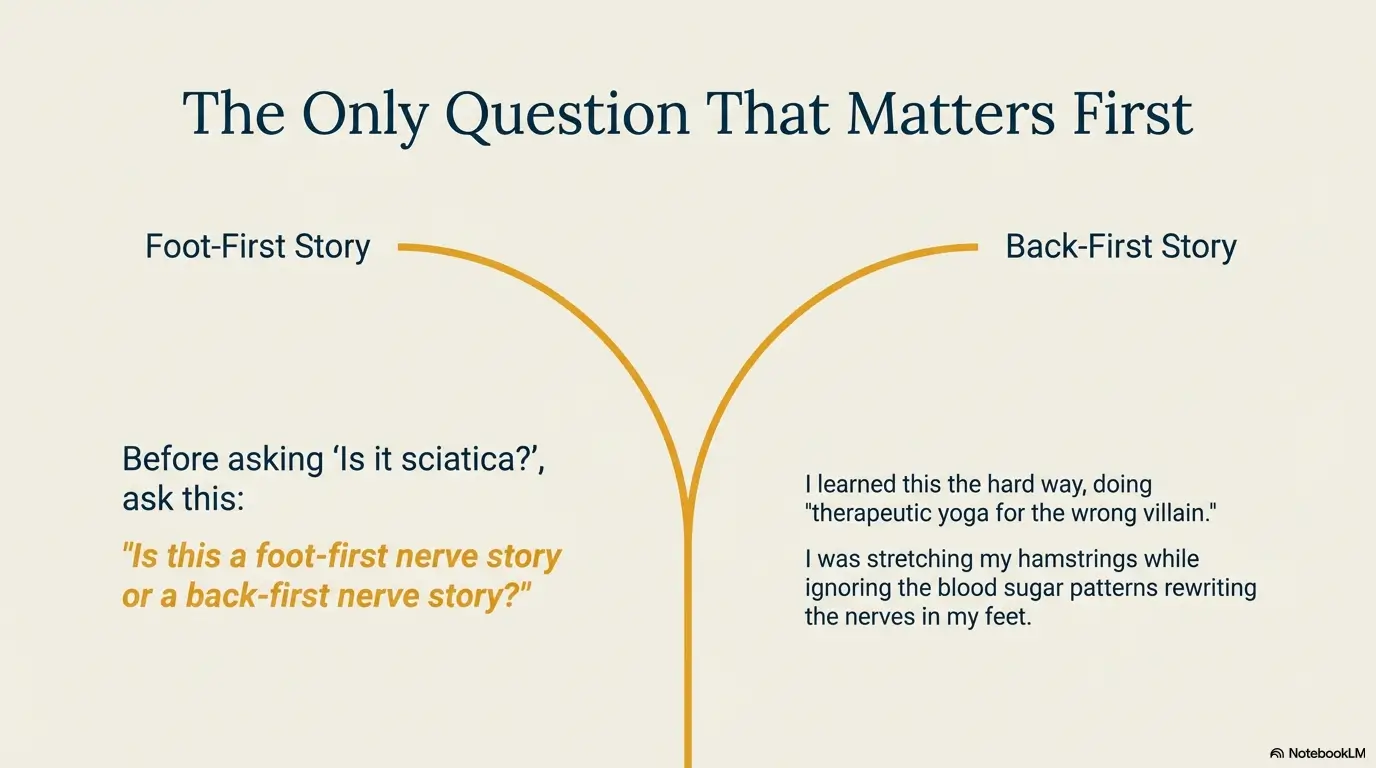
If your feet feel like they’re on a low-grade stove, the first question isn’t “Is it my back?” It’s “Is this a foot-first nerve story or a back-first nerve story?”
I learned this the stubborn way. A friend once joked that I was doing “therapeutic yoga for the wrong villain.” I laughed—then admitted it was true. I had been stretching my hamstrings like a full-time job while ignoring blood sugar patterns that were quietly rewriting the nerves in my feet.
Here’s the seven-clue map we’ll use:
- Start point: toes/soles first vs hip/back first
- Distribution: both feet vs one-sided lane
- Timing: night burn vs activity- or posture-linked spikes
- Movement response: spinal positions change it vs they don’t
- Other nerve signs: numbness, balance wobble, skin changes
- Simple safe self-checks: pattern recognition, not diagnosis
- Red flags: the moments you stop DIY and escalate
- Diabetic neuropathy often starts in the toes and climbs upward
- Sciatica often starts higher and travels down one side
- Timing and movement response sharpen the call
Apply in 60 seconds: Write one sentence describing your start point and spread pattern.
Clue #1: Where the fire starts
Diabetic neuropathy is usually “foot-first.” The burning often starts at the toes or soles and creeps up in a “stocking” pattern. Sciatica is more often “back/hip-first,” where pain or tingling originates near the low back, buttock, or back of the thigh before shooting downward.
When I first felt the burn, I kept waiting for back pain to “show up and explain everything.” It didn’t. The feet were the headline, the back was quiet, and that quietness was information.
Two small, practical markers:
- If you can point to a specific day or lift that triggered it, sciatica rises on the list.
- If it feels like a gradual, creeping change tied to years of blood sugar swings, neuropathy becomes a prime suspect.
Show me the nerdy details
Sciatica is a symptom pattern linked to irritation of lumbar nerve roots or the sciatic nerve pathway. Diabetic peripheral neuropathy reflects metabolic and microvascular injury to distal nerves. These mechanisms can overlap in sensation but diverge in distribution and triggers.
Clue #2: Symmetry vs a single-track story
This clue is almost unfairly useful. Neuropathy is commonly bilateral and relatively symmetric, especially early-to-mid stages. Sciatica is often one-sided. Not always, but often enough that your body’s “map” becomes a huge hint.
I once tried to convince myself that my right foot was the only “real problem,” because it hurt louder. The moment I compared both feet honestly, I saw the pattern: the left was quieter but definitely in the same story.
Quick reality check:
- Both feet burning, similar intensity: neuropathy climbs higher on the list.
- One leg/foot dominating with a clear line down the back or side of the leg: sciatica becomes more likely.
Also note the “border case”: you can have both. Diabetes doesn’t give you immunity from disc irritation; it can make nerves more sensitive to any insult.
Clue #3: The time-of-day trick
Many people with diabetic neuropathy describe a cruel rhythm: the burn intensifies at night. Less distraction, cooler rooms, and a nervous system on high alert can make symptoms feel amplified.
Sciatica, in contrast, is more often tied to posture, sitting time, bending, or specific activities. That doesn’t mean sciatica can’t wake you up—it can. But if your feet reliably turn into a bonfire after sundown, neuropathy gets louder in the differential chorus.
I kept a tiny log for 7 days—nothing fancy, just a note on my phone. It took 3 minutes a day and gave me more clarity than hours of doom-scrolling.
- Morning rating
- Late afternoon rating
- Bedtime rating
The pattern was embarrassingly consistent. That consistency helped me stop arguing with my own body.
Clue #4: Movement gives it away
This is where sciatica often tells on itself. If changing spinal positions reliably changes symptoms, that’s a useful clue. Examples:
- Sitting makes it worse, standing or walking briefly eases it.
- Bending forward lights it up.
- Gentle extension reduces leg symptoms for some people.
Neuropathy tends to be less responsive to these mechanical changes. The burn can fluctuate, but it doesn’t usually obey a neat spine-position rule.
My humbling moment: I tried three different “sciatica stretches” for two weeks. The only thing that improved was my flexibility. The burning didn’t budge. That is data, not failure.
- Mechanical triggers are meaningful signals
- Neuropathy often ignores your best stretch routine
- A 7-day log beats memory
Apply in 60 seconds: Note one position that reliably worsens and one that reliably eases symptoms.
Clue #5: Sensation and skin signals
Diabetic neuropathy is not just pain. It can pair burning with:
- Numbness in toes
- Tingling like static
- Reduced vibration sense
- Balance wobble in the dark
You may also notice subtle skin or foot changes over time: dryness, callus build-up, minor wounds you don’t feel as sharply as you should. Sciatica can cause numbness too, but typically in a more lane-like distribution that matches a nerve root or the sciatic path.
I remember stepping on a tiny piece of glass and feeling oddly calm—because I barely felt it. That moment was more alarming than any pain spike. It was a quiet sign that sensation was shifting.
Show me the nerdy details
Clinicians often test light touch, pinprick, temperature, vibration, and reflexes. A stocking distribution and loss of vibration sense can point toward peripheral neuropathy, while dermatomal patterns and reflex asymmetry can suggest radiculopathy.
Clue #6: Quick home self-checks (safe, not diagnostic)
These checks won’t diagnose you. They can organize your story before you see a clinician. Think of them as clarity tools.
- Pattern sketch: Draw where you feel burning/numbness. Is it both feet in a stocking shape or one leg in a line?
- Night vs day log: 7 days, three time points. Takes under 5 minutes per day.
- Foot-care mirror check: Look for redness, cracks, calluses, and small wounds. You’re not hunting drama; you’re preventing surprises.
Mini 60-second estimator (time + discomfort):
Input 1: Did symptoms start in the toes/soles? (Yes/No)
Input 2: Are both feet involved in a similar way? (Yes/No)
Input 3: Does posture or back movement clearly change symptoms? (Yes/No)
Output guide: 2–3 “Yes” to the first two inputs and “No” to movement response leans toward a neuropathy pattern. A strong “Yes” to movement response with a one-sided line pattern leans toward sciatica. Bring this summary to your appointment.
Save this guide and confirm the current testing pathway on your provider’s official page.
Clue #7: Red flags you shouldn’t outsmart
Even the most disciplined self-check has limits. If you notice any of the following, seek urgent care:
- New bowel or bladder control issues
- Rapidly worsening weakness in the leg or foot drop
- Fever, unexplained weight loss with back pain
- Open sores on the foot with signs of infection
I’m a fan of “calm experimentation,” but red flags are not a puzzle. They are a boundary.
2025 cost + coverage reality checks
If you’re in the U.S., uncertainty doesn’t just hurt physically; it can drain your wallet. The goal isn’t to collect every test. The goal is to sequence the right ones so you don’t pay twice for the same answer.
Eligibility checklist (fast and binary)
- Yes/No: Do you have diabetes or prediabetes diagnosed by a clinician?
- Yes/No: Are your symptoms present in both feet?
- Yes/No: Do symptoms worsen at night more than with posture?
- Yes/No: Have you had recent A1C fluctuations or medication changes?
Next step: If you answered “Yes” to 2+ items, ask about a focused neuropathy evaluation and foot safety plan.
Save this checklist and confirm your lab coverage rules on your insurer’s official page.
Fee/rate snapshot (ranges vary by plan and region)
| Item | Typical purpose | 2025 out-of-pocket range (rough) | Notes |
|---|---|---|---|
| A1C + metabolic labs | Context for diabetic neuropathy risk | $0–$60 | Often low cost with insurance |
| Primary care/endo visit | Medication + risk review | $20–$150 | Depends on copay/coinsurance |
| Physical therapy eval | Mechanical sciatica assessment | $25–$200 per visit | Ask for a 3-visit trial plan |
| EMG/Nerve conduction study | Differentiate peripheral vs root patterns | $150–$1,000+ | High variability by facility |
| Lumbar MRI | Disc/stenosis evaluation | $200–$2,000+ | Prior authorization may apply |
Save this table and confirm the current fee on the provider’s official page.
Decision card: When A vs B (fast)
Choose a neuropathy-first path if your burning is bilateral, toe-first, slowly progressive, and worst at night.
Choose a sciatica-first path if symptoms are one-sided, line-like, tied to sitting/bending, and improve with specific positions.
Time/cost trade-off: Starting with the right pathway can save 2–4 weeks and reduce duplicate imaging or therapy visits.
Save this card and confirm your plan’s prior authorization rules before scheduling higher-cost tests.
- Start with pattern + basic labs if neuropathy is likely
- Start with function + mechanical exam if sciatica is likely
- Escalate to EMG/MRI when the first step fails to clarify
Apply in 60 seconds: Ask for a written, stepwise plan before approving higher-cost imaging.
What to ask your clinician to shorten the path
Appointments are short. Your questions must be sharp. Here’s a compact script you can borrow:
- “My symptoms started in ____ and spread to ____. Does that pattern suggest peripheral neuropathy or radiculopathy?”
- “Can we start with a low-cost first step before ordering MRI?”
- “Would an EMG/NCS change the plan, or are we using it to confirm what we already suspect?”
- “What’s my foot safety plan for the next 30 days?”
- “Which medications or supplements might worsen neuropathy symptoms for me?”
I bring a one-page note with my log and a tiny body map. It sounds nerdy. It also saves 10–15 minutes of circular conversation and gets me a clearer plan.
Show me the nerdy details
Clinicians synthesize history, exam findings, reflex patterns, sensory testing, and sometimes imaging or electrodiagnostics. A good question is one that changes the decision tree, not one that chases certainty for its own sake.
A smart first-week plan
If you want a plan that respects your body and your calendar, try this 7-day sequence.
Days 1–2: Map and protect
- Make a two-foot comparison note.
- Check skin daily; keep feet clean and dry.
- Choose supportive shoes; avoid barefoot kitchen marathons.
Days 3–4: Test the mechanical hypothesis safely
- Notice whether sitting time, bending, or certain positions reliably worsen symptoms.
- If you have known diabetes, review your recent glucose patterns.
Days 5–7: Build your appointment packet
- 7-day timing log
- Body map
- Medication list
- Questions list
My small win here was emotional: I stopped acting like pain was a moral test. I treated it like data. That shift alone made the week feel 30% less chaotic.
Short Story: The night my feet rewrote my assumptions (120–180 words)
It was 1:40 a.m., the kind of hour when every symptom becomes a cursed poem. I was pacing my hallway, trying to outrun the heat in my feet. I did the thing the internet loves: I stretched. I leaned. I twisted. I performed a whole midnight audition for the role of “perfect sciatica patient.” Nothing changed. The burning stayed put, stubborn and symmetrical, like two small furnaces in identical shoes.
The next morning, I wrote three lines in my notes app: “Toe-first. Both feet. Night worse.” That was it. No drama. No diagnosis cosplay. At my appointment, those three lines shifted the conversation from imaging to a broader neuropathy plan—labs, foot care, and realistic expectations. The relief wasn’t instant. But the confusion was. And that was the real turning point.
Infographic: Two patterns, two paths
Diabetic Neuropathy Pattern
- Start: toes/soles
- Spread: “stocking” upward
- Sides: often both feet
- Timing: commonly worse at night
- Extras: numbness, balance changes, reduced vibration sense
First smart step: symptom map + glucose/A1C context + foot safety plan.
Sciatica Pattern
- Start: low back/hip/buttock
- Spread: down one leg in a line
- Sides: often one-sided
- Timing: linked to posture/activity
- Extras: dermatomal numbness, reflex changes
First smart step: mechanical exam + short PT trial + targeted escalation if needed.
This infographic supports pattern recognition and does not replace medical diagnosis.
A reputable deep dive if you want the official clinical framing
If you prefer to cross-check your pattern notes against a trusted medical overview, start with an official diabetes-focused resource before you chase back-specific content.
When both can be true (and why it matters)
This is the sneaky middle ground. Diabetes can make nerves more vulnerable, so a mild disc issue that might have been background noise can become a full-volume symptom. In that scenario, you might feel:
- Baseline, bilateral burning from neuropathy
- Plus a sharper, one-sided flare triggered by sitting or lifting
I’ve seen people get stuck because they demand a single villain. The body isn’t a tidy detective novel. Sometimes it’s a messy ensemble cast.
If your clinician suggests a dual-track plan—foot protection and glucose optimization plus a short mechanical rehab trial—that’s not indecision. That’s efficient coverage.
- Use pattern logs to assign priorities
- Trial low-risk interventions first
- Escalate tests only if the plan would change
Apply in 60 seconds: Ask, “What result would make us change the plan?” before ordering the next test.
Sleep, pain, and the night economy
Night burning is a special kind of personal betrayal. It steals rest and then charges interest the next day. If neuropathy is likely, you’ll often do better focusing on sleep protection and consistent glucose habits alongside symptom-targeted care.
I used to underestimate the compounding effect. Two bad nights turned me into an anxious researcher. After four bad nights, I was ready to let any algorithm diagnose me. That’s a normal human response. It’s also a signal to simplify.
Small, safe moves many clinicians support:
- Consistent bedtime routine
- Foot temperature comfort strategies (not extreme heat)
- Discussing medication timing with your clinician
Even a 20–30 minute improvement in sleep onset can meaningfully reduce next-day pain sensitivity.
A quick regional note
If you’re reading from the U.K., Canada, Australia, or much of Europe, primary care pathways often emphasize conservative management and pattern-based triage before advanced imaging. In the U.S., access varies more by plan design, prior authorization, and network rules. Regardless of system, your best leverage is the same: a clear description of onset, distribution, timing, and triggers. That language travels well across healthcare models.
Quote-prep list for higher-cost tests
If you’re considering EMG/NCS or a lumbar MRI, collect these items first to avoid surprise bills:
- Your plan’s imaging or electrodiagnostic prior authorization rules
- In-network facilities and the clinician’s ordering requirements
- Your estimated deductible and coinsurance status
- A written list of symptoms that justify medical necessity
Your goal is not to haggle. It’s to keep the pathway clean and predictable.
Save this list and confirm today’s coverage tier on your insurer’s official page.
FAQ
Can diabetic neuropathy feel exactly like sciatica?
It can feel close enough to confuse anyone, especially when burning spreads beyond the feet. The clearest separators are symmetry, toe-first onset, and night-dominant patterns versus posture-linked, one-sided line pain. Apply in 60 seconds: Write a one-line pattern summary and bring it to your visit.
What if I have diabetes but my pain is only on one side?
That can happen. One-sided symptoms can still be neuropathy, but sciatica or another focal nerve issue becomes more plausible. Your clinician may consider a mechanical exam and, if needed, targeted testing. Apply in 60 seconds: Note which positions worsen the symptoms most.
Do I need an MRI right away?
Not always. Many people benefit from a short conservative trial if there are no red flags. The decision should depend on whether imaging would change the plan. Apply in 60 seconds: Ask, “What would we do differently if the MRI is positive?”
Is an EMG/NCS better than an MRI for this question?
They answer different questions. EMG/NCS can help distinguish peripheral nerve patterns from root-level issues; MRI shows structural changes in the spine. Your clinician can choose based on your pattern and exam. Apply in 60 seconds: Ask which test has the highest chance of changing your treatment plan.
What are the most important daily habits if neuropathy is likely?
Foot inspection, safe footwear, consistent glucose management, and early attention to small wounds can reduce complications and anxiety. Apply in 60 seconds: Set a daily reminder for a 30-second foot check.
When should I seek urgent care?
New bowel/bladder issues, rapidly worsening weakness, foot drop, or infected foot wounds are urgent signals. Apply in 60 seconds: If any are present, don’t self-manage—call urgent care or emergency services.
Two official resources worth bookmarking
If you want a clean reference for back-related pathways and diabetes-specific complications, these two pages are reliable starting points for mainstream guidance.
Last-mile clarity before you spend
Here’s the simplest way I know to prevent a money-and-time spiral:
- If it’s bilateral, toe-first, night-worse: start with diabetes/neuropathy pathway and foot protection.
- If it’s one-sided, line-like, posture-worse: start with mechanical pathway and a short PT trial.
- If your story is mixed: ask your clinician for a dual-track plan with clear stop points.
The best clinicians I’ve met don’t order everything. They order the next most informative thing.
Last reviewed: 2025-12; sources: ADA, Mayo Clinic, NIDDK.
Conclusion
The hook we opened with was simple: the costliest mistake is an assumption. Burning feet can be a back story—but just as often, they’re a metabolic nerve story that starts quietly and grows bold at night. When you shift from label-chasing to pattern-reading, you reclaim control fast.
Your 15-minute next step is doable: sketch the symptom map, run the three-input pattern guide, and write five appointment questions. Then request a stepwise plan that begins with the lowest-cost, highest-clarity move. Clarity first, tests second. Your feet—and your future calendar—will thank you.