
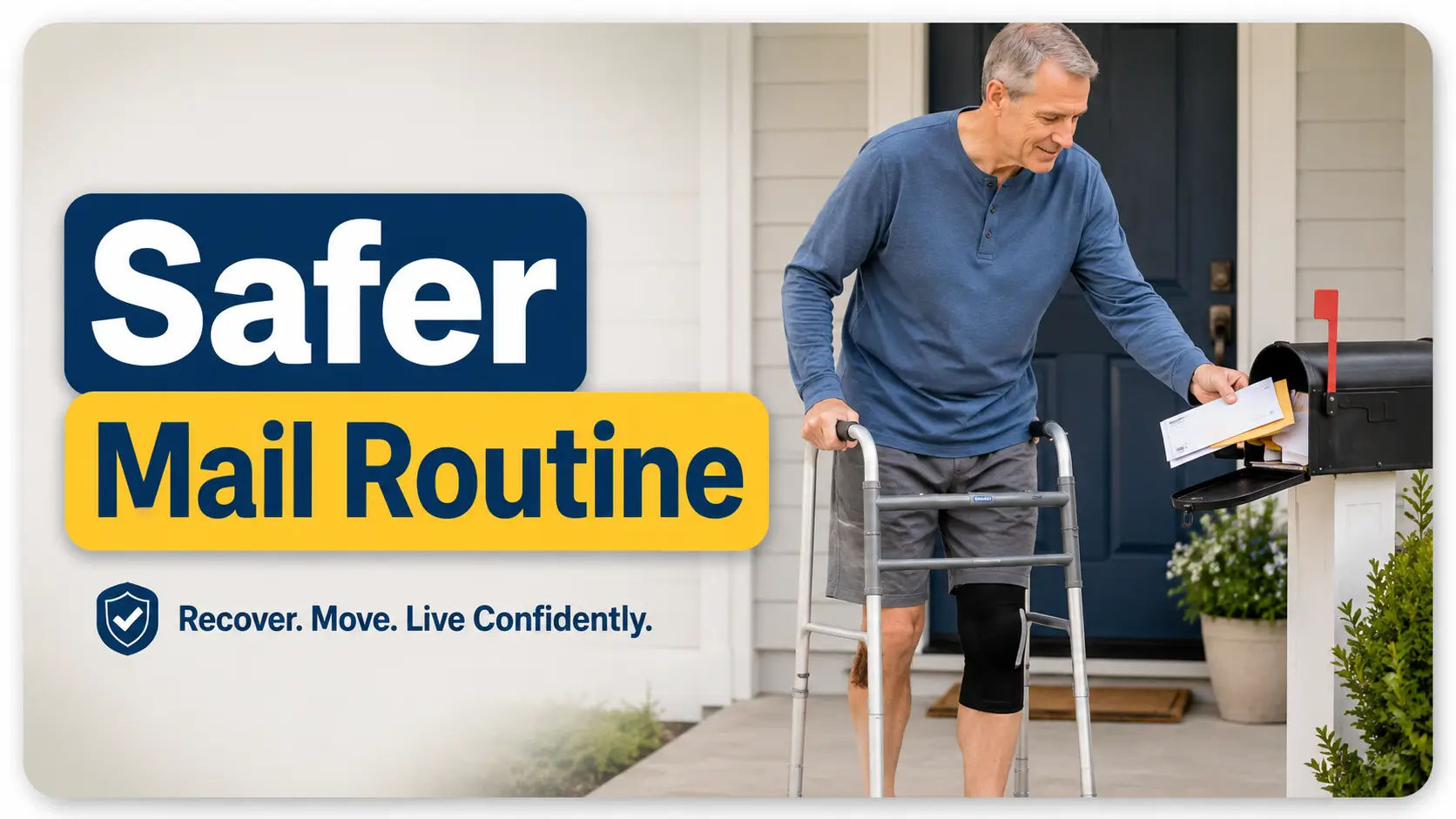
Post-surgery home safety
Getting Mail From the Porch After Joint Replacement:
A Safer Tiny Routine That Matters
Mail looks harmless. A few envelopes. Maybe a pharmacy flyer. Maybe one box that seems light enough to carry with two fingers. But after hip, knee, or shoulder replacement, this tiny errand can quietly combine several recovery hazards at once: walking, turning, reaching, bending, door thresholds, steps, weather, pets, medication fog, and the small human temptation to rush.
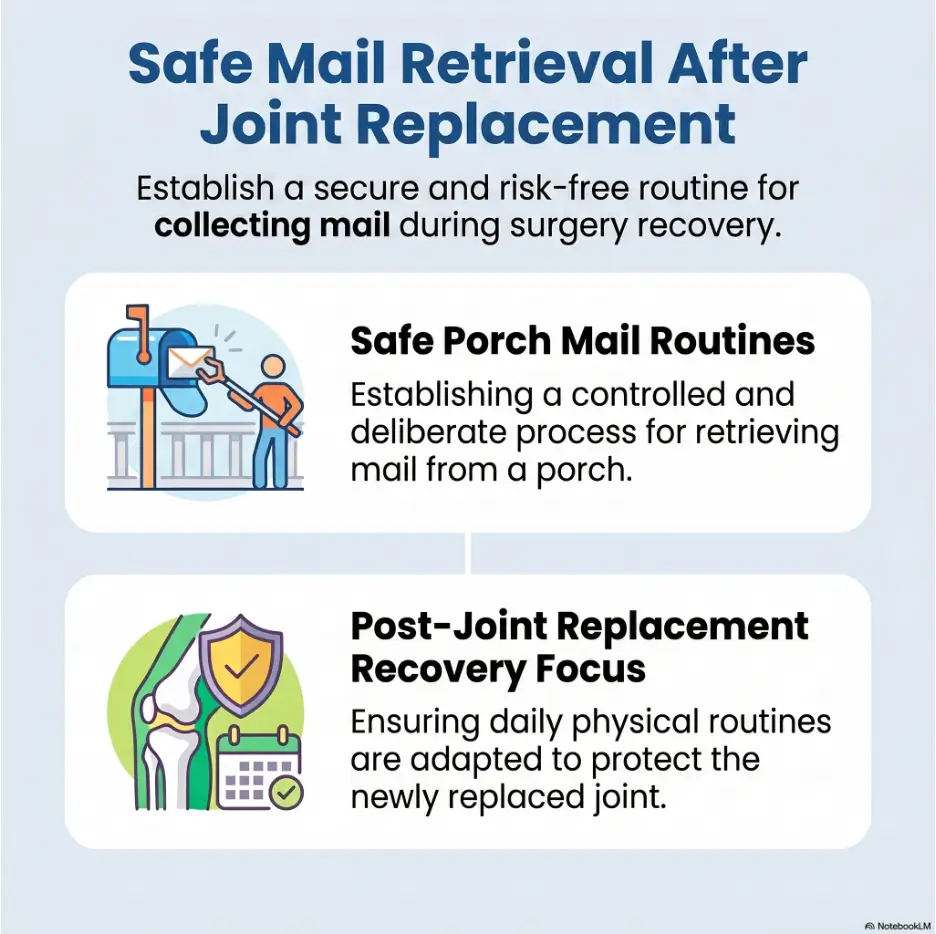
This guide treats porch mail pickup as what it really is during early recovery: a short mobility task that deserves a plan. Not a dramatic plan. Not a bubble-wrap-the-house plan. Just a boring, repeatable routine that protects your new joint, your balance, your incision, and your confidence.
Whether you are recovering alone, helping a parent after surgery, or setting up a safer entryway before discharge day, the goal is simple: make tomorrow’s mail run so uneventful that nobody has to tell the story twice.
Protect balance
Spot the porch moments that turn a simple walk into a fall risk.
Avoid wasted buys
Compare simple tools, paid help, and no-cost mail alternatives without overbuying.
Help caregivers
Turn the doorway, porch, and mailbox into a calmer recovery zone.
The best mail routine after joint replacement is not heroic. It is predictable, slow, and almost boring. 📬
Snapshot
This article is for adults recovering at home after hip, knee, or shoulder replacement and for caregivers setting up a safer porch routine. You will learn why mail pickup can become risky, how to scan the doorway before stepping out, what tools may help, which purchases are optional, and when to ask your surgeon, physical therapist, or caregiver for help.
Table of Contents
Before You Act: Safety Comes First
This article is general educational content. It cannot replace your surgeon’s discharge instructions, your physical therapist’s movement rules, your medication guidance, or the specific precautions tied to your hip, knee, or shoulder replacement.
That matters because “getting the mail” is not one movement. It can include standing from a chair, using a walker or cane, opening a door, crossing a threshold, stepping onto a porch, reaching into a mailbox, bending for a dropped envelope, turning back around, and carrying items while tired. Recovery turns ordinary actions into small mechanical puzzles.
If you have new chest pain, shortness of breath, fainting, confusion, severe swelling, wound drainage, new redness, sudden calf pain, or a fall, treat that as a medical issue rather than a home safety puzzle. Call your care team or emergency services as appropriate.
Key takeaway
The safest mail plan is the one that matches your actual restrictions. If your surgeon or PT says no bending, no twisting, limited weight-bearing, sling use, stair limits, or no outdoor walking yet, the mailbox does not get a vote.
What This Guide Can and Cannot Do
This guide can help you think through porch setup, safer movement habits, caregiver planning, low-cost tools, and alternatives such as mail hold or help from a neighbor.
It cannot tell you exactly when you personally can walk outside, use stairs, bend, lift packages, stop using a walker, or return to normal activity. Those decisions depend on your surgery type, bone quality, strength, balance, medications, home layout, and recovery progress.
A Note for Caregivers
If you are helping a parent, spouse, or friend, resist the urge to frame this as “taking away independence.” A safer mail routine gives independence a runway. The person is more likely to regain confidence when the small daily tasks stop feeling like surprise exams.
A caregiver’s best job here is not to hover. It is to remove the hidden traps before the recovering person has to negotiate with them while tired, sore, or foggy from medication.
Why Porch Mail Is Riskier Than It Looks
Mail pickup feels too small to plan. That is exactly why it deserves attention after joint replacement. People prepare for showers, stairs, cars, and beds. The mailbox sneaks in wearing a tiny hat.
The risk is rarely the envelope itself. The risk is the chain of movements around it: open, step, reach, turn, carry, return, close. Any weak link can turn a quick errand into a fall, a painful twist, or a frightening near miss.
Tiny Task, Hidden Hazards
A porch is not the same as a hallway. It may have uneven boards, a raised threshold, a welcome mat that curls at the corner, damp leaves, a package left at shin height, or a pet trying to stage a jailbreak.
After surgery, your reaction time may be slower. Pain medication, poor sleep, anemia, dehydration, and simple fatigue can all make balance less trustworthy. Even a person who feels mentally clear may not be moving with their usual precision.
The Mailbox Is Not the Only Risk
A mailbox attached to the wall near the door may seem easier than one at the curb, but it can still require reaching, twisting, or stepping over a threshold. A curbside box may add distance, driveway slope, traffic awareness, uneven pavement, and weather.
Packages change the equation too. A padded envelope may be harmless. A box of pet food, medical supplies, or household goods can be too bulky to carry safely with a walker or cane.
How Hip, Knee, and Shoulder Replacement Change the Task
After hip replacement, bending, twisting, and crossing thresholds may be the concern, depending on your surgical approach and precautions. After knee replacement, stiffness, swelling, step control, and sudden pain can make a quick porch walk feel clumsy. After shoulder replacement, the issue may be reaching, using the operated arm, managing a sling, and carrying anything without straining the healing area.
That is why a one-size mail rule rarely works. The safer question is not “Can I get the mail?” It is “Which part of the mail routine is most likely to challenge my current restriction?”
The Safer Porch Mail Flow
1. Pause
No rushing, no “quick grab,” no multitasking.
2. Scan
Check shoes, phone, pets, lighting, weather, and clutter.
3. Stabilize
Use the prescribed walker, cane, rail, or caregiver support.
4. Retrieve
Use a reacher, tray, pouch, or helper instead of bending.
5. Return
Turn slowly, keep hands free, and sort mail indoors.
The 30-Second Porch Safety Scan
Before opening the door, pause for half a minute. That pause is not weakness. It is recovery intelligence with shoes on.
The scan should be boring enough to repeat every day. The fewer decisions you make in the moment, the less likely you are to improvise while balancing on one foot near a threshold.
Check the Body Before the Door
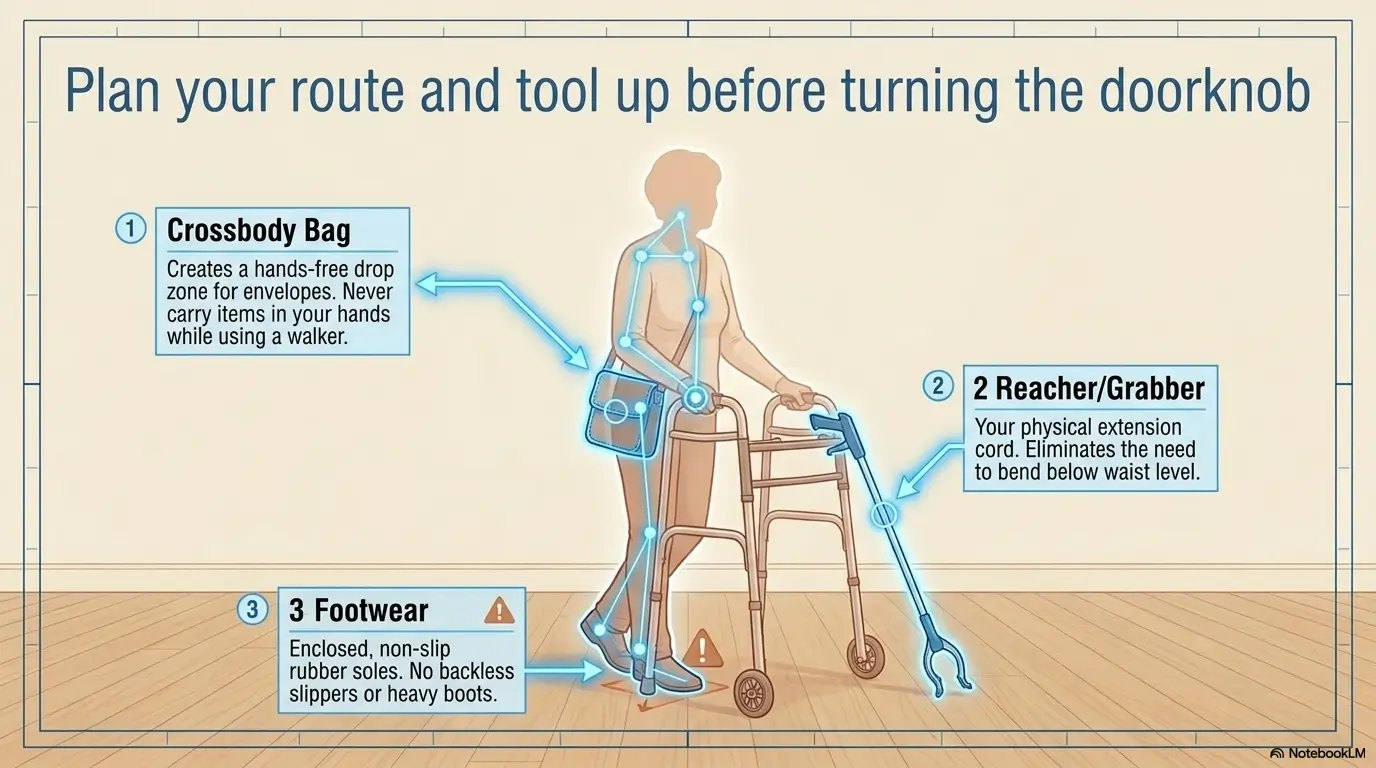
- Are you wearing stable, non-slip shoes?
- Do you have your prescribed walker, cane, crutches, or sling positioned correctly?
- Is your phone with you in case you need help?
- Do you feel dizzy, sleepy, lightheaded, or unusually weak?
- Are you due for medication, or did you recently take something that affects balance?
If the answer to the dizziness question is yes, the mail can wait. Paper is patient. Porches are not always so forgiving.
Check the Path Before the Step
Look through the window or crack the door only when stable. Check for wet leaves, ice, rain, packages, extension cords, holiday decorations, loose mats, pets, and anything that narrows the walking path.
If you use a walker, the porch needs enough width for the walker to land flat. A front wheel caught on a mat can turn a confident step into a tiny thunderclap.
Keep One Hand Free
Mail is not worth losing the hand you need for balance. Keep one hand available for your mobility aid, a rail, or steadying support recommended by your therapist.
If carrying mail means you cannot use your cane correctly, change the carrying method. Use a crossbody pouch, apron pocket, walker basket, or ask someone else to bring it in.
Key takeaway
A safe mail pickup starts before the door opens. Shoes, phone, mobility aid, weather, pets, and clutter should be checked while you are still inside.
Doorways, Thresholds, and Steps
The doorway is where many mail routines get awkward. You are managing a door, a walker or cane, a raised threshold, a possible step down, and a small change in light. That is a lot of choreography for a task that started with a coupon booklet.
Doorways also invite rushing because they feel transitional. You are not “outside” yet, but you are no longer comfortably inside. That in-between moment is where good plans earn their keep.
Why Thresholds Catch Toes and Walkers
A raised threshold can catch a toe, walker leg, cane tip, or slipper edge. After knee replacement, lifting the foot high enough may feel less automatic. After hip replacement, the turn through the doorway may be more awkward than expected. After shoulder replacement, opening a heavy door with the non-operated arm may shift your balance.
Do not treat the threshold as background scenery. Treat it as the first obstacle in the route.
Steps Should Follow Your PT Plan
If your porch has steps, use the stair technique taught by your physical therapist. Many patients are given specific rules for leading with the stronger leg, using handrails, and placing assistive devices. Those rules can vary by surgery, strength, and surgeon preference.
Do not rely on half-remembered advice from a cousin, a forum, or a video watched at midnight. Your PT has seen your actual gait. The internet has not seen your porch.
The “One More Step” Mistake
Many porch mishaps come from extending the task. You step out for the mail, then notice a package, then move a planter, then pull the trash bin closer, then realize you are tired and standing in the wrong place.
Mail pickup should be one job. If you see another chore, write it down or ask for help. Recovery does not need bonus rounds.
| Porch feature | Why it matters after joint replacement | Safer adjustment |
|---|---|---|
| Raised threshold | Can catch toes, walker legs, or cane tips | Practice with PT or caregiver before doing it alone |
| Loose welcome mat | Can slide, curl, or stop a walker wheel | Remove it temporarily or secure it firmly |
| Single porch step | May require specific leg sequence and rail use | Follow PT-taught step technique |
| Dim porch light | Makes edges and packages harder to see | Use brighter lighting or avoid nighttime mail runs |
| Storm door | Can pull attention away from balance | Ask someone to hold it or adjust the routine |
Bending, Reaching, and Carrying Mail
The mail is almost never at the perfect height. It may be on the floor, stuffed into a low slot, wedged in a box, placed behind a package, or fluttering just far enough away to tempt a reach.
After joint replacement, bending and reaching are not moral tests. They are movement choices with consequences. Choose the duller, safer option.
Avoid Deep Bending Unless Cleared
If your care team has told you not to bend past a certain point, do not break that rule for mail. A dropped envelope can wait for a reacher, a caregiver, or your next cleared movement practice.
For hip replacement patients, bending and twisting can be especially important depending on precautions. For knee replacement patients, bending may be limited by swelling and pain. For shoulder replacement patients, reaching outward or overhead may be the bigger issue, especially when wearing a sling.
Use a Tool Before You Use a Twist
A reacher, small wall basket, mail tray, hook, or pouch can turn a risky movement into a controlled one. The goal is not to buy every recovery gadget with cheerful packaging. The goal is to remove the one movement that keeps tempting you.
If mail drops through a slot onto the floor, a reacher may help. If mail is stuffed into an outdoor box, a small tote or pouch may help. If the mailbox is too low, a temporary indoor drop zone or neighbor pickup may be better than trying to solve the problem with bravery.
Carry Less Than You Think You Can
Carrying mail is not about weight alone. It is about balance, grip, attention, and whether you need both hands for support. A stack of envelopes may be light, but if it blocks your view or occupies the hand that should be using a cane, it is too much for that moment.
Packages deserve their own rule: if you cannot carry it while using your prescribed mobility aid correctly, do not carry it. Slide it aside only if cleared and safe, or ask someone to bring it inside.
Show me the nerdy details
Mail pickup is a compound task. It mixes gait, balance, reach distance, grip, attention, surface change, obstacle detection, and load management. That is why one small change, such as a wet step or a box near the door, can raise the difficulty sharply.
A useful way to judge the task is to ask: “Can I keep my base of support stable, use my prescribed device correctly, avoid restricted movements, and return indoors without rushing?” If any answer is no, the safer choice is help, delay, or a modified setup.
Tools, Services, and Budget Options
A safer mail routine does not have to be expensive. In many homes, the best fix is free: ask someone else to bring in the mail for the first recovery window, remove the porch mat, turn on the light, and stop collecting mail at night.
Still, a few tools and services can be worth comparing. The right choice depends on your mailbox type, mobility aid, support network, porch layout, and how long your restrictions may last.
Good, Better, Best Mail Setup
| Setup level | What it includes | Best for | Cost mindset |
|---|---|---|---|
| Good | Stable shoes, phone, cleared path, mail picked up during daylight | Short recovery windows with a low-risk porch | Mostly free |
| Better | Reacher, pouch or walker basket, removed loose mat, caregiver backup during bad weather | People using a walker, cane, or sling | Low to mid-range tools |
| Best | Mail hold, neighbor pickup, porch drop zone, PT practice on exact doorway setup | Higher fall risk, steps, ice, dizziness, or living alone | May include paid help or service planning |
Notice that “best” does not mean fanciest. It means the setup reduces the most risk for your actual home. A premium gadget that does not solve your doorway problem is just a shiny object with a receipt.
Free Options Before Buying Anything
- Ask a family member, neighbor, or caregiver to bring in mail once daily.
- Choose one daylight pickup time instead of checking repeatedly.
- Remove loose mats and porch clutter.
- Keep shoes, phone, and mobility aid near the door.
- Ask your PT to practice your doorway, porch step, or mailbox motion.
- Use USPS Hold Mail if mail accumulation becomes a problem.
USPS Hold Mail may be useful when you are recovering alone, staying with family after surgery, or trying to reduce daily trips to the porch. It is not only for vacations. It can also be a short-term recovery tool when used appropriately.
When Paid Help May Be Worth Considering
Paid help may make sense if you live alone, have several porch steps, have poor lighting, use a walker on uneven surfaces, feel dizzy after medication, or do not have reliable family support. The goal is not luxury. It is reducing preventable risk during a narrow recovery period.
Before paying for a caregiver, home aide, errand service, or handyman adjustment, ask exactly what task they will perform. “Help after surgery” is vague. “Bring in mail and packages at 4 p.m., clear the porch path, and report hazards” is useful.
| Option | What to compare | Watch out for |
|---|---|---|
| Reacher tool | Grip comfort, length, weight, ability to pick up envelopes | Too long or too flimsy for indoor use |
| Walker basket or pouch | Secure attachment, easy access, does not affect walker stability | Overloading it with packages |
| Handyman help | Lighting, rail stability, threshold visibility, mat removal | Cosmetic fixes that do not address movement risk |
| Caregiver or aide | Task list, timing, fall-risk awareness, communication | Paying for broad help without specific porch duties |
| Mail hold or pickup | Dates, pickup plan, package handling | Letting mail pile up after hold ends |
Key takeaway
Before buying recovery tools, identify the exact movement problem: bending, reaching, carrying, stepping, door control, lighting, or lack of help. Then choose the smallest solution that solves that problem.
For related home safety setup, you may also find it helpful to review walker path safety, parking lot safety with a walker, and how to ask a neighbor for help after surgery.
Common Mistakes That Make Mail Riskier
Most mail pickup mistakes are not dramatic. They are ordinary shortcuts. Socks instead of shoes. One hand full. Dog at the door. A quick bend. A second chore added to the first. Little dominoes with very tidy handwriting.
The good news: once you name these mistakes, they become much easier to avoid.
Mistake Checklist
- Going outside in socks, loose slippers, sandals, or bare feet.
- Opening the door before the walker or cane is positioned.
- Bending quickly because the mail is “right there.”
- Letting a dog rush the door.
- Carrying mail in the same hand used for a cane.
- Trying to bring in packages, trash, and mail in one trip.
- Going back out after dizziness, nausea, or unusual weakness.
- Checking the mail after dark when porch edges are hard to see.
- Stepping around a package instead of asking someone to move it.
- Using a wet or icy porch because the mail feels urgent.
Short Story: The Envelope That Could Wait
Martin had been home three days after knee replacement when he saw the mail sticking halfway through the slot. One white envelope had slipped to the floor. It looked almost offended, lying there by the mat.
He felt fine. Not great, but fine enough. He opened the door, leaned forward, and reached. His knee tightened, his walker shifted, and for one sharp second the room seemed to tilt.
Nothing terrible happened. His daughter, who had been in the kitchen, steadied the walker and picked up the envelope. It was a coupon.
That afternoon they moved a small basket inside the door, put a reacher beside it, and agreed that mail would be collected once daily after lunch. Martin still got the mail eventually. He just stopped letting paper make the rules.
The Combining-Chores Problem
One of the sneakiest mistakes is turning mail pickup into a mini errand loop. You bring in mail, then a package, then move a trash bin, then water a plant, then check the car. By the time you return indoors, you have done five tasks under the name of one.
During early recovery, make one-trip discipline your friend. Mail is mail. Packages are packages. Trash is trash. Each job gets its own plan.
Key takeaway
The phrase “while I’m already out here” is a red flag after joint replacement. One small task can become too much when you add bending, carrying, and extra steps.
Caregiver Setup for a Safer Entryway
Caregivers can make mail pickup safer without making the home feel like a clinic. The best setup is quiet, practical, and easy to maintain. Think less “medical command center” and more “no-rush landing pad.”
Start with the exact path: chair to door, door to threshold, threshold to mailbox or porch drop zone, then back inside. Walk it slowly while imagining a walker, cane, sling, stiff knee, sore hip, or tired evening brain.
Build a No-Rush Mail Station
- Place stable shoes near the door, not across the room.
- Keep the prescribed mobility aid positioned where it can be reached safely.
- Put a phone within reach before the person opens the door.
- Add a reacher if mail often lands low.
- Use a small basket, pouch, or tray for mail once it is inside.
- Remove loose mats, clutter, cords, and decorations from the path.
- Check porch lighting and replace weak bulbs if needed.
- Keep pets away from the door during mail pickup.
If the recovering person has memory slips, medication confusion, or nighttime disorientation, a written note near the door may help: “Shoes. Walker. Phone. Daylight. No packages.” It is not childish. It is a tiny guardrail for a tired brain.
For medication-related safety concerns, see this related guide on how to monitor medication confusion.
Ask PT to Practice the Real Porch
A physical therapist can often help translate general recovery rules into your actual home setup. Ask about the doorway, porch step, mailbox height, walking aid, handrail use, and whether a reacher or basket makes sense.
Bring photos or a short written description to an appointment if the therapist cannot see the porch in person. Include step height, railing location, door swing direction, mailbox placement, and whether the person uses a walker, cane, crutches, or sling.
Real-world example
A daughter helping her mother after hip replacement noticed the porch mailbox was only four feet from the door. At first, it seemed safe. Then she watched the actual movement: her mother opened the storm door, twisted slightly to hold it, stepped over a raised threshold, reached sideways into the box, then turned back with mail in her cane hand.
The fix was simple. They removed the loose mat, used a doorstop when someone was nearby, moved a basket inside, and arranged for the neighbor to bring mail in on rainy days. No fancy equipment. Just fewer traps in the sequence.
When to Seek Help
Mail pickup should never become the reason someone hides symptoms. If a porch trip causes a fall, near fall, sharp pain, dizziness, wound concern, or new swelling, it is worth telling the care team. Small details can help them protect recovery.
When in doubt, document what happened: time of day, medication timing, shoes worn, mobility aid used, weather, surface condition, pain level, and whether there was a twist, stumble, or impact.
Call Your Care Team After a Fall
Even if you feel okay after a fall, contact your surgeon, clinic, or care team for guidance. Some issues are not obvious in the first few minutes, especially when adrenaline and pain medication are both in the room.
Do not minimize the report because the fall happened during a “small” task. Small tasks are still real tasks after surgery.
Symptoms That Deserve Urgent Attention
- Chest pain or shortness of breath.
- Fainting, severe dizziness, or confusion.
- New severe pain in the surgical area.
- Sudden swelling, calf pain, or warmth.
- Wound drainage, spreading redness, or fever.
- A fall, even if you think nothing is broken.
- New inability to bear weight or use the limb as instructed.
For general fall-prevention resources for older adults, the CDC offers practical materials that can support conversations with healthcare professionals and caregivers.
What to Tell Your PT or Surgeon
Instead of saying “I had trouble getting the mail,” describe the exact problem. Specifics make help easier.
- “The threshold catches my walker.”
- “I feel dizzy around 30 minutes after taking pain medication.”
- “The mailbox is low, and I have to bend.”
- “My dog rushes the door when I open it.”
- “The porch step feels higher when I come back in.”
- “I can get envelopes, but packages are too awkward.”
That level of detail can help your care team adjust instructions, practice a movement, recommend a safer tool, or suggest temporary help.
FAQ
When Can I Get My Own Mail After Joint Replacement?
It depends on your surgery, balance, medications, mobility aid, porch setup, and your surgeon or PT instructions. Some people may manage a simple indoor mail slot early with help nearby. Others should wait longer, especially if there are steps, ice, dizziness, or bending restrictions.
Is It Safe to Use a Walker on the Porch?
A walker may be safe only if the porch surface is flat, dry, wide enough, and free of mats, cords, packages, and loose boards. Ask your PT to review your exact porch setup if possible. Walker wheels or legs can catch on thresholds and uneven surfaces.
Can I Bend Down to Pick Up Mail After Hip Replacement?
Do not bend beyond the limits given by your surgeon or PT. Depending on your precautions, deep bending or twisting may be restricted. Use a reacher, ask for help, or change where mail lands until you are cleared.
What Should I Do If My Mailbox Has Steps?
Ask your PT for a step plan based on your surgery and mobility aid. If steps are wet, icy, dark, or do not have a secure rail, consider having someone else bring in the mail, using USPS Hold Mail temporarily, or creating a safer delivery routine.
Can I Carry Packages After Knee Replacement?
Ask your care team about lifting and carrying limits. Even light packages can be awkward if they block your view or interfere with your walker or cane. If a package changes your balance, it is too much for that trip.
What If I Live Alone After Surgery?
Set up help before you need it. Consider a neighbor pickup plan, family check-in, temporary caregiver support, mail hold, or delivery instructions. Keep your phone with you, use prescribed mobility aids, and avoid porch trips during poor weather or after dizziness.
Should I Use a Reacher for Mail Pickup?
A reacher can help if mail falls low or if bending is restricted. Choose one that is light, comfortable, and easy to control. Practice indoors first. A reacher is not a substitute for safe footing, proper mobility aid use, or surgeon/PT restrictions.
What If I Already Slipped but Feel Okay?
Contact your care team for guidance, especially after recent joint replacement. Also write down what happened so you can prevent a repeat: shoes, surface, weather, medication timing, mobility aid, and whether you twisted, landed, or caught yourself.
Make Tomorrow’s Mail Run Boring
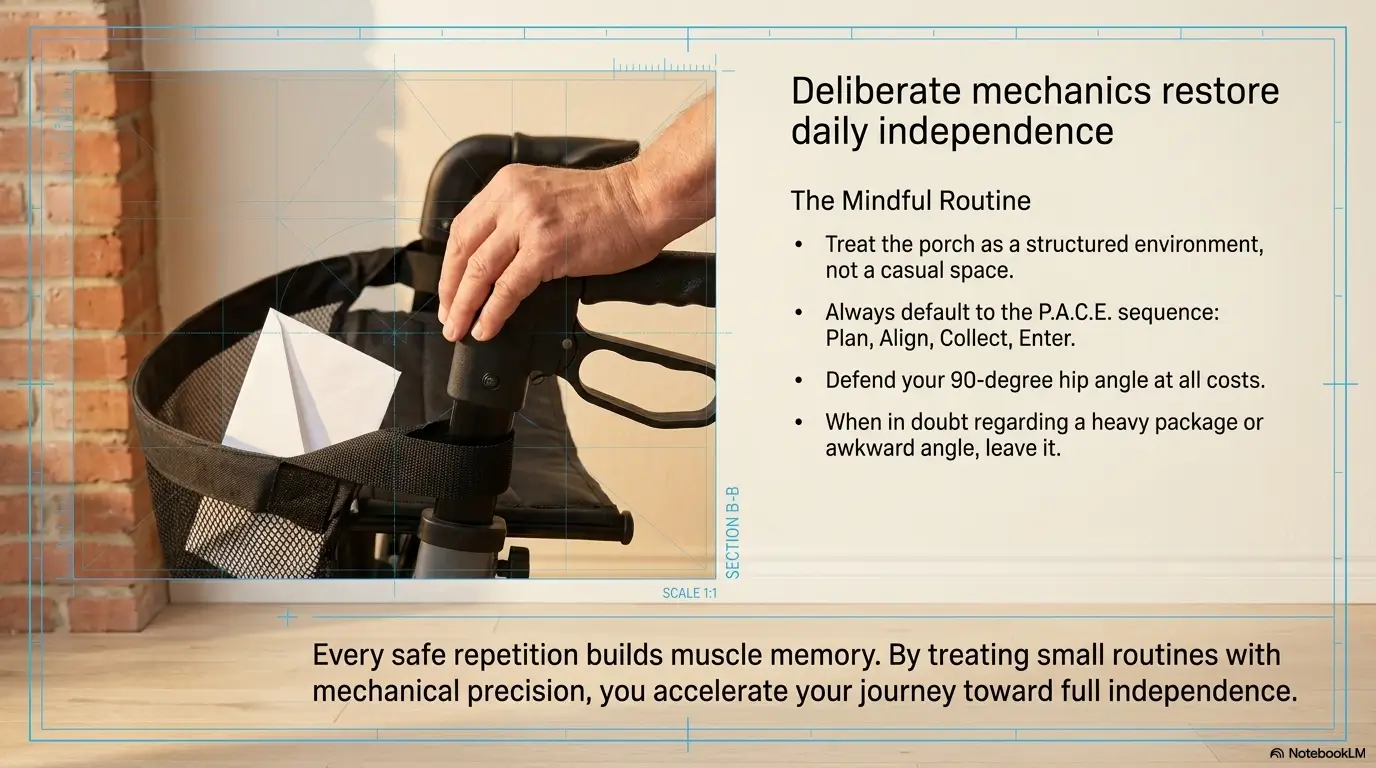
The safest mail routine after joint replacement is not the one that proves you are tough. It is the one that keeps recovery quiet. No rush. No bent-over scramble. No “while I’m here” chores. No package wrestling in slippers.
Your 15-minute next step is simple: build a no-rush mail station today. Put stable shoes, your phone, mobility aid, and reacher near the door. Remove the loose mat or clutter. Choose one daylight pickup time. Ask one person to cover mail during bad weather. If porch steps or distance are a problem, ask your PT to practice the exact setup with you.
Mail will keep arriving. Recovery asks for something quieter: a routine that lets you meet the day without negotiating with the porch.
15-minute setup checklist
- Place shoes, phone, mobility aid, and reacher near the door.
- Remove or secure the porch mat.
- Clear packages, cords, decorations, and pet items from the path.
- Turn on or test the porch light.
- Write one rule: “Mail only. No packages. No extra chores.”
Last reviewed: 2026-07