

The most dangerous number in pain management isn’t “0.” It’s a confident-looking 60% scribbled on a rushed follow-up note.
If you’re trying to decide whether medial branch block (MBB) percent relief can predict RFA success—and whether the 50% vs 80% cutoff will move you forward or get you stalled—you’re not really fighting math. You’re fighting noise: sedation, “good day” bias, inconsistent movement testing, and paperwork rules that treat your body like a permission slip.
Keep guessing and you risk two expensive outcomes: delaying relief that’s actually available—or getting an RFA that was never aimed at your main pain generator.
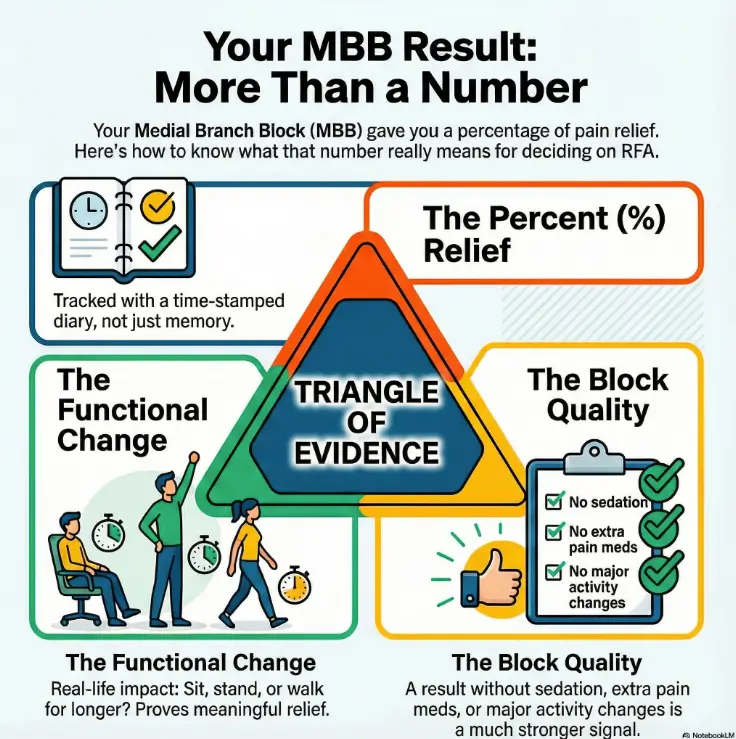
This post gives you a defendable decision in minutes: percent plus function plus block quality—using a time-stamped 24-hour diary and a simple “clean block” score.
- ✓ Turn your block day into usable data
- ✓ Handle the 50–79% gray zone without panic
- ✓ Walk into follow-up with approval-proof notes
Table of Contents
MBB % decoded: what the number actually measures
Let’s take the mystery out of “percent relief.” When a medial branch block helps, it suggests that numbing the medial branch nerves reduced pain signals coming from the facet joint region. That’s useful. It’s also… not the same thing as proving a single, clean diagnosis with courtroom certainty.
I’ve seen readers treat their % like a fortune cookie: “I got 60%, therefore my future is…” But your percent is a snapshot of one day, influenced by meds, movement, expectations, and technique. The goal is to turn that snapshot into a signal you can trust.
Relief vs diagnosis: the category error most people make
Diagnostic language makes this confusing. An MBB can be used as a “test,” but it’s a test performed in a real body with real variables. You can get partial relief because:
- Facet pain is part of the picture, but not the whole picture.
- The block numbed something adjacent (spread), creating a “better than expected” day.
- Your baseline pain that morning was already lower (sleep, stress, weather, activity).
So yes: relief matters. But it’s not a single switch labeled “facet pain: ON/OFF.”
Function counts: the “stairs/sitting/sleep” metric clinicians notice
Here’s the practical upgrade: track function along with pain. If your pain score drops from 8 to 4, that’s meaningful. If you can also sit through dinner, drive 20 minutes, or climb a flight of stairs without bracing like you’re defusing a bomb—that’s the kind of improvement that translates into real-life value.
Many clinics already encourage tracking what happens after the injection—how you feel, how long relief lasts, and what you could do differently that day. Hospital patient-education pages often emphasize that your post-injection experience can vary and should be observed carefully.
Let’s be honest… pain isn’t a math test (but your diary can be)
Pain scores feel precise, but they’re human. That’s not a flaw—it’s the nature of pain. The trick is to make your reporting consistent:
- Use the same 0–10 scale all day.
- Rate pain at the same moments (morning, noon, afternoon, evening).
- Write down what you were doing when you rated it.
Show me the nerdy details
When clinicians talk about “signal” vs “noise” in diagnostic blocks, they mean repeatability and confounder control. A clean baseline, consistent activity testing, minimal sedation, and accurate time stamps reduce noise. That doesn’t guarantee an answer—it increases the odds that the number reflects the intended target.
- Track pain and function (sitting, stairs, sleep, driving).
- Use consistent time stamps to reduce “memory editing.”
- Interpret % relief in context of meds, activity, and technique.
Apply in 60 seconds: Write down your baseline pain score right now plus one function you want back.
50% vs 80% cutoff: why this fight exists (and who it protects)
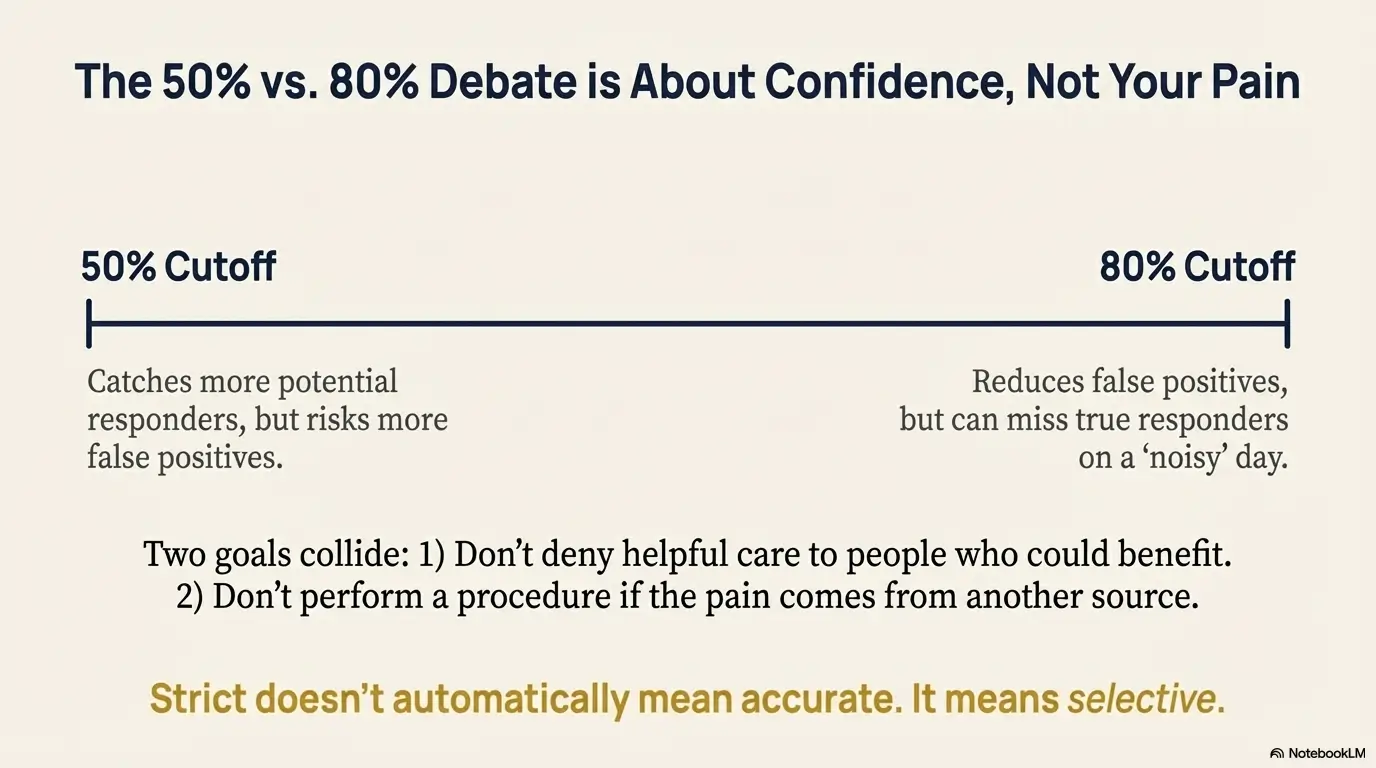
The cutoff debate exists because two reasonable goals collide:
- Goal A: Don’t deny helpful care to people who could benefit.
- Goal B: Don’t perform a nerve procedure on someone whose pain isn’t coming from that nerve pathway.
That collision often shows up in insurance rules, clinic protocols, and second-opinion conversations. If you’ve ever felt like your body got turned into a percentage-based permission slip… yeah. You’re not imagining it.
Two goals collide: catching responders vs avoiding false positives
50% relief can be seen as “good enough to justify the next step” because it may capture people with mixed pain sources (facet + something else). But it can also include more “false positives”—cases where relief came from factors other than the intended nerve target.
80% relief is stricter. It tends to reduce false positives, but it can also exclude real facet-pain contributors—especially when the day of the block is messy (sedation, extra meds, inconsistent activity, weird baseline pain).
Curiosity gap: why stricter cutoffs can still miss true facet pain
Here’s the twist people don’t expect: a stricter rule can miss true cases when the test day is “noisy.” If you barely moved after the injection, or your baseline pain was unusually low, you might not have created a fair opportunity for the block to show its value.
In other words: strict doesn’t automatically mean accurate. It means selective.
What insurers are trying to prevent (and why that’s not always “about you”)
Insurance policies are built to be applied at scale. They often aim to reduce procedures that don’t match their evidence thresholds or documentation standards. That can feel cold, but it also explains why documentation quality becomes part of the “success prediction” conversation—even though documentation doesn’t change your nerves.
- Yes/No: Did you record a baseline pain score before the block?
- Yes/No: Did you test at least 2 movements that usually trigger your pain?
- Yes/No: Can you describe a functional change (sitting, stairs, driving, sleep)?
- Yes/No: Do you know whether sedation or extra meds were used?
Next step: If you answered “No” to 2+ items, your next move is improving data quality—not arguing with a number.
Neutral action: Bring this checklist to your follow-up and fill it in together.
50–79% relief: the gray-zone playbook (what to do next)
If you landed in the 50–79% range, welcome to the most common and most annoying outcome: “It helped… but not enough to feel certain.”
Gray-zone results deserve a calm framework, not doom-scrolling. This is where you turn uncertainty into next actions that protect you from two losses: (1) doing something unnecessary, and (2) delaying something helpful.
If you improved—but not cleanly: look for pattern + repeatability
Ask three questions:
- Pattern: Did relief match the specific pain you came in for (same location, same trigger)?
- Timing: Did relief show up in the expected window for the anesthetic used?
- Function: Did anything in daily life improve in a way you can describe?
I’ve had readers say, “My pain was only down 60%, but I stood at the stove and cooked for the first time in months.” That’s not a rounding error. That’s a life signal.
Curiosity gap: when a second block adds clarity (and when it’s just delay)
A repeat block can help when your first block day was “messy” (you didn’t move much, medication changes, sedation, inconsistent ratings). It can also help when your clinician is trying to improve diagnostic confidence before doing RFA.
But repeating can be pure delay if the first block was clean and the relief was clearly minimal—or if the pain pattern is shifting toward a different generator (disc, SI joint, myofascial, sciatica-style nerve pain, or irritation that might be better clarified with something like an L5–S1 selective nerve root block discussion).
The “percent + function + block quality” triangle (one-line rule)
If your percent is moderate, but function improved and block quality was clean, you have a coherent argument for the next step. If your percent is moderate, function didn’t change, and confounders were heavy, the argument is weaker—and your next best move is a cleaner test, not a louder opinion.
- Look for matching pain pattern + expected timing + functional shift.
- Repeat testing only if it adds clarity (not just paperwork).
- Use the triangle: percent + function + block quality.
Apply in 60 seconds: Write one sentence: “Before, I couldn’t ___; after the block, I could ___ for ___ minutes.”
Block-quality audit: the hidden variables that inflate (or erase) your %
This section is where we get fiercely practical. A “bad” MBB result sometimes means “facet pain isn’t the driver.” Sometimes it means “the test day didn’t test anything.”
Think of this as a post-game review. You’re not blaming anyone. You’re finding the hidden variables that can make a 40% day look like 80%—or a true responder look like a non-responder.
Sedation/anxiety meds: how they can blur the signal
Some people receive sedation or medications to help with anxiety and comfort. That can be appropriate—procedures are stressful. But it can also blur interpretation: sedation can change your pain perception, activity level, and ability to do meaningful movement testing right after the block.
If sedation was used, your best move is simple: document it, and interpret your % with that reality in mind.
Extra pain meds + “good day” bias: why memory lies under stress
The most common “inflation” pathway is accidental: you took extra pain meds, you rested unusually, or you had a better-than-usual baseline day. Then you compare that day to a normal bad day and call it “90%.” It’s human. It’s also how people end up confused six weeks later.
Fix: baseline first (before the procedure), then consistent check-ins after.
Volume/spread + timing: what “should” happen in the first 8 hours
Clinics use local anesthetic with expected time windows (shorter-acting vs longer-acting). You don’t need to memorize drug names to track timing—you just need to note when relief started and when it faded.
If relief lasted far beyond what you were told to expect, don’t panic and don’t assume magic. Ask whether the block included anything beyond local anesthetic (some do), and whether reduced guarding allowed your muscles to calm down for longer than the numbing effect itself.
Curiosity gap: the one detail in your procedure note that changes the story
Want the highest-leverage detail to request? The procedure note often includes what levels were targeted, what medication was used, and whether sedation was used. That single page can turn “I think it helped” into a clear, defensible narrative.
Show me the nerdy details
Confounders are not “excuses.” They are variables that can change both the magnitude and the interpretability of pain reporting after a diagnostic intervention. Sedation can reduce movement testing, medication changes can shift baseline, and broader anesthetic spread can affect adjacent structures. A clean block is about controlling variables—not forcing a particular result.
Give yourself 0–2 points for each item:
- Baseline captured: pain score + function written down before procedure
- Movement tested: you tried 2–3 trigger movements after the block
- Meds stable: no extra pain meds or unusual changes that day
- Minimal sedation: you were alert enough to test and record
- Time-stamped notes: you recorded relief at set times
Output: 0–3 = noisy; 4–7 = usable; 8–10 = strong signal.
Neutral action: Share your score at follow-up and ask, “Would repeating improve clarity?”
Pain diary that actually works: the 24-hour, time-stamped method
Most people are told to “track your pain.” That advice is correct—and also too vague to be helpful. Here’s a method that takes 3 minutes per check-in and gives you data you can actually use.
Baseline first: lock the “before” number (or % becomes wishful math)
Before the procedure (or before any sedating medication), record:
- Baseline pain (0–10)
- Primary pain location (one sentence)
- One function that’s currently limited (e.g., “sit 15 minutes,” “drive 10 minutes,” “stand at sink 5 minutes”)
Activity test: do the movements that usually trigger pain
This is the step people skip—and it’s the step that makes the diary meaningful. If your pain is triggered by extension, rotation, standing, walking, sitting, or bending, test that on purpose (safely). Don’t perform stunts. Just test the real-life trigger movements that normally bring pain into focus.
Here’s what no one tells you… duration matters as much as percent
Two people can both report “70% relief,” but one has relief for 90 minutes and the other has relief for 8 hours. Those are different stories. Record when relief begins, peaks, and fades. That timing helps your clinician interpret what happened—especially when you’re in the gray zone.
| Time | Pain (0–10) | Function test | What changed? | Meds / notes |
|---|---|---|---|---|
| Baseline (pre) | __ | __ | __ | __ |
| +1 hour | __ | __ | __ | __ |
| +2 hours | __ | __ | __ | __ |
| +4 hours | __ | __ | __ | __ |
| +8 hours | __ | __ | __ | __ |
| Bedtime / next morning | __ | __ | __ | __ |
Neutral action: Bring this diary to your follow-up and ask, “How does this change the RFA decision?”
Single vs dual blocks: the real question underneath “cutoff”
Sometimes the cutoff debate is really a stand-in for another decision: do we need one block or two before moving to RFA?
Some clinics use a stepwise pathway (block → repeat block → RFA). Others proceed differently depending on clinical context, documentation needs, and patient specifics.
Why some clinics run Step 1 → Step 2 → RFA protocols
The rationale is usually diagnostic confidence. If you can reproduce meaningful relief under similar conditions, it reduces the chance that the first result was a fluke. If your insurer requires it, it also reduces denial risk. That’s not a value judgment—it’s how systems behave.
False positives vs false negatives: who pays the price (time, pain, coverage)
A false positive costs time, money, and recovery for a procedure that may not help. A false negative costs you something else: delayed relief, more lost days, more “maybe next month.” Neither is great. The goal is choosing the pathway that reduces the most likely loss in your situation.
When repeating a block is medically reasonable vs “box-checking”
Repeat can be reasonable when:
- Your first block day was noisy (sedation, meds changed, low baseline pain).
- You didn’t test trigger movements and can’t interpret the %.
- Your relief pattern was plausible but not clear enough to commit.
Repeat is less useful when the pain pattern doesn’t match facet behavior, relief was minimal under clean conditions, or your symptoms are evolving toward a different pain generator—especially if what you’re actually dealing with looks more like sciatica vs a herniated disc (or, sometimes, piriformis syndrome that mimics sciatica).
RFA success isn’t only MBB %: the other predictors you can control
Even major institutions describe RFA as a procedure that interrupts pain signaling by targeting nerve tissue. That’s a mechanism, not a promise. What tends to shape satisfaction is the match between your pain generator and the targeted nerves—plus expectations, rehab, and how “mixed” your pain picture is.
I like a blunt question here: What are you trying to buy back? Not “pain relief” in the abstract—something concrete. Walking the dog. Sitting through a movie. Sleeping without bracing.
Mixed pain generators: facet pain + something else (common, not a failure)
Many people have more than one driver: facet joints, discs, SI joint irritation, myofascial pain, nerve irritation. If you get partial relief from MBB, it can mean the facet component is real but not exclusive. That’s not “bad news.” It’s a map—and for people whose symptoms are drifting toward leg-dominant pain, it can help to sanity-check the pattern against classic sciatica nerve pain features before you assume the next step is automatically facet-focused.
Expectation reset: timeline for soreness vs maximal effect
Some people feel sore after RFA; some feel improvement gradually. Patient-education resources often describe RFA as a procedure that uses heat from radiofrequency energy to affect the nerve pathway involved in pain transmission, with recovery guidance that emphasizes safety and activity restrictions in the short term.
Translation: ask about the expected “sore window,” the realistic timeline for assessing benefit, and what activity plan they recommend right after—and if you’re building your expectations around “how long this should last,” anchor it to a realistic lumbar medial branch RFA duration timeline.
Cervical vs lumbar nuance: what to ask (without self-diagnosing)
You don’t need to become your own clinician. You do need to ask clear questions:
- Which levels are being targeted—and why those levels?
- What pain pattern do you expect those nerves to influence?
- What would count as “success” at 2 weeks and at 8 weeks?
And if your symptoms are more neck/arm than low back/leg, it helps to be able to name the pattern—this quick overview of cervical radiculopathy symptoms can make your questions sharper without turning you into your own diagnostician.
- Relief pattern matched your usual pain
- Function improved in a measurable way
- Block day was reasonably clean
- Relief was unclear and tracking was weak
- Meds/sedation/activity blurred the result
- Pain pattern is shifting or not facet-like
Neutral action: Pick one box and write the strongest sentence supporting it.
Common mistakes: don’t let these shortcuts decide your RFA
This is the “loss-prevention” section. Not because you’re doing anything wrong—because the system invites shortcuts, and shortcuts create bad decisions.
Mistake #1: rating pain after you changed meds, sleep, or workload
If your baseline day changes, your percent becomes slippery. You don’t need perfection—just honesty. Note any unusual factors: extra meds, unusually restful day, unusually stressful day, big activity change.
Mistake #2: skipping time stamps (your brain edits the story)
Memory is an unreliable narrator. (Mine is a drama queen.) Time stamps keep the story factual.
Mistake #3: confusing numbness/relaxation with true pain generator relief
Feeling “looser” is nice. But your decision should be based on whether your usual trigger pain changed in a meaningful way.
Mistake #4: treating one number as a guarantee
Even a high % isn’t a guarantee. It’s a stronger signal—but outcomes still depend on targeting, technique, and the broader pain picture.
- Time stamps beat memory every time.
- Track trigger movements, not just “vibes.”
- Write down confounders (sleep, meds, stress, activity).
Apply in 60 seconds: Add one line to your notes: “Today was unusual because ___.”
Approval-proof documentation: how cases get delayed (and how to prevent it)
If you’ve ever had a procedure delayed for “missing documentation,” you know the special flavor of rage it produces. Not because paperwork is evil—because pain doesn’t wait politely while forms catch up.
In the US, prior authorization workflows vary (Medicare, Medicare Advantage, commercial insurers), but the pattern is consistent: if your story isn’t documented clearly, it’s easy to pause your care.
Missing baselines: the silent prior-auth killer
No baseline pain score and no baseline function = no clear “before.” And without a “before,” it’s hard to justify the “after.”
Functional wins: document them like outcomes, not vibes
Swap “I felt better” for something concrete:
- “I could sit 25 minutes instead of 10.”
- “I walked 12 minutes instead of 4.”
- “I slept 5 hours without waking from pain.”
What to request today: procedure note + meds + levels + anesthetic + sedation
Ask your clinic for a copy of the procedure note. You’re looking for:
- Levels targeted
- Medication used (type/amount)
- Whether sedation/anxiolytics were used
- Pre- and post-procedure pain scores (if recorded)
- Procedure note (levels, meds, sedation)
- Your 24-hour pain/function diary
- Your top 2 functional goals (time-based)
- Any med changes around the procedure day
- Questions you want answered in writing (timeline, expectations, next step)
Neutral action: Put these in one folder (paper or digital) before your follow-up.
Show me the nerdy details
Documentation isn’t just bureaucracy; it’s translation. It converts an internal experience (pain relief) into a standardized narrative that clinicians and insurers can interpret. Clear baselines, time stamps, and functional outcomes reduce ambiguity, which reduces delays.
Who this is for / not for
This guide is designed for time-poor readers who want a clean decision path—not a medical textbook.
This is for you if…
- You’re considering RFA after an MBB and want to interpret the percent relief.
- You’re stuck in the 50–79% gray zone and want next-step clarity.
- You want to reduce insurance/approval friction with better tracking and documentation.
This may not be for you if…
- Your symptoms include major red flags (progressive weakness, systemic symptoms) that need urgent evaluation.
- Your pain pattern has changed dramatically (new trauma, different location, new neurologic symptoms).
- You’re looking for a guaranteed outcome (no one can offer that honestly).
Special note: prior spine surgery, widespread pain, or rapidly changing symptoms
These situations can make “single-number interpretation” harder because multiple pain sources can overlap. It doesn’t mean you can’t pursue relief—it means you should prioritize a structured clinical re-evaluation and be extra careful with signal quality. If you’ve had surgery before and the pain story is complicated, it may help to read up on failed back surgery syndrome and why pain can persist or change so you know what to ask (and what not to assume).
When to seek help: red flags after MBB or before RFA decisions
Most people do fine after these procedures, but you should know the red flags that deserve urgent attention. Many hospital aftercare pages explicitly advise contacting your care team for concerning symptoms after an injection.
Urgent: severe new weakness, fever, progressive numbness, bowel/bladder changes
If you experience any of these, don’t “wait it out.” Seek urgent evaluation—and if you want a quick checklist for what crosses the line, review low back pain emergency warning signs.
Reassess: pain pattern changes (new trauma, night pain, systemic symptoms)
If the story of your pain changes—new injury, pain that wakes you consistently, unexplained systemic symptoms—press pause on self-interpretation and get reassessed.
If you’re spiraling: ask for a structured re-eval, not a rushed yes/no
This is more common than people admit. Pain makes the future feel narrow. A structured follow-up visit with your diary and procedure note often does more for anxiety than another hundred forum posts. (Ask me how I know.)
FAQ
Does 80% MBB relief guarantee RFA success?
No. A high percent is a stronger signal, but outcomes still depend on targeting, technique, and whether your pain is mainly facet-driven. Use 80% as “more confidence,” not “certainty.”
Is 50% relief “good enough” for RFA in the US?
It can be, depending on your clinical picture and your insurer’s policy. If 50% came with a clear functional improvement and a clean test day, it may be more meaningful than a higher number from a noisy day.
Why do some clinics repeat MBBs before RFA?
To increase confidence that the relief is reproducible and linked to the intended nerve pathway—and sometimes to meet coverage requirements. Repeating is most useful when the first block day was noisy or the relief was plausible but unclear.
Can sedation or anxiety meds affect MBB results?
Yes—mainly by changing your activity level and perception during the window when you should be testing trigger movements. If sedation was used, document it and interpret your % with that context.
How long should I track pain after an MBB—hours or days?
Hours matter most for diagnostic interpretation (especially the first day). A 24-hour diary with time stamps is usually enough to capture the meaningful window, but follow your clinic’s instructions for activity and safety.
Why did I feel better longer than the anesthetic “should” last?
Sometimes reduced guarding, calmer muscles, better sleep, or a temporary break in the pain cycle can extend the “good day” feeling. Ask your clinician what was injected (local anesthetic alone vs additional medication) and how they interpret your timing.
What matters more: pain score drop or functional improvement?
Both matter. Pain score captures intensity; function captures real-life impact. If your pain score changed modestly but your function improved clearly, that can be a strong practical signal.
What should my clinic document for insurance approval?
Typically: baseline pain, post-block response, timing/duration of relief, levels targeted, medications used, and whether sedation was used. Bring your diary and ask for the procedure note.
Next step: one concrete action (do this today)
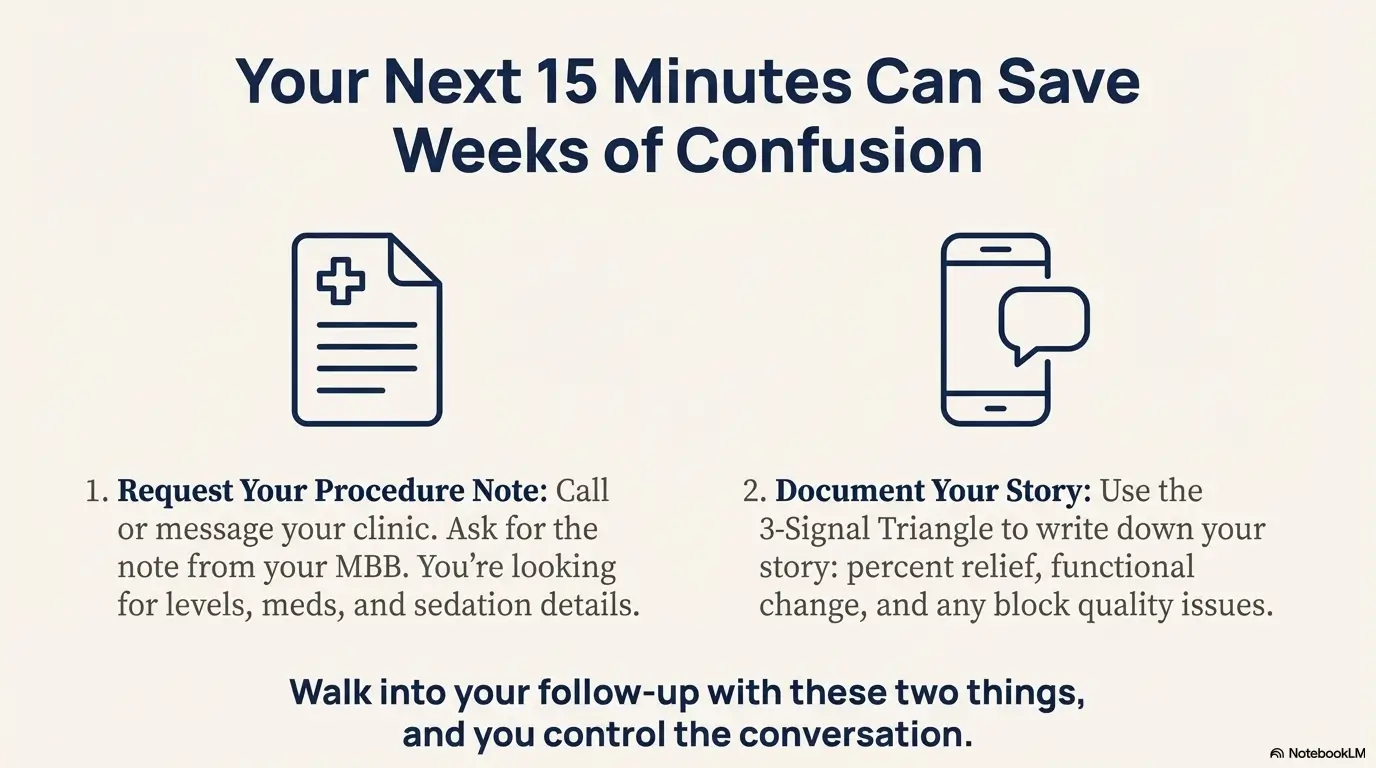
If you do nothing else, do this. It takes 10–15 minutes and can save weeks of confusion.
Request your MBB procedure note + run a 24-hour pain/function diary
Call or message your clinic and ask for a copy of your procedure note. Then run the time-stamped diary you saw above (or re-run it if you’re heading into a repeat block).
Bring 3 items to follow-up: percent, function change, block-quality confounders
- Percent: your best estimate based on time-stamped notes
- Function change: one measurable daily-life improvement
- Confounders: sedation, med changes, weird baseline day, limited movement testing
Choose your lane: repeat block vs proceed to RFA vs rethink pain generator
Ask your clinician to help you choose one lane—and explain why. The goal is a decision that you can repeat back in one clean sentence. And if the “different pain generator” lane is on the table, it can help to understand how other pathways are evaluated (for example, transforaminal vs interlaminar epidural options are sometimes discussed when nerve-root inflammation is the main driver rather than facet pain).
- Get the procedure note (levels, meds, sedation).
- Track percent and function with time stamps.
- Use confounders to decide if a repeat test adds clarity.
Apply in 60 seconds: Draft a message to your clinic requesting the procedure note.
Wrap-up: your next 15 minutes
Let’s close the loop from the beginning: yes, MBB percent relief can predict RFA success—but only when you treat that percent like a signal that needs context. The 50% vs 80% cutoff debate isn’t a moral argument about who “deserves” care. It’s a practical tradeoff between missing real responders and approving procedures for the wrong pain generator.
Your 15-minute CTA: open your notes app and write three lines: baseline pain, one functional goal, and whether your block day had confounders. Then request your procedure note. It’s not glamorous—but it’s the kind of boring action that gets you unstuck.
Short Story: The day a “60%” result stopped being disappointing (120–180 words) …
A reader once told me their MBB gave “only” 60% relief. They said it like a confession, like they’d failed a test. But when I asked what changed, they paused and said: “I drove to the grocery store without bracing my core the whole time. I stood in line without looking for a place to sit. I got home and realized I wasn’t doing the pain-face.”
The number hadn’t been the point. The pattern had. Their procedure note showed no sedation, stable meds, and clear time-stamped relief in the expected window. Their clinician didn’t promise anything—but did say the story was coherent: percent, function, and block quality aligned. They chose their lane, went forward with eyes open, and judged success by the thing they actually wanted back: normal minutes in a normal day. That’s the standard I wish more people used.
Last reviewed: 2025-12-17