
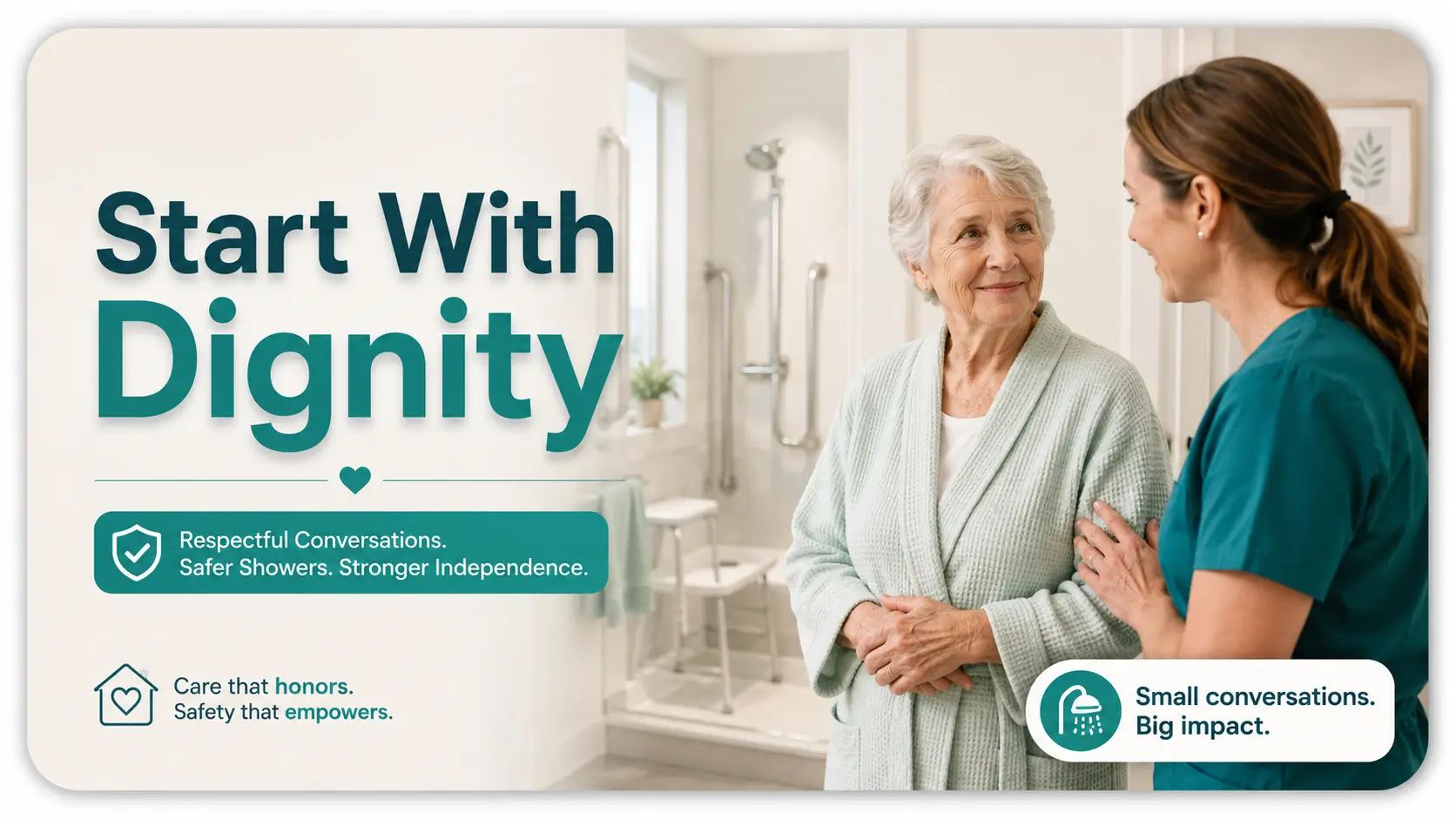
Protecting Dignity, Preventing Falls
The hardest part of shower safety is often not the tile, the tub, or the slippery soap that behaves like a small aquatic criminal. It is the sentence before the sentence. You want to ask about shower safety because you care, but the words can come out sounding like an inspection, a verdict, or a quiet announcement that someone is “old now.”
That is the modern caregiving knot: you are trying to prevent a fall without bruising dignity. If you guess wrong, the conversation can close like a bathroom door with a lock. If you delay, small warning signs can grow into bigger risks, especially when dizziness, pain, medications, poor lighting, or mobility changes enter the room.
This guide gives you practical language, respectful scripts, and a 10-minute bathroom walkthrough that keeps independence at the center. The method is simple: notice, ask, offer one small improvement, and know when a clinician or occupational therapist should step in.
The Dignity-First Shower Safety Rule
A good shower safety conversation does not begin with equipment. It begins with control. The person bathing should feel like the decision-maker, not the subject of a family safety audit.
Better framing: “I want the bathroom to keep working for you,” not “You can’t do this alone anymore.”
Table of Contents
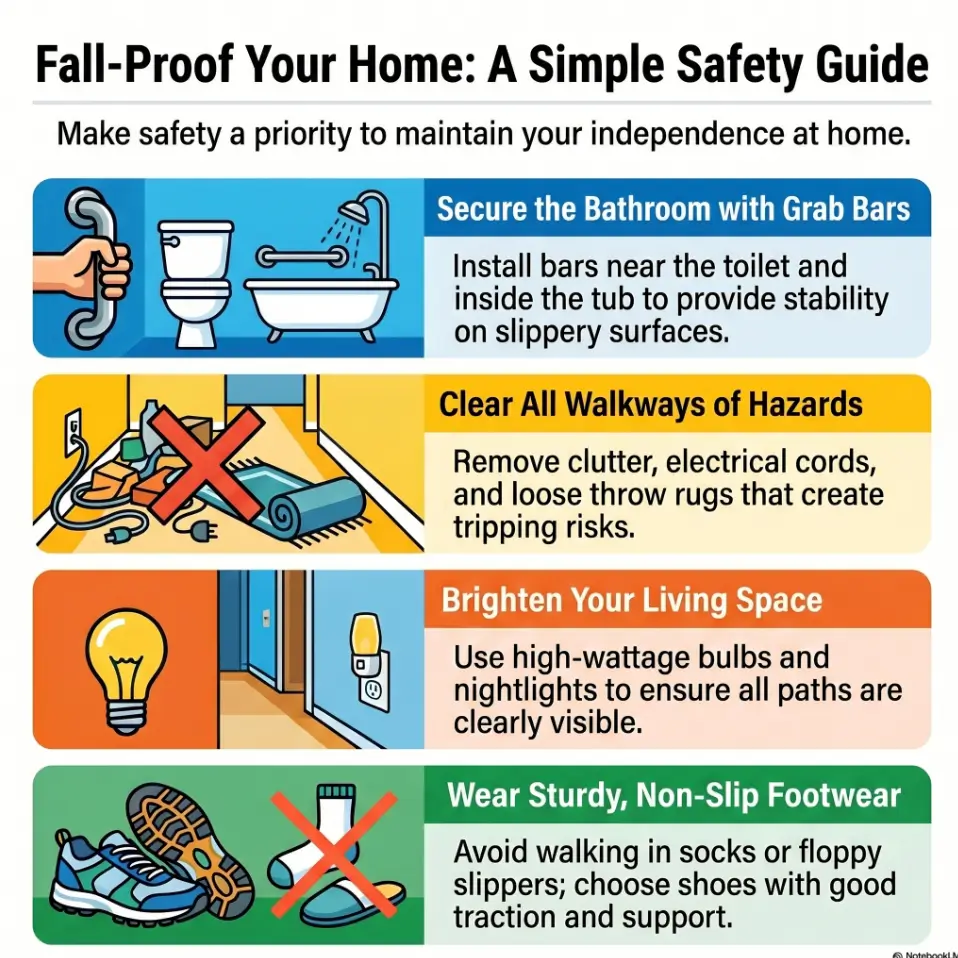
Safety Disclaimer
This guide is for general caregiver communication and home-safety education. It is not medical advice, occupational therapy guidance, legal advice, or emergency instruction. If someone has fallen, fainted, hit their head, developed sudden weakness, become confused, or feels unsafe bathing alone, contact a healthcare professional promptly. For immediate danger, call emergency services.
Bathroom safety can involve medical issues, home design, balance, vision, pain, medications, and privacy. A conversation can help open the door, but it cannot replace a professional assessment when warning signs are present.
- Use this guide for conversation, not diagnosis.
- Escalate quickly after falls, fainting, confusion, or new weakness.
- When risk is unclear, ask a clinician or occupational therapist.
Apply in 60 seconds: Write down the one safety concern you have before starting the conversation.
Start With Dignity, Not the Drain
Why “Are you safe in the shower?” can sound like “You can’t handle life”
“Are you safe in the shower?” sounds practical on paper. In real life, it can land like a clipboard slapped onto the breakfast table. The person hears more than the words. They may hear, “You are losing ability,” “I am monitoring you,” or “Your bathroom has become a family committee.”
That reaction is not stubbornness. It is self-protection. Bathing is one of the most private daily routines a person has. When someone asks about it too directly, pride may put on a raincoat and refuse to come outside.
Start by recognizing the emotional weight. The topic is not merely water and tile. It is independence, privacy, modesty, aging, recovery, pain, and the quiet fear of needing help.
The better opening: “I want your bathroom to keep working for you”
Try framing the bathroom as the thing that needs support, not the person. That small shift matters.
Instead of saying, “You need to be careful in there,” say, “I want your bathroom to keep working for you, especially on tired days.”
This keeps the person in charge. It also makes the problem feel ordinary. Bathrooms are tricky for nearly everyone at some point. Steam, soap, tile, rugs, low light, and tight turns create a little obstacle course before coffee has even filed its morning paperwork.
Use independence as the shared goal, not supervision as the hidden agenda
The goal is not to win the argument. The goal is to preserve independence for as long as safely possible. That means your language should point toward choice, comfort, and daily ease.
Good phrases include:
- “I want you to have more control, not less.”
- “Could we make the bathroom less annoying?”
- “Would one small change make showering easier?”
- “I’m not trying to take over. I want to understand what feels harder.”
If your loved one already uses a walker, cane, brace, or post-surgery support, connect the shower conversation to daily function rather than fear. For example, someone managing mobility challenges may also benefit from practical home routines like carrying a plate safely with a walker or setting up everyday tasks so independence stays realistic.
Spot the Moment Before You Speak
After a fall scare is not always the best time
After a close call, everyone’s nervous system is wearing tap shoes. The person who slipped may feel embarrassed. You may feel scared. The room may feel too bright, too loud, and too full of opinions.
That does not mean you should ignore it. It means the first sentence should be calm. Try: “I’m glad you’re okay. We don’t have to solve everything right now, but I do want us to look at what made that happen.”
If there was a head hit, fainting, new confusion, or new weakness, do not wait for the perfect conversation. Get medical help. The etiquette of safety changes when urgent warning signs appear.
Look for quiet clues: towel grabs, skipped showers, bruises, wet floors
Many people do not announce, “The shower has become scary.” They adapt. They hold a towel bar that was never meant to hold body weight. They skip showers. They leave wet footprints farther than usual. They bruise a hip and call it “nothing.”
Quiet clues may include:
- Grabbing the sink, towel rack, or shower curtain for balance.
- Leaving soap or shampoo on the floor because reaching is hard.
- Taking much longer to bathe than before.
- Avoiding showers before appointments or family visits.
- Complaining that the bathroom is cold, dim, cramped, or tiring.
- Using furniture or walls for balance outside the bathroom.
These clues are invitations to ask gently, not evidence to prosecute. No one wants to be cross-examined by a loved one holding a wet bath mat.
“Let’s be honest…” embarrassment often enters the room before safety does
Embarrassment has excellent timing. It arrives early and sits in the best chair. A loved one may reject a shower chair not because the chair is useless, but because the chair feels like a label. Grab bars may look, to them, like a public announcement written in chrome.
Before suggesting solutions, ask what feels uncomfortable about the idea. The answer may surprise you. It might be appearance, cost, privacy, installation mess, landlord approval, or fear that one change will lead to ten more.
Money Block: Conversation Readiness Checklist
Use this yes/no check before bringing up shower safety.
| Question | Yes / No | Next step |
|---|---|---|
| Is the person calm and not in pain right now? | Yes / No | If no, wait unless there is urgent risk. |
| Can you speak privately? | Yes / No | If no, choose another time. |
| Do you have one specific observation? | Yes / No | If no, do not make vague accusations. |
| Are you ready to ask before advising? | Yes / No | If no, write your first sentence down. |
Neutral action line: Choose one calm moment and one specific observation before starting.
Use the Soft-Ask Formula
Step 1: “I noticed…” without turning into a detective
The soft-ask formula begins with observation, not accusation.
Say: “I noticed the bath mat was sliding a little yesterday.”
Do not say: “I’ve been watching how you walk after your shower.”
The difference is oxygen. One sentence gives the conversation room to breathe. The other makes the person feel studied.
Step 2: “Would it make things easier if…” instead of “You need…”
“You need” is efficient. It is also the phrase that sends many adults straight into resistance. Try “Would it make things easier if…” instead.
Examples:
- “Would it make things easier if the soap were higher up?”
- “Would it help to have a steadier place to hold near the shower entrance?”
- “Would a brighter bulb make mornings easier?”
- “Would sitting for part of the shower save energy?”
This phrasing does two things at once. It lowers defensiveness and invites the person to edit the solution.
Step 3: Offer one small change, not a bathroom renovation opera
Do not arrive with a full renovation plan, three product tabs, a contractor recommendation, and the emotional energy of a daytime courtroom scene. Offer one small change.
One change is digestible. One change can be tested. One change does not imply that life has become a before-and-after commercial.
Start with something low-emotion:
- Move shampoo and soap to waist height.
- Add brighter lighting.
- Replace a curled mat.
- Add non-slip strips.
- Place a towel within easier reach.
If the person is recovering from surgery, shower setup may need more planning. A guide on bathroom setup after shoulder surgery can help connect the conversation to comfort and function instead of blame.
- Use one observation.
- Ask whether a change would help.
- Offer one improvement, not a shopping list.
Apply in 60 seconds: Replace “You need…” with “Would it make things easier if…” in your planned sentence.
Don’t Say These Bossy Phrases
“You’re going to fall” sounds like a verdict
It may be true that the risk worries you. Still, “You’re going to fall” often sounds fatalistic, scolding, and parental. It can make the person defend their ability instead of discussing the bathroom.
Try this instead: “Bathrooms can be tricky because water, soap, and tile make balance harder. Has anything felt less steady lately?”
This sentence names the risk without making the person the problem.
“You need grab bars” can feel like an aging label
Grab bars can be excellent tools when properly selected and installed, but the phrase “You need grab bars” may land like a stamp that says frail. A sturdier wording is gentler.
Try: “Would it be useful to have something solid to hold near the shower entrance?”
Or: “A lot of bathrooms have terrible places to hold on. That towel bar is decorative, which is a rude design choice.”
“I’m just trying to help” often lands after the damage is done
“I’m just trying to help” is usually said after someone feels pushed. It may be honest, but it rarely repairs the moment. It can also imply that the other person is unreasonable for resisting.
Try naming the emotional issue instead:
- “I may be saying this clumsily.”
- “I don’t want this to feel like I’m taking over.”
- “Your privacy matters. I’m trying to talk about the bathroom, not your independence.”
That kind of repair keeps the door open. The door may be only cracked, but cracked is better than bolted.

Try These Respectful Scripts Instead
For a parent who rejects help
Try:
“I know you don’t want people fussing over you. I don’t either. I noticed the shower entrance looks awkward, and I wondered if one small change would make it easier without changing your routine.”
Why it works: It acknowledges the objection before the person has to defend it. It also keeps the focus on one small change.
For a spouse who feels watched
Try:
“I don’t want you to feel monitored. I do want us both to feel confident in the bathroom. Is there anything about getting in, turning, washing, or stepping out that feels annoying lately?”
Why it works: Spouses often need extra care around privacy because the relationship already holds love, habit, and daily irritation in the same laundry basket.
For an older adult who values privacy
Try:
“You don’t have to tell me personal details. I’m just wondering whether the bathroom setup itself could be easier: lighting, floor, soap, towel reach, or something sturdy to hold.”
Why it works: It gives the person categories to choose from without requiring a vulnerable confession.
For a loved one who already had a close call
Try:
“That scare shook me, and I imagine it was upsetting for you too. Could we look at the bathroom together for ten minutes and see whether anything made that slip more likely?”
Why it works: It names the event without using it as ammunition.
Short Story: The Towel Bar Treaty
Elaine noticed her father gripping the towel bar when he stepped out of the shower. The old version of her would have said, “Dad, that thing is not safe.” She knew exactly how he would respond: a shrug, a joke, and a topic change so fast it would leave skid marks. Instead, she waited until lunch. “Can I ask something practical?” she said.
“That towel bar looks like it was built for towels, not humans. Would it be useful to have something sturdier in that spot?” He frowned, then laughed. “It is a dramatic towel bar,” he said. They agreed to look at options together, with him choosing the style. The lesson was not that grab bars are magical. The lesson was that control matters. When Elaine stopped arguing with pride and started collaborating with it, the bathroom became a shared project instead of a battlefield.
Make Safety Feel Like Convenience
Frame grab bars as bathroom handrails, not weakness markers
People accept handrails on stairs without treating them as moral failure. A grab bar is simply a handrail for a wet room. That framing can soften the emotional edge.
Say: “The shower needs a handrail where the floor gets slippery.”
Not: “You’re at the age where you need safety bars.”
The first sentence blames the environment. The second sentence labels the person. Labels are sticky; avoid throwing them.
Call a shower chair an energy-saving seat when that feels more acceptable
A shower chair can sound medical. An energy-saving seat can sound practical. Both may describe the same object, but the emotional temperature changes.
Try connecting it to ordinary tasks:
- “It might make washing feet easier.”
- “It could help on tired mornings.”
- “It gives you the option to sit, not the obligation.”
For people managing sciatica or leg pain, a seating setup may be especially relevant. A practical guide on shower chair setup for sciatica can help frame the chair as a comfort tool, not a symbol.
Mention lighting, mats, and handheld showerheads before medical equipment
Low-emotion upgrades often get less resistance. Lighting does not accuse anyone. Soap placement does not call a family meeting. A handheld showerhead can sound like convenience rather than medical equipment.
Start with the least identity-charged change that solves a real problem. Once trust is preserved, bigger changes become easier to discuss.
Money Block: Low-Drama Bathroom Upgrade Map
| Tier | Upgrade | Why it feels easier to accept |
|---|---|---|
| Tier 1 | Brighter lighting | Improves visibility without implying frailty. |
| Tier 2 | Non-slip strips or mat | Targets the wet surface, not the person. |
| Tier 3 | Handheld showerhead | Feels like convenience and comfort. |
| Tier 4 | Professionally installed grab bars | Can be framed as bathroom handrails. |
| Tier 5 | Shower chair or transfer bench | Best framed as energy-saving support. |
Neutral action line: Start with the lowest tier that addresses the actual problem.
Who This Is For / Not For
For adult children trying not to parent their parent
This guide is for the adult child standing in the hallway of a strange new season, holding concern in one hand and restraint in the other. You may be noticing changes your parent has not named yet. You may also feel the old family pattern tugging at your sleeve.
The aim is not to become the boss. The aim is to become a respectful collaborator. Ask. Listen. Offer. Then stop talking sooner than your anxiety would prefer.
For caregivers who need a calmer first conversation
Caregivers often carry invisible math: fall risk, appointment schedules, pain levels, insurance calls, transportation, and the memory of the last close call. That math can make your voice sound sharper than your heart feels.
Use scripts because scripts reduce panic. A prepared sentence is a handrail for your own emotions.
For spouses navigating pride, privacy, and practical risk
With spouses, shower safety can touch tenderness and irritation at once. One person may feel worried. The other may feel watched. Both may feel tired.
Keep the conversation mutual when possible. “How can we make the bathroom easier for both of us?” may land better than “You need help.”
Not for emergencies, repeated falls, sudden confusion, or unsafe solo bathing
This guide is not enough when danger is active. Repeated falls, sudden confusion, fainting, new weakness, chest pain, shortness of breath, severe dizziness, or a head injury need medical attention. A person who feels afraid to shower alone should not be brushed off as dramatic.
For people recovering from hip surgery, showering may need specific precautions, equipment, and timing. A guide on showering after hip surgery can help families ask better questions before changing the bathroom routine.
Common Mistakes That Turn Care Into Control
Mistake 1: Bringing it up in front of other people
Do not start the shower safety conversation at a holiday table, in front of siblings, or while grandchildren are drifting through the kitchen like snack-seeking satellites. Privacy matters.
A private conversation says, “I respect you.” A public conversation says, “Welcome to your performance review.”
Mistake 2: Starting with products before feelings
Products are easier to discuss than feelings, so families often jump straight to grab bars, mats, chairs, and contractor estimates. But the first barrier may not be physical. It may be emotional.
Start with: “What part feels annoying or tiring?”
Then discuss tools.
Mistake 3: Making the shower the symbol of lost independence
If the shower becomes the symbol of decline, every suggestion will feel heavier. Reframe the bathroom as a workspace that needs better design.
We do this elsewhere without drama. We change desk chairs, add kitchen lighting, use jar openers, buy better shoes, and adjust car seats. The bathroom deserves the same ordinary practicality.
Mistake 4: Turning one refusal into a family courtroom
A refusal is information. It is not always the final answer. Ask why.
Maybe the person dislikes the look of grab bars. Maybe they worry about cost. Maybe they rent and fear damaging tile. Maybe they are embarrassed. Maybe they think accepting help means losing control over more decisions later.
Once you know the objection, you can solve the real problem instead of wrestling the decoy.
- Discuss shower safety privately.
- Ask what the person dislikes about the idea.
- Treat refusal as a clue, not a courtroom loss.
Apply in 60 seconds: Prepare one follow-up question: “What part of that idea bothers you most?”
Ask Permission Before You Problem-Solve
“Can I ask something a little practical?”
This sentence is small, but mighty. It gives the person a moment to consent before the topic arrives.
“Can I ask something a little practical?” works because it signals respect. It also warns the conversation that it should take off its muddy shoes before entering.
“Would you rather talk about this now or after dinner?”
Choice protects dignity. Even when the topic is important, giving a choice can reduce defensiveness.
Try:
- “Would now be okay, or would after dinner be better?”
- “Would you rather talk about the bathroom today or this weekend?”
- “Would you rather I just listen first, or would you like ideas?”
These choices are not fake choices. They are small ways of returning control.
“Here’s what no one tells you…” choice protects dignity better than persuasion
Persuasion often pushes. Choice invites. When people feel cornered, they defend the corner. When they feel included, they can think.
Try saying: “Here’s what no one tells you. Most bathroom changes work better when the person using the bathroom chooses them.”
That line can reset the tone. It says, “Your preference is not an obstacle. It is part of the design.”
Show me the nerdy details
Bathroom fall risk is not caused by one factor. It is a systems problem. Wet surfaces reduce friction. Steam can affect visibility. Reaching for soap changes the body’s center of mass. Turning in a tight space requires balance, hip strength, ankle response, and confidence. Medications, pain, neuropathy, low blood pressure, poor sleep, and recent surgery can all change how stable a person feels. That is why a conversation works best when it asks about the task sequence: entering, standing, reaching, turning, washing, drying, and exiting. It also explains why “just be careful” is weak advice. Good safety design reduces the number of moments where perfect balance is required.
Turn the Conversation Into a 10-Minute Bathroom Walkthrough
Check the entry: step height, wet floor, towel reach
Ask to look at the bathroom together, not inspect it alone. Say: “Can we do a quick ten-minute walkthrough and look for anything annoying?”
At the entry, notice:
- Is there a step into the tub or shower?
- Is the floor slippery when damp?
- Does a rug curl at the edge?
- Is there something sturdy to hold?
- Can the towel be reached without twisting or rushing?
If pain affects walking, stairs, or bathroom movement, connect the shower conversation to daily function. For example, walker pain management for seniors can be part of a broader plan to make home routines safer and less exhausting.
Check the inside: footing, soap placement, balance points
Inside the shower, look for the small hazards that become loud at the wrong moment.
- Soap placed too low.
- Shampoo bottles on the floor.
- No stable handhold near the turn.
- A slick tub surface.
- A shower curtain that sticks or pulls.
- A showerhead that forces awkward reaching.
Ask: “What feels most annoying once the water is on?” That question is better than “What is dangerous?” because annoyance is easier to admit than fear.
Check the exit: drying, lighting, robe, phone access
Many shower problems happen at the exit. The person is wet, possibly tired, and stepping from one surface to another. This is not the time for acrobatics.
Look at:
- Whether the towel is close enough.
- Whether lighting is bright enough.
- Whether the floor outside the shower stays dry.
- Whether a robe or clothing can be reached easily.
- Whether a phone or call device is accessible outside the wet zone.
Keep it collaborative: “What feels annoying in here?”
The best walkthrough question is not “Do you feel unsafe?” It is “What feels annoying in here?”
Annoyance is socially acceptable. It lets the person complain about the bathroom, not confess weakness. That complaint can become the trail of breadcrumbs that leads to a real safety improvement.
“Can I ask something practical?”
Entry, footing, reaching, turning, drying, exit.
Start with the least embarrassing fix that solves the real problem.
Money Block: 10-Minute Bathroom Walkthrough Card
Use this when: The person is open to looking at the bathroom but does not want a lecture.
| Minute | Look at | Ask |
|---|---|---|
| 0–3 | Shower entry and floor | “Does this spot ever feel slick?” |
| 3–6 | Soap, shampoo, and reach | “Is anything annoying to reach?” |
| 6–8 | Exit, towel, lighting | “What would make stepping out easier?” |
| 8–10 | One small improvement | “Which change would bother you least?” |
Neutral action line: End by choosing one small change and one date to revisit it.
When to Seek Help
A recent fall, near-fall, or head hit
If someone has fallen in or near the bathroom, do not treat the event as a mere household inconvenience. A fall can signal balance issues, medication effects, pain changes, vision problems, blood pressure changes, or unsafe home design.
Seek medical guidance after a fall, especially if there was a head hit, new pain, swelling, dizziness, confusion, or trouble walking. If symptoms are severe or sudden, call emergency services.
If the person also has ongoing orthopedic pain, documenting symptoms clearly can make medical visits more useful. A simple pain timeline before an orthopedic visit can help organize what changed, when it changed, and what daily activities are affected.
New dizziness, weakness, confusion, or medication changes
New dizziness or weakness deserves attention. So does confusion, especially if it appears suddenly. Medication changes can also affect balance, alertness, blood pressure, or bathroom confidence.
Do not assume the shower is the only issue. The bathroom may simply be where the larger issue becomes visible.
Fear of showering, skipped bathing, or needing furniture for balance
Fear of showering is important. Skipped bathing can be a clue that the routine has become too hard, painful, cold, tiring, or frightening. Using furniture, towel bars, or walls for balance can also suggest that the environment is not supporting the person well enough.
For people with hip pain, knee pain, back pain, or recent procedures, bathroom safety may connect to broader mobility planning. Families may find it useful to review orthopedic home care equipment before buying items randomly.
When an occupational therapist or clinician can assess the home safely
An occupational therapist can often evaluate how a person performs daily tasks and suggest practical home changes. A clinician can review medical causes such as dizziness, weakness, pain, medication side effects, or neurological symptoms.
Bring specific observations. “She seems unsafe” is less useful than “She stopped showering twice this week, grips the towel bar when stepping out, and reported dizziness after a medication change.” Details turn fog into a map.
Money Block: Help-Now vs Plan-Soon Decision Card
| Situation | What to do | Why |
|---|---|---|
| Fall with head hit, severe pain, fainting, or confusion | Seek urgent medical help | Possible injury or medical cause needs prompt review. |
| New dizziness or weakness | Call a clinician | Medication or health changes may be involved. |
| Avoiding showers due to fear | Ask about the task and consider OT input | Fear often points to a fixable barrier. |
| No urgent signs, but bathroom feels awkward | Do a 10-minute walkthrough | Small changes may reduce daily risk. |
Neutral action line: Match the response to the risk level, not to family anxiety alone.
FAQ
How do I talk to my elderly parent about shower safety without offending them?
Start with respect and shared goals. Say you want the bathroom to support their independence, not take it away. Ask what feels awkward, slippery, tiring, or annoying before suggesting fixes. Keep the first conversation short. A small, calm opening is better than a grand speech with emotional fireworks.
What is the least bossy way to suggest grab bars?
Avoid “You need grab bars.” Try: “Would it be useful to have something sturdy to hold near the shower entrance?” You can also call them bathroom handrails. That makes the idea feel practical instead of medical.
Should I mention falls directly?
Yes, but gently. Instead of predicting disaster, say: “Bathrooms can be tricky because water, soap, and tile make balance harder.” Then ask whether anything in the shower feels less steady lately. If a fall already happened, discuss it calmly and seek medical guidance when warning signs are present.
What if my parent refuses every shower safety idea?
Back off the debate and preserve trust. Ask what they dislike about the idea. Sometimes the objection is appearance, cost, privacy, landlord approval, or feeling labeled as frail. Once you understand the real objection, offer a smaller option.
Is a shower chair embarrassing for older adults?
It can be. Reframe it as comfort, energy conservation, or a practical seat for shaving, washing feet, or resting. The word “safety” is useful, but sometimes “comfort” opens the door first.
What should I do if someone is afraid to shower alone?
Treat that as important information, not stubbornness. Ask what part feels unsafe and consider contacting a clinician, occupational therapist, or home-safety professional. Fear may be linked to pain, dizziness, weakness, poor lighting, slippery surfaces, or a previous close call.
Can I install bathroom safety items without asking first?
Usually, ask first unless there is immediate danger and you are responsible for the home environment. Surprise fixes can feel invasive. Collaboration works better than a stealth renovation ambush, especially when privacy and independence are already sensitive.
What bathroom changes are easiest to discuss first?
Start with low-emotion upgrades: brighter lighting, non-slip strips, moving soap within reach, a handheld showerhead, or a sturdier bath mat. Then discuss grab bars or seating if needed. Begin where acceptance is easiest and risk reduction is still meaningful.
How much does shower safety equipment usually cost?
Costs vary widely by product, installation needs, home layout, and local labor rates. A simple non-slip mat may be inexpensive, while professionally installed grab bars or a bathroom remodel can cost much more. Ask a clinician or occupational therapist what is actually needed before buying a cart full of “just in case” items.
Who can professionally assess bathroom safety?
An occupational therapist is often a strong starting point because daily tasks are their focus. A primary care clinician, physical therapist, home health agency, or aging-in-place specialist may also help. For pain-related mobility problems, bring notes about symptoms, near-falls, and what parts of bathing are difficult.
Next Step: Ask One Question Today
The 15-second starter line
Use this sentence:
“Can I ask something practical? Is there anything about the shower that feels slippery, tiring, or annoying lately?”
That is enough for today. It does not accuse. It does not diagnose. It does not drag a shower chair into the room before anyone has agreed there is a problem.
Why this works
It works because it protects dignity while opening a real door. “Slippery, tiring, or annoying” gives the person three easy entry points. They do not have to say, “I am scared.” They can say, “The mat moves,” or “The shampoo is hard to reach,” or “I hate stepping out when the floor is cold.”
From there, you can choose one small change together. Maybe it is brighter lighting. Maybe it is moving soap. Maybe it is a better mat. Maybe it is asking a clinician whether dizziness or medication changes could be involved.
The conversation that began near the drain can end somewhere better: with more trust, more control, and a bathroom that works with the person instead of testing them.
- Ask one practical question.
- Listen for the real barrier.
- Choose one improvement together.
Apply in 60 seconds: Save the 15-second starter line in your notes before your next visit or phone call.
Last reviewed: 2026-05.