

Stop Guessing with Your HSA: A Smarter Approach to Orthopedic Support
A brace can save you money and reduce pain, but it can also become a beautifully packaged mistake that drains your HSA on something too flimsy, too bulky, or simply wrong for your specific needs.
Most people don’t buy the wrong product out of carelessness. They buy because knee pain, wrist strain, and back flare-ups get flattened into one anxious shopping decision, where “HSA eligible” is often mistaken for “the smart choice.”
The true cost isn’t just the price, it’s delayed care, wasted reimbursements, and the realization that your support only worked in the product photos.
This guide helps you match the right support to your body, activity, and pain pattern. We define the trigger and the job, judging products by function, fit, and follow-through rather than the loudest marketing.
Before another sleeve or splint lands in your cart, slow the story down.
Table of Contents
Safety / Disclaimer
This article is educational, not diagnostic, and it is not individualized tax advice. Braces and supports can be part of pain management, but they are not a magic passport around evaluation. Worsening pain, numbness, weakness, increasing swelling, deformity, fever, sudden color change, or loss of function deserve proper medical attention. On the tax side, HSA distributions are generally tax-free only when used for qualified medical expenses, and the IRS ties that concept to unreimbursed medical expenses that would otherwise qualify under its medical expense rules.
I have seen people do something wonderfully human here: buy a device because it feels like action. Action is comforting. Action also has a hobby of dressing up as strategy. A brace can be helpful. It can also delay the moment you admit the ankle is not “a little angry,” it is unstable, or that the wrist pain is no longer a quirky desk-life tax but a repeating problem that keeps changing your sleep and grip.
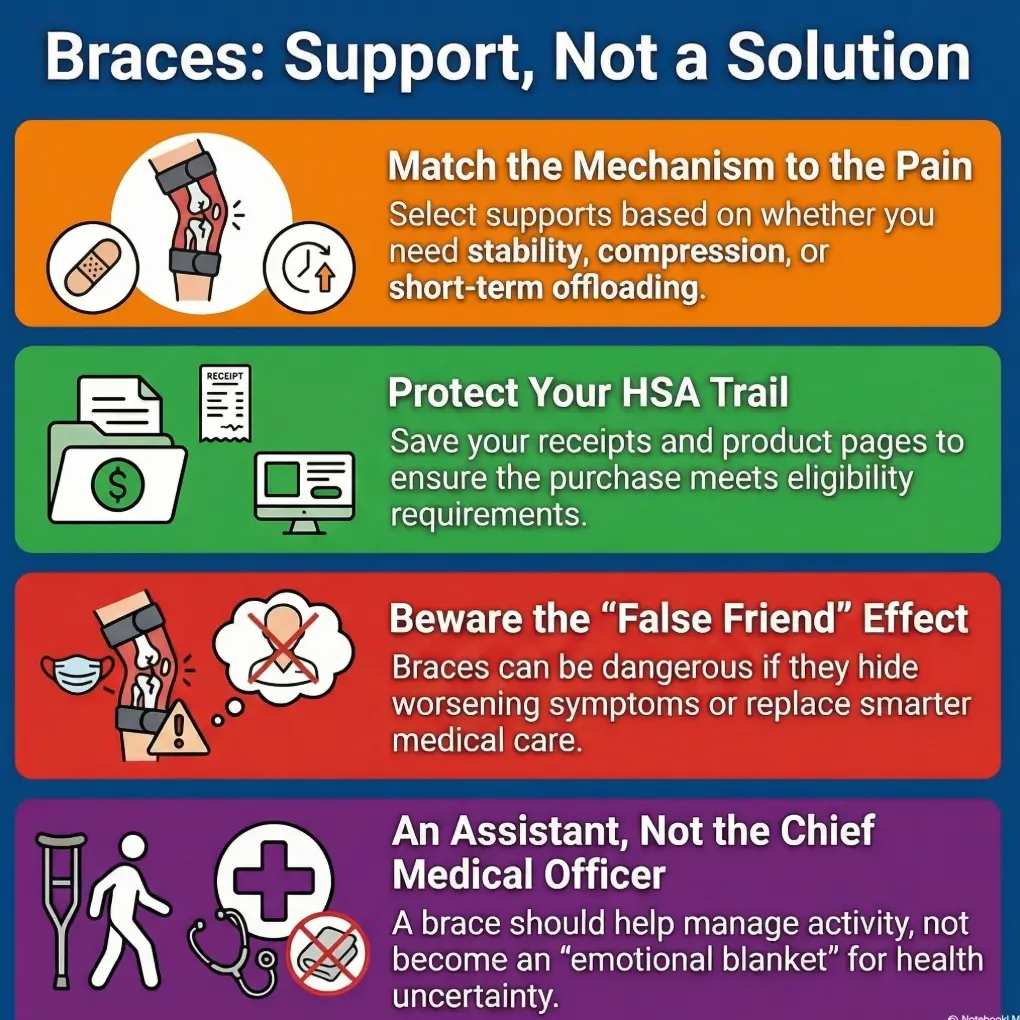
The safest frame is simple: use supports as tools, not verdicts. A support may reduce stress on a body part. It does not tell you why the pain started, whether it is improving, or whether you should keep loading through it. If your symptoms are escalating or drifting toward emergency territory, it helps to know the difference between a manageable flare and low back pain red flags that need urgent attention.
- Use it to support a plan, not replace one
- Escalating symptoms change the decision tree fast
- HSA language helps, but documentation still matters
Apply in 60 seconds: Before buying, write one sentence: “This support is for my __ pain during __ activity.” If that sentence is fuzzy, your purchase probably is too.
Start Here First: Who This Is For / Not For
Who this is for
This guide is for US adults trying to make orthopedic pain slightly less bossy without turning the whole process into a money leak. It is for the person comparing a knee brace with a sleeve, the office worker wondering whether a thumb splint is overkill, the recreational walker debating an ankle support, and the very practical soul asking, “Can I use HSA dollars on this without having future me hate present me?” Readers navigating a high-deductible plan may also want a broader look at orthopedic pain management on an HDHP, because the brace is often only one line item in a much longer receipt.
Who this is not for
This is not for severe or rapidly worsening symptoms that need diagnosis. It is not for readers looking for a blanket promise that anything labeled “HSA eligible” is automatically right for their body. It is also not for people hoping a brace can moonlight as a substitute for evaluation after a fall, twist, pop, or sudden load event. That road often begins with optimism and ends with the phrase, “I thought I was being careful.”
One of my own recurring lessons, learned with the grace of a shopping cart wheel that refuses to go straight, is that readers under time pressure want permission to simplify. Fair enough. But the useful simplification is not “buy support.” It is “define the exact problem first.” That shift alone trims a shocking amount of waste.
- Is the item meant for medical support rather than general wellness?
- Is it for a specific pain point or body-area problem you can describe clearly?
- Can you keep the receipt and product listing if reimbursement questions appear later?
- Are you buying one targeted option instead of panic-ordering three?
Neutral next step: if you answered “no” to two or more, pause the purchase and narrow the use case first.
Pain First, Product Second: What Problem Are You Actually Trying to Solve?
Stability pain: when the joint feels unreliable, not just sore
Some pain is loud but structurally calm. Other pain arrives with that unnerving sensation that the joint is not entirely committed to being a joint. The ankle that rolls a little too easily. The knee that feels odd on stairs. The thumb that objects during grip and pinch. In those cases, support is often about stability and motion control, not merely comfort.
Compression pain: when support helps you feel “held together”
Compression can feel terrific because it changes body awareness. You feel contained. Sometimes that is genuinely helpful for mild swelling or symptom relief. Sometimes it is just a very expensive hug. MedlinePlus notes that splints, braces, and assistive devices can be part of symptom management for some musculoskeletal conditions, which is useful, but still a long way from saying every ache deserves a wrap.
Motion-triggered pain: when certain angles light the fuse
If pain appears only during stairs, typing, lifting, or sleep position changes, you already have a better buying filter than most marketplaces will ever provide. That pattern is gold. A support should be chosen around the motion that provokes symptoms, not around the broad emotional category of “my body is being rude.”
Recovery pain: when the goal is calming tissue, not powering through
Short-term support can make sense when the aim is to reduce aggravation and create a window for recovery habits. The trap is assuming relief equals healing. Those are cousins, not twins.
Let’s be honest: most shoppers are not really asking, “Which brace is best?” They are asking, “Which one gives me enough relief to get through the week without making this worse?” That is a good question. It is just not solved by star ratings alone. In many cases, the better sequence is support plus a real plan for physical therapy and conservative care, not support as a solo act.
Show me the nerdy details
From a biomechanics perspective, supports usually do one or more of four things: increase proprioceptive awareness, limit or guide motion, add compression, or redistribute load. Those are different mechanisms. If you do not know which mechanism you need, product comparison becomes theater with thumbnails.
Body Part Changes Everything: The Brace That Works for One Joint Fails on Another
Knee supports: walking, stairs, standing, and exercise are not the same use case
Knees are divas. A sleeve that feels fine for a slow grocery run can be useless on stairs. A more structured brace can feel reassuring for one problem and deeply annoying for another. If symptoms center on motion control or instability, structure matters more than soft compression. If the issue is mild swelling or vague soreness, a simple sleeve may be enough. The expensive mistake is buying a heroic-looking hinged contraption for a problem that mostly needed a modest, wearable solution.
Wrist and thumb supports: desk pain versus lifting pain versus nighttime pain
Wrist pain is a category with too many roommates. Keyboard strain, lifting strain, nighttime irritation, thumb-base pain, and overuse all create different support needs. MedlinePlus notes that various wrist splints may help symptoms, and that some people may need night use more than daytime use. That detail matters because wear timing can be as important as the device itself. If your symptoms are clearly rooted in workstation habits, it may help to pair support choices with better keyboard and mouse placement at a desk job rather than expecting a brace to compensate for every ergonomic sin.
Back supports: occasional unloading versus daily dependence
Back supports produce unusually strong placebo romance. You put one on, stand taller, and suddenly believe the rest of your life will be supervised and orderly. Sometimes a back support is useful for short bursts or specific tasks. Sometimes it quietly becomes the manager of every chore. That is where trouble starts. Readers comparing options in that lane may also want a deeper look at when back braces for lumbar stenosis actually make sense.
Ankle and foot supports: stability, swelling, and shoe fit create different winners
The most practical ankle support in the world is useless if it does not fit inside the shoe you actually wear. This sounds obvious until you buy something sturdy, discover it only works with one pair of shoes, and then begin living like a hostage to your footwear. For sprains and soft-tissue injuries, AAOS notes that moderate sprains often require a period of bracing, but the exact device type depends on the injury and severity.
Elbow and shoulder supports: where “support” can quietly turn into frustration
Upper-limb supports are often less forgiving. A device can migrate, bunch, rub, or simply annoy you into noncompliance. And a support you stop wearing is not “good value.” It is a fabric monument to optimism.
- Choose first by body part, then by symptom pattern
- Wearability matters as much as advertised support level
- The wrong structure can be as unhelpful as no structure
Apply in 60 seconds: Name the exact joint, the aggravating movement, and whether you need compression, motion control, or temporary offloading.

The Hidden Filter: HSA Eligible Does Not Mean Universally Smart to Buy
What “qualified medical expense” really signals for readers
Here is the plain-English version. “HSA eligible” is helpful retail shorthand, but the tax concept underneath it is “qualified medical expense.” The IRS says HSA distributions used for qualified medical expenses are not taxed, and its Form 8889 instructions point readers back to the rules used for medical expenses generally. That means the real question is not whether a product page uses agreeable language. It is whether the purchase fits the underlying medical-expense framework and your own unreimbursed situation.
Why marketplace labels can help, but should not replace judgment
Retailers are trying to reduce friction. That is understandable. But “eligible” in a storefront can invite lazy thinking, especially around posture gadgets, comfort products, or items drifting toward general wellness. The IRS medical-expense FAQ around nutrition, wellness, and general health is a useful reminder of the boundary: not everything that feels healthy or sensible is a medical expense in the tax sense. The same caution applies when people start piling a brace onto a bigger spending stack without understanding self-pay cash price ranges or how one extra purchase changes the month’s treatment budget.
Receipts, product pages, and packaging: what to save before reimbursement
Keep the receipt. Save the product page as a PDF or screenshot. Keep packaging if it clarifies what the device is intended to do. This is not bureaucracy for sport. It is a hedge against future ambiguity. And ambiguity, in finance, has a way of showing up at the least charming moment.
Borderline purchases: where readers get sloppy and regret it later
The expensive mistake is not always buying the wrong brace. Sometimes it is buying the right category for the wrong reason, then having no paper trail when reimbursement questions appear later. I have watched people be wildly organized about comparing prices and utterly casual about documentation, which is like polishing the silverware while leaving the front door open.
| Situation | Better move |
|---|---|
| Clear joint support for a specific problem | Buy one targeted item and save documentation |
| General posture or wellness gadget with vague claims | Pause and verify fit for your actual medical use case |
| Impulse bundle of multiple supports | Reduce to one body area and one activity first |
Neutral next step: document why you are buying the item before you buy it.
Don’t Buy by Pain Level Alone: Match the Brace to the Activity That Triggers It
For walking and standing pain
If symptoms emerge after 15 to 30 minutes of standing or during regular walking, the support decision should focus on load tolerance, shoe compatibility, and whether the problem feels unstable or simply irritated. A device that works brilliantly on the couch but fails in a shoe is a fine prop and a poor solution. If the real issue is that symptoms bloom the longer you are upright, readers may also find useful context in why pain can worsen while walking or what standing in line does to an irritated back or leg.
For desk work and repetitive strain
Desk pain often tempts people into over-bracing. The fantasy is understandable: strap on certainty, answer email, become bionic. In reality, many repetitive-strain problems respond best when the support is used thoughtfully, sometimes during sleep or during the most irritating tasks rather than every waking hour. MedlinePlus specifically notes that some wrist splints may be most useful at night first. If your workday setup is part of the problem, compare the brace question with a smarter sit-stand schedule for desk-job pain or even the larger furniture choice of an ergonomic chair versus a standing desk.
For sleep-related discomfort
Nighttime pain changes the game because the goal is not performance but positioning. Bulky devices that feel protective by day can be absurdly intrusive at night. If you dread wearing it to bed, compliance will collapse by Tuesday. In those cases, positioning tools and sleep setup sometimes matter more than gear, which is why some readers do better after learning how to sleep with sciatica more strategically or deciding between a knee pillow and a body pillow for night support.
For return-to-exercise decisions
A brace can provide confidence during a return-to-exercise phase, but confidence is not a substitute for progression. MedlinePlus advice on shin splints is a quiet reminder of the broader principle: do not rush back to previous intensity, and build gradually. Supports may help manage the path back, but they do not cancel tissue reality. That is equally true whether you are debating a return to running or testing whether the treadmill or elliptical is the less provocative choice.
For flare days versus everyday management
Some devices earn their keep as flare-day tools, not daily uniforms. That distinction saves money and reduces dependence. Your body does not need every support to become part of your personality.
Rule of thumb: buy for the activity that reliably triggers symptoms. Do not buy for the abstract idea of being “someone with pain.” That category is too broad to be useful and too expensive to be left unsupervised.
Common Mistakes That Turn “Support” Into a Setback
Wearing too much brace for too little problem
Over-structuring a mild problem can create its own friction. You move awkwardly, avoid useful motion, and start interpreting ordinary sensations as danger. There is a whole genre of overcorrection that begins with responsible intentions and ends with your body acting like a suspicious committee.
Wearing too little brace for an unstable joint
The opposite mistake is buying the softest, cutest, least-intrusive option for a problem that actually needs more control. If the joint feels unreliable, minimal compression may feel pleasant while changing almost nothing that matters.
Tightening for reassurance instead of fit
People love to overtighten. It feels decisive. It can also create skin problems, numbness, pressure spots, and that deeply unromantic awareness that circulation was apparently optional. MedlinePlus first-aid guidance warns that splints should not be tied too tightly because doing so can cut off blood flow. Different scenario, same cautionary music.
Using pain relief as proof of healing
This one is a classic. “It feels better in the brace, so I must be better.” Perhaps. Or perhaps the device is temporarily changing the load and motion enough to calm symptoms while the underlying problem remains delightfully unimpressed. The same illusion shows up when people confuse a calmer symptom day with a resolved condition after imaging, even though MRI findings and pain do not always match cleanly.
Replacing rehab habits with gear accumulation
There is a moment when buying another support becomes a hobby. This is rarely the moment of peak wisdom. If your cart starts looking like a small orthopedic costume department, step back.
- Too much structure can create new problems
- Too little structure can waste time and money
- Relief during wear is not the same as true recovery
Apply in 60 seconds: Ask: “What exactly is this device changing for me, compression, motion, load, or confidence?” If the answer is only confidence, keep looking.
Don’t Do This: The Shopping Behaviors That Waste HSA Money Fast
Buying three versions before defining the actual pain pattern
Bulk confusion is still confusion. Ordering a sleeve, a wrap, and a brace “to see what works” may feel efficient, but it often produces comparison fog. You will not learn much if the use case is still vague.
Trusting only star ratings from people with a different condition
A five-star review from someone with gym-related knee irritation tells you very little if your issue is post-injury instability on stairs. Review sections are emotional weather systems, not diagnostic maps.
Treating posture devices like universal cure-alls
Posture products attract heroic marketing because they promise simplicity. Bodies, meanwhile, remain committed to nuance. Vague posture promises are often where buyers drift from orthopedic support toward general-wellness ambiguity, which is exactly the zone that deserves extra caution on both usefulness and HSA logic.
Ignoring return policies, sizing charts, and material tolerances
The most accurate product category in the world still fails if the sizing is wrong, the fabric irritates your skin, or the closure system makes you swear before breakfast. A return policy is not a nice bonus. It is part of the value calculation.
Assuming “doctor recommended” language means much on its own
That phrase can mean many things and explain almost nothing. What matters more is the support design, the intended use, and whether it fits your actual symptom pattern. The same goes for cost language: a product can sound “worth it” until you compare it against the broader cost of living with chronic back pain or the price of a more targeted medical evaluation.
- Your exact pain trigger: stairs, typing, lifting, sleep, walking, or standing
- Your body area and whether the issue feels unstable, swollen, stiff, or motion-sensitive
- Your preferred wear window: day, night, workouts, chores, or flare days only
- Your shoe or clothing constraints
- Your documentation habit: receipt saved, product page saved, packaging kept
Neutral next step: compare products only after this list is complete.
Short-Term Relief, Long-Term Risk: When Support Helps and When It Starts Running the Show
The case for temporary offloading
There is nothing wrong with temporary help. In fact, sometimes it is exactly what you need. AAOS describes how braces or immobilization can be used in certain injury contexts to rest an area and reduce aggravation. That is the sensible use case: create a calmer window, reduce stress, and pair the support with a larger recovery plan.
The risk of over-reliance during daily life
But supports can drift from tool to supervisor. You begin reaching for the brace before every normal task. Confidence narrows. Movement shrinks. And the line between “this helps” and “I no longer trust myself without it” gets blurry.
When braces support recovery
Braces support recovery best when they have a job description: reduce irritation during a certain phase, during a certain task, for a certain period. Temporary offloading with a purpose is strategy.
When braces quietly shrink confidence and strength
They become a problem when they replace all other adaptation. If the brace is doing the emotional work of making you feel safe, but nothing else in the plan is changing, you are renting reassurance rather than building resilience. That is often the moment to think beyond the device and revisit whether physical therapy for chronic low back pain or a more structured treatment path belongs in the picture.
How to think in phases, not forever-products
Think in phases. Flare phase. Walking phase. Return-to-gym phase. Workday phase. This keeps the device in proportion and prevents the classic trap of treating a temporary support like a lifelong identity badge.
Short Story: A friend once bought a premium back brace after a week of angry lower-back pain. It looked so capable that you half expected it to file taxes. For three days, he wore it for everything, including loading the dishwasher with the solemnity of a moon mission. By week two, the pain was only slightly better, but his confidence without the brace had cratered.
What finally helped was boring and unglamorous: reducing the most irritating tasks, taking movement breaks seriously, and using the brace only for the chores that reliably provoked symptoms. The expensive lesson was not that the brace was bad. It was that he had asked it to become a lifestyle instead of a tool.
Show me the nerdy details
Behaviorally, supports can create a feedback loop: symptom relief increases perceived safety, perceived safety increases use, and increased use can outgrow the device’s original purpose. The solution is not anti-brace ideology. It is explicit wear criteria and scheduled reassessment.
Price Tag vs Payoff: How to Judge Value Without Buying the Most Dramatic Device
Low-cost supports that may be enough
Sometimes the unglamorous option is the adult answer. A basic sleeve or simple strap can be enough when the goal is light compression, awareness, or minor support. If it addresses the actual trigger, the lower price is not “settling.” It is good judgment wearing sensible shoes.
Mid-range braces that solve fit and comfort better
Mid-range products often justify themselves through wearability. Better closures. Better contouring. Less sliding. More durable stitching. The best brace is frequently not the strongest one. It is the one you will actually wear correctly for the right tasks.
Premium models: when the upgrade is real and when it is theater
Premium pricing makes sense when the design meaningfully changes function, fit, durability, or motion control. It is theater when the upgrade is mostly branding, larger plastic components, or a confidence costume that does not solve your use case.
Durability, washability, and repeat-use math
If you will wear the support three times a week for three months, comfort and washability matter. If it smells like regret after four uses, its cost per wear starts to look less elegant.
The real cost of a brace that slides, pinches, or gets abandoned
The real waste is not always the sticker price. It is the brace you stop wearing after 20 minutes. The one that pinches behind the knee. The one that rolls at the wrist. The one that makes shoe fit impossible. Cheap but usable beats premium and exiled to a closet. And if you are weighing gear against the possibility of other interventions, it helps to understand the broader economics of a visit, including what a joint injection consultation can actually cost.
| Tier | Typical logic | Watch-out |
|---|---|---|
| Low-cost | Mild compression or short-term trial | May not control motion enough |
| Mid-range | Better fit, closures, and comfort | Still useless if category is wrong |
| Premium | Worth it only when structure and wearability truly matter | Can become “hero product” theater |
Neutral next step: buy the least dramatic device that still solves the actual job.
The Fit Test at Home: How Readers Can Tell a Brace Is Helping, Not Just Squeezing
Signs the brace is doing useful work
A helpful brace usually makes the target activity feel more controlled, more tolerable, or less provocative without creating new problems somewhere else. You should feel support, not captivity. You should also be able to describe what changed. “It feels steadier on stairs.” “Typing hurts later, not sooner.” “My ankle feels less wobbly in the shoe I actually use.”
Signs the fit is wrong
Red marks that linger, slipping, rolling, pinching, bunching, or a strange new ache are all useful data. The body is a better reviewer than the comments section. Listen to it first.
Skin, swelling, numbness, and pressure warnings
Numbness, tingling, color changes, or increasing swelling are not “breaking it in.” They are warnings. That is especially true if you tightened the device into a private argument with your circulation.
The 20-minute, 2-hour, and next-morning check
This is the home fit test I trust most. Check at 20 minutes for immediate discomfort. Check at 2 hours for sliding, pressure, skin irritation, and whether it still feels helpful. Check the next morning for delayed irritation or the weird surprise of feeling worse after a full wear cycle. Three checkpoints. A surprisingly honest conversation.
When to stop wearing it and reassess
If the brace creates new symptoms, if the original pain worsens, or if the benefit is only “I panic less” without any real functional gain, reassess. The goal is helpful support, not a wearable superstition.
Is it instability, compression relief, motion-triggered pain, or flare recovery?
Walking, typing, stairs, lifting, sleep, exercise, or standing?
Compression, motion control, offloading, or positioning?
Save the receipt, product page, and reason for purchase.
When to Seek Help Instead of Another Brace
Pain after a fall, twist, pop, or sudden load
A new mechanical event changes the story. If the pain followed a twist, fall, pop, or sudden load, you are no longer in generic “support shopping” territory. You are in “this may need proper evaluation” territory.
Numbness, tingling, weakness, or color change
Neurologic symptoms and circulation changes are not decorative details. They are flags. Do not try to out-accessorize them.
Swelling that increases instead of settles
A good support plan should not accompany steadily worsening swelling or escalating dysfunction. That is not a shopping problem. That is a clinical one.
Pain that wakes you, lingers, or spreads
Night pain, pain that starts traveling, or pain that outlasts reasonable modification deserves a better answer than another product thumbnail.
Symptoms that keep returning despite “helpful” supports
If the brace seems to help but the problem keeps boomeranging back, that is useful information. You may be managing consequences without addressing the cause. Many people delay help because the brace provides just enough relief to keep the cycle going. It is the medical equivalent of putting a tasteful rug over a creaky floorboard and calling the house repaired. If your symptoms include severe neurologic changes, it is worth recognizing red flags such as cauda equina warning signs rather than shopping for a more ambitious brace.
- New injury mechanics deserve evaluation
- Numbness, weakness, or color change are escalation signs
- Recurrence matters more than temporary relief
Apply in 60 seconds: If you have a red-flag symptom, stop comparing products and change the goal from shopping to getting assessed.

FAQ
Are braces and supports usually HSA eligible in the US?
Some are, especially when they fit the IRS concept of qualified medical expenses. But “usually” is not a magic word I would trust with tax-adjacent purchases. The safer approach is to look at the item’s medical purpose, keep documentation, and avoid drifting into vague wellness territory. The IRS says qualified medical expenses for HSA purposes are generally unreimbursed medical expenses that would otherwise qualify under its medical expense rules.
Do I need a prescription for an HSA eligible orthopedic brace?
Not always. Some items can qualify without a prescription, depending on the product and circumstances. But edge cases are exactly where people become overconfident. If the item sits in a gray zone, confirm with your HSA administrator or tax professional and keep stronger documentation than you think you need.
Can I use HSA money for a knee brace bought online?
Potentially yes, if the purchase fits the qualified-medical-expense rules and is not otherwise reimbursed. Buying online does not disqualify the item. What matters is what it is, why you bought it, and whether you can document the purchase cleanly.
What is the difference between a compression sleeve and a medical support brace?
A compression sleeve mainly provides pressure and body awareness. A medical support brace often adds more structure or motion control. One is not morally superior. They simply do different jobs. Choose based on the problem you are trying to solve.
Is a posture corrector treated the same way as a joint support?
Not necessarily. This is where shoppers should be cautious. Products marketed broadly for posture, wellness, or comfort may be less straightforward than supports aimed at a specific joint or orthopedic function. Use extra judgment here.
Can I reimburse myself later if I paid out of pocket first?
In many cases, HSA owners can reimburse themselves later for qualified medical expenses incurred after the HSA was established, assuming they kept proper records. The IRS training material on qualified medical expense distributions states that tax-free distributions can reimburse qualified expenses incurred after the HSA is established.
What records should I keep for HSA purchases?
Keep the receipt, date of purchase, product listing, and anything that clarifies the medical purpose of the item. If there is any ambiguity, stronger documentation is your friend. Future you deserves fewer mysteries, not more.
When does wearing a brace too often become a problem?
When it starts replacing sensible movement, confidence, or reassessment rather than supporting them. If you feel unable to do routine activities without the device, or if symptoms recur the moment it comes off, pause and reassess the plan instead of doubling down on wear time.
Next Step
Pick one pain pattern, one body area, and one activity you want to protect this week
That is the whole move. Not “find the best brace.” Not “optimize my entire orthopedic future before lunch.” Just one pain pattern, one body area, one activity. Stairs. Keyboard use. Walking. Sleep. Lifting. Then compare supports only within that narrow lane, and save the product page and receipt if you buy. That small constraint prevents a surprising number of expensive detours.
The curiosity loop from the beginning closes here: the box on your doorstep is not the plan. The plan is the thinking that happens before the box exists. Done well, a brace can reduce friction, buy you breathing room, and help you protect an irritated joint while you do smarter things around it. Done badly, it becomes a soft monument to panic buying with respectable typography.
Your 15-minute action step: write down the joint, the trigger, and the job the support must perform. Then rule out any product that cannot clearly serve that one job. It is not glamorous. It is not cinematic. It is, however, how adults keep both their bodies and HSA dollars from wandering off unsupervised. If that written plan starts revealing larger care questions, it may be time to think beyond the brace and into issues like what counts as failed conservative care before MRI approval or what to do after an MRI denial appeal in orthopedic pain management.
Last reviewed: 2026-03.
Relevant entities readers may encounter while researching this topic include the IRS, Form 8889, Publication 969, Publication 502, MedlinePlus, and the American Academy of Orthopaedic Surgeons. Those are better companions for this decision than a marketplace title trying to sound like destiny.