

Second Opinion Visit
A second opinion visit can feel oddly quiet on the outside and thunderous on the inside. You are sitting in a clean exam room, paper crinkling under your knees, while a life-sized decision waits in the corner: surgery, chemotherapy, a new medication, a diagnosis that does not quite fit, or a treatment plan that arrived too fast.
How to prepare questions for a second opinion is not really about collecting 42 impressive medical questions. It is about walking into the appointment with the real decision in your hands, the records that make the case visible, and enough language to ask, “What evidence would change the plan?”
Guessing can cost time, money, confidence, and sometimes safety. This guide helps you turn fog into a one-page plan: what to bring, what to ask first, how to compare two opinions, and when waiting is not safe.
Here is the clean path.
- Start with the decision.
- Bring the proof.
- Ask for the reasoning.
- Leave with the next safe step.
The Second Opinion Visit Is a Decision Meeting
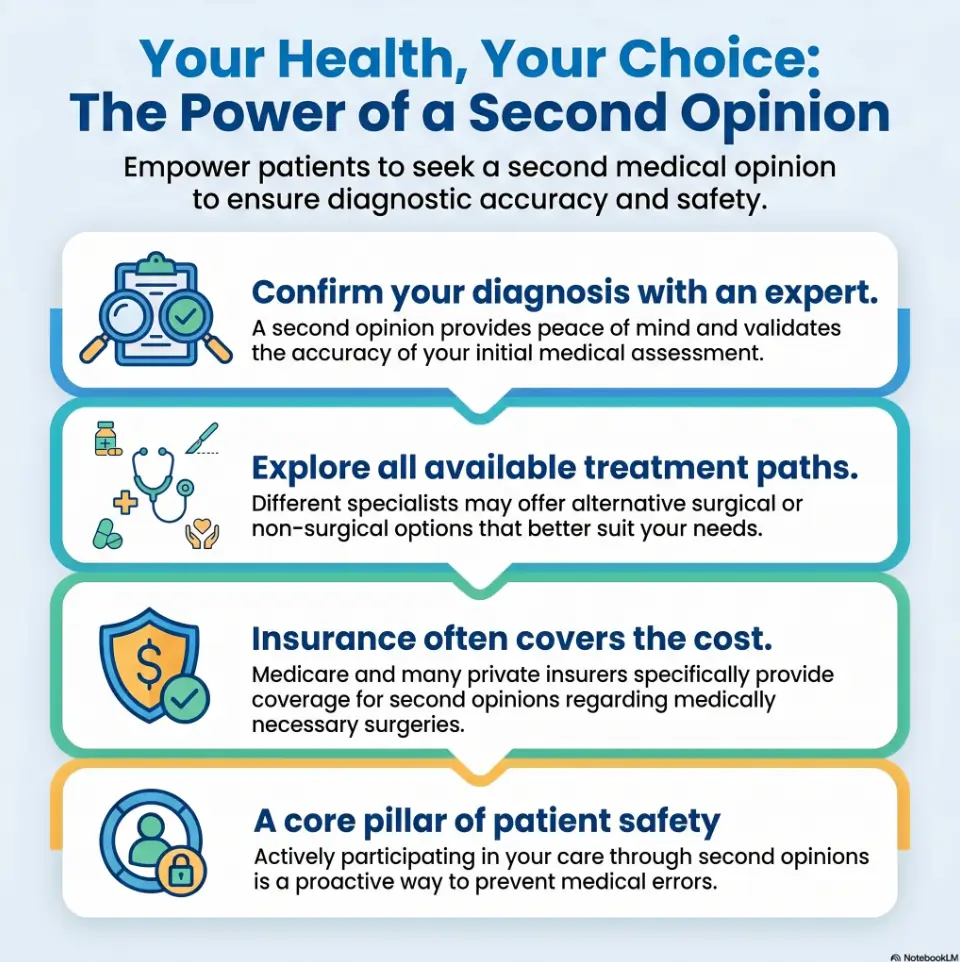
A good second opinion does three things: it checks the diagnosis, compares reasonable options, and clarifies timing. The best questions do not attack the first doctor. They make the medical reasoning visible.
Fast answer: Prepare by writing your main decision in one sentence, gathering medical records and imaging, ranking your top five questions, and asking the second doctor where they agree, where they differ, and what evidence matters most.
Table of Contents
Safety and Disclaimer
This guide is for general education only. It is not medical advice, diagnosis, treatment guidance, insurance advice, or a substitute for a licensed clinician who knows the patient’s full history.
A second opinion can be wise, especially before major surgery, a serious diagnosis, or a treatment with lasting side effects. But it should not delay emergency care, urgent treatment, or time-sensitive therapy. If symptoms are severe, suddenly worsening, or life-threatening, seek immediate medical help.
For orthopedic pain, surgery decisions, imaging uncertainty, or specialist referrals, it may also help to prepare with an orthopedic appointment checklist before asking a new clinician to review your case.
- Use it for major, uncertain, expensive, or risky decisions.
- Do not use it to postpone emergency symptoms.
- Ask your current doctor whether waiting is medically safe.
Apply in 60 seconds: Write, “Is it safe for me to wait for this second opinion?” at the top of your question list.
Start With the Real Decision, Not a Pile of Symptoms
The easiest way to waste a second opinion is to arrive with a suitcase full of symptoms but no clear decision. Symptoms matter, of course. They are the smoke. But the doctor also needs to know where the fire alarm is pointing.
Before the appointment, name the fork in the road. Are you trying to confirm a diagnosis? Avoid unnecessary surgery? Choose between two treatments? Understand whether a medication is worth the side effects? Decide whether waiting is safe?
Name the fork in the road
A clear decision sounds like this:
- “I need to know whether surgery is necessary now.”
- “I need to know whether the diagnosis explains all of my test results.”
- “I need help comparing medication, therapy, and a procedure.”
- “I need to know whether it is safe to wait two weeks.”
That one sentence becomes your compass. Without it, the appointment can drift into a polite tour of medical history. Everyone nods. Nothing lands.
Turn anxiety into a one-sentence mission
Anxiety is not useless. It is raw energy without a filing system. Give it a sentence.
Try this format:
“The decision I need help making is whether I should choose [Option A], [Option B], or wait, because [main concern].”
For example: “The decision I need help making is whether I should have knee replacement this year, continue injections and therapy, or wait, because pain is limiting work and stairs.”
If pain is part of your case, a detailed description can sharpen the appointment. A guide on how to describe pain to a doctor can help you turn “it hurts everywhere” into useful clinical detail.
The question behind the question
Many patients ask, “What should I do?” That is understandable, but it is too heavy for one question. A stronger version is: “What evidence would make you choose Option A over Option B for someone like me?”
That question asks the doctor to show the hinge, not just the door.
Money Block: Decision Card
| If your main worry is… | Ask this first |
|---|---|
| Diagnosis uncertainty | “Do you agree with the diagnosis, and what evidence matters most?” |
| Surgery pressure | “What happens if I wait, and what would make surgery urgent?” |
| Side effects | “What trade-offs matter most for daily function and long-term health?” |
| Cost or access | “Which parts need authorization, imaging review, or in-network care?” |
Neutral action line: Choose the row that matches your real worry and make that your first question.
Bring the Records That Let the Doctor Think Clearly
A second opinion without records is like asking a mechanic to diagnose a car from the sound you imitate in the parking lot. Brave, theatrical, and not ideal.
The second doctor needs the evidence, not just the story. Your story matters because it explains the lived problem. The records matter because they let the doctor test the story against labs, imaging, procedures, pathology, medication history, and previous reasoning.
The must-have medical packet
Bring or upload these when they apply:
- Recent visit notes and specialist notes
- Lab results with dates and reference ranges
- Imaging reports such as X-ray, CT, MRI, ultrasound, or PET reports
- Actual imaging files when requested, often on disc, portal transfer, or cloud link
- Pathology reports and biopsy results
- Operative reports from prior surgery
- Medication list, including dose and schedule
- Allergies and previous medication reactions
- Prior procedures, injections, therapy, or hospitalizations
- A short symptom timeline
If your case involves musculoskeletal pain, function matters too. A functional pain assessment can help you describe what pain prevents: stairs, sleep, work, driving, dressing, lifting, walking, or caregiving.
Don’t rely on memory when the stakes are high
Memory is a foggy little intern. Useful, yes. But not the lead surgeon.
When stress rises, details scatter. You may remember that the scan was “bad” but not which level of the spine, which lesion, which lab marker, or whether the report used words like “mild,” “moderate,” “suspicious,” “stable,” or “progressive.” Those words can steer the whole appointment.
Ask what is missing before the visit
Call or message the second-opinion office before the appointment. Ask what they need to review the case properly. Some specialists need actual imaging, not just the report. Cancer specialists may need pathology slides. Surgeons may need prior operative reports. Insurance teams may need referral forms or authorization documents.
Money Block: Records Checklist
Answer yes or no:
- Do I have the original diagnosis or visit note?
- Do I have the proposed treatment plan in writing?
- Do I have recent labs and imaging reports?
- Do I have actual imaging files if the specialist requested them?
- Do I have a medication and allergy list?
- Do I have a one-page timeline of symptoms and major events?
Neutral action line: If you answer “no” to two or more, call the first office or patient portal before the second opinion visit.
Ask the Diagnosis Questions First, Before Treatment Takes the Wheel
Treatment questions are louder. They have names, schedules, costs, risks, and recovery times. Diagnosis questions are quieter, but they sit underneath everything.
A treatment plan built on an uncertain diagnosis is a staircase missing a step. You might still climb it, but your foot knows something is wrong.
“Do you agree with the diagnosis?”
This should be one of your first questions. It is not rude. It is the core of the appointment.
Ask the doctor to say whether they agree, partly agree, disagree, or need more information. That four-part answer is far more useful than a vague “looks reasonable.”
“What else could explain these results?”
Ask about alternative diagnoses, false positives, false negatives, borderline findings, and whether another specialist should review the case. In cancer care, for example, treatment decisions may depend on pathology, staging, biomarkers, imaging, and patient health. In orthopedic care, a painful MRI finding may not always be the pain generator.
If you have pain but imaging is confusing, normal X-ray but pain continues is a common situation where the question is not “Is the patient exaggerating?” but “What did the test show, and what did it not show?”
“Which test result matters most?”
This question reveals the doctor’s weighting system. Are they leaning most on pathology? Imaging? Symptoms? Physical exam? Family history? Disease stage? Prior treatment response?
Once you know the anchor, you can ask better follow-ups: “Is that result definitive?” “Could it be re-read?” “Would repeating the test change the plan?”
Show me the nerdy details
Second opinions often differ because clinicians weigh evidence differently. One doctor may prioritize imaging progression, while another may prioritize symptoms, pathology, exam findings, or risk tolerance. This does not automatically mean one person is careless. It may mean the evidence is incomplete, the diagnosis has uncertainty, or the patient’s goals change the best path. Your job is not to become a medical detective with a tiny hat. Your job is to ask which evidence drives the recommendation and what missing information could change it.

Make the Doctor Show Their Work
The most useful second-opinion question may be the least dramatic: “How did you reach that conclusion?”
It does not accuse. It invites reasoning. It also helps you compare two opinions without turning the appointment into a courtroom where everyone is wearing a stethoscope and no one wants to be cross-examined.
“How did you reach that conclusion?”
Ask the doctor to walk through the evidence in plain English. If they use medical terms you do not understand, stop them gently and ask for translation.
A good answer often includes:
- What diagnosis is most likely
- What findings support it
- What findings do not fit neatly
- What options are reasonable
- What risks matter if treatment is delayed
“Which guidelines or studies apply to my case?”
For cancer, major organizations such as the American Cancer Society and the National Cancer Institute encourage patients to ask prepared questions and understand treatment options. For surgery and Medicare coverage, Medicare explains that second surgical opinions may be covered when a doctor recommends a medically necessary surgery or major procedure.
Guidelines are not handcuffs. They are guardrails. Ask whether the recommendation follows standard care, whether your case has exceptions, and what patient-specific factors matter.
“What would change your mind?”
This is the hinge question. It reveals whether the recommendation is firm, conditional, or dependent on missing information.
Examples:
- “Would a pathology re-review change the plan?”
- “Would new imaging change the timing?”
- “Would physical therapy results change whether surgery is needed?”
- “Would a different lab result make medication safer or riskier?”
- Ask which facts drive the recommendation.
- Ask what information is missing.
- Ask what would change the plan.
Apply in 60 seconds: Add “What would change your mind?” as question number five on your list.
Compare Treatment Options Without Getting Lost in Medical Fog
Second opinions are especially useful when there is more than one reasonable treatment path. That is also when the conversation can become muddy. Medicine has many nouns. Some of them wear lab coats and charge facility fees.
“What are all reasonable options?”
Ask for the full set of reasonable options, not just the doctor’s favorite option. Depending on the condition, that may include:
- Standard treatment
- Watchful waiting or active surveillance
- Medication
- Physical therapy or rehabilitation
- Injections or procedures
- Surgery
- Lifestyle support
- Clinical trials
- Doing nothing for now, when medically appropriate
For orthopedic cases, the right “option list” may include conservative care, imaging, injections, therapy, bracing, surgery, or a referral to another specialist. If you are still deciding whether an MRI is the next right step, MRI referral for orthopedic pain may help you frame the records and timing questions.
“What happens if I wait?”
This question matters because some conditions allow careful review, while others are time-sensitive. Waiting one week for records may be reasonable in one case and dangerous in another.
Ask for a practical answer:
- “What is the safest waiting window?”
- “What symptoms mean I should not wait?”
- “Could waiting make treatment less effective?”
- “Could waiting help avoid unnecessary treatment?”
“What are the trade-offs, not just the benefits?”
Benefits are the brochure. Trade-offs are the kitchen after everyone leaves.
Ask about side effects, recovery time, pain, cost, work disruption, fertility, mobility, sleep, driving, caregiving, long-term monitoring, and quality of life. If the plan involves joint replacement or orthopedic recovery, articles such as joint replacement pain management and choosing rehab after surgery can help you think through daily-life consequences.
Do we agree?
What matters most?
What is reasonable?
Can I safely wait?
Can I access it?
Use this framework: If a second opinion does not answer all five, ask what remains unresolved before you leave.
Common Mistakes That Make Second Opinions Less Useful
A second opinion can be powerful, but it is not magic. It works best when you bring the right context and avoid a few appointment gremlins.
Mistake 1: asking only, “What would you do?”
That question can help, but it is too broad by itself. Better: “What would you recommend, and what facts are driving that recommendation?”
Doctors are people. They have training, experience, and preferences. You want the medical reasoning, not just the final vote.
Mistake 2: hiding the first opinion
Some patients worry that showing the first opinion will bias the second doctor. That concern is human. But hiding the first plan usually makes the visit weaker.
A second opinion works best when the doctor can see the original diagnosis, test results, imaging, and proposed plan. The goal is not to stage a medical blind audition.
Mistake 3: bringing 37 questions with no ranking
Bring the full list if you need to. But mark the top five. Put the urgent decision first.
When everything is urgent, nothing gets answered clearly. A ranked list protects the appointment from wandering off into the weeds wearing a tiny backpack.
Mistake 4: forgetting insurance and logistics
Even a perfect recommendation has to pass through the earthly gates of coverage, referrals, network rules, appointment availability, and cost. Ask whether treatment must happen at a specific hospital, whether the specialist is in network, and whether preauthorization is needed.
If you are dealing with insurance denials or specialist access, denied second opinion for orthopedic pain and orthopedic referral wait times may help you prepare the next practical step.
Money Block: Quote-Prep List for the Appointment Office
Before you schedule or transfer care, gather:
- Insurance card and plan name
- Referral requirements, if any
- Prior authorization status
- Whether the doctor, facility, lab, and imaging center are in network
- Estimated visit fee, imaging review fee, or pathology review fee
- Whether telehealth is available for record review
Neutral action line: Call the office with this list before the appointment, not after the bill arrives wearing tap shoes.
Don’t Do This: The Questions That Sound Smart but Don’t Help
Some questions feel strong in the moment but lead to weak answers. They put the doctor in a defensive position or chase certainty that medicine cannot honestly provide.
“Is the first doctor wrong?”
A better version is: “Where do you agree or disagree with the first assessment, and why?”
This keeps the focus on evidence. It also makes room for partial agreement, which is common. The second doctor may agree with the diagnosis but disagree on timing. Or agree with surgery but recommend a different approach.
“Can you guarantee this will work?”
A better version is: “What outcome range should I realistically expect, and what are the biggest uncertainties?”
Guarantees belong to toaster warranties, not complex bodies. What you need is a realistic range: best case, likely case, hard case, and what would happen if the first plan fails.
“What is the newest treatment?”
New is not always best. Sometimes it is promising. Sometimes it is expensive confetti. Ask whether the newest option is proven, appropriate, available, covered, and safer than standard care.
For spine and pain procedures, for example, comparing approaches matters more than chasing novelty. A guide such as TFESI vs interlaminar ESI for sciatica shows why technique, diagnosis, and patient fit matter.
Short Story: The Folder on the Passenger Seat
Marianne almost canceled her second opinion because she felt disloyal. Her first surgeon had been kind. The office staff knew her voice. The plan sounded reasonable enough, at least until she tried to explain it to her daughter and realized she could not say why surgery had to happen before summer.
The night before the appointment, she put a blue folder on the passenger seat: MRI report, medication list, therapy notes, and five questions written in block letters. The second doctor did not dismiss the first plan. He agreed surgery might be needed. But he pointed to one missing detail: her function had improved after a recent injection, and the timing was not as urgent as she feared. She left with a monitoring plan and a date to reassess. The folder did not make the decision easy. It made the next step honest.
Who This Is For and Not For
Second opinions are not only for rare diseases or dramatic TV-medicine moments. They are for meaningful decisions where the cost of misunderstanding is high.
This is for patients facing a meaningful decision
Consider a second opinion when you are facing:
- A new cancer diagnosis
- Major surgery
- A rare or unclear diagnosis
- Conflicting test results
- Chronic pain that is not improving
- A high-risk medication
- A treatment with serious side effects
- A recommendation that feels rushed or poorly explained
For back, hip, knee, or shoulder care, a second opinion may be useful when pain persists after therapy or imaging does not match symptoms. Related guides on physical therapy not helping orthopedic pain, MRI pain mismatch, and hip vs spine pain can help you organize the “why is this still happening?” part of the conversation.
This is also for caregivers
Caregivers can help organize records, take notes, track deadlines, listen for contradictions, and ask questions the patient may be too tired or overwhelmed to remember.
A caregiver does not need to become the family’s unpaid medical librarian, although many quietly do. A simple shared note with medications, dates, questions, and next steps can reduce the mental load.
This is not for delaying urgent care
Chest pain, stroke symptoms, severe allergic reaction, uncontrolled bleeding, suicidal thoughts, sudden weakness, severe shortness of breath, sudden confusion, or rapidly worsening symptoms need urgent or emergency care.
If your concern is severe low back pain with red flags, review emergency warning signs through a resource such as low back pain emergency or cauda equina syndrome red flags, and seek immediate care when symptoms match.
- Use it for clarity before surgery or high-risk treatment.
- Use it when diagnosis and symptoms do not line up.
- Skip the waiting game when emergency symptoms appear.
Apply in 60 seconds: Write one sentence: “I am seeking a second opinion because the decision affects…”
The Two Doctors Disagree Plan
Two different medical opinions can feel like standing between two orchestras playing different scores. The noise is real. But disagreement does not automatically mean one doctor is careless.
Sometimes the evidence allows more than one reasonable path. Sometimes one doctor has more subspecialty experience. Sometimes the missing piece is not medical at all, but personal: your risk tolerance, caregiving duties, job demands, transportation, finances, or goals.
Ask where the disagreement begins
Do not ask only, “Which one is right?” Ask where the split starts.
- Is it the diagnosis?
- Is it the test interpretation?
- Is it the treatment priority?
- Is it the timing?
- Is it the risk tolerance?
- Is it the patient’s personal goal?
Ask whether they can confer
When opinions differ, ask whether both doctors can review the case together or whether the second doctor can send a written summary. This is especially useful when care might transfer, when surgery is being considered, or when the diagnosis depends on imaging or pathology interpretation.
Here’s what no one tells you
Sometimes the second opinion does not give you a clean “yes” or “no.” It gives you a better map.
You may leave knowing the first doctor was reasonable, the second doctor sees another safe option, and the final decision depends on what trade-off you can live with. That may not feel tidy, but it is honest medicine.
Money Block: Coverage Tier Map for Conflicting Opinions
| Tier | What it means | Next step |
|---|---|---|
| Tier 1 | Doctors agree on diagnosis and plan | Ask about timing and risks |
| Tier 2 | Doctors agree on diagnosis but differ on treatment | Compare benefits, harms, and waiting window |
| Tier 3 | Doctors differ on diagnosis | Request record, imaging, or pathology review |
| Tier 4 | Missing evidence blocks the decision | Ask what test or report is needed |
| Tier 5 | Urgency is unclear | Ask how long waiting is medically safe |
Neutral action line: Identify your tier before choosing which opinion to follow.
Build a Question List That Fits a 20-Minute Visit
The perfect question list is not the goal. A usable list is.
Medicine already has enough marble hallways. Your questions should feel like handrails.
The five-question spine
Start with these five:
- Do you agree with the diagnosis?
- What evidence matters most?
- What are my reasonable options?
- What happens if I wait?
- What would you recommend and why?
These questions work because they follow the order of a real decision. Diagnosis first. Evidence second. Options third. Timing fourth. Recommendation fifth.
Add personal-context questions
Then add questions that reflect your actual life. Medicine happens in a body, but treatment happens in a calendar, a bank account, a bedroom, a kitchen, a workplace, and a family system.
Ask how the plan changes based on:
- Age and other health conditions
- Current medications
- Work demands
- Caregiving duties
- Pregnancy plans or fertility concerns
- Mobility limits
- Transportation
- Insurance coverage
- Travel distance
If surgery recovery is part of the decision, practical home questions matter. Guides on bathroom setup after shoulder surgery, knee replacement apartment setup, and wedge pillow after surgery can help you ask better recovery questions before you commit.
Let’s be honest
You may forget something. The doctor may run late. The portal may hide the report in a tab named something like “miscellaneous clinical document,” because apparently medicine needed a scavenger hunt.
That is why you rank the top five questions. If only five get answered, the appointment still works.
- Put diagnosis first.
- Ask what evidence matters most.
- Ask how timing changes risk.
Apply in 60 seconds: Circle your top five questions before the visit starts.
Money, Insurance, and Access Questions Patients Forget
Second opinions are medical decisions, but they are also access decisions. Coverage rules, referrals, network status, facility fees, and preauthorization can shape what is realistic.
This is not cynical. It is practical. A brilliant recommendation you cannot access is still information, but it may not be a plan.
“Is this visit covered?”
Ask whether the second opinion, imaging review, pathology review, telehealth visit, specialist consult, or additional testing is covered by insurance.
Original Medicare generally covers second opinions for medically necessary surgery or major procedures when a doctor recommends them, with normal Part B cost-sharing. Medicare may also cover a third opinion if the first and second opinions differ. Medicare Advantage plans have network and authorization rules, so call the plan before assuming coverage.
For orthopedic and spine costs, related planning pages such as orthopedic pain management with a high deductible, HDHP imaging cost estimate, and hospital outpatient vs ASC facility fee can help you ask the money questions earlier.
“Will treatment need to happen here?”
Some second opinions only provide recommendations. Others require you to transfer care. Ask clearly:
- “Can I take this recommendation back to my current doctor?”
- “Would you need to become my treating doctor?”
- “Would surgery or treatment happen at this facility?”
- “Can my local doctor coordinate follow-up?”
“What costs might surprise me?”
Ask about facility fees, out-of-network labs, anesthesia, imaging, genetic testing, prescriptions, rehabilitation, durable medical equipment, and follow-up visits.
For Medicare patients, also ask whether the clinician accepts assignment. For private insurance, ask whether the doctor, facility, anesthesiology group, imaging center, and lab are all in network. The tiny print has teeth.
When to Seek Help Now, Not Later
A second opinion should sharpen care, not stall it. The most important question may be, “Is it safe to wait?”
Emergency warning signs come first
Seek emergency care for chest pain, trouble breathing, stroke-like symptoms, severe bleeding, fainting, sudden confusion, severe allergic reaction, suicidal thoughts, sudden severe pain, sudden weakness, loss of bowel or bladder control, or rapidly worsening symptoms.
If you are unsure whether symptoms are urgent, call your doctor, nurse line, local urgent care, or emergency services based on severity. Do not let a scheduled second opinion become a velvet rope in front of needed care.
Call your doctor quickly if timing is unclear
Use direct wording:
“Is it medically safe for me to wait for a second opinion, and if so, how long?”
Ask them to name the warning signs that should change the plan. Write those signs down. Ask whom to call after hours.
Don’t let politeness become a health risk
Being gracious is lovely. Being untreated because you were afraid to ask is not.
A good clinician should understand why clarity matters. You are not betraying anyone by asking for another expert review. You are trying to make a decision inside a body you have to live in every day.
FAQ
What questions should I ask at a second opinion appointment?
Ask whether the doctor agrees with the diagnosis, what evidence supports it, what other explanations are possible, what treatment options exist, what happens if you wait, and what risks or side effects matter most.
Should I tell my doctor I’m getting a second opinion?
Usually, yes. It helps you obtain records, referrals, imaging files, and treatment summaries. Many doctors expect second opinions, especially for serious diagnoses, major surgery, or treatment plans with significant risks.
What records do I need for a medical second opinion?
Bring medical notes, lab results, imaging reports, actual imaging files if requested, pathology reports, medication list, allergy list, prior treatment history, and a current symptom timeline.
Can a second opinion change my diagnosis?
Yes. Sometimes it confirms the first diagnosis. Sometimes it changes the diagnosis, stage, test interpretation, timing, or treatment options. Even when the diagnosis stays the same, the second opinion may clarify why the plan makes sense.
How do I compare two different medical opinions?
Ask each doctor how they reached the recommendation, what evidence they weighted most, which guidelines apply, what risks they are trying to prevent, and what information would change their view.
Is it rude to ask for a second opinion?
No. It is a normal part of medical decision-making. It is especially reasonable when the diagnosis is serious, the treatment is invasive, the cost is high, or you do not understand the reasoning behind the plan.
How many questions should I bring?
Bring a full list, but mark the top five. Start with the decision that must be made soonest. A ranked list protects the appointment from getting swallowed by smaller concerns.
Can I bring someone with me?
Yes. A trusted person can take notes, remember details, ask follow-up questions, and help you compare what was said after the appointment. Ask the office about visitor rules if the appointment is in person.
Can I get a second opinion by telehealth?
Sometimes. Telehealth may work well for record review, imaging discussion, medication questions, or treatment comparison. It may not be enough when a physical exam, procedure planning, or urgent evaluation is needed.
What if insurance denies the second opinion?
Ask for the denial reason in writing, check whether a referral or prior authorization is missing, and ask about appeal rights. If the issue is orthopedic pain or surgery, documentation from your first clinician may help support medical necessity.
Next Step: Make Your One-Page Second Opinion Sheet
The appointment does not need to become a binder thick enough to stun a raccoon. One page can change the whole tone.
Create a document with four parts:
- Diagnosis or concern: What you have been told so far.
- Current recommendation: Surgery, medication, therapy, monitoring, testing, or treatment change.
- Top five questions: Diagnosis, evidence, options, timing, recommendation.
- Missing records checklist: Notes, labs, imaging, pathology, medication list, timeline.
The curiosity loop closes here: the second opinion is not about proving a doctor wrong. It is about making the decision visible enough to choose the next safe step.
Within the next 15 minutes, open a blank note and write: “The decision I need help making is…” Then list your top five questions. That small page can turn a stressful appointment into a clearer conversation.
- State the decision in one sentence.
- Bring the records that support review.
- Ask what evidence would change the plan.
Apply in 60 seconds: Start your note with: “The decision I need help making is…”
Last reviewed: 2026-05.