

Manage Sciatica While Standing in Theme Park Lines
Sciatica in “barely moving” queues is rarely about doing something “wrong”—it’s a static-load problem. This low-profile approach lets you change the input and unload irritated nerves without public stretching or drawing unwanted attention.
The Strategy: Subtle, Repeatable Resets
- • Tiny Micro-Movements: Change your position before the flare-up starts.
- • Subtle Weight Shifting: Use a hip-neutral stance to balance the load.
- • “Looks-Normal” Leans: Utilize rails or phone poses to unload the irritated side.
Run this loop every 30–60 seconds. It’s small enough for a packed line, specific enough to remember under distraction, and conservative enough to keep you on the safe side.
Safety / Disclaimer (read first): This is general education, not medical advice. Stop any move that increases leg pain, numbness, or weakness. Avoid aggressive stretching or “pushing through.” If you’ve had recent injury, surgery, or worsening symptoms, get clinical guidance.
Table of Contents
Who this is for / not for
This article is for the person who can walk around the park okay… but standing still in a line feels like your body is being slowly argued with. That’s a real pattern. Many people notice that motion helps and “statue mode” doesn’t.
Who it helps most
- Sciatica that flares when standing still (lines, queues, concerts, security lines).
- People who need low-profile movements in public.
- Mild-to-moderate symptoms where walking feels better than standing.
Small confession: I used to think the fix was “stand up straight and power through.” That lasted until the third line of the day—when my body staged a tiny protest and my mood followed.
Who should skip this and get help first
- New foot drop, new leg weakness, or rapidly worsening numbness.
- Loss of bowel/bladder control, or “saddle” numbness.
- Severe pain after a fall/accident, fever, or unexplained weight loss.
- Pain that’s escalating fast over days (not the same stubborn pattern over weeks).
- New weakness matters more than pain intensity.
- Fast-worsening numbness is a stop sign.
- If you’re unsure, choose caution over bravery.
Apply in 60 seconds: Do a quick self-scan: pain only vs. numbness/weakness. If it’s the latter, pause the plan and seek care.
Money Block: eligibility checklist (quick yes/no)
- Yes if: your main issue is pain that builds during standing still, and gentle movement eases it.
- No if: you have new weakness, major numbness, or severe pain after an injury.
- Maybe if: you’re unsure—start with the smallest moves and stop if symptoms worsen.
Next step: If you’re a “Yes/Maybe,” start with the 60-second reset cycle below for 3 minutes.
Why “standing still” hits harder than walking
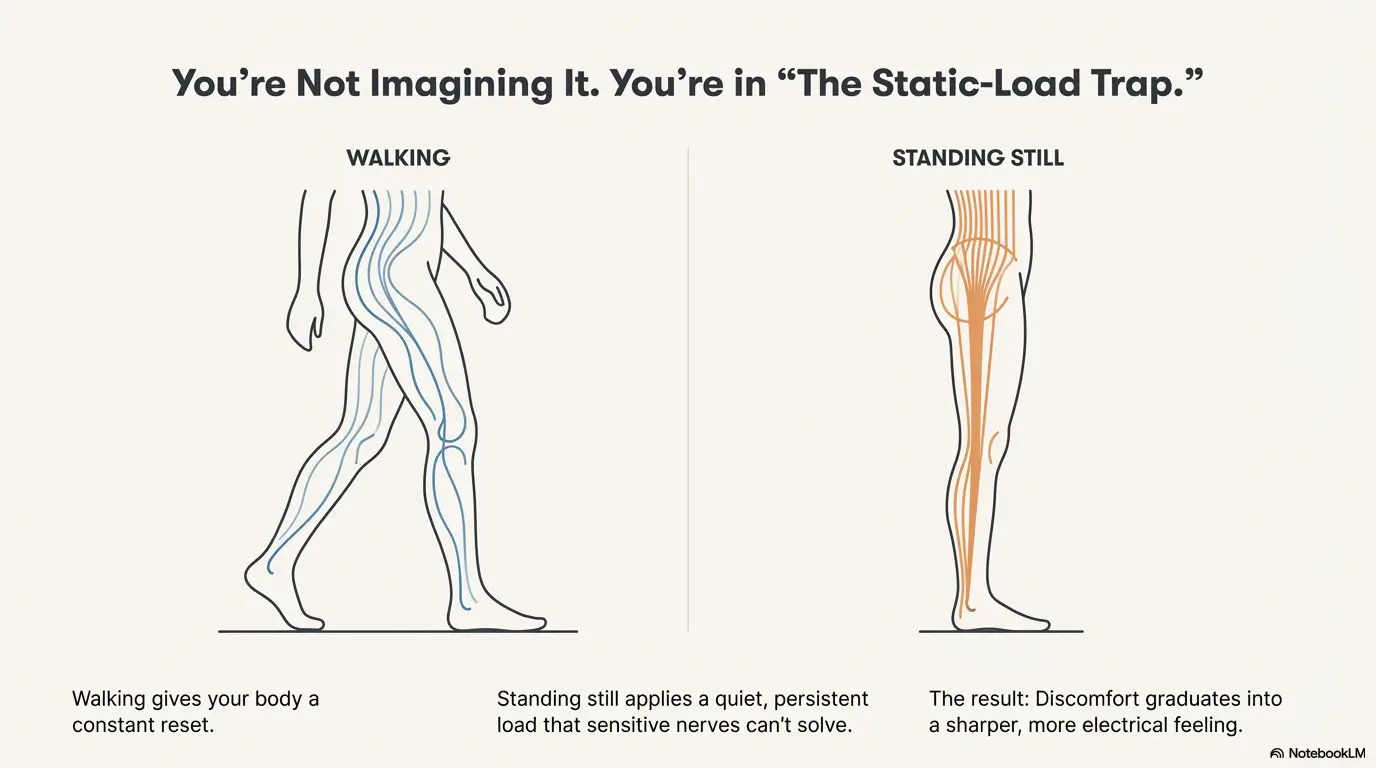
Standing in line is sneaky because it’s not intense. It’s just… constant. A quiet, persistent load that your body can’t “solve” because the position barely changes. If your sciatica is sensitive right now, that static load can be enough to keep the irritation going.
The static-load trap
When you stand motionless, small muscles in your hips, back, and legs hold you up like an unpaid internship. They don’t get the reset that walking provides. The result can be a slow rise in discomfort—often starting as an ache and graduating into a sharper, more electrical feeling. (If this sounds familiar beyond theme parks—like office days—this pattern overlaps with desk-job sciatica flare-ups and the “standing still” problem that comes with them.)
The theme-park line effect (the part no one plans for)
- Concrete floors don’t forgive.
- Slow shuffles aren’t “real walking,” so you don’t get the same relief.
- Phone posture can pull you into a rib-down, hip-tilted stance without you noticing.
I learned this the hard way at a park where I told myself “it’s fine, we’re barely moving.” Ten minutes later: not fine. Very not fine.
“Your body wants variety,” not heroics
The goal is not to stretch aggressively in public. The goal is to introduce tiny variety so your tissues stop getting loaded the exact same way for 30 minutes. That’s why micro-movements work: they’re small enough to be socially invisible, but meaningful enough for your body to register. If you like having a structured “swap positions on purpose” rhythm, the logic is similar to a sit-stand schedule for desk-job sciatica—just miniaturized for a queue.
Show me the nerdy details
Think of your system as a “load + sensitivity” equation. Standing still raises load in a very consistent pattern, and sensitive nerves dislike consistent compression or tension. Walking changes joint angles and muscle activation in a repeating cycle, which can reduce the feeling of being “stuck.” Micro-movements mimic that cycle without needing space or speed.
The 60-second “invisible reset” cycle
This is the centerpiece. It’s not a stretch routine. It’s a tiny movement loop you can do while chatting, scrolling, or pretending you’re studying the map like a responsible adult.
The baseline stance (your default in line)
- Feet about hip-width.
- Soft knees (not locked).
- Ribs stacked over hips—no exaggerated “military posture.”
- Chin gently tucked; shoulders down and easy.
One of my most annoying discoveries: locking my knees made me feel “stable”… and also made my leg pain ramp up faster. Stability is not always kindness.
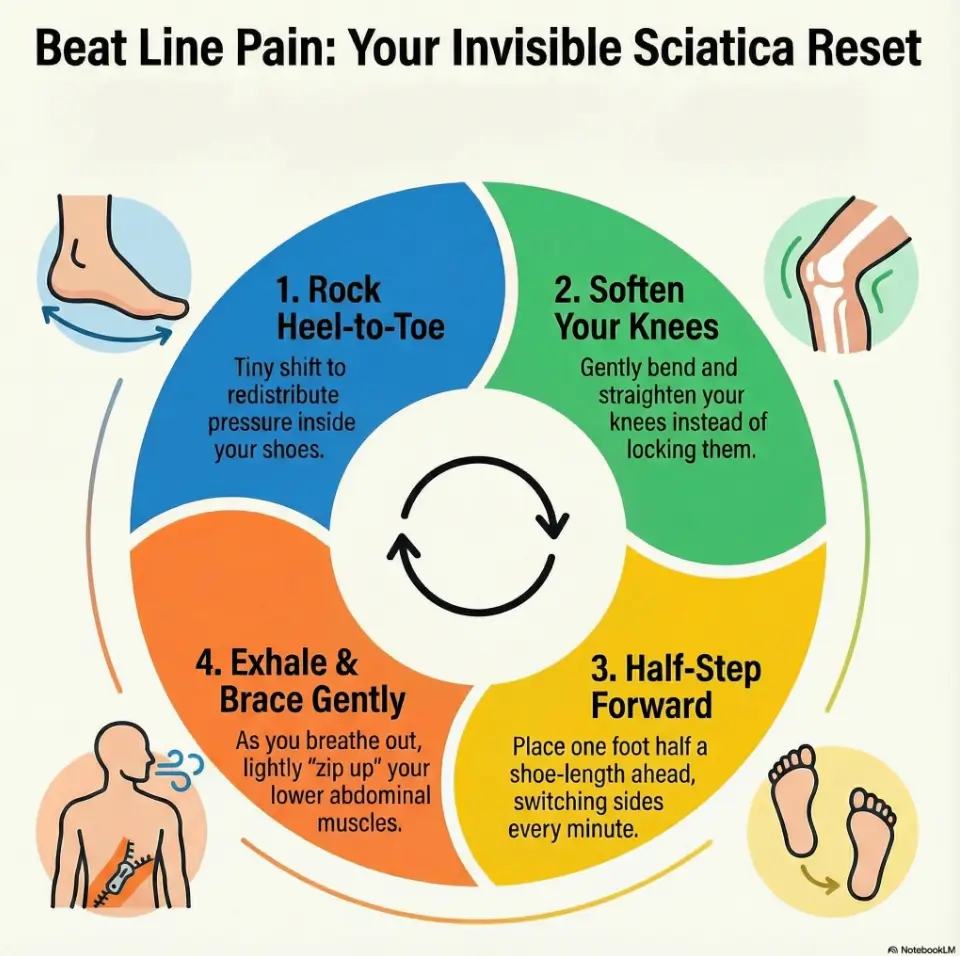
The 4 micro-moves (rotate every 15 seconds)
- Heel-to-toe rock (tiny—like redistributing pressure inside your shoes).
- Knee soften/straighten (1–2 cm range; nobody notices).
- Half-step switch (one foot half a shoe-length forward, then swap).
- Gentle exhale brace (on the exhale, lightly “zip up” your lower belly—no hard bracing).
- Keep it subtle and repeatable.
- Stop before the pain spikes, not after.
- Rotate moves so no tissue takes the full load.
Apply in 60 seconds: Do Rock → Soften → Half-step → Exhale one time through. Then repeat.
Let’s be honest… you won’t remember this in a real line
So don’t memorize a list. Memorize a loop. Say it in your head like a four-beat song:
Rock → Soften → Half-step → Exhale
That’s it. The only rule is: keep it small and pain-free. If any move increases symptoms, skip it and keep the rest.
Short Story: the day I stopped “saving” my back for later (120–180 words) …
Short Story: I once did the classic theme-park logic: “I’ll deal with it after this ride.” After that: “after the next ride.” And then “after lunch.” By mid-afternoon, I was standing in a line pretending to be interested in the gift shop posters because shifting my weight felt like it would expose me. My leg started tingling, my patience got thin, and I got weirdly resentful at… everyone, honestly.
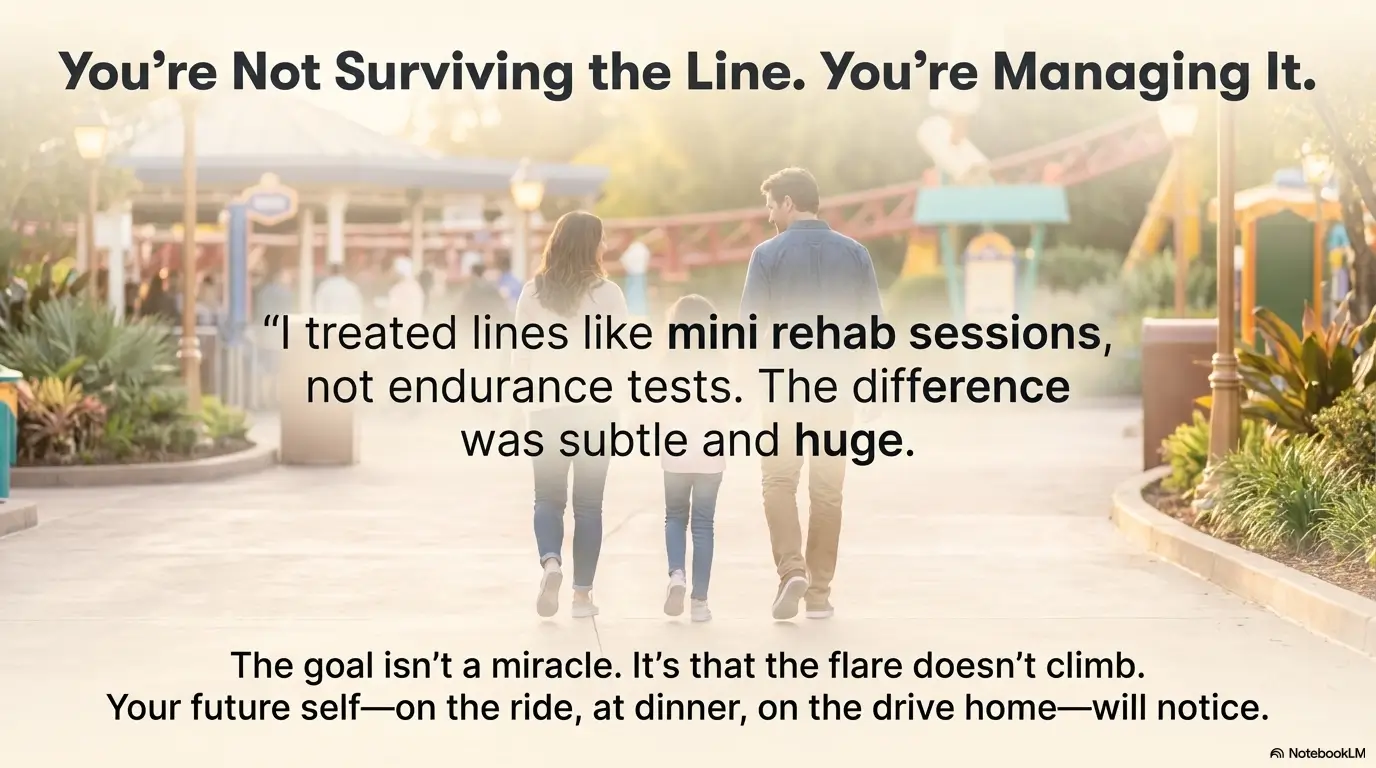
A friend noticed and said, quietly, “Why are you standing like a statue?” That comment did more than any pep talk. I started doing tiny heel-to-toe rocks and half-steps while we chatted. Nothing dramatic happened—no miracle, no choir of angels—but the flare didn’t climb. For the rest of the day, I treated lines like mini rehab sessions, not endurance tests. The difference was subtle and huge.
The rail/phone lean trick that looks normal
If you can unload even a small percentage of your body weight, your symptoms often calm down faster. The trick is doing it without twisting your pelvis into a position your back hates.
The “casual lean” setup (no weird angles)
- Lightly rest your forearm on a rail/stanchion.
- Keep hips square—avoid turning your body like you’re leaning into a corner.
- Let the lean be gentle, like “resting,” not “hanging.”
My personal tell: if I feel relief in the first 30 seconds but irritation at minute two, my lean was probably a twist in disguise.
When leaning helps vs. makes it worse
- Helps when it unloads the painful side without twisting.
- Makes it worse when it rotates your hips or locks one knee.
Decision Card: rail lean vs. micro-step
- Choose the rail lean if: your pain eases when you unload weight and you can stay square.
- Choose micro-steps if: leaning triggers twisting or you feel numbness ramp up.
- Choose breathing + rock if: you’re packed in tight and can’t change stance much.
Neutral action: Try one option for 60 seconds, then switch and compare calmly.
If you want the medical definition in plain language, the U.S. National Institute of Neurological Disorders and Stroke explains sciatica as pain along the sciatic nerve pathway—useful context if you’re trying to separate “normal soreness” from a nerve-style flare. If you want the “what does nerve pain actually feel like?” version, this guide to sciatica nerve pain patterns can help you label the sensation without spiraling.
Here’s what no one tells you…
The “wrong” lean can mimic a bad car-seat angle. You’ll feel it fast. If symptoms rise within 2 minutes, treat that as feedback—not failure—and switch to the 60-second cycle instead.
Foot positioning that quiets the irritated side
Foot position changes what your hips and low back do. You don’t need perfect form. You need a stance that doesn’t poke the bear.
The “toe-out a hair” test (micro, not duck feet)
Rotate one foot outward just a little—think “a few degrees,” not a full turnout. Hold for 30 seconds and notice:
- Does your leg feel less tense?
- Does your hip feel less pinned?
- Or does it irritate symptoms?
If it helps, keep it. If not, return to neutral.
The shoe-length stagger (secret weapon for long waits)
Put one foot half a shoe-length ahead of the other. Switch every minute. This reduces static tension without looking like a lunge. It also gives your pelvis a tiny “permission” to settle into a calmer position.
I used to avoid this because I worried I’d look odd. Then I noticed: half the line is shifting anyway. You’re not drawing attention—your pain is just narrating the moment like it owns the place.
The “dead leg” warning sign
If your leg starts going numb faster in one stance, don’t negotiate with it. Switch sooner. Numbness is your body’s way of saying, “This angle is a problem,” not “Try harder.”
Show me the nerdy details
Small changes in foot angle can change hip rotation, pelvic tilt, and muscle tension through the chain. That can shift how much tension or compression sensitive tissue experiences. The goal isn’t perfect biomechanics; it’s finding your lowest-symptom position and returning to it repeatedly.
- Try toe-out a hair for 30 seconds.
- Try shoe-length stagger for 60 seconds.
- Pick the calmer option and rotate sides.
Apply in 60 seconds: Stagger your stance now, then switch feet after 60 seconds.
Common mistakes that quietly make lines worse
This is the part where we stop accidentally feeding the flare. These mistakes are common because they feel “responsible” (stand tall, stretch it out) even when they backfire.
Mistake #1: Big stretches in a small space
Aggressive hamstring stretching can increase nerve sensitivity for some people. If you’ve ever stretched and thought, “Why did that make it zing more?”—you’re not alone. Save big stretches for a calmer environment where you can go gently and stop early. If you want a calmer, structured option later, consider a simple core-stability reset like McGill Big 3 in 10 minutes (done gently and without chasing pain).
Mistake #2: Locking knees + bracing hard
“Standing at attention” loads the back and hips. Hard bracing can also make breathing shallow, which tends to increase overall tension. Choose soft knees and a gentle exhale brace instead.
Mistake #3: Phone slump (the flare you didn’t notice you started)
Phone posture is sneaky because it feels normal. If your chin drops forward and your ribs drop, your hips often compensate. Your best correction is tiny: bring the phone up a bit and let your ribs stack over hips again.
I once spent an entire queue watching a ride video recap on my phone, head down. By the time we moved, my back felt like it had opinions about my life choices.
Don’t do this: the “one-side hang” posture
You know the move: you dump your weight into one hip because it feels good for a moment. It’s the body’s short-term comfort strategy… with a long-term bill attached.
Why hip-hanging feels good for 10 seconds… then punishes you
It unloads briefly, then compresses one side. If your sciatica is touchy, that asymmetry can become a quick trigger. (If you’re trying to understand whether your pain is truly “sciatica” versus a look-alike, comparisons like sciatica vs piriformis syndrome can clarify what’s likely going on.)
The swap: balanced unload instead of collapse
- Use a light rail lean with hips square.
- Use shoe-length stagger and switch sides.
- Keep knees soft—both of them.
A quick self-check
If one hip is higher and one knee is locked, you’re probably hanging. Reset to neutral. Nobody is grading you. Your nervous system is just collecting data.
The “line survival plan” for different wait times
Different lines require different strategies. A 7-minute queue is a sprint. A 45-minute queue is a slow campaign. Let’s match your effort to the situation.
If the line is 5–10 minutes
- Pick two moves: heel-to-toe rock + soft knee.
- Alternate every 20–30 seconds.
- Skip big posture “corrections.” Stay subtle.
If the line is 20–60 minutes (the real test)
Build a repeating loop:
- Stance (neutral, soft knees)
- Lean (if available and painless)
- Micro-step (half-step switch)
- Breathe (gentle exhale brace)
If you’re trapped shoulder-to-shoulder
Use the lowest-visibility combo: heel-to-toe rock + exhale brace. If you can’t move your feet, you can still change load by shifting pressure and breathing.
Money Block: mini calculator (3 inputs, 1 output)
- Input 1: Your current discomfort (0–10).
- Input 2: How packed is the line? (Low / Medium / High).
- Input 3: Are you allowed to lean? (Yes / No).
Output: If discomfort is 0–3, reset every 60 seconds. If 4–6, reset every 30–45 seconds. If 7+, stop escalating: use the smallest moves and consider a break or assistance.
Neutral action: Pick one cadence and follow it for 3 minutes before judging.
One more real-world note: theme parks often have brief “compression moments” (stopping suddenly, shuffling forward in bursts). That’s when your body tends to hang on one side. Make those moments your cue to reset.
When to seek help (so you don’t gamble a vacation on a nerve flare)
Vacations are expensive. But your nervous system is more expensive. The goal here is to keep things safe: micro-movements, not “self-treatment bravado.”
Seek urgent care now if you have
- New weakness, foot drop, or rapidly worsening leg function.
- Bowel/bladder changes or saddle numbness.
- Severe symptoms after a fall, crash, or other trauma.
Book a clinician visit soon if
- Pain/numbness is steadily worsening or spreading.
- Your standing tolerance keeps shrinking week to week.
- You’re stuck in a cycle where small triggers cause big flares.
What to track (takes 30 seconds)
- How long you can stand before symptoms rise (in minutes).
- Where you feel it (low back, butt, calf, foot).
- What helps fastest (walking, leaning, micro-steps, breathing).
Two trustworthy voices that usually explain this well for everyday readers: Cleveland Clinic and Mayo Clinic. They both emphasize that sciatica is a symptom pattern rather than a single disease—and that context matters when deciding what’s safe. If you’re mapping next steps, you may also find it helpful to compare chiropractor vs physical therapy (especially if you’re deciding where to start) and to skim a simple overview of physical therapy for sciatica so you know what “good PT” typically includes.
FAQ
1) Why does my sciatica get worse when I’m standing in line?
Standing still creates a steady, unchanging load through the hips and low back. If your system is sensitive, that consistency can amplify symptoms. Walking changes joint angles and muscle activation in cycles, which often feels better.
2) Are micro-movements actually effective for sciatica, or is this placebo?
Micro-movements can help because they change load patterns without needing space. They’re not a cure, but they can reduce flare intensity for many people—especially when standing still is the trigger. (If your brain tends to latch onto symptoms and spin worst-case stories, you’re not alone—this is a common loop in chronic pain, sometimes called cyberchondria in chronic pain.)
3) Should I stretch my hamstrings while waiting in a theme park line?
Be cautious. Aggressive stretching can increase nerve sensitivity for some people. In a crowded line, it’s usually safer to stick to small, repeatable resets (rocking, soft knees, half-steps) and save stretching for later when you can do it gently.
4) What’s the best stance for sciatica: feet together or shoulder-width?
Most people do better with feet about hip-width and knees soft. Feet together often encourages hip-hanging and knee locking, which can make symptoms climb.
5) Can leaning on a rail help sciatica, or can it make it worse?
Both. A gentle, square-hip lean can unload the painful side and help. A twisted lean can aggravate symptoms quickly. Use the “2-minute rule”: if it worsens within two minutes, switch to the reset cycle instead.
6) What shoes help sciatica when standing on concrete all day?
In general, shoes that feel stable and cushioned enough for you can help reduce fatigue from hard surfaces. But shoe choice is individual. If a shoe makes you feel like you’re wobbling or collapsing inward, it may increase irritation. If you want a practical starting point, this guide to sciatica-friendly walking shoes can help you filter options without overthinking it.
7) How often should I change position to prevent a flare?
A good starting point is every 30–60 seconds. If symptoms are already rising, shorten it to 30–45 seconds. The goal is to change the input before your pain hits the “now it’s hard to calm down” threshold.
8) Does a back brace help for standing-in-line sciatica?
For some people, short-term support can make standing feel more tolerable, but it’s not required. If you use one, keep it comfortable and avoid over-bracing. The micro-movement plan still matters.
9) What if walking helps but standing still hurts—what does that mean?
It often means your symptoms are sensitive to static loading. That’s why this article focuses on creating small movement cycles while you’re stuck in place. If you’re unsure what’s driving the pattern, it can also help to understand sciatica vs herniated disc basics—mostly so you know what questions to ask if you end up getting evaluated.
10) When is sciatica an emergency?
New weakness, foot drop, saddle numbness, or bowel/bladder changes are urgent. Severe symptoms after injury are also urgent. When in doubt, err on the side of medical evaluation—this red-flag guide for low back pain emergencies is a good “no guessing” reference.
Next step (one concrete action)
You don’t need a perfect plan. You need a plan you’ll actually do while you’re distracted by ride times and churros.
Build your “Queue Cue” in 2 minutes
- Set a silent vibration timer for 45 seconds.
- Name it (mentally): Rock → Soften → Half-step → Exhale.
- Run it once at home, then use it in the first long line of the day—before symptoms ramp up.
Small personal note: the first time I tried this, I felt silly for 10 seconds… and then I realized nobody cared. Everyone is too busy checking wait times and deciding if they’re hungry again. (They are.)
Wrap-up: your discreet line plan (15-minute setup)
Let’s close the loop from the title: yes, you can do this without looking weird. The secret isn’t a magic stretch. It’s tiny variety on purpose—so your body doesn’t get trapped in one position long enough to spark the flare.
A one-screen checklist you can screenshot
- Default stance: hip-width, soft knees, ribs over hips.
- Every 45 seconds: Rock → Soften → Half-step → Exhale.
- If there’s a rail: gentle square-hip lean (no twisting).
- If numbness rises: switch sooner, shrink movements, consider a break.
Infographic: the 60-second reset loop
Money Block: quote-prep list (what to gather before you adjust anything)
- Where the sensation travels (back → butt → calf → foot).
- Your standing tolerance time (in minutes) before symptoms rise.
- Top 2 “calmers” (walking, leaning, half-step, breathing).
- Top 2 “spikers” (knee lock, hip hang, phone slump, twisting lean).
Neutral action: Save these four bullets in your phone notes after today’s park visit.
If you do one thing after reading this: don’t wait for the flare to “prove itself.” Use the loop early, keep it subtle, and treat every line as a chance to stay ahead of symptoms. Your future self—on the ride, at dinner, on the drive home when you have to get in and out of a low car—will notice. (And if driving itself is your trigger, especially with pedals, you may want to skim sciatica while driving a manual transmission before your next trip.)
Last reviewed: 2026-01.