

Next-Day Stability Over Same-Day Sweat: The Sciatica Recovery Protocol
You don’t lose progress on the machine. You lose it the next morning—when your calf tingles, your lower back tightens, and you realize yesterday’s “good workout” just bought you a bad day.
“If you’re weighing incline walking vs. elliptical for sciatica, the real issue isn’t calories or cardio stats. It’s which option keeps your nerve symptoms calm 24 hours later.”
Radiating leg pain, delayed flare-ups, and stiffness that creeps below the knee don’t care how smooth the workout felt at minute ten. Keep guessing, and you risk restarting the pain cycle every week.
This guide provides a practical framework to compare treadmill incline walking and elliptical training based on symptom response, not gym folklore. You’ll learn to spot delayed nerve irritation and dose effort using the same pacing logic clinicians use: test, observe, adjust.
Because consistency heals. And hero workouts don’t.
For many people with sciatica, the machine that causes fewer next-day flare-ups is the one that keeps pain stable during exercise and for 24 hours after. Elliptical often lowers impact, while incline walking can load hips and back differently and may irritate symptoms in some bodies. The winner is your response pattern: low pain rise, no delayed spike, and steady week-to-week tolerance.
Table of Contents
Start Here: The 24-Hour Rule That Beats Guesswork
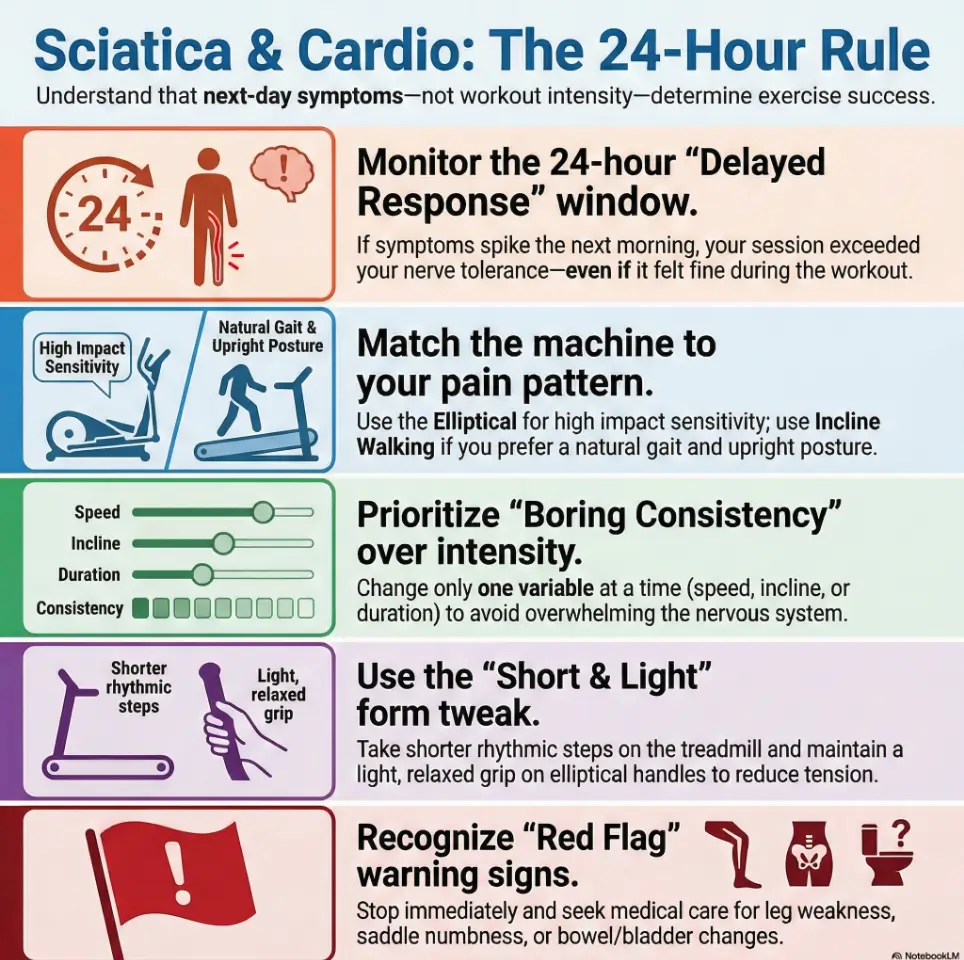
Why “felt fine during the workout” can be misleading
I’ve watched this movie too many times: session feels “surprisingly okay,” then next morning the calf tingles, the buttock burns, and sitting becomes a negotiation. Nerve-irritable conditions don’t always complain immediately. They often send the bill later. That’s why in sciatica self-management, same-day comfort is only half the story.
The flare-up window: 0–2 hours vs 24-hour delayed response
Use two windows: (1) during and up to 2 hours after, and (2) the next morning. If symptoms jump by more than a small, brief amount and stay elevated into the next day, you likely exceeded your current tolerance. NHS guidance emphasizes staying active but pacing symptoms, and AAOS also stresses movement with sensible progression rather than bed rest or all-or-nothing swings.
Let’s be honest—your next day is the real scorecard
Here’s the operator rule: if you can complete a session and wake up with similar or better symptoms, you’re in the safe adaptation zone. If you wake up worse for most of the day, that session was too much—even if the workout app congratulated you.
- Track symptoms at 0–2 hours and 24 hours.
- Progress only when both windows stay stable.
- Treat next-morning pain as the primary decision signal.
Apply in 60 seconds: Set a daily 8 a.m. reminder titled “Leg/back check-in: better, same, worse?”
Quick Compare: Incline Walking vs Elliptical by Symptom Pattern
Nerve irritation pattern: radiating leg pain, tingling, zaps
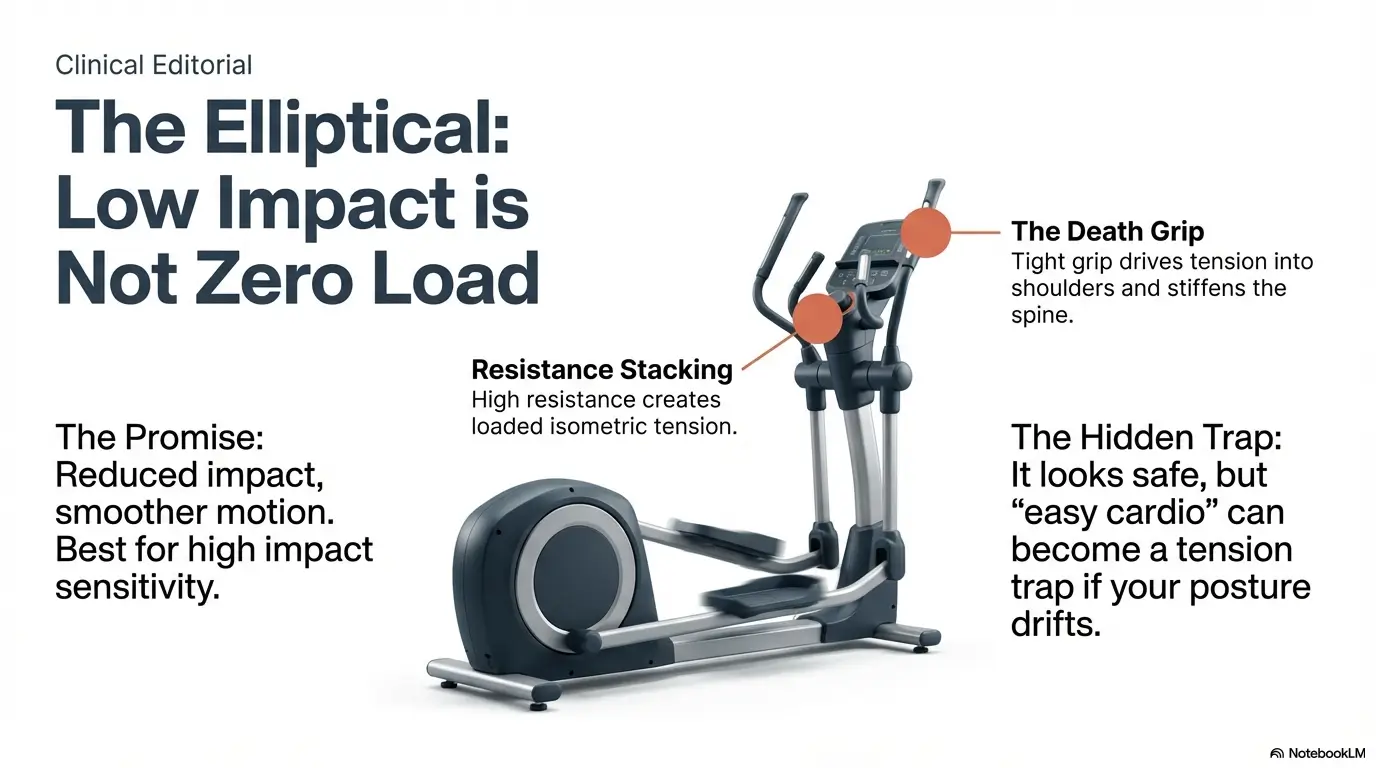
Elliptical often wins early here because impact is lower and stride is smoother. But “lower impact” is not “zero load.” If posture drifts, resistance stacks too quickly, or you death-grip the handles, symptoms can still escalate.
Mechanical back/hip sensitivity pattern: stiffness, ache, load intolerance
Some people prefer gentle incline walking because it feels familiar and easier to dose. Others flare from trunk lean, overstride, or too-steep incline. A tiny setup miss can feel like a major body betrayal 12 hours later.
Endurance pattern: cardio fatigue without symptom escalation
If your cardio system is deconditioned but your nerve symptoms are stable, either modality can work. The better tool is the one that lets you build minutes with minimal symptom drift and predictable recovery.
Decision Card: When A vs B
Choose Elliptical First if impact sensitivity is high, leg symptoms radiate below knee easily, or flat walking already irritates.
Choose Incline Walking First if elliptical posture feels awkward, hip flexors crank up, or walking mechanics are clean and symptom-stable.
Neutral action: Test each for 3 matched sessions before deciding.
Show me the nerdy details
A practical loading model: total irritability = motion quality × intensity × duration × recovery behavior (sleep position, sitting load, cumulative life stress). Two people can do “the same workout” and get opposite outcomes because these multipliers differ.
Who This Is For / Not For
Best for: mild-to-moderate sciatica symptoms seeking cardio options
If you can walk, move, and change positions without severe neurologic symptoms, this framework helps you compare machines safely. It’s built for adults who want practical self-management and fewer relapse loops.
Not for: progressive weakness, bowel/bladder changes, severe neurologic signs
Red-flag territory is not “try harder and see.” Major medical guidance flags leg weakness, loss of feeling, and bowel/bladder changes as urgent warning signs requiring immediate medical care.
If you’re in a post-acute flare, what to do before choosing either modality
First stabilize irritability: shorter bouts, easier effort, more frequent movement breaks. I usually tell people to earn the right to progress by getting 3–4 calm days first. Think “boring wins.” Boring is underrated medicine.
- No red flags: use symptom-guided trialing.
- Active flare: reduce irritability before testing modalities.
- Urgent signs: seek same-day medical evaluation.
Apply in 60 seconds: Write your current status as one line: “Stable / irritable / red-flag.” Let that decide today’s plan.
Incline Walking First? What It Helps—And What It Can Aggravate
Where incline can support conditioning and gait confidence
Incline walking can feel psychologically safer because it resembles normal life movement. For many, it improves cardiovascular work at lower speed and can reduce the urge to run too soon. It also gives clean feedback: you know exactly what speed and incline you used.
Where incline can backfire: stride length, speed creep, trunk lean
The trap is subtle. You start fine at minute 6, then chase pace by minute 14. Stride lengthens, heel-brake increases, trunk tips forward, and symptoms quietly load. Next morning? Not great. I’ve done this myself—felt “strong” during the session, paid for it during coffee.
The “too steep too soon” trap most people miss
Steep incline amplifies demand on posterior chain and lumbar-hip control. If your core/hip endurance is not ready, compensations show up fast. Keep incline conservative early and progress one variable at a time.
Eligibility Checklist (Yes/No)
- Can you walk 10–15 minutes on flat without symptom escalation? (Yes/No)
- Can you keep torso upright without leaning into rails? (Yes/No)
- Can you finish and feel similar the next morning? (Yes/No)
Neutral action: If any answer is “No,” lower incline and shorten duration before progressing.
Elliptical First? Why It Feels Safer for Some (and Wrong for Others)
Reduced impact and smoother cyclic motion—when it helps
When impact sensitivity is high, elliptical can be a relief. The motion is continuous, and many people tolerate longer sessions at lower perceived strain. If your symptoms are aggravated by step impact, this can be the gentler starting bridge. If flat walking is still touchy, a brief detour through recumbent vs upright bike options for sciatica can help you keep conditioning without poking the nerve every session.
Hidden irritants: resistance stacking, posture drift, handle over-gripping
The machine can fool you into doing too much because it feels smooth. Resistance climbs, shoulders rise, lumbar spine stiffens, grip tightens, and your nervous system goes on alert. “Easy cardio” becomes loaded isometric tension.
Here’s what no one tells you: low impact can still overload irritated nerves
Low impact is a tool, not a guarantee. If the dose is wrong, the body doesn’t care what the brochure said. Keep resistance lower than ego wants for at least the first week of testing.
Mini Calculator: Your Flare Risk Score
Score = (RPE out of 10) + (pain rise during session, 0–10) + (next-morning rise, 0–10)
Interpretation: ≤4 = good tolerance; 5–7 = hold steady; ≥8 = reduce dose next session.
Neutral action: Use the score for 6 sessions before changing machine.
Common Mistakes That Cause Next-Day Flare-Ups
Mistake #1: Progressing by calendar instead of symptom response
“Week 2 means add intensity” is how people restart pain cycles. Your tissue and nervous system don’t read calendars.
Mistake #2: Chasing sweat, not symptom stability
Sweat is a hydration event, not proof of safe progression. If pain geography spreads farther down the leg the next day, the session was too aggressive.
Mistake #3: Changing incline, speed, and duration all at once
One change at a time. When three dials move together, you can’t tell what caused the flare.
Mistake #4: Ignoring sleep-position and sitting load after training
A clean workout can still be undone by two hours of slumped sitting and a twisted sleep position. Frequent movement breaks are a practical way to reduce symptom buildup. If nighttime is your trouble zone, pairing this with a side-sleeper sciatica-at-night setup and a realistic how to sleep with sciatica routine can protect your recovery window.
Field note: Your workout is not just 20 minutes on a machine. It’s the whole 24-hour load budget.
Don’t Do This: 7 “Looks Safe” Moves That Quietly Spike Symptoms
Long warm-up jumps straight into working intensity
Warm-ups should prepare tissues, not sneak in fatigue.
Grip-and-hunch posture on elliptical handles
White-knuckle grip drives shoulder and trunk tension.
Incline walking with overstriding and heel-brake pattern
Overstride shifts load and can increase irritation in sensitive phases.
“Pain is okay if it’s under 7/10” myth in nerve-irritable phases
That threshold is too permissive for many people with neural irritability. Conservative beats brave here.
Bonus 3 mistakes people rarely notice
- Skipping cooldown and sitting immediately for 60+ minutes.
- Adding strength work after cardio “because I feel warmed up.” If you do layer strength, use a low-irritability core sequence like McGill Big 3 in 10 minutes or a controlled dead bug exercise for sciatica before heavier options.
- Testing new shoes and new machine settings on the same day. If gait comfort is uncertain, audit your sciatica-friendly walking shoes first.
- Keep one variable change per session.
- Protect the first 2 hours after exercise.
- Treat spread of symptoms down the leg as a caution sign.
Apply in 60 seconds: Pick one “do not stack” rule for this week and write it on your treadmill note.
The 2-Week Self-Test Protocol (So You Can Pick with Data)
Week structure: alternating modality days, matched effort
Run an A/B test over 14 days:
- Day 1: Modality A (e.g., elliptical), easy-moderate effort
- Day 2: Recovery walk/mobility
- Day 3: Modality B (e.g., incline walk), matched effort and duration
- Repeat for 6 total test sessions (3 each)
Keep sessions 12–20 minutes initially. Same shoes, similar time of day, similar warm-up.
What to track: pain location shift, intensity, duration, morning stiffness
Track four markers:
- Intensity (0–10)
- Location (back/buttock vs below knee)
- Duration (how long symptoms stay elevated)
- Morning stiffness (minutes to feel “normal-ish”)
Decision threshold: when one option clearly wins
If one modality yields 2 or more better next-day outcomes out of 3, that’s your current winner. Keep it for 2–3 more weeks before retesting the other.
Small note, big result: keep everything else boring for 14 days
Don’t add new lifting, new shoes, new mattress, new everything during your test. Data only works when noise is low. If your baseline is already jumpy, this is the moment to run a quick sciatica pain when walking check before blaming either machine.
Quote-Prep List: Bring This if You Need PT Help
- 6-session log with 24-hour outcomes
- Which machine, settings, duration, and RPE
- What worsened symptoms: sitting, sleep, stairs, driving
- Red-flag symptoms present/absent
Neutral action: Bring this list to your first appointment to shorten trial-and-error. A focused visit on physical therapy for sciatica works much better when your log is specific.
Show me the nerdy details
A/B self-tests work because they reduce decision bias. By matching perceived effort and duration, you isolate the motion profile variable (incline walking vs elliptical) and detect delayed-response differences across repeated exposures.
Form Tweaks That Lower Flare Risk Immediately
Incline walking setup: incline cap, cadence cue, posture stack
- Start with a modest incline cap (often 1–3% as a trial range).
- Shorter, quicker steps beat long reaching strides.
- Stack ribs over pelvis; avoid hanging on rails.
Elliptical setup: resistance cap, stride comfort, torso neutrality
- Use lower resistance than you think for week 1.
- Choose stride length that feels smooth, not forced.
- Relax grip; shoulders down; eyes forward.
Recovery anchors: cooldown, gentle mobility, post-session sitting breaks
Finish with 3–5 minutes easy motion, then 1–2 mobility drills you tolerate. Set a 30–40 minute sitting break rule the rest of the day when possible. For desk-heavy days, a simple sit-stand schedule for desk-job sciatica helps protect gains from your training session.
Infographic: “Less Next-Day Flare” Setup Map
- Incline: low-to-moderate start
- Stride: short + rhythmic
- Posture: tall, no rail hanging
- Stop rule: symptoms spread below knee
- Resistance: conservative week 1
- Grip: light, shoulders relaxed
- Torso: neutral, no hunching
- Stop rule: rising neural symptoms next day
Common denominator: stable during session + stable 24 hours later.
Open Loop: If Both Trigger Symptoms, What’s the Third Option?
Flat walking intervals and recumbent options as temporary bridges
If both modalities flare symptoms, step down—not out. Try flat walking intervals (e.g., 4 x 4 minutes easy with 2-minute rests) or recumbent bike sessions at very easy effort. This keeps conditioning alive while irritation calms. A practical starting point is this recumbent bike setup for sciatica approach.
Split sessions (2 x short bouts) vs one long bout
Two 8–10 minute sessions often beat one 20-minute block in sensitive phases. Same total minutes, lower peak irritability.
How to reintroduce incline or elliptical without restarting the pain cycle
Use a 10% progression cap on total load per week (time or intensity, not both). Hold steady after any borderline session until symptoms normalize.
Short Story: The Tuesday Trap (138 words)
A client once told me, “I only flare on Wednesdays, which is weird because I train on Tuesdays.” It wasn’t weird. Tuesday was her “prove I’m better” day: incline up two levels, speed up a notch, skipped cooldown, then a two-hour drive home. Wednesday morning she blamed sciatica randomness. We stripped the heroics. Same machine, lower load, fixed posture, 5-minute cooldown, and a standing break every 35 minutes that evening. In ten days, Wednesday stopped being scary. What changed wasn’t her courage. It was her system. Sciatica management often feels emotional because pain is emotional. But decisions can still be mechanical, calm, and testable. The body likes consistency more than inspiration.
When to Seek Help (and Not Push Through)
Red flags requiring urgent medical evaluation
Urgent signs include new or worsening leg weakness, loss of sensation, bowel/bladder changes, or saddle-area numbness. These require immediate medical evaluation, not exercise modification.
Signs you need physical therapy guidance, not more trial-and-error
If you’ve run a clean 2-week test and still flare unpredictably, involve a PT. Also seek guidance if symptoms progressively spread distally (farther down leg), sleep is consistently disrupted, or activity tolerance shrinks week to week.
What to bring to your appointment: your 2-week tracking log
Bring your data. Clinicians can adjust faster when they see exact settings, response timing, and context. You’ll save weeks of wandering.
- Red flags = urgent evaluation.
- Unclear patterns after 2 weeks = PT-guided plan.
- Bring your log to accelerate diagnosis and dosing.
Apply in 60 seconds: Save your symptom log in your phone notes now, not after your next flare.

FAQ
Is elliptical better than treadmill incline for sciatica?
Sometimes. Elliptical often feels easier in impact-sensitive phases, but posture and resistance errors can still flare symptoms. The better option is the one with the most stable 24-hour response pattern over repeated sessions.
Can incline walking make sciatica worse the next day?
Yes, especially if incline is steep too early, stride overreaches, or trunk leans forward. Delayed next-day worsening is a common sign the prior dose exceeded current tolerance.
What incline level is safest for sciatica symptoms?
There is no universal number. A conservative start is generally safer than aggressive incline. Use symptom response to titrate and change only one variable at a time.
How long should I walk with sciatica without flaring?
Start with a tolerable dose (often short sessions) and build gradually only if next-day symptoms remain stable. If symptoms rise and persist, reduce duration first.
Is it normal to feel fine during exercise but worse the next morning?
Yes, this delayed flare pattern is common in irritable nerve conditions. That’s why the 24-hour check is essential for decision-making.
Should I stop cardio completely during a sciatica flare?
Usually not, unless symptoms are severe or red-flag signs appear. Many people do better with modified, lower-dose movement instead of full inactivity.
Which burns more calories with less nerve irritation: incline or elliptical?
Calorie burn depends on intensity and body size, but lower irritation usually comes from better dosing and form—not the machine label. Choose the option you can recover from predictably.
Can posture on the elliptical trigger leg symptoms?
Yes. Hunching, gripping hard, and trunk rigidity can increase symptom irritability even at low impact.
How do I know if pain is muscle soreness or nerve flare?
Muscle soreness is usually diffuse and local. Nerve flare often follows a radiating pattern, tingling, zaps, or spread below knee, and may worsen with certain positions. If you’re unsure, a quick differential guide on hamstring stretch vs nerve pain can make pattern-reading clearer.
When should I see a doctor instead of modifying workouts?
Immediately for red flags (new weakness, bowel/bladder changes, saddle numbness). Otherwise, seek evaluation if symptoms are progressive, persistent, or not improving with careful modification. If uncertainty is high, start with a high-level primer on sciatica nerve pain patterns and escalate to in-person care promptly when warning signs appear.
Next Step: Do This Today
Choose one modality for 3 sessions, cap intensity, log 24-hour response
Pick either incline walking or elliptical and run three calm, matched sessions this week. Keep the effort honest-easy to moderate. No hero days. Record your 24-hour response each time.
If no delayed flare-up pattern appears, continue; if it does, switch and retest
This closes the loop from our hook: the goal is not the “best machine,” it’s the most reliable next day. If your mornings improve, you’re winning—even if the workout feels humble. In pain recovery, humble consistency beats dramatic effort almost every time.
Educational disclaimer: This article is for general education, not diagnosis or individualized medical advice. If symptoms worsen quickly or include neurologic red flags, seek urgent medical care.
Last reviewed: 2026-02.