
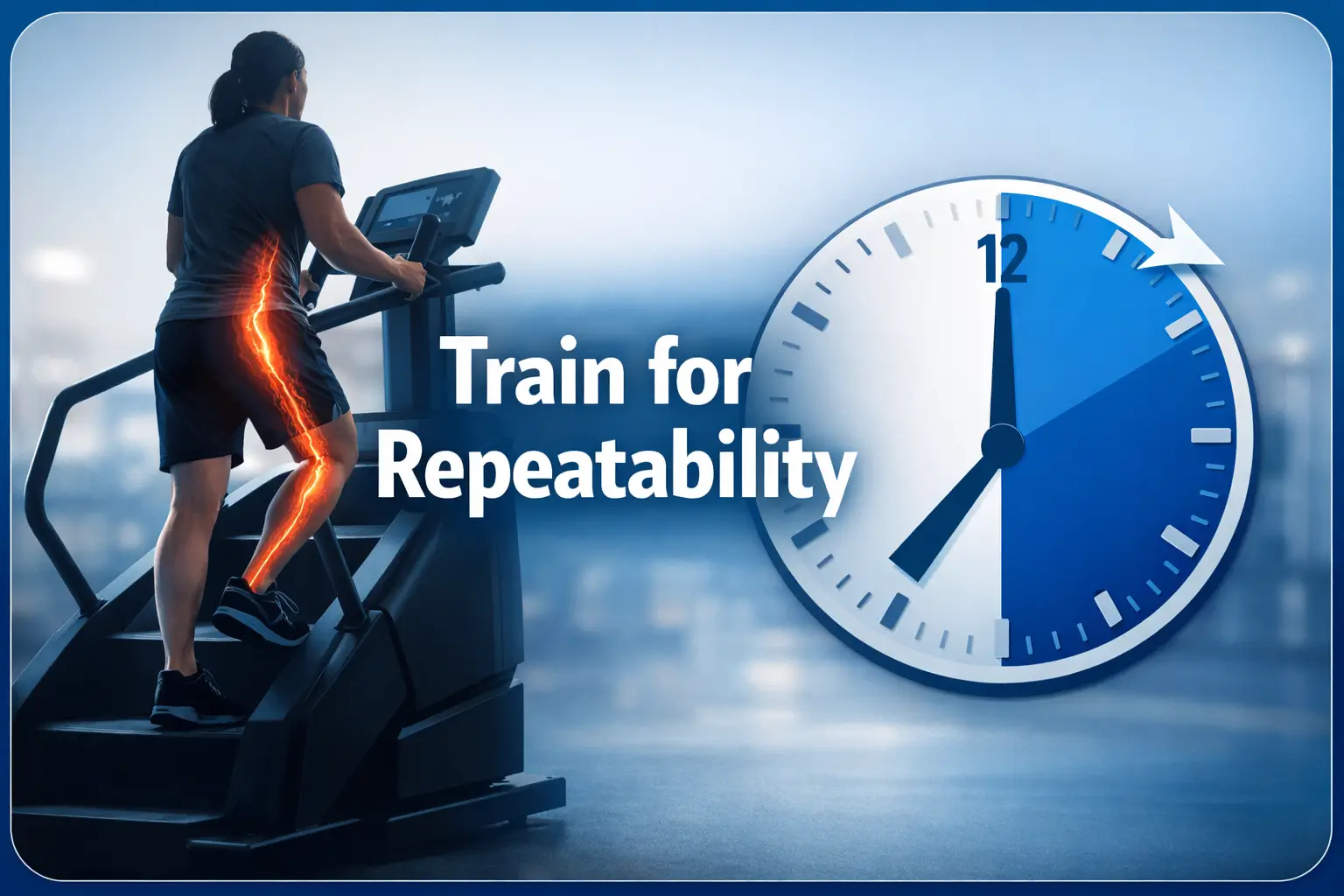
Mastering the Stair Climber: Break the Sciatica Flare Cycle
A stair climber session can feel perfectly fine at 7:00 p.m. and still hijack your morning by 7:00 a.m. That delay is the trap, and it is exactly why so many keep repeating the same cycle of neural irritation.
The issue isn’t the cardio; it’s a quiet mechanics problem. As resistance creeps up and posture leaks, stiffness and reduced sitting tolerance follow the next day. This guide offers a safer way to condition without feeding symptoms.
The 24-Hour Strategy for Sustainable Recovery:
- Low-Irritation Progression: Build endurance without the “morning-after” bill.
- Stoplight Decision Rules: Know exactly when to hold, regress, or progress.
- Pattern Tracking: Use real-world feedback, not gym hype, to guide your volume.
The Shift:
Train for repeatability, not heroics. Let your symptoms, not your ego, set the next dose.
Table of Contents
Stair Climber + Sciatica: Why this combo flares so fast
The hidden load shift: from glutes to irritated structures
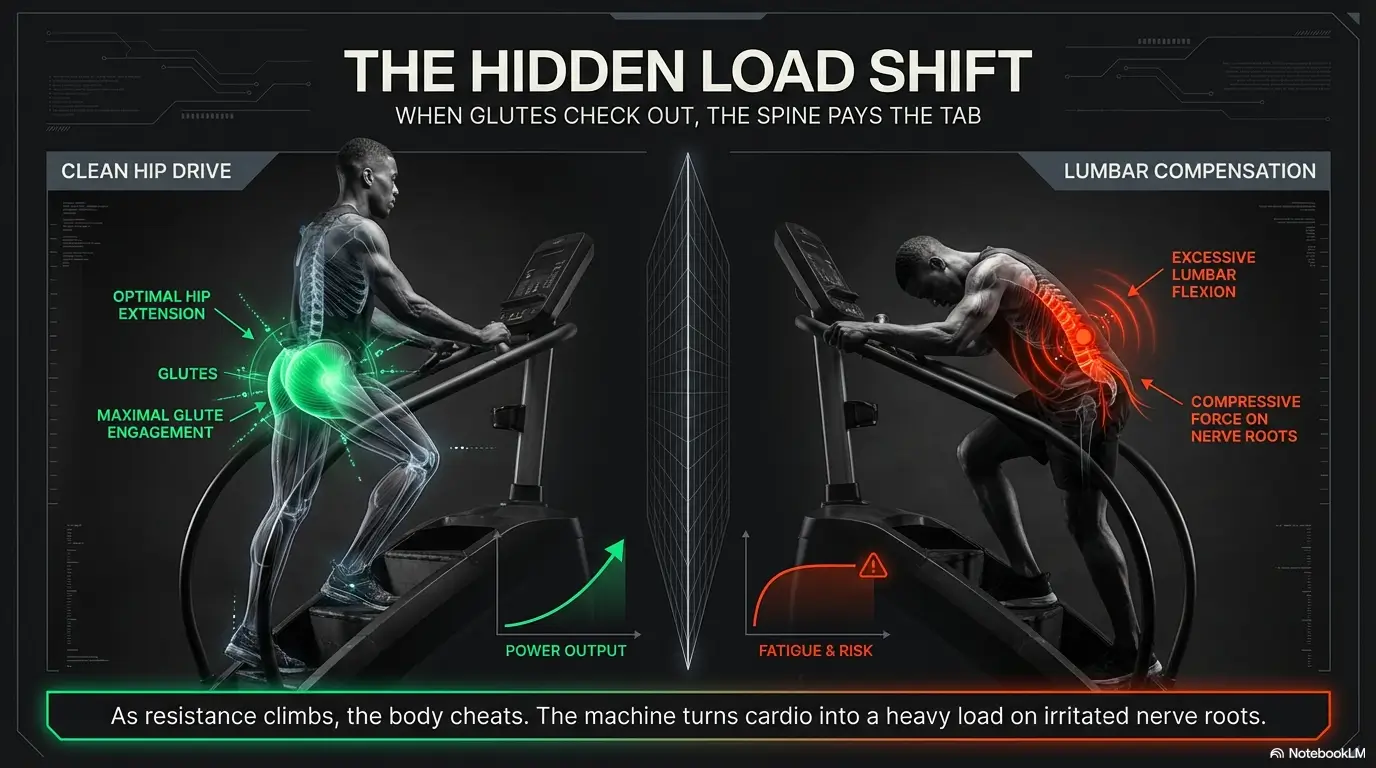
Stair climbers look simple. Step, step, sweat, done. But once resistance climbs, people often lose clean hip drive and shift effort into lumbar compensation. Translation: glutes stop doing enough, and your back plus neural tissues pick up the tab.
I’ve seen this pattern in real gyms: first five minutes feel smooth, then cadence drops, torso folds forward, and the machine quietly turns “cardio” into pseudo-strength work. When that happens, irritated nerve roots can become more sensitive, even if pain during the set stays low.
Why “cardio burn” can mask early nerve warning signs
Breathing hard can drown out subtle warning signals. The body’s stress chemistry and effort focus make people underestimate form drift. You think, “This is working.” Your nervous system thinks, “We’ll discuss this tomorrow morning.”
That delay is the trap. Sciatic flares often show up as next-day spread (buttock → thigh → calf), new tingling, or sitting intolerance that wasn’t obvious during the workout.
Let’s be honest… “I felt fine during the workout” is the trap
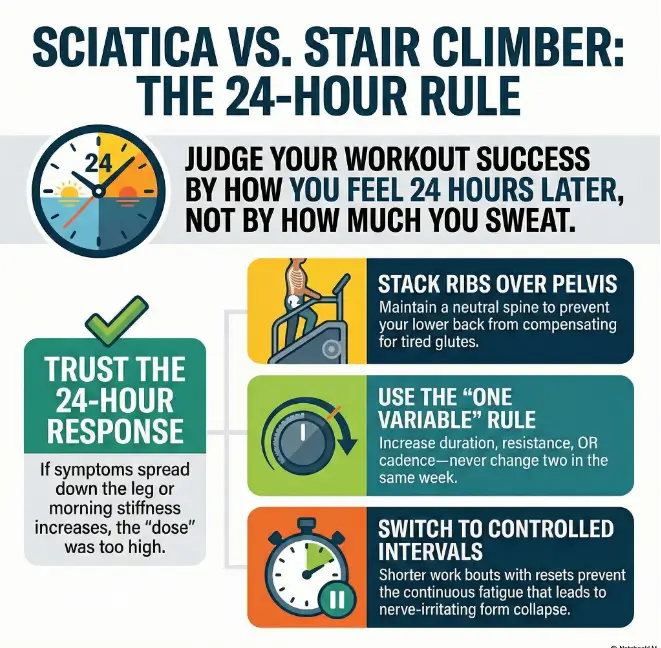
“Felt fine” is not a green light by itself. For sciatica-prone training, the real metric is 24-hour response. If symptoms travel farther down the leg, last longer, or reduce function the next day, the dose was too high even if the session felt heroic in the moment.
- High resistance can shift load away from glutes to the lumbar region.
- Effort can mask early nerve irritation signals.
- Judge sessions by next-day function, not in-workout pain alone.
Apply in 60 seconds: Before each set, say out loud: “Cadence first, posture second, resistance third.”
Pain pattern check first: flare, fatigue, or red flag?
Normal muscle fatigue vs nerve-type pain (quick distinction)
Muscle fatigue usually feels local, dull, and symmetrical, think quads and glutes that recover with rest. Nerve-type pain tends to be sharper, electric, burning, or traveling along a path (often one side dominant), with tingling or numbness mixed in.
Quick self-check:
- Fatigue: broad muscle heaviness, better after light movement.
- Flare: pain radiates farther, sitting tolerance drops, morning stiffness spikes.
- Red flag: new severe weakness, bowel/bladder changes, saddle numbness.
Radiation, tingling, and next-morning stiffness: what each suggests
Radiation below the knee often means symptoms are becoming more neurally irritable. Tingling can mean heightened nerve sensitivity. Next-morning stiffness that takes 60 to 90 minutes to settle suggests yesterday’s dose exceeded your current capacity.
One client told me, “I can survive the workout but lose my morning.” That sentence changed her plan. We cut resistance by 3 levels, held cadence steady, and she got mornings back within 10 days.
The 24-hour rule that predicts whether you overdid it
Use this simple rule:
- Green: symptoms same or better next day.
- Yellow: mild increase that settles within 24 hours.
- Red: pain spreads, weakness rises, function drops.
Train again only on green or stable yellow. Red means regress immediately and reassess.
Show me the nerdy details
Nerve tissues are load-sensitive and time-sensitive. Two sessions with identical total work can produce different outcomes depending on how the load is distributed (continuous grind vs interval with resets), spinal position under fatigue, and whether symptom spread is peripheral (farther down leg) or centralizing (moving closer to back). The 24-hour model works because delayed inflammatory and neural sensitivity responses often peak after the session, not during it.
Resistance mistakes that quietly provoke sciatic symptoms
Too high, too soon: when Level 12 behaves like strength work
On many machines, “moderate” settings are not truly moderate for irritated backs. A high level can force shorter, choppier steps and trunk bracing patterns that raise symptom risk. If your cadence collapses by minute 4, resistance is probably too high for today.
Grinding cadence and trunk lean: the double-stress pattern
Low cadence + forward lean is a classic double-stress combo. You get prolonged loading per step and less clean hip extension. That can amplify neural sensitivity, especially if one side is already guarding.
I made this mistake myself years ago: I chased calories, gripped rails, leaned forward, and wondered why I couldn’t sit through dinner afterward. Hard lesson. Useful lesson.
“If it burns, it works” — why this mindset backfires for sciatica
For nerve-sensitive training, “more burn” is not a universal win. Smart training here means consistent exposure without escalation. You want repeatable sessions you can recover from, not heroic sessions that steal three days.
- Don’t turn cardio into stealth strength work.
- If cadence drops, lower resistance first.
- Symptoms tomorrow matter more than calorie count today.
Apply in 60 seconds: Set a minimum cadence floor and reduce resistance the moment you can’t hold it.
Form before force: posture cues that reduce nerve irritation
Ribcage-over-pelvis stacking for neutral spine under fatigue
Think “zipper up the front of your torso.” Keep ribcage roughly over pelvis. Not rigid, just organized. This reduces dramatic lumbar flexion/extension swings when tired.
Useful cue: “Tall chest, soft ribs, quiet lower back.” If your lower back starts “doing drama,” cut level by 1 to 2.
Foot pressure and step contact: stop toe-dominant climbing
Toe-heavy climbing often drives calf overload and unstable pelvis mechanics. Aim for whole-foot contact through the step. Midfoot pressure usually gives better glute contribution and calmer lumbar behavior. If calf tension keeps spiking, compare whether it is true posterior-chain tightness or nerve-driven pain mistaken for a hamstring stretch issue.
Handrail dependence and lumbar extension: the posture leak
Death-gripping rails seems safer, but often encourages odd trunk positions. Light fingertip support is fine; full-body hanging is not. If you must lean heavily to survive the level, the level is wrong.
Try this 3-cue loop every 2 minutes:
- “Ribs over pelvis.”
- “Whole foot, quiet ankle.”
- “Light hands, strong hips.”
Modify resistance safely: a progression that protects your back
Start zone: low-to-moderate resistance, conversational effort
Start where you can talk in short sentences. If speech disappears, form usually follows. A practical opening target is 12 to 20 minutes total work in broken intervals, not one long grind.
Session template (Week 1 baseline):
- 5-minute gentle warm-up (low resistance)
- 6 rounds: 90 seconds work + 90 seconds easy
- 3-minute cooldown + 2-minute walk reset
Interval structure: shorter bouts, longer resets
Intervals reduce continuous irritation exposure. You get repeated practice under control, instead of one long deterioration. For many people, 60 to 120 second work bouts are the sweet spot during flare-prone weeks.
Progression math: one variable at a time (not all at once)
Pick one:
- Increase duration by 2 to 3 minutes total, or
- Increase resistance by 1 level, or
- Increase cadence slightly (2 to 4 steps/min), or
- Reduce rest by 10 to 15 seconds.
Never change two major variables in the same week if symptoms have been unstable. If your irritability has been high, it can help to rotate with a sciatica-friendly recumbent bike setup on alternate cardio days.
Here’s what no one tells you… cadence stability often matters more than adding levels
Steady cadence with clean posture beats high resistance with ugly movement. Every time. Think consistency over intensity: boring workouts that you can repeat become surprisingly powerful in 3 to 4 weeks.
Show me the nerdy details
Progressive overload for nerve-sensitive conditions works best when weekly load increments stay conservative. A practical rule is to keep total weekly training stress increases modest and prioritize movement quality metrics (cadence stability, symptom spread, next-morning stiffness) over output metrics (calories, max level). This preserves adaptation while limiting neural irritability spikes.
- Use intervals before steady-state when symptoms are unpredictable.
- Change only one variable per week.
- Track next-day function as your primary score.
Apply in 60 seconds: Write your “one variable” for this week on your phone lock screen.
Who this is for / not for
For: mild-to-moderate exercise-triggered sciatic symptoms, no progressive deficits
This plan fits people who flare with certain workloads but can still walk, perform daily tasks, and recover within 24 to 48 hours when dose is right. It’s also useful if your symptoms are mechanically sensitive, better with some movements, worse with others. If walking is your baseline limiter, start by mapping triggers from this walking-specific sciatica breakdown.
Not for: severe or worsening neurologic signs, trauma, or systemic red flags
Urgent evaluation is needed for bowel/bladder control changes, saddle numbness, rapidly progressive weakness, severe trauma-related pain, fever with back pain, or abrupt severe worsening. These are not “push through” situations.
Major institutions and spine organizations consistently flag these as emergency symptoms that should not be delayed.
If your pain is unpredictable at rest, this plan is not step one
If pain is escalating at rest, waking you nightly, or spreading regardless of activity modification, get assessed first. The goal is safe training, not stubborn training.
Don’t do this: 7 common mistakes on stair climbers with sciatica
Jumping straight into high resistance during warm-up
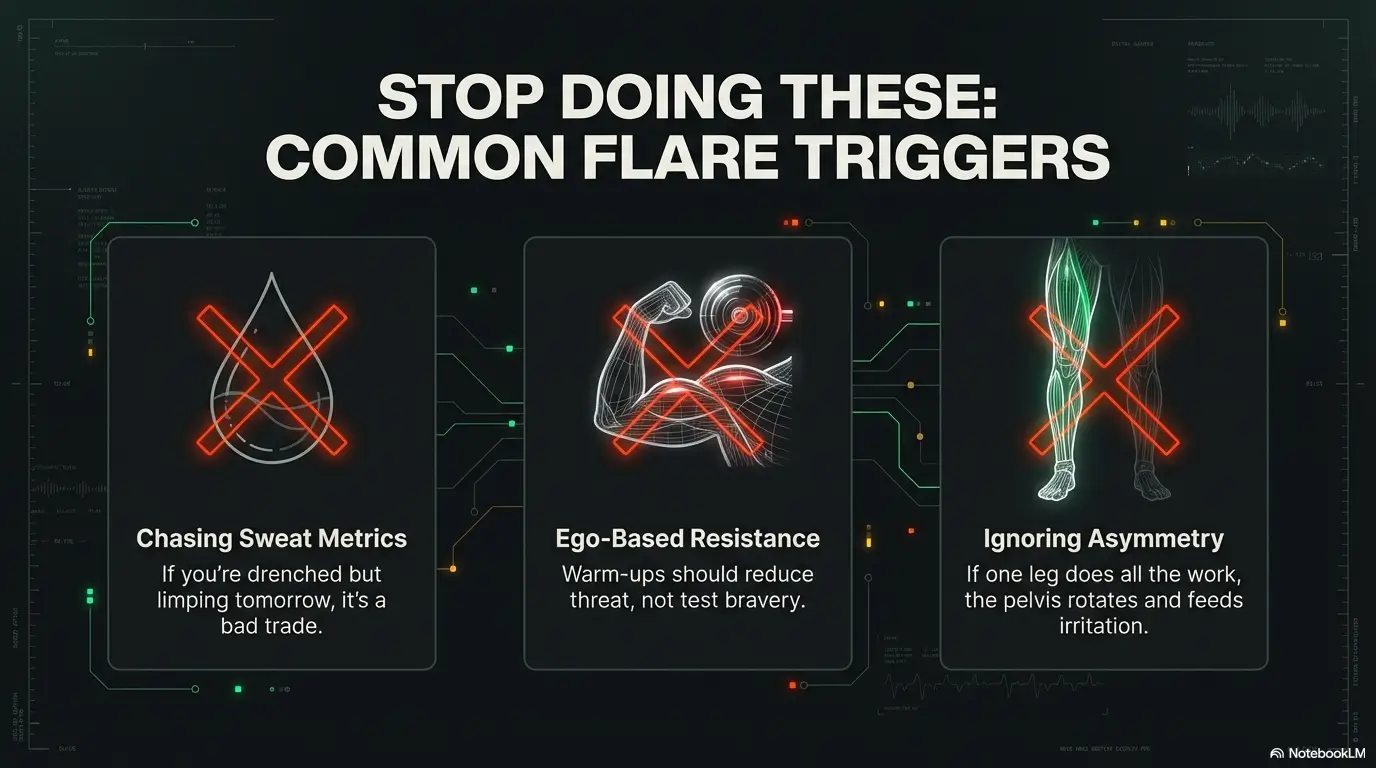
Warm-up should reduce threat, not test bravery. Start easier than your ego prefers for 4 to 6 minutes.
Chasing sweat metrics instead of symptom response
Sweat is not a pain-management KPI. If you’re drenched but limping tomorrow, that’s a bad trade.
Extending session time and resistance in the same week
Classic overload error. Pick one knob only.
Ignoring asymmetry (one side drives, one side absorbs)
If one leg “does all the work,” your pelvis often rotates subtly, feeding irritation. Watch mirror feedback or record 20 seconds from behind.
No deload week after a flare
After a red week, reduce total workload for 5 to 7 days. Recovery is training, not failure.
Treating pain during exercise as the only metric
If you only score pain in-session, you’ll miss delayed flares.
Skipping cooldown and immediate post-session reset
Two to five minutes of gentle downshifting can reduce next-day stiffness for many people. For some, finishing with a calm floor reset like the 90-90 position for sciatica helps settle symptoms before they snowball overnight.
- Warm up gently before any hard work.
- Avoid changing duration and resistance together.
- Always include cooldown plus next-day check.
Apply in 60 seconds: Put a “cooldown = non-negotiable” reminder in your workout timer.
Equipment settings that matter more than people think
Step rate range for symptom control vs symptom provocation
There is no universal perfect step rate, but huge variability is usually a bad sign. Choose a sustainable band you can hold with clean form (for many, moderate and steady beats aggressive and erratic). If your rate oscillates wildly, reduce resistance.
Resistance-band alternatives when machine settings are too coarse
Some stair machines jump in chunky level increments. On those days, use lower machine resistance and add controlled accessory work off-machine later (like hip-dominant band work) rather than forcing a too-big jump on the stair unit.
Shoe cushioning and heel-to-toe drop: when to experiment carefully
Shoes can change symptom feel through load distribution and ankle mechanics. Don’t overhaul everything at once. Test one shoe variable for 1 to 2 weeks while keeping workout dose stable, then compare morning symptoms. If you need a baseline, this guide on sciatica-friendly walking shoes can help you set a controlled starting point.
Eligibility checklist (quick yes/no):
- Can you maintain neutral-ish trunk posture for 10 minutes? (Yes/No)
- Can you finish without new below-knee pain? (Yes/No)
- Are next-morning symptoms same or better? (Yes/No)
Neutral action: If any answer is “No,” reduce one variable at your next session.
If stair climber keeps flaring you: smarter cardio swaps (temporary, not forever)
Incline walking with capped grade and pace
Incline walking can be easier to dose because pace and grade control are more transparent. Start with modest incline and cap pace to preserve posture and symmetry. If you’re deciding between machines, compare your current tolerance with this treadmill vs elliptical for sciatica framework.
Recumbent bike intervals for lower neural irritability days
On highly sensitive days, recumbent intervals can maintain conditioning while reducing load spikes. Keep intervals short and effort conversational-to-moderate. If you’re split between options, use this recumbent vs upright bike comparison for sciatica to match your current flare profile.
Pool walking or deep-water running as bridge options
Water can reduce compressive load and let you keep rhythm when land-based options are hot. It’s not forever, it’s a bridge while irritability calms. If you want a practical entry plan, use this primer on swimming with sciatica.
Decision card: When A vs B
If symptoms are stable: Stair climber intervals with low-to-moderate resistance.
If symptoms are volatile: Recumbent bike or incline walk with capped effort.
If flare is active: Pool walking/deep-water running + walking tolerance rebuild.
Neutral action: Re-test stair climber once two consecutive sessions stay green.
Recovery window strategy: what to do in the 24 hours after training
What to monitor: pain spread, morning stiffness, sitting tolerance
Track three numbers:
- Pain spread zone (back only / butt-thigh / below knee)
- Morning stiffness duration (minutes)
- Sitting tolerance (minutes before symptoms rise)
This is your control panel. Not fancy, but brutally effective.
Mobility “minimum dose” to avoid rebound stiffness
Think small and frequent. Two to three micro-mobility breaks (3 to 5 minutes each) can beat one heroic stretching marathon. Use gentle movement that does not peripheralize symptoms. If glides tend to aggravate you, review this troubleshooting guide on why sciatic nerve flossing can make pain worse and how to dose it more carefully.
When to regress, hold, or progress next session
- Regress: symptoms spread farther, stiffness duration jumps, sitting tolerance drops.
- Hold: mild temporary increase, recovered by next day.
- Progress: same or better metrics across two sessions.
Mini calculator (no app needed):
Next-session load score = (pain spread change) + (stiffness change) + (sitting tolerance change).
If 2+ markers worsen, reduce one training variable. If all stable/improved twice, increase one variable.
Neutral action: Enter the three markers in your notes app right after cooldown and again next morning.
Short Story: The Week I Stopped “Winning” Workouts
A reader once told me she measured success by the machine’s calorie number. She’d leave sweaty, proud, and then wake up unable to sit through breakfast without leg pain. We changed almost nothing dramatic, just resistance down two clicks, intervals instead of steady grind, and a stubborn rule: no progression unless the next morning stayed green. By day three, she felt under-challenged and annoyed.
By day six, her stiffness time dropped from about 75 minutes to around 25. By week two, she resumed a normal workday without that “electrical hum” down the calf. She didn’t become less disciplined; she became less reckless. That was the turning point. Her fitness returned faster when she stopped paying for every session with tomorrow’s function.
FAQ
Can stair climbers make sciatica worse?
Yes, especially when resistance is too high, cadence collapses, and posture degrades. The machine itself isn’t automatically bad; poor dosing is usually the issue.
What stair climber resistance is safest for sciatica?
The safest level is the one where you can keep stable cadence, neutral-ish trunk alignment, and no next-day spread of symptoms. Start lower than you think, then progress one variable weekly.
Is stair climber better or worse than treadmill for sciatica?
Depends on your current irritability. Some people tolerate incline walking better because it’s easier to dose. Others prefer stair intervals. Use the 24-hour response as your tie-breaker.
Should I stop if pain goes down my leg while climbing?
If pain starts radiating farther down the leg during a session, stop and reassess. Resume only at a reduced dose, and seek clinical input if this keeps recurring.
How many minutes on a stair climber is safe with sciatica?
There’s no universal number. For many, 12 to 20 total work minutes in intervals is a better starting point than long steady-state sessions. Recovery markers decide progression.
Why does sciatica hurt more the next day, not during exercise?
Because effort can mask early warning signals, and neural sensitivity may increase after loading. That’s why next-day function matters more than in-session confidence.
Are intervals safer than steady-state stair climbing?
Often yes during sensitive phases, because reset periods limit continuous irritation and help maintain form quality.
Can poor posture on a stair climber pinch a nerve?
Poor posture usually doesn’t “pinch” in a simple way, but it can increase mechanical stress and neural irritation. Better stacking and controlled cadence often reduce symptoms.
What shoes are best for stair climbing with sciatica?
Use stable, comfortable shoes and test one change at a time. Don’t switch shoe type and training load in the same week if you want clean feedback.
When should I see a doctor or physical therapist?
Seek urgent care for bowel/bladder changes, saddle numbness, major weakness, fever with severe back pain, or severe worsening after injury. For persistent radiating pain, declining tolerance, or sleep disruption, schedule evaluation soon. If you are unsure where to start, a structured physical therapy pathway for sciatica is often the safest first clinical step.
Next step: run a 7-day “low-irritation stair protocol”
One concrete action: do 3 sessions this week at reduced resistance + 24-hour symptom logging
Keep it simple:
- Three sessions (non-consecutive days)
- Low-to-moderate resistance
- Intervals over steady grind
- Two check-ins: right after + next morning
Use a stoplight scale (green/yellow/red) to decide next-session load
Green: keep or tiny progress. Yellow: hold. Red: regress and consider evaluation.
Keep one-page notes: level, cadence, duration, next-morning symptoms
If you track nothing else, track those four. Patterns appear quickly, usually within a week.
Infographic: Low-Irritation Stair Progression (7 Days)
GREEN
Symptoms same or better next day
Action: progress one variable only
YELLOW
Mild increase, resolves within 24h
Action: hold current plan
RED
Spread below knee, weakness, function drop
Action: regress + seek clinical input
Session Formula: Warm-up 5 min → 6×(90s work + 90s easy) → Cooldown 3 min
- Use intervals and conservative resistance first.
- Progress only when 24-hour markers stay green.
- Escalate care quickly if red flags appear.
Apply in 60 seconds: Schedule your first 20-minute low-irritation session now and pre-create your symptom log template.
This is educational content, not a diagnosis or personalized treatment plan. If symptoms are severe, changing, or persistent, get evaluated by a licensed clinician. Urgent care is needed for new bowel/bladder changes, saddle numbness, major leg weakness, fever with severe back pain, or severe worsening pain after injury.
Last reviewed: 2026-02-11.