

Precision Over Panic: Navigating the Straight Leg Raise
Most people try the Straight Leg Raise test at home like it is a verdict. It is not. It is a clue, and a useful one, if you treat it with precision instead of panic.
If you are dealing with low back pain and leg pain, the hardest part is not always the pain itself. It is the uncertainty. One day the symptoms flare, the next day they ease, and every search result sounds absolute. That is how people over-test, misread hamstring tension as sciatica, or miss early red flags that actually matter.
The cost of guessing is real: delayed care when function is slipping, or unnecessary fear when your nervous system is simply irritable. This guide helps you run a safer home Straight Leg Raise, interpret angle and pain-pattern signals with context, and decide your next step with less noise.
- ✅ Identify “Positive” Results: Understand what the test suggests and what it cannot diagnose.
- ✅ Escalation Markers: Know when to seek immediate care for progressive weakness or bowel/bladder changes.
- ✅ Practical Method: Built around one controlled test, one function marker, and clear timelines.
No drama. No doom-scrolling. Just cleaner data and better decisions.
Because in spine pain, trend beats guesswork.
Table of Contents
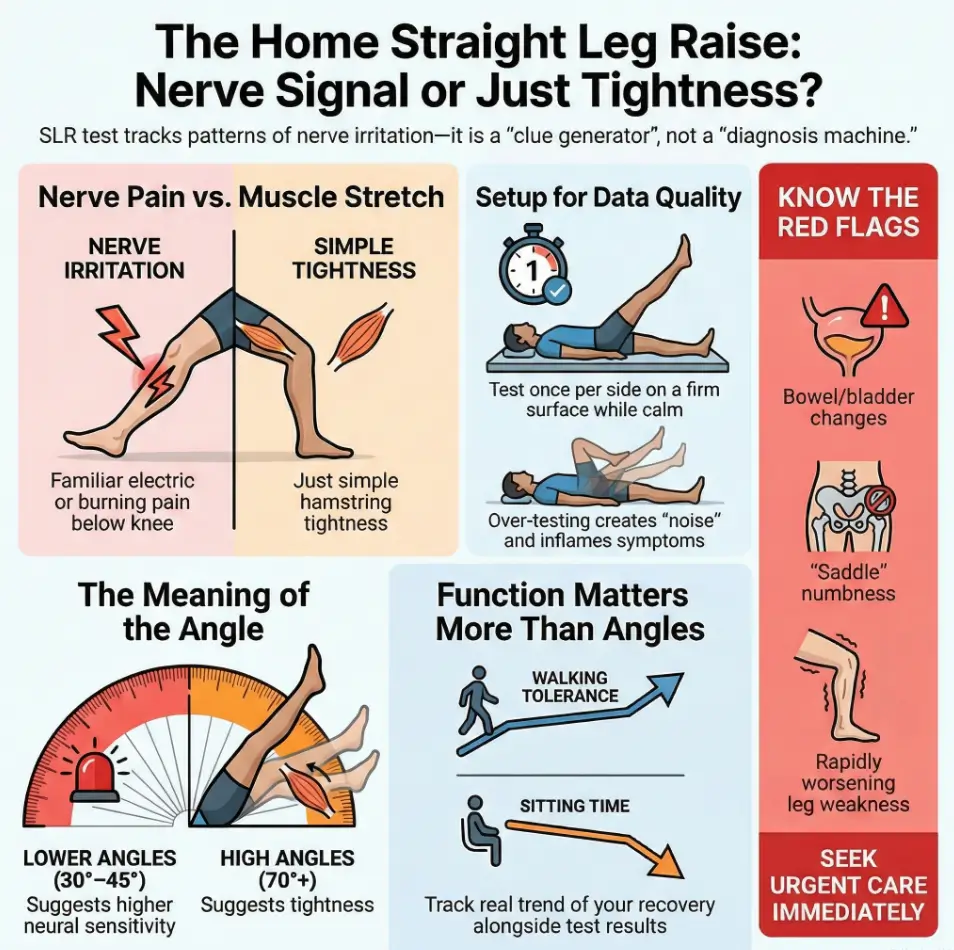
A home Straight Leg Raise can suggest nerve irritation if pain travels below the knee at certain angles, but it cannot diagnose a herniated disc, confirm severity, or determine whether surgery is needed. Treat it as one clue, not the final verdict. Pair results with symptom pattern, daily function changes, and red flags. Seek urgent care for bowel or bladder changes, saddle anesthesia, fever with back pain, or rapidly worsening weakness.
This content is educational and not personal medical advice. Do not force painful movement. Stop the test if pain spikes sharply, numbness spreads, or weakness worsens. Urgent care is needed for bowel or bladder dysfunction, saddle numbness, new major weakness, fever with back pain, recent major trauma, or cancer/infection risk factors.
Start Here: What a Home SLR Can and Cannot Tell You
What it can suggest: possible nerve root irritation pattern
The Straight Leg Raise is less like a courtroom verdict and more like a smoke alarm. It does not tell you where the fire started. It tells you to pay attention. If lifting one straightened leg reproduces familiar radiating pain below the knee, that pattern can suggest neural irritation. The key word is pattern. One random twinge, one awkward rep, or one stressful day does not create a diagnosis.
I once watched a friend run this test six times in ten minutes, chasing certainty. By rep four, everything hurt including places that were fine before. The lesson was simple and brutal: over-testing creates noise. Good self-checks are calm, measured, and boring. Boring data is useful data.
What it cannot confirm: exact diagnosis, level, or severity
An SLR cannot tell you whether the issue is L4, L5, or S1 with clinical certainty. It cannot confirm imaging findings. It cannot distinguish all causes of radiating pain. It cannot tell you whether you need injections, physical therapy, or surgery. It cannot rule in or rule out every condition that matters. It is one piece in a larger puzzle that includes strength, sensation, reflex changes, walking tolerance, sitting tolerance, and symptom evolution over time.
In practice, the same “positive” feeling can come from different mechanisms: irritated nerve tissue, tight protective muscle guarding, fear-amplified sensitivity, or combinations of all three. If you are trying to separate symptom types, this breakdown on nerve pain versus muscle soreness after physical therapy can help sharpen your labels.
Why one test is never the verdict in spine pain
Spine pain behaves like weather. You do not define a season from one windy afternoon. Clinicians look for trendlines: better, worse, or unstable across days. They pair exam findings with history and function. Can you walk farther than last week? Sit through a meal? Sleep without waking every hour? Those answers often matter more than a single provocative movement.
- Use one controlled session, not repeated stress-testing.
- Track pattern and function together, not test result alone.
- Escalate if red flags appear or weakness progresses.
Apply in 60 seconds: Write one sentence now: “My goal is to detect patterns, not prove a diagnosis.”
Signal First: What “Positive” Actually Means in Real Life
Leg pain vs hamstring stretch: the symptom language that matters
People often say, “It felt tight, so I guess it is positive.” Not so fast. Tightness behind the thigh can be simple hamstring tension. A more concerning signal is familiar pain that travels along a line, often sharp, electric, burning, or deep ache that mimics your usual symptoms. Language matters because it sharpens your observation. “Tight” is vague. “Burning line down the outer calf at 40 degrees” is usable. If this distinction is fuzzy, compare your symptoms with this guide on hamstring stretch versus nerve pain.
Below-knee radiation and angle response, explained simply
Below-knee radiation is often more suspicious for neural involvement than buttock-only discomfort. Angle response helps too: early provocation at lower angles may raise concern, while only high-angle hamstring pull is often less specific. Still, context rules everything. If your daily pain pattern is clear and the test reproduces it predictably, that signal is stronger than a one-off unusual sensation.
Let’s be honest… “I felt tightness” is not the same as nerve pain
Most people are not “doing it wrong.” They are doing it too fast and naming sensation too loosely. Think of sensation labels as camera focus. The clearer the label, the better the next decision. A practical trick: score symptom quality from 0 to 10 for “stretch sensation” and “radiating pain sensation” separately. Two numbers are better than one muddy description.
Mini self-check phrase you can use during testing: “Is this my familiar pain path, or just tissue stretch?” This single question can prevent half the false alarms I see in self-triage journals.
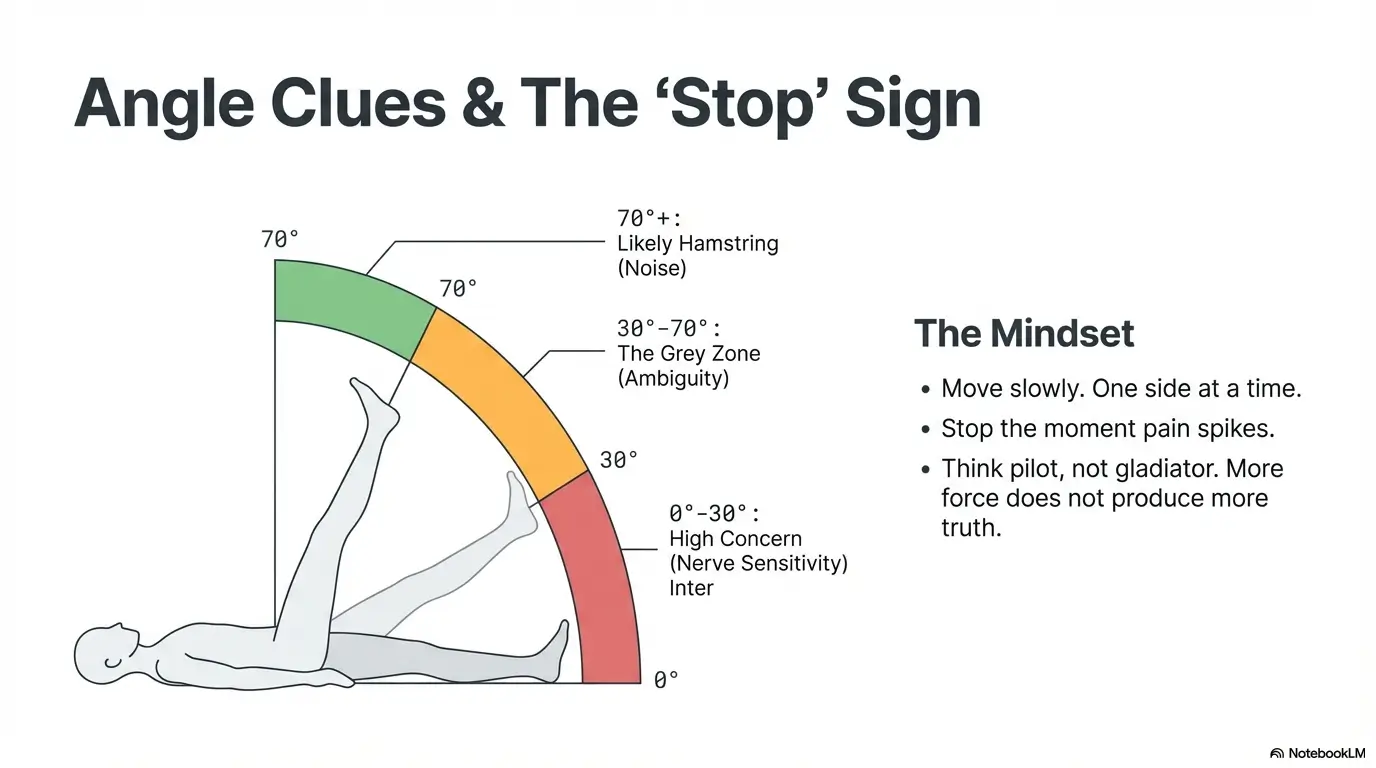
Angle Clues: Why 30°, 45°, and 70° Feel Different
Low-angle provocation and why clinicians pay attention
When familiar radiating pain appears early, especially around lower angles, clinicians pay closer attention. It can suggest higher sensitivity in neural structures. But angle by itself is not destiny. A stiff morning, poor sleep, or fear bracing can shift thresholds. Think trend, not moment.
Mid-range ambiguity: where most self-tests get misread
The middle angles are where confusion lives rent-free. Many people feel mixed sensations: some stretch, some ache, maybe a little zing. This is where rushing causes bad conclusions. Move slower, pause, note location and quality, then lower. It is okay to write “uncertain.” Uncertain data is still honest data.
High-angle tension: when it’s more likely muscle than nerve
At higher angles, hamstring tension often dominates, especially if symptoms are diffuse and stay above the knee. That does not always mean “all clear.” It simply means specificity drops. If your daily symptoms include coughing pain, sitting intolerance, or progressive weakness, those carry serious weight even if SLR is less dramatic.
Anecdote from clinic prep notebooks: people who tested with patience produced cleaner logs and better first appointments. People who hunted certainty with force usually arrived more flared and less clear.
Show me the nerdy details
SLR is a neurodynamic provocation test. The response is shaped by neural mechanosensitivity, muscular flexibility, hip position, and cognitive threat appraisal. Because multiple systems contribute to the signal, a single positive or negative finding has limited standalone diagnostic value. Serial observations paired with function often improve interpretation quality.
- Lower-angle familiar radiation may be a stronger clue.
- Mid-range results are often ambiguous and require careful notes.
- High-angle tightness alone is frequently less specific.
Apply in 60 seconds: Add one extra field to your note: “first angle where familiar pain appears.”
Before You Test: Setup Rules That Prevent Bad Data
Surface, pillow, footwear, and warm-up variables
Setup is not cosmetic. It is data quality control. Use a firm surface, neutral head support, and bare feet or consistent footwear each time. Do not test cold right after sitting frozen for two hours. A brief 2 to 3 minute gentle walk can reduce noisy guarding. Keep room temperature stable when possible. Small variables can change sensation more than you think.
One-leg-at-a-time protocol to reduce bias
Test one side, rest briefly, then test the other. Same pace. Same sequence. Same stop rule. If you modify three things at once, interpretation becomes guesswork. Consistency turns your note into something a clinician can actually use.
60-second note template to capture usable observations
Use four fields only:
- Side tested (left/right)
- Approximate first-angle symptom onset
- Pain path (back, buttock, thigh, below-knee line)
- Recovery time back to baseline (minutes)
That is enough. You do not need a novelist’s diary. You need repeatable breadcrumbs.
- Control variables before interpreting results.
- Use identical pacing left vs right.
- Track recovery time, not just symptom onset.
Apply in 60 seconds: Copy the 4-field template into your phone notes now.
Decision card: When A vs B
- A: One controlled test + stable function → Monitor, keep moving gently, recheck in 24 to 48 hours.
- B: Test triggers escalating pain or weakness → Stop self-testing and arrange clinical evaluation quickly.
Neutral action: pick A or B once, then follow it for the next day instead of bouncing between plans.
Don’t Force It: Common Mistakes That Distort Results
Pushing through pain to “get certainty”
This is the classic trap. More force does not produce more truth. It produces irritation. If pain rises sharply, the test is already telling you enough. Respect the stop point. Think pilot, not gladiator.
Bending the knee, rotating hip, or lifting too fast
Compensations creep in quietly. A slightly bent knee, rotated hip, or quick leg yank can change the signal. Slow movement reveals pattern. Fast movement creates drama. Drama looks informative but usually is not.
Testing repeatedly in one session and inflaming symptoms
Three to five attempts per side is often too much for irritable symptoms. A single careful attempt per side, maybe two max, is usually enough for home tracking. Remember the goal: detect pattern without feeding the flare.
Short personal note: I used to think more tracking meant better tracking. Then I saw how over-measuring turns people into anxious statisticians of pain. Precision is good. Obsession is not. If symptom spikes follow movement drills, review this explanation of why sciatic nerve flossing can sometimes make pain worse.
False Alarms: Why a Positive SLR Does Not Equal “Disc Damage”
Neural sensitivity vs structural compression
A positive-feeling SLR can reflect a sensitized nervous system, not necessarily severe structural compression. Symptoms can be loud even when tissue findings are modest. The reverse can also happen. This mismatch is why one home test should never dictate major treatment choices. For a broader comparison, see sciatica vs herniated disc.
Hamstring guarding, fear tension, and pain amplification
Guarding is your body’s security guard on overtime. Helpful at first, exhausting later. If you are bracing hard, your threshold drops and everything feels louder. Anxiety can tighten the whole chain from jaw to calf. That is not imaginary. It is physiology. If anxiety spirals are part of your pain cycle, this piece on cyberchondria in chronic pain is worth reading.
Medications, fatigue, and stress as hidden confounders
Bad sleep, high stress, and medication changes can alter pain response day to day. A test result on a rough day may look worse than your actual trajectory. Track context with a tiny note: sleep quality, stress level, unusual activity. Two or three words can explain a lot.
Coverage tier map: What changes from Tier 1 to Tier 5
- Tier 1: Mild intermittent symptoms, no neurologic deficits, stable function.
- Tier 2: Recurrent symptoms with occasional below-knee radiation, manageable recovery.
- Tier 3: Persistent daily symptoms, work or sleep disrupted, inconsistent response to self-care.
- Tier 4: Progressive weakness, numbness spread, major function decline over 48 to 72 hours.
- Tier 5: Emergency signs such as bowel/bladder changes or saddle numbness.
Neutral action: identify your tier and choose response intensity that matches it.
Show me the nerdy details
Pain is an output shaped by peripheral input and central processing. In practical terms, mechanical sensitivity, local inflammation, sleep debt, stress hormones, and threat perception can all shift pain thresholds without one-to-one correlation to structural severity. This is why consistent function tracking outperforms single-point fear decisions.
Missed Signals: Why a Negative SLR Doesn’t Fully Clear You
Symptom timing: flare-ups that vanish during testing
You might test during a temporary calm window and get little provocation. That does not erase what happened during sitting, driving, or coughing. Timing matters. If symptoms are position-dependent, a single lying-down test can miss the real trigger landscape.
Position dependence: sitting/coughing triggers that SLR may miss
Some people are worst in flexed seated postures, prolonged desk work, or vibration exposure from commuting. SLR may under-detect those patterns. Combine SLR notes with one functional stressor note such as sitting tolerance or walking tolerance to avoid blind spots. If sitting is a major trigger, use a structured sit-stand schedule for desk-job sciatica.
Here’s what no one tells you… mild weakness can precede dramatic pain
Not every serious development shouts. Sometimes it whispers as subtle weakness, toe drag, or faster fatigue on stairs. If function is declining even when pain seems manageable, escalate earlier. Pain intensity alone is a poor gatekeeper.
Short anecdote: a reader once said, “My pain was a 4, so I waited. But my foot felt oddly lazy on stairs.” That “lazy foot” detail mattered more than the number.
- Track function and triggers beyond lying-down testing.
- Watch for subtle weakness, not just pain spikes.
- Escalate when ability declines over time.
Apply in 60 seconds: Add one function metric today: “minutes I can sit before symptoms climb.”
Who This Is For / Not For
Useful for: non-traumatic back-leg pain pattern tracking
This home framework fits adults with non-traumatic back and leg pain who need a structured way to observe symptom behavior before or between clinical visits. It helps convert vague fear into specific notes. That alone can improve care quality and reduce appointment chaos.
Not for: severe trauma, post-op complications, systemic red flags
If you had a major fall, high-speed accident, recent spinal procedure with worsening symptoms, fever with back pain, unexplained weight loss plus neurologic change, or cancer/infection risk profile, home testing is not the main event. Clinical assessment should lead.
Better alternatives when pain is too irritable to test safely
If symptoms flare with minimal movement, skip provocation tests. Use tolerance-based monitoring instead: short walking windows, positional changes every 20 to 30 minutes, and symptom logging at rest. Sometimes the best data comes from what you can do, not what you can provoke. Guided movement can still help, and this overview of physical therapy for sciatica gives a safe framework.
When to Seek Help: Red Flags and Escalation Timelines
Same-day urgent signs you should not watch-and-wait
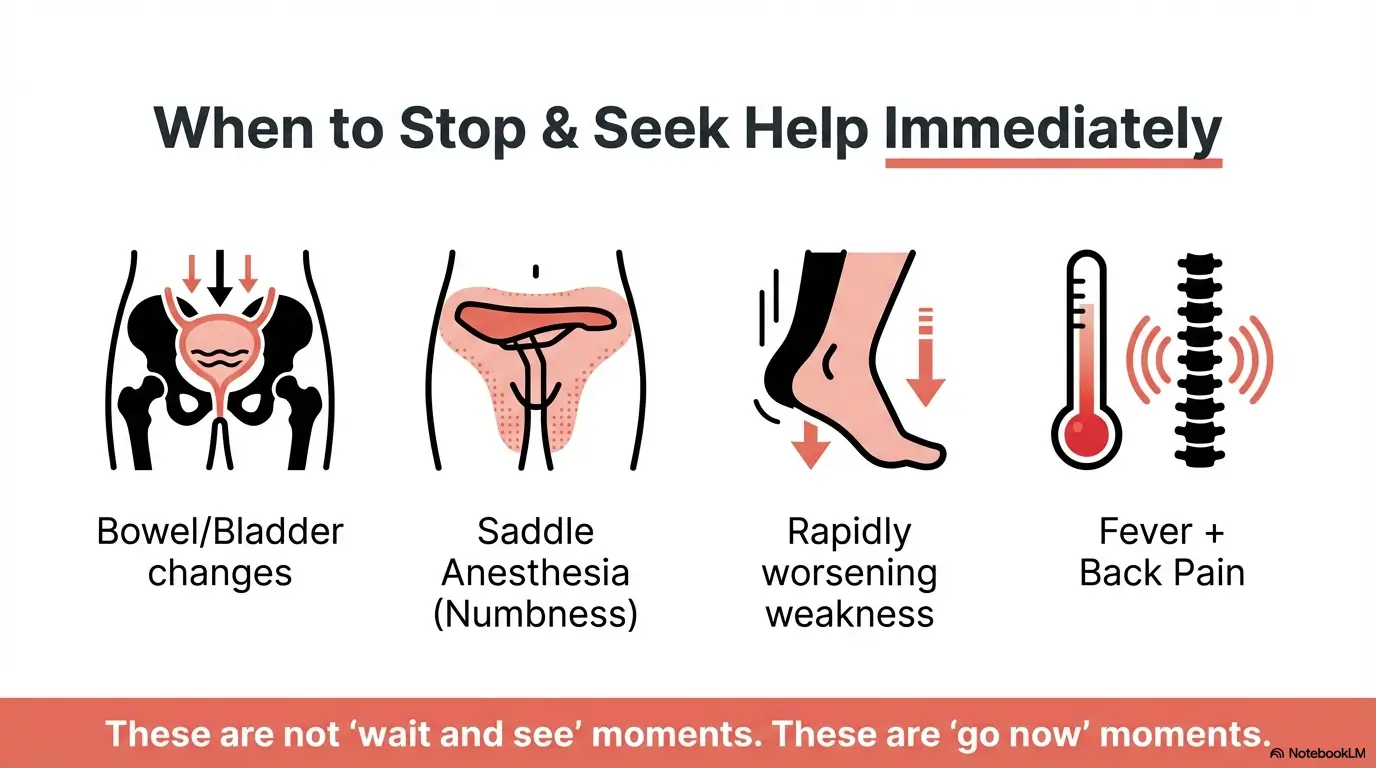
Seek urgent care immediately for bowel or bladder dysfunction, saddle anesthesia, rapidly worsening leg weakness, fever with back pain, or severe trauma context. These are not “monitor for a week” signs. Keep this emergency checklist handy: low back pain emergency warning signs.
48–72 hour threshold for persistent functional decline
If function is clearly worsening over 48 to 72 hours, escalate. This includes shrinking walking distance, reduced standing tolerance, new motor difficulty, or increasing numbness distribution. Time matters. Earlier evaluation often means calmer treatment paths.
What to bring to a visit: symptom map, trigger list, test notes
Bring one page:
- Primary symptom map (where pain and numbness travel)
- Top 3 triggers and top 2 relievers
- SLR notes: side, angle clue, pain path, recovery time
- Function trend over the last 3 days
This turns a rushed visit into a high-clarity conversation.
Eligibility checklist (yes/no)
- Can you perform one slow test without sharp escalating pain? (Yes/No)
- Are there zero emergency red flags today? (Yes/No)
- Has function stayed stable over the last 48 hours? (Yes/No)
If any answer is “No,” prioritize clinical care over further self-testing. Neutral action: decide your next contact step now.
Common Mistakes in Self-Triage (Beyond the Test Itself)
Treating internet checklists like diagnosis
Checklists are maps, not territory. They help orientation, not certainty. If you use them as binary truth machines, you will either panic too early or delay too long.
Ignoring progressive weakness because pain “is manageable”
People under-react when pain stays moderate. But neurologic change can progress with pain levels that seem tolerable. Function drift is the real headline.
Stopping all activity vs overloading too soon
Total rest can stiffen and sensitize. Aggressive return can re-irritate. The middle lane usually wins: gentle movement, symptom-aware pacing, and gradual load progression. If you need low-impact cardio choices, compare treadmill versus elliptical for sciatica and swimming with sciatica.
Mini calculator: escalation score
Give yourself 1 point for each item:
- Symptoms worsening day by day
- New numbness area
- New weakness or foot control changes
Output: 0 to 1 points = monitor closely; 2 points = book prompt clinical review; 3 points = urgent evaluation today. Neutral action: calculate once daily, same time.
Infographic: Home SLR Decision Pathway
Calm setup, one test per side, slow movement.
Note angle clue, pain path, and recovery minutes.
Signal only, ambiguous, or escalating concern.
Monitor, book care, or seek urgent help for red flags.
Next Step: One Concrete Action You Can Take Today
Do one controlled SLR session and log four fields: side, angle, pain path, recovery time
One session. Not five. Do it calmly, stop early if symptoms escalate, and capture only what matters. Clarity beats volume. The goal is to walk into your next decision with signal instead of noise.
Pair with one functional marker (walking tolerance or sit tolerance)
Choose one daily function marker you can repeat under similar conditions. If your marker improves while SLR findings stay similar, that is still progress. If your marker worsens despite “better-looking” test notes, trust function over appearance. If walking is your chosen marker, this guide on sciatica pain when walking can help you structure progression.
Use this log to decide: monitor, book PT/primary care, or seek urgent care
Your log is a decision tool. It is not a trophy. If trend is stable or improving, continue measured self-management and planned care. If trend declines, escalate without drama and without delay.
Short Story: The Notebook That Cut Through the Noise
Two winters ago, a reader sent me a photo of her “pain notebook.” Three pages, neat columns, and zero storytelling flourishes. Day one said: left side, 40 degrees, line of pain to outer calf, recovery 12 minutes. Day two looked similar. Day three added a short note: “stairs feel less scary.” That tiny sentence changed everything.
She stopped doom-scrolling at midnight and booked a targeted appointment with useful data in hand. Her clinician did not need a detective novel. They needed a pattern. Within two weeks, she had a paced plan, fewer flare-ups, and a quiet confidence that felt almost physical. Not because the notebook diagnosed her, but because it gave her choices with edges. In pain, that is a form of freedom.
- Run one careful session, then stop.
- Track how life tasks change, not just pain sensation.
- Escalate promptly when trend worsens.
Apply in 60 seconds: Schedule tomorrow’s 2-minute recheck at the same time of day.
FAQ
Can a Straight Leg Raise at home diagnose sciatica?
No. It can suggest a pattern consistent with nerve irritation, but it cannot diagnose cause, level, or treatment pathway on its own.
What angle is considered a positive SLR test?
There is no single home-use cutoff that guarantees diagnosis. Lower-angle reproduction of familiar radiating pain may be more concerning, but interpretation depends on full symptom context and function.
If my hamstring feels tight, is that a positive result?
Not necessarily. Hamstring tightness alone is common and less specific. A stronger concern is familiar radiating pain pattern, especially below the knee.
Why is one leg positive and the other normal?
Asymmetry is common. Many conditions are side-dominant. It may reflect unilateral irritation, movement differences, or protective guarding on one side.
Can I do the SLR test daily to track improvement?
You can, but keep it minimal and controlled. Over-testing can flare symptoms and distort interpretation. One calm session is usually enough.
What’s the difference between back pain and nerve pain on SLR?
Back discomfort can be local and non-specific. Nerve-like pain often has a radiating path, sometimes with tingling, burning, or electric quality.
Does a negative SLR rule out a herniated disc?
No. A negative finding does not fully exclude disc-related issues. Timing, position dependence, and neurologic signs still matter.
Should I stop exercising if SLR triggers leg pain?
Usually you should modify rather than stop everything. Reduce provoking loads, keep gentle movement, and escalate care if weakness or neurologic signs progress. A conservative starting point is yoga for sciatica with symptom-aware modifications.
When should I see urgent care instead of waiting?
Urgent care is needed for bowel/bladder dysfunction, saddle numbness, rapidly worsening weakness, fever with back pain, or major trauma-related symptoms.
Is seated SLR as useful as lying-down SLR at home?
Seated versions may offer clues but can be less standardized for home users. If symptoms are irritable, seated observations may still help when logged carefully with function trends.
Conclusion
At the start, we promised to cut through the noise around home SLR testing. Here is the clear ending: the test is useful when treated as a signal, risky when treated as a verdict. You do not need perfect certainty today. You need a stable next step. In the next 15 minutes, run one controlled check, log four fields, pair it with one function marker, and choose one path: monitor, book care, or urgent evaluation for red flags. Calm data, honest trendlines, better decisions.
Last reviewed: 2026-02.