
Home safety guide for walker users
How to Make a Kitchen Walker-Friendly
Without Turning It Into a Hospital Room
A kitchen can be the heart of a home and still behave like a tiny obstacle course. The refrigerator door swings out like a drawbridge. A soft rug curls at the corner. A trash can waits exactly where a walker needs to turn. None of these things looks dramatic, but together they can turn breakfast into a quiet negotiation with gravity.
The good news is that a walker-friendly kitchen does not have to look cold, clinical, or stripped of personality. Most useful changes are small: clearer paths, better lighting, smarter storage, stable rest points, and fewer reasons to bend, twist, rush, or carry hot liquids across the room.
This guide is for caregivers, older adults, post-surgery patients, families, and anyone trying to make daily kitchen routines safer without remodeling the whole house. Think of it as a practical room tune-up: less showroom, more lived-in wisdom.
Move with less friction
Create a predictable walker lane that makes turning, pausing, and reaching feel less like choreography.
Cook without rushing
Set up seated prep, landing zones, and safer storage so small meals do not become big hazards.
Keep home feeling like home
Make safety upgrades that respect dignity, comfort, habit, and the familiar rhythm of the room.
Small promise: by the end, you will know what to move first, what to stop buying, and how to test the kitchen like a real morning routine. 🥣
Snapshot
This article is for people adapting a kitchen for walker use after surgery, during aging in place, or while supporting a loved one with mobility limits. You will learn how to clear the walking path, reduce trip hazards, move daily items to safer heights, create seated prep space, improve lighting, and decide when an occupational therapist or medical professional should be involved.
Table of Contents
A Quick Safety Note Before You Start Moving Furniture
This guide offers practical home-safety ideas, not medical advice or a substitute for an in-person evaluation. A walker-friendly kitchen can reduce daily friction, but it cannot diagnose dizziness, treat sudden weakness, replace post-surgery instructions, or solve repeated falls by itself.
If the person using the walker has new confusion, chest pain, shortness of breath, fainting, sudden leg weakness, severe pain, a recent fall with possible injury, or a sudden change in balance, treat that as a health issue first. The kitchen can wait. The body is the first room that needs attention.
Key takeaway
Use kitchen changes to support safer movement, not to cover up medical red flags. If falls, faintness, sudden weakness, or major pain are part of the story, call a clinician before rearranging the room.
For post-surgery recovery, always follow the discharge instructions from the surgeon, physical therapist, or care team. A hip replacement patient, a shoulder surgery patient, and someone with spinal stenosis may all use a walker, but their safe movements can differ. The room should fit the person, not the other way around.
For related home recovery planning, it may also help to review signs a parent needs more help after surgery and orthopedic home care equipment. Those topics pair naturally with kitchen safety because the kitchen is where independence often gets tested first.
What this guide can and cannot do
This guide can help you spot trip hazards, storage problems, poor lighting, unsafe door swings, and daily routines that ask too much from a walker user. It can also help caregivers make changes without turning the kitchen into a showroom of plastic gadgets.
It cannot promise that a kitchen will be safe for every person. Walker use depends on strength, balance, vision, pain level, medication effects, fatigue, cognition, floor surface, footwear, and the exact type of walker being used. Safety is a stack of small details, not one magic mat.
Use the person as the measuring tool
Many kitchens look roomy in photos but feel tight when a walker enters the scene. The best test is simple: watch the person move through the kitchen slowly, without carrying anything, while using the walker the way they normally do.
Notice where the walker taps a cabinet, where the person backs up, where they reach with one hand while the other hand searches for support, and where they seem to hold their breath. Those tiny moments are the room whispering its repair list.
Start With the Walker Lane, Not the Cabinets
Most people begin a kitchen safety project by opening cabinets. That feels productive. It also misses the first problem. Before plates, pans, and pantry bins matter, the walker needs a clean path through the room.
A walker-friendly kitchen begins with what you might call the walker lane: the main route from the kitchen entrance to the counter, refrigerator, sink, stove or microwave, trash area, and seating spot. This lane should be boring in the best possible way. No surprises. No decorative ambushes. No little foot traps wearing the costume of home décor.
The walker lane should feel boring on purpose
When someone uses a walker, turning and stopping matter as much as moving forward. A kitchen path that works for a quick-footed adult may not work for someone who needs time to shift weight, place the walker, step forward, pause, and turn.
The ideal route should allow the person to enter the kitchen, approach a counter, turn toward the refrigerator, reach the sink, and return to a seat without scraping past stools, island corners, pet bowls, or open appliance doors. If a person must side-step with the walker, squeeze through a narrow gap, or back up blindly, the room is asking for trouble.
Do not judge the lane by how it looks when everything is closed and tidy. Test it with normal life in motion: the refrigerator door open, the dishwasher lowered, a grocery bag on the counter, a chair pulled out, and someone else standing near the sink. A kitchen is not a museum. It has weather.
Watch the corners where walkers get trapped
Corners are often the quiet villains. They look harmless until a walker meets an island edge, a pantry corner, or a refrigerator door that blocks the turning space. The person may then twist, lift the walker, or take small uneven steps to escape the pinch point.
Common trap zones include the space between an island and refrigerator, the gap between a table and lower cabinets, the route from sink to trash can, and the corner where a step stool or folding chair “temporarily” lives for six months. Temporary items have a talent for becoming permanent hazards.
If you only change one thing today, clear the turning zones. A walker user often needs more room at corners than in straight paths because turning requires body control, walker placement, and visual confidence at the same time.
Walker lane mini-check
- Can the person enter without bumping the walker into furniture?
- Can they turn near the refrigerator without stepping backward into clutter?
- Can the dishwasher, oven, or refrigerator open without blocking the only safe path?
- Can they pause at a counter without standing in the way of someone else?
- Can they leave the kitchen without reversing through a narrow gap?
The space test that reveals the truth
A kitchen can look spacious and still be unfriendly to walker use. The real question is not “Can a person fit?” It is “Can a person move slowly, turn safely, stop easily, and avoid reaching for support that is not meant to hold body weight?”
Ask the walker user to move through the kitchen at a normal, unhurried pace while someone observes from a few feet away. Do not coach every step unless safety requires it. Watch what the body does naturally. Hesitation, wobbling, furniture grabbing, breath-holding, or lifting the walker over objects are all useful clues.
Then remove one friction point and repeat the same route. This keeps the project practical. Instead of declaring war on the entire kitchen, you are tuning one stubborn instrument at a time.
Clear the Floor Before Buying Anything New
The cheapest walker-friendly kitchen upgrade is often not a product. It is empty floor. That sounds almost too simple, but clear floor space is the difference between a walker gliding and a walker getting snagged by the domestic underbrush of cords, bowls, rugs, bags, and bins.
Before ordering equipment, look down. The floor tells the truth. It shows what the walker must cross, catch, dodge, or roll over every day.
Rugs are cozy until they become brakes
Kitchen rugs and runners are popular because they soften the room, absorb drips, and make the sink area more comfortable. For walker users, they can also become brakes. A walker leg can catch on a raised edge. A wheel can drag across a wrinkle. A foot can slide where the rug shifts.
The riskiest rugs are loose, curled, thick, uneven, or placed in the main route. Long runners can be especially sneaky because they create many edges. Even a “non-slip” rug may bunch over time, especially on smooth flooring or near water.
If a mat is truly needed near the sink, choose a low-profile option that lies flat, stays secured, and does not create a lip the walker must climb. Then test it with the walker, not just with your hand. A mat that feels stable when pressed by a palm may behave differently under repeated walker movement.
Small objects create big consequences
Pet bowls, charging cords, grocery bags, low baskets, cleaning tools, step stools, and small trash cans often sit low enough to disappear from a busy caregiver’s attention. For a walker user, low clutter can become a trip wire.
The problem is not only tripping. Obstacles can force a person to steer around them, widen the path, twist the walker, or take a less stable step. When the body is tired, even a small detour can become a wobbly little opera.
Move pet bowls out of the walker lane. Route cords along walls instead of across traffic areas. Store grocery bags on a counter or bench until someone can unpack them. Put cleaning tools on hooks or in a closet rather than leaning them beside the refrigerator like sleepy garden reeds.
Key takeaway
Before buying safety gear, remove what the walker already has to fight. Clear floor space is the first upgrade because it helps every other upgrade work better.
Do not trust non-slip labels blindly
Labels can be useful, but they are not a safety guarantee. A mat can be marketed as non-slip and still slide on a particular floor. A rubber backing can age, collect dust, or lose grip after washing. A cushioned mat can feel comfortable underfoot but create an edge that disrupts walker movement.
Use a simple rule: if the walker catches, drags, or changes rhythm when crossing the mat, the mat has failed the person. The kitchen should not ask the walker user to adapt to the mat. The mat should earn its place.
| Floor item | Why it matters | Safer first move |
|---|---|---|
| Loose rug | Edges can catch walker legs or feet. | Remove it or replace with a secured low-profile mat. |
| Pet bowl | Creates a low obstacle and spill risk. | Move to a wall-side feeding station outside the route. |
| Step stool | Tempts unsafe reaching and blocks corners. | Store away and move needed items lower. |
| Charging cord | Can wrap, snag, or surprise tired feet. | Route along the wall or relocate the charging spot. |
Build a Countertop Command Zone
A walker-friendly kitchen should reduce the number of trips, searches, reaches, and bends required for ordinary tasks. One of the easiest ways to do that is to create a countertop command zone: a small, stable area where daily essentials live together.
This is not clutter if it prevents unsafe movement. It is a tiny operations desk for everyday life. Coffee, breakfast, medication reminders, water, utensils, napkins, and a favorite mug can all become safer when they stop hiding in five different cabinets.
Keep daily items within one safe reach
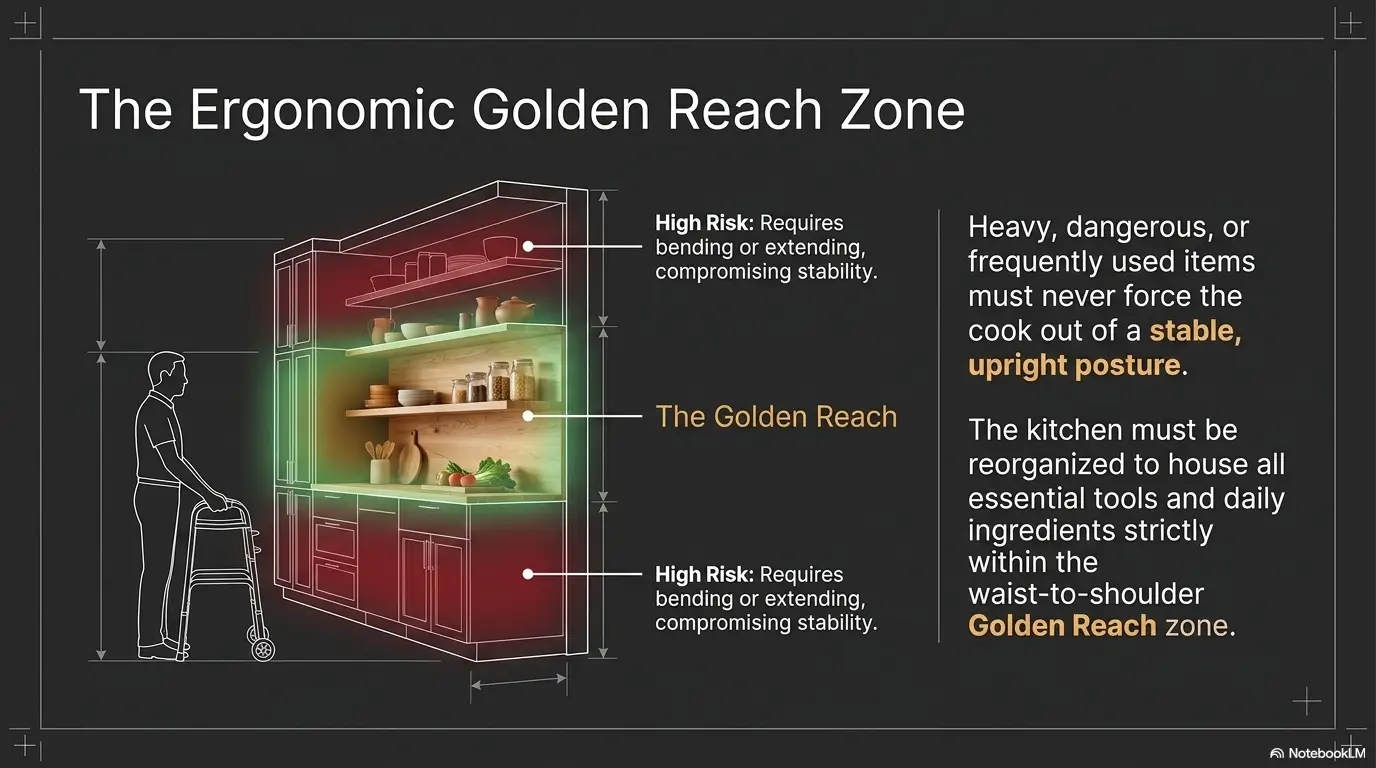
The safest storage zone for many walker users is between about knee and shoulder height, adjusted to the person’s body, restrictions, and reach. Items used every day should not live on high shelves, in deep lower cabinets, or behind heavy cookware.
Start with the most predictable items: plates, bowls, mugs, water bottles, medications, snacks, coffee supplies, utensils, paper towels, lightweight pans, food storage containers, and cleaning cloths. Move them where the person can reach without climbing, crouching, twisting, or leaning far away from the walker.
If the person has post-surgery restrictions, be more cautious. A shoulder surgery patient may need items on the non-surgery side. A hip surgery patient may need less bending. Someone with fatigue may need fewer cabinet doors to open. The best command zone is personal, not Pinterest-perfect.
The best shelf is not the prettiest shelf
Many kitchens are arranged for visual neatness rather than safe use. The holiday dishes sit beautifully above the daily plates. The heavy pot looks tidy under the stove. The coffee filters are tucked in a high cabinet because they fit there.
A walker-friendly kitchen changes the question. Instead of asking where something looks best, ask where it reduces movement. The best shelf is the one that lets the person complete a task with fewer risky steps.
For example, if breakfast happens every morning, place the bowl, spoon, cereal, napkin, and cup near the same counter. If medication is taken with food, keep the routine visible and safe, while still following storage instructions. If tea is the nightly ritual, store the mug and tea bags near the kettle rather than across the kitchen.
A tray can become a tiny safety system
A shallow tray or bin on the counter can gather items that otherwise scatter through the room. It can hold a mug, spoon, napkins, pill organizer, snack, reading glasses, and a small notepad for reminders. The goal is not to carry the tray while using the walker. The goal is to keep essentials from becoming a scavenger hunt.
For someone with memory changes or post-surgery brain fog, a labeled tray can reduce confusion. For a caregiver, it creates an easy place to restock. For the walker user, it can turn the kitchen into a room that offers help quietly, without fuss.
Command zone setup list
- Choose one counter area that is easy to approach with the walker.
- Remove decorative items that take up landing space.
- Add only daily-use items, not the whole kitchen drawer.
- Use a shallow tray, open bin, or clearly labeled container.
- Test whether the person can use the area without leaning, twisting, or stepping away from the walker.
For food tasks that require one hand, the related guide on one-handed meal prep can help you think through simpler setups. Even if the walker user has two usable hands, many kitchen moments become one-handed because one hand instinctively searches for support.
Fix the Refrigerator, Dishwasher, and Door-Swing Traffic Jam
Appliances are not just machines. They are moving walls. A refrigerator door, dishwasher door, oven door, or pantry door can change a safe kitchen path into a blocked route in one second.
When making a kitchen walker-friendly, test the room with doors open. The open-door version of the kitchen is the one people actually use.
Door swing can become a hidden barrier
A refrigerator door may force the person to stand to the side, reach across the door, or step backward to close it. A dishwasher door may block the route from sink to counter. An oven door may require bending and two-handed lifting right where the walker cannot fit close enough.
Observe how the person uses each appliance. Do they park the walker too far away? Do they leave one hand unsupported while pulling open a heavy door? Do they step backward into a chair or trash can? These moments are often more revealing than the appliance manual.
If possible, create landing space next to each appliance. A landing zone is a clear counter or stable surface where an item can rest immediately after being removed. Without a landing zone, the person may carry hot, cold, wet, or heavy items farther than their balance safely allows.
Move daily foods to the easiest shelf
Refrigerators often store the most-used foods in awkward places simply because that is where they have always lived. For walker users, the easiest shelf should hold the daily foods: water, prepared meals, fruit, yogurt, milk alternatives, condiments, leftovers, and snacks.
Avoid storing heavy containers low or deep. Large water pitchers, gallon jugs, and oversized leftovers can require two hands, forward bending, and a strength reserve that may not be available at the end of the day.
Use smaller containers when possible. A half-full pitcher that can be managed safely is better than a heroic jug that demands a wrestling match. Independence often comes from right-sizing the task.
Make the trash can earn its place
Trash cans are strangely powerful. They drift into corners, block sink access, sit beside refrigerators, and occupy the exact spot where a walker needs to turn. Because they are familiar, people stop seeing them.
Move the trash can out of the main turning zone. If the person often throws away packaging while preparing food, place the can where it is reachable from a stable counter position without requiring a backward step. A smaller can on a counter may work for food wrappers if floor space is tight, while the larger can can live outside the lane.
Create a Safe Seated Prep Spot
Standing is not a cooking requirement. That sentence may feel obvious, but many people keep standing in the kitchen because they believe sitting means “giving in.” It does not. Sitting can be a smart strategy, especially after surgery, during fatigue, or when balance changes from one part of the day to another.
A seated prep spot gives the walker user permission to slow the room down. It can make chopping, sorting groceries, reading labels, peeling fruit, stirring batter, or arranging a small meal safer and less draining.
Standing is not a cooking requirement
Many kitchen tasks do not need to happen on two feet. A person can sit at a table to prepare a sandwich, divide snacks, open mail, sort medications with a caregiver, fold towels, or prep vegetables. A seated position may reduce rushing because the body is not spending its energy simply staying upright.
The seat should be stable, easy to approach, and at a height that does not require dropping down or pushing up with unsafe effort. Avoid wobbly stools, rolling chairs, lightweight folding chairs that slide, or seats placed where the walker blocks the only exit route.
For some people after hip, knee, back, or shoulder surgery, chair height and arm support matter. A chair that works for a healthy visitor may not work for someone who must follow movement limits. When in doubt, ask the care team or therapist which seating setup is appropriate.
The seat must not become another obstacle
Adding a chair can help, but only if it has a good home. A chair parked in the middle of the walker lane creates a new hazard. The best seated prep spot is close enough to the counter or table to be useful and far enough from the main path to keep movement open.
Think of the chair as a rest station, not a roadblock. It should allow the person to approach, turn, sit, stand, and resume using the walker without threading through furniture legs.
If the kitchen is very small, use a nearby dining table instead of forcing the seating into the kitchen. The walker-friendly solution is not always inside the exact room. Sometimes the safest kitchen prep area is the table three steps away.
Short Story: The Mug That Changed Breakfast
Marian came home after knee surgery determined to make her own morning tea. Her daughter cleared the counters, bought a new kettle, and moved the cereal lower. Still, every morning felt tense.
The problem was not the tea. It was the mug. Marian kept reaching into a high cabinet, turning away from her walker, and stretching just enough to make everyone in the room go silent.
They moved one mug, one spoon, and one tea tin to a small tray beside the kettle. Then they placed a sturdy chair near the table, outside the main path.
The next morning, nothing looked dramatic. No grand remodel. No heroic equipment. Just a quiet cup of tea made without a risky reach. Sometimes safety arrives wearing slippers.
Key takeaway
A seated prep spot is not a sign of defeat. It is a way to save balance for the moments that truly require standing.
Make Lighting Work Like a Safety Rail
Lighting is not decoration in a walker-friendly kitchen. It is part of the safety system. Good lighting helps the person see spills, edges, cabinet handles, cords, rugs, pets, and changes in floor surface before the walker or foot meets them.
Bad lighting turns the kitchen into a guessing game. Shadows hide puddles near the sink. Glare turns shiny floors into confusing patches. A dark route to the refrigerator at night can make a simple glass of water more risky than it needs to be.
Shadows hide spills, edges, and cords
Overhead lighting alone may not be enough, especially if cabinets cast shadows over the counters or if the person stands between the light and the task. Add task lighting where real actions happen: near the sink, stove, microwave, coffee area, pantry, and seated prep spot.
Under-cabinet lights can make counters easier to read. A plug-in lamp in a nearby dining area can support seated prep. A small light near the pantry can prevent reaching into a dark shelf and knocking items loose.
Lighting should be simple to operate. A lamp that requires bending behind furniture is not helpful. A switch that is blocked by the walker lane is not helpful. Motion-sensor options can be useful, especially for night routes.
Night trips need their own plan
Many people visit the kitchen at night for water, medication, a snack, or an ice pack. At night, the body may be stiff, medication may affect alertness, and the room may look unfamiliar in low light.
Create a lit route from bedroom or living area to kitchen. Use plug-in night lights, motion-sensor lights, or a lamp that can be turned on before the person begins moving. Keep the floor especially clear along this route because nighttime walking leaves less room for improvisation.
If nighttime kitchen trips are frequent after surgery, consider setting up water, approved snacks, or medication supplies closer to the resting area, following medical instructions. The safest kitchen trip may be the one that does not need to happen at 2:00 a.m.
Glare can be as bad as darkness
Bright light is not always better. Harsh glare on shiny floors, polished counters, or appliance doors can make edges harder to judge. For people with vision changes, glare can be disorienting.
Use soft, even lighting where possible. Avoid placing bright bulbs where they reflect directly into the person’s eyes. If the kitchen floor is highly reflective, test the lighting at the time of day when glare is worst. Morning sun through a window can change the whole room.
Rethink Hot, Wet, and Heavy Kitchen Tasks
Walker-friendly kitchen safety is not only about walking. It is also about what the person is trying to carry, lift, pour, drain, wipe, open, and set down. Hot liquids, wet floors, and heavy containers deserve special attention because they add urgency to a body that already needs time.
The goal is to shorten the distance between the task and the safe landing place. Less carrying, less rushing, fewer two-handed maneuvers, and more stable pauses.
The classic kitchen triangle may not fit walker use
Traditional kitchen design often praises the triangle between sink, stove, and refrigerator. For walker use, that idea may be less useful than safe stopping points. A walker-friendly kitchen values short reaches, steady surfaces, and places to pause.
Instead of asking whether the kitchen is efficient, ask whether each task has a safe landing zone. Can a hot bowl come out of the microwave and land immediately on a counter? Can a wet cup be placed near the sink without crossing the room? Can food from the refrigerator be set down before the person turns?
Put landing zones near hot items
Hot items make people rush. Rushing and walker use are poor companions. Create clear counter space beside the microwave, stove, toaster oven, coffee maker, kettle, and sink. The space does not need to be large, but it must be reliably clear.
If the microwave is above shoulder height, it may be especially problematic. Removing hot bowls from a high microwave can require reaching, tipping, and handling steam near the face. A counter-height microwave may be safer for some households, but appliance changes should fit the room, wiring, budget, and the person’s abilities.
For a kettle or coffee maker, consider whether the person must carry a full cup across the kitchen. Smaller cups, lidded travel mugs, thermos-style containers, or preparing drinks at a seated spot may reduce risk. For more detail on moving food safely, the guide on how to carry a plate with a walker can help.
Do not carry hot liquids across the room
Hot liquids create two risks at once: burn risk and balance risk. If a person spills hot tea while using a walker, the instinctive reaction may be to flinch, step quickly, or release support. That split second matters.
Reduce the need to carry hot liquid. Move the mug closer to the kettle. Use a lidded cup. Fill cups only partway. Slide items along a counter when safe rather than carrying them through open space. Prepare food at the table when possible. Ask whether the task can be broken into smaller steps.
Show me the nerdy details
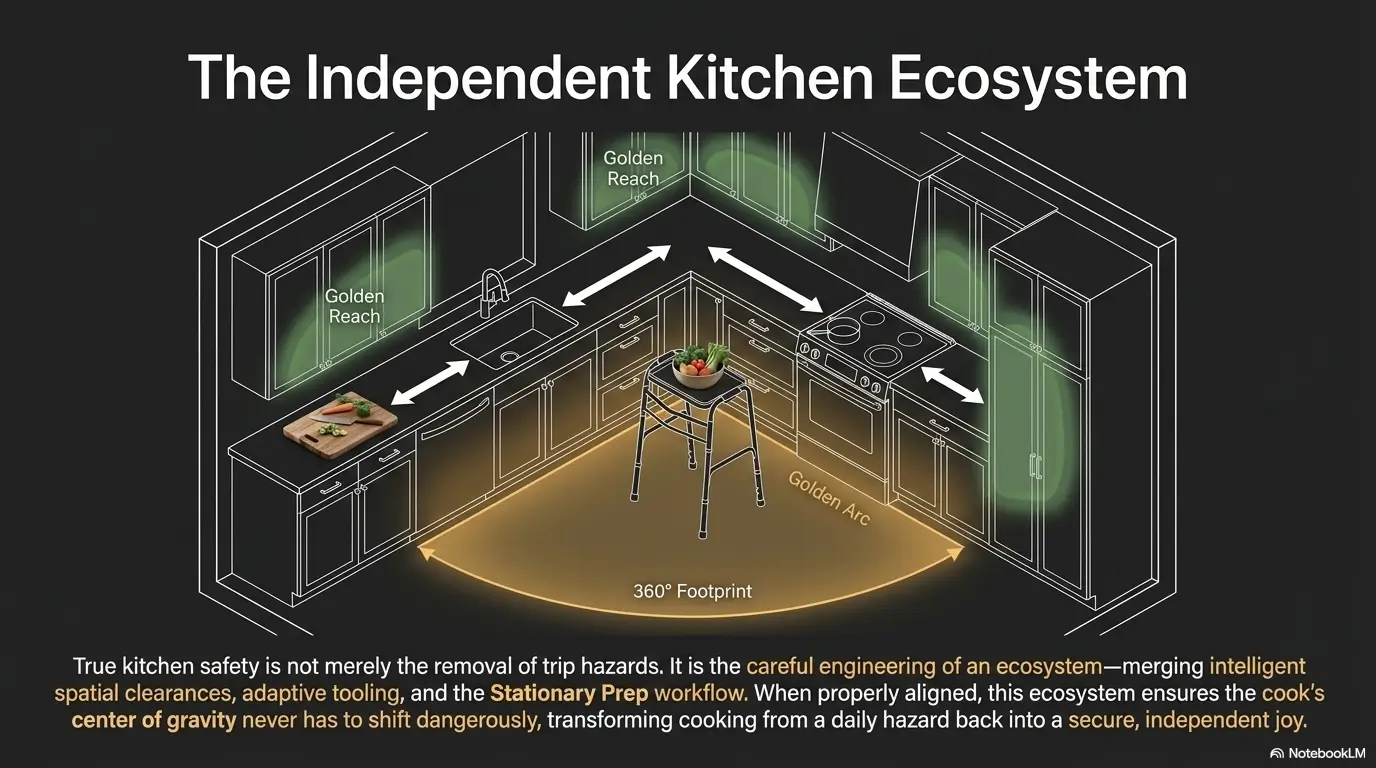
A walker improves base of support, but it also changes how a person uses their hands. When both hands are needed for the walker, carrying objects becomes complicated. When one hand leaves the walker to carry or reach, support changes again.
Kitchen safety improves when tasks are redesigned so the person does not have to combine walking, carrying, turning, and reacting to heat or spills at the same time. Separating those demands is the quiet engineering behind a safer routine.
That is why landing zones, seated prep, small containers, lidded cups, and waist-height storage can be more useful than one flashy gadget. They reduce the number of things the brain and body must manage at once.
The Walker-Friendly Kitchen Flow
1
Clear
Remove rugs, cords, bowls, and floor clutter.
2
Lower
Move daily items to easy reach.
3
Land
Add clear surfaces near hot and wet tasks.
4
Sit
Create a stable seated prep spot.
5
Test
Run a real morning routine slowly.
Common Mistakes That Make Kitchens Riskier
Most unsafe kitchen choices are not careless. They are normal household habits that become risky when mobility changes. A room designed for quick steps and two free hands may need a new script when a walker enters the story.
Here are the mistakes worth catching early, before they turn into daily frustration.
Mistake: making the kitchen look clean but not usable
A tidy kitchen can still be unsafe. If daily items are stored too high, too low, too deep, or too far apart, the room may look calm while forcing risky movement.
For example, clearing the counters may make photos look better, but if the person then has to open three cabinets to make breakfast, the neatness has a cost. Walker-friendly design is not about hiding everything. It is about placing the right things where they reduce strain.
Mistake: removing every chair
Families sometimes remove chairs to open space. That can help if chairs block the walker lane. But removing every rest point may make the kitchen harder to use, especially for someone who fatigues quickly or needs a safe place to sit during prep.
The better move is selective seating. Keep one stable chair where it supports real routines, and remove or relocate chairs that block turns. Space and rest are both safety tools.
Mistake: buying gadgets before changing layout
A gadget can help when it solves a specific problem. But buying tools before studying the room often creates more clutter. A reacher, shelf insert, rolling cart, or special utensil may be useful, but only if it reduces bending, reaching, lifting, confusion, or unsafe travel.
Change the layout first. Clear the path. Move daily items. Add lighting. Create landing zones. Then decide which tools still earn a place. This sequence saves money and keeps the kitchen from becoming a gadget aquarium.
| Mistake | What it looks like | Better move |
|---|---|---|
| Too tidy | Everything is hidden, including daily essentials. | Keep frequent-use items visible and reachable. |
| No rest point | All chairs removed to create space. | Keep one stable seat outside the walker lane. |
| Gadget pileup | Helpful tools become counter clutter. | Add tools only when they replace a hazard. |
| Forgotten trash can | Trash blocks the sink or turning area. | Place it where it is reachable but not in the route. |
Add Helpful Tools Without Creating Clutter
Tools can make a walker-friendly kitchen easier, but the tool should serve the routine. If it creates a new place to trip, a new drawer to search, or a new item to maintain, it may not be helping.
The rule is simple: one tool in, one hazard out. Every addition should reduce reaching, bending, lifting, carrying, or confusion.
Choose tools that reduce reaching
Helpful options may include pull-out shelves, lazy Susans, lightweight cookware, easy-grip utensils, clearly labeled bins, shelf risers, reachers, nonslip jar openers, and lidded cups. The best choices depend on the person and kitchen.
Pull-out shelves can help if lower cabinets are still safe to use. Lazy Susans can make pantry items easier to find without digging. Lightweight cookware can reduce the strain of lifting. Labels can help when fatigue or memory makes searching frustrating.
But avoid turning the counter into a supply store. A tool should have a specific job and a specific home. If no one knows where it belongs, it will eventually migrate into the walker lane.
Avoid tools that demand two steady hands
Some convenience products assume the user has two free hands, strong grip, good balance, and plenty of counter space. That may not match a walker user’s reality.
Be cautious with heavy rolling carts, complicated choppers, high-mounted organizers, deep bins, and gadgets that slide during use. A tool that requires bracing, twisting, or force may transfer risk from one task to another.
Whenever possible, test tools during a real task. Can the person open it? Use it with one hand if needed? Put it away safely? Clean it without awkward bending? If the answer is no, the tool may be more charming than useful.
A small tool map for caregivers
Caregivers often want to buy something because buying feels like action. That instinct comes from love, but placement usually matters more than purchase. Before shopping, write down the exact problem.
“Mom cannot reach the mugs safely” is a better problem statement than “We need accessibility products.” It might be solved by moving one mug, adding a shelf insert, or changing the breakfast setup. The smallest good solution is usually the one that lasts.
One tool in, one hazard out checklist
- Does this tool reduce a real daily movement problem?
- Can the person use it without stepping away from the walker unsafely?
- Does it have a stable storage place outside the walker lane?
- Is it easy to clean, open, close, and put away?
- Does it replace a risky reach, bend, lift, or carry?
Key takeaway
The best kitchen tool is not the fanciest one. It is the one that quietly removes a risky movement from a routine the person already does.
When to Seek Help or Stop
Some kitchens can be improved with a weekend reset. Others need professional eyes. Knowing the difference protects the person using the walker and the caregiver who may be trying to solve too much alone.
Kitchen changes are worthwhile, but they should not become a quiet substitute for care when the situation is bigger than furniture placement.
Good fit for DIY changes
Do-it-yourself changes may be reasonable when the person has mild to moderate mobility support needs, uses the walker consistently, understands safety instructions, and mainly needs the room arranged for easier daily routines.
Examples include moving daily dishes lower, clearing rugs, adding night lights, creating a seated prep spot, relocating the trash can, or changing the breakfast setup. These are practical household edits, not major medical decisions.
Not enough for repeated falls or sudden weakness
If the person has repeated falls, dizziness, fainting, sudden weakness, new confusion, severe pain, new numbness, medication side effects, or major balance changes, stop treating the kitchen as the whole problem. The room may need changes, but the person also needs medical attention.
Likewise, if a caregiver feels that the person cannot safely be alone in the kitchen, do not rely on one more mat, chair, or grabby gadget. Ask for professional guidance. Safety should not depend on luck and crossed fingers.
When an occupational therapist makes sense
An occupational therapist can look at how the person actually performs daily tasks and recommend practical changes. This may include storage height, seating, safe transfer techniques, energy conservation, adaptive tools, and whether the room layout supports the person’s current abilities.
Physical therapists, aging-in-place specialists, home health teams, and licensed contractors may also be helpful, depending on the need. A contractor may address structural changes. A therapist may address task performance. A clinician may address medical risk. Good help has different instruments in the orchestra.
Question list to ask a professional
- Is the current walker the right type and height for kitchen tasks?
- Which kitchen movements should be avoided after this surgery or diagnosis?
- Is seated prep recommended, and what chair height is safest?
- Are rugs, mats, or floor transitions a concern in this home?
- Would grab bars, railings, cabinet changes, or appliance changes be appropriate?
- What warning signs mean the person should not cook alone?
Key takeaway
Call for help when the problem is not just the kitchen. Repeated falls, sudden changes, severe pain, confusion, or unsafe solo cooking deserve professional guidance.
FAQ
How much space does a walker need in a kitchen?
A walker needs enough room for the person to move forward, turn, approach counters, open appliances, and stop without backing into obstacles. Exact clearance depends on the walker type, body size, layout, and turning ability, so test the actual route with the actual person.
Are kitchen rugs safe for someone using a walker?
Loose, thick, curled, or raised rugs are usually risky because walker legs, wheels, or feet can catch on them. If a mat is needed, choose a low-profile secured option and test it carefully with the walker.
Should a walker user cook while standing?
Some people can safely stand for short kitchen tasks, but seated prep and frequent rest points often make cooking safer and less tiring. The right choice depends on balance, endurance, surgery restrictions, pain, and therapist or clinician guidance.
What kitchen items should be moved first?
Move daily-use items first: cups, plates, bowls, utensils, medications, snacks, coffee supplies, lightweight cookware, cleaning cloths, and trash bags. Place them between comfortable reach zones so the person does not need to climb, crouch, twist, or dig.
Is a kitchen island helpful or harmful?
It depends on clearance. An island can provide landing space and a useful surface, but it can also block turns or trap the walker between appliances. Test the route with appliance doors open before deciding.
How can I make the stove safer for walker use?
Keep clear landing space beside the stove, use lightweight cookware, avoid carrying hot liquids across the room, and reduce rushed transfers. If standing at the stove is tiring or unsafe, consider simpler meals, seated prep, or caregiver support.
What should caregivers check weekly?
Check floor hazards, lighting, clutter creep, refrigerator access, trash can placement, appliance door clearance, food storage height, and whether the walker path remains open. Homes drift back toward old habits unless someone gently resets them.
When should we call an occupational therapist?
Call when falls, fatigue, balance issues, complex medical needs, memory concerns, post-surgery restrictions, or major home changes are involved. An occupational therapist can connect the person’s abilities to practical room changes.
Do a 10-Minute Walker Path Audit Tonight
The best next step is not a full remodel. It is a 10-minute walker path audit. Take the walker to the kitchen entrance and move through one ordinary routine slowly. Coffee. Breakfast. Water. Leftovers. Medication with a snack. Choose the routine the person actually does.
Do not aim for perfection. Aim for three useful changes: one floor hazard, one storage problem, and one lighting or appliance-access problem. This keeps the project small enough to finish and meaningful enough to matter.
The 10-minute kitchen audit
- Start at the kitchen entrance with the walker.
- Move to the main counter, refrigerator, sink, microwave, trash, and seat.
- Open the refrigerator, dishwasher, and any frequently used cabinet doors.
- Notice every bump, awkward turn, reach, pause, and backward step.
- Remove one floor hazard immediately.
- Move one daily item to a safer height.
- Create or clear one landing zone for hot, wet, or heavy items.
- Choose one stable seated prep spot.
- Add or reposition one light if shadows make the route harder to read.
- Repeat the route and see what changed.
By tonight, the kitchen can be safer without looking like a clinic. Clear the floor. Move the daily mug. Shift the trash can. Give the person a stable place to sit. Add light to the shadowy corner. These are not glamorous changes, but kitchens are built from unglamorous miracles: a cup of tea, a quiet breakfast, a bowl warmed without fear.
A walker-friendly kitchen is not a lesser kitchen. It is a kinder one. It lets the room keep its warmth while removing the tiny negotiations that wear a person down. Start with the path, respect the routine, and let safety become part of the home’s ordinary music.
Last reviewed: 2026-06