
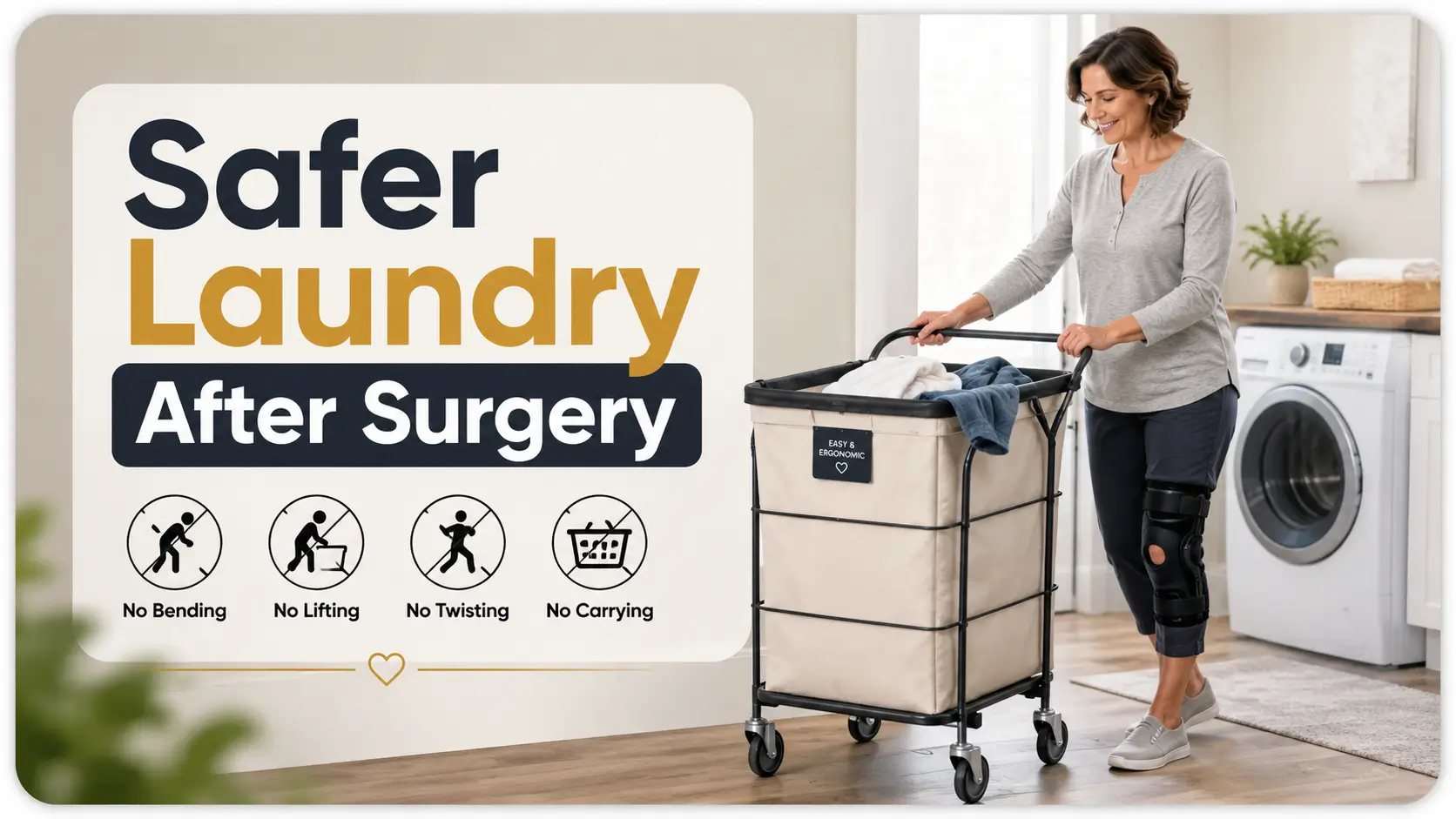
Recovery-friendly home guide
Laundry Basket Alternatives After Joint Surgery:
Move Clothes Without Wrecking Recovery
Laundry is one of those small household tasks that turns strangely dramatic after surgery. Before recovery, a basket is just a basket. After hip, knee, shoulder, ankle, or spine-related surgery, that same basket can become a bulky little villain: too low, too heavy, too wide, too eager to make you bend, twist, reach, or wobble.
This guide is for the person trying to stay useful without being reckless, and for the caregiver who wants the laundry system to stop feeling like a domestic obstacle course. We will look at rolling carts, small laundry bags, waist-height hampers, staged loads, washer-dryer transfer tricks, and when the smartest “basket alternative” is simply asking for help before the house turns into a sock museum.
The goal is not heroic independence. The goal is a boring, repeatable laundry lane that protects your surgery restrictions, your balance, your energy, and your peace of mind.
Less bending
Set up laundry where hands meet clothes at a safer height.
Less carrying
Use wheels, tiny loads, helper swaps, or delivery options.
Less guessing
Match the setup to surgery type, stairs, fatigue, and restrictions.
Small promise: by the end, you will have one practical “no-bend laundry lane” you can set up today. 🧺
Snapshot
This article is for recovering patients, spouses, adult children, renters, busy caregivers, and anyone trying to keep laundry moving after joint surgery without turning a chore into a setback. You will learn which basket alternatives reduce lifting, bending, twisting, reaching, and stair carrying, plus how to build a safer laundry workflow around your medical restrictions.
Table of Contents

Safety First: Not Medical Advice, Not a Bravery Contest
Laundry feels too ordinary to deserve a safety speech. That is exactly why it catches people off guard after joint surgery. A person may carefully follow instructions for showering, sleeping, walking, and getting into the car, then casually scoop up a hamper full of towels and discover that “ordinary” can be a very persuasive little trap.
This guide is educational. It can help you think through safer laundry basket alternatives after joint surgery, but it does not replace instructions from your surgeon, physical therapist, occupational therapist, nurse, or discharge paperwork. Your personal restrictions are the boss of this whole operation.
If your instructions say not to lift more than a certain amount, not to bend past a certain angle, not to twist, not to bear weight, not to use the operated arm, or not to carry items on stairs, those rules outrank every clever cart, cute hamper, and five-star product review on the internet.
Key takeaway
The best laundry tool is the one that fits your restrictions. A rolling cart may be wonderful for one person and wrong for another if it requires pushing, pulling, stair use, or awkward turning that the care team has not cleared.
The Rule That Beats Every Product Review
Product descriptions love words like ergonomic, lightweight, collapsible, and easy-grip. Helpful? Sometimes. Enough? Not by itself.
After surgery, “ergonomic” should mean fewer risky movements: less bending, less lifting, less twisting, less reaching, less stair carrying, less blocked vision, and less fatigue. A basket with padded handles is still a problem if it encourages you to carry a heavy load down twelve steps while your knee feels like a weather station.
A good laundry setup should make the safe choice automatic. It should almost annoy you with how simple it is: dirty clothes go here, heavy towels go there, clean items get folded at waist height, and anything involving stairs waits for a helper or a different plan.
Chores Are Not Rehab Exercises
It is tempting to treat laundry as proof that recovery is going well. “I can do a load” starts to sound like “I am back.” But chores are messy exercise. They involve uneven loads, slippery socks, pets underfoot, fatigue, surprise bending, and the mysterious physics of wet towels.
Prescribed rehab exercises are usually controlled and specific. Laundry is not. A sock lands behind the dryer. A fitted sheet becomes a sail. A basket clips the doorframe. A small pivot becomes a twist. The body does not care that the task felt harmless in your head.
Keep rehab in the rehab lane. Keep laundry in the safety lane.
Who This Guide Is For, And Who Should Skip DIY Laundry
This guide is for people recovering from hip, knee, shoulder, ankle, foot, or back-limited surgery who have been told they may do light household activity, but need a smarter way to move clothing. It is also for caregivers who want to help without hovering like a worried lighthouse.
The advice is intentionally cautious because laundry is not worth a fall, a wound problem, a pain flare, or a strained repair. If the choice is between “clean towels today” and “protect the surgery,” protect the surgery. The towels will not file a complaint.
For Hip, Knee, Shoulder, Ankle, and Back-Limited Recoveries
Different surgeries create different laundry problems. Hip precautions may make deep bending unsafe. Knee surgery can make stairs, squatting, pivoting, and repeated trips difficult. Shoulder surgery may restrict lifting, reaching, pulling wet clothes, or carrying anything with the operated arm.
Ankle and foot surgery may make balance the main issue, especially if you are using crutches, a walker, a boot, or a scooter. Back-related recovery can make bending, twisting, and lifting the suspicious trio. For older adults or anyone with dizziness, medication side effects, neuropathy, or poor sleep, laundry can become a fall-risk puzzle before the washer even starts humming.
If you are helping a parent after surgery, it may also help to read signs a parent needs more help after surgery. Laundry is often one of the first household tasks that reveals whether the home setup is truly working.
Who Should Not Experiment With Laundry Workarounds
Skip DIY laundry attempts and contact your care team if you have new severe pain, dizziness, faintness, wound drainage, fever, new swelling, sudden weakness, shortness of breath, chest pain, calf pain, confusion, or a near-fall. Also pause if your restrictions are unclear. Guessing is not a recovery strategy. It is a dice game wearing slippers.
If you are newly home from surgery, tired, on pain medication, or still learning a walker or crutches, laundry can wait. The safest laundry basket alternative during the earliest phase may be a caregiver, neighbor, adult child, laundry pickup service, or a temporary pile sorted into small bags at waist height.
Readiness checklist
- You understand your lifting, bending, twisting, reaching, and weight-bearing limits.
- You can move through the laundry route without rugs, cords, pets, clutter, or poor lighting in the way.
- You can keep at least one hand available for support when needed.
- You can stop after one small load without feeling pressured to finish everything.
- You have a helper plan for stairs, bedding, wet towels, and heavy baskets.
Caregiver Note: Help Should Mean Less Chaos
Good help does not mean doing everything while the recovering person feels useless. It means setting up the chore so fewer decisions are required. Put dirty clothes in one reachable place. Separate towels from lightweight clothing. Label a “helper only” basket for heavy items. Keep the detergent at waist height. Remove hallway clutter.
For many families, the awkward part is not the laundry. It is the asking. A simple neighbor plan can reduce that friction. If that would help, use ideas from how to ask a neighbor for help after surgery and turn laundry help into a predictable, low-drama routine.
Why Normal Laundry Baskets Cause Trouble After Surgery
A normal laundry basket is designed for capacity, not recovery. It wants to be filled. It wants two hands. It wants you to bend down into it, hoist it up, shuffle around corners, and twist toward the washer. In ordinary life, that is just Tuesday. After surgery, it is choreography with too many trapdoors.
The basket itself is rarely evil. The problem is the movements it invites. Big containers invite big loads. Low containers invite bending. Wide containers block your view. Handles invite carrying. Deep corners invite rummaging. None of these are ideal when your body is working under temporary construction permits.
Wide Baskets Invite Twisting
Wide plastic baskets often require two hands, which means you may not have a hand free for a railing, cane, walker, countertop, or doorframe. They can also force your arms away from your body and make hallway turns awkward.
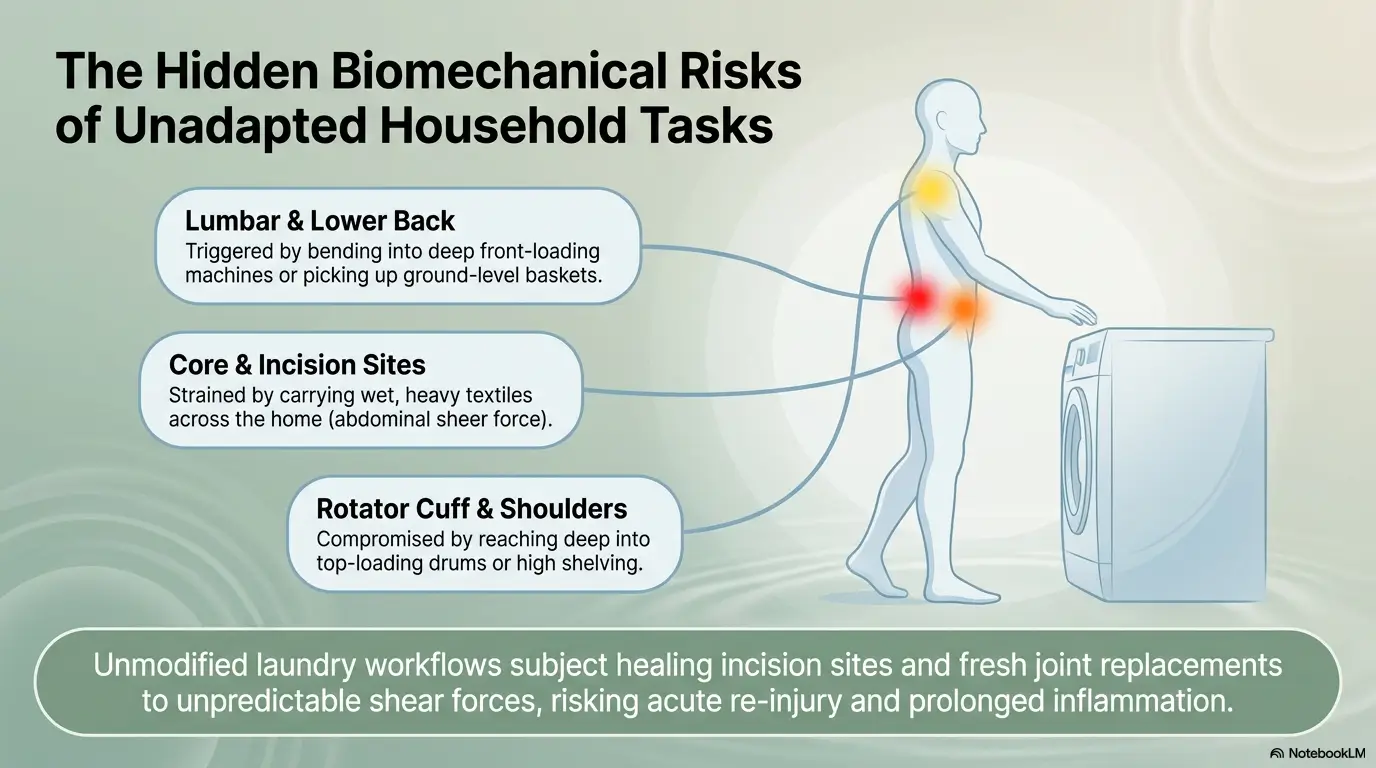
Because the basket is wide, people often rotate their torso instead of stepping around fully. That little twist may feel harmless, especially when you are focused on not dropping socks. But for hip, knee, back, or balance-limited recovery, twisting with a load can be the small hinge that swings open a large problem.
Deep Baskets Punish Bending
Deep baskets create trouble twice. First, you bend to pick them up. Then, you bend again to dig out items at the bottom. If the basket sits on the floor, the chore becomes a repeated bend-and-reach cycle.
That matters after hip replacement, knee surgery, lumbar procedures, and many other recoveries where bending is restricted or simply painful. Even if bending is technically allowed, repeated bending can increase fatigue, and fatigue has a sneaky way of making good body mechanics evaporate.
The Load Looks Lighter Than It Is
Laundry has a talent for disguising weight. A few shirts, two jeans, a sweatshirt, and a towel do not look dramatic. Wet towels, bedding, bath mats, and denim are different creatures. They sit in the basket with innocent faces while behaving like gym equipment.
The danger is often the phrase “just one more thing.” That is how a safe small load becomes a full basket, then a heavy basket, then a heavy basket carried while tired. The safer system is to make loads smaller on purpose, even if that feels inefficient. Recovery often rewards “less efficient” choices that prevent setbacks.
Key takeaway
Capacity is not your friend during early recovery. A smaller bag, half-full cart, or divided hamper may look less efficient, but it keeps the chore from silently turning into lifting practice.
Best Laundry Basket Alternatives After Joint Surgery
The best alternative is not one magic product. It is the option that reduces the exact movements your recovery plan wants you to avoid. For many people, that means wheels. For others, it means tiny loads. For shoulder recovery, it may mean no carrying at all. For stair-heavy homes, it may mean a helper system rather than a gadget.
Think of the laundry setup in three pieces: where dirty clothes collect, how clothes travel, and where clean clothes are folded or stored. A safer laundry basket alternative may solve one piece or all three.
Rolling Laundry Cart: Best Default for One-Level Homes
A rolling laundry cart is often the strongest default choice when the laundry area is on the same level as the bedroom or bathroom. Wheels reduce carrying. A taller cart can reduce bending. A cart with a stable base can keep the load visible and easier to manage.
Look for a cart that lets you push forward rather than drag backward. Walking backward with laundry is a tiny horror film for recovery: thresholds, rugs, pets, cords, and uneven flooring all become more dangerous when you cannot see where your feet are going.
The best cart height depends on the person and the machines. Ideally, you should not need to stoop deeply to add or remove clothing. A waist-height cart, or a cart with removable bags that can be lifted in small bundles, often works better than a low rolling bin.
Small Soft Laundry Bags: The Underrated Recovery Hack
Small laundry bags are not glamorous. That is their charm. They force tiny loads, reduce the temptation to fill a mountain basket, and can be staged on a table, chair, or counter rather than the floor.
Choose bags with simple handles that do not require gripping hard or reaching awkwardly. Avoid giant drawstring bags during early recovery unless someone else will carry them. A giant bag can become a floppy sack of chaos, especially if it swings against your leg, boot, walker, or incision area.
Crossbody laundry bags sound hands-free, but they are not automatically safer. A strap can shift your posture, press on a tender area, or create imbalance. After shoulder surgery, crossbody use may be especially questionable unless your clinician has cleared it.
Waist-Height Hampers That Stop the Bend
A waist-height hamper can be a quiet recovery miracle. Dirty clothing goes in without a deep bend. Liners can be removed in smaller bundles. The hamper can sit near a dresser, bathroom doorway, or temporary recovery station so clothes do not gather on the floor.
The best hamper is not always the prettiest. Décor-first hampers can be narrow, tippy, too deep, too low, or annoying to clean. Recovery-first hampers should be stable, open easily, and allow the liner to come out without wrestling.
If you are recovering from hip or knee surgery, avoid low floor baskets during the early phase unless your care team has cleared that movement. The phrase “I’ll just grab it quickly” has a long history of causing avoidable regret.
Compare the Main Options
| Alternative | Best for | Watch out for | Smart setup tip |
|---|---|---|---|
| Rolling laundry cart | Single-level homes, light loads, reduced carrying | Backward pulling, tight turns, stairs, tippy wheels | Push forward and keep loads half full |
| Small soft bag | Forcing tiny loads, staging laundry at waist height | Overfilling, swinging, crossbody imbalance | Use one bag per small load type |
| Waist-height hamper | Reducing bending at the collection point | Deep liners, unstable frames, heavy removal | Use removable liners and split heavy items |
| Laundry backpack | Some hands-free situations after clearance | Balance shifts, shoulder strain, posture changes | Use only for very light items and only if cleared |
| Helper or laundry service | Stairs, bedding, wet towels, early recovery | Scheduling, cost, privacy concerns | Outsource the heavy week, not your dignity |
Match the Method to the Surgery, Not the Product Photo
A glossy product photo cannot know whether you have posterior hip precautions, a painful knee bend, a shoulder sling, a walking boot, stairs, carpet, or a dog who believes every laundry trip is a parade. The method has to match the recovery.
When in doubt, ask your physical therapist or occupational therapist to review the actual laundry route. A two-minute conversation can save weeks of improvised mistakes.
Hip or Knee Surgery: Reduce Stairs and Bending
After hip or knee surgery, the big enemies are often bending too low, twisting, pivoting, carrying too much, and using stairs while distracted. A rolling cart on the same level can help, but only if the route is clear and the load is light.
For hip recovery, avoid low baskets that require deep bending. For knee recovery, avoid large loads that make you rush or compromise your stair pattern. If you live in an apartment or multi-level home, a temporary laundry station can reduce trips. Similar thinking applies when planning a knee replacement apartment setup, where fewer risky routes usually beat prettier organization.
Ask your clinician about safe turning. Many people are told to step their feet around rather than twist through the hip, knee, or back. That matters when moving clothes from washer to dryer, turning around in a narrow laundry closet, or scooting a cart around a doorframe.
Shoulder Surgery: Avoid One-Arm Overload
Shoulder surgery can make laundry surprisingly complicated. Lifting a basket, pulling wet clothes from a washer, reaching into a top-load machine, carrying a tote, or yanking a fitted sheet can all involve the shoulder more than expected.
If one arm is in a sling, the other arm may start doing everything. That can overload the non-surgical side, strain the neck, or encourage awkward leaning. A rolling cart may help, but pushing or steering may still involve the shoulder. Ask before assuming wheels solve the problem.
If you are also trying to type, eat, dress, or cook one-handed, your total daily shoulder load matters. You may find helpful crossover ideas in shoulder sling typing setup and one-handed meal prep. The theme is the same: make the environment carry more of the workload.
Ankle, Foot, or Balance-Limited Recovery: Protect Balance First
After ankle or foot surgery, hands-free does not automatically mean safe. A backpack may free your hands, but it can change your center of gravity. A tote may seem light, but it can swing. A cart may roll too quickly or catch on a threshold.
If you are using crutches, a walker, a scooter, or a boot, your laundry system should not compete with your mobility device. This is where staged laundry helps. Put a small bag on a counter. Have someone move it later. Fold clothing where you sit. Keep the route boring, clear, and well-lit.
Decision table
| If your main limit is bending | Use waist-height hampers, raised carts, reachers if approved, and avoid floor baskets. |
| If your main limit is lifting | Use tiny loads, helper swaps, wash-and-fold, or carts that do not require carrying. |
| If your main limit is balance | Keep hands free for support, remove trip hazards, and avoid swinging bags. |
| If your main limit is shoulder use | Avoid totes, overhead reaching, wet pulls, and one-arm carrying unless cleared. |
Short Story: The Towel That Changed the Plan
Maria came home after knee surgery determined to be “easy to care for.” She used a walker, kept her ice pack schedule, and accepted help with meals. Laundry, though, felt too personal to hand over.
On day six, she carried three damp towels from the bathroom to the laundry closet. Halfway there, one towel slipped. She did not fall, but she caught herself with a sharp twist and spent the rest of the afternoon sore, embarrassed, and quiet.
That evening, her daughter moved a tall hamper beside the bathroom door and labeled a small bin “towels only.” Every other day, someone emptied it into the washer.
The lesson was not that Maria had failed. The lesson was simpler: a good recovery system removes the moment where pride has to make a risky decision.
Stairs Are the Real Laundry Test
Stairs change the entire laundry equation. A basket that feels manageable on flat ground can become unsafe when it blocks your view, steals your hand from the railing, changes your balance, or makes you hurry.
If your laundry machines are in a basement, upstairs closet, garage, or shared apartment laundry room, do not choose a basket alternative based only on the container. Choose based on the full route. The stairs, doors, thresholds, lighting, and resting spots are part of the product, whether the product listing admits it or not.
Why Stairs Turn Laundry Into a Fall-Risk Puzzle
Carrying laundry on stairs often means you cannot see your feet clearly. You may not be able to hold the handrail. If the basket bumps your leg or the wall, your body has to correct quickly. After surgery, quick corrections are not always available.
Stairs also create decision pressure. Once you are halfway up or down, you may feel committed. That is when a load that was “probably fine” becomes a negotiation with gravity, fatigue, and pride. Gravity is not known for its bedside manner.
Safer Options Before Carrying Laundry on Stairs
Before carrying laundry on stairs, consider alternatives. Set up a temporary clothing station on the same level as your recovery area. Ask a helper to carry loads on a set schedule. Use small bags that a caregiver can easily grab. Try laundry pickup for bedding and towels. If there is a laundry chute, use caution because retrieving items may still involve bending, reaching, or carrying.
A staged basket system can help in multi-level homes. The recovering person places lightweight items in a waist-height bin. A helper moves the bin once per day or every other day. Clean clothes return in small bundles and are folded near where they will be used. Nobody has to discuss every sock.
- Put a “helper only” label on bedding, towels, jeans, and bath mats.
- Keep one week of easy recovery clothing on the same level as the bedroom or recliner.
- Use a small clean-clothes bin near the dryer so folding does not require a second trip.
- Place night lights or motion lights near stair landings if evening laundry is unavoidable for helpers.
- Do not carry laundry while using crutches unless your clinician has specifically approved a safe method.
The Most Dangerous Load Is the One Carried Out of Frustration
The riskiest laundry trip is often not the first one. It is the one someone makes because they are tired of waiting, tired of asking, tired of feeling dependent, or tired of seeing the same pile in the hallway.
Build the system before that mood arrives. Recovery frustration is real. It is also predictable. A good plan should assume that patience will run thin and make the safer option easier than the risky one.
Key takeaway
Stairs deserve their own rule. If laundry blocks your view, takes your railing hand, or makes you rush, the basket is not the issue. The route is.
The Washer-Dryer Transfer Zone Needs Its Own Plan
Many people focus on moving laundry across the house and forget the transfer zone. But the washer and dryer are where bending, reaching, twisting, and pulling often happen in quick succession.
The goal is to face the task, move your feet instead of pivoting, keep loads small, and avoid fishing around for dropped items. If possible, ask your therapist to watch you describe or demonstrate the movement. A small adjustment in stance or machine setup can make the chore much less dramatic.
Front-Load Machines: Watch the Bend
Front-load machines can be easier for some people because clothes move horizontally, but they often require bending. Pedestals or risers may reduce the bend, though they must be stable and appropriate for the machine. A chair or stool may help some people transfer laundry while seated, but this should match your restrictions and balance.
Small loads matter here. A small load comes out in a few manageable handfuls. A large wet load may require pulling, leaning, and twisting. Treat wet clothes as heavier than dry clothes, especially towels, bedding, denim, and sweatshirts.
Top-Load Machines: Watch the Reach
Top-load machines can create a different problem: deep reaching. Shorter users, shoulder surgery patients, and people with balance limits may have to lean forward to reach the bottom. That can stress the shoulder, back, hip, or ankle.
If you use a reacher, ask whether it is appropriate for your recovery. A reacher can help with dropped socks or light items, but it is not a crane for heavy wet towels. Use it for small, easy items rather than turning it into a wrestling match with a bath sheet.
The Sock Is Not Worth It
A single dropped sock does not deserve a risky bend, twist, or one-legged wobble. Leave it, use a reacher if approved, or ask for help. The sock will survive its brief exile.
This is where recovery gets strangely philosophical. Small temptations test us because they look too silly to respect. But respecting the silly thing is how you protect the serious thing.
Mistake checklist
- Do not twist from washer to dryer while your feet stay planted.
- Do not pull a heavy wet load with one arm, especially after shoulder surgery.
- Do not dig into a low basket after every transfer.
- Do not bend for dropped items when tired or dizzy.
- Do not use laundry as proof that you are “back to normal.”
Better Systems Than Better Baskets
Sometimes the best laundry basket alternative is not a basket. It is a system that makes laundry smaller, lighter, closer, and less urgent. Products help, but systems carry the real weight.
A better system answers four questions: Where do dirty clothes go? Who moves heavy items? Where are clean clothes folded? What happens when fatigue shows up? If the system answers those questions, you need less willpower.
Use a Two-Bin Sorting Rule
Complicated sorting systems are not recovery-friendly. Use two bins. One for light clothes. One for heavy items. Or one for upstairs items and one for downstairs items. The point is not perfect laundry science. The point is to keep heavy, risky loads from sneaking into ordinary loads.
For example, put T-shirts, underwear, pajamas, and light socks in the “self-manage” bin if your care team allows it. Put towels, jeans, sweatshirts, bath mats, and bedding in the “helper” bin. This turns a vague chore into a simple traffic system.
Move Clean Clothes Less Often
Clean laundry often travels too much. It leaves the dryer, goes to a basket, moves to a bed, gets folded, goes back to a basket, then moves to drawers. After surgery, every extra trip is another chance to bend, twist, carry, or get tired.
Fold near the dryer if the height is safe. Use a rolling rack for hanging clothes. Keep recovery outfits in an accessible zone rather than returning every item to its perfect drawer. For a few weeks, your home does not need to win a magazine spread. It needs to stop asking your body for extra errands.
Outsource the Heavy Week
Wash-and-fold, family help, neighbor help, or temporary laundry pickup is not a luxury when it prevents a setback. It is a recovery tool. The highest-value items to outsource are usually bedding, towels, jeans, pet blankets, and anything that becomes heavy when wet.
If money is tight, outsource only one category. Ask a friend to do towels every Saturday. Have a family member carry laundry on stairs but let you fold light clothes while seated. Pay for pickup only during the first two weeks. Partial help still counts.
Key takeaway
Do not optimize the basket before you shrink the chore. Smaller loads, fewer trips, and a helper plan usually matter more than buying the fanciest container.
No-bend laundry flow
Collect at waist height
Split heavy items
Use wheels or help
Face the machine
Stop if symptoms rise
The safest system is not glamorous. It is a small loop that keeps laundry light, visible, reachable, and easy to pause.
Show me the nerdy details
A laundry task becomes riskier when it combines load, distance, posture, and uncertainty. A light object held close to the body on a clear path is very different from a wide basket held away from the body while turning through a doorway.
The practical formula is simple: reduce the weight, shorten the route, raise the working height, slow the transfer, and remove surprise movements. That is why tiny loads can beat large “ergonomic” baskets, and why a helper who carries towels once a week may be more useful than a new hamper.
The safest setup is usually the least cinematic one. No lunging, no fishing behind machines, no spinning with wet jeans, no stair heroics. Just a boring loop your recovering body can repeat without argument.
Buying Checklist Before You Click Add to Cart
Buying a laundry basket alternative after surgery should feel less like shopping and more like removing friction from a recovery plan. The question is not “Which one has the most features?” The question is “Which one asks the least from my healing body?”
Before buying anything, walk the route mentally. Bedroom to hamper. Hamper to laundry area. Washer to dryer. Dryer to folding spot. Folding spot to storage. Notice stairs, thresholds, door swings, tight corners, rugs, pets, lighting, and places where you usually bend.
Stable Base and Easy Grip
A cart should have a stable base, smooth wheels, and handles that do not require wrist strain. It should not tip when half full. It should not roll away too easily. If you need two hands to control it, that matters if you also need a cane, walker, railing, or countertop support.
For hampers and bags, check how you grip them when they are partly full. Handles should be easy to grab without bending deeply or pinching hard. Avoid designs that look sleek but require finger strength, awkward wrist angles, or a tug-of-war with a liner.
No Deep Bending Required
Capacity often competes with safety. A huge hamper may hold more, but it may also require deeper reaching and heavier lifting. During recovery, easy access beats capacity. A smaller, taller, more open container often works better than a deep decorative bin.
If you already own a low basket, you may not need to replace it forever. Put it on a sturdy bench, chair, or table only if that setup is stable and safe. Do not create a wobbly tower of laundry ambition. A basket sliding off a chair is not a feature.
Lightweight When Empty and Easy to Clean
The container should not be the problem before laundry is even inside it. Heavy wooden hampers, metal frames with awkward lids, and bulky rolling bins can be annoying during recovery. Lightweight, wipeable, washable, and simple usually wins.
Easy cleaning matters because laundry may sit longer when recovery days are rough. Washable liners, breathable materials, and wipeable frames can prevent odors without demanding extra scrubbing.
Buyer Scorecard
| Question | Green flag | Red flag |
|---|---|---|
| Can I use it without deep bending? | Opening sits near waist height | Deep floor bin or low basket |
| Can I keep loads small? | Divided sections or small bags | Huge capacity that invites overfilling |
| Can I move it without carrying? | Smooth wheels on one level | Must be lifted over stairs or thresholds |
| Can I grip it comfortably? | Large, simple handles | Thin straps or awkward pinch grips |
| Can someone else help easily? | Clear labels, removable liner, light bundles | One heavy mystery hamper |
Key takeaway
Do not buy for the best day. Buy or set up laundry for the tired day, the stiff day, the foggy day, and the day when the hallway rug tries to audition as a trip hazard.
When To Seek Help or Stop
Recovery chores should not increase symptoms in a meaningful way. Mild tiredness may happen, but new pain, swelling, dizziness, wound changes, or near-falls are not “normal laundry consequences.” They are stop signs with laundry lint on them.
If laundry causes symptoms, stop and contact your care team. It is better to ask early than to wait until a small issue becomes a larger setback.
Call the Care Team if Chores Increase Pain
Contact your surgeon, nurse line, physical therapist, or care team if laundry leads to increased pain, swelling, dizziness, wound drainage, fever, new weakness, shortness of breath, chest pain, calf pain, or a near-fall. Do not try to troubleshoot serious symptoms with a new basket.
If night pain, swelling, or symptom changes are hard to explain, write down what happened: the load, the route, stairs, machine type, pain location, timing, and what made it better or worse. This kind of detail can make the conversation more useful. For a related approach, see how to explain night pain to a doctor.
Ask About Occupational Therapy Home Setup
Occupational therapists are practical home-strategy experts. They can help with laundry, dressing, bathing, cooking, reaching, sitting, carrying, and safe routines. If your laundry area is awkward, your stairs are unavoidable, or you live alone, an OT perspective can be golden.
Ask, “Can someone review my laundry setup and show me safer ways to move clothes within my restrictions?” That question is specific. It gives the clinician something useful to answer.
Get Help Before the Fall, Not After
Temporary help is cheaper, safer, and gentler than recovering from a preventable fall. It can also be emotionally easier when it is planned rather than requested in a crisis.
Set a time limit. “For the next two weeks, someone else carries towels and bedding.” That feels more manageable than “I cannot do laundry anymore.” Recovery needs clear boundaries, not dramatic verdicts.

FAQ
What can I use instead of a laundry basket after surgery?
Common options include a rolling laundry cart, small soft laundry bags, a waist-height hamper with removable liners, divided lightweight loads, helper-based laundry routines, or wash-and-fold service. The safest choice depends on your surgery type, home layout, and medical restrictions.
Is a rolling laundry cart safe after hip replacement?
It may be helpful on one level because it can reduce carrying, but it is not automatically safe. Avoid heavy pushing, pulling, twisting, deep bending, stairs, and backward dragging unless your care team has cleared those movements.
How do I carry laundry after knee surgery?
Keep loads very small, avoid bulky baskets, and keep one hand available for support when needed. If stairs are involved, ask your physical therapist what is safe. Many people need a helper for towels, bedding, and stair routes during early recovery.
Can I do laundry after shoulder surgery?
Only if your surgeon or therapist has cleared the specific movements involved. Pulling wet clothes, reaching into machines, carrying baskets, and steering carts may all stress the shoulder. When unsure, outsource or ask for help.
Is a laundry backpack safer than a basket?
Not always. A backpack may free your hands, but it can change balance, posture, and pressure on healing areas. It may also be unsuitable after shoulder, back, hip, or balance-limited recovery. Use it only for very light loads and only if it fits your restrictions.
How heavy is too heavy for laundry after joint surgery?
There is no universal safe number. Follow your care team’s lifting limit. If no limit is clear, ask before carrying loads. Wet towels, jeans, and bedding should be treated as higher-risk because they become heavy quickly.
What is the safest way to move wet towels?
Split towels into very small loads, use a rolling cart on the same level if appropriate, or ask someone else to move them. Avoid carrying wet towels in bulk, especially on stairs or while using a mobility aid.
Should I buy a laundry basket with wheels or handles?
Wheels usually reduce carrying on a single level, while handles may work for tiny loads. The best choice depends on your surgery, home route, stairs, grip comfort, and whether pushing or pulling is allowed.
Set Up a No-Bend Laundry Lane in 15 Minutes
The safest next step is not buying a new product at midnight while comparing wheel diameters like a tiny engineer. Start with one simple lane. Make dirty clothes easier to collect, heavy items easier to identify, and risky loads easier to hand off.
Choose one waist-height drop zone today. A chair, bench, counter, or tall hamper may work if it is stable and does not block a walking path. Place a small bag or liner there. Label a second bag for heavy items: towels, bedding, jeans, sweatshirts, bath mats. Put a reacher nearby if your care team has approved using one.
Then choose one transport rule: wheels on one level, helper for stairs, no wet towel carrying, or laundry service for bedding. Make the rule simple enough that you can follow it when tired.
15-minute setup plan
- Move one hamper or small bag to waist height.
- Create a separate heavy-item bag for towels, bedding, jeans, and bath mats.
- Clear the laundry route of rugs, cords, shoes, boxes, and pet toys.
- Place detergent and supplies where they do not require deep bending or overhead reaching.
- Write one helper rule, such as “No stair laundry until cleared.”
- Ask your surgeon, PT, or OT whether this setup fits your restrictions.
Recovery is full of small negotiations between independence and patience. Laundry should not be the place where patience loses. Build the quiet lane. Let the system carry what your body should not. Clean clothes can wait their turn; healing gets the front of the line.
Last reviewed: 2026-06