
Nerve Flossing: Mastering the Fine Line Between Relief and Flare-Up
The fastest way to turn a cranky sciatic nerve into a full-blown flare is to treat “nerve flossing” like a stretch you should push through.
If sciatic nerve flossing made your pain worse, you’re not broken—you likely irritated a sensitized nerve root with too much dose (range, reps, speed), the wrong timing (after long sitting, post-workout, first thing AM), or a “glide” that quietly became a tensioner.
Keep guessing, and you don’t just lose a workout—you lose sleep, sitting tolerance, and whole days.
- Stop rules you can trust
- A 24-hour flare checklist
- A re-entry plan that stays boring on purpose
This is general education, not medical advice. Stop any move that spikes symptoms. If you have severe or rapidly worsening weakness, new numbness in the groin/saddle area, or trouble controlling bladder/bowels, seek urgent care immediately. If you’re pregnant, post-op, on blood thinners, or have major spine trauma history, get clinician guidance before nerve glides.
If sciatic nerve flossing made your pain worse, you’re not “failing rehab.” You likely irritated a sensitized nerve. Today you’ll get: stop rules you can trust, a 24-hour flare checklist that calms symptoms without babying you, and a re-entry plan that keeps glides gentle (sliders, not tensioners). I’ll also show you exactly when to stop white-knuckling and get help.
Table of Contents
Fast Answer (snippet-ready)
If sciatic nerve flossing made your pain worse, treat it like an irritation flare: stop the glide for 24–48 hours, calm symptoms (positions that reduce leg pain, gentle walking if tolerated), and avoid stretching into sharp/zingy sensations. Resume only when symptoms return to baseline and you can do small, pain-free “sliders” (not tensioners). If you notice new weakness, numbness spreading, or bowel/bladder changes, seek medical help.
Quick personal note: the first time I tried “nerve flossing” after a YouTube spiral, I treated it like a productivity hack—more reps, more range, more “commitment.” My reward was a leg that felt like it had its own opinion. If that’s you, you’re in the right place. (And if you recognize the “doomscroll → symptom spiral” loop, you’ll like how cyberchondria shows up in chronic pain—because the internet can absolutely turn volume into panic.)
1) Stop Signals First: “Good Sore” vs “Nerve Mad”
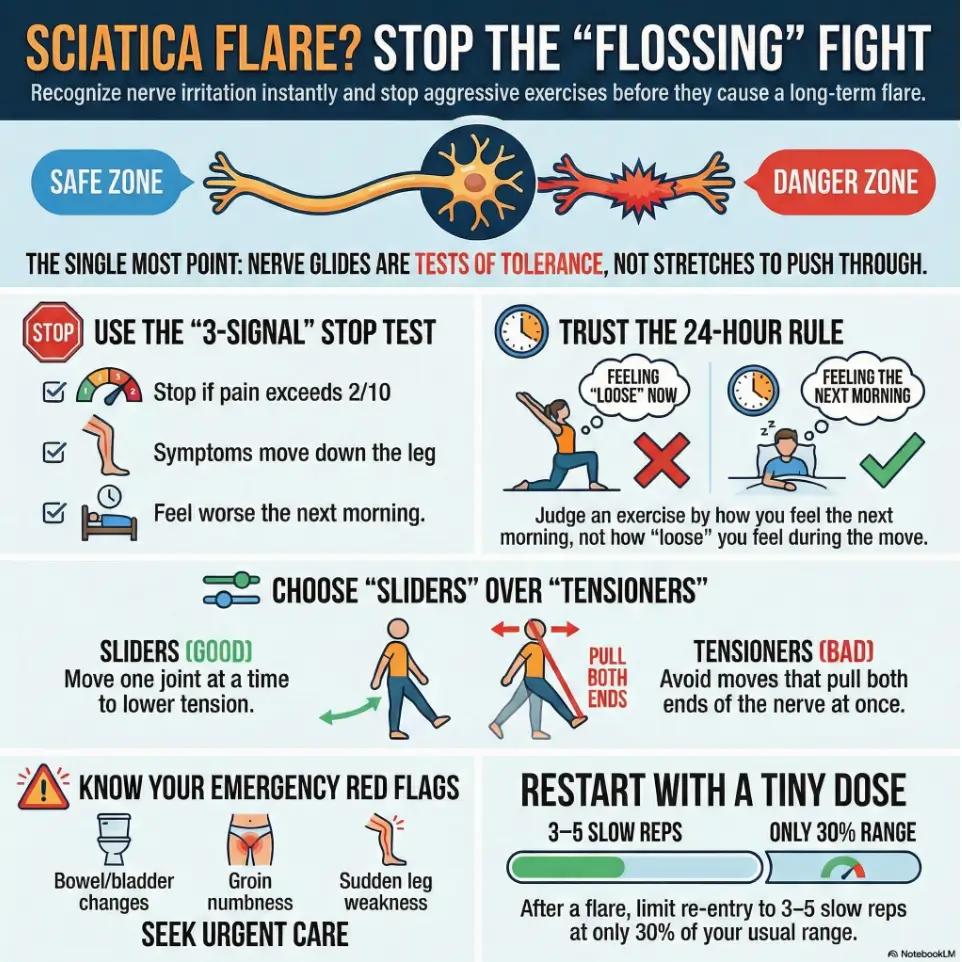
The 3-signal test (don’t guess)
With muscles, “a little uncomfortable” can be normal. With irritable nerves, that mindset is how you accidentally punch the fire alarm. Use this simple triage:
- Intensity: sharp/electric/zingy more than 2/10 = stop.
- Spread: symptoms traveling farther down the leg (peripheralizing) = stop.
- After-effect: worse for hours or worse next morning = stop.
If you’re unsure, treat “maybe” as “no” for one day. You can always re-test tomorrow. You can’t always rewind a flare.
- Stop if the sensation is sharp/electric or jumps above 2/10.
- Stop if symptoms move farther down the leg.
- Stop if you pay for it later (hours or next morning).
Apply in 60 seconds: Say out loud: “Intensity, spread, after-effect.” Then decide.
The “24-hour rule” that protects you
The most useful rule in home rehab is boring: judge an exercise by how you feel later, not by how it feels during. Many people feel temporary “looser” sensations during glides… and then wake up with a hotter, more irritable leg.
So here’s the 24-hour rule:
- If symptoms are same or better that evening and next morning, the dose is probably okay.
- If symptoms are worse next morning (more leg pain, more numbness/tingle, less tolerance to sitting/standing), your dose was too much.
Think of your nerve like a smoke detector, not a motivational speaker. It doesn’t give pep talks. It gives alarms.
Curious but crucial: why “more reps” backfires
A sensitized nerve can react to volume more than intensity. Ten “mild” reps can irritate more than three gentle reps—especially if you’re doing them fast, at end range, or after long sitting.
I’ve seen the classic pattern: you do glides, feel “something moving,” get hopeful, add reps, and then the nerve says, “Cute. Absolutely not.” That’s not weakness. It’s biology: irritated neural tissue is protective.
Show me the nerdy details
Neurodynamic work is typically described as “sliding/gliding” vs “tensioning.” Sliding aims to move the nerve relative to surrounding tissues with lower strain; tensioning increases strain to build tolerance—but it’s more provocative for irritable symptoms. In practice, the same-looking movement can become a tensioner if you push range, speed, or stack positions that lengthen both ends of the nerve at once.
Answer these as Yes/No. If you hit any “Stop,” don’t DIY it alone.
- Stop: New bowel/bladder control problems. (If you’re unsure what counts as “emergency,” bookmark low back pain ER red flags so you don’t have to decide at 2 a.m.)
- Stop: New saddle/groin numbness.
- Stop: Rapidly worsening weakness (toe/heel walking suddenly harder).
- Proceed cautiously: Symptoms are stable, you can walk, and pain isn’t escalating daily.
If you checked any “Stop,” skip glides and get urgent evaluation. If not, use the 24-hour flare checklist below before you re-test sliders.
Neutral action: take 60 seconds to write down which “Stop” items are clearly not present.
2) What Changed? The Hidden Variables That Turn Glides Into Flares
Slider vs tensioner—same move, different outcome
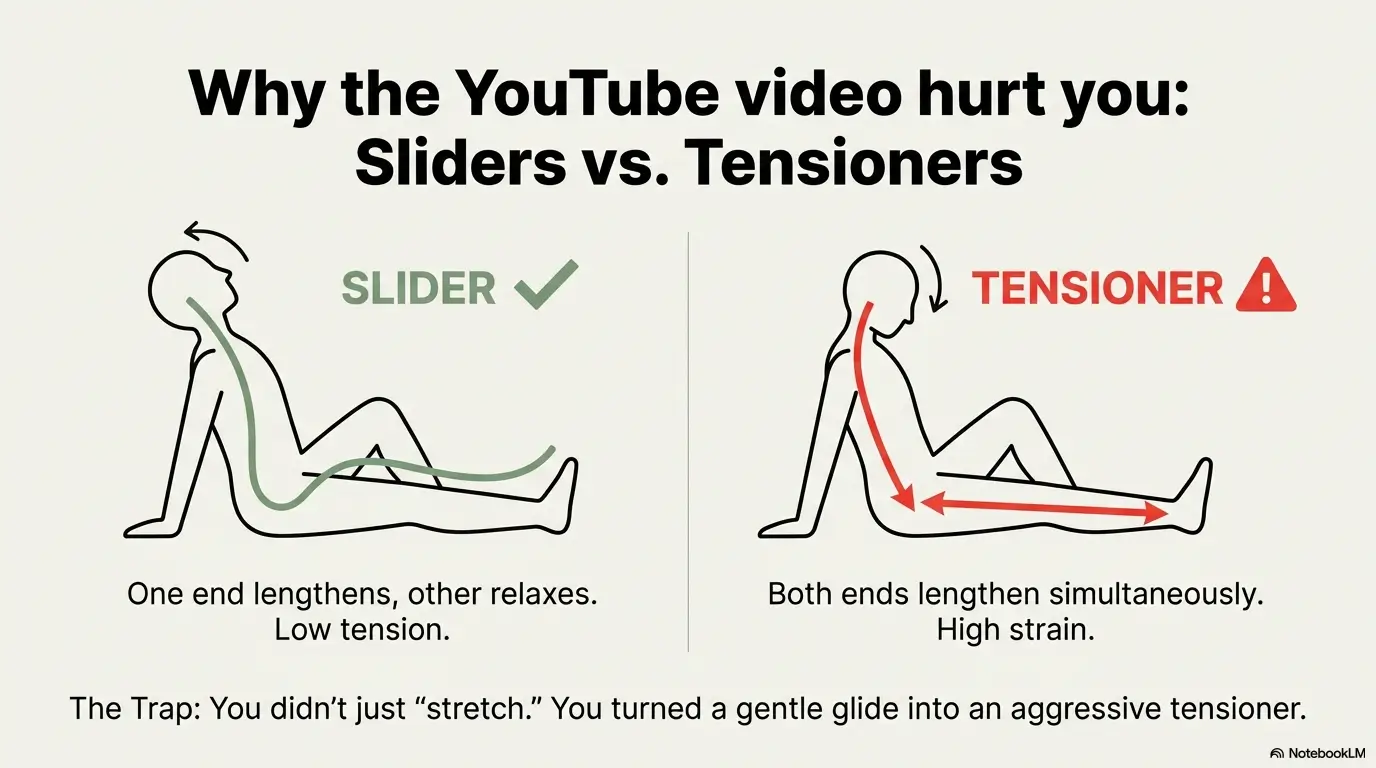
Here’s the sneaky part: two people can do the “same” sciatic glide from a video and get opposite results—because one is doing a slider, the other accidentally turned it into a tensioner.
- Slider (gentler): one end lengthens while the other relaxes → lower overall tension.
- Tensioner (spicier): both ends lengthen → higher strain and more likely to flare irritable symptoms.
Translation: you weren’t “weak.” You may have been doing a more aggressive version without realizing it. I’ve done this. It’s alarmingly easy.
Dose matters: reps, speed, range, frequency
Nerves like small, calm inputs when they’re angry. They hate surprise parties. The dose variables that most often backfire:
- Reps: doing 15–30 because the video said so.
- Speed: “flossing” fast like you’re late for a meeting.
- Range: chasing a deeper pull, especially into tingling.
- Frequency: doing it multiple times a day “to speed it up.”
The better question isn’t “How many reps is recommended?” It’s: What’s the smallest dose that makes me more tolerant tomorrow?
Timing traps: after long sitting, after workouts, first thing AM
Timing is the hidden tripwire. Many flares happen when you glide during your most irritable windows:
- After long sitting: the system is already compressed/irritated. If you work a desk job, pairing this with a sane rhythm (not “sit for 3 hours then panic”) matters—see a sit-stand schedule for sciatica at a desk job.
- Right after workouts: tissues are inflamed, you’re warm (and overconfident).
- First thing in the morning: some backs are stiffer; end-range moves feel “tighter” and more provocative. If mornings are your danger zone, start with morning sciatica nerve glides (the calmer version) instead of full-send flossing.
Anecdote: my worst flare was after a long flight. I stood up, felt like a folding chair, and decided that was the perfect moment to “mobilize the nerve.” Reader, it was not.
3) Who This Is For / Not For
For you if…
- Radiating leg pain that’s irritable, inconsistent, or easily provoked.
- You flared during/after glides and want a safer reset.
- You’re trying to keep moving without gambling your week.
Not for you (pause and get guidance) if…
- Progressive weakness, foot drop, or severe numbness.
- Unexplained fever, recent major trauma, cancer history + new back pain.
- Bowel/bladder changes or saddle-area numbness (urgent).
In the U.S., “urgent” can be a painful word (financially and emotionally). But some symptoms are time-sensitive. When nerves controlling bladder/bowels are involved, the priority is preventing long-term damage, not toughing it out.
4) The “Stop Now” List: Moves That Commonly Make Sciatica Worse
Don’t stretch into nerve pain (that’s not a hamstring)
Sciatic symptoms often masquerade as “tight hamstrings.” The trap is treating a nerve like a rope. If you feel electric, burning, zappy, or cold sensations—especially below the knee—assume nerve irritation, not muscle tightness. If you want a clearer baseline definition (what sciatica actually is), keep this sciatica nerve pain explainer handy.
Don’t chase numbness/tingling as a “release”
Tingling isn’t a badge of progress. For many people, it’s the nervous system saying, “I’m being stressed.” If tingling increases with reps or lingers afterward, you just got feedback. Believe it.
Don’t combine flossing + deep forward folds in the same session
Stacking provocative inputs is how you turn a minor irritation into a multi-day flare. Deep forward folds (especially rounded-back stretching), plus aggressive flossing, plus long sitting afterward is the classic triple-combo.
- Avoid sharp/electric sensations below the knee.
- Don’t chase tingling as “proof it’s working.”
- Don’t stack deep forward folds with glides the same day.
Apply in 60 seconds: Pick one: glides or stretching—never both while flared.
5) 24-Hour Flare Checklist: Calm the Nerve Without “Babying” It
A flare plan is basically a boundary conversation with your nervous system: “I hear you. I’m not going to poke you. But we’re also not going to freeze in fear.” The goal is downshift, then restore tolerance.
Step 1 — De-escalate positions (pick the least-worst)
Your first job is to find a position that reduces leg symptoms. Not “perfect.” Just “less angry.” Try short bouts (2–10 minutes), then change:
- Side-lying with a pillow between knees (hips stacked). If you’re debating options, knee pillow vs body pillow for sciatica can save you trial-and-error.
- On your back with knees supported (pillow under knees). If you want a structured version, try the 90/90 position for sciatica (simple, boring, effective).
- Prone (on stomach) only if it reduces leg symptoms.
Anecdote: I used to try to “find the one perfect posture” and then stay there like a museum statue. My symptoms preferred variety. Yours might too.
Step 2 — Micro-movement menu (choose one)
Movement can be medicine—if it reduces leg symptoms. Choose one of these and keep it easy:
- 5–10 minute easy walk if it reduces leg symptoms (or at least doesn’t worsen them). If walking is your “reset,” footwear matters more than people admit—see sciatica-friendly walking shoes.
- Posture resets: gentle standing tall, small hip hinges, shoulder blades relaxed—no pain spike.
- Breathing downshift: 2 minutes slow breathing to reduce guarding.
If walking helps, it’s not because you “fixed the disc” in 8 minutes. It’s because your system tolerates that input better right now.
Step 3 — What to avoid for one day (yes, even if it “usually helps”)
- Deep hamstring stretching into nerve sensations
- Long car rides without breaks (and if you can’t avoid driving, you’ll want a low-car in/out strategy for sciatica so your exit doesn’t become the flare.)
- High-rep flossing “to calm it down” (irony: it often does the opposite)
- Heavy lifting with breath-holding and rounded back
Let’s be honest… you want a fix tonight
I get it. Night pain has a special talent for turning you into an amateur surgeon with Wi-Fi. But when the nerve is hot, the winning move is almost always: less, calmer, shorter instead of deeper, longer, harder.
If sleep is the battlefield right now, don’t improvise: build a calmer setup (and don’t stack “fixes” all at once). A few practical options: side sleeper sciatica at night positioning, whether sleeping with a heating pad for sciatica is actually safe for you, and a gentle “comfort tool” like a weighted blanket for sciatica (for some people, it reduces guarding; for others, it’s too much—signals first).
This isn’t medical advice—it’s a simple guardrail. Higher volume + higher range + multiple sessions increases flare risk.
Neutral action: use the result to choose the smallest dose you can test for 24 hours.
6) Re-Entry Plan: How to Restart Flossing Without Re-Flaring
Start tiny: 3–5 reps, slow, 30–50% range
The first re-test is not a workout. It’s a signal check. Start with 3–5 reps, slow, and only 30–50% of the range you think you “should” have. If you feel dramatic stretching or tingling, you’ve already gone too far.
Use sliders only (keep tension low)
Keep it slider-style: as one end lengthens, the other end relaxes. This is why many PTs cue “gentle glide” rather than “stretch.” If your video doesn’t explain the difference, assume it’s incomplete education—not your fault, just a limitation of the format.
The “baseline check” before you add anything
- Symptoms are same or better that evening.
- Symptoms are same or better next morning.
- Your tolerance to the main trigger (often sitting) did not worsen.
Anecdote: the day I finally improved was the day I stopped “adding” and started “auditing.” I treated the re-test like a careful financial transaction, not an emotional argument.
- 3–5 reps beats 20 reps when you’re irritable.
- 30–50% range is “smart,” not “wimpy.”
- Pass the next-morning check before progressing.
Apply in 60 seconds: Set a timer for 60 seconds and do only one tiny set—then stop.
7) Common Mistakes That Turn Rehab Into Roulette
Mistake: treating nerve glides like muscle stretches
The most common error is trying to “feel the stretch.” With sciatic irritation, the sensation you chase might be the very thing that lights you up later. Muscle stretching often tolerates a slow ramp. Nerve symptoms often prefer a gentle glide that stays below the alarm threshold.
Mistake: escalating range instead of improving tolerance
Range is seductive because it’s measurable. Tolerance is boring because it’s subtle. But tolerance is what restores your life. If you can sit 10 minutes longer without leg pain, that’s a real win—even if your knee isn’t “perfectly straight” in a glide.
Mistake: ignoring the “symptom centralization” clue
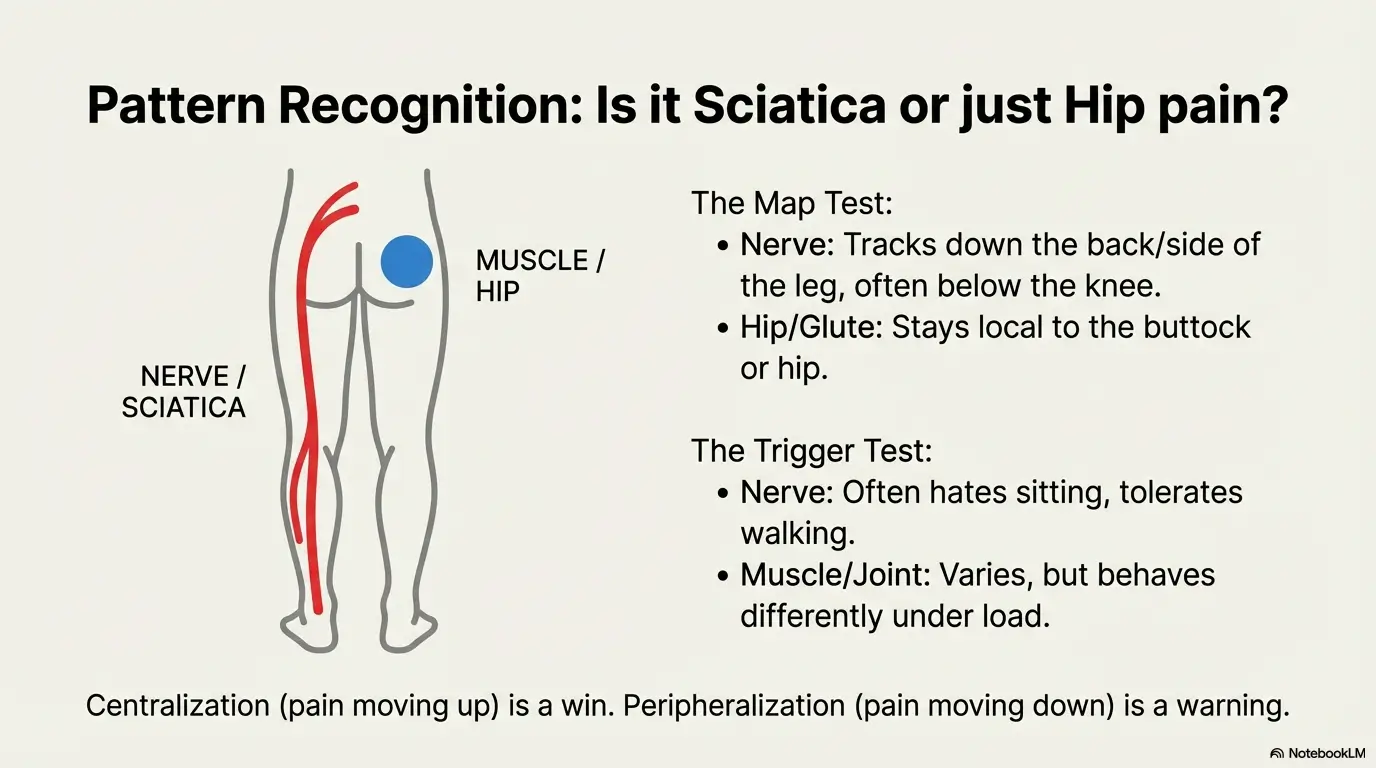
Here’s the clue many people miss: if symptoms shift upward (less down the leg, more localized), that’s often a better sign than “feeling something all the way down.” If symptoms shift downward (farther into calf/foot), that’s your stop signal. This one detail can keep you from repeating the same mistake with different exercises.
Here’s what no one tells you… relief during can still mean “worse later”
Some movements feel relieving because they temporarily change sensitivity. That doesn’t guarantee the tissue load was appropriate. Your true feedback is later: the evening and next morning. (Yes, it’s annoying. Yes, it’s also effective.)
Show me the nerdy details
Centralization/peripheralization is commonly used clinically to describe symptom location changes. The mechanism can vary (disc irritation, nerve root sensitivity, inflammation, mechanical sensitivity), but the practical use is simple: symptoms moving farther down the leg usually signals increased neural irritation; symptoms retreating upward often suggests improved tolerance or reduced irritation.
- Best for: hot, irritable symptoms that flare easily.
- Time: 1–2 days of “calm + walk.”
- Cost: low; you’re buying stability.
- Trade-off: you delay “fixing” and focus on calming.
- Best for: symptoms near baseline; no spread; no next-morning worse.
- Time: 60 seconds.
- Cost: low, but requires discipline.
- Trade-off: you must stop early, even if it feels “fine.”
Neutral action: pick A or B for the next 24 hours—write it down so you don’t renegotiate at 11 p.m.
8) Self-Checks: Is This Sciatica, Hip, or Something Else?
Quick reality check: “sciatica” is often used as a catch-all for leg pain. Sometimes it’s true nerve root irritation (radicular pain). Sometimes it’s referred pain from joints or muscles. Your job at home is not to diagnose perfectly; it’s to notice patterns that guide safer choices.
The “map test”: where symptoms travel matters
Draw a quick map (mentally or on paper). Symptoms that track down the back/side of the leg and go below the knee can suggest nerve involvement. Hip or glute pain that stays local may behave differently and often tolerates different exercises.
If you’re stuck in the “is this even sciatica?” loop, these comparisons can clarify the pattern you’re working with: sciatica vs herniated disc, sciatica vs piriformis syndrome, and diabetic neuropathy vs sciatica.
The “positions test”: sitting vs standing vs walking
Ask: what happens with sitting? Standing? Walking? Many nerve-irritation patterns dislike sitting and tolerate gentle walking. Not always, but often enough that it becomes a useful clue. I’ve personally used walking as my “reset button” when sitting was clearly gasoline.
If standing helps but sitting doesn’t, you may also benefit from changing your workstation instead of arguing with your spine. For example: standing desk setup for sciatica (with sane breaks) and ergonomic chair vs standing desk when you’re deciding where to spend money.
The “cough/sneeze” clue (handle carefully)
If coughing/sneezing sharply increases symptoms, it can hint at pressure sensitivity in the spine/nerve root area. This is not a home test you push. It’s a note you observe. If it’s intense or worsening, that’s information worth sharing with a clinician.
- Track location: down the leg vs local hip/glute.
- Track triggers: sitting vs walking tolerance.
- Track spread: farther down usually means “back off.”
Apply in 60 seconds: Write one sentence: “Worse with ___, better with ___.”
9) When to Seek Help (Don’t White-Knuckle This)
Go urgent today if…
- Bowel/bladder changes
- Saddle-area numbness
- Rapidly worsening weakness
- Major trauma (fall, car accident)
Book a clinician/PT soon if…
- Pain persists beyond 2–4 weeks (and if you’re weighing options, physical therapy for sciatica is often the most practical “first structured step.”)
- Recurrent flares, numbness progressing, or sleep wrecked nightly
- You keep “passing” daytime tests but failing the next morning
What to bring to the appointment (so you get answers faster)
If you’ve ever left an appointment thinking “I forgot the important parts,” this is your fix. Bring a tiny record:
- Symptom timeline (when it started, what changed)
- Flare triggers (sitting, bending, driving, workouts)
- What reduced symptoms (walking, certain positions, heat/ice if used)
- What worsened them (glides, stretching, prolonged sitting)
- “What’s my stop signal for home exercises?”
- “Do my symptoms look more like nerve root irritation vs hip referral?”
- “What’s the minimum effective dose for glides right now?”
- “What should improve in 2 weeks if we’re on the right track?”
- “Which movements should I temporarily avoid while irritable?”
Neutral action: copy these into your phone notes before you book.
Real-world U.S. note: if you’re navigating providers, names you’ll commonly run into include APTA (professional PT organization), major hospital systems like Mayo Clinic or Cleveland Clinic, and specialists in orthopedics or neurosurgery when red flags appear. You don’t need the perfect doorway—just the right urgency level.
I remember sitting on the edge of the bed at 2:58 a.m., phone glow on my face, bargaining like a person at a used-car lot. “Okay,” I told my leg, “just let me do ten glides and we’ll both calm down.” Ten became twenty because the first few felt “productive.” Then came the weird part: I felt relief while doing them, like the nerve was sliding smoothly—so I added range.
I fell asleep hopeful. The next morning, I couldn’t tolerate tying my shoes without lightning down the calf. That was the moment I learned the difference between immediate sensation and true tolerance. I stopped treating rehab like a dare. I used the 24-hour rule. I walked for eight minutes instead. And the flare finally backed off—not because I found a magic move, but because I stopped feeding the fire.
Bowel/bladder changes, saddle numbness, rapidly worsening weakness, major trauma.
- Intensity > 2/10?
- Symptoms spread down the leg?
- Worse later/next morning?
3–5 reps, 30–50% range, slow, pain-free. Pass evening + next-morning baseline check.
FAQ
Why does sciatic nerve flossing make pain worse?
Usually because the nerve (or nerve root) is already sensitized, and the glide you did was too aggressive for your current tolerance—too much range, too many reps, too fast, or accidentally turned into a tensioner. Another common reason is timing: doing it right after long sitting or during a flare window. Use the 3-signal test and the 24-hour rule to dose it safely.
Should I stop nerve flossing if I feel tingling?
Treat tingling as information. If tingling spikes above a mild level, spreads farther down the leg, or lingers afterward, stop. If it’s faint, brief, and you return to baseline later and next morning, your dose may be acceptable—but many flares improve faster when you keep glides strictly pain-free at first.
How long should a flare last after nerve glides?
Mild irritation often settles within 24–72 hours if you stop provoking inputs and use a calm movement plan (positions + short walks). If your symptoms are worsening daily, spreading, or not improving over 1–2 weeks, it’s time to get evaluated.
Is sciatic flossing safe for a herniated disc?
Sometimes, but “safe” depends on irritability and dose. Herniated-disc-related nerve root irritation can be very sensitive to tensioning and end-range moves. A clinician can help classify your pattern and select the right entry point. At home, the safest approach is tiny, pain-free sliders with strict next-morning checks—never chasing tingling.
What’s the difference between nerve flossing and stretching?
Stretching targets muscle length. Nerve flossing (neurodynamic gliding) aims to help the nerve move relative to surrounding tissues. When you “stretch into nerve pain,” you’re often increasing strain on sensitized tissue. Sliders keep tension lower; tensioners raise it. For flares, sliders are usually the safer first step.
How many reps of sciatic nerve glides should I do?
Start smaller than you think: 3–5 reps is a good re-entry test when you’ve flared. If you pass the 24-hour rule consistently, you can gradually increase—slowly. “More” is not automatically “better” for nerves.
Can I do nerve flossing every day?
Only if it consistently passes the next-morning baseline check and does not spread symptoms. Many people do better with “every other day” early on, or with a single tiny set per day. If you’re flaring, pause 24–48 hours first.
What should I do instead of flossing during a flare?
Use the 24-hour flare checklist: de-escalate positions, add short walks if tolerated, avoid deep stretching and stacked provocative moves, and protect sleep with “less, calmer, shorter” inputs. Then re-test tiny sliders when you return to baseline.
Next Step (One Concrete Action)
Do this now: run the 3-signal test + start the 24-hour flare checklist
- If symptoms spread or spike: stop glides and follow the checklist today.
- If symptoms settle: restart with sliders, tiny range, low reps tomorrow.
If you want the simplest “operator” plan: commit to one variable change at a time. Don’t change range and reps and frequency and timing all at once. That’s how people get stuck in experiment soup.
Show me the nerdy details
When you change multiple variables at once, you lose attribution—meaning you can’t tell what helped or hurt. Treat rehab like A/B testing: one variable, one day, one next-morning check. Your nervous system becomes easier to understand, and your plan becomes easier to trust.
▶︎ If the video doesn’t load, open it on YouTube: watch here
Conclusion
Remember the hook—the fear that nerve flossing “made it worse,” and maybe you broke something? Most of the time, you didn’t break anything. You irritated a system that already felt threatened. That’s why the fix isn’t heroics. It’s decision-making: stop signals, calm inputs, and tiny re-entry.
The open loop to close is this: more reps doesn’t mean more progress. With sciatica, “more” often just means “louder.” The quiet path—24 hours of calm, then pain-free sliders—wins surprisingly often.
Your 15-minute next step: do the 3-signal test, choose one least-worst position, and take a short walk if it reduces leg symptoms. Then decide: pause 24–48 hours or re-test tiny sliders tomorrow. No gambling. Just data.
Last reviewed: 2026-01-25