
Post-surgery home safety guide
Bathroom Doorway Fall Risks After Surgery:
The Small Threshold That Can Cause a Big Setback
The bathroom doorway looks harmless. It is a strip of flooring, a door swing, a little threshold, maybe a mat with cheerful stripes. But after surgery, that small crossing can become the narrow bridge between “I’m managing fine” and “something went wrong.” Pain medication, stiffness, swelling, fatigue, and a walker that suddenly feels too wide can turn a familiar doorway into a tiny obstacle course.
This guide is for the first days and weeks when recovery is still tender and ordinary movements feel newly negotiated. The goal is not to make your home look like a clinic. The goal is to make the bathroom entry predictable, well-lit, uncluttered, and supported so the body does not have to improvise while half-awake at 2:17 a.m.
We will focus on the doorway itself: the threshold, the pivot, the walker turn, the wet floor, the doorframe temptation, the privacy problem, and the caregiver choreography. A safer bathroom begins before the bathroom, right where the hallway ends and the decision to step, turn, reach, or rush begins.
Spot hidden trip points
Thresholds, rug edges, walker snags, and tight turns become easier to see before the first night home.
Plan safer movement
Build a simple route from bed to bathroom that works with braces, walkers, canes, and fatigue.
Know when to get help
Learn which stumbles, symptoms, and setup problems deserve a call to the care team.
Start with the doorway, not the product cart. A cleared path, better light, and the right support pattern can prevent a surprising amount of bathroom chaos. 🛁
Snapshot: This article is for adults recovering from surgery, family caregivers, and discharge-planning readers who want to reduce bathroom doorway fall risks after surgery. You will learn how to scan the doorway, manage thresholds and walker turns, reduce nighttime risk, choose safer support points, and decide when professional help is needed.
Table of Contents
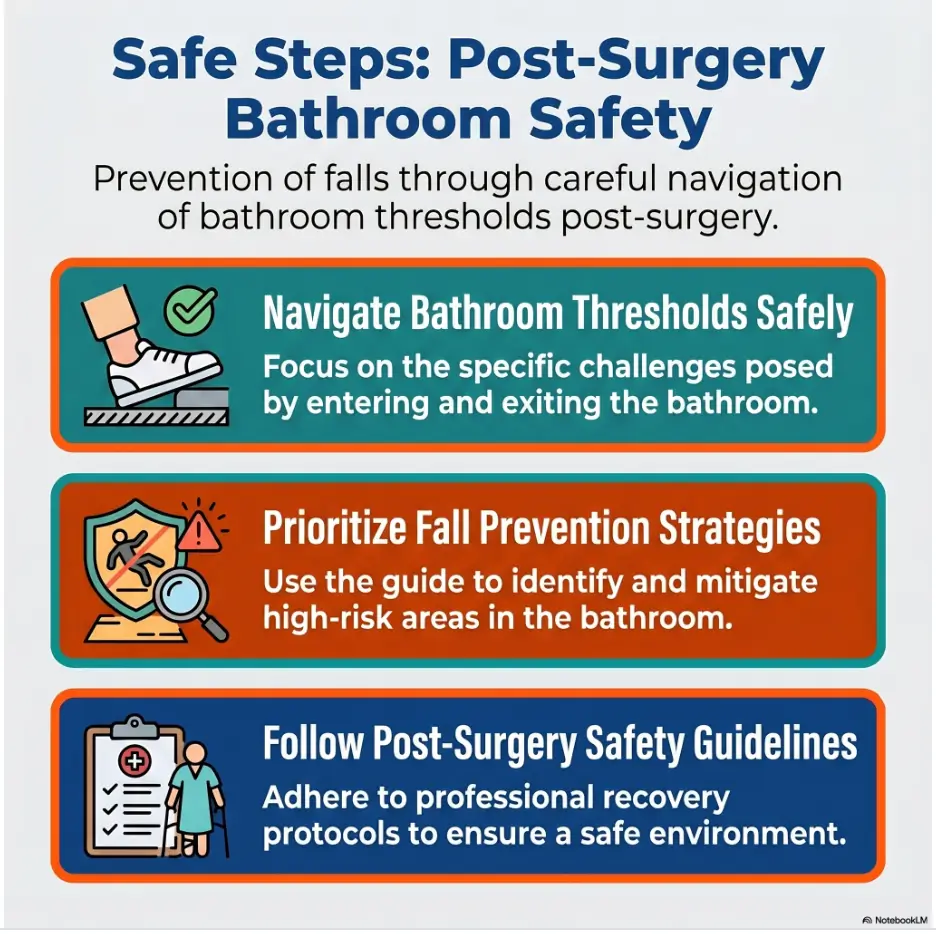
Safety First Before Changing the Bathroom
This guide is general education, not personal medical advice. After surgery, fall risk can shift quickly because of anesthesia aftereffects, pain medication, dizziness, weakness, swelling, restricted movement, and bathroom urgency.
Follow discharge instructions first. If your surgeon, physical therapist, occupational therapist, home health nurse, or discharge planner gave specific rules about weight bearing, bending, showering, walking, or toileting, those instructions sit at the head of the table. Everything else is a guest.
Bathroom doorway fall risks after surgery deserve extra care because the doorway is a transition zone. The body is not just walking. It may be turning, stepping over a lip, managing a walker, reaching for a switch, avoiding a mat, protecting an incision, and trying not to rush.
Why this topic needs restraint
It is tempting to buy every safety product in sight after surgery. Grab bars, mats, raised seats, bedside commodes, shower chairs, reachers, lights, and rails all have their place. But a doorway fall is often caused by a sequence, not one missing gadget.
A rug edge catches the walker. The person reaches for the doorframe. The light is dim. The threshold is damp. The body is tired. A single product may not fix that chain.
The safer approach is to look at the whole route: bed, hallway, bathroom doorway, toilet, sink, shower or tub, and the return trip. That is where practical prevention begins.
What to check with the care team
Before changing routines, ask whether the person has any special precautions. Hip surgery, knee replacement, spine surgery, shoulder surgery, abdominal surgery, and foot or ankle surgery can all change how someone should move through a bathroom doorway.
Useful questions include: Can the person step over a raised threshold? Should they use a walker every time? Are they allowed to twist? Is bending safe? Should someone assist nighttime bathroom trips? Is showering allowed yet?
If you are preparing for recovery, the article on orthopedic home care equipment can help you think through common tools without turning your hallway into a warehouse aisle.
Key takeaway:
Do not treat a bathroom doorway as a simple walking space after surgery. Treat it as a transfer zone where lighting, flooring, assistive devices, fatigue, and body position meet at once.
The Doorway Problem Starts Before the Bathroom
Many bathroom falls do not happen in the shower. They happen on the way in, while entering, or while leaving. The doorway is where a smooth hallway turns into a tighter, wetter, more private space with more decisions per square foot.
After surgery, the brain may still remember the old route. The body does not. A person who used to glide into the bathroom in the dark may now have to manage a walker, a brace, tender stitches, swollen joints, or one arm tucked in a sling.
Recovery legs do not read tiny thresholds well
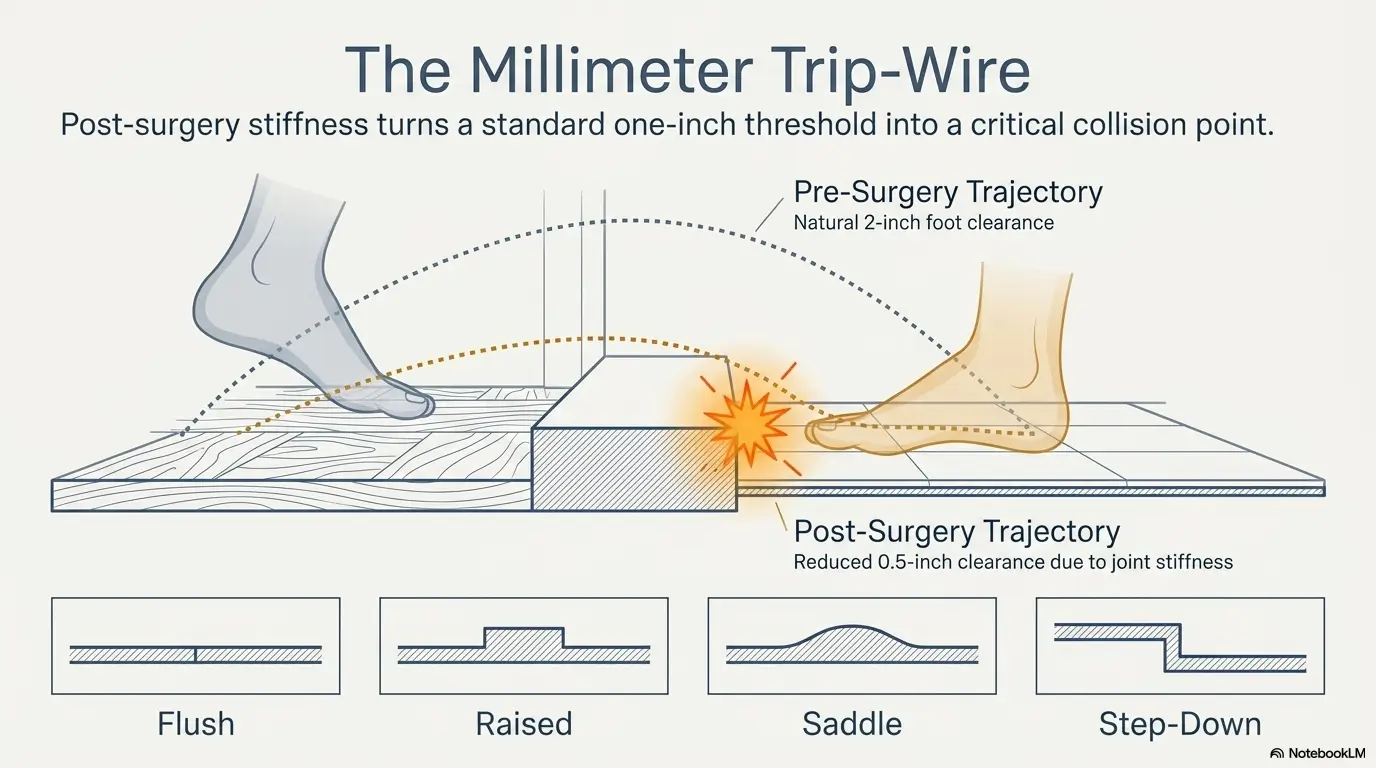
A half-inch threshold can be forgettable on an ordinary Tuesday. After surgery, it can become a curb in miniature. Reduced foot clearance, shorter steps, stiff joints, swelling, numbness, weakness, or protective movement can make the foot drag instead of lift.
Thresholds are especially tricky because they ask for timing. The foot has to rise, move forward, clear the lip, land flat, and then allow the second foot or walker to follow. That sounds simple until the person is tired, medicated, or urgently trying to reach the toilet.
Transition strips, rug edges, saddle thresholds, uneven tile, and raised vinyl seams all deserve attention. They may not look dramatic. The bathroom doorway is not a theater villain. It is more like a loose violin string: small, quiet, and capable of ruining the whole passage.
Pain changes how people step
Pain is not just a feeling. It changes movement. A person may lean away from a sore hip, avoid bending a knee, protect an incision, brace the abdomen, or put less weight through one leg.
That protective pattern can make doorway crossing awkward. Instead of stepping straight through, the person may angle sideways, pause halfway, reach for the trim, or plant the walker unevenly. Each small adaptation can steal a little balance.
For shoulder surgery, the problem may be different. The legs may work well, but one arm cannot help with balance or support. A doorway that once allowed a casual hand on the frame now asks the patient to manage everything with one side of the body. For related setup ideas, see bathroom setup after shoulder surgery.
The pause, pivot, reach problem
Doorway risk often appears during a pause. The person stops at the threshold, shifts weight, turns the walker, reaches for a switch, nudges the door, or checks whether there is space to enter.
That pause can become unstable because the body is between movements. One foot may be on hallway flooring and one on bathroom tile. The walker may be partly turned. The hand may be reaching for something that cannot support body weight.
When families prepare the bathroom, they often look inside the room: toilet height, shower chair, grab bar, bath mat. Those matter. But the doorway is the handshake between rooms. If that handshake is clumsy, the rest of the setup has to work harder.
Doorway risk scorecard
- 1 point: Raised threshold, rug edge, or uneven flooring at the entry.
- 1 point: Walker, cane, brace, boot, or sling changes how the person enters.
- 1 point: Bathroom trips are likely at night.
- 1 point: Doorway is narrow or requires a tight turn.
- 1 point: The person reaches for trim, towel bars, knobs, or the sink for balance.
A higher score does not mean panic. It means the doorway deserves a slower walkthrough before the first real bathroom trip.
Who Needs This Guide, And Who Needs More Help
This guide is useful for short-term recovery planning when the person can follow instructions, communicate needs, and move with the device or assistance recommended by the care team. It is also useful for caregivers who are trying to prepare a home before discharge.
It is not a substitute for clinical guidance when symptoms are changing, the person is unsafe alone, or the household is guessing through high-risk movement. The bathroom is no place for heroic improvisation. Even the bravest people need boring safety sometimes.
Good fit: short-term recovery with manageable mobility
This guide fits situations where a person is recovering from a planned procedure and needs practical home setup help. Examples include knee replacement, hip surgery, shoulder surgery, foot surgery, spine procedures, or abdominal surgery where toileting and shower routines need temporary adjustment.
The person may be using a walker, cane, crutches, brace, surgical boot, sling, raised toilet seat, or shower chair. They may be allowed to move around but need a safer path and better support habits.
Caregivers can use this guide before the first night home, before the first shower, or after a near-fall that made everyone suddenly stare at the bathroom doorway with new suspicion.
Not enough: severe dizziness, confusion, or repeated near-falls
If the person has repeated stumbles, new confusion, severe dizziness, fainting, sudden weakness, shortness of breath, uncontrolled pain, bleeding, or cannot safely toilet without help, do not solve that with a new rug or a pep talk.
Call the care team. Ask whether medication side effects, dehydration, low blood pressure, infection, anemia, nerve issues, or surgical complications need evaluation. A doorway setup can reduce hazards, but it cannot diagnose why someone is suddenly unsafe.
If the person is waiting for an orthopedic appointment and pain is part of the picture, this guide on how to describe pain to a doctor can help turn vague discomfort into clearer, useful details.
Caregivers, this is your section too
Bathroom doorway safety is not just a patient problem. It is a shared routine. Adult children, spouses, friends, neighbors, home aides, and discharge helpers may all be part of the choreography.
The caregiver role is not to hover like a nervous chandelier. It is to make the route predictable, remove obvious hazards, agree on help rules, and notice changes before they become emergencies.
A helpful caregiver might say, “Let’s test the walker turn before nighttime,” instead of “Be careful.” “Be careful” is kind, but it is too foggy. A doorway needs instructions with shoes on.
Short Story: The doorway that looked fine
Marian came home after knee surgery on a Friday afternoon. Her daughter cleared the shower, bought a non-skid mat, and placed fresh towels within reach. The bathroom looked ready, almost ceremonially tidy.
That night, Marian walked toward the bathroom with her walker. At the doorway, one front walker leg caught on the raised strip between hallway carpet and tile. She did not fall, but she grabbed the door trim hard enough to scare them both.
The next morning, they changed the plan. The rug outside the door disappeared. A motion nightlight went in. The door stayed open. Her daughter practiced the turn with her twice before lunch.
The lesson was not that Marian was careless. The lesson was that the bathroom had been prepared, but the doorway had not been invited to the meeting.
The 5-Second Doorway Scan Before the First Night Home
Before the first night home, stand at the bathroom doorway and scan like a practical detective. Do not begin with products. Begin with the floor, the sides, and the light.
The goal is to catch small hazards while everyone is awake, dressed, and thinking clearly. Midnight is a poor time to discover that the walker bumps the door or the rug curls like a sleepy cat.
Look down: threshold, rug, cord, and water
Look at the floor zone from the hallway into the bathroom. Is there a raised threshold? A loose mat? A cord? A scale? A laundry basket? A trash can? Shoes? A floor vent? A wet patch near the sink or tub?
Remove anything that asks the recovering person to step around, over, or between objects. After surgery, “just step around it” is not a safety plan. It is a tiny obstacle wearing a fake mustache.
Pay special attention to rugs near the doorway. Decorative rugs often slide, curl, wrinkle, or catch walker feet. If a mat is truly needed, it should be flat, non-skid, and placed where it does not interfere with the entry path.
Look sideways: walker width, door swing, and towel rack
Next, check side space. Can the walker fit through without scraping or twisting? Does the door swing into the person’s path? Does a towel rack, hamper, vanity corner, or wall hook narrow the entry?
A doorway may fit the person but not the recovery setup. A walker adds width. A brace changes leg position. A surgical boot changes foot clearance. A caregiver standing nearby needs space too.
Try the real movement. Approach the doorway with the actual device, turn if needed, enter, pause, and exit. Do not measure only the opening. Measure the dance.
Look up: light switch, shadows, and night path
Finally, look at lighting. Can the person see the threshold before stepping? Is the light switch reachable without leaning? Are there shadows at the doorway? Is the hallway bright enough at night?
Motion nightlights can help, especially between bed and bathroom. A bedside lamp, clear path, and easy footwear placement matter too. The safest bathroom doorway may still fail if the route from bed is dark and cluttered.
If joint surgery recovery is part of the situation, the ideas in bedroom lighting setup after joint surgery pair well with this doorway scan.
5-second doorway scan checklist
- Floor: Remove loose rugs, cords, scales, shoes, laundry, and low clutter.
- Threshold: Check for raised lips, uneven flooring, or transition strips.
- Width: Test the walker, cane, brace, boot, or caregiver position through the doorway.
- Support: Identify where the hand naturally reaches and whether that support is actually safe.
- Light: Make the route visible before the person needs it at night.
Why Doorframes, Towel Bars, and Sinks Can Betray You
One of the most common bathroom doorway mistakes after surgery is treating anything vertical as a grab bar. Doorframes, towel bars, knobs, sliding doors, sink edges, and decorative shelves all look useful when balance wobbles.
The trouble is that “nearby” and “safe to bear weight” are not the same thing. A towel bar may hold towels beautifully for years and still fail the moment a tired person yanks on it during a stumble.
Doorframes feel sturdy until balance shifts
Door trim feels solid under the fingers, but it is not designed as a medical support. A person may grab it while stepping over a threshold, turning a walker, or trying to avoid a wet patch.
If balance shifts suddenly, the hand may slide, the trim may not provide the right angle, or the person may twist the body in a way that increases pain. Doorframes are familiar. That familiarity can be the trap.
Door knobs are worse. They can turn, move, or pull the person sideways. Sliding shower doors can shift. Towel bars can loosen. None of these should become the emergency steering wheel.
Install support where the hand actually reaches
Support works best when it matches the real movement. Watch where the person naturally reaches when entering, turning, standing from the toilet, or leaving the bathroom. That tells you where support may be needed.
Properly installed grab bars can be helpful when recommended and placed correctly. Installation matters because bathroom walls vary, and a bar that is not anchored properly can create false confidence.
For renters, temporary solutions may be limited. Do not assume suction devices are appropriate for body-weight support. Ask a physical therapist, occupational therapist, landlord, or home health team about safer options that fit the home.
Do not let towel bars pretend to be safety equipment
Towel bars are for towels. This is their tiny kingdom. They are not built for sudden body weight, twisting force, or a frightened grip during a near-fall.
If a person is already reaching for a towel bar, treat that as useful information. It means the bathroom entry or toilet transfer needs a safer support plan.
A simple caregiver note can help: “Do not pull on towel bars, door knobs, or sliding doors. Use the walker, grab bar, or call for help.” Put the rule where it can be seen without bending or searching.
Key takeaway:
If the person reaches for a towel bar, knob, or doorframe, do not scold the instinct. Replace the unsafe reach with a safer support pattern.
The Threshold Test Most Families Forget
A doorway threshold deserves its own test because it behaves differently under real recovery conditions. The person may clear it easily at noon with shoes on, then struggle at night after medication, fatigue, or a shower.
Testing should be slow, supervised when appropriate, and based on the prescribed device or assistance plan. Do not create a risky trial just to prove a point. The goal is information, not bravery theater.
Can the foot clear it when tired?
Ask whether the recovering person can clear the threshold when tired, stiff, or rushed. Early in the day, a step may look fine. Later, the foot may drag, the knee may resist bending, or the person may shorten the stride without noticing.
Hip and knee surgery can reduce confidence with stepping. Foot and ankle surgery can make weight shift awkward. Spine or abdominal surgery can make twisting feel unsafe. Shoulder surgery can reduce available support from one arm.
If the threshold is a problem, ask the care team about safe technique, temporary equipment, or whether a different bathroom route is better during early recovery.
Can the walker cross without catching?
Walkers create their own threshold questions. Do the front feet catch? Do wheels bump? Do rubber tips stick? Does the person lift the walker too high? Does the walker land unevenly on tile?
Some people remove the walker at the bathroom door because it feels too awkward. That is understandable, but it can be dangerous if the walker is part of the prescribed mobility plan.
If the walker does not fit or feels unsafe, ask a physical therapist, occupational therapist, home health nurse, or discharge planner about alternatives. A narrower device, bedside commode, raised toilet setup, doorway adjustment, or assisted transfer routine may be safer than abandoning support.
The sock test is not enough
A dry daytime test in socks does not prove the doorway is safe. Real bathroom conditions include damp feet, urgency, dim light, medication effects, and fatigue.
Test with the actual footwear recommended for the person. Test with the walker, cane, brace, or boot. Test the direction into the bathroom and the direction out.
The return trip matters because the person may be more tired after toileting, standing from the toilet, washing hands, or showering. Many families prepare the entrance and forget the exit. The exit has feelings too.
Threshold test table
| Test | What to watch | Why it matters |
|---|---|---|
| Foot clearance | Toe catching, dragging, hesitation | Small lips can trip a tired recovery step |
| Walker crossing | Rubber tips, wheels, uneven landing | A snag can pull balance forward |
| Night route | Shadows, switch reach, sleepy turns | Most people move less carefully when half-awake |
| Return trip | Fatigue after toileting or showering | Leaving can be harder than entering |
Wet Floor, Doorway Pivot, and Nighttime Trips
Bathroom doorway fall risks after surgery often come from combinations. Wet floor alone is risky. A tight pivot alone is risky. Nighttime grogginess alone is risky. Put them together, and the doorway becomes a small storm system.
The practical goal is to reduce the number of problems happening at the same time. Better lighting, fewer rugs, slower movement, and clearer support can break the chain.
The danger is not just slipping
People often think of bathroom falls as slips. But many post-surgery doorway incidents involve pivots, hesitation, reaching, or catching a foot.
A person may step into the bathroom, notice water, stop suddenly, twist the walker, reach for the sink, and lose balance. The slip never gets a starring role. It is an ensemble cast of small hazards.
Keep the doorway floor dry. Place towels where they do not create a trip hazard. Make sure shower curtains, bath mats, and clothing do not spill into the entry path.
Bath mats need grip, not personality
A bath mat after surgery has one job: stay flat and stay put. It does not need tassels, plush drama, curled corners, or a personality larger than the bathroom.
Loose, fluffy, or decorative rugs can catch toes, walker feet, canes, or surgical boots. If a mat slides even once during a test, remove it from the doorway area.
If a non-skid mat is needed outside the shower, place it where it does not block the entry, door swing, or walker path. The mat should solve a problem, not audition for one.
Nighttime bathroom trips need their own rule
Nighttime changes the home. The hallway feels longer. Shadows soften edges. Medication may cause grogginess. Urgency can make a person move faster than the body is ready to move.
Use a simple rule: sit up, pause, stand, pause, then move. This is especially important after pain medicine, sleep disruption, dehydration, or blood pressure changes.
Keep the assistive device within reach. Place glasses, phone, footwear, and lighting where the person does not have to bend, twist, or search. If assistance is recommended, the nighttime rule should include calling before moving.
Bathroom Doorway Safety Flow
1. Clear
Remove rugs, cords, baskets, scales, shoes, and low clutter.
2. Check
Inspect threshold lips, uneven flooring, wet zones, and door swing.
3. Test
Use the real walker, cane, brace, boot, or caregiver position.
4. Light
Make the bed-to-bathroom route visible before nighttime.
5. Decide
Write the help rule: call, pause, use the device, or wait.
Walker Width, Door Swings, and the Too-Tight Moment
A doorway can be technically wide enough and still feel unsafe. That is because recovery movement is not a straight line on graph paper. It is a real person with a device, pain, clothing, fear, and a bladder that may not be interested in project management.
The too-tight moment often happens when the person enters, tries to turn, and realizes the door, walker, toilet, sink, or caregiver is in the way.
The doorway may fit the person but not the recovery setup
A walker adds width and changes timing. A cane changes weight shift. Crutches require room for arm movement. A brace or boot can make the leg swing outward. A raised toilet seat may change how far the person needs to turn.
Do not assume the bathroom is accessible because the person used it before surgery. Recovery creates a temporary body with new rules. The home has to meet that body where it is.
If the doorway is too narrow, ask the care team about safe alternatives. Sometimes the answer is a different bathroom, a bedside commode, a temporary door removal, a modified transfer plan, or more caregiver assistance.
Measure the actual movement, not just the opening
Door width is only one number. The real test includes approach, entry, turn, door position, toilet transfer, handwashing, and exit.
Leave the door open during testing. Then test whether partially closing it changes the movement. Many people value privacy, but privacy should not trap the walker, block caregiver access, or force a risky pivot.
If you are preparing after hip surgery, related routines such as choosing toilet seat riser height may affect how much turning and lowering the person has to do in the bathroom.
Privacy can fight safety
Bathroom privacy matters. Dignity matters. No one wants recovery to feel like living inside a hospital clipboard. But in early recovery, a closed door can slow help, narrow the entry, or force a risky turn.
Consider practical compromises: leave the door partly open, use a temporary curtain, agree on a call phrase, or have the caregiver wait nearby but out of sight.
The best plan respects privacy without pretending the person is safer than they are. Dignity and safety can share a hallway if everyone talks before the urgent moment arrives.
Key takeaway:
Do not measure only the bathroom doorway. Test the full movement with the real device, real footwear, real door position, and real return trip.
Safer Bathroom Entry Setup After Surgery
A safer bathroom entry setup starts with subtraction. Remove what does not need to be there. Then add only what solves a clear problem.
That order matters. Families often buy equipment before clearing the path. Then the bathroom becomes a crowded little museum of good intentions.
Clear the landing zone outside the bathroom
The landing zone is the space just outside the bathroom door. It should be boring, open, and easy to see. Remove laundry baskets, scales, cords, shoes, small stools, pet bowls, trash cans, decorative stands, and loose mats.
Make sure there is room for the person to pause before entering. Pausing is not failure. It is a safety behavior. A clear landing zone gives the body time to organize itself before stepping into a tighter space.
If a caregiver needs to assist, the landing zone must fit both people. A helper standing in the wrong spot can accidentally block the walker or force the person to twist.
Create a predictable hand-support pattern
Think of support as a sequence. The person may need safe support from bed to hallway, at the bathroom entry, near the toilet, at the sink, and near the shower or tub.
That does not mean every wall needs hardware. It means the person should not have to guess where to place a hand or whether a fixture can hold weight.
If grab bars are needed, professional installation is often worth it. If equipment is temporary, ask whether it is safe for the person’s surgery type, strength, and home layout.
Keep essentials within reach, not on the floor
Toilet paper, wipes, towels, clean clothing, medication, and hygiene items should not require bending, twisting, or stepping across the doorway. Floor storage is a quiet saboteur after surgery.
Use a stable shelf, counter space, or caregiver-prepared basket placed at waist height when possible. Avoid placing items behind the toilet or low under the sink during early recovery.
If shoulder surgery limits one arm, think carefully about which side items are on. If hip or knee surgery limits bending, raise commonly used items higher. If spine surgery limits twisting, keep items in front of the body.
Safer entry setup: remove, move, add
| Step | Action | Example |
|---|---|---|
| Remove | Take away trip and snag hazards | Loose rugs, cords, laundry baskets, scales |
| Move | Place essentials at safe reach height | Towels and wipes on counter, not floor |
| Add | Add support only where it solves a real movement problem | Proper grab bar, nightlight, stable toilet aid |
Show me the nerdy details
A bathroom doorway creates a high-demand transition because the person may shift from one surface to another, adjust step height, narrow the walking path, change direction, and manage a mobility device at the same time. This raises the “task load” on balance.
After surgery, the body may have slower reaction time, less strength, altered sensation, medication effects, pain guarding, or reduced range of motion. That means the margin for error is smaller. A threshold that once required almost no attention may now require conscious planning.
The practical fix is not to make every surface perfectly flat. It is to reduce simultaneous demands: clear the route, improve light, avoid loose mats, use prescribed devices, plan hand support, and slow the sequence from bed to bathroom and back.
When to Seek Help Before the Next Bathroom Trip
Some bathroom doorway problems are layout problems. Others are medical or recovery problems showing up at the doorway because that is where balance is tested.
Do not minimize near-falls. A stumble, wall bump, sudden sit-down, grabbed towel bar, or “I almost went down” moment is useful data. It means the current setup or assistance plan may not be enough.
Call the surgical team for new or worsening symptoms
Call promptly for dizziness, fainting, confusion, sudden weakness, uncontrolled pain, shortness of breath, chest pain, wound bleeding, fever, head impact, or concern that the surgical area was injured.
Also call if the person cannot follow weight-bearing instructions, cannot safely get to the toilet, or has new medication side effects that affect alertness or balance.
For urgent symptoms, use emergency services. A bathroom fall after surgery can cause head injury, wound problems, fractures, or damage to the surgical repair. It is better to ask early than to explain later why the towel bar is on the floor.
Ask for PT or OT if the doorway feels unsafe
Physical therapists and occupational therapists can help assess transfers, walking devices, bathroom entry, toilet setup, shower access, and safer movement patterns. They can also teach techniques that fit the surgery and the home.
If the walker does not fit, the toilet transfer feels awkward, the person keeps reaching for unsafe supports, or caregivers are unsure how to assist, PT or OT input can save guesswork.
A home health referral may be appropriate for some patients. Ask the discharge team what is available and what insurance may cover.
Treat near-falls as warnings, not almost nothing
A near-fall is not a failed fall. It is a warning flare. The person’s body, the doorway, and the routine just gave you a preview.
Write down what happened. Time of day, medication timing, footwear, device used, lighting, floor condition, and where the person reached all matter.
Then adjust one or two specific things before the next bathroom trip. Better light. Door open. Rug removed. Helper called. Walker used. The fix should be concrete enough that everyone can remember it.
Key takeaway:
A near-fall after surgery is not “nothing.” It is a message from the route, the body, or both. Change the plan before the next trip.
FAQ
Why is the bathroom doorway risky after surgery?
The bathroom doorway combines several hazards in one small place: a threshold, tight turning space, wet flooring, dim light, urgency, medication effects, and reduced balance. After surgery, even a familiar doorway can require more planning.
Should I remove bathroom rugs after surgery?
Loose, curling, fluffy, or sliding rugs near the doorway are often safer removed during early recovery. If a mat is needed, use a flat non-skid option that does not catch the foot, cane, walker, or surgical boot.
Is it safer to leave the bathroom door open?
Often, yes during early recovery, especially if a caregiver may need quick access or the door blocks a walker turn. Privacy can be handled with a partial opening, curtain, call routine, or nearby caregiver position.
Can I use the sink or towel bar for balance?
A sink may not be placed safely for balance, and towel bars are not designed as body-weight supports. Use properly installed grab bars, prescribed devices, or clinician-recommended supports instead.
What if my walker does not fit through the bathroom door?
Do not simply leave the walker outside without medical guidance. Ask a physical therapist, occupational therapist, home health nurse, or discharge planner about safer equipment, transfer strategies, or temporary alternatives.
Are raised thresholds dangerous after hip or knee surgery?
They can be, especially when foot clearance, strength, balance, or weight-bearing is limited. Ask the surgical team or therapist for safe stepping technique and whether the threshold needs a temporary workaround.
How can I reduce nighttime bathroom fall risk?
Clear the path, add nightlights, keep footwear and assistive devices within reach, sit before standing, pause before walking, avoid rushing, and use assistance if recommended.
When should I call for medical help after a bathroom stumble?
Call promptly after a fall, head impact, new pain, wound bleeding, dizziness, confusion, weakness, shortness of breath, or any concern that the surgical area was injured.
Do a Doorway Walkthrough Before the First Shower
The first shower after surgery often gets all the attention. But before water, steam, towels, and fatigue join the scene, do a doorway walkthrough. It takes about 15 minutes and can reveal problems that a quick glance misses.
Use the real route. Start from the bed or chair where the person will likely begin. Use the prescribed walker, cane, brace, boot, sling, or caregiver assistance. Move toward the bathroom, pause at the doorway, enter, turn, approach the toilet or shower area, and exit.
Watch where the person hesitates. Watch what the walker touches. Watch what the hand reaches for. Watch whether the lighting is good enough. Watch whether the door helps or becomes a wooden nuisance with hinges.
Then fix one hazard before adding one product. Remove the loose rug. Move the laundry basket. Add a nightlight. Leave the door partly open. Put towels at waist height. Write down the help rule.
A good help rule is simple: “Use the walker every time.” “Call before nighttime bathroom trips.” “No shower unless someone is home.” “Pause before stepping over the threshold.” Choose one rule that fits the actual risk.
15-minute doorway walkthrough plan
- Minute 1-3: Clear the landing zone outside the bathroom.
- Minute 4-6: Check the threshold, rug edges, wet zones, and floor transitions.
- Minute 7-9: Test the real device through the doorway and turn space.
- Minute 10-12: Check lighting from bed to bathroom, including nighttime visibility.
- Minute 13-15: Write one help rule and place essentials within safe reach.
The promise of this whole guide is simple: make the doorway less surprising. Recovery already contains enough unknowns. A bathroom entry should not be one of them.
Within the next 15 minutes, stand at the bathroom doorway and remove one thing that could catch a foot, walker, cane, or tired decision. That is the first quiet win. The rest of recovery can build from there.
Key takeaway:
The safest next step is not complicated: walk the real route, with the real device, before the first shower or nighttime bathroom trip.
Last reviewed: 2026-05