

Patient billing clarity before orthopedic care
Orthopedic Payment Plan Questions to Ask Before Treatment
So the bill does not limp in later
Orthopedic care can feel deceptively simple from the exam room chair. A knee hurts. A shoulder catches. A hip needs help. Then the paperwork arrives with its own anatomy: surgeon fee, facility fee, anesthesia, imaging, braces, implants, physical therapy, deductibles, prior authorization, and a payment plan that may or may not be as gentle as it sounds.
This guide is for the patient, caregiver, spouse, adult child, busy worker, weekend athlete, or careful retiree who wants to ask smarter billing questions before surgery, injections, MRI scans, braces, or rehab. The goal is not to make you suspicious of care. The goal is to keep money confusion from walking into the room wearing a white coat.
A monthly payment can look calm on paper while the true cost hides behind it like fog at the edge of a parking lot. Before you sign, finance, schedule, or pay in full, you need one clear sentence in your pocket: “What could I still owe after this estimate?”
Know what is included
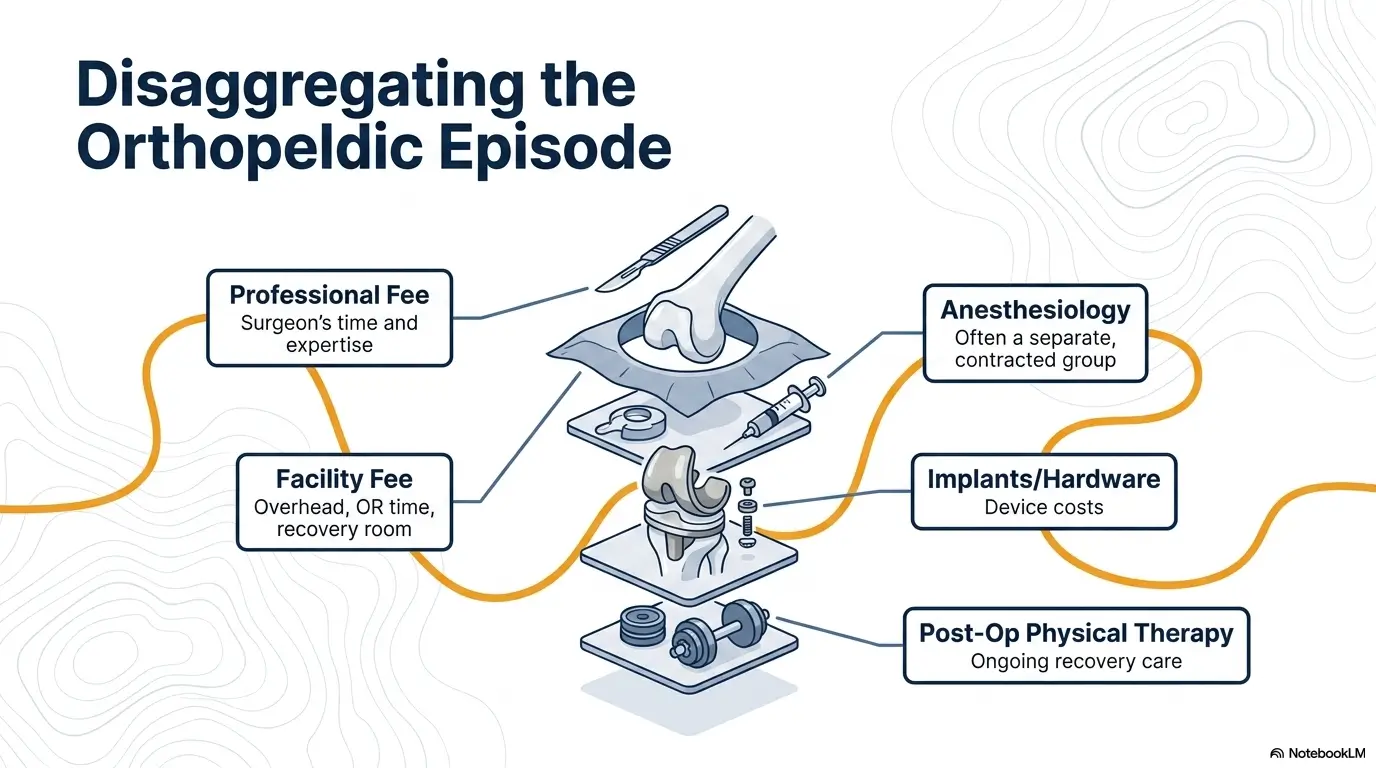
Separate the doctor bill from facility, imaging, anesthesia, implants, braces, and rehab costs.
Read the financing terms
Spot interest, deferred-interest traps, fees, credit checks, late penalties, and refund rules.
Protect the treatment decision
Ask about cost without delaying care when symptoms are urgent or medically risky.
🩺 Bottom line: the safest orthopedic payment plan is not the one with the smallest monthly number. It is the one you understand in writing.
Snapshot
This article is for US patients and caregivers comparing orthopedic treatment costs before surgery, injections, imaging, braces, or physical therapy. You will learn what to ask the billing office, what to confirm with insurance, what payment-plan terms deserve caution, and how to save the answers in writing before care begins.
Table of Contents
Safety / Disclaimer
This article is general education for patients and caregivers. It is not medical, legal, insurance, tax, or financial advice. Orthopedic treatment decisions should be made with a licensed clinician who understands your symptoms, imaging, medical history, medications, work demands, and safety risks.
Payment decisions should be reviewed with the provider’s billing office, your insurer, and, when needed, a qualified financial counselor or consumer-debt professional. A lower monthly payment is not automatically safer if it hides interest, fees, delayed insurance problems, or unclear refund rules.
Cost questions matter, but they should not delay urgent medical evaluation. Severe trauma, loss of sensation, sudden weakness, signs of infection, fever with joint swelling, chest pain, shortness of breath, bowel or bladder changes, or rapidly worsening pain deserve prompt medical attention.
Key takeaway:
Use this guide to ask clearer billing questions, not to choose or delay treatment on cost alone. If money might change whether you get care, tell the clinician and billing office early. Silence is where bad surprises grow little teeth.
Start With the Real Bill, Not the Monthly Number
A payment plan can make a large orthopedic bill look manageable. That is useful when the terms are clear. It is dangerous when the monthly number becomes the only number you notice.
Orthopedic care often moves through several rooms before it reaches your mailbox. The exam may happen in one office. The MRI may be read by a radiologist you never meet. The injection may involve a facility charge. The surgery may include a surgeon, an anesthesiologist, an implant, a surgery center, post-op visits, medications, and physical therapy.
To your body, it feels like one treatment journey. To the billing system, it may be a small orchestra of separate invoices, each tuning its own instrument.
Ask what the payment plan actually covers
Start by asking, “Does this payment plan cover every bill related to my treatment, or only this office’s charges?” That question is humble, direct, and surprisingly powerful.
For a knee arthroscopy, for example, the orthopedic practice may quote the surgeon’s professional fee. The surgery center may send a separate facility bill. Anesthesia may bill separately. If an implant, brace, crutches, or post-op therapy is needed, those costs may not be inside the original quote.
For an injection, ask whether the quote includes the medication, imaging guidance, facility fee, office visit, and follow-up visit. For imaging, ask whether the price includes both the scan and the professional interpretation. For physical therapy, ask whether the payment plan covers one visit, an evaluation, a package, or the expected full course.
The “one bill” trap that quietly becomes five
The “one bill” trap happens when the care experience feels unified but the billing entities are not. A patient may schedule everything through one health system portal and still receive separate statements from multiple departments or contracted professionals.
This is especially common when care happens at a hospital outpatient department or ambulatory surgery center. The provider may be in network, but the facility, anesthesia group, imaging provider, or therapy clinic may have different contracts with your insurer.
That does not mean anyone is trying to trick you. It does mean you need to ask the boring question before the exciting treatment date: “Can you list every party that may bill me for this episode of care?”
Let’s be honest: the monthly payment can be the shiny object
A $128 monthly payment feels less frightening than a $4,600 estimate. A $79 monthly payment may feel even better. But a low monthly payment can stretch the debt longer, add interest, or delay the moment when you realize other bills were not included.
Before you accept a payment plan, compare three numbers: the estimated total cost, the total amount paid if you use the plan, and the possible remaining balance after insurance finishes processing. If the billing office cannot explain those three numbers, you are not looking at a plan yet. You are looking at a fog machine.
| Question | Why it matters | What a clear answer sounds like |
|---|---|---|
| What does this plan cover? | Prevents surprise separate bills | “It covers the orthopedic surgeon only. Facility and anesthesia bill separately.” |
| What is the total cost if I use the plan? | Shows interest and fees | “If paid over 24 months, the total is $3,280 including fees.” |
| What could I still owe later? | Exposes estimate gaps | “You may still owe therapy copays and any deductible not reflected here.” |
| Can I get this in writing? | Creates a paper trail | “Yes, we can send the estimate and plan terms through the portal.” |
For more prep before a visit, you may also want to use an orthopedic appointment checklist so the clinical and billing questions travel together instead of living in separate pockets.
Who This Is For, And Who Should Pause
Payment-plan research makes the most sense when you have time to compare options safely. It is not meant to turn urgent symptoms into a spreadsheet project. Your body gets a vote, and sometimes it votes loudly.
Good fit: planned care with time to compare options
This guide is most helpful for planned or semi-planned orthopedic care. That may include joint injections, arthroscopy, carpal tunnel procedures, outpatient spine injections, elective imaging, knee or hip replacement planning, sports-injury evaluation, brace fitting, or physical therapy after a non-emergency diagnosis.
It is also useful for people with high-deductible health plans, Medicare Advantage plans, self-pay situations, out-of-network questions, or insurance approvals that seem to move at the speed of cold honey.
A caregiver can use these questions for an older parent who is overwhelmed by paperwork. A freelancer can use them before scheduling a procedure that affects both income and cash flow. A busy parent can use them to avoid a pile of unexpected copays during the same month the car needs tires and the dog eats something dramatic.
Not for this: urgent symptoms or medical red flags
Do not use payment-plan shopping to delay emergency evaluation. Severe injury, deformity after a fall, inability to bear weight after trauma, sudden foot drop, new numbness in the groin area, fever with a hot swollen joint, spreading redness after surgery, shortness of breath, chest pain, or sudden severe back pain with bowel or bladder changes should be treated as urgent.
There are also quieter red flags. If pain is rapidly worsening, if weakness is changing how you walk, if a wound looks infected, or if you cannot care for yourself safely at home, call your clinician or seek urgent care. Billing questions can wait in the hallway. Safety should not.
When the money question should not delay care
Many patients feel embarrassed saying, “I am worried I cannot afford this.” Please say it anyway. Good clinicians and billing teams hear this more often than you think.
A useful sentence is, “I want to follow the treatment plan, but cost may affect whether I can complete it. Can we talk about timing, alternatives, financial assistance, or lower-cost settings without increasing medical risk?”
That sentence does not challenge the clinician’s expertise. It gives them the missing context. A treatment plan that is medically elegant but financially impossible may collapse before it helps.
Key takeaway:
Cost clarity is wise for planned care. It is not a reason to delay evaluation for serious symptoms. When in doubt, ask the medical question first and the billing question second.
The Estimate Question Most Patients Forget
Many patients ask, “How much is it?” That is a fair question. The better version is, “What is included, what is not included, and what assumptions is this estimate based on?”
An estimate is not a final bill. It is a forecast. Forecasts can be useful, but only when you know whether the weather report includes the storm behind the mountain.
Ask for a written good-faith-style estimate
Whenever possible, ask for a written estimate before treatment. If you are uninsured or not using insurance, ask whether you are entitled to a good faith estimate for expected charges. If you are using insurance, ask for a written estimate anyway, even if the exact legal process differs.
The estimate should ideally include the procedure name, CPT codes if available, diagnosis codes if relevant, facility location, expected provider charges, expected insurance adjustment, estimated deductible, coinsurance, copay, and estimated patient responsibility. If the billing office cannot include everything, ask them to identify what is missing.
CPT codes are not magic spells, though they sometimes look like them. They are billing codes that help your insurer estimate how a service may process. Having them makes your insurance call much more productive.
“What is not included?” is the magic sentence
The most revealing question is not “What is included?” It is “What is not included?”
Ask specifically about anesthesia, imaging, radiology interpretation, lab work, implants, surgical hardware, braces, crutches, walkers, medications, follow-up visits, physical therapy, occupational therapy, home health, complications, and additional procedures if the plan changes during care.
If you are having shoulder surgery, for example, ask whether the sling is included. If you are having knee replacement, ask about post-op physical therapy and durable medical equipment. If you are getting a spine injection, ask whether the facility fee and fluoroscopy guidance are included.
Here’s what no one tells you: estimates age fast
An estimate can be accurate when printed and stale two weeks later. Deductibles reset. Prior authorization expires. Insurance contracts change. A planned office procedure may move to a surgery center. A surgeon may decide that a different approach is safer. A complication may require additional care.
Before you schedule, ask, “How long is this estimate valid?” Then ask, “What would cause it to change?”
If the treatment date crosses into a new calendar year, pay extra attention. A deductible reset can turn a manageable estimate into a very different conversation. Patients with high-deductible plans should be especially careful here; timing can matter as much as price.
Estimate-prep list
- Procedure name and expected setting
- CPT codes and diagnosis codes, if available
- Provider name, facility name, and anesthesia group, if known
- Whether insurance has approved the service
- Estimated deductible, copay, coinsurance, and out-of-pocket maximum status
- What is excluded from the estimate
- How refunds work if insurance later pays more than expected
Patients comparing scan costs may also find this related guide on high-deductible imaging cost estimates helpful, especially when an MRI or CT is part of the orthopedic plan.
Insurance Timing Can Make or Break the Plan
Insurance timing is where many payment plans wobble. A plan based on an early estimate may look reasonable before insurance processes the claim. Then the explanation of benefits arrives, and suddenly the numbers have learned gymnastics.
Before you sign, you need to know whether the payment plan is based on an estimate, a pre-service quote, a finalized claim, or a balance after insurance. Those are not the same thing.
Ask where you are in your deductible today
Your deductible status can change the entire decision. If you have met most of your deductible, the same procedure may cost much less out of pocket than it would have in January. If you are still at the beginning of your deductible, you may owe the negotiated rate until the deductible is met.
Call your insurer and ask, “As of today, how much of my deductible and out-of-pocket maximum have I met?” Then ask whether any pending claims have not posted yet. This matters because yesterday’s physical therapy visit, lab bill, or urgent care visit may not have appeared in the system.
For families, also ask whether the deductible is individual, family, or embedded. A parent scheduling a child’s orthopedic procedure may discover that the child’s individual deductible is different from the family total.
Confirm prior authorization before signing anything
Prior authorization is not the same as a guarantee of payment, but skipping it can create expensive confusion. Ask the provider and insurer whether authorization is required for the procedure, imaging, injection, surgery, brace, or therapy.
If authorization is pending, ask whether you should wait before signing a financing agreement. A payment plan signed before authorization may become awkward if the insurer denies the service, requests conservative treatment first, or approves a different setting.
Patients dealing with MRI denials may want to review how documentation and appeals can work in orthopedic care. A related guide on orthopedic pain management after MRI denial appeal can help you understand what questions to ask without turning your kitchen table into a claims office.
Ask if the provider will re-bill after insurance processes
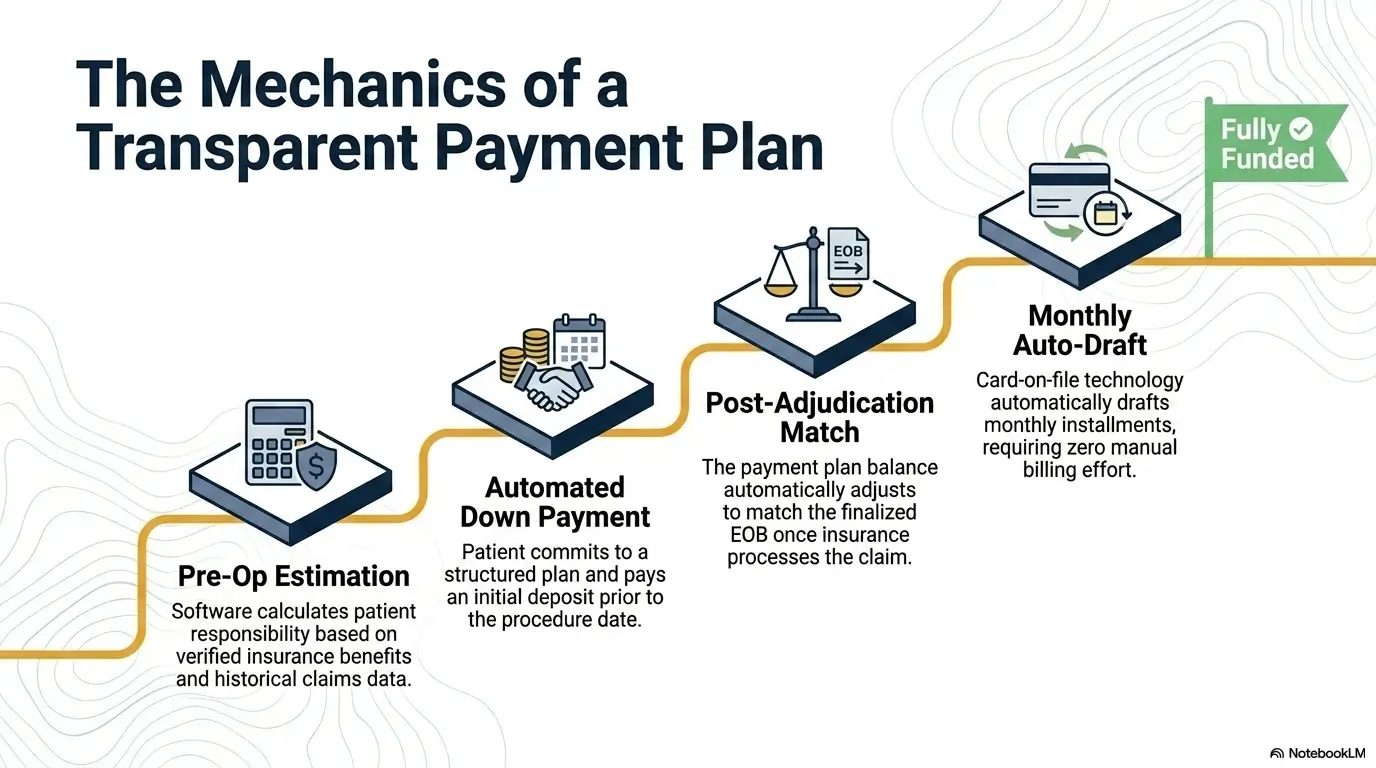
Some offices collect an estimated patient responsibility before treatment. Others wait until insurance processes. Some set up a plan on the estimated balance and adjust later. You need to know which one you are agreeing to.
Ask, “If insurance processes differently than expected, will you automatically adjust my payment plan?” Then ask, “If I overpay, will the refund be automatic, or do I need to request it?”
Also ask how long refunds usually take. A refund policy that exists in theory but moves slower than a museum escalator can still affect your cash flow.
| Insurance status | Payment-plan risk | Question to ask |
|---|---|---|
| Authorization approved, claim not processed | Estimate may still change | “Will this be adjusted after the EOB?” |
| Authorization pending | Denial or delay may change the plan | “Should I wait to sign until approval is confirmed?” |
| Deductible nearly met | Timing may lower patient responsibility | “Are pending claims included in this estimate?” |
| New plan year soon | Deductible may reset | “Will the treatment date affect my out-of-pocket cost?” |
Do Not Sign Until You Ask About Interest
“Payment plan” can mean several different things. It may be an in-house installment agreement with the clinic. It may be a third-party medical credit product. It may be a promotional financing offer. It may be a zero-interest arrangement if paid on time. These are cousins, not twins.
The words matter because the consequences differ. An in-house plan may have no credit check. A third-party plan may involve a credit application. A deferred-interest promotion may look friendly until the promotional period ends.
Is it zero-interest, deferred-interest, or regular financing?
True zero-interest financing means you are not charged interest under the stated terms. Deferred interest is different. With deferred interest, interest may accumulate in the background and become due if you do not pay the full balance by the promotional deadline.
That distinction is not small print trivia. It can be the difference between a predictable plan and a financial trapdoor.
Ask, “Is this true no-interest financing, or deferred interest?” Then ask, “If I have even one dollar left after the promotional period, what happens?”
Ask for the APR in writing
Ask for the annual percentage rate, late fees, administrative fees, origination fees, autopay requirements, grace period, missed-payment consequences, and total amount paid if you follow the plan exactly.
Do not rely on “It is usually interest-free” or “Most patients do fine.” Those may be true in spirit, but you need the written terms that apply to your actual agreement.
A calm script is: “I am not refusing the plan. I just need the APR, fees, payment schedule, and late-payment rules in writing before I decide.”
The “same as cash” phrase deserves suspicion
“Same as cash” sounds soft, almost cozy. But it can hide strict deadlines. If the balance is not paid in full by the promotion end date, interest may apply. Sometimes it applies only going forward. Sometimes it applies retroactively, depending on the agreement.
Ask for a payoff date and mark it somewhere you will actually see it. Not a note buried in your phone. Not a paper folded into the glove compartment. Put it where bills get paid.
If the monthly payment suggested by the lender will not pay off the balance before the promotional period ends, that is a serious warning. A payment plan should not require clairvoyance.
Key takeaway:
Never judge a medical financing offer by the monthly payment alone. Ask for the APR, total paid, fees, payoff deadline, and what happens if you miss a payment or fail to pay by the promotional end date.
Show me the nerdy details
When comparing orthopedic payment plans, create a quick “total cost of credit” note. Write down the starting balance, APR, monthly payment, number of payments, fees, and final payoff date. Multiply the monthly payment by the number of payments, then add any upfront fees. Compare that number with the original balance.
If a plan says “no interest if paid in full within 12 months,” divide the full balance by 12. If that number is higher than the advertised monthly payment, the advertised payment may not clear the balance before the promotional deadline. Ask the finance company to confirm the monthly payment required to avoid interest.
Also ask whether extra payments go directly to principal and whether there is any prepayment penalty. In medical financing, the fine print is not decoration. It is the hinge on the door.
Common Mistakes That Turn Care Into Debt Fog
Most billing mistakes do not happen because patients are careless. They happen because the health care billing system asks patients to make financial decisions while they are worried, sore, busy, and often holding an ice pack.
The good news is that a few simple questions can prevent many of the messiest surprises.
Mistake 1: choosing the lowest monthly payment only
A low monthly payment may be helpful if your cash flow is tight. But it can also stretch the debt longer, increase total cost, or keep you paying for a procedure long after new medical needs appear.
Ask yourself: “Can I afford this payment if I also owe therapy copays, medication costs, or time off work?” Orthopedic care is often followed by recovery costs. The first bill is not always the last bill.
Mistake 2: assuming in-network means everything is in-network
One of the most expensive assumptions is that an in-network surgeon means every related service is also in network. The facility, anesthesia group, imaging center, lab, physical therapy clinic, and durable medical equipment provider may have different network status.
Ask for the names and tax ID numbers of the providers or facilities involved when possible. Then call your insurer. Use the phrase, “I want to verify network status for every billing entity involved in this procedure.”
Mistake 3: ignoring the physical therapy bill
Physical therapy can be one of the most repeated costs after orthopedic care. A $35 copay may not sound painful until it happens twice a week for eight weeks. Coinsurance can be even harder to predict.
Ask how many visits are commonly recommended, whether your insurer limits visits, whether authorization is required, and whether therapy is billed as a specialist visit, outpatient hospital visit, or rehab service.
If physical therapy is not helping or costs are forcing hard choices, tell your clinician rather than simply stopping. This guide on what to do when physical therapy is not helping orthopedic pain can help you prepare that conversation.
Mistake 4: paying upfront without refund rules
Some offices ask for payment before treatment based on estimated patient responsibility. That can be legitimate. But you should know what happens if insurance later pays more than expected, the procedure changes, or you cancel.
Ask, “If I overpay, how will I receive the refund, and how long does that usually take?” Also ask whether the refund goes back to your card, your payment-plan account, or a paper check.
Mistake checklist before you sign
- I compared total cost, not only the monthly payment.
- I know which providers and facilities may bill me separately.
- I asked about physical therapy, braces, imaging, and follow-up visits.
- I confirmed whether prior authorization is required.
- I know the refund policy if insurance pays differently.
- I saved the estimate and payment terms in writing.
The Facility Fee Question Can Save a Wallet Bruise
Where orthopedic care happens can affect what you owe. The same general service may be priced differently in a physician office, hospital outpatient department, ambulatory surgery center, or imaging facility.
This does not mean the cheapest setting is always appropriate. Safety, equipment, anesthesia needs, infection risk, medical history, and procedure complexity matter. But when multiple safe settings are available, the location question can be worth real money.
Ask whether treatment is office-based, hospital outpatient, or surgery center
Ask, “Where will this be billed: office, hospital outpatient department, or ambulatory surgery center?” Then ask, “Will there be a facility fee?”
A facility fee is a charge from the hospital or facility for the room, staff, equipment, and overhead involved in care. It may apply even when the visit feels like a normal clinic appointment, especially within hospital-owned systems.
If you already know your procedure may involve facility fees, this related guide on hospital outpatient versus ambulatory surgery center facility fees can help you ask more precise questions.
Compare the same procedure in different settings
Ask whether imaging, injections, or minor procedures can be done safely in a lower-cost setting. For example, some scans may be cheaper at freestanding imaging centers than hospital outpatient departments. Some injections may be office-based, while others require imaging guidance or a facility setting.
The right question is not, “Can we do this cheaply?” The right question is, “Is there a medically appropriate lower-cost setting for this service?” That phrasing respects clinical judgment while opening the cost conversation.
Ask who owns the bill
Payment terms may be controlled by the orthopedic practice, hospital system, surgery center, imaging center, or third-party finance company. If you have a problem later, you need to know who can actually change the bill.
Ask, “If I need to discuss a refund, correction, payment hardship, or insurance rebilling, who handles that?” Write down the department name, phone number, and portal message path.
Orthopedic payment plan decision flow
1. Map the bill
Surgeon, facility, anesthesia, imaging, implants, brace, rehab.
2. Verify insurance
Network status, deductible, authorization, EOB timing.
3. Test the plan
APR, fees, credit check, late rules, payoff date.
4. Save proof
Estimate, exclusions, refund policy, contact names.
Credit Checks, Collections, And the Fine Print
Medical bills may feel different from credit cards, but payment agreements can still affect your financial life. The details depend on whether the provider keeps the plan in-house, uses a third-party lender, or sends unpaid balances to collections.
Do not assume that “medical” automatically means forgiving, informal, or harmless. Billing departments can be kind. Systems can still be rigid.
Ask whether applying affects your credit
Before applying for any financing product, ask whether there is a credit check. Then ask whether it is a soft inquiry or a hard inquiry.
A soft inquiry generally does not affect your credit score. A hard inquiry may. If you are planning to apply for a mortgage, car loan, apartment lease, or business credit soon, this matters.
Ask, “Is this an in-house payment plan or a credit product?” If it is a credit product, read the agreement as carefully as you would read any other loan paperwork.
Ask when unpaid balances go to collections
Every office has its own policy for unpaid balances. Some send reminders for months. Some transfer accounts sooner. Some use outside collection agencies. Some may restrict future non-emergency scheduling until old balances are addressed.
Ask, “How many days past due before the account may go to collections?” Also ask, “Will I receive written notice first?”
If you cannot pay, call early. Billing offices often have more options before an account becomes seriously overdue. Once it moves to collections, the conversation may become more formal and less flexible.
Do not assume “medical” means gentle
Medical debt rules and credit reporting practices can change over time and may vary by state, creditor, and account type. That is why you should ask what happens to missed payments before you agree to the plan.
A practical question is, “If I miss a payment, is there a grace period, a late fee, a higher interest rate, or a chance the balance will be sent to collections?”
This may feel uncomfortable for 20 seconds. It can save months of confusion later.
Credit and collections scorecard
- Low risk: written in-house plan, no interest, no credit check, clear grace period, clear refund rules.
- Medium risk: third-party financing, soft credit check, promotional deadline, manageable payoff schedule.
- Higher risk: hard credit inquiry, unclear APR, deferred interest, late fees, vague collections policy.
- Stop and clarify: pressure to sign today without written terms.
Negotiation Questions That Do Not Sound Awkward
Many patients hear “negotiate” and imagine a tense scene, as if they are haggling over a rug in a thunderstorm. Medical billing negotiation can be quieter than that. Often it is simply asking the right department whether a discount, assistance program, review, or timing option exists.
You are not being rude by asking. You are trying to understand a bill before it becomes a burden.
“Is there a self-pay discount?”
If you are uninsured, out of network, or choosing not to use insurance for a particular service, ask whether a self-pay or cash-pay price is available. Some offices have a different rate for patients who pay without insurance billing.
Ask whether the self-pay price includes the full episode of care or only one portion. A cash price for an MRI may include the scan but not the reading. A surgical quote may include the surgeon but not anesthesia or facility fees.
If you are comparing self-pay options, this guide on self-pay cash price ranges may help you think through what a quote should include.
“Do you offer financial assistance?”
Hospitals, nonprofit systems, and some clinics may offer financial assistance, charity care, hardship discounts, or payment counseling. Eligibility rules vary, and you may need to apply with income documents or household information.
Do not assume you earn too much or too little to ask. The billing office can tell you whether a program exists and how to apply. Ask before treatment when possible, but ask after receiving a bill too.
A good phrase is, “I am concerned about affordability. Can you send me your financial assistance policy and application?”
“Can I pay after insurance finalizes?”
If insurance is involved, paying the full estimate upfront may not always be the best move. Ask whether you can wait until the explanation of benefits is available, especially if the estimate is uncertain.
If the office requires prepayment, ask whether it can collect only the expected copay or a smaller deposit until insurance processes. Some offices have firm rules. Others have flexibility if you ask early and politely.
Keep the tone calm: “I understand you need payment arrangements. I am trying to avoid overpaying before insurance finalizes. What options do you offer?”
Short Story: Maria asked the boring question
Maria scheduled a shoulder procedure after months of night pain. The office quoted a monthly payment that looked possible, so she nearly signed during her lunch break.
Then she asked, “What is not included?” The billing coordinator paused and explained that anesthesia and the surgery center would bill separately. Physical therapy was also outside the plan.
Maria did not cancel care. She asked for the facility estimate, called insurance, and learned she was close to her out-of-pocket maximum. Waiting three weeks for a pending claim to process changed her expected balance.
The practical lesson was not that every bill can be made small. It was that one plain question can move a patient from panic to planning. The boring question became the little lantern.
Key takeaway:
Negotiation does not have to sound combative. Ask about self-pay pricing, financial assistance, payment after insurance, and coding review in a calm, specific way.
When to Seek Help or Stop Before Signing
Some uncertainty is normal. Health care billing is complicated even for people who work near it every day. But certain situations call for extra help before you sign a payment plan or postpone care.
Call your insurer when the estimate feels unclear
Call your insurer if you are unsure about network status, prior authorization, deductible, coinsurance, out-of-pocket maximum, therapy limits, or whether a particular facility is covered. Take notes during the call.
Ask for a call reference number if available. Write down the date, representative name or ID, and what they said. Insurance phone calls are not poetry, but a good note can be a sturdy umbrella later.
Ask the billing office for a supervisor or counselor
If the first answer is vague, rushed, or inconsistent, ask politely for a billing supervisor, financial counselor, or patient advocate. You can say, “I know this is detailed. Is there someone who handles estimates and payment arrangements who could review this with me?”
This is not a complaint. It is routing. The front desk may not have the tools to answer complex insurance and payment questions.
Get medical guidance if cost is changing your treatment choice
If cost is making you consider delaying surgery, skipping imaging, stopping therapy, declining a brace, or changing medication, tell your clinician. There may be safer alternatives, staged options, home-exercise guidance, lower-cost equipment, or assistance programs.
Do not silently disappear from care because the bill scared you. A clinician cannot help solve a problem they do not know exists.
Stop-and-clarify signals
- You are pressured to sign before receiving written terms.
- No one can explain what is excluded from the estimate.
- The office cannot say whether insurance authorization is required.
- The payment plan uses deferred interest and the payoff date is unclear.
- You do not know who handles refunds if insurance pays more than expected.
- You are considering delaying medically needed care because of cost fear.
FAQ
What should I ask before agreeing to an orthopedic payment plan?
Ask what the plan covers, what it excludes, whether insurance has processed, whether interest or fees apply, what the total cost will be, and what happens if treatment changes, is canceled, or creates separate bills.
Are orthopedic payment plans usually interest-free?
Some are interest-free, but others use deferred interest, third-party financing, fees, or credit products. Ask for the APR, promotional deadline, late-payment rules, and total repayment amount in writing.
Can I negotiate an orthopedic surgery bill?
Often, you can ask about self-pay discounts, financial assistance, payment timing, coding review, lower-cost settings, or hardship options. It is usually easier to ask before treatment or soon after the first bill arrives.
Should I pay the full orthopedic estimate before insurance pays?
Not always. If insurance is involved, ask whether the amount is only an estimate and whether refunds are automatic if insurance later pays more than expected. Ask whether you can wait for the explanation of benefits.
Why did I get separate bills after orthopedic treatment?
Orthopedic care may involve separate billing from the surgeon, facility, anesthesiologist, radiology provider, lab, implant supplier, brace provider, and physical therapy clinic. Ask for a list of possible billing entities before treatment.
What if I cannot afford the recommended orthopedic treatment?
Tell the clinician and billing office directly. Ask about financial assistance, staged treatment, lower-cost settings, insurance authorization, generic equipment options, and whether delaying care creates medical risk.
Can a medical payment plan affect my credit?
It can, depending on whether a credit product is used, whether the application involves a hard inquiry, and whether missed payments are sent to collections. Ask before applying.
What is the biggest red flag in an orthopedic payment plan?
A vague answer to “What could I still owe after this?” is a major red flag. So is pressure to sign quickly without written terms, APR details, refund rules, or insurance assumptions.
Make One Call Before You Commit
The calmest decision is the documented one. Before orthopedic treatment, make one call to the billing office and ask five questions. It can take less than 15 minutes, and it may prevent weeks of financial confusion later.
You are not trying to become a billing expert. You are trying to leave a clear trail. The goal is not to avoid care. The goal is to enter care with fewer shadows in the room.
Use the five-question script
- What is included in this estimate?
- What is not included?
- Has insurance approved and processed this yet?
- What is the total cost if I use the payment plan?
- What happens if I cancel, reschedule, or my treatment changes?
If you have two more minutes, add: “Can you send that through the patient portal or email?” A verbal answer is useful. A written answer is better.
Save the answer in writing
Save the estimate, payment terms, refund policy, insurance assumptions, authorization status, and names of the billing entities. If the answer comes by phone, send a portal message afterward: “Thank you for speaking with me today. I understood that the estimate includes X and excludes Y. Please let me know if I misunderstood.”
This small step turns a slippery phone call into a useful record. It is not dramatic. It is adult life with a paperclip.
Final 15-minute action
Call the orthopedic billing office today and ask the five-question script above. Then save the answers in your portal, email, or notes app with the date and contact name.
If one answer feels foggy, do not sign yet. Ask for clarification, call your insurer, or request a billing counselor. A good treatment plan deserves a payment plan that can stand in daylight.
Last reviewed: 2026-05