

The injection can be identical—and your bill can still swing from $400 to $4,000 because a single choice quietly changed: hospital outpatient vs ambulatory surgery center facility fee.
If you’ve ever been “scheduled” like it was routine care and then got a chorus of invoices (doctor, facility, imaging, maybe anesthesia), you’re not imagining things. This is what it feels like when site of service becomes the real price driver. Keep guessing and you don’t just risk a bigger number—you risk signing away leverage, missing an out-of-network billing entity, and discovering the true total only after you’ve already shown up.
A facility fee is the site’s charge for the room, staff, monitoring, supplies, and operational overhead required to perform the procedure. In HOPD vs ASC settings, the same CPT can trigger different claim structures, different allowed amounts, and different patient responsibility math on your EOB. If you want a deeper, line-item-level explainer, start with this companion guide on hospital outpatient facility fees.
Good news: this is fixable. Not with vibes—with breadcrumbs.
This guide is built around a simple, repeatable method: get four numbers in writing, capture billing entity names, and make one calm call that prevents the “double bill.”
Codes. Names. Place-of-service. Then you choose.
Table of Contents

Facility-fee reality check: who this is for / not for
If you’re here, you’re probably time-poor and purchase-intent. You want a number. Fair.
But before we talk money, we need one honest filter: should you be shopping sites-of-care at all, or is this a “don’t mess around” moment where the safest setting wins?
Who this is for (price-shopping without harming care)
- You’ve been offered an epidural steroid injection (ESI) and you’re choosing between a hospital outpatient department (HOPD) and an ambulatory surgery center (ASC).
- You have insurance (or you’re cash-pay) and you want a written estimate before you show up.
- You can tolerate a short delay (days, not weeks) to get clarity and pick a site.
Quick personal moment: I’ve watched a family member get “scheduled” like it was a haircut—until the billing office explained, casually, that the procedure would be in a hospital outpatient suite “because that’s where we do them.” The care was fine. The invoice was not. And that invoice didn’t exist in isolation—it fit into the bigger ecosystem of chronic back pain costs that quietly accumulate while you’re just trying to function.
Who this is not for (urgent neuro symptoms, unstable medical situation)
- Severe or rapidly worsening weakness, new bowel/bladder symptoms, fever, or signs of infection.
- High medical complexity where your clinician recommends hospital-level backup for a clear reason.
- Situations where delaying care to shop would meaningfully increase harm.
- If time is flexible, compare HOPD vs ASC in writing.
- If symptoms are urgent, prioritize care and document billing details afterward.
- If you’re unsure, ask your clinician why that site is recommended.
Apply in 60 seconds: Ask, “Is there a medical reason this must be done in HOPD?” and write down the answer.
Open loop: “Can I switch sites without restarting the whole process?”
Often, yes—but it depends on your clinician’s privileges, your insurer’s network contracts, and whether prior authorization is tied to a specific facility. Later, you’ll get a script that makes this question easy to answer in one call (without sounding like you’re accusing anyone of anything).
- Can your clinician perform the injection at both HOPD and an ASC? Yes / No
- Is the ASC in-network for your plan? Yes / No
- Can you get a written estimate with CPT + place of service? Yes / No
Next step: If any answer is “No,” shop the paperwork first (estimate + network verification) before shopping the facility.
Facility fee first: the line item tied to the building
Here’s the simplest truth in this entire article: HOPD vs ASC is not just a location choice. It’s a billing system choice.
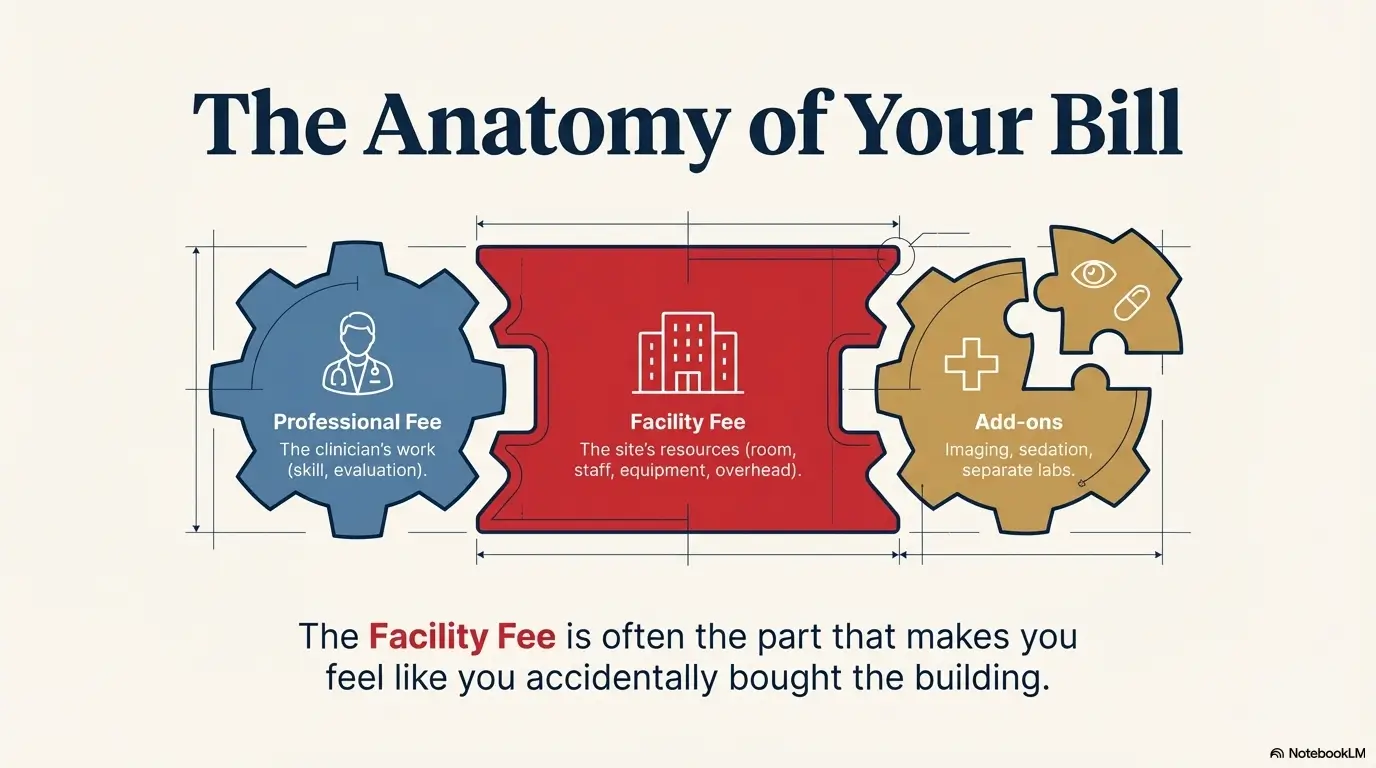
The “facility” part of your bill is the payment for the site: staff, equipment, recovery area, and the operational ecosystem that exists so a clinician can walk in and do the work. It can be reasonable. It can also be the part that makes you feel like you accidentally bought the building.
What “facility/technical fee” really means (plain English)
- Professional fee: the clinician’s work (evaluation, procedure skill, documentation).
- Facility/technical fee: the site’s resources (room, monitoring, supplies, nursing, overhead).
- Add-ons: imaging guidance, medications, sedation/anesthesia, pathology/labs (when applicable).
A small anecdote: the first time I asked, “Can you tell me the total?” the scheduler gave me one number. The billing office later gave me three. That wasn’t dishonesty. It was departmental math—each department seeing only its slice.
Why HOPD pricing trends higher than ASC for the same service (payment systems + overhead)
Hospitals often carry different cost structures and are paid under different frameworks than freestanding surgery centers. The American Medical Association has discussed how payment can vary across outpatient sites-of-service, and that variation is exactly what patients experience as “the same thing, wildly different bill.”
Curiosity gap: “If the injection is the same… where does the extra money go?”
Into the infrastructure: hospital compliance overhead, staffing models, facility operations, and sometimes simply higher contracted rates. The injection can be identical. The ledger is not.
Show me the nerdy details
On claims, the procedure can generate separate components: a professional claim (clinician) and a facility claim (site). Some services are packaged differently depending on whether the setting is HOPD, ASC, or an office-based suite. Even when the CPT looks similar, the site-of-service can influence how the payer adjudicates (allowed amounts, bundling, and patient cost-sharing).
Site-of-service decoding: HOPD vs ASC on the claim
Most patients never see the moment where the decision is locked in: a single field that says, in effect, “where this happened.”
That site choice changes how the claim is submitted, how the insurer reads it, and which buckets your out-of-pocket draws from.
Place-of-service + billing forms (why your EOB looks different)
Your Explanation of Benefits (EOB) is basically an insurance translator. It takes whatever the provider bills and converts it into what’s allowed, what the plan pays, and what you owe. When your care occurs in HOPD vs ASC, you may see different facility line items, different bundling, and different “patient responsibility” math—even when your symptoms, your doctor, and the injection itself didn’t change.
Coding breadcrumbs patients can ask for (CPT + modifiers + “where performed”)
You don’t need to be a coder. You just need three breadcrumbs that make everything else verifiable:
- The CPT code(s) for the injection and any imaging guidance.
- The place of service (HOPD vs ASC) and the facility name.
- Whether there are separate billing entities (anesthesia group, radiology, facility).
Personal note: I keep a tiny “billing notes” file on my phone with 3 fields—name, date, reference number. It feels overly cautious until it saves you 45 minutes later.
ASC-specific nuance you can use when sanity-checking bills
ASC billing often has its own packaging rules and modifier conventions. You don’t need to memorize them. You just need to know that ASCs and HOPDs can legitimately submit different claim structures for the same clinical act—which is why “compare the all-in episode” beats “compare one line item.”
Four-number estimate: the only math that matters
“What will it cost?” is a fair question. It’s also the question most offices can’t answer accurately unless you ask it the right way.
Instead of chasing a mythical single number, get four. These four are what turn uncertainty into a real decision.
Number #1: Allowed amount (not “charges”)
Charges are sticker price. Allowed amount is the negotiated reality between your plan and the provider/facility. Your out-of-pocket usually keys off the allowed amount, not the charge. If you get only one number, push for allowed.
Number #2: Deductible remaining (the month your cost flips)
If you’re early in the plan year, your deductible may be the silent driver. Later in the year, the same procedure can feel “cheaper” because you’ve already paid the deductible. No one is lying. Your timeline is doing math. If you’re on an HDHP and trying to forecast the “big ticket” tests that sometimes sit next to spine care, you may also want to compare your plan math with lumbar MRI cost on an HDHP so you’re not surprised by imaging on top of the injection episode.
Number #3: Coinsurance/copay (how 20% becomes huge)
A coinsurance percentage sounds small until it multiplies against a large allowed amount. This is how “only 20%” can become the most expensive sentence in your inbox.
Number #4: How many separate bills (and from whom)
Let’s be honest… this is the number people avoid because it complicates the script. Ask anyway:
“How many separate bills should I expect, and what are the names of the billing entities?”
- Allowed amount beats billed charges.
- Deductible timing can swing your out-of-pocket.
- Coinsurance multiplies fast at higher-cost sites.
Apply in 60 seconds: Text yourself: “Allowed + Deductible + Coinsurance + # of bills” before you call.
Estimate your out-of-pocket using the allowed amount, deductible remaining, and coinsurance rate. (This is a rough planning tool—not a guarantee.)
Enter numbers to calculate.
Neutral action: Use this estimate to decide which office to call next for a written breakdown.
Add-on ambush: imaging, anesthesia, and “unbundled” bills
The biggest emotional whiplash isn’t the price. It’s the feeling that you were billed by a committee.
Many procedures create multiple claims and multiple bills—especially when imaging guidance or anesthesia/sedation is involved. Even if the injection itself is straightforward, the billing ecosystem can be anything but.
Imaging guidance and documentation language (why it shows up as its own cost driver)
Epidural injections are often performed with imaging guidance (commonly fluoroscopy) to improve placement accuracy. That guidance can generate its own billed component or change how the facility packages charges. If you see imaging on the estimate, don’t panic—just make sure it’s included in the all-in math.
No Surprises Act, in plain terms: when you’re protected—and when consent can change things
Federal surprise-billing protections exist to reduce “gotcha” out-of-network bills in certain situations, especially when you reasonably chose an in-network facility. The important part is this: protections can be limited in some cases, and certain paperwork (notice-and-consent) can change how billing is handled. If someone asks you to sign something you don’t understand, pause. You’re not being difficult. You’re being financially literate.
Here’s what no one tells you… “In-network facility” doesn’t automatically mean “everyone is in-network”
The facility can be in-network while an anesthesia group or a radiology group is not. This is why you ask for the list of billing entities by name. It’s also why “one quote” is often a fairy tale—unless it explicitly includes everyone who will bill. If anesthesia is part of your plan (or even “maybe”), it helps to understand what tends to generate separate charges in procedural care—see how anesthesia billing often works in endoscopic discectomy for a practical frame of reference.
Quick lived-experience: I once asked, “Is this in-network?” and got a cheerful yes. Later I learned the question I should’ve asked was, “Is every billing entity in-network?” Same room. Different sentence. Different outcome.
- Ask for the list of billing entities (facility, clinician, anesthesia, imaging).
- Confirm network status for each name, not just the building.
- Get it in writing before you arrive.
Apply in 60 seconds: Add one line to your call notes: “Billing entities: ____.”
Price swing mystery: why two people pay $400 vs $4,000
Let’s address the question under the question: “Am I doing something wrong?”
Usually, no. Two people can receive essentially the same injection and pay radically different totals because pricing isn’t just medicine—it’s plan design, network contracts, and timing.
Plan design (HDHP vs copay plans) and timing effects
High-deductible plans can feel brutal early in the year and strangely “reasonable” later. Copay-style plans can feel predictable—until a facility fee changes the equation. The same event lands on different math depending on your policy’s structure.
Negotiated rates vary by site (and hospitals must post standard charges online)
Hospitals are required to publish pricing information in standardized formats. In the real world, those files are a starting point, not a final quote—but they can hint at whether an HOPD site runs “high” compared to other options. CMS maintains hospital price transparency guidance that explains what hospitals must post and how those files are structured.
Curiosity gap: “Why the same CPT can have wildly different ‘allowed amounts’ by location”
Because “allowed” is a negotiated number, and negotiation depends on market concentration, contracts, and site-of-service. Translation: your zip code can be a price tag.
Show me the nerdy details
In many insurance arrangements, reimbursement differs across outpatient settings because payment policies and contracting differ. That’s why comparing “charges” is misleading; the useful comparison is your insurer’s allowed amount and your cost-sharing rules in each setting.
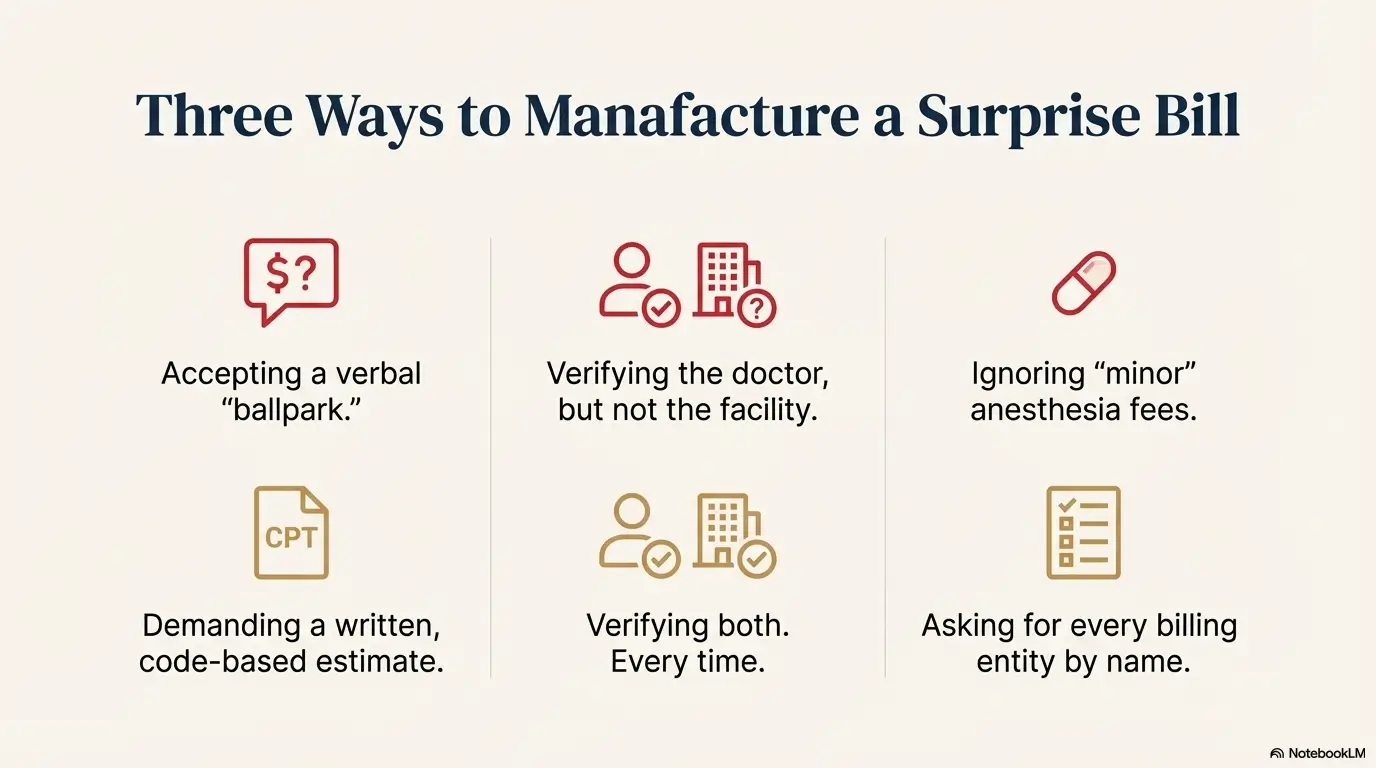
Common mistakes: the fastest ways to manufacture a surprise bill
Surprise bills aren’t always malicious. Often they’re the predictable result of predictable mistakes.
Here are three that show up again and again—because they’re the easiest to make when you’re busy, in pain, and just trying to get on with your day.
Mistake #1: accepting a “ballpark” instead of a written, code-based estimate
Ballparks are comforting. They’re also non-binding. If the estimate doesn’t list CPT code(s), place-of-service, and separate billing entities, it’s not an estimate—it’s a mood.
Mistake #2: verifying the doctor is in-network but skipping the facility (or vice versa)
You can be perfectly in-network with the clinician and still get hammered by a facility fee in a different network tier, or the reverse. Verify both. Every time.
Mistake #3: ignoring anesthesia/imaging because “it’s minor” (it isn’t, financially)
Even when sedation is light, the billing can be heavy. Don’t let “optional” language trick you into skipping the question.
Personal note: I once said, “Oh, we’re not doing anesthesia.” Later: “You had sedation.” The distinction matters clinically, but it can also matter to billing. Ask what will be billed, not what it’s called in conversation.
- Insurance member ID + group number
- Procedure name + body region (e.g., lumbar/cervical)
- Requested site (HOPD vs ASC) and facility name
- Deductible remaining + coinsurance % (from your insurer portal)
- A note field: “Billing entities (names) + reference numbers”
Neutral action: Use this list to get comparable estimates from two sites in the same day.
Don’t sign this: consent that erases your leverage
This section is the grown-up one. It’s also the one that saves people real money.
Sometimes, the most expensive thing you can do is sign quickly because you feel embarrassed to slow down the line.
“Notice & consent” in human language: when a signature can waive protections
You may be presented with forms that acknowledge out-of-network involvement or consent to being billed in a certain way. I’m not here to scare you; I’m here to give you a rule of thumb:
- If a form says you agree to out-of-network billing, ask why it’s necessary and whether an in-network option exists.
- If you don’t understand it, ask for a copy and time to review.
- If anyone pressures you, that’s your cue to pause—not to comply faster.
How to respond (polite, firm, effective)
“I’m not comfortable waiving protections or accepting out-of-network billing without a written estimate. Can you confirm the network status for every billing entity and re-issue the estimate?”
This is not rude. This is adult.
Curiosity gap: “Why pre-auth can be ‘approved’ and the price still isn’t real”
Prior authorization usually means the service meets plan criteria. It does not automatically mean you know the final allowed amount, the facility fee, or whether an out-of-network entity will be involved. Think of pre-auth as permission, not price.
- Pre-auth can confirm medical necessity while leaving cost unknown.
- Consent forms can change your billing outcome.
- Pause when the paperwork gets vague.
Apply in 60 seconds: Ask for a copy of every form before you sign—then take a photo.
Apples-to-apples compare: HOPD vs ASC vs office-based suite
If you only compare the facility fee, you’ll miss the plot. The plot is the total episode cost: professional + facility + add-ons.
Here’s the simplest comparison framework I know—the one I wish every busy patient had on a sticky note.
The comparison grid (what to request from each site)
| What to request | HOPD | ASC | Office-based suite |
|---|---|---|---|
| Written estimate with CPT + place-of-service | Must-have | Must-have | Must-have |
| List of billing entities (names) | Commonly multiple | Sometimes fewer | Often fewer, but confirm |
| Network verification for facility + each entity | Critical | Critical | Critical |
| All-in estimate (professional + facility + add-ons) | Ask directly | Ask directly | Ask directly |
Use hospital price transparency data as a starting point (then confirm your plan’s allowed amount)
CMS explains how hospital price transparency works and what hospitals must publish. In practice, those files can be messy—but they’re still useful as a “smoke alarm.” If the hospital’s published numbers look dramatically higher than an ASC quote, that’s a signal to request a written all-in estimate and confirm the allowed amount with your insurer.
Negotiation levers that don’t backfire (cash rate, prompt-pay, payment plan)
- Ask for the cash-pay rate (even if insured). Sometimes it’s a useful comparator—especially if you’re exploring self-pay TFESI cost scenarios where “cash” isn’t a preference, it’s the reality.
- Ask for a prompt-pay discount only after you have the written estimate.
- Request a payment plan if the timing of deductible makes the hit unavoidable.
Lived experience: I’ve had billing offices respond surprisingly well to calm, specific questions. Not emotional ones. Not vague ones. Specific ones.
- Choose ASC when: you can get a written all-in estimate, it’s in-network, and your clinician can perform it there safely.
- Choose HOPD when: your clinician recommends hospital-level backup for a clear reason, or the ASC can’t provide the necessary resources.
- Pause and re-check when: the estimate lacks billing entity names or you’re asked to sign unfamiliar consent for out-of-network billing.
Neutral action: Make the call that produces two estimates you can compare line-by-line.
When to seek help: medical red flags + billing escalation ladder
This is the part where we respect two realities at once: your health matters more than your bill, and your bill still matters enough to protect.
Medical: urgent symptoms that shouldn’t wait
- New or worsening weakness, numbness, trouble walking, or sudden severe pain.
- Fever, chills, or increasing redness/swelling at the injection site.
- Severe headache (especially if worse when upright) or headache with fever/neck stiffness.
- New bowel or bladder changes.
If any of these happen, call your clinician or seek urgent care promptly. No blog post is worth “waiting it out” on serious symptoms.
Billing: surprise bill triage (insurer → facility billing → clinician group → formal dispute)
- Start with your insurer: ask how the claim was processed and what the allowed amount was.
- Call the facility billing office: request an itemized statement and confirm the place-of-service.
- Call the clinician group: confirm what was billed and whether any entities were out-of-network.
- Escalate: ask about dispute options, internal appeals, and any applicable protections for surprise billing scenarios.
Keep-a-proof pack: reference numbers, names, dates, copies
My unglamorous habit: I write down 3 things every call—name, date/time, reference number. It’s not paranoid. It’s efficient. You’ll thank Past You.
Show me the nerdy details
Disputes often hinge on documentation: what you were told, what the written estimate stated, and how the claim was adjudicated. Keeping a clean timeline (calls, reference numbers, copies of estimates and notices) can reduce the back-and-forth dramatically.
FAQ
Is an epidural injection cheaper at an ASC than a hospital outpatient department?
It can be, often because the facility fee and contracted rates differ by site. But “cheaper” only counts if you compare the all-in episode cost: professional fee + facility fee + add-ons (imaging/anesthesia) and confirm network status for every billing entity. If you’re deciding between approaches, a practical comparison of TFESI vs interlaminar ESI for sciatica can also help you ask better “what exactly is being done” questions before you price-shop.
What is a facility fee, and can it be negotiated?
A facility fee is the site’s charge/allowed amount for providing the space, staff, monitoring, and operational infrastructure. Negotiation varies by provider and payer. The most realistic levers are requesting a cash-pay rate (as a comparator), asking for prompt-pay discounts when available, and setting a payment plan—after you have the written estimate.
Can I request the same injection at an ASC instead of HOPD?
Sometimes. It depends on clinician privileges, clinical appropriateness, and insurer authorization rules. Start by asking your clinician, “Is there a medical reason this must be done in HOPD?” Then ask billing whether the authorization is tied to a specific facility. If you’re still unsure what “type” of epidural you’re being scheduled for, use a simple explainer like transforaminal vs interlaminar epidural so your estimate is tied to the right procedure.
Why did I receive separate bills for the doctor, facility, anesthesia, and imaging?
Because multiple entities can legitimately bill for different components of care. The facility bills for the site and resources, the clinician bills for professional services, and separate groups may bill for imaging or anesthesia/sedation. A good estimate lists every billing entity by name.
Does prior authorization guarantee my final price?
No. Prior authorization typically confirms plan criteria for coverage. It does not guarantee the exact allowed amount, the facility fee impact, or whether an out-of-network entity will be involved. Treat pre-auth as permission, not a price quote.
How do I avoid out-of-network anesthesia bills at an in-network facility?
Ask for the anesthesia group’s name (if anesthesia/sedation is planned), then confirm that group’s network status with your insurer. If they won’t provide a name or say “it depends,” request a written estimate listing all billing entities and ask whether an in-network option is available.
Where can I find hospital “standard charges” online—and what are their limits?
Hospitals publish price transparency files, and CMS provides guidance on what must be posted. These files can be technical and may not reflect your insurer’s allowed amount. Use them as a starting signal—then confirm the allowed amount and your cost-sharing rules for your plan.
What documents should I keep if I need to dispute the bill?
Keep the written estimate, any notice-and-consent forms, itemized bills, your EOB, and call notes (names, dates, reference numbers). If you can keep everything in one folder (digital or paper), you’ll save time and reduce stress.
Next step: one call that prevents the “double bill”
If you do only one thing in the next 15 minutes, do this: make a call that produces a written estimate you can compare.
Call today: request a written estimate listing CPT codes + place of service + all billing entities
Here’s a script that works without sounding confrontational:
- “I’m comparing HOPD vs ASC. Can you email me a written estimate that includes CPT code(s), the facility name, the place-of-service, and the names of all billing entities?”
- “Can you tell me how many separate bills I should expect and from whom?”
- “Is there any anesthesia/imaging group involved, and are they in-network for my plan?”
Short lived-experience: the tone matters. Calm curiosity gets more detail than stressed urgency. I’ve tested it. (Sadly.)
Save-proof pack: what to screenshot, what to ask for by email, what to bring day-of
- Screenshot your insurer portal: deductible remaining + coinsurance.
- Ask billing to email the estimate and any notices you’re expected to sign.
- Bring the estimate (digital is fine) and your call reference numbers.
Conclusion: close the loop and move
So—why does your epidural bill “double” when nothing about the injection seems different?
Because you weren’t just buying a procedure. You were buying a site-of-service, and the site can bring a facility fee, different contracted rates, and extra billing entities along for the ride.
The open loop from the beginning—can you switch sites without restarting everything?—usually resolves once you ask for three breadcrumbs: CPT code(s), place-of-service, and a list of billing entities. With that, your insurer can confirm the allowed amount and whether authorization is facility-specific. You stop guessing. You start choosing.
Your next 15-minute win: make one call that produces a written, code-based estimate for HOPD and ASC. Compare the all-in episode cost. Then pick the safest option that you can actually afford—without surprises.
Last reviewed: 2025-12.
Short Story: I once watched someone I care about sit in a waiting room with that familiar mix of hope and dread—hope that pain relief might finally arrive, dread that the bill would be a second injury. We’d done “the right things,” or so we thought: confirmed the doctor, confirmed the appointment time, confirmed the word “covered.” Then the facility called with a simple question:
“Are you okay with outpatient hospital?” It sounded like a location preference. It wasn’t. We asked for the estimate in writing, and suddenly the story had chapters: professional fee, facility fee, imaging line, “potential separate anesthesia billing.” Nothing about the injection changed. Only our visibility did. We didn’t argue. We didn’t accuse. We just requested clarity. And that clarity turned a foggy yes into a decision we could actually live with.