

Turn Your Appointment into a Decision, Not Another Loop
A chronic pain appointment can turn surprisingly fast from “Let me explain what hurts” into a scavenger hunt for paperwork. Don’t let the “paperwork fog” shrink your visit.
Knowing what to bring to an orthopedic appointment is more than “tidy-patient theater”—it’s the difference between clarity and delay. When you guess or assume the records are already there, you risk repeated requests and missed patterns.
This guide helps you build a practical appointment packet:
- Medical Records & Imaging
- Medication & Allergy Details
- Pain Diary & Daily Function
- Insurance Basics & Questions
Table of Contents
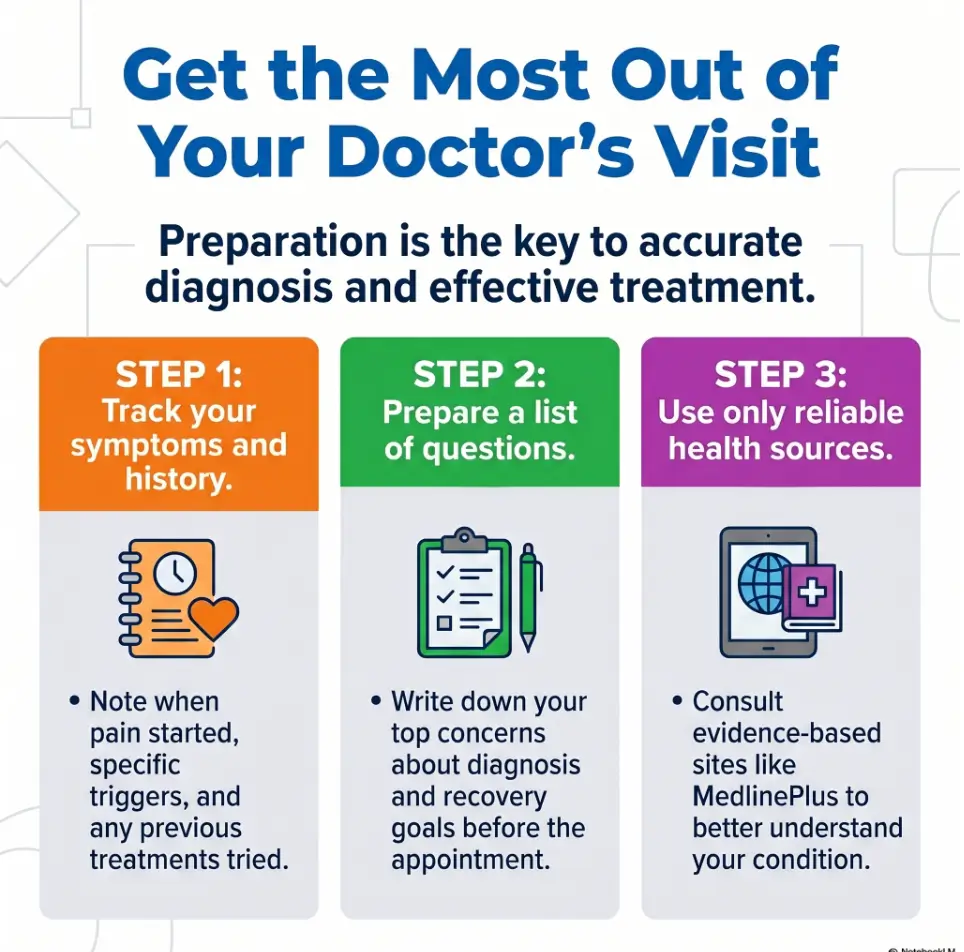
Safety and Disclaimer
This guide is for general educational use for adults in the United States preparing for an orthopedic appointment. It cannot diagnose your pain, choose treatment for you, or replace care from a licensed clinician who can examine you.
Chronic pain can come from joints, tendons, muscles, nerves, inflammation, old injuries, infection, autoimmune disease, spine problems, or causes that are not orthopedic at all. That is why the goal is not to “perform” your pain perfectly. The goal is to bring enough clear information so your clinician can evaluate you safely.
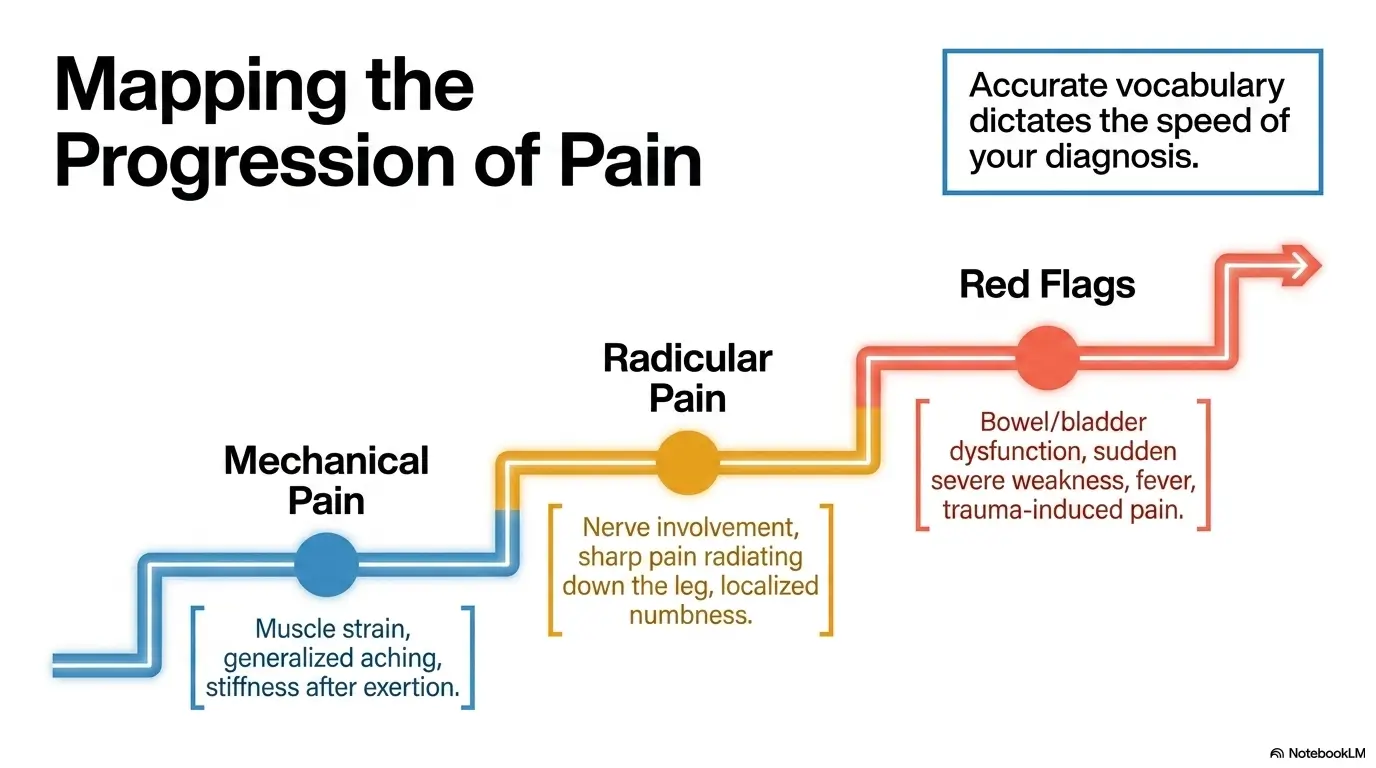
Do not wait for a routine appointment if you have severe or rapidly worsening symptoms, new weakness, loss of bladder or bowel control, numbness in the groin or saddle area, fever with severe back or joint pain, chest pain, shortness of breath, major trauma, or a hot swollen joint. Mayo Clinic patient guidance flags several of these as symptoms that may need prompt medical attention, especially when back pain comes with fever, weakness, numbness, weight loss, trauma, or bowel or bladder changes. If you are unsure whether the orthopedic office, urgent care, or the ER is the right door, a guide to urgent care vs. orthopedic clinic decisions can help you frame the next call more clearly.
- Use this guide for routine or semi-urgent orthopedic visits.
- Seek urgent help for neurologic, infectious, traumatic, or rapidly worsening symptoms.
- When in doubt, call the orthopedic office, primary care office, nurse line, or emergency services.
Apply in 60 seconds: Write “red flags first” at the top of your pain notes so you remember to mention any dangerous symptom immediately.
The Appointment Bag That Saves the Visit
The best appointment bag is not fancy. It is a calm little command center: ID, insurance card, records, imaging, medication list, questions, and the one-page pain summary you will build later in this guide.
I once watched someone pull thirty pages from a tote bag with the emotional confidence of a magician producing scarves. The problem was that every page looked equally important. The newest MRI report was hiding between a grocery receipt and a physical therapy handout from 2019. A tidy packet would have done more than a heroic paper avalanche.
The “front desk first” items
Start with the items that prevent administrative friction. The front desk may need these before the clinician ever sees you:
- Photo ID
- Insurance card
- Referral, if your plan requires one
- Prior authorization notice, if available
- Copay method
- Workers’ compensation or auto injury claim details, if relevant
- Current pharmacy name and phone number
These items are boring in the same way seatbelts are boring. You only respect them once they save the day.
The records your doctor actually needs
Bring relevant medical records, not your entire life archive unless the office asks for it. Orthopedic clinicians usually need records that explain what happened, what has been tried, and what risks matter.
- Prior orthopedic notes
- Primary care notes related to the pain
- Urgent care or ER discharge papers
- Operative reports from prior surgery
- Injection records
- Lab results related to inflammation, infection, arthritis, or surgery clearance
- Physical therapy evaluation and progress notes
Don’t bring a mystery folder
A thick folder is not automatically helpful. A well-labeled stack is. Put the newest records on top, separate imaging from reports, and keep your medication list visible. If you have ten minutes, use sticky notes. If you have two minutes, use paper clips. We are not building a museum. We are helping a doctor find the right clues fast.
- Put ID, insurance, and referral documents at the front.
- Group medical records by newest first.
- Keep imaging reports and actual images separate but easy to find.
Apply in 60 seconds: Write “newest first” on a sticky note and place it on your record packet.
Pain History: Turn Fog Into a Timeline
Chronic pain turns time into soup. One month becomes “a while,” last spring becomes “recently,” and the first flare hides somewhere behind a vacation, a move, or that one week when the stairs became personal enemies.
Your orthopedic clinician does not need a perfect autobiography. They need a timeline clear enough to spot patterns.
When it started, what changed, and what keeps returning
Write down the first date you remember, even if it is approximate. “March 2025 after lifting a suitcase” is better than “forever.” “Gradually worse over 18 months” is better than “bad for a long time.” For people whose symptoms blur between back, leg, hip, or nerve pain, reviewing how hip vs. spine pain can overlap may help you describe the pattern without forcing a diagnosis too early.
Include:
- When the pain began
- Whether it started suddenly or gradually
- Any injury, fall, surgery, new workout, or repetitive activity
- Whether symptoms are stable, improving, worsening, or cycling
- Previous diagnoses you were given
The 30-second pain snapshot
Before the visit, prepare a short snapshot. This is the part you can say even if the exam room makes your brain leave through a side door.
Example: “My right knee pain started about eight months ago. It is worse on stairs and after sitting. It feels sharp in the front of the knee, about 7 out of 10 during flares. Physical therapy helped a little, but I still cannot walk more than twenty minutes without swelling.”
That is not dramatic. That is useful.
Here’s what no one tells you…
Doctors often need patterns more than adjectives. Pain words matter, but pain behavior matters more. “Burning pain after 10 minutes of walking” can point in a different direction than “deep ache after lifting.” If the pain feels electric, radiating, burning, or strange after exercise, it may be useful to compare nerve pain vs. muscle soreness after physical therapy before you write your symptom notes.
Try describing pain through four lenses:
- Location: Where exactly is it?
- Quality: Sharp, dull, burning, tingling, deep, electric, cramping?
- Timing: Morning, night, after activity, at rest, during sleep?
- Function: What does it stop you from doing?
Show me the nerdy details
Clinicians often think in patterns. Mechanical pain may worsen with specific movements or loads. Nerve-related pain may burn, tingle, radiate, or come with numbness or weakness. Inflammatory pain may involve morning stiffness or swelling. These are not diagnoses by themselves, but they can help your clinician decide what to examine, what imaging or lab work may matter, and which treatments are reasonable to try first.
Imaging: The Disc, the Portal, and the Trap Door
Imaging has a trap door: many patients bring the report but not the actual images. The report is helpful. The images may be essential.
An MRI report might say “mild degenerative changes.” That phrase can feel either comforting or infuriating, depending on how much pain you are in. But the orthopedic clinician may want to inspect the images directly and compare them with your exam. Report plus symptoms plus physical findings is where the decision-making music begins.
Bring images, not only reports
If your X-ray, MRI, CT, or ultrasound was done outside the orthopedic office’s health system, bring the actual image files when possible. The American Academy of Orthopaedic Surgeons advises patients to bring relevant imaging studies, lab results, and medical records to appointments. Many orthopedic offices also specifically ask for CDs, image-share access, or digital copies when imaging was performed elsewhere.
Useful imaging items include:
- X-ray images and reports
- MRI images and reports
- CT images and reports
- Ultrasound reports
- Bone scan or nerve study reports, if relevant
- Image-share login or access instructions
Ask for the right format before the visit
Call the imaging center before appointment day. Ask what the orthopedic office prefers: CD, USB, portal sharing, cloud image link, or printed report. Some offices can import CDs. Some prefer digital transfer. Some have a portal that behaves beautifully. Others behave like a raccoon wearing a lab coat.
Neutral action line: Call both the imaging center and orthopedic office at least 2 business days before your appointment if outside imaging is involved.
The quiet mistake: assuming “they can see it”
Hospitals, private imaging centers, urgent care clinics, and orthopedic practices do not always share the same record system. Even when both use patient portals, access may not automatically cross over.
Do not assume “it’s in the computer.” That phrase has eaten many appointments. If your visit may depend on a scan, a practical primer on MRI referral for orthopedic pain can help you understand why records, symptoms, and prior treatment notes often travel together.
Medication List: Small Paper, Big Consequences
A medication list looks humble, but it can change treatment decisions. Orthopedic care may involve anti-inflammatory medicines, injections, surgery planning, blood thinner precautions, sedation planning, infection risk, or medication interactions. That tiny list is carrying a backpack full of consequences.
Bring a written list or a printed pharmacy list. A phone photo can work in a pinch, but a paper copy is easier to scan quickly.
Include prescriptions, OTC meds, supplements, and injections
Do not list only prescription medications. Include over-the-counter medicines and supplements too. AAOS medication safety guidance for orthopedic care emphasizes knowing current medications and dosages, including over-the-counter medicines and dietary supplements.
Your list should include:
- Medication or supplement name
- Dose
- How often you take it
- Why you take it
- Prescribing clinician, if known
- Whether it helps, does nothing, or causes side effects
Include injections too: steroid injections, gel injections, biologic injections, trigger point injections, nerve blocks, or pain clinic procedures. Dates matter. Approximate dates are still better than fog. If you are comparing options before an injection discussion, it may help to read about pain management before cortisone injection so your questions are less “Should I?” and more “What problem are we trying to solve?”
Allergies need symptoms, not just names
“Penicillin allergy” is a start. “Penicillin caused hives and throat swelling in 2018” is better. “Oxycodone made me nauseated” is not the same as a dangerous allergy, but it is still useful for planning.
List medication allergies and reactions like this:
- Medication: Penicillin
- Reaction: Hives and throat swelling
- Timing: 2018, after two doses
Let’s be honest… the bottle parade is clunky
If you cannot make a list in time, bring the bottles in a bag. Yes, it feels like arriving with a tiny pharmacy. Still better than guessing under fluorescent lights while a medical assistant asks, “How many milligrams?” and your mind produces only static.
| Item | What to write | Why it matters |
|---|---|---|
| Prescription medicine | Name, dose, frequency | Helps avoid interactions and duplicate therapy |
| OTC medicine | Ibuprofen, acetaminophen, naproxen, aspirin, creams | Affects safety planning and pain strategy |
| Supplements | Vitamins, fish oil, herbal products | Some may matter before procedures or surgery |
| Allergies | Drug name plus reaction | Separates side effects from dangerous reactions |
Neutral action line: Print a pharmacy medication list or write one page by hand before appointment day.
Treatment History: Show What Already Failed
When you have chronic pain, “I tried everything” is emotionally true. Clinically, it is too blurry. Your doctor needs to know what you tried, for how long, what helped, what failed, and what made things worse.
A failed treatment is not embarrassing. It is data. A side effect is not a confession. It is a safety clue.
Physical therapy notes and home exercise history
Physical therapy records can be very helpful, especially if your visit may involve imaging decisions, surgery discussion, work restrictions, or insurance authorization. Bring the evaluation, progress notes, discharge summary, and home exercise plan if you have them. If therapy has not helped the way you expected, a focused explanation of what to document when physical therapy is not helping orthopedic pain can make your history much more useful.
Write down:
- Start and end dates
- Number of sessions
- Exercises or focus areas
- What improved
- What worsened
- Why therapy stopped
I keep a healthy respect for the phrase “I did PT.” It can mean two visits, twelve weeks, or three heroic months of clamshell exercises while questioning one’s life choices on a yoga mat.
Injections, braces, medications, and alternative care
Bring details on steroid injections, gel injections, nerve blocks, pain clinic treatments, braces, orthotics, chiropractic care, acupuncture, massage, heat, ice, TENS units, and home routines. For knee symptoms, treatment notes may include bracing, exercise changes, injections, or practical tools such as a TENS unit for knee pain.
For each one, write: what, when, how long, result, and side effects. Even “helped for 3 weeks” matters. Temporary relief may still teach your clinician something.
The “I tried everything” problem
Replace “everything” with a grid. It does not need to look pretty. It needs to be readable.
| Treatment | When | How long | Result | Side effects |
|---|---|---|---|---|
| Physical therapy | Spring 2025 | 8 sessions | Improved flexibility, pain returned | None |
| Naproxen | June 2025 | 2 weeks | Helped swelling | Stomach upset |
| Steroid injection | August 2025 | Relief lasted 4 weeks | Pain returned gradually | Temporary flushing |
Neutral action line: Fill in at least three rows before your visit, even if the dates are approximate.
Function Evidence: Pain Is More Than a Number
Pain scores are useful, but they are not the whole language. “7 out of 10” tells your doctor intensity. “I cannot climb stairs, sleep through the night, or drive more than 20 minutes” tells your doctor impact.
Function is where pain leaves fingerprints.
Bring examples from real life
Prepare specific examples from daily life. The best examples are ordinary, concrete, and slightly annoying. Ordinary is not trivial. Ordinary is where disability often lives.
- Stairs
- Walking distance
- Driving
- Sitting at work
- Lifting groceries
- Kneeling
- Dressing
- Bathing
- Cooking
- Childcare
- Sleep
- Hobbies
For example: “I can walk two blocks before leg pain starts.” “I wake at 3 a.m. most nights.” “I avoid lifting my toddler.” These are not complaints. They are clinical coordinates. If walking, stairs, or support devices are part of your daily reality, an article on walker pain management for seniors can also help you describe what equipment helps, what irritates symptoms, and what still feels unsafe.
Use a two-week symptom diary
A two-week diary is enough for many routine visits. You do not need a leather-bound pain memoir with watercolor margins. A simple note on your phone works.
Track:
- Pain level in the morning and evening
- Activity before a flare
- Medication used
- Sleep quality
- Numbness, weakness, swelling, stiffness, or instability
- Next-day effect
The detail that changes the conversation
“Pain is 7 out of 10” is useful. “Pain is 7 out of 10 after two blocks and wakes me around 3 a.m. three nights a week” is harder to miss. It gives the doctor severity, trigger, frequency, and function in one sentence. For people with hip pain that gets louder at night, a guide to hip pain at night may help turn vague sleep complaints into clearer examples.
One-Page Pain Packet: The 5-Box Map
Start date, trigger, worsening pattern.
Location, quality, severity, nerve signs.
Walking, stairs, sleep, work, daily tasks.
PT, injections, medications, braces, results.
Top 3 decisions you need help making.
Who This Is For / Not For
This guide is for people preparing for a routine or semi-urgent orthopedic visit. It is not for symptoms that need emergency evaluation. That line matters because chronic pain can become familiar enough to trick you. Familiar pain is not always safe pain.
This is for routine or semi-urgent orthopedic visits
This checklist can help if you are seeing orthopedics for:
- Chronic knee pain
- Hip pain
- Back or neck pain
- Shoulder pain
- Arthritis symptoms
- Old injuries that keep flaring
- Tendon pain
- Limited range of motion
- Pain that has not improved with basic care
It also helps if you are seeking a second opinion, discussing possible surgery, trying to understand imaging, or asking whether physical therapy, injections, bracing, or other next steps make sense. If you are specifically weighing whether another opinion is available after delays or insurance pushback, review what to do after being denied a second opinion for orthopedic pain.
This is not for emergency symptoms
Do not wait for a standard orthopedic appointment for chest pain, sudden paralysis, new loss of bladder or bowel control, fever with severe back or joint pain, major trauma, a hot swollen joint, or rapidly worsening weakness. These symptoms may need urgent or emergency evaluation.
When the appointment may need a different specialist
Orthopedics is often the right door for bones, joints, muscles, tendons, ligaments, and many spine concerns. But sometimes the best next step may involve another clinician.
| Symptom pattern | Possible next step to ask about | Why |
|---|---|---|
| Multiple swollen joints, long morning stiffness | Rheumatology | May involve inflammatory or autoimmune causes |
| Burning, tingling, radiating pain with numbness | Neurology, spine care, or pain management | Nerve involvement may need targeted evaluation |
| Foot or ankle pain with footwear issues | Podiatry or foot and ankle orthopedics | Specialized mechanics and orthotic planning may help |
| Severe symptoms after trauma | Emergency care | Fracture, bleeding, neurologic injury, or infection must be ruled out |
Neutral action line: Ask, “Is orthopedics the right specialty for this pattern, or should another specialist be involved?”
Insurance, Referrals, and Paperwork: The Boring Stuff That Bites
Insurance paperwork is the beige carpet of American healthcare: nobody admires it, but you notice fast when it trips you.
Before your appointment, check whether your plan requires a referral, prior authorization, network confirmation, or special rules for imaging and injections. This is especially important for HMO plans, marketplace plans, Medicare Advantage plans, workers’ compensation claims, and auto injury cases. For plan-specific friction, a guide to Medicare Advantage orthopedic care can help you prepare better questions before the front desk becomes the plot twist.
Check referral rules before you go
Call your insurance plan or check your member portal. Then call the orthopedic office to confirm they have what they need. “My primary care doctor sent it” is useful, but “the office confirmed they received it” is better.
Ask:
- Do I need a referral?
- Is this orthopedic doctor in network?
- Do I need prior authorization for the visit?
- Are imaging, injections, or braces handled separately?
- Do I need claim information for workers’ comp or auto injury?
Bring work, school, and disability forms carefully
If you need work restrictions, school accommodations, FMLA paperwork, disability forms, or return-to-work letters, bring them. But do not assume complex forms will be completed at the first visit while you wait. For injury claims, the details matter even more, especially when your records may affect workers’ comp settlement documentation.
Many offices need time to review records, complete an exam, follow office policy, and verify what they can honestly document. Some charge form fees. Some require separate appointments. Some require the patient section to be completed first.
Don’t hand over forms at checkout and vanish
Ask these four questions before leaving:
- Who completes this form?
- How long does it usually take?
- Is there a fee?
- Do you need records from another office first?
A form is not just paperwork. It can affect pay, leave, school access, job duties, and legal deadlines. Treat it like a small, bureaucratic dragon. Respectful, but watched closely.
- Confirm referrals before the visit.
- Bring claim details for workers’ comp or auto injury.
- Ask about form processing time before you leave.
Apply in 60 seconds: Add “referral confirmed?” and “forms policy?” to your top-three question list.
Questions to Ask Before Treatment Gets Real
When chronic pain has drained your patience, it is tempting to ask only one question: “Can you make this stop?” That question is human. It is also too large for a short visit.
Bring a short question list that helps you understand diagnosis, options, risks, cost, timing, and next steps.
Diagnosis questions
- What are the most likely causes of my pain?
- What findings support that diagnosis?
- What else needs to be ruled out?
- Could my symptoms involve nerves, inflammation, or another non-orthopedic cause?
- What would make you change your mind about the diagnosis?
Imaging and test questions
- Do I need imaging now?
- What would the result change?
- Are there lower-cost or lower-risk options first?
- Should we compare old and new imaging?
- Do I need lab work or nerve testing?
Medication and opioid-safety questions
Ask about non-opioid options, side effects, interactions, and how long to try a treatment before reassessing. AAOS patient education includes pain-control and opioid-alternative questions among topics patients may discuss before orthopedic surgery. Even if you are not having surgery, the same spirit applies: ask what the medicine is meant to do, how to use it safely, and when to stop or follow up. For broader planning, you may want to compare your visit questions with orthopedic pain management options before the conversation turns into a blur of acronyms.
- What are the non-opioid options?
- What side effects matter for my medical history?
- Can I take this with my current medications?
- How long should I try it before reassessing?
- What should I do if it does not help?
Short Story: The Three Questions on the Back of an Envelope
A friend once went to a shoulder appointment with a folder, an MRI disc, and the anxious glow of someone who had read twelve forum threads after midnight. In the waiting room, she realized she had no actual questions. So she wrote three on the back of an envelope: “What is causing this?” “What can I try before surgery?” “What would make this urgent?” The visit changed.
She still did not get a magical answer, because bodies are not vending machines. But she left with a plan: two more weeks of targeted therapy, a medication adjustment, and a follow-up if weakness appeared. The envelope looked ridiculous. The questions were excellent. Sometimes the most useful medical tool is not high-tech. It is a pen, a quiet minute, and the courage to ask what decision comes next.
Common Mistakes That Make Chronic Pain Visits Harder
Most appointment mistakes are not character flaws. They happen because pain steals sleep, attention, patience, and sometimes your ability to remember whether the MRI was in February or “during that weird month when the car also needed tires.”
Still, a few mistakes can make a chronic pain visit harder than it needs to be.
Mistake 1: Arriving with no timeline
Scattered memories can make a 15-minute visit feel like a courtroom drama staged inside a shoebox. Bring a timeline. Even five bullet points help.
Mistake 2: Hiding treatments that did not work
Some people worry that failed treatments make them sound difficult. They do not. They make the next decision smarter. Tell the clinician what failed, what helped briefly, what caused side effects, and what you could not afford or tolerate.
Mistake 3: Describing pain only emotionally
Pain is emotional. Of course it is. But the care plan also needs location, pattern, function, nerve signs, swelling, stiffness, and risk clues. Try pairing emotion with function: “I am exhausted because the pain wakes me four nights a week.” If medical searching has made you more anxious than informed, you may also recognize the spiral described in cyberchondria and chronic pain.
Mistake 4: Forgetting the actual images
A printed MRI report may not be enough when the specialist needs to inspect the scan. If outside imaging matters, bring the disc, share link, or access instructions. This is especially important when symptoms and scans do not line up neatly, a frustrating issue often called an MRI pain mismatch.
- Use dates instead of “forever.”
- Use function limits instead of only pain scores.
- Use treatment results instead of “nothing worked.”
Apply in 60 seconds: Replace one vague phrase in your notes with a measurable detail.
When to Seek Help Before the Appointment
Chronic pain can teach endurance. That is not always a gift. Sometimes the right move is not to endure longer, but to get help sooner.
This section is the safety net. Read it even if you are mostly here for the checklist.
Go urgently for red-flag symptoms
Seek urgent medical care or emergency care for symptoms such as:
- New or rapidly worsening weakness
- Numbness in the groin or saddle area
- New loss of bladder or bowel control
- Fever with severe spine or joint pain
- Unexplained weight loss with persistent pain
- Severe pain after trauma, fall, or accident
- Chest pain or shortness of breath
- A hot, swollen, very painful joint
- New inability to bear weight
Mayo Clinic patient education notes that back pain with new bowel or bladder problems, fever, weakness, numbness, trauma, or other concerning symptoms can need prompt evaluation. For a hot swollen joint, clinicians often worry about infection or inflammatory causes that should not be parked on the calendar like a dentist cleaning. If low back symptoms include alarming neurologic changes, review the warning signs in low back pain emergency guidance and seek timely care.
Call the orthopedic office for fast triage
Call the office if you have worsening post-surgical pain, new swelling, possible infection signs, medication reactions, sudden symptom changes, or new inability to use the limb. The office may tell you to come sooner, go to urgent care, contact your surgeon, or go to the emergency department.
The rule of thumb
If the symptom feels dangerous, rapidly worsening, infectious, or neurologic, do not “save it” for the appointment. Pain preparation is useful. Delay can be costly.
The Visit-Day Script: What to Say First
The first minute matters. Not because you need to impress anyone, but because a clear opening helps the visit find its tracks. Chronic pain stories can sprawl. A good first sentence gives the clinician a map.
Open with the decision you need
Try one of these:
- “I need to understand what is causing this and what my next step should be.”
- “I want to know whether this needs imaging, therapy, medication changes, or another referral.”
- “I am worried because my function has changed, especially with walking and sleep.”
- “I need help deciding whether surgery is on the table or whether we still have reasonable non-surgical options.”
Give the short version before the long story
Use this structure:
“My pain is in one location. It has been going on for this long. It gets worse when this happens. It stops me from these activities. I have already tried these treatments. My biggest concern is this.”
This does not erase your full story. It simply opens the door cleanly.
Pattern interrupt: Start with what you can’t do
For chronic pain, “I can’t sleep through the night or climb stairs” may orient the visit faster than a full biography. Function tells the doctor what the pain is costing you. If the main issue is stairs, your notes may also benefit from reading about hinged knee braces for stairs or other supports you have tried, tolerated, or avoided.
Next Step: Build the One-Page Pain Packet
Here is the practical landing strip for everything above: build a one-page pain packet. Not a novel. Not a legal brief. One page that helps your appointment begin with clarity.
The 15-minute action
Create five boxes on one page:
- Pain timeline: start date, trigger, worsening pattern, previous diagnosis
- Current symptoms: location, quality, severity, numbness, weakness, swelling, stiffness
- Medications and allergies: name, dose, frequency, reaction details
- Treatments tried: PT, injections, braces, medications, home care, results
- Top three questions: diagnosis, next step, urgent warning signs
Put images and paperwork behind it
After the one-page summary, add imaging discs or image-share instructions, printed imaging reports, physical therapy notes, surgery records, insurance card, referral, and forms. The one-page summary goes on top because it tells the reader what the stack means.
End with the question that matters
Write this at the bottom of the page:
“What decision are we trying to make today?”
That question closes the loop from the first sentence of this article. You are not walking into the room with a bag of pain and hoping someone can untangle it. You are bringing a map. If your biggest concern is cost, coverage, or how much to do before a deductible is met, it may help to read about orthopedic pain management with a high deductible before you ask about imaging, injections, or therapy plans.

FAQ
What should I bring to my first orthopedic appointment for chronic pain?
Bring photo ID, insurance card, referral if needed, medication list, allergy list, prior imaging, test results, medical records, physical therapy notes, symptom diary, written questions, and any work, school, or disability forms. If the pain involves prior surgery, also bring operative notes and post-surgical records if available.
Should I bring MRI or X-ray images if I already have the report?
Yes. The written report is helpful, but the orthopedic clinician may need the actual images to compare the findings with your symptoms and physical exam. If the imaging was done outside the current health system, ask the imaging center about a CD, USB, portal share, or digital image link before the visit. If your X-ray looks normal but pain continues, it may also help to understand why a normal X-ray does not always explain ongoing pain.
Do I need a pain diary before seeing an orthopedic doctor?
It is not always required, but it can help. A two-week diary can show pain triggers, sleep disruption, medication response, swelling, weakness, numbness, and functional limits. Keep it simple: date, activity, pain level, symptoms, medication used, and next-day effect.
Can I bring someone with me to the appointment?
Yes, if the office allows it. A support person can help remember instructions, describe changes they have noticed, take notes, and ask follow-up questions. This can be especially useful if you are discussing surgery, injections, disability paperwork, or complex treatment choices.
What questions should I ask about chronic pain treatment?
Ask what diagnosis is most likely, what else needs to be ruled out, whether imaging or tests are needed, what non-surgical options exist, what medication side effects matter, when to follow up, and what symptoms should prompt urgent care. Also ask what decision the visit is meant to make.
Should I bring disability or work restriction forms?
Yes, bring them, but do not assume they will be completed during the first visit. Many offices need an exam, records, office policy review, and processing time. Ask who completes the forms, whether there is a fee, and how long the process usually takes.
What should I not do before an orthopedic appointment?
Do not guess medication doses, rely only on memory, hide previous treatments, assume imaging transferred automatically, or wait on emergency symptoms. Also avoid burying the most important concern at the end of the visit. Say the biggest function problem early.
Will the orthopedic doctor prescribe pain medicine at the first visit?
Maybe, but not always. The plan may include imaging, physical therapy, anti-inflammatory strategies, injections, bracing, medication review, specialist referral, or surgery discussion depending on your diagnosis and safety factors. Ask what each option is meant to improve and when to reassess.
Conclusion
The appointment bag that saves the visit is not about being the perfect patient. It is about protecting your time, your memory, and your chance at a useful next step.
Bring the front desk items. Bring the actual imaging when possible. Bring medication and allergy details. Bring your treatment history without shame. Most of all, bring the story of how pain changes your daily life: stairs, sleep, walking, work, driving, lifting, dressing, caring for people you love. For older adults or caregivers, a broader guide to senior orthopedic pain management can help connect the appointment plan with safer daily routines at home.
In the next 15 minutes, make the one-page pain packet: timeline, symptoms, medications, treatments tried, and top three questions. Put it on top of your records. Then write one final sentence at the bottom: “What decision are we trying to make today?”
That question is small. It can steer the whole room.
Last reviewed: 2026-05
Tags: orthopedic appointment, chronic pain checklist, pain diary, medical records, orthopedic visit preparation
Meta description: What to bring to an orthopedic appointment for chronic pain, including imaging, records, medications, questions, and red flags.