

Day 3 is when a lot of people declare their procedure “failed”—and it’s often the noisiest, least trustworthy moment on the whole timeline.
If you’re searching lumbar medial branch RFA duration, you’re not craving inspiration. You’re trying to plan your life: when relief should show up, how long it might last, and what actually changes the odds—especially when your back pain flares with standing, arching, or twisting.
Keep guessing and you risk two expensive losses: a procedure aimed at the wrong pain generator, or months of relief wasted because you never used the “good window” to rebuild capacity.
Lumbar medial branch radiofrequency ablation is a targeted heat treatment that interrupts pain signals from the medial branch nerves that serve the facet joints. Relief is often measured in months (commonly cited around 6–12), but durability hinges on diagnosis fit, the quality of your medial branch blocks, and a realistic recovery timeline.
Clear checkpoints.
Calm troubleshooting.
Here’s how to tell soreness from failure.
How “wearing off” usually returns.
And the questions that keep your next step honest.
- Think in timelines: procedure day ≠ relief day ≠ “wear off” day.
- Block quality matters more than hype or MRI wording.
- Plan now for the “good window” so relief lasts longer in real life.
Apply in 60 seconds: Write down your top 3 pain triggers (e.g., extension, standing, twisting) before you scroll further.
Table of Contents
Duration first: how long lumbar medial branch RFA lasts in real life
The phrase you’ll hear most often is “months of relief,” and in many clinics you’ll also hear the same shorthand: often around 6–12 months. Cleveland Clinic, for example, describes RFA pain relief that can last in that general range for many people. That’s the headline—but the real value is understanding the shape of the timeline so you don’t get spooked by normal bumps.
- Procedure day: the “work” happens.
- Early days: soreness or a flare can show up (annoying, not always meaningful).
- Weeks 1–4: many people start feeling the true effect somewhere in this window.
- Months later: pain may stay down—or gradually creep back as nerves recover.
A quick story from the trenches: a reader once told me their RFA “failed” because day 3 hurt more than day 0. By week 3, they were walking longer and standing in the kitchen without bracing like a sailor in a storm. Same procedure, different interpretation. The calendar matters.
- Relief often shows up on a delay.
- “Wearing off” is usually gradual, not a cliff.
- Track function (walking/standing tolerance), not just pain score.
Apply in 60 seconds: Pick one function metric (minutes you can stand, steps you can walk) to track weekly.
Typical window: 6–12 months (why it’s common, not guaranteed)
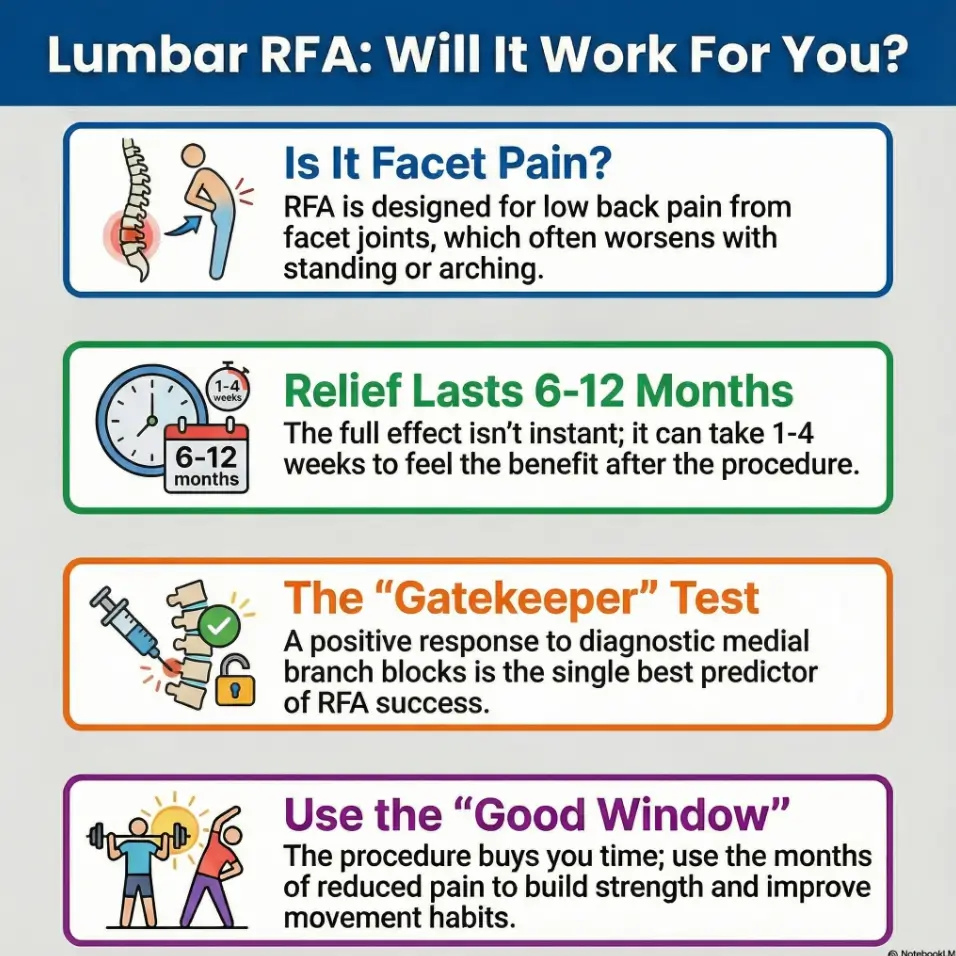
If you need the honest version: RFA isn’t a “forever” fix. It aims to interrupt pain signaling from the facet joints by targeting the medial branch nerves. Over time, nerves can recover function—so relief can fade.
But “not forever” doesn’t mean “not worth it.” For time-poor people, months of better sleep, easier movement, and fewer bad days can be a big deal— especially if you use that time to rebuild strength and habits (we’ll get there).
Timeline split: procedure length vs time-to-relief vs time-to-wear-off
One reason competitor pages feel frustrating is they blur three different clocks into one sentence. Here’s the clean split:
| Clock | What it answers | What you’ll likely notice |
|---|---|---|
| Procedure time | “How long am I at the clinic?” | Check-in + setup + procedure + short recovery period. |
| Time-to-relief | “When will I feel the real effect?” | Often measured in days to weeks, not hours. |
| Duration of relief | “How long will it last?” | Often months; sometimes longer, sometimes shorter. |
Curiosity gap: the one detail that predicts durability better than optimism
The big predictor isn’t your pain rating on a random Tuesday. It’s whether the facet joints were truly the pain generator— and the strongest practical clue is the quality of your diagnostic medial branch blocks. Not just “I felt something,” but a clean, meaningful, reproducible response. We’ll unpack that next.

Facet-fit check: who lumbar medial branch RFA is for (and who it isn’t)
Before we talk “how long,” we should talk “should.” Lumbar medial branch RFA is designed for facet-mediated low back pain—pain arising from the small joints that guide motion between vertebrae. If your pain is mostly from something else, RFA can feel like buying a key for the wrong lock.
This doesn’t diagnose you. It helps you decide whether it’s worth a deeper conversation.
- Yes if your pain is mostly in the low back (not primarily below the knee).
- Yes if extension/standing often aggravates it (some people call it “the sink pain”).
- Yes if imaging mentions facet arthropathy and your story fits.
- No / cautious if you have progressive leg weakness, bowel/bladder changes, fever, or major trauma.
- No / cautious if pain is dominantly nerve-like shooting down the leg (another generator may dominate).
Neutral next action: If you checked 2+ “Yes,” ask your clinician whether medial branch blocks are appropriate to confirm the source.
Who this is for: patterns that often match facet-joint pain
- Back pain that feels mechanical: worsens with certain positions or prolonged standing.
- Pain that stays mostly in the back or buttock, not a dominant “electric” leg pain pattern.
- Repeated “it’s worse when I arch” descriptions (extension can load the facets).
Who this is not for: signs another pain generator is driving the story
- New, progressive neurologic symptoms (weakness, major numbness changes).
- Pain with systemic red flags (fever, unexplained weight loss, history of cancer, night pain that doesn’t let up).
- A classic sciatica-dominant pattern where leg pain is the main event.
Edge cases: prior surgery, scoliosis, older adults, mixed diagnoses
Real life is messy. Many people have more than one contributor (facet + disc + SI joint irritation). That doesn’t automatically disqualify you—but it does mean you’ll want a clinician who treats the decision like a map, not a coin flip. I’ve watched people do better when the plan is “confirm, then target,” rather than “try everything fast.”
Block logic: why medial branch blocks decide whether RFA is worth it
If you remember one sentence from this entire article, let it be this: Medial branch blocks are the gatekeeper. They’re used because facet pain can masquerade as other back pain—and because “facet arthropathy” on an MRI can exist even when it’s not the main pain driver.
What blocks can prove (and what they can’t)
A medial branch block is a diagnostic step: numbing the nerve supply to the facet joint to see if pain drops in a meaningful way. It’s not a permanent treatment. It’s a test.
Show me the nerdy details
In plain terms, the goal is diagnostic specificity. A clean, time-linked pain reduction after targeted anesthetic supports “facet-mediated” pain. A messy response (small change, unclear timing, too many new variables) makes interpretation harder and can reduce confidence in RFA as the next step.
Here’s what no one tells you… blocks can flatter the story
Blocks can temporarily make you feel better for reasons that have nothing to do with long-term success: reduced guarding, a calmer nervous system, even the relief of “finally doing something.” That’s not shameful—it’s human. It just means you should treat the block result like data, not destiny.
Curiosity gap: “How much relief counts?” (and how clinicians think about it)
Different practices use different thresholds and protocols. Instead of chasing a single magic number online, ask a more useful question: “How confident are we that my facets are the primary generator—and what’s that confidence based on?” That one sentence invites a clinician to explain the logic, not just the sales pitch.
Procedure day: what lumbar medial branch RFA actually looks like
Competitor pages often say “quick procedure,” and that may be true in the technical sense. But the lived experience is more like: arrive, settle, get positioned, procedure, then a short monitoring period. MedlinePlus (a National Library of Medicine resource) describes RFA for chronic pain as being performed with imaging guidance and notes the visit can take a meaningful block of time—so plan your day accordingly.
Positioning + imaging guidance: how needles find the right spot
You’ll typically be positioned so the clinician can access the lumbar region, and imaging guidance helps place the needle where it needs to go. This is one reason you want an experienced pain practice: precision matters more than bravado.
Comfort plan: local anesthetic, possible sedation, and expectations
Many clinics focus on comfort: numbing at the skin and deeper tissues, sometimes light sedation depending on your case and facility protocol. A small but real operator tip: ask what you’ll feel when they test position (pressure? warmth?) so you’re not startled and tensing mid-procedure.
Quick clarity: “How many levels are we treating?” (and why it matters)
This is a high-yield question because it impacts procedure complexity and what “success” looks like. If you treat one level but your pain generator spans multiple joints, your outcome may be incomplete.
Pain question: does lumbar RFA hurt during or after?
The internet loves extremes: “It’s painless!” vs “It’s unbearable!” The more honest answer is: most people feel manageable discomfort, and the experience is strongly influenced by anxiety, positioning tolerance, and how your body reacts to needles. West Texas Pain Institute frames the topic around comfort measures during the procedure and support through recovery—an approach I generally like, because it acknowledges your nervous system is part of the room.
During: what “numbing + positioning” usually feels like
- Pinch/burn with numbing at the skin.
- Pressure as the needle is positioned.
- Occasional “weird but not dangerous” sensations when they confirm placement.
After: soreness, flare, and the sunburn-like description you’ll hear
Many people report localized tenderness or a sore, “bruised” feeling for a bit. This is exactly why you shouldn’t declare failure at day 2. I once watched someone “prove” it didn’t work by doing an aggressive garage clean-out on day 1—then blaming the procedure for the predictable consequences. (I say that with love. We all do chaotic things when we’re desperate to feel normal.)
Let’s be honest… you might over-test your back in the first 48 hours
The itch to test is real: “Can I bend now? Can I stand now? Can I twist now?” Try to treat the first couple days as a quiet runway, not a performance audition.
Recovery timeline: day 0 to week 4 (when to judge the result)
This is where people waste the most emotional energy: interpreting noise as signal. The early period can be confusing because soreness can mask benefit, and benefit can show up gradually. Access Pain Solutions discusses the “how long does it take to work” question in a way that aligns with the reality that response may take time—so give your body a fair window before you judge.
Days 0–2: rest rules, driving, and what to avoid
- Plan a lighter day than you think you need.
- Avoid testing heavy extension or twisting “just to see.”
- If you had sedation, follow clinic guidance about driving and decision-making.
Enter your procedure date to generate two check-in points. This is not medical advice—just a planning tool for your calendar.
Output: —
Neutral next action: Put those dates on your calendar and track one function metric weekly.
Days 10–14: when many start noticing improvement
This is a common “first real signal” window. Not everyone feels it here, but many do. If you’re getting small wins—standing a little longer, fewer “catch” moments—count that as progress.
Weeks 2–4: why some benefits show up late
Your body isn’t a light switch. There’s inflammation, muscle guarding, and the simple fact that fear changes movement. When pain drops, you often move differently—then the second wave of improvement shows up.
Fade explained: why relief wears off (and what “regrowth” feels like)
“Does the nerve grow back?” is one of the most common questions in this space. Many reputable medical sources explain RFA as creating a lesion that interrupts pain signaling, and that effects can diminish over time as nerve function recovers. This is why repeat procedures are sometimes considered when the first one was clearly helpful.
Nerve regrowth: why 6–12 months is a common return point
The simple model: the treated nerve pathway gradually recovers, and pain signaling can return. The more nuanced model: your spine biomechanics, muscle endurance, and day-to-day loading determine how “loud” that returning signal becomes.
Curiosity gap: when “same pain” returning means a different diagnosis
If pain returns but feels sharper, travels differently, or comes with new neurologic symptoms, don’t assume it’s “just regrowth.” Sometimes the original facet pain quieted enough for another contributor to become noticeable. That’s not failure—it’s a clearer map.
Repeat RFA basics: when it’s considered and what changes the plan
Repeat RFA is typically discussed when the first procedure produced meaningful relief and function gains, then pain returns later. A “repeat plan” should still include re-checking diagnosis fit and reviewing what was treated (levels/coverage).
Common mistakes: 7 ways people accidentally shorten relief
This section is not here to scold you. It’s here to protect you. When people tell me RFA “didn’t last,” the culprit is often a handful of predictable patterns—most of them totally fixable.
- Mistake 1: Treating the wrong generator because the MRI used the word “facet.”
- Mistake 2: Ignoring the block data and moving forward on vibes.
- Mistake 3: Measuring success only by pain score, not function.
- Mistake 4: Returning to the exact extension/twist habits that loaded the joints.
- Mistake 5: Changing too many variables at once (new meds + new PT + new workouts).
- Mistake 6: Over-testing early, under-building later.
- Mistake 7: Skipping the “good window” plan—then losing months you could have banked.
- Use block results like data, not decoration.
- Build capacity while pain is quieter.
- Track triggers so you don’t unknowingly re-load the facets.
Apply in 60 seconds: Write one “too much too soon” rule for yourself (e.g., “No heavy lifting in week 1”).
Make it last: what to do during the “good window”
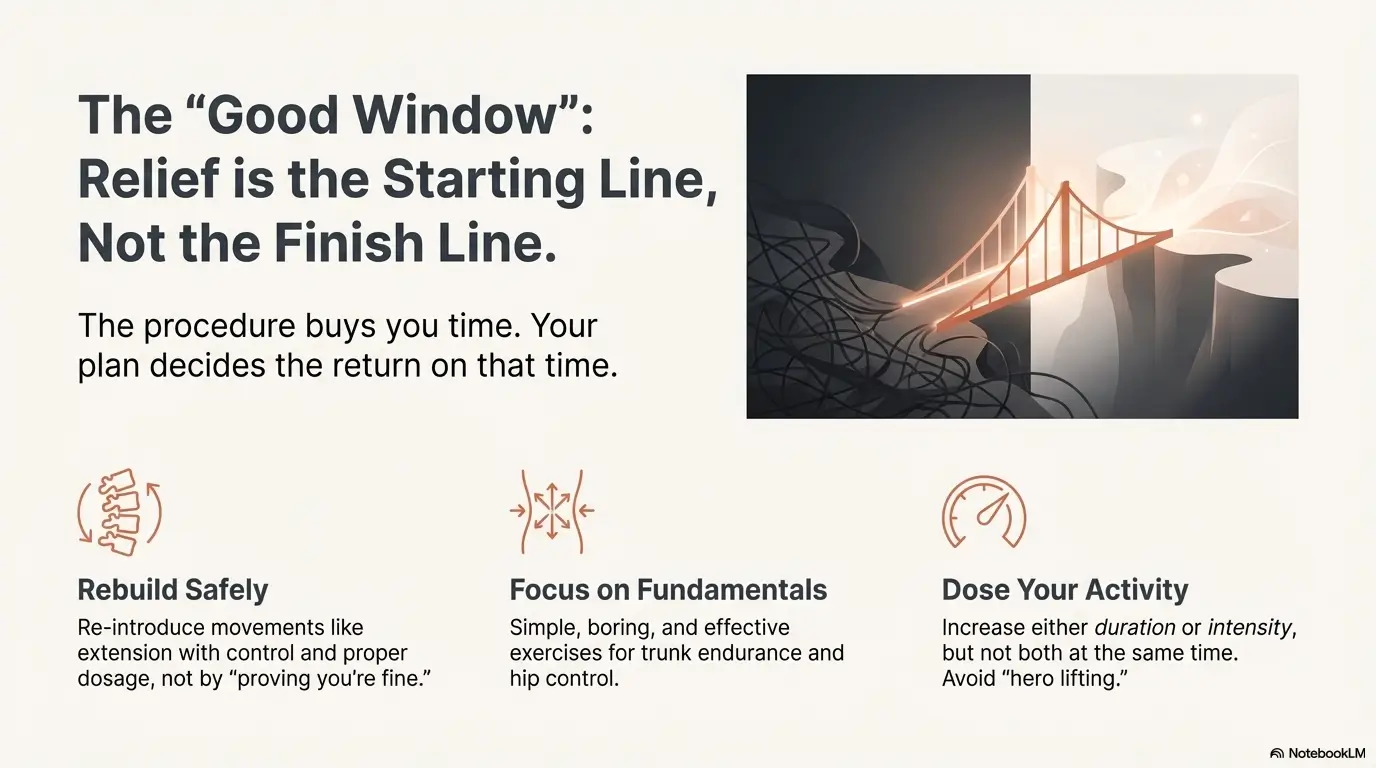
Here’s the conversion-conscious truth: the procedure may buy you time, but your plan decides the return on that time. If you do nothing different, you’ll often end up right back in the same mechanical loop that irritated the joints in the first place.
Do this while it’s working: rebuild extension tolerance safely
Many facet patterns worsen with extension. That doesn’t mean you should avoid extension forever. It means you should re-introduce it with dosage and control—like rehabbing a sprain, not “proving you’re fine.”
Movement fundamentals: trunk endurance + hips (simple, boring, effective)
- Trunk endurance: gentle holds, breathing, bracing without clenching.
- Hip control: hinge patterns that reduce lumbar overextension.
- Walking tolerance: small daily doses that don’t spike symptoms.
Activity dosing: how to add load without re-irritating joints
A practical rule I like: increase one variable at a time—duration or intensity, not both. I’ve seen readers keep relief longer simply by doing less “hero lifting” and more “boring consistency.”
- Blocks strongly suggest facet source.
- You need months of function to rebuild.
- Conservative care plateaued.
- Diagnosis is unclear.
- Red flags or new neurologic changes.
- Major life stress makes rehab impossible right now.
- Leg pain dominates.
- Pain changes character after the block.
- Relief is inconsistent and timing is unclear.
Neutral next action: Ask your clinician to explain the “primary generator” in one sentence and the evidence behind it.
Troubleshoot calmly: if lumbar medial branch RFA didn’t work
The worst feeling is paying in pain, time, and money—and then wondering if you were the outlier. If RFA didn’t help, you deserve a calm, structured next step, not a shrug. Access Pain Solutions lays out the idea of re-evaluation, repeat procedures in select cases, and alternative approaches—use that as a framework, but make it personal to your results.
0% relief: confirm target and diagnosis before repeating
If you got essentially no benefit, repeating the same thing without new information is rarely satisfying. This is where you ask: were the right levels treated, was the diagnosis fit strong, and are there signs another generator (disc, SI, stenosis) is driving the story?
Show me the nerdy details
A useful troubleshooting lens is “signal integrity.” If the diagnostic steps didn’t produce a clean signal, the therapeutic step is less likely to hit. Another lens is “coverage.” If pain mapping suggests multiple levels, partial coverage can produce partial results.
Partial relief: consider missed branches/levels + rehab gap
Partial relief can be data: it may suggest you targeted one contributor but not the full picture. It can also indicate you got relief but didn’t convert it into capacity—so symptoms returned quickly under the same loads.
Short-lived relief: what it suggests—and what to ask for next
Short-lived relief sometimes points to “correct area, incomplete plan.” Ask for the procedural notes in plain English and discuss whether the broader pain picture was fully addressed.
Safety first: risks, side effects, and when to seek help
Any procedure has tradeoffs. Reputable medical resources list common side effects like localized soreness, and also emphasize when to contact a clinician. The goal here is not to scare you—it’s to keep you from dismissing something important.
Common: soreness, numb patches, temporary flare
- Localized tenderness at needle sites.
- Temporary increase in discomfort (a flare) before improvement.
- Minor bruising or sensitivity.
Rare but serious: infection/bleeding/nerve injury—why screening matters
Serious issues are uncommon, but they’re the reason clinics ask about blood thinners, infections, and medical history. If your clinician is meticulous about screening, that’s not bureaucracy—that’s competence.
When to seek help now: weakness, spreading numbness, severe swelling/redness
Seek urgent medical evaluation if you have new weakness, bowel/bladder changes, fever, severe worsening pain with systemic symptoms, or significant redness/swelling at the site. When in doubt, call the treating clinic or seek urgent care.
Accessible note: This timeline is a general planning guide. Your clinician’s instructions and your medical history come first.
Cost & next step: US insurance, repeat timing, and one concrete action
Let’s talk about the part nobody wants to learn the hard way: the paperwork. In the US, coverage and prior authorization vary. Medicare policies, CMS guidance, and private insurers (think UnitedHealthcare, Aetna, Blue Cross Blue Shield, Cigna) may have different documentation requirements—especially around diagnostic blocks. The cleanest move is to get clear on “what’s required” before the procedure day.
- Procedure name + CPT/diagnosis codes (ask the clinic).
- How many levels planned (lumbar levels matter).
- Your insurer name + plan type.
- Whether you need prior authorization.
- Estimated patient responsibility (deductible/coinsurance).
- Tier 1: Clear diagnosis + clean block response + approved auth.
- Tier 2: Diagnosis likely, but paperwork needs more notes.
- Tier 3: Mixed pain generators; insurer asks for more conservative care documentation.
- Tier 4–5: Unclear diagnosis or red flags → evaluation first.
Neutral next action: Ask the clinic for the billing codes and whether they expect prior auth before scheduling.
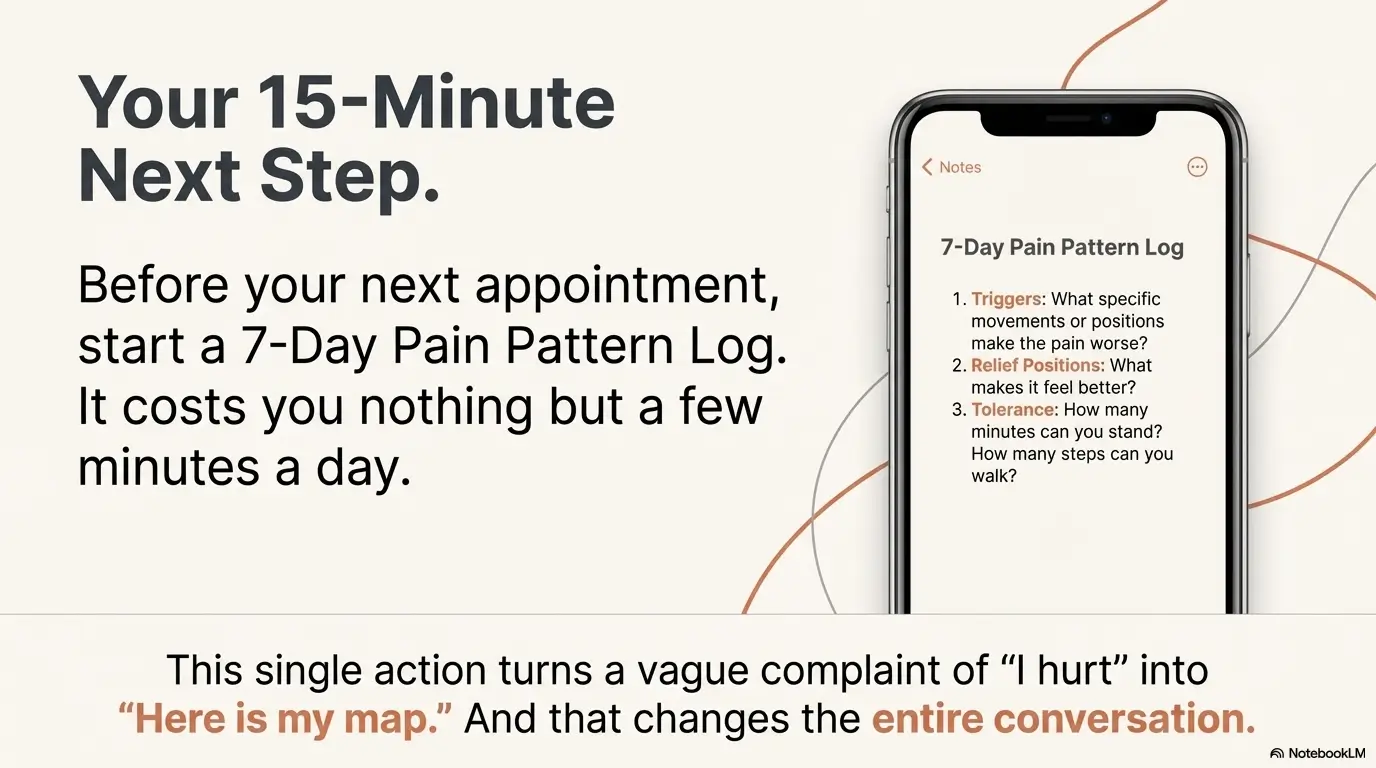
Now the most important part: the next step that costs you 15 minutes, not a month of uncertainty.
A reader emailed me after two years of “everything helps a little, nothing lasts.” They were ready to book RFA because the MRI said “facet arthropathy,” and honestly—who wouldn’t cling to a label that sounds fixable? But their pain story was muddy. Sometimes extension hurt. Sometimes sitting hurt. Sometimes walking was the only thing that helped.
I asked them to do one boring thing for seven days: write down triggers, relief positions, and the exact time-of-day pattern. No poetry. No heroics. Just data. At the consult, that log changed the whole conversation. The clinician noticed a pattern more consistent with a different generator and recommended a different diagnostic step first. The reader didn’t get an instant miracle—but they did avoid paying for the wrong key.
FAQ
How long does lumbar medial branch RFA last for facet joint pain?
Many people experience relief for months, and a commonly cited ballpark is around 6–12 months, though it varies. The biggest driver is whether diagnostic blocks strongly confirmed facet-mediated pain and whether you used the “good window” to rebuild capacity.
How long does it take to feel relief after lumbar RFA?
Some feel improvement within days, but many notice the more reliable effect over 1–4 weeks. Early soreness can mask benefit, so track function and give it a fair window unless you have concerning symptoms.
Is it normal to have worse pain after RFA at first?
Temporary soreness or a flare can happen. What matters is the trend over time and whether you have red flags like fever, spreading redness, or new weakness. If you’re unsure, call the treating clinic.
How many times can you repeat medial branch RFA?
Repeat procedures are often discussed when the first RFA produced meaningful, clearly linked relief and function gains, then pain returned later. The “right time” and whether it makes sense depends on your diagnosis fit, what was treated, and your overall medical picture.
What if the medial branch block helped but RFA didn’t?
This can happen if coverage was incomplete (levels/branches), the block response was hard to interpret, or another generator is contributing more than expected. Ask for a structured re-evaluation: confirm the target, review procedural notes, and discuss alternative diagnostic steps.
What’s the difference between a facet joint injection and medial branch RFA?
A facet joint injection generally delivers medication into or near the joint region, often aiming for short-term symptom reduction. Medial branch RFA targets the nerve pathway that carries pain signals from the facet joints, aiming for longer-lasting interruption of that signaling. Your clinician should explain which fits your pattern and why.
Does cooled RFA work better for lumbar facet pain?
Some techniques aim to create a different lesion size/shape. “Better” depends on your anatomy, levels treated, and provider experience. Ask what technique they use and what outcomes they typically see in cases like yours.
What are the most common risks or side effects?
Common issues include localized soreness, temporary flare, and bruising. Serious complications are uncommon but can include infection, bleeding, or nerve injury. Screening (medications, infection risk, medical history) is part of safety.
When should I call my doctor after RFA?
Call urgently if you have fever, significant redness/swelling, worsening neurologic symptoms (new weakness), severe headache, or bowel/bladder changes. When in doubt, call the treating clinic or seek urgent evaluation.
Will Medicare or private insurance cover lumbar medial branch RFA?
Coverage varies. Many plans cover RFA when documentation supports medical necessity, and diagnostic blocks are often part of the pathway. The fastest way to avoid surprise bills is to ask the clinic for billing codes and whether prior authorization is expected.
Conclusion: a 15-minute next step you can actually do
Remember the hook—the calendar? Here’s the clean close: lumbar medial branch RFA can offer months of relief, sometimes around that commonly cited 6–12 month window, but the “odds” are shaped most by diagnosis fit and the quality of your diagnostic block story. In other words: you don’t just buy a procedure. You buy a plan.
Your 15-minute next step is beautifully unglamorous: open a note on your phone and start a 7-day pain pattern log. Track three things: (1) triggers, (2) relief positions, (3) walking/standing tolerance. Bring it to your consult. It turns “I hurt” into “here’s my map,” and that changes the entire conversation.
Last reviewed: 2025-12-16