

The fastest way to get blindsided on surgery day isn’t choosing the “wrong” technique—it’s assuming one label automatically dictates everything.
If you’re comparing endoscopic discectomy local anesthesia vs general anesthesia microdiscectomy, here’s the contrarian truth clinics live by: you’re making two decisions, not one—approach and anesthesia plan.
What’s making this feel chaotic is modern reality: “local” can mean local numbing + MAC sedation, “twilight” is a dial, and two surgeons can offer the same procedure with totally different defaults depending on team comfort and facility protocols.
Keep guessing, and you risk the worst kind of surprise: a plan that collides with your position tolerance, airway risk, or nausea history when you’re already stressed.
Quick definition to anchor your research: MAC (monitored anesthesia care) is titrated IV sedation with continuous monitoring while you usually breathe on your own; general anesthesia means you’re fully asleep with a controlled airway—often chosen for stillness and prone-position safety.
Here’s what you’ll get next: the fit filter, the facility factor (ASC vs hospital), and the exact “conversion-to-GA” questions that force a clear plan. Good. Now we can be specific. And stop chasing vibes.
Table of Contents
Decision first: “anesthesia plan” vs “surgery type”
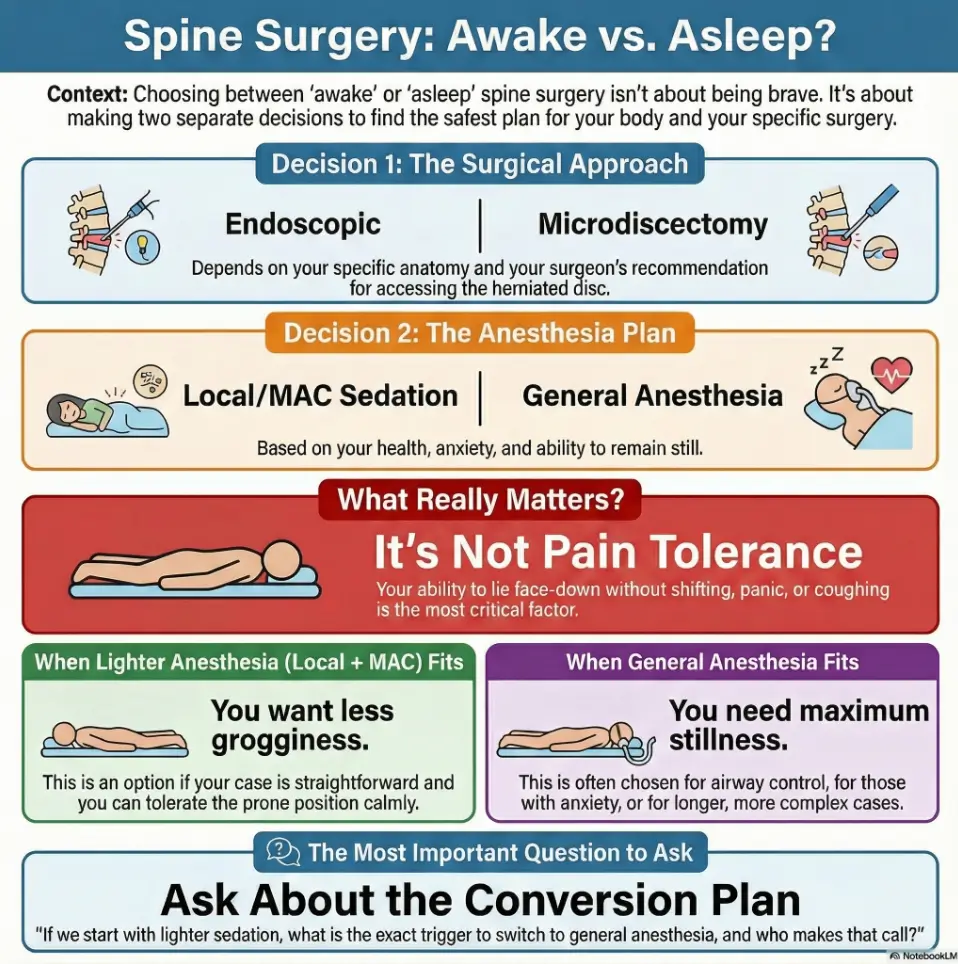
Here’s the move that saves you 30 minutes of spiraling: you’re making two decisions, not one.
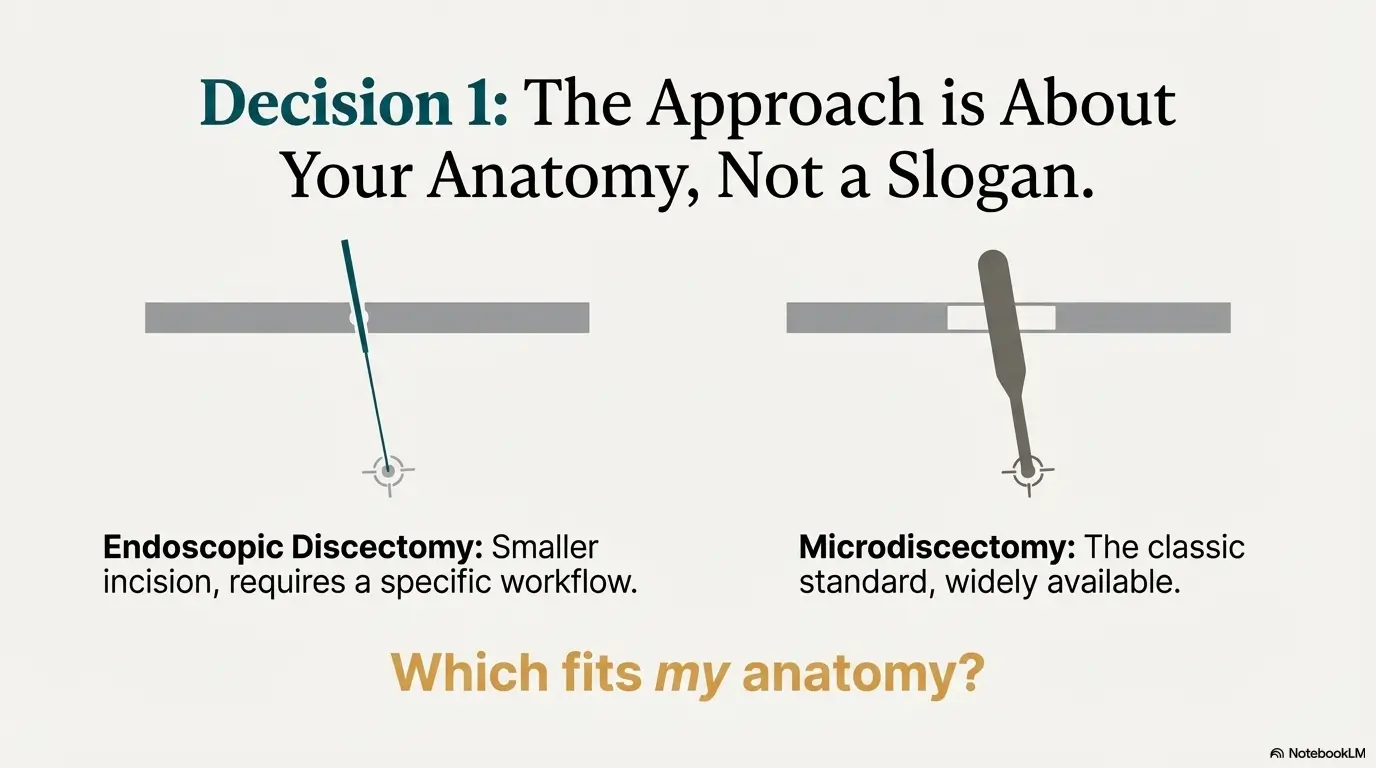
Decision A: the surgical approach (endoscopic discectomy vs microdiscectomy).
Decision B: the anesthesia plan (local, MAC sedation, general, sometimes regional).
Most people mash those together into one sentence—“endoscopic means local,” “micro means general”—and then get whiplash when the surgeon says, “We do that asleep here.” That’s not a bait-and-switch. It’s how real-world practice works: surgeon preference, facility policy, and your medical profile shape what’s offered—especially if your symptoms trace back to a herniated disc and sciatica treatment decision pathway where injections, rehab, and surgery can all be on the table.
Two decisions, not one: approach (endoscopic vs micro) vs anesthesia (MAC vs GA)
If you separate the decisions, you can ask better questions. You stop arguing about labels and start comparing outcomes: airway control, motion risk, nausea, discharge, and whether being “awake” is a benefit or a stressor for you.
Open loop: the single constraint that flips everything (it’s not pain tolerance)
Many readers assume “pain tolerance” is the key. It rarely is. The constraint that flips the plan most often is position tolerance: can you lie prone (face down) comfortably for the required time without panic, coughing, or uncontrolled shifting? We’ll close this loop later with a simple consult script and a quick self-check.
- Endoscopic vs micro is a surgical decision.
- Local/MAC vs general is an anesthesia decision.
- The best choice is about constraints, not bragging rights.
Apply in 60 seconds: Write two lines on paper: “Approach options” and “Anesthesia options.” Keep them separate during your research.
- Shorter, straightforward case (as judged by your surgeon)
- You tolerate prone positioning without panic
- You strongly want less deep anesthesia hangover
- Need maximum stillness / predictable OR flow
- Positioning is hard for you (pain, anxiety, breathing)
- You prefer “sleep through it” and wake up done
Neutral next action: Ask your surgeon which pairing they offer for your level and anatomy, and why.
Anesthesia decoding: local, MAC, general, regional—what each means in a spine OR
“Local anesthesia” is one of the most misunderstood phrases on the internet. People hear “local” and picture a dentist visit. In spine surgery discussions, local often means local anesthetic at the incision + sedation managed by anesthesia. That sedation is commonly called MAC (monitored anesthesia care). Different facilities also use “twilight,” “conscious sedation,” or “IV sedation.” Same galaxy, different planets.
Local-only vs local + MAC: what patients usually feel vs remember
Local-only can mean you’re awake and aware with numbness at the incision. Local + MAC usually means you’re drowsy, calmer, and may remember little—yet you can still respond if asked. The goal isn’t to win a toughness contest. The goal is to keep you comfortable and still.
A small lived-experience note: I’ve watched a family member talk about “twilight” like it’s a single setting. It’s not. It’s a dial. Your anesthesiologist turns that dial based on your breathing, blood pressure, comfort, and movement. That’s why two people can describe the “same” sedation as totally different experiences.
General anesthesia: why airway/position control matters in prone cases
General anesthesia typically means you’re fully asleep with a protected airway (often a breathing tube). In prone positioning, airway control matters because you can’t casually adjust a face-down patient who’s anxious, coughing, or moving. General anesthesia is also a way to make the OR tempo more predictable—especially when the surgeon needs extended stillness.
Regional/spinal talk: where it appears in literature (and why safety language gets careful)
You’ll see spinal or epidural anesthesia discussed in some spine contexts. It’s not “bad” by default—it’s just not universally offered, and the details can get technical fast. The Anesthesia Patient Safety Foundation has published careful discussions about specific local anesthetics in the spinal space and why informed consent and symptom awareness matter. If your plan includes regional techniques, you want the “why this method for me” explanation—not a one-word label.
Show me the nerdy details
MAC is not a single drug or depth. It’s a framework: continuous monitoring + titrated medications (often combinations) that can range from lightly calming to deeply sleepy, without necessarily meeting the formal criteria of general anesthesia. Different facilities draw the line differently. That’s why asking “MAC” alone is not enough—you want what they plan to use, how deep, and what triggers escalation.
- Local + MAC can be calm and forgettable—or not.
- General is often chosen for airway and motion control.
- “Twilight” is a dial, not a label.
Apply in 60 seconds: At your consult, ask: “If you say ‘MAC,’ how deep do you typically run it for this case?”
- Johns Hopkins Medicine — Minimally Invasive Lumbar Discectomy (patient education)
- Cleveland Clinic — Minimally Invasive Spine Surgery (overview + expectations)
- PubMed — Review on anesthesia methods for endoscopic discectomy (peer-reviewed literature)
Endoscopic + “awake” reality: what changes when feedback is possible
Endoscopic discectomy gets talked about like it’s a different species of surgery. In reality, the reason “awake” comes up more often is simple: the approach can be less disruptive, and some surgeons are comfortable doing it with lighter anesthesia in selected patients. That selection part is where the internet gets sloppy—especially for readers who are still sorting out whether their leg symptoms are truly sciatica nerve pain or something else.
When local/MAC is commonly discussed in endoscopic contexts (and why)
In published discussions of full-endoscopic lumbar discectomy anesthesia methods, local anesthesia shows up frequently as an option, alongside general and other techniques. The key phrase you’ll see in serious writing is not “everyone can do it awake.” It’s “depends on patient, surgical factors, and anesthesia team.” Translation: your body and your case have a vote.
Here’s what no one tells you… “awake” can still feel intense if positioning is hard
The incision being small doesn’t mean the experience feels small. A face-down position, pressure points, a mask or nasal cannula, the sensation of “don’t move,” and the emotional weight of hearing OR noises—those can feel big. I’ve seen tough people handle pain brilliantly and still hate the feeling of being constrained. If you’re already anxious, “awake” can amplify that.
Open loop: why some surgeons won’t offer “awake” even if you ask
Even if it’s technically possible, some surgeons prefer a plan that maximizes stillness and reduces last-minute variables—especially in facilities where protocols are strict or rescue resources are organized a specific way. That doesn’t make them worse. It makes their risk management different. We’ll turn this into a question you can ask that gets a real answer, not a vibe.
Short Story: I once sat with a friend the night before her procedure while she tried to “pick the right anesthesia” like it was a menu item. She wanted to be brave, and she’d read that “awake” meant faster recovery. But the thing that kept showing up in her voice wasn’t pain—it was the fear of being trapped in a position she couldn’t tolerate. We practiced: lying flat for 10 minutes, then 15, then 20. At minute 12 she started fidgeting.
Not dramatic. Just… restless. That tiny moment changed the conversation at her consult. She didn’t say “I’m anxious.” She said, “I can’t comfortably stay face down without moving.” The surgeon nodded like she’d just given the most useful information all week. She chose a plan that prioritized stillness and woke up relieved—not because she was “less brave,” but because she chose the safer constraint for her body.
Microdiscectomy + general anesthesia: the practical reasons (not the marketing ones)
Microdiscectomy is the “classic” conversation in many clinics, and general anesthesia is commonly used. Not because the procedure requires drama, but because general anesthesia is a clean way to control a few variables that matter in spine surgery—especially when the underlying diagnosis is clearly mapped (for example, sciatica vs herniated disc patterns in imaging and exam) and the goal becomes execution and safety.
What GA solves in prone positioning (airway + stillness)
General anesthesia tends to make the entire scene more controlled: airway protected, patient still, muscles relaxed when needed. It reduces the chance of involuntary movement at the wrong moment. That’s not a moral judgment against “awake.” It’s a risk-control choice.
When local±epidural appears in microendoscopic discectomy discussions
You’ll see research comparing general anesthesia and local (sometimes with epidural components) in microendoscopic discectomy contexts. If you skim only headlines, you can get the wrong takeaway (“they’re identical!”). Research often says outcomes can be similar in some measures, but patient selection and study limitations matter. That nuance is why your surgeon’s “we do it this way here” can still be completely reasonable.
Open loop: the hidden variable: team comfort + facility protocols
Two surgeons can be equally skilled and still choose different anesthesia defaults because their teams and facility routines differ. This is why the best question isn’t “Do you offer local?” It’s “What’s your standard plan here, and what would make you change it for me?”
Evidence check: what studies suggest—and what they can’t promise you
You don’t need to become a journal person. You do need one sober frame: evidence can inform your expectations, but it can’t override your constraints.
In systematic reviews comparing anesthesia types in microendoscopic discectomy contexts, authors often report that some complication or outcome measures do not differ dramatically between groups—while also warning about heterogeneity and bias. In reviews of anesthesia methods for full-endoscopic discectomy, you’ll see multiple approaches discussed, with local appearing commonly as an option in selected situations. That’s useful. It’s not permission to assume “local is best” or “general is overkill.”
Meta-analysis snapshot: outcomes can look similar, but limitations matter
When studies blend different techniques, patient populations, and surgeon experience levels, “no big difference” can mean “we didn’t detect one,” not “there is none.” If you’re a time-poor reader, here’s the practical translation: use evidence to shape the questions you ask, not to self-prescribe a plan.
Endoscopic discussion snapshot: local is common as an option, selection is everything
Endoscopic anesthesia discussions often circle back to the same theme: patient factors, surgical factors, anesthesiologist factors. That triad is your permission slip to be specific about you: sleep apnea, reflux, anxiety, medication tolerance, and your ability to stay still in a prone position.
Show me the nerdy details
When you see “local anesthesia” in studies, confirm whether it means true local-only, local + IV sedation, or local + regional technique. When you see “general anesthesia,” confirm whether neuromonitoring was used, what endpoints were tracked (blood loss, length of stay, complications), and whether the population was selected (single-level cases vs mixed). This isn’t busywork—it changes how comparable the groups truly are.
- “Similar outcomes” doesn’t mean “same experience.”
- Study labels can hide different sedation depths.
- Your constraints (airway, motion, anxiety) drive the safest plan.
Apply in 60 seconds: Ask your surgeon: “In your own outcomes, what’s different between your awake-style cases and asleep cases?”
Who this is for / not for (the anesthesia-fit filter)
This is the section that saves you from booking the wrong consult. Not because you’re “not a candidate,” but because you might be chasing a plan that doesn’t match your constraints.
Best fit signals for local/MAC paths (tolerance, anxiety profile, case simplicity)
- You can lie prone without panicking or shifting.
- You want less deep anesthesia hangover (and you’re okay with partial awareness).
- Your surgeon indicates your case is straightforward and appropriate for their awake-style workflow.
Not-a-fit signals (severe anxiety, can’t tolerate prone, complex redo/long case)
- You get claustrophobic, nauseated, or breathless lying face down.
- You’ve had panic attacks in medical settings (especially when restrained or unable to move).
- Your surgeon expects a longer or more complex case (including redo surgery) and wants maximum stillness.
Must-disclose conditions early (sleep apnea, reflux, prior anesthesia reactions)
Major medical institutions like Johns Hopkins and Cleveland Clinic include anesthesia-related risks in their patient education, including reactions to anesthesia and breathing concerns. If you have sleep apnea (especially if you use CPAP), reflux/GERD, prior severe nausea after anesthesia, or a history of difficult airway, don’t “wait to mention it.” Lead with it. It changes medication choices and monitoring plans—along with the everyday details you may already be managing, like NSAID safety for back pain and how you tolerate common meds.
- Can you comfortably lie face down for 20–40 minutes without needing to shift? (Yes/No)
- Do you have diagnosed sleep apnea or use CPAP? (Yes/No)
- Do you have severe reflux/GERD symptoms? (Yes/No)
- Have you had strong nausea/vomiting after anesthesia before? (Yes/No)
- Do you strongly prefer to remember nothing? (Yes/No)
One-line next step: Bring your “Yes” answers to your consult and ask how they change the anesthesia plan.
Neutral next action: Put these answers in your phone notes so you don’t forget them under stress.
Don’t-do-this: 7 costly comparison mistakes patients make
If you take nothing else from this article, take this: most “bad experiences” aren’t from choosing endoscopic vs micro. They’re from walking in with an assumption that collides with reality on surgery day.
Mistake #1: assuming “local” automatically means “safer” (it depends)
Local/MAC can reduce certain medication exposures and grogginess for some people. But “safer” isn’t a universal sticker. If your biggest risk is airway or breathing instability in a prone position, general anesthesia with airway control can be the safer path. Your risk is personal.
Mistake #2: ignoring nausea/GERD/OSA planning (it changes meds and monitoring)
People underplay nausea because it sounds like a minor inconvenience. It can be a major recovery spoiler—especially if it prevents you from walking, hydrating, or taking meds. Tell your team if you’ve had post-op nausea. Tell them if you have reflux. Tell them if you have sleep apnea. Those are not “small details.” They steer prevention.
Mistake #3: not asking about conversion-to-GA triggers and who decides
If you’re considering a lighter plan, you must ask about the conversion plan. Not as a scare tactic. As a safety plan. Who makes the call? What triggers it? How quickly can it happen? This is the grown-up version of “I want local.”
Mistake #4: comparing surgeon marketing, not surgeon repetition (experience + workflow)
Time-poor readers often latch onto shiny words: “tiny incision,” “walk out same day,” “awake.” Those don’t tell you how many of these cases the team does, what their complication management looks like, or how consistent their anesthesia staff is. Ask the boring question: “How often do you do this exact case?” Boring is profitable in medicine—especially if you’re trying to reduce the odds of a long-tail outcome like failed back surgery syndrome where the procedure may be “done,” but the story doesn’t feel finished.
Mistake #5: assuming outpatient means “easy”
Outpatient means you go home. It does not mean nothing happened. Your discharge plan (ride, meds, nausea control, stairs at home, a human who can watch you for the first night) matters more than whether your incision was 8 mm or 18 mm.
Mistake #6: letting anxiety masquerade as “research”
I say this gently: sometimes we keep reading because it feels like control. If your anxiety is high, a plan that prioritizes stillness and a smooth anesthetic course may beat a plan that asks you to “tolerate awareness.” Being strategic is not being weak.
Mistake #7: skipping the facility question
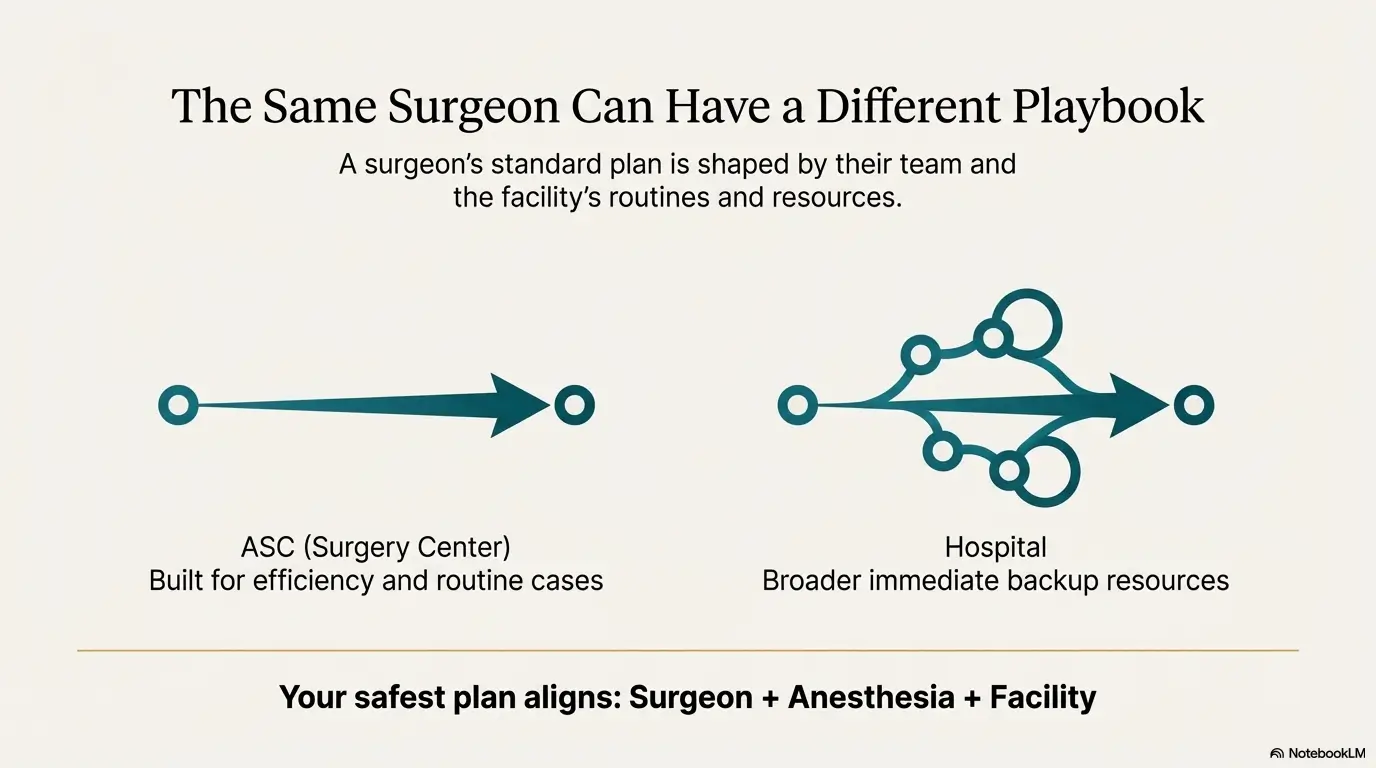
The same surgeon can practice in settings with different equipment, staffing, and protocols. Ask where your case will happen and why.
Day-of to day-7: what you’ll feel (not just “recovery time”)
This is what readers actually want: “What will I feel like when I wake up?” And “Will I regret choosing one plan?” The honest answer is that both plans can be smooth, and both can be annoying in different ways.
PACU differences: nausea/grogginess vs “clear-headed but sore” tradeoffs
- General anesthesia can come with sore throat (from airway devices), grogginess, and nausea in some patients.
- Local + MAC may feel clearer faster for some people, but discomfort from positioning and the memory of moments may be sharper.
Personal note: the first time I saw someone wake up “fine” but nauseated, I realized nausea is not a footnote. It’s a mood killer. It can turn a decent day into a long day.
Walking, sitting, and driving: what “outpatient” really requires
Outpatient centers often want you walking a bit before discharge. Sitting tolerance varies. Driving is not just about pain—it’s about medications and reaction time. Some people feel ready quickly; others feel “wobbly” longer than expected. Plan for variability, not best-case fantasy.
Let’s be honest… some people don’t want to remember anything (and that preference matters)
There’s a quiet truth in many consult rooms: a lot of people don’t want awareness. They want “lights out, wake up done.” If that’s you, you’re not wrong. You’re choosing a plan that protects your nervous system from a stress experience. That can be a good trade.
Enter three simple inputs. You’ll get a conversation starter for your consult—nothing more.
Neutral next action: Copy the output into your consult notes and ask the anesthesia team to respond to it.
Facility factor: ASC vs hospital (the part most articles bury)
Here’s the uncomfortable truth: you can do perfect research and still get surprised if you ignore the facility. An ambulatory surgery center (ASC) and a hospital OR are not the same ecosystem. The surgeon may be the same person. The surrounding resources and routines can differ.
Same-day discharge logistics and observation time expectations
ASCs are built for efficient outpatient flow. That can be wonderful—shorter waits, consistent staff, familiar routines. It also means discharge requirements are real: stable breathing, controlled nausea, safe walking, a ride, and a plan at home. If you live alone, or you have stairs, or you get woozy easily, those details aren’t background noise. They’re the plan.
Anesthesia team consistency and rescue capability differences
Hospitals often have broader immediate backup resources. ASCs often have tight protocols and strong routine—just different. Ask directly: “If I need escalation, what does that look like here?” If the answer is crisp, you’re in a well-run place. If the answer is foggy, pause.
Show me the nerdy details
Facility protocols influence anesthesia decisions: staffing ratios, airway equipment standards, transfer agreements, and how quickly additional specialists can be involved if needed. These are the invisible rails your anesthesia team rides on. You don’t have to judge them—you just have to know what they are.
- ASC vs hospital changes logistics and escalation pathways.
- Discharge requirements are part of the anesthesia decision.
- Ask for the rescue plan without embarrassment.
Apply in 60 seconds: Ask: “If nausea hits hard, what’s your standard prevention plan here?”
Consult script: the 12 questions that force a clear plan
When people tell me they “didn’t get answers,” it’s rarely because the clinic refused. It’s because the questions were too polite. You don’t need to be rude. You just need to be specific.
The anesthesia plan (local vs MAC vs GA) in one sentence—ask them to write it
- “For my case, what anesthesia plan do you recommend here?”
- “When you say ‘local,’ do you mean local-only or local + MAC sedation?”
- “How deep do you typically run MAC for this case?”
The conversion plan (exact triggers, meds, who calls it)
- “If we start with local/MAC, what triggers conversion to general?”
- “Who makes that call in the room?”
- “How often does conversion happen in your practice?”
- “If conversion happens, what changes for my recovery and discharge?”
The discharge plan (nausea prevention, pain meds, ride/home setup)
- “What’s your nausea prevention plan, especially if I’ve had it before?”
- “What will pain control look like the first 24 hours?”
- “When can I safely drive again (based on meds, not optimism)?”
- “What should my helper at home watch for the first night?”
Show me the nerdy details
Ask for the plan in “if/then” language. Example: “If I move during the critical portion, then what happens?” This reveals whether the team has a rehearsed protocol or an improvised approach. Protocol doesn’t guarantee perfection, but it’s a strong signal of safety culture.
- Your MRI report (level, side, any mention of stenosis or “sequestration”)
- Medication list (especially blood thinners, diabetes meds, sleep meds)
- History of anesthesia nausea or airway issues
- Sleep apnea status (CPAP settings if you have them)
- Your home constraints (stairs, living alone, caregiver availability)
Neutral next action: Put these in one folder so the consult becomes a decision meeting, not an interview.
Safety / Disclaimer
This article is general education, not medical advice. Spine surgery and anesthesia decisions depend on your anatomy, imaging, medical history, medications, airway risk, and facility protocols. Two people with “the same herniated disc” can still be safe candidates for different plans. Use this to improve your consult questions, not to self-select an anesthesia method without clinical guidance—especially if you’re still working through diagnosis clarity (for example, sciatica vs piriformis syndrome or diabetic neuropathy vs sciatica can look deceptively similar early on).
Also: if you feel pressured to choose an option you don’t understand, pause. A good team can explain the plan in plain English and tell you what would make them change it.
When to seek help: don’t “sleep on” these symptoms
Major institutions include “when to call” guidance in their patient education for a reason: the sooner you respond to certain symptoms, the better outcomes tend to be. If you’re reading this pre-op, save this section. If you’re reading it post-op, don’t try to be heroic.
Call emergency services: breathing trouble (and other severe red flags)
- Difficulty breathing, severe shortness of breath, or chest pain
- Sudden severe weakness, inability to move a limb, or collapse
- Signs of severe allergic reaction (swelling, hives with breathing issues)
Call your surgeon urgently: fever, bleeding, severe/worsening pain, new neuro deficits
- Fever, wound redness, drainage, or increasing swelling
- New or worsening leg weakness, new numbness in a concerning pattern
- Loss of bladder/bowel control or numbness in the saddle area (urgent)
- Calf swelling or severe calf pain (clot concern)
- Breathing trouble is an emergency.
- New weakness or bladder/bowel changes are urgent.
- Infection signs deserve a same-day call.
Apply in 60 seconds: Put your surgeon’s after-hours number in your favorites before surgery day—and if you’re unsure whether symptoms cross the line, review a clear low back pain emergency checklist so you don’t second-guess the obvious under stress.
Next step: bring the “Anesthesia Fit Checklist” to your consult
If you do one thing in the next 15 minutes, do this: make a one-page checklist you can hand to the team. It turns your appointment into a decision meeting. It also quietly signals, “I’m serious, prepared, and I want a safe plan.” Clinics respond well to that.
Your top 3 priorities (avoid nausea, avoid awareness, minimize airway risk)
- Priority #1: __________________ (example: “avoid severe nausea”)
- Priority #2: __________________ (example: “I prefer to remember nothing”)
- Priority #3: __________________ (example: “minimize breathing risk in prone position”)
Your risk flags (OSA/CPAP, reflux, anticoagulants, prior reactions)
- Sleep apnea / CPAP: Yes / No / Not sure
- Reflux/GERD: Yes / No
- Strong nausea after anesthesia: Yes / No
- Blood thinners / diabetes meds / sleep meds: Yes / No
Your must-answer question: “What’s the conversion-to-GA plan in your practice?”
Ask it exactly like that. It forces specificity. It exposes whether the plan is thoughtful or casual. And it closes the open loop from the beginning: the constraint that flips your plan is usually your ability to stay safely still in position, without creating an airway or movement problem.
Small access; surgeon-specific workflow
Common standard; wide availability
Less deep anesthesia for some; needs position tolerance
Airway + stillness control; predictable OR flow
FAQ
Is endoscopic discectomy done under local anesthesia in the United States?
It can be, especially in select patients and in practices that routinely run an awake-style workflow. “Local” often means local anesthetic at the incision plus IV sedation (MAC). The exact plan depends on the surgeon, anesthesia team, and facility protocols.
Is microdiscectomy always done under general anesthesia?
Not always, but general anesthesia is commonly used. The practical reason general is common is airway control and stillness during prone positioning.
What’s the difference between MAC sedation and general anesthesia for spine surgery?
MAC (monitored anesthesia care) is sedation managed by anesthesia while you breathe on your own, with medications adjusted in real time. General anesthesia typically means you’re fully asleep with a controlled airway. The “depth” and memory of MAC can vary widely.
Will I feel pain during endoscopic discectomy with local anesthesia and sedation?
Many patients report pressure or discomfort rather than sharp pain, but experiences vary. Positioning and anxiety can amplify sensations. If you’re concerned, ask exactly how the team handles discomfort and what the escalation plan is if you can’t tolerate it.
Can I switch to general anesthesia if I panic during “awake” discectomy?
Sometimes, yes—but it depends on facility capabilities and the team’s protocol. This is why you should ask about the conversion plan before surgery day: triggers, who decides, and how quickly they can convert safely.
How does sleep apnea (OSA) affect anesthesia choice for a discectomy?
OSA can change monitoring, medication choices, and the safest anesthesia depth. Some people benefit from airway control; others may do fine with careful sedation planning. Tell the team early if you have OSA or use CPAP so they can design the safest plan.
Which option has less post-op nausea: MAC sedation or general anesthesia?
It depends on your history and the medications used. Some people experience less nausea with lighter sedation; others still get nausea from certain drugs or motion sensitivity. If you’ve had strong nausea before, ask for a prevention plan.
Does “awake feedback” reduce nerve injury risk during endoscopic discectomy?
In theory, patient feedback can help identify discomfort quickly, but it also can increase stress and movement risk in some patients. The safer plan is the one that matches your ability to stay still and the surgeon’s workflow.
How long does grogginess last after general anesthesia for microdiscectomy?
Some people feel clearer within hours; others feel “foggy” into the next day. Your sleep, medications, nausea, and individual response matter. Plan for a slow day after surgery rather than a tight schedule.
What should I ask the anesthesiologist before outpatient discectomy?
Ask for the anesthesia plan in one sentence, what “MAC” means in their hands, your nausea prevention plan, and the conversion/rescue plan if the first plan isn’t enough. Also ask what your helper should watch for the first night.
Conclusion
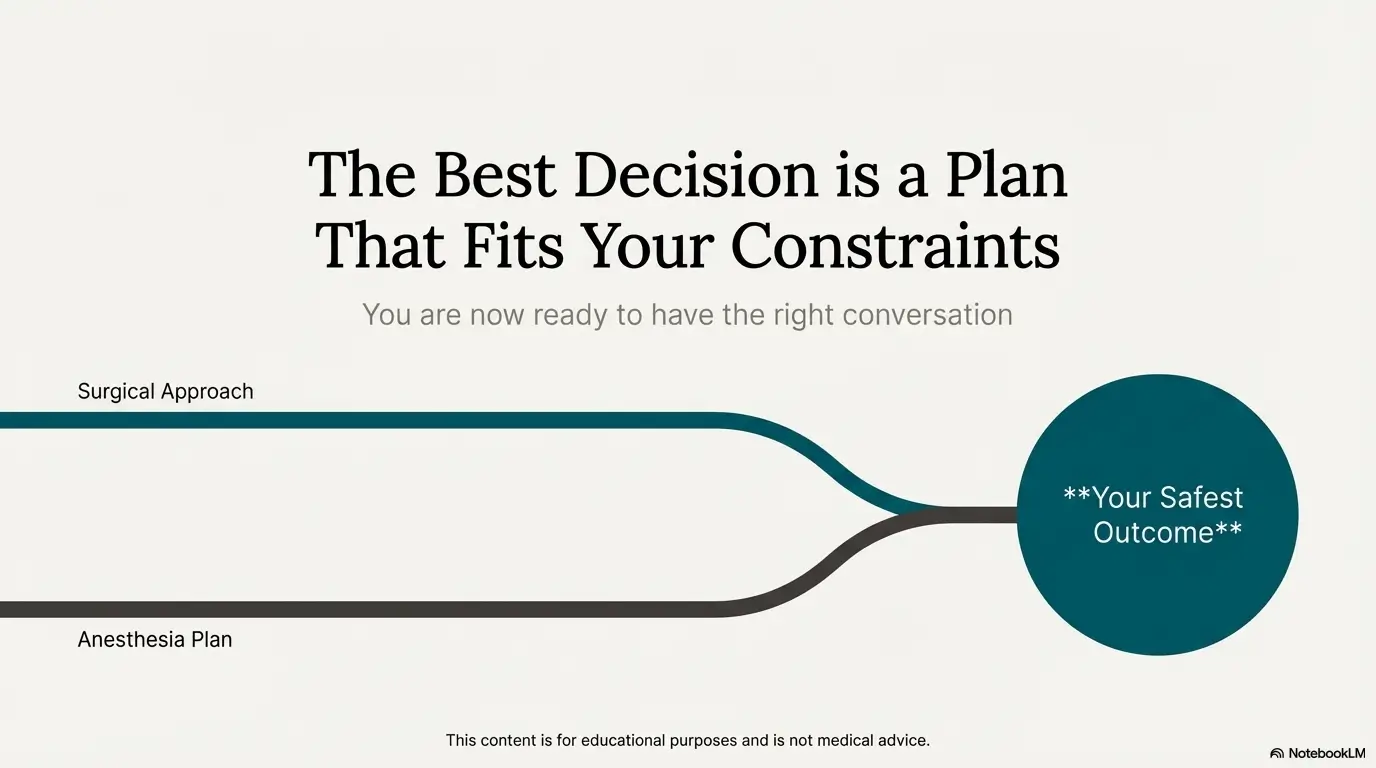
If you came in thinking this was a simple contest—local good, general bad—you’re not alone. The internet trains us to pick a side. But the safest and best-feeling outcome usually comes from something less dramatic: a plan that fits your constraints.
Here’s the loop we opened at the start, now closed: the “small detail” that flips the best choice is rarely pain tolerance. It’s your ability to stay safely still in position, with a breathing and nausea plan that matches your body and the facility’s protocols.
In the next 15 minutes, do one thing: write your top 3 priorities and your risk flags, then use the consult script questions. Get the anesthesia plan and the conversion plan in plain English. That’s not overthinking. That’s how time-poor people make high-stakes decisions without regret.
Last reviewed: 2025-12