

Senior orthopedic appointment guide
Orthopedic Visit Checklist for Seniors:
What to Bring, Ask, and Avoid
An orthopedic visit can feel strangely small for such a large problem. A knee that has turned every staircase into a negotiation. A shoulder that wakes you at 2 a.m. A hip that has quietly shortened grocery trips, church mornings, garden time, or the walk from the parking lot. Then, after weeks of waiting, the appointment arrives and the whole story has to fit inside a short exam-room window.
This guide is built to help seniors, adult children, and caregivers arrive with the right details before memory gets foggy, pain gets minimized, or the important question slips away like a receipt in a winter coat pocket. It does not try to turn you into a medical expert. It helps you become a clearer narrator of your own body.
The goal is simple: bring better information, ask better questions, understand the next step, and avoid the common appointment mistakes that can lead to confusion, delays, or decisions made too fast.
Bring the right proof
Records, scans, medication lists, fall notes, and devices that make the visit more useful.
Ask cleaner questions
Diagnosis, treatment options, risks, timing, recovery, and what happens if you wait.
Leave with a plan
Know the next test, next appointment, home steps, warning signs, and who to call.
Small promise: by the end, you can make a one-page visit sheet tonight and walk into the appointment with fewer loose threads. 📝
Snapshot
This article is for seniors, caregivers, and adult children preparing for an orthopedic appointment for joint pain, stiffness, falls, mobility changes, arthritis, fractures, injections, physical therapy, or possible surgery. You will learn what to bring, what to write down, what questions to ask, what mistakes to avoid, and how to leave with a clear next step.
Table of Contents
Safety / Disclaimer: What This Checklist Can and Cannot Do
This guide is for appointment preparation and health communication only. It does not diagnose joint pain, recommend a specific treatment, or replace care from a licensed medical professional.
Orthopedic problems can be simple, stubborn, or serious. A sore knee after gardening is not the same as sudden inability to bear weight after a fall. A stiff shoulder is not the same as new weakness, fever, or spreading redness. This article helps you organize information for a routine orthopedic visit, but it should not be used to delay urgent care.
Seniors should seek urgent medical help for sudden severe pain, inability to walk or bear weight, suspected fracture, new weakness, numbness, confusion after a fall, head injury symptoms, chest pain, shortness of breath, fever with a hot swollen joint, or rapidly worsening swelling and redness.
Key takeaway
A checklist is powerful for routine care, but red flags outrank preparation. If pain follows a major fall, a joint looks infected, or walking suddenly becomes impossible, do not wait for a scheduled appointment.
Why This Checklist Matters Before the Exam Room Door Opens
An orthopedic appointment is part detective story, part engineering inspection, and part conversation about quality of life. The doctor is not only asking, “Where does it hurt?” The deeper question is, “What is changing in your body, your movement, and your daily life?”
For seniors, those changes may arrive quietly. A person stops using the basement stairs. The favorite big grocery store becomes “too much walking.” A morning walk shrinks from twenty minutes to the mailbox and back. Pain does not always announce itself with drama. Sometimes it just edits the day.
The appointment is short, but the story is long
Most orthopedic visits have a limited window. There may be a nurse intake, a review of imaging, a physical exam, a discussion of options, and a plan. That is a lot to fit between greeting and goodbye.
Without preparation, the appointment can drift toward the loudest symptom of the day. If the knee hurts most today, the hip weakness from last week may never come up. If the shoulder feels fine in the exam room, the night pain that has been stealing sleep for months may sound less urgent.
A checklist protects the full story. It helps you bring the facts that pain, stress, and white-coat nerves can hide.
What the doctor needs that memory may not deliver
Orthopedic decisions often depend on details that are easy to forget. Which side hurts? When did it start? Did it begin after a fall, a twist, a long walk, or no obvious event? Does it hurt at night? Does it improve with rest? Does it lock, catch, buckle, burn, tingle, or radiate?
Then come the background details: previous surgery, injections, physical therapy, braces, medications, blood thinners, diabetes, osteoporosis, heart disease, kidney disease, allergies, and anesthesia problems. None of these are minor decorations. They can shape treatment choices.
The appointment improves when the doctor can see both the painful joint and the life around it.
The quiet cost of “I forgot to mention that”
Forgetting one detail does not mean the visit is ruined. But certain omissions can slow care. If imaging is missing, the clinic may need to repeat it or wait for records. If a medication is left off the list, a pain reliever or injection plan may be less safe. If falls are not mentioned, the treatment plan may miss balance, footwear, vision, home hazards, or assistive-device needs.
One forgotten sentence can become another appointment, another phone call, another week of uncertainty. A checklist is not glamorous. It is a small guardrail against avoidable delay.
Short Story: The knee that was not just a knee
Margaret, seventy-six, came to her orthopedic appointment ready to talk about her right knee. She had written “stairs are awful” on a sticky note, then nearly left it on the kitchen table.
Her daughter asked one more question in the parking lot: “Didn’t you almost fall near the laundry room?” Margaret waved it off. “That was nothing.” But they wrote it down anyway.
Inside the exam room, that “nothing” changed the conversation. The doctor asked about balance, footwear, lighting, walker use, and whether the knee was buckling. The plan still included knee care, but it also included fall-risk steps and a safer way to handle stairs.
The lesson was not that every stumble is a crisis. It was that small details can open the right door.
Who This Guide Is For and Who Needs Urgent Care Instead
This orthopedic visit checklist is designed for routine or scheduled appointments. It is useful when symptoms are uncomfortable, limiting, persistent, or confusing, but not clearly dangerous in the moment.
That distinction matters. A planned orthopedic visit is a good place to discuss chronic arthritis pain, slow loss of mobility, recurring stiffness, old injuries, joint replacement questions, brace options, physical therapy progress, and whether imaging or injections make sense. It is not the right place to wait out signs of a possible emergency.
Best fit: seniors with joint pain, stiffness, or mobility changes
This guide fits seniors who are seeing an orthopedist for knee pain, hip pain, shoulder pain, arthritis, back-related leg symptoms, foot or ankle issues, hand stiffness, mobility changes, or recovery after an injury.
It also helps when the main problem is not pain alone. Some orthopedic visits begin because a person is moving differently. Maybe the leg feels unreliable. Maybe standing from a chair takes two tries. Maybe a cane has entered the picture, not with ceremony but with quiet resignation near the front door.
Those details belong in the visit. Orthopedic care is not only about joints on an X-ray. It is about whether a person can safely move through home, errands, sleep, work, hobbies, and family life.
Also useful for adult children and caregivers
Adult children and caregivers often see patterns the patient has adapted to. They may notice the laundry basket has moved downstairs, the walker is being avoided, or the parent who used to stride through the farmer’s market now looks for a bench after five minutes.
A caregiver can help by bringing records, taking notes, asking questions, and listening for the plan. The key is support, not takeover. The senior should remain the central voice whenever possible.
Not enough for emergencies or sudden neurologic symptoms
Do not use a routine checklist as a reason to wait if symptoms are sudden, severe, or linked to a fall or accident. New inability to bear weight, suspected fracture, new bowel or bladder problems with back pain, new weakness, severe swelling, fever, or confusion after a fall should be handled urgently.
When in doubt, contact a medical professional, urgent care, emergency services, or the orthopedic office for triage instructions. A careful appointment is good. Timely care is better when warning signs appear.
Key takeaway
Use this guide for planned orthopedic visits. Use urgent care pathways for sudden inability to walk, suspected fracture, serious fall symptoms, infection signs, new weakness, or severe rapidly worsening pain.
Bring These Records Before You Bring Your Worries
The first job of the orthopedic visit is to reduce guesswork. Records help do that. A clear stack of information can save time, prevent repeated tests, and give the doctor a cleaner view of what has already been tried.
Do not assume every clinic can instantly see every scan, report, hospital note, medication, or therapy record. Medical systems do not always talk to each other as elegantly as commercials suggest. Sometimes the most useful thing in the room is a folder.
Imaging: X-rays, MRI, CT scans, and reports
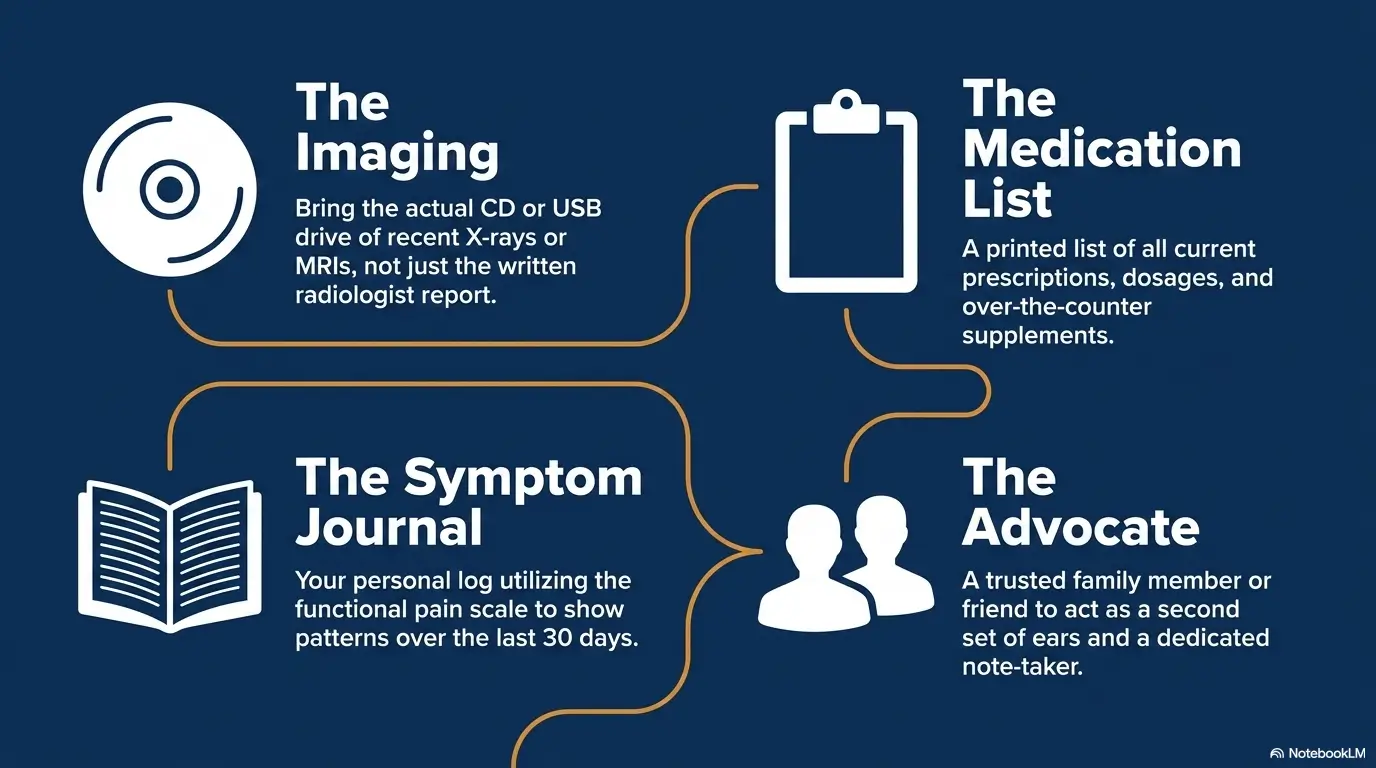
Bring any relevant imaging reports and, when available, the actual imaging files. This may include X-rays, MRI scans, CT scans, ultrasound reports, bone density reports, or hospital imaging after a fall.
The written report is useful, but the actual image can matter too. A surgeon or orthopedic specialist may want to review the images directly, not only the radiologist’s summary. If your imaging center offers a disc, portal download, or secure transfer, ask the orthopedic clinic which format it prefers before the visit.
If you have already had imaging, write down where and when it was done. A simple line such as “Left knee X-ray, March 2026, Valley Imaging Center” can help the office track it down.
Medication list: prescriptions, OTC pain relievers, and supplements
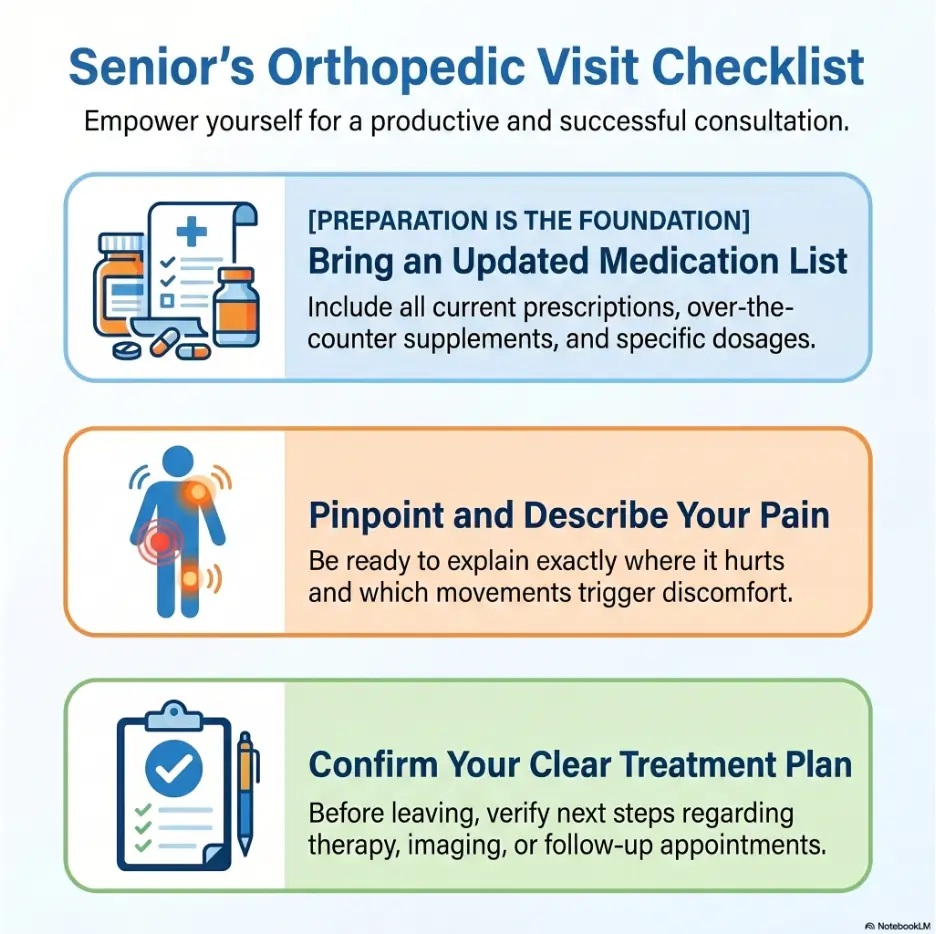
A medication list should include prescription drugs, over-the-counter pain relievers, topical creams, sleep aids, vitamins, minerals, herbal products, and supplements. Include dose, how often you take it, and why you take it if you know.
Orthopedic doctors need this information because pain plans can overlap with blood pressure medicine, blood thinners, diabetes medicine, kidney issues, stomach bleeding risk, fall risk, and surgery planning. Even “just ibuprofen sometimes” is worth mentioning.
Bring the bottles if making a list feels hard. A grocery bag of pill bottles may not look elegant, but it is better than guessing. The medicine cabinet has a long memory.
Prior treatment notes: injections, PT, surgeries, and braces
Write down what has already been tried. This includes physical therapy, home exercises, injections, braces, canes, walkers, shoe inserts, surgery, chiropractic visits, pain clinic treatments, ice, heat, and medication trials.
Try to include dates and results. “Cortisone injection helped for three weeks” is more useful than “I had a shot once.” “Physical therapy made stairs easier but did not help night pain” is more useful than “PT did not work.”
If you have written notes from a previous orthopedist, hospital discharge papers, therapy progress summaries, or post-op instructions, bring them. If you are preparing after surgery, articles such as signs a parent needs help after surgery may also help caregivers notice practical problems at home.
Insurance, referral, and pharmacy details
Bring insurance cards, photo ID, referral paperwork if required, a list of preferred pharmacies, and any workers’ compensation, Medicare Advantage, or supplemental insurance information that may affect authorization.
For seniors, referral rules and network restrictions can affect imaging, therapy, injections, surgery location, and follow-up care. If the visit may lead to physical therapy or a procedure, the office may need accurate insurance details to avoid billing confusion later.
Orthopedic visit document checklist
- Photo ID and insurance cards
- Referral or authorization paperwork, if required
- X-ray, MRI, CT, ultrasound, or bone density reports
- Actual imaging files or disc, if available
- Medication list with dose and frequency
- Allergies and past reaction notes
- Previous surgery records or implant information
- Physical therapy notes or home exercise plan
- Injection history with dates and results
- Fall history and mobility-device notes
- Preferred pharmacy information
Pain Details Doctors Actually Use
“It hurts” is true, but it is not enough. Orthopedic care becomes more precise when pain has a map, a clock, and a consequence. Where is it? When does it happen? What does it stop you from doing?
The best pain description does not need fancy language. It needs honest, concrete details. A doctor can do more with “I can walk one block before my right hip aches in the groin” than with “My hip is terrible.”
Location: point to the pain, not just the joint
Instead of naming only the joint, point to the exact area. Knee pain in the front, inside, outside, or back of the knee can suggest different problems. Hip pain in the groin can mean something different from pain on the outside of the hip or pain that travels from the low back.
Use a plain map of the body if helpful. Circle the painful area. Mark where pain travels. If there is numbness, tingling, burning, weakness, catching, locking, clicking, buckling, or swelling, write that down separately.
For readers who struggle to name symptoms clearly, this guide on how to describe pain to a doctor can help turn vague discomfort into useful language.
Timing: morning stiffness, night pain, and walking distance
Timing can be a clue. Does the joint feel worst in the morning, after sitting, during stairs, while walking, at night, or after activity? Does pain warm up and improve, or does it build the longer you move?
Night pain deserves special attention because it affects sleep and can shift treatment priorities. If pain wakes you, write down how often, what position triggers it, and whether changing position helps. A practical guide on explaining night pain to a doctor can be useful before the appointment.
Walking distance is also powerful. Instead of saying “I cannot walk far,” estimate the distance. “I can walk from the car to the front door but not through the store” paints a clearer picture than “walking is hard.”
Severity plus what the pain stops you from doing
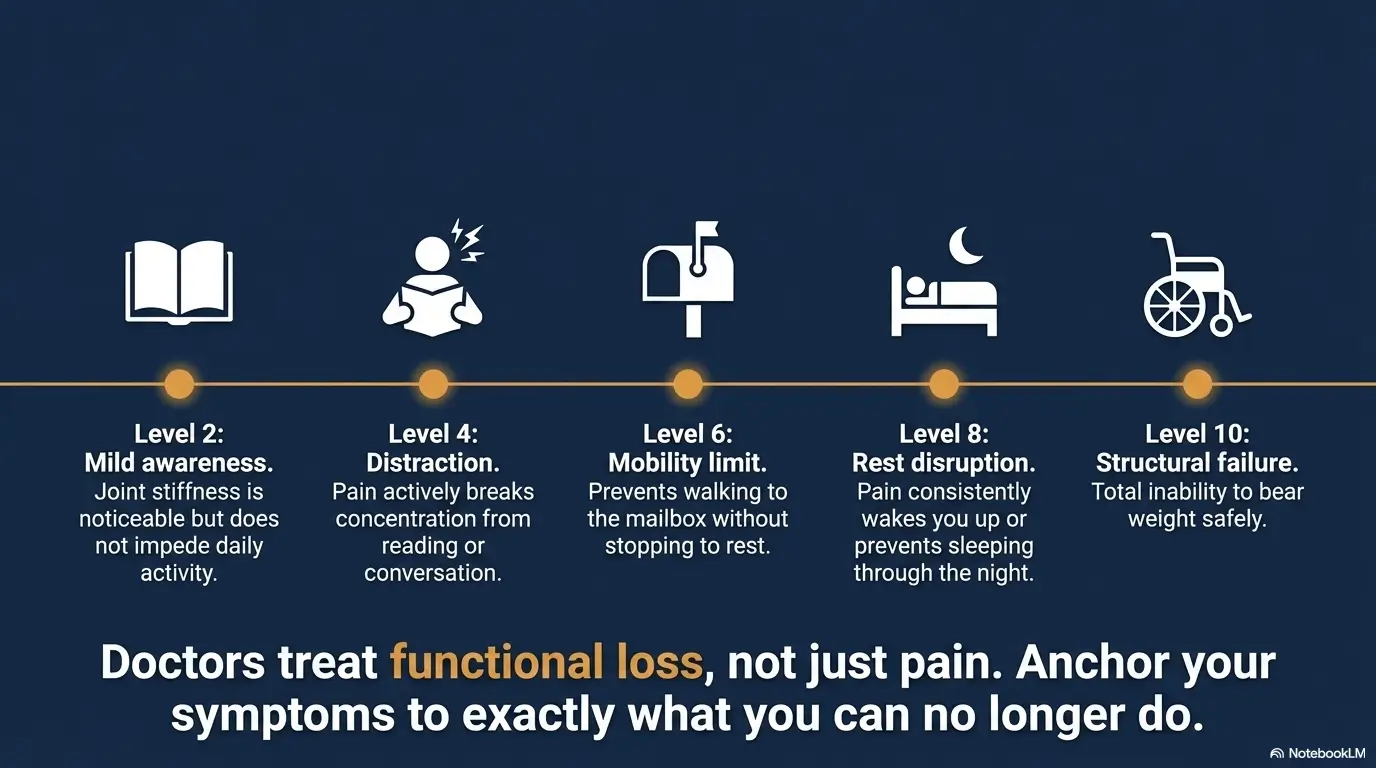
A pain scale from 0 to 10 can help, but it is not the whole story. One person’s 6 may be another person’s 8. Function adds meaning.
Try pairing the number with an activity. “Pain is 4 at rest, 7 on stairs, and 8 when getting out of a low chair.” That tells the doctor where the problem lives in daily life.
Also mention what you have stopped doing. Did you quit walking the dog? Stop driving at night because getting in and out of the car hurts? Avoid the bathtub? Sleep in a recliner? Those changes can be medically relevant even if they feel ordinary by now.
The “bad day” note: bring one honest example
Many seniors naturally downplay symptoms in front of clinicians. The exam room can bring out a brave little performance: “I manage.” “It is not that bad.” “Other people have it worse.”
Bring one honest bad-day example. Not an exaggerated one. A real one. “Last Tuesday, I could not finish cooking dinner because standing at the stove made my back and knee pain spike.” Or, “I skipped my granddaughter’s recital because I was afraid of the parking lot and stairs.”
That kind of detail turns pain into a life problem, and life problems are what treatment plans are supposed to address.
Mini pain note template
Copy this onto paper or into your phone before the visit:
- Where it hurts: right inner knee, outside hip, front shoulder, low back into leg
- When it hurts: stairs, night, first steps, standing, walking distance
- How it feels: sharp, dull, burning, catching, buckling, stiff, swollen
- How bad: resting pain, activity pain, worst pain
- What it stops: bathing, driving, shopping, sleeping, cooking, walking, stairs
- What helps: rest, ice, heat, medicine, brace, cane, position change
Fall History: The Detail Seniors Often Minimize
Falls are often treated like private embarrassment instead of medical information. Many seniors say, “I tripped,” “It was silly,” or “I did not really fall.” But in an orthopedic visit, fall history can change the questions, the exam, the diagnosis, and the treatment plan.
A fall can reveal weakness, balance issues, medication side effects, vision trouble, unsafe footwear, home hazards, joint instability, or fear of movement. It can also point toward injuries that are easy to miss when a person is trying hard to be stoic.
Report every fall, even the “small” one
Tell the orthopedic doctor about every recent fall, even if you were not seriously injured. Include near-falls too, especially if the leg buckled, the foot caught, dizziness occurred, or you grabbed furniture to stay upright.
One fall can increase the chance of another. That does not mean you should live in fear. It means the visit should include prevention, not just pain control.
Fall history is especially important if you use a cane, walker, brace, wheelchair, stair rail, shower chair, or furniture for balance. Bring the device you actually use, not the one you think you are “supposed” to use.
What to write down after a fall
After a fall, write down what happened while the details are fresh. Where were you? What were you doing? Did you trip, slip, feel dizzy, feel weak, or have the joint give way? Did you hit your head? Could you get up without help?
Also note the surface, footwear, lighting, and time of day. “Fell on the bedroom rug at night while walking to the bathroom in socks” tells a richer story than “fell at home.”
If pain changed after the fall, write that down. A new limp, new swelling, new bruising, new back pain, or new fear of walking all belong in the appointment.
Balance, dizziness, footwear, home hazards, and fear of walking
Orthopedic care may involve more than the joint. If falls are part of the story, the doctor may ask about balance, dizziness, blood pressure changes, medication effects, vision, neuropathy, shoes, rugs, lighting, pets, stairs, and bathroom safety.
Fear of falling also matters. Some people move less because they are afraid, then lose strength and confidence, which can make falls more likely. It becomes a loop, and the loop needs to be named before it can be broken.
Falling changes treatment choices
If a senior has frequent falls, the plan may need to include balance-focused physical therapy, assistive-device training, home safety changes, bone health review, medication review, or a different recovery plan after surgery.
For example, a knee injection might help pain, but if the knee is buckling, pain relief alone may not solve the main danger. A cane may reduce risk, but only if it is the correct height and used on the correct side. A walker can help, but not if doorways, rugs, and bathroom layout make it awkward.
This is why fall history belongs in the first half of the visit, not as a last-minute doorway confession.
Orthopedic Visit Readiness Flow
1. Gather
Imaging, medication list, prior treatment notes, insurance details.
2. Describe
Pain location, timing, triggers, walking distance, lost activities.
3. Report
Falls, near-falls, buckling, dizziness, home hazards, device use.
4. Ask
Diagnosis, options, risks, timing, recovery, what happens if you wait.
5. Confirm
Next test, prescription, therapy, follow-up, warning signs, contact route.
Common Mistakes That Can Weaken the Visit
Most appointment mistakes are not careless. They are human. Pain is tiring. Medical offices are stressful. Seniors may not want to complain. Adult children may not want to push. Everyone wants to be polite, efficient, and brave.
But orthopedic visits work better when honesty outranks politeness. The goal is not to dramatize symptoms. It is to avoid sanding off the edges that matter.
Mistake 1: Saying “I’m fine” when daily life has shrunk
Many seniors say “I’m fine” because they are used to managing. They may not mention that they no longer climb stairs, sleep poorly, avoid showers, skip errands, or turn down invitations.
Doctors need to hear about shrinking activity. Orthopedic treatment is often based on function as much as imaging. If the X-ray looks moderate but life has become very limited, that matters. If the scan looks severe but the person is functioning well, that matters too.
Mistake 2: Forgetting over-the-counter pain medicine
Over-the-counter medicine counts. Acetaminophen, ibuprofen, naproxen, aspirin, topical pain creams, sleep aids, and supplements can affect safety decisions. This is especially true for seniors with kidney disease, stomach bleeding risk, heart disease, blood thinners, diabetes, or upcoming procedures.
Do not say “no medications” if you take pills from the pharmacy aisle. The body does not care whether a medicine came from a prescription pad or a checkout lane.
Mistake 3: Leaving imaging at home because “the doctor can look it up”
Sometimes the doctor can look it up. Sometimes not. Portals fail, records lag, networks do not connect, and outside imaging centers may not send the right file.
Bring copies when possible. If the clinic already has everything, wonderful. If not, you just saved the visit from becoming a paperwork scavenger hunt.
Mistake 4: Asking about surgery before asking about diagnosis
Surgery questions are reasonable, especially if pain is severe or long-lasting. But the first question should usually be, “What is the most likely diagnosis?” Treatment choices make more sense after the problem is named.
For example, knee pain may come from arthritis, meniscus changes, ligament injury, referred hip pain, nerve irritation, bursitis, or more than one issue at once. Asking about surgery too early can skip the more useful conversation about what is actually driving the symptoms.
Mistake checklist to review the night before
- Do not minimize pain if it has changed your daily life.
- Do not forget non-prescription pain medicine or supplements.
- Do not assume outside imaging is already available.
- Do not begin with “Do I need surgery?” before asking what the diagnosis is.
- Do not go alone if memory, hearing, stress, or complex decisions may be an issue.
- Do not leave without knowing the next step.
Questions to Ask Before You Agree to a Treatment
A good orthopedic visit should not feel like being handed a menu in a language you almost understand. Physical therapy, injections, braces, imaging, medication, surgery, watchful waiting, home changes, and follow-up timing may all come up. Questions help turn that menu into a plan.
You do not need to ask every question below. Choose the ones that match the visit. A written list is useful because the moment a doctor says “MRI,” “replacement,” “injection,” or “arthritis,” the mind can scatter like dropped buttons.
What is the most likely diagnosis?
Start here. Ask the doctor to explain the likely diagnosis in plain English. If there are multiple possibilities, ask what points toward each one and what information is still missing.
You can also ask whether the problem is mainly joint, tendon, muscle, bone, nerve, balance-related, or a combination. That helps you understand why the recommended treatment fits the suspected cause.
What are the non-surgical options first?
Many orthopedic problems are treated first with non-surgical options. These may include physical therapy, activity changes, weight management when appropriate, braces, assistive devices, shoe changes, anti-inflammatory strategies, injections, or home safety improvements.
Ask which options are most realistic for your age, health history, budget, insurance, transportation, home layout, and personal goals. A perfect plan that cannot be followed is not a perfect plan. It is a decorative brochure.
What improvement should I expect, and how soon?
Every treatment should come with a timeline. Ask what improvement would count as success, how long it may take, and what to do if symptoms do not improve.
For example, if physical therapy is recommended, ask how many weeks before reassessment. If an injection is offered, ask when relief may begin, how long it may last, and what the next option is if it does not help. If surgery is discussed, ask what recovery looks like week by week, not just “after recovery.”
What happens if I wait?
This is one of the most useful questions in orthopedic care. Waiting may be reasonable for some conditions. For others, delaying care can lead to more pain, weakness, falls, worsening deformity, or a more difficult recovery.
Ask what signs would mean the plan needs to change. Ask whether waiting affects surgery options later. Ask whether there are activities you should avoid while deciding.
Show me the nerdy details
Orthopedic decisions usually combine four types of information: symptoms, physical exam findings, imaging, and functional impact. Imaging alone rarely tells the whole story. A scan may show age-related changes that are not the main pain source, or it may understate how much a problem affects daily life.
This is why your walking distance, fall history, medication list, and “what pain stops me from doing” notes matter. They help the clinician match the treatment to the patient, not just the picture.
A good question is not just “What does the scan show?” It is “Does the scan match my symptoms, exam, and goals?”
Treatment Choices Without the Overwhelm
Orthopedic treatment can feel like a row of doors. Physical therapy behind one. Injections behind another. A brace, a cane, a new scan, a surgery discussion, a wait-and-see plan. The trick is not to open every door. It is to understand why the doctor is pointing to one first.
For seniors, the “best” treatment is not always the most aggressive treatment. It is the plan that fits the diagnosis, health history, safety risks, daily goals, support system, and willingness to follow through.
Physical therapy: what it can and cannot fix
Physical therapy can improve strength, balance, range of motion, walking mechanics, confidence, and function. It may help pain by improving how the body loads a joint or supports a painful area.
But physical therapy is not magic dust. It may not reverse advanced arthritis, repair every tear, or fully solve pain caused by severe structural problems. That does not make it useless. It means expectations should be specific.
Ask what the therapy goal is. Is it to reduce pain, improve walking, build strength before surgery, prevent falls, delay surgery, or recover after an injury? A clear goal makes it easier to judge whether therapy is helping.
Injections: pain relief, timing, and repeat limits
Injections may be discussed for certain joint, tendon, bursa, or spine-related pain problems. The purpose is often to reduce inflammation, reduce pain, improve function, or help confirm a pain source.
Ask what type of injection is being recommended, what it is expected to do, how soon relief may start, how long relief may last, how often it can be repeated, and whether it affects future surgery timing.
Also ask about risks based on your health history, especially diabetes, blood thinners, infection risk, immune suppression, osteoporosis, or previous reactions.
Braces, canes, walkers, and shoe changes
Assistive devices are not a sign of defeat. They are tools. A cane can reduce load and improve confidence. A walker can widen the base of support. A brace may improve stability or comfort. Shoe changes can alter pressure and reduce irritation.
The danger is using the wrong tool, wrong size, or wrong technique. A cane that is too tall, a walker that catches on rugs, or a brace that slips can create new problems. Bring your current device to the visit so the doctor or therapy team can evaluate it.
If you are already managing daily tasks with a walker, this related guide on carrying a plate with a walker may help connect clinic advice to kitchen reality.
Surgery: when it enters the conversation
Surgery may enter the conversation when pain, damage, instability, deformity, fracture risk, or loss of function is significant enough that non-surgical options are unlikely to meet the goal. But “surgery was mentioned” does not always mean “surgery is happening tomorrow.”
Ask why surgery is being considered, what problem it is meant to solve, what it may not solve, what recovery requires, what support is needed at home, and what risks apply to your health profile.
For joint replacement planning, practical home preparation can be just as important as the surgical decision. Articles such as knee replacement nightstand setup can help turn a medical plan into a safer recovery environment.
| Treatment option | Good question to ask | What to listen for |
|---|---|---|
| Physical therapy | What specific function should improve? | Walking, stairs, balance, strength, range of motion, pain control |
| Injection | What is the goal and how long might relief last? | Pain relief timeline, repeat limits, risks, effect on surgery timing |
| Brace or cane | Can someone check the fit and technique? | Correct height, correct side, safe home use |
| Medication | Is this safe with my other conditions? | Kidney, stomach, heart, blood thinner, diabetes, fall-risk issues |
| Surgery | What happens if I wait, and what does recovery require? | Risk of delay, home support, rehab, expected gains, possible limits |
Key takeaway
The right treatment is not just the strongest option. It is the option that matches the diagnosis, safety risks, timeline, home support, and the daily activity you most want back.
Medications and Health Conditions That Need a Red Flag
Orthopedic care does not happen in a separate room from the rest of the body. A painful knee may be the reason for the visit, but the treatment plan may depend on heart disease, kidney function, diabetes, bone density, blood thinners, allergies, or previous anesthesia problems.
This section is not meant to scare you. It is meant to keep the visit honest. A good plan needs the whole patient, not just the noisy joint.
Blood thinners, diabetes, heart disease, kidney disease, and osteoporosis
Tell the orthopedic doctor if you take blood thinners or aspirin, have diabetes, heart disease, kidney disease, liver disease, osteoporosis, immune problems, or a history of blood clots. These can affect medication choices, injection decisions, surgical planning, healing, and infection risk.
Diabetes can matter for steroid injections and wound healing. Kidney disease can affect anti-inflammatory medication safety. Blood thinners can change procedure planning. Osteoporosis can affect fracture risk, implant planning, and fall prevention.
Bring the names of all specialists involved in your care, especially your primary care doctor, cardiologist, endocrinologist, nephrologist, neurologist, or pain management physician.
Allergies and past anesthesia problems
Write down medication allergies and what happened. “Allergic to penicillin” is less useful than “penicillin caused hives and breathing trouble” or “codeine caused severe nausea.”
If surgery may be discussed, mention past anesthesia problems, severe nausea after surgery, confusion after anesthesia, breathing issues, difficult intubation, or reactions to pain medicine. Also mention if a family member had a serious anesthesia reaction.
Steroids, anti-inflammatory drugs, and supplement interactions
Many seniors take supplements or over-the-counter products that can matter before procedures. Fish oil, herbal products, sleep aids, anti-inflammatory drugs, aspirin, and certain vitamins may affect bleeding risk, sedation, blood pressure, or medication interactions.
Do not stop prescribed medicines on your own unless a clinician tells you to. The right move is to list everything and ask what should be continued, paused, adjusted, or reviewed with another doctor.
Why surgery planning starts before surgery is scheduled
Surgery planning begins before a date appears on the calendar. The doctor may need to consider medical clearance, dental issues, infection risk, home support, transportation, physical therapy, fall risk, medication adjustments, and recovery equipment.
If you live alone, use stairs, care for a spouse, have limited transportation, or already use a walker, say so early. Recovery planning is not an afterthought. It is part of whether the treatment can succeed safely.
Caregiver Notes: How to Help Without Taking Over
A caregiver can make an orthopedic visit smoother, safer, and less overwhelming. But there is an art to helping without swallowing the patient’s voice. The senior is not luggage being checked in. The senior is the main witness.
The best caregiver role is part note-taker, part memory backup, part advocate, and part calm second set of ears. That role becomes especially valuable when treatment choices are complex or emotions run high.
Ask permission before answering for the patient
Before answering a question directed at the patient, ask permission. A simple “Would you like me to add what I noticed at home?” keeps dignity intact. It also helps the doctor hear both perspectives without confusion.
Caregivers should avoid correcting every detail unless it changes care. The goal is not a courtroom transcript. The goal is a clear, respectful picture of pain, mobility, falls, and daily function.
Track what changes at home, not just what hurts
Caregivers often notice functional changes before the patient names them. Watch for shorter walks, more furniture-grabbing, skipped showers, trouble with shoes and socks, lower appetite because cooking hurts, or increased time in bed or recliner.
These details can help the doctor understand risk. For example, a parent may say the hip pain is “annoying,” while the caregiver knows the parent has stopped going upstairs and is sleeping on the sofa.
Record the plan: diagnosis, next test, medication, therapy, follow-up
At the end of the visit, write down the plan in plain language. Include the likely diagnosis, any tests ordered, medication instructions, therapy plan, activity limits, brace or device advice, follow-up date, and warning signs.
Ask for printed instructions or portal notes if available. If instructions conflict or feel unclear, ask before leaving. The hallway is not the place to realize nobody knows whether the new medicine is once daily or twice daily.
The tiny notebook trick that prevents big confusion
Use one small notebook or phone note for orthopedic care. Keep symptoms, falls, medications, questions, appointment dates, and treatment responses in one place.
Do not scatter notes across envelopes, text messages, portal screenshots, and memory. Pain already creates enough clutter. One notebook is a humble little lighthouse.
Caregiver appointment role card
- Ask the senior what they most want answered before the visit.
- Bring records, medication list, device notes, and fall history.
- Let the senior answer first when possible.
- Add home observations respectfully.
- Write down the diagnosis, treatment plan, and follow-up instructions.
- Confirm warning signs and who to call with questions.
When to Seek Help Before the Scheduled Appointment
Some symptoms should not wait for a routine orthopedic appointment. This is especially important for seniors because fractures, infections, medication complications, and fall-related injuries can become more serious quickly.
If you are unsure whether a symptom is urgent, call the orthopedic office, primary care office, urgent care, or emergency services for guidance. It is better to ask early than to spend three days negotiating with pain that is trying to shout.
Go urgently for sudden inability to walk or bear weight
Sudden inability to walk or bear weight deserves prompt evaluation, especially after a fall, twist, car accident, or direct blow. Seniors can have fractures that are not obvious at first, and “I can still move it” does not always rule out serious injury.
Severe new pain, visible deformity, major swelling, or a limb that looks shortened or rotated should be treated as urgent.
Seek care after a fall with head injury symptoms or confusion
After a fall, seek medical help if there was head impact, loss of consciousness, confusion, new sleepiness, severe headache, vomiting, new weakness, vision changes, or unusual behavior. This is especially important for seniors who take blood thinners.
Even if the orthopedic complaint is hip, knee, shoulder, or wrist pain, head injury symptoms should not be ignored.
Call the doctor for fever, redness, swelling, or worsening pain
A hot, red, swollen joint with fever or feeling very ill can be a warning sign. So can rapidly worsening pain, drainage from a wound, new severe calf swelling, chest pain, or shortness of breath after surgery or injury.
Do not try to tough out symptoms that suggest infection, clot, fracture, or neurologic change. Seniors often pride themselves on endurance, but endurance is not the same as safety.
Do not wait for routine care if pain follows a major fall or accident
If pain starts after a major fall or accident, routine appointment timing may not be appropriate. Call for advice. The office may recommend urgent care, emergency evaluation, earlier imaging, or a different specialist pathway.
Waiting can sometimes turn a treatable injury into a longer recovery. The safer question is, “Should this be seen sooner?”
Key takeaway
Do not wait for a scheduled orthopedic visit if symptoms suggest fracture, infection, head injury, new weakness, inability to walk, chest pain, shortness of breath, or serious post-fall confusion.
FAQ
What should a senior bring to an orthopedic appointment?
Bring photo ID, insurance cards, referral paperwork, medication list, allergy list, imaging reports, actual imaging files if available, prior surgery notes, physical therapy records, injection history, fall history, assistive devices, and written questions.
Should I bring my actual imaging disc or just the written report?
Bring both if possible. The written report is useful, but many orthopedic specialists prefer to review the actual images. Call the clinic before the visit to ask whether it accepts discs, portal transfers, or digital uploads.
What should I write down about joint pain before the visit?
Write down the exact location, when it started, what triggers it, what relieves it, pain level at rest and with activity, swelling, stiffness, locking, buckling, numbness, night pain, walking distance, and what daily activities have become harder.
Is it okay to bring a caregiver into the exam room?
Yes, in most cases. A caregiver can help with memory, notes, transportation, and questions. The senior should still speak for themselves when possible, and the caregiver should ask permission before adding observations.
What questions should I ask before agreeing to surgery?
Ask what the diagnosis is, why surgery is recommended, what non-surgical options remain, what improvement is realistic, what recovery requires, what risks apply to your health history, what happens if you wait, and how many follow-up visits or therapy sessions may be needed.
Should I mention falls even if I was not seriously injured?
Yes. Falls and near-falls can reveal balance issues, joint buckling, weakness, dizziness, unsafe footwear, medication effects, home hazards, or fracture risk. They can change the treatment plan even when the fall did not cause a major injury.
What medications should I list for the orthopedic doctor?
List prescriptions, over-the-counter pain relievers, aspirin, blood thinners, topical creams, sleep aids, vitamins, minerals, herbal products, and supplements. Include dose and frequency when possible.
How do I prepare if I use a cane, walker, brace, or wheelchair?
Bring the device you actually use. Ask whether it fits correctly, whether you are using it safely, and whether a physical therapist should review technique. Mention any falls, near-falls, doorways, stairs, rugs, or bathroom problems at home.
Make a One-Page Visit Sheet Tonight
The best next step is not dramatic. It is one page. A single sheet of paper can do more for an orthopedic visit than a long, anxious evening of internet searching.
Set a timer for 15 minutes. Use plain language. Do not try to write a medical novel. The goal is to bring the doctor a clean snapshot of what hurts, what changed, what has already been tried, and what you need answered.
Write your top three symptoms
Start with the three symptoms that most affect daily life. For each one, write location, timing, trigger, and what it stops you from doing.
Example: “Right knee pain on inside of knee. Worse on stairs and when standing from low chair. Pain 3 at rest, 7 on stairs. Stopped walking around the block.”
Add your medication list and fall history
Add all medications and supplements. Then add falls and near-falls from the last year, or longer if they changed movement or confidence. Include whether you hit your head, needed help getting up, or had new pain afterward.
If the list is long, bring medication bottles or take clear photos of labels. Accuracy matters more than neatness.
Attach imaging, insurance, and referral notes
Gather imaging reports, therapy notes, referral paperwork, and insurance cards the night before. Put them in a folder or bag near the door. If you use a cane, brace, or walker, put it with the folder so it comes too.
The appointment begins before the car starts. A calm morning often comes from a prepared evening.
Bring one clear question you do not want to forget
Choose one question that matters most. It might be, “What is causing this pain?” “How can I reduce fall risk?” “What are the non-surgical options?” “What happens if I wait?” or “What should I do if pain gets worse before follow-up?”
One good question can anchor the visit. It gives the conversation a center, like a candle in a dark hallway.
Your one-page orthopedic visit sheet
- Main problem: What hurts or what movement changed?
- Top three symptoms: Location, timing, trigger, severity, daily-life effect.
- Falls or near-falls: Date, place, cause, injury, fear of walking.
- Medications: Prescriptions, OTC pain relievers, supplements, blood thinners.
- Past treatment: PT, injections, braces, surgery, imaging, pain clinic visits.
- Health conditions: Diabetes, heart disease, kidney disease, osteoporosis, allergies.
- Devices: Cane, walker, brace, wheelchair, shoe inserts.
- One must-ask question: The question you will not leave without asking.
Last reviewed: 2026-06