

Medical bill decoding guide
Why Your Orthopedic Bill Has Multiple Providers:
Decode the Charges Before You Pay
An orthopedic bill can feel like a stack of envelopes from strangers who somehow all attended the same appointment. One bill has the surgeon’s name. Another has a facility name. A third mentions anesthesia, radiology, a brace supplier, or a physical therapy group you barely remember. It is unsettling because the care felt like one event, but the billing arrives as a small paper parade.
This guide turns that parade into a map. You will learn why orthopedic care often produces separate bills, how to compare those bills with your Explanation of Benefits, and which names deserve a phone call before you send payment. The goal is not to make you a billing expert overnight. The goal is to help you pause, sort, question, and protect your wallet with a calmer hand.
Whether you had knee surgery, an MRI after a sports injury, a shoulder repair, a fracture visit, or a parent’s joint replacement, the same rule applies: do not judge the bill by the envelope. Match the claim, check the network story, and ask whether insurance has finished processing before you pay.
Spot separate billers
Learn why surgeons, facilities, anesthesia teams, radiology groups, and equipment suppliers may bill apart.
Read the EOB first
Use your insurance document as the decoder ring before paying a provider statement.
Call with better questions
Replace panic with specific questions about claim status, network status, dates, codes, and balances.
Bottom line: one orthopedic visit can create many legitimate bills, but that does not mean every balance is ready to pay. 🧾
Snapshot
This article is for insured orthopedic patients, surgery patients, parents managing a child’s sports-injury bill, and caregivers sorting statements after a procedure. It explains why multiple providers may appear, how to compare bills with your EOB, and how to build a one-page bill check before sending money.
Table of Contents

Safety and Billing Disclaimer Before You Start
This article is for general education only. It is not medical, legal, insurance, tax, or financial advice. Orthopedic billing rules vary by state, insurance plan, network status, procedure type, provider contract, and facility setting.
Use this guide as a practical sorting tool, not as a substitute for your insurer, provider billing office, state insurance department, employee benefits office, Medicare plan, Medicaid office, or a qualified medical billing advocate. If a bill is large, near collections, connected to workers’ compensation, tied to a denied surgery claim, or related to a lawsuit or injury settlement, get individual help before making irreversible decisions.
Key takeaway
A medical bill is not automatically wrong because it has an unfamiliar name. It is also not automatically right because it looks official. The safe middle path is to match every bill to the EOB, claim status, date of service, provider role, and patient responsibility before paying.
Why this topic is high stakes
Orthopedic care can be expensive because it often involves imaging, procedures, implants, anesthesia, facility resources, braces, follow-up visits, and therapy. A small misunderstanding can turn into an overpayment, a missed appeal window, or a balance that gets harder to untangle after it ages.
The emotional part matters too. Pain, surgery, and recovery already drain attention. A confusing bill often arrives when the patient is still limping to the kitchen, sleeping badly, or asking a family member to drive them to follow-up visits. That is exactly when simple systems help.
What this guide can and cannot do
This guide can help you understand why several providers may bill separately, what the most common orthopedic billing buckets are, and how to organize questions before calling. It can also help you avoid the classic mistakes: paying too early, ignoring an unfamiliar bill, assuming duplicates too quickly, or waiting until collections anxiety enters the room wearing muddy boots.
It cannot tell you whether a specific CPT code is correct, whether a contract adjustment was calculated properly, whether a denial should be overturned, or whether a particular balance is legally collectible. Those questions need the actual documents, plan terms, and sometimes professional review.
The “One Visit, Many Bills” Problem Starts Here
Patients often expect one medical event to produce one bill. That expectation feels reasonable. You walked into one clinic, one hospital, or one surgery center. You saw one orthopedic team. You left with one sore knee, shoulder, ankle, hip, wrist, or back.
But healthcare billing does not always follow the patient’s memory of the day. It follows legal entities, provider contracts, facility arrangements, insurance claim rules, and separate service lines. In orthopedic care, those lines can multiply quickly.
Why orthopedic care is rarely billed as one simple line item
Orthopedics sits at the busy intersection of office visits, imaging, procedures, equipment, surgery, rehabilitation, and sometimes hospital care. A sprained ankle may involve an office evaluation, X-ray, walking boot, and follow-up. A torn ACL may involve an orthopedic surgeon, MRI facility, radiology interpretation, surgery center, anesthesia group, brace supplier, and physical therapy clinic.
Each part may be owned, staffed, contracted, or billed by a different organization. Even when everyone wears similar badges and works in the same building, the billing systems may be separate behind the curtain.
Think of it less like buying one sandwich and more like hosting a small orchestra. The surgeon may conduct the main piece, but the room, anesthesia, imaging, supplies, and recovery team may each have their own sheet music.
The difference between a provider bill, a facility bill, and an insurance EOB
A provider bill usually comes from a professional or professional group. This may include the orthopedic surgeon, physician assistant, nurse practitioner, anesthesiologist, radiologist, or physical therapist.
A facility bill comes from the place where care happened. This may be a hospital outpatient department, inpatient hospital, ambulatory surgery center, or imaging center. The facility bill may cover the room, staff, equipment, supplies, recovery area, and overhead connected to the setting.
An Explanation of Benefits, often called an EOB, comes from your insurance plan. It is not a bill. It is a statement showing what was billed, what the plan allowed, what the plan paid, what adjustments were applied, and what the plan believes may be your responsibility.
Mini rule
Do not compare a provider bill to your memory. Compare it to the EOB, the date of service, the provider role, and the claim status. Memory is warm and human. Billing is cold and fussy. You need both, but the paper trail wins disputes.
Here’s what no one tells you: the bill may arrive in chapters
One of the most confusing parts of orthopedic billing is timing. The surgeon’s bill may arrive first. The facility bill may arrive weeks later. An anesthesia statement may appear after that. A brace supplier may bill under a company name you have never seen.
This delay does not automatically mean something is suspicious. Claims move through different systems at different speeds. Some providers submit quickly. Others wait for documentation, coding, insurance response, or internal review.
The danger is that patients often pay the first bill and mentally close the folder. Then another bill arrives, and it feels like a duplicate or a betrayal. Before reacting, build a timeline by date of service and provider role.
| Document | Who sends it | What it usually means | Should you pay from it? |
|---|---|---|---|
| Provider bill | Doctor, professional group, supplier, or therapy clinic | A request for payment from that entity | Only after matching with insurance processing |
| Facility bill | Hospital, outpatient department, or surgery center | A request for payment for the site and facility resources | Only after checking the EOB and adjustments |
| EOB | Insurance plan | A claim summary showing allowed amounts, payments, denials, and patient responsibility | No, the EOB itself is not a bill |
| Estimate | Provider, facility, or insurer | A pre-service cost projection | No, compare it with final claims later |
The Surgeon Is Only One Name on the Paper Trail
When people say, “I got an orthopedic bill,” they often mean the surgeon’s bill. That is understandable. The surgeon is the person they remember most clearly, especially if there was an operation, injection, fracture care, or post-op plan.
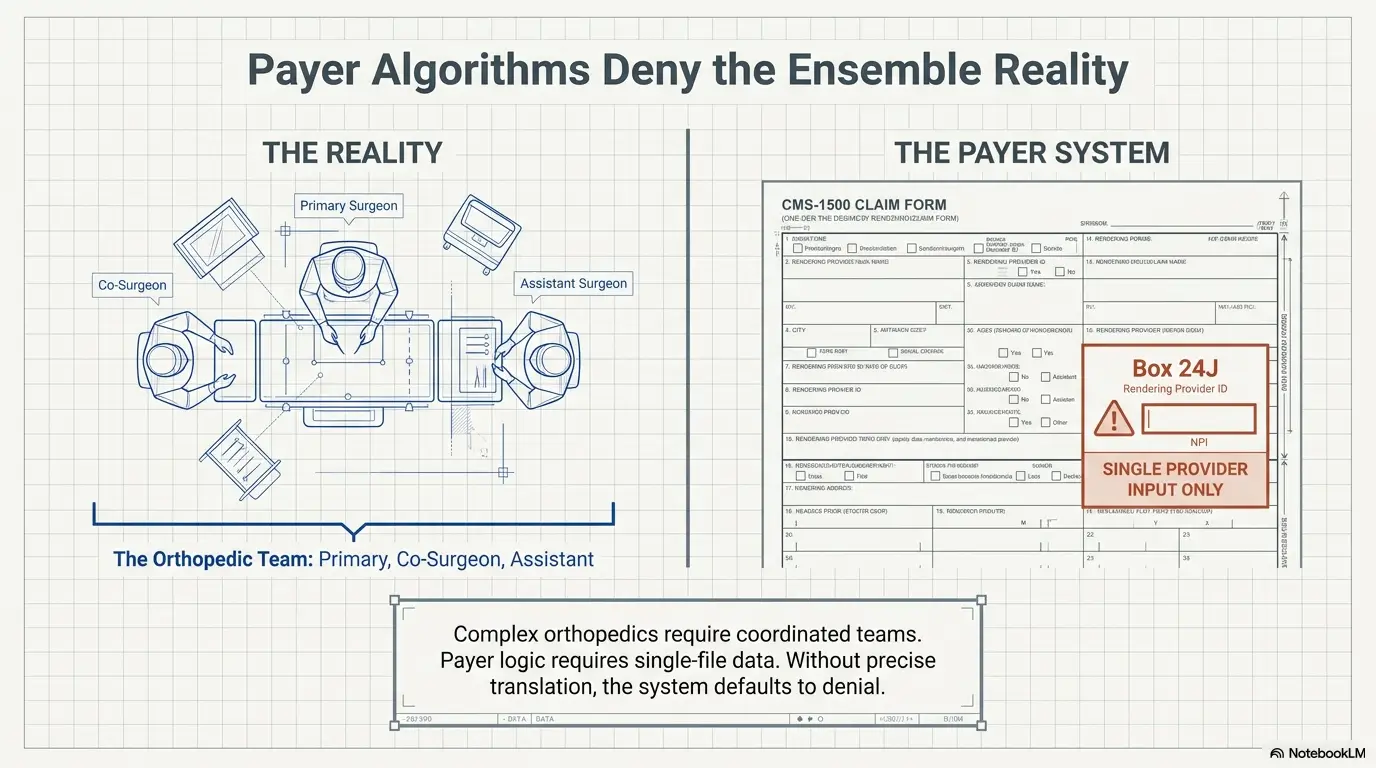
But the surgeon’s bill is only one thread. It may cover professional judgment, procedure work, fracture management, surgical care, or follow-up rules. It usually does not cover every person, room, supply, image, implant, or medication involved.
What the orthopedic surgeon usually bills for
The orthopedic surgeon may bill for an office visit, new patient evaluation, follow-up evaluation, injection, fracture care, surgical procedure, or post-operative professional services. If surgery occurred, the surgeon’s fee generally represents the professional work of evaluating, planning, operating, documenting, and managing certain follow-up care.
For example, after a rotator cuff repair, you may receive a surgeon bill for the procedure itself. That bill is separate from the operating room, anesthesia, implants or anchors, recovery area, and physical therapy afterward.
Some orthopedic procedures include a “global period,” which means certain routine follow-up visits may be included in the surgical payment for a set period. But that does not mean every related service is free. Imaging, braces, complications, unrelated problems, therapy, or services outside the global rules may still generate separate charges.
Why an assistant surgeon or physician assistant may appear
An assistant surgeon, physician assistant, nurse practitioner, or surgical assistant may appear on a bill if they helped during a procedure or provided a separately billable service. This can surprise patients because they may not remember meeting every person in the operating room.
Sometimes the assistant is medically necessary for exposure, positioning, tissue handling, implant placement, closure, or safety. Sometimes a payer may question or deny the assistant charge depending on the procedure, plan rules, and documentation.
If you receive an assistant surgeon bill, do not ignore it simply because the name is unfamiliar. Also do not assume it is automatically owed. Match it to the EOB and ask the billing office what role the provider had, whether the claim has fully processed, and whether the plan allowed the service.
When follow-up visits are included, and when they are not
Routine post-op checks after certain surgeries may be included in the surgeon’s global surgical package. That can mean you do not see a separate professional charge for standard wound checks or routine progress visits during the covered period.
But billing can change if the visit involves a new problem, a complication requiring separate management, imaging, a procedure, a brace, or care outside the expected post-op bundle. A patient who had knee surgery and later asks about new hip pain may see a separate office visit charge because the issue is not part of the knee surgery follow-up.
When in doubt, ask a precise question: “Was this follow-up visit considered part of the surgical global period, or was it billed separately because of a new service or diagnosis?” That question is sharper than “Why did you bill me?” and usually gets a better answer.
Key takeaway
The surgeon’s bill may be legitimate, but it is rarely the whole orthopedic cost story. The safest habit is to identify the role behind each name: surgeon, assistant, facility, anesthesia, radiology, equipment, lab, or therapy.
The Facility Fee Can Be the Quiet Giant
The facility fee is often the bill that makes patients sit up straight. It may come from a hospital, hospital outpatient department, or ambulatory surgery center. It can be larger than the professional bill because it reflects the cost of the setting, not just the clinician’s time.
That does not make every facility fee wrong. It does mean you should understand what type of facility you used and how your insurance treats that setting.
Why hospitals and surgery centers bill separately
A surgeon may perform the operation, but the facility provides the operating room, nurses, surgical equipment, sterilization, recovery area, medications, supplies, safety systems, and administrative infrastructure. Those costs may be billed by the facility, not the surgeon.
This separation can happen even when the surgeon’s practice is closely associated with the facility. In many cases, the professional bill and facility bill are separate claims. Your EOB may show different claim numbers, different billing entities, and different allowed amounts.
For a patient comparing care settings, this matters. A procedure done in a hospital outpatient department may have a different cost structure than the same procedure done in an independent ambulatory surgery center or office setting. The cheaper setting is not always clinically appropriate, but the setting should not be invisible to you.
What a facility fee may cover behind the scenes
A facility fee may cover staff, rooms, monitors, sterile instruments, medications, supplies, recovery care, implants, storage, documentation systems, and emergency readiness. In surgical settings, it can also reflect pre-op and post-op nursing time.
If you had an outpatient knee arthroscopy, for instance, the surgeon’s professional claim may describe the operation. The facility claim may include the operating room and recovery resources. The anesthesia group may bill separately. The brace supplier may also submit its own claim.
The confusing part is that all of these may share the same date. Same date does not mean duplicate. Same date often means several parts of the same care episode.
The small location detail that can change the whole bill
Location can change cost dramatically. A visit in a physician office, hospital outpatient department, ambulatory surgery center, or hospital inpatient unit may be billed differently. Even a clinic that looks like a normal doctor’s office may be owned by a hospital and billed as a hospital outpatient location.
Before a planned procedure, ask: “What is the facility type and billing location?” Then ask your insurer how that setting is covered under your plan. This is especially useful if you have a high deductible health plan, coinsurance, or a plan that treats hospital outpatient services differently from office-based care.
For more help thinking through facility costs, you may find it useful to compare this topic with hospital outpatient versus ASC facility fee differences. The principle is the same: the room can change the receipt.
Facility fee check
- Was the care performed in an office, hospital outpatient department, ambulatory surgery center, or inpatient hospital?
- Does your EOB show a separate facility claim?
- Did the facility process as in-network or out-of-network?
- Does the provider bill match the same date of service but a different role?
- Was there an estimate before care, and did the final allowed amount differ?
Anesthesia Bills Often Arrive From a Stranger
Anesthesia bills can feel especially strange because patients are, by design, not fully present for the most memorable part of the anesthesiologist’s work. You may remember a short conversation before surgery, then wake up in recovery. Weeks later, a bill arrives from a group name that sounds unrelated to your surgeon.
That surprise is common. Anesthesia providers often bill separately from the surgeon and facility.
Why the anesthesiologist may not work for the hospital
Many hospitals and surgery centers use independent anesthesia groups. The anesthesiologist or certified registered nurse anesthetist may provide care at the facility without being employed directly by that facility. That separate business relationship can lead to a separate claim and separate bill.
This is one reason “the hospital was in-network” is not always the end of the story. A facility can be in-network while certain professional groups have different contracts. Federal surprise billing protections may apply in some situations, but the details depend on the service, plan, provider, consent rules, and state protections.
If an anesthesia bill is unexpectedly out-of-network, do not pay immediately just to make the envelope go away. Ask your insurer whether the claim is protected under surprise billing rules, whether it should be reprocessed, and whether your cost-sharing should be limited to an in-network amount.
How anesthesia time can affect the final charge
Anesthesia billing often depends on base units, time, and sometimes modifiers. In plain English, the type of procedure and length of anesthesia care can affect the charge. A longer surgery may lead to higher anesthesia charges than a shorter procedure.
Patients do not need to calculate anesthesia units at the kitchen table. The practical move is simpler: compare the anesthesia claim on your EOB with the bill, confirm the date of service, check whether the plan allowed the charge, and ask whether the balance matches the insurer’s patient responsibility amount.
If the numbers do not match, ask both sides. Billing offices sometimes send statements before claims finish processing. Insurers sometimes deny or process claims incorrectly. The first answer is not always the final answer.
Don’t assume “in-network hospital” means “in-network anesthesia”
Before a scheduled orthopedic surgery, ask your surgeon’s office and facility which anesthesia group is expected to participate. Then call your insurer with the group name and facility name. Ask whether the anesthesia group is in-network for your specific plan, not just for the insurance company in general.
This is especially important for people with employer plans, narrow-network plans, marketplace plans, Medicare Advantage plans, or any plan where the network can feel like a maze built by a caffeinated accountant.
If you are already holding the bill, shift from prevention to repair. Ask whether the anesthesia claim is final, whether any out-of-network protection applies, and whether the biller will place the account on hold while insurance reviews it.
Key takeaway
An anesthesia bill from an unfamiliar group is not automatically a scam or a duplicate. But if it processed out-of-network after in-network facility care, pause and ask your insurer about surprise billing protections before paying.
Imaging Charges Can Split Into Two Bills
X-rays, MRIs, CT scans, and ultrasound-guided procedures can create separate charges that confuse even careful patients. The reason is usually the split between the technical component and the professional component.
In plain English, one charge may be for taking the image. Another may be for reading it.
The technical charge: taking the X-ray, MRI, or CT scan
The technical charge usually covers the equipment, room, technologist, supplies, and operational cost of producing the image. If you had an MRI, this may come from an imaging center, hospital outpatient department, or orthopedic clinic with imaging equipment.
For a simple X-ray in an orthopedic office, the technical charge may be bundled into the office’s billing process or appear separately. For an MRI or CT scan, the technical charge is more likely to be a noticeable claim because the equipment and facility costs are higher.
If your plan has a deductible or coinsurance, imaging can be one of the first places you feel the financial weight. You may also need prior authorization, depending on your plan and the type of scan.
The professional charge: reading and interpreting the image
The professional charge usually covers the radiologist’s interpretation. A radiologist may review the images and create a report for your orthopedic clinician. That professional interpretation can be billed by a radiology group whose name you do not recognize.
This is why an MRI may generate two claims: one from the imaging facility and one from the radiology group. The patient experience was one scan. The billing system sees two functions.
Before assuming duplicate billing, compare the descriptions. One may mention imaging services or facility charges. The other may mention interpretation, professional services, or radiology reading.
Why the radiology group name may look unfamiliar
Radiology groups often contract with hospitals, clinics, or imaging centers. You may never meet the radiologist, but their interpretation can become part of your medical record and treatment plan.
If the radiology bill looks unfamiliar, check the date of service, scan type, ordering provider, and EOB. If the date matches the scan and the EOB shows a professional radiology claim, the bill may be connected to your orthopedic care.
If the date, body part, or facility does not match, call before paying. Mistakes happen. So does confusion when several family members receive care around the same time.
Imaging bill matching list
- Find the scan date on the bill.
- Find the same date on your EOB.
- Look for separate technical and professional claims.
- Check whether the provider names match the facility or radiology group.
- Compare the bill balance with the EOB patient responsibility.
- Call if the scan type, body part, or date does not match your records.
If imaging costs are a major worry before the scan, the guide on HDHP imaging cost estimates may help you prepare better questions before scheduling.
Braces, Boots, Slings, and Ice Machines Have Their Own Billing Trail
Durable medical equipment, often called DME, includes items such as braces, walking boots, slings, crutches, walkers, cold therapy devices, and some post-op supports. In orthopedic care, DME is common because bones, joints, tendons, and ligaments often need protection while healing.
The billing surprise is simple: being handed an item in the clinic does not mean it was included in the visit charge.
Durable medical equipment is not always bundled into the visit
A knee brace, shoulder sling, walking boot, or post-op ice machine may be billed separately from the office visit or surgery. Sometimes the orthopedic practice bills it. Sometimes a separate DME supplier bills it. Sometimes insurance covers part of it, applies it to the deductible, or denies it depending on plan rules.
Patients often miss this because the item feels like part of the appointment. Someone measures your leg, adjusts the straps, and sends you home. The moment is practical and quick. The bill, sadly, has a longer memory.
If you are offered equipment, ask whether it will be billed to insurance, whether there is a rental or purchase charge, whether prior authorization is needed, and whether you can use an in-network supplier.
Why a knee brace may come from a separate supplier
Orthopedic offices may work with DME vendors that provide equipment to patients during visits. The supplier may have its own billing system, insurance contracts, and claim process. That is why the bill may not come from the orthopedic clinic at all.
This can be legitimate, but it is worth checking. Confirm the supplier name, item description, date, and insurance processing. If the item was returned, exchanged, or never received, document that quickly.
For patients using HSA or FSA funds, equipment rules can matter too. If you are sorting brace costs, you may also want to read about HSA-eligible braces and supports for a broader planning view.
Let’s be honest: “they handed it to me” does not mean it was free
This is one of the most useful phrases in orthopedic billing. “They handed it to me” describes how you received the item. It does not describe how the item was billed.
A front desk, medical assistant, brace fitter, or clinician may give you equipment because you need it for safety or recovery. That does not mean the charge was included in the copay. It also does not mean you had a clear estimate at the time.
Before paying a DME bill, ask: “Was this billed as a purchase or rental? Did insurance process it? Is this supplier in-network? Does the billed item match what I received?” Those questions often reveal whether the issue is a normal deductible charge, a network problem, a coding issue, or a genuine error.
Short Story: The brace bill that looked like a duplicate
Marina’s teenage son twisted his knee during a weekend soccer game. At the orthopedic visit, he had X-rays, a brief exam, and left with a hinged knee brace. Marina paid the office copay and felt relieved. The knee was swollen, but the plan was clear.
Three weeks later, a bill arrived from a company she did not recognize. It listed a brace, the same date as the appointment, and a balance that made her mutter at the kitchen counter.
Her first instinct was to throw it into the “duplicate nonsense” pile. Instead, she pulled the EOB, matched the date, and called the orthopedic office. The company was the DME supplier. Insurance had processed it, but the balance had been applied to her deductible.
The bill was not fun. It was also not random. One phone call turned a mystery into an unpleasant but understandable charge.
Physical Therapy May Become a Second Billing Universe
Physical therapy often begins after the orthopedic visit or surgery, but its billing life may be completely separate. This is where patients can lose track because therapy is repetitive. One initial evaluation, several follow-up visits, changing copays, visit limits, and different billing dates can blur together.
If surgery is the dramatic thunderclap, therapy is the steady rain. It may matter just as much to recovery, and it can create many smaller bills.
Why PT charges may come from a separate company
Some orthopedic practices own or partner with physical therapy clinics. Others refer patients to independent therapy providers. Hospitals may also operate outpatient therapy departments. Each arrangement can produce different billing names and cost structures.
Your surgeon may say, “Start PT next week,” but the therapy clinic still bills under its own tax ID, network contract, and visit rules. That means your therapy bill may not look like part of your surgery bill at all.
For each therapy provider, confirm whether the clinic is in-network, whether a referral or authorization is required, and whether your plan uses copays, coinsurance, or deductible billing for therapy visits.
How visit limits, referrals, and copays change the cost
Some plans limit the number of therapy visits per year. Others require authorization after a certain number of visits. Some charge a flat copay per visit. Others apply deductible and coinsurance. A few use different rules for hospital-based therapy compared with office-based therapy.
That means two patients doing the same exercises in the same building may owe different amounts. One may pay a $30 copay. Another may owe the full allowed amount until the deductible is met. A third may need authorization after six visits.
Ask before the second or third visit, not after the twelfth. Therapy is often scheduled in clusters, and cost confusion can grow quietly while you are focused on regaining range of motion.
The insurance detail patients often check too late
The detail patients often check too late is whether the specific therapy location is in-network for their specific plan. Not “Do they take my insurance?” That phrase can mean many things. The better question is: “Are you in-network for my exact plan, and how will my visits be billed?”
Also ask your insurer: “How many therapy visits do I have? Do I need authorization? Is the initial evaluation billed differently from follow-up visits? Do benefits reset by calendar year or plan year?”
If pain is continuing despite therapy, the article on physical therapy not helping orthopedic pain may help you prepare for a follow-up conversation with your clinician. That is separate from billing, but the two often meet when visits keep adding up.
| PT billing question | Why it matters | Who to ask |
|---|---|---|
| Is this location in-network for my exact plan? | Network status can change the patient balance | Insurer and PT billing office |
| Do I need a referral or authorization? | Missing paperwork may cause denials | Insurer, surgeon’s office, PT clinic |
| Is there a visit limit? | Later visits may be denied or require review | Insurer |
| Is the evaluation billed differently? | The first visit may cost more than follow-up visits | PT billing office |
| Does my deductible apply? | You may owe more early in the plan year | Insurer |
Key takeaway
Physical therapy can turn one orthopedic injury into a series of recurring claims. Before visits stack up, confirm network status, authorization rules, visit limits, and whether you owe copay, coinsurance, or deductible amounts.
Common Mistakes That Make Orthopedic Bills Harder to Fix
Most billing mistakes made by patients are not foolish. They are understandable reactions to stress. The envelope arrives. The language is stiff. The amount is unpleasant. The deadline looks stern. The brain says, “Pay it, ignore it, or panic.”
A better response is slower and stronger: sort, match, question, document.
Mistake 1: Paying the provider bill before reading the EOB
The provider bill may show a balance before insurance has finished processing, or it may not reflect the final allowed amount and adjustments. If you pay too early, you may later need to chase a refund. Refunds can happen, but they are rarely as swift and graceful as the original payment request.
Before paying, find the matching EOB. Confirm the provider name, date of service, claim number, billed amount, allowed amount, insurance payment, adjustment, and patient responsibility. If the EOB says the claim is pending or denied, ask more questions before paying.
Mistake 2: Ignoring a bill because the name looks unfamiliar
Unfamiliar names are common in orthopedic billing. The radiology group, anesthesia group, pathology lab, DME supplier, or assistant surgeon may not be a name you remember. Ignoring the bill can create late fees, collection notices, or missed dispute windows.
Instead, treat unfamiliar names as investigation flags. Search your EOBs for the date. Call the main orthopedic office and ask whether that entity was connected to your care. Call the biller and request an itemized statement if needed.
Mistake 3: Assuming every charge from the same date is a duplicate
Orthopedic bills often share dates because several services happen during one appointment or procedure. A same-day surgeon, facility, anesthesia, radiology, and DME charge may all be tied to the same event.
A true duplicate usually has the same provider, same service, same date, same code or description, and same claim pattern. A same-date charge from a different provider role may be separate, not duplicate.
Mistake 4: Waiting until the account reaches collections
Billing problems are easier to fix while the account is still with the provider or facility. Once collections enter, the conversation can become more rigid and stressful. The best time to call is when the bill first looks wrong, not after the third notice.
If you are actively disputing a bill, ask the billing office to place the account on hold while it is reviewed. Get the representative’s name, date, and reference number. Keep notes like you are leaving breadcrumbs for your future self.
Mistake checklist
- Paying a provider statement before insurance finishes processing
- Ignoring bills from unfamiliar medical group names
- Assuming same-date charges are duplicates without checking provider roles
- Forgetting to ask for an itemized bill
- Not documenting calls, reference numbers, and promised account holds
- Waiting until collections before asking questions
Show me the nerdy details
A medical claim can change several times before the final patient balance is clear. The provider submits charges. The insurer applies plan rules, network contracts, allowed amounts, deductible, copay, coinsurance, and exclusions. The provider then posts insurance payments and adjustments before billing the patient.
This is why a provider statement and EOB may temporarily disagree. The safest question is not “Why is this so expensive?” The sharper question is: “Has the claim fully processed, and does this balance match the final EOB patient responsibility?”
The EOB Is Your Decoder Ring, Not Your Bill
The EOB is the document that turns billing fog into shapes. It may still be annoying. It may still use language that feels like it was translated from ancient printer paper. But it is the best starting point for understanding what your insurer did with the claim.
Do not pay from the EOB itself. Use it to check whether the provider bill makes sense.
How to match provider names, dates, claim numbers, and allowed amounts
Start with the date of service. Orthopedic billing often has multiple claims from the same date, so date alone is not enough, but it is the first sorting tool.
Next, match the provider name. This may be the surgeon, facility, anesthesia group, radiology group, DME supplier, or therapy clinic. Then compare the billed amount, allowed amount, insurance payment, adjustment, and patient responsibility.
If the provider bill asks for more than the EOB says you owe, call before paying. If the EOB says you owe more than the bill, do not volunteer extra money. Pay the valid bill after confirming the claim is final.
What “patient responsibility” really means
Patient responsibility is the amount your plan believes you may owe after processing the claim. It can include deductible, copay, coinsurance, non-covered services, or other plan-based amounts.
The phrase “may owe” matters because billing offices still need to post payments and adjustments correctly. If the provider’s statement does not match the EOB, the discrepancy needs review.
Also remember that multiple EOBs may exist for one episode of care. A knee surgery could have an EOB for the surgeon, facility, anesthesia, brace, and therapy. Your job is not to merge them into one emotional blob. Your job is to match them one by one.
Why denied claims deserve a second look before panic sets in
A denied claim does not always mean the patient owes the full billed amount. Denials can happen because of missing information, coding issues, authorization problems, coordination of benefits, network confusion, or documentation requests.
If a claim is denied, call the insurer and ask why. Then call the billing office and ask whether they are appealing, correcting, or resubmitting the claim. Ask that the account be paused while the claim is under review.
For orthopedic patients, denials can be especially frustrating after imaging, surgery, injections, or therapy. Do not assume the first denial is the final word. Also do not assume it will fix itself without follow-up.
The 5-Step Orthopedic Bill Check
Collect every bill, EOB, estimate, and receipt.
Pair each bill with the matching EOB claim.
Check provider role, date, network status, and balance.
Call when names, amounts, or claim status do not align.
Pay, appeal, request correction, negotiate, or seek help.
When to Seek Help Before Paying
Some bills can be solved with one careful phone call. Others need backup. The trick is knowing when the issue is too large, too risky, or too tangled to handle alone.
Help may come from your insurer, provider billing office, employer benefits department, state insurance department, Medicare plan, Medicaid office, patient advocate, medical billing advocate, or attorney. The right helper depends on the type of plan and the nature of the dispute.
Ask your insurer when charges seem out-of-network unexpectedly
If you used an in-network facility but received an out-of-network bill from anesthesia, radiology, assistant surgery, or another provider you did not choose, call your insurer before paying. Ask whether federal or state surprise billing protections apply.
Use direct wording: “I received a bill from an out-of-network provider connected to care at an in-network facility. Does the No Surprises Act or any state protection apply to this claim?”
If the representative says no, ask them to explain why and document the answer. If the answer seems inconsistent with the EOB or your situation, ask for a supervisor or written appeal instructions.
Contact the billing office when names, dates, or procedures do not match
If the bill has the wrong date, wrong body part, wrong provider, wrong insurance, wrong patient, or a service you do not recognize, contact the billing office. Ask for an itemized statement and claim review.
Be calm but specific. “I do not recognize this” is a start. “The bill lists a right shoulder service on May 12, but my appointment was for my left knee on May 14” is stronger.
Ask the office to pause billing while they investigate. If they agree, write down the date, person, and expected review time. If they refuse, ask what dispute process is available.
Consider a billing advocate for large balances, surgery bills, or appeals
A medical billing advocate may help review itemized bills, EOBs, coding issues, network disputes, denied claims, and negotiation options. This can be worth considering when the balance is large enough that mistakes or missed appeals could cost more than the advocate’s fee.
Help may be especially useful for surgery bills, multiple providers, denied pre-authorized services, out-of-network disputes, workers’ compensation overlap, accident claims, or bills already moving toward collections.
Before hiring anyone, ask about fees, experience, scope, expected timeline, and whether they make promises. Be cautious with anyone who guarantees a specific reduction. Medical billing is too plan-specific for magic wand language.
Question list for a billing call
- Has insurance fully processed this claim?
- What claim number does this bill match?
- Does the balance match the EOB patient responsibility?
- Was this provider in-network for my specific plan?
- Was this service denied, adjusted, appealed, or resubmitted?
- Can the account be placed on hold during review?
- Can you send an itemized statement?
- What is the deadline to appeal or dispute this balance?
FAQ: Orthopedic Billing Questions Patients Ask After the Envelope Arrives
Why did I get separate bills after one orthopedic appointment?
You may receive separate bills because different parts of the visit were billed by different entities. The orthopedic clinician, facility, imaging provider, radiology group, lab, equipment supplier, or therapy provider may each submit separate claims. Match every bill to your EOB before paying.
Why is the anesthesiologist billing me separately?
Anesthesia providers often bill separately from the surgeon and facility. They may belong to an independent anesthesia group. If the bill processed out-of-network after care at an in-network facility, ask your insurer whether surprise billing protections apply.
Can an assistant surgeon charge me even if I never met them?
Possibly. An assistant surgeon or qualified assistant may bill if they helped during the procedure and the service was documented and allowed by your plan. Because rules vary, compare the claim with your EOB and ask what role the assistant had.
Why did my MRI create two different charges?
An MRI may create a technical charge for taking the scan and a professional charge for the radiologist’s interpretation. These may come from different billing names. Same date does not automatically mean duplicate.
Do I have to pay before insurance finishes processing?
Usually, it is safer to wait until insurance has fully processed the claim, unless you have confirmed the amount is final or agreed to a specific prepayment arrangement. Ask the billing office whether the claim is final and whether the balance matches the EOB.
What should I do if the bill says out-of-network?
Call your insurer and ask why it processed out-of-network. If the provider was connected to emergency care or non-emergency care at an in-network facility, ask whether federal or state surprise billing protections apply. Do not pay a large unexpected out-of-network balance without checking.
How can I tell whether a charge is a duplicate?
Compare provider name, date, service description, claim number, billed amount, and EOB details. Same date alone is not enough. A true duplicate usually repeats the same service from the same provider, while separate legitimate charges often come from different provider roles.
Can I negotiate an orthopedic bill?
Sometimes. Negotiation may be possible for self-pay balances, financial hardship, large bills, prompt-pay discounts, or payment plans. However, insured in-network claims often follow contract rules. Ask politely, get terms in writing, and avoid skipping the EOB review.
Build a One-Page Bill Check Before You Pay
The most useful next step is not a heroic three-hour billing investigation. It is a one-page bill check you can start in 15 minutes. A simple page beats a messy folder because it gives every bill a place to land.
Open a notebook, spreadsheet, or blank document. Make one row for each bill. Then fill in the basics: date of service, provider name, provider role, amount billed, EOB patient responsibility, claim status, and next action.
Gather every bill, EOB, and receipt from the same date of service
Start with one date of service. Do not try to solve six months of orthopedic care at once unless you enjoy paperwork as a contact sport. Choose the surgery date, MRI date, injection date, or first appointment date that produced the confusing bills.
Collect provider bills, facility bills, EOBs, receipts, estimates, payment confirmations, portal messages, and prior authorization letters. If something is missing, write “missing” rather than waiting for the perfect file.
Circle names that do not match and call before sending payment
Unfamiliar names deserve attention, not panic. Circle them and ask what role they played. Was the name connected to anesthesia, radiology, DME, lab work, facility billing, or therapy?
Call with your date of service and claim number ready. A prepared caller often gets a clearer answer because the representative does not have to sift through fog while you shuffle papers.
Use one concrete question: “Has insurance fully processed this claim?”
This question is the hinge. If the claim has not fully processed, payment may be premature. If it has processed, compare the final EOB with the bill. If they match and the service is recognized, you can decide whether to pay, request a payment plan, ask about financial assistance, or negotiate when appropriate.
If they do not match, ask why. The answer may be posting delay, corrected claim, denial, appeal, coordination of benefits, network status, or a billing error. Each problem has a different door. Your one-page check helps you find the handle.
One-page orthopedic bill check template
| Date of service | Example: March 14 |
| Provider or company name | Surgeon, facility, anesthesia, radiology, DME, PT |
| Claim number | Copy from EOB or insurer portal |
| Bill balance | Amount provider asks you to pay |
| EOB patient responsibility | Amount insurer says may be yours |
| Status | Pending, processed, denied, appealed, corrected, paid |
| Next action | Pay, call insurer, call biller, request itemized bill, appeal, seek help |
Final key takeaway
Your next 15 minutes can save hours later: gather the documents from one date of service, match each bill to an EOB, circle unfamiliar names, and ask whether insurance has fully processed the claim. Calm paperwork is not glamorous, but it is powerful.
Orthopedic billing feels complicated because it is built from many moving parts. But you do not need to understand every contract, code, and reimbursement formula to protect yourself. You need a repeatable process: identify the provider role, match the EOB, verify the balance, and ask the right question before money leaves your account.
Start with the most confusing bill on your desk. Write down the date, the name, the amount, and the claim status. Then ask the small question that opens the right door: “Has insurance fully processed this claim?”
Last reviewed: 2026-06