

Two to four inches is the difference between “clean socks” and tomorrow’s leg lightning.
When you’re folding laundry with sciatica, the flare usually isn’t the shirt—it’s the setup: a surface that’s too low, a basket living on the floor, and dozens of tiny bends and twists that feel harmless until they stack. If this sounds familiar, you’ll notice the same pattern shows up in other “everyday” chores like washing dishes with sciatica and mopping with sciatica—the task isn’t dramatic, but the angles add up.
The Elbow-to-Hip Method
Stand tall with shoulders relaxed and elbows bent about 90°. Measure your standing elbow height from the floor, then set your folding surface 2–4 inches below that. This keeps your hands working in a safe reach zone while protecting a neutral spine from sustained forward flexion.
Stop paying the “next-day pain tax.” This approach is built around reducing awkward posture and cumulative load—not “perfect posture” myths. The fix is boring, fast, and requires no heroics.
- ✓ Set your folding height in under 60 seconds
- ✓ Eliminate the bend–twist–time combo that triggers flares
- ✓ Move laundry (even stairs) without loaded rotation
No pain bargaining. Just cleaner mechanics.
Table of Contents
Folding height formula: Elbow-to-Hip Method (elbow − 2–4″)
Most “laundry ergonomics” advice says “use a comfortable height,” which is like telling someone to “buy a comfortable mattress.” Helpful in spirit. Useless in a hallway closet.
Here’s the measurable version for folding laundry with sciatica: stand tall, shoulders relaxed, elbows around 90°, and set your folding surface 2–4 inches below your elbow height. That small drop lets your hands work without shrugging, while your spine stays neutral instead of curling into a long forward bend.
- Start point: elbow height from the floor while standing tall
- Target surface: elbow height minus 2–4 inches
- Goal feeling: hands move; torso stays quiet
A familiar scene: you start folding on a low bed. It feels fine for 2 minutes. Then your shoulders rise, your neck tightens, and you begin “helping” your arms by rounding your back. That’s the moment your table tells the truth.
20-second measurement (no tools)
No tape measure? No problem. Use the “forearm reference”: make a gentle fist, bring your elbow to 90°, and imagine a line across the room from your elbow. Now picture your folding surface sitting just a little below that line—roughly the thickness of two fingers to a palm lower.
If you can fold a shirt with your shoulders staying down (no creeping shrug), you’re close. If you catch yourself “lifting” your shoulders to keep your hands working, the surface is too high. If you catch yourself bending forward to reach the work, it’s too low.
The 2–4″ range: when to use 2″ vs 4″
Think of the range as a dial you adjust based on your body and your symptom sensitivity that day:
- Use ~2 inches below elbow if you’re shorter, folding bulky items (towels/hoodies), or you get neck/upper-back tension easily.
- Use ~3 inches below elbow as the “default” for mixed loads (shirts, pants, kids clothes).
- Use ~4 inches below elbow if you’re tall with long arms or you prefer your wrists neutral (less wrist extension).
Micro-cue: “quiet shoulders, stacked ribs, chin level”
This is your instant posture audit: quiet shoulders (no shrug), stacked ribs (not flared), chin level (not craned). If you lose two of the three, change the setup before you “push through.”
- Set the folding surface 2–4″ below elbow height
- Use shoulder creep as your “wrong height” alarm
- Adjust the dial based on bulk and symptom day
Apply in 60 seconds: Stand at your folding spot and do one shirt. If your shoulders climb, raise/lower the surface before you continue.
Mini calculator: your folding surface target (elbow − 2–4″)
Enter your standing elbow height (from floor to elbow). You’ll get a target range for your folding surface. This stores nothing and works with one number.
Neutral action: jot the number on a sticky note and test it once—then adjust by 1″ if needed.
Show me the nerdy details
This formula is a practical “fit the task to the body” shortcut: it reduces time spent in sustained trunk flexion (forward bend) and minimizes repeated rotation. Ergonomics frameworks used by groups like NIOSH focus on reducing awkward postures and cumulative load—this is a home-friendly way to apply the same principle without overengineering your laundry room.

Why folding flares sciatica: the bend-twist-time combo
Sciatica doesn’t always flare from one dramatic move. More often, it’s death by a hundred tiny “harmless” ones: bend into the basket, twist to the stack, bend again, twist again—until your body starts negotiating with pain.
The Trigger Triad (laundry edition)
- Bend: repeated forward hinge, especially reaching into a low basket
- Twist: small rotations while loaded (hands holding fabric, torso rotating)
- Time: staying in the position long enough for your body to stiffen and complain
Forward hinge + rotation: why “reaching into the basket” is the real villain
It’s rarely the folding motion that gets you. Folding itself is small and close. The problem is the reach-and-recover cycle—especially if the basket lives on the floor. Each grab asks your spine to flex, your pelvis to shift, and your torso to rotate slightly as you reorient the item.
That combo can irritate a cranky nerve path even when each individual movement feels “fine.” The fix is unglamorous: put the basket waist-high, keep it on the same side as your working hand, and stop harvesting clothes from below mid-thigh. (If you’re noticing this same “reach-and-recover” pattern on stairs, it’s worth reading how vacuuming stairs can flare sciatica—the mechanics are cousins.)
Open loop: Why Day 1 feels fine—and Day 3 bites back
Here’s the weird part: Day 1 often feels okay. That’s because your body can borrow comfort from novelty, adrenaline, and short exposure. Day 3 is when accumulation shows up—stiffness, protective muscle guarding, and a nervous system that learned the chore as a threat.
The good news: the same accumulation works in your favor. If you remove the bend-twist-time combo, the “next-day pain tax” usually shrinks fast—often within a week of consistent setup. (And if you’re the type who spirals into doom-scrolling symptoms after a flare, you’re not alone—this is exactly the loop described in cyberchondria and chronic pain.)
Short Story: The basket that “wasn’t heavy” (120–180 words) …
Short Story: A person folds laundry on a low couch because it feels cozy and “not strenuous.” The first load is fine. The second load takes longer because socks vanish into a little black hole. They start leaning forward, reaching into the basket, twisting to drop stacks behind them, and holding their breath during the awkward grabs. Nothing feels dramatic—just mildly annoying. That night, they sleep okay.
The next morning, the leg pain is sharper and the back feels “locked.” They blame the laundry itself, like folding shirts is inherently dangerous. But the real culprit was invisible: the couch height made every grab a mini-forward bend, and the stacks behind them turned every placement into a twist. When they moved the basket to a waist-high chair and set stacks in front, the same amount of laundry took fewer “spinal reps.” The pain didn’t vanish instantly, but the next-day spike stopped feeling inevitable.
- Reaching into a low basket is the highest-risk move
- Twisting while placing stacks quietly adds up
- Time in the position matters as much as the position
Apply in 60 seconds: Raise the basket to waist height and move stacks in front of you—then fold one small pile as a test run.
Choose your folding surface: counter vs table vs bed vs chair+board
You don’t need the perfect laundry room. You need a surface that lets you fold with short reach and neutral spine. That’s it.
The best surface is the one that reduces the Trigger Triad without creating a new problem (like wrist strain or shoulder shrugging). Here are the real-world tradeoffs.
Decision card: which folding surface wins today?
Pick based on symptom day, space, and how much bending you can tolerate today.
Counter / high dresser (best if available)
- Pros: minimal bending, quick setup
- Pain traps: shoulder shrug if too high, reaching across deep counters
- Quick fix: pull items closer; don’t work at the back edge
Table / ironing board (most adjustable)
- Pros: easy to set to elbow-based height
- Pain traps: wobble, too narrow for stacks
- Quick fix: keep stacks small; add a second “stack spot”
Bed (common, but risky)
- Pros: soft on feet, feels convenient
- Pain traps: encourages rounding and prolonged flexion
- Quick fix: raise the work onto a firm board or suitcase at the right height
Chair + board (small apartment hero)
- Pros: portable height hack, minimal equipment
- Pain traps: twisting if you set stacks behind you
- Quick fix: build front-facing zones (more on that next)
Neutral action: choose one surface for a week and refine it—constant switching often recreates the same mistakes.
Best-case setup: high surface + light reach (what “high” means in practice)
“High” doesn’t mean shoulder level. It means your elbow minus 2–4 inches. A kitchen counter is often close, but not always—especially if you’re shorter or your counters are deep.
If the counter is deep, your hands drift forward and your back follows. Pull a small pile to the edge so you’re working in your forearm reach zone, not your “lean and hope” zone.
If you must use a bed: raise the work, don’t lower your spine
Beds are comfort traps. They invite the long forward bend that feels gentle—until it doesn’t.
- Put a firm board or suitcase on the bed to raise the work closer to your elbow-based height.
- Sit with hips supported and feet grounded (more in the sit/stand section).
- Keep the basket up—don’t keep diving down into a pile like you’re apple-bobbing for socks.
Small-apartment hack: chair + board + foot support
This one is surprisingly effective: place a sturdy chair beside you, set a board or flat bin lid on top, and use it as a folding platform. Add a small footrest (or a thick book) so one foot can rest slightly higher—micro-shifting without thinking.
A tiny scene: you fold three shirts, switch which foot is on the “little step,” and your back stops clenching like it’s bracing for impact. That’s not magic. That’s load distribution.
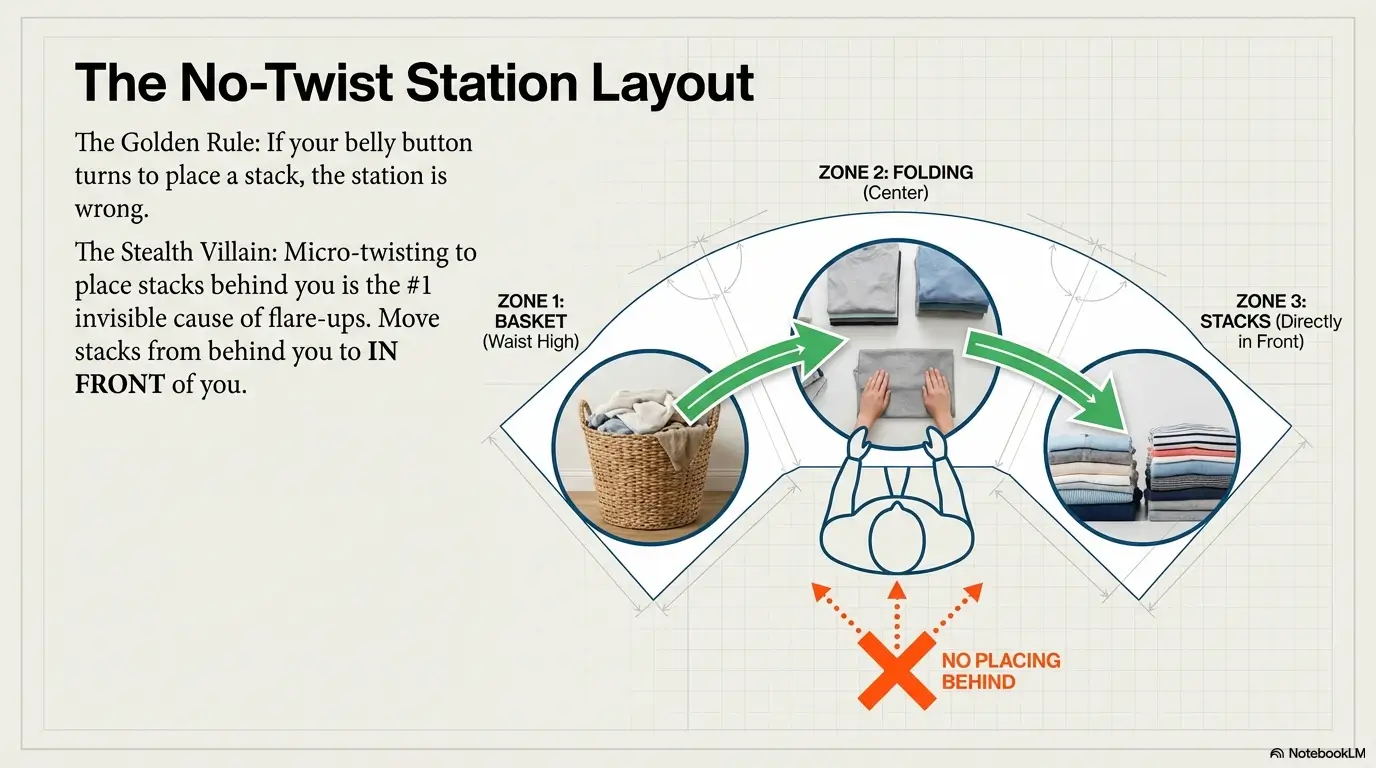
No-twist station layout: Basket → Fold Zone → Stack Zone
This is the section most people skip because it feels “extra.” It’s also the section that can reduce tomorrow’s pain the fastest, because it removes the stealth villain: micro-twisting.
Your goal is simple: everything you touch should be forward-facing. Not “kind of in front.” Actually in front.
Basket placement rule: same-side, waist-high support (never floor)
Put the basket on a chair, stool, or the dryer top—anything that keeps it around waist height. Keep it on the same side as your dominant hand so you aren’t rotating to retrieve items.
- Right-handed: basket on right, fold center, stacks slightly left-center
- Left-handed: basket on left, fold center, stacks slightly right-center
Stack placement rule: forward-facing, within forearm reach
Your stacks should live where your forearms can reach without your ribs turning. If you feel your belly button rotating toward the stack, it’s too far to the side or behind you.
Keep stacks intentionally small. A stack that grows tall becomes a precision task, and precision tasks make you hold your breath and stiffen. That stiffness is expensive.
Open loop: The one “tiny reach” that doubles tomorrow’s pain
It’s the reach behind you. The “just this once” twist to put a pile on the bed behind your hip. It feels trivial—until you do it 80 times.
If you only fix one thing, fix that: keep stacks in front, not behind. You’ll see why when we get to the common mistakes section—and how to escape the “I’ll just finish this pile” trap without quitting.
Infographic: The No-Twist Folding Station (front-facing workflow)
1) Basket (waist-high)
Same-side placement. No floor dives.
2) Fold Zone (center)
Work close. Quiet torso.
3) Stack Zone (front-facing)
Within forearm reach. No behind-you piles.
Rule: If your belly button turns, your station is wrong.
Rotate objects and zones—don’t rotate your spine.
- Basket waist-high, same side
- Fold zone centered
- Stacks in front, within forearm reach
Apply in 60 seconds: Move your stacks from behind you to in front of you—then fold five items as a proof test.
The no-hunch stance: split stance + weight shift (laundry edition)
Your posture doesn’t need to be perfect. It needs to be dynamic. The most protective stance for laundry is a gentle split stance with micro weight shifts—because it stops you from locking into one position.
Feet + hips + ribs: the 10-second setup
- Feet: one foot slightly forward (like you’re about to take a slow step)
- Hips: soft knees, weight evenly distributed
- Ribs: stacked over pelvis (no “rib flare”)
Then, every few folds, shift your weight forward/back by an inch. It’s not exercise. It’s a nervous system signal: “We’re safe. We’re moving.”
Hands stay centered: reduce trunk rotation
If your hands drift to one side, your torso follows. Keep the fold happening in the middle, like you’re working over a small island, even if you’re at a narrow table.
- Bring the item to you (slide the fabric), not your spine to the item.
- Keep stacks small enough that placement stays simple and close.
- Use “two-step turns” if you must change direction: step your feet, then turn—never twist on a planted pelvis.
Pattern interrupt micro-H3: “If your shoulders creep up, your table is lying.”
This is the funniest and most reliable cue: if your shoulders are creeping toward your ears, your surface is wrong, your reach is too far, or your stacks are placed like a prank. Fix the setup. Your body is not being dramatic—it’s giving you a receipt.
If you want the “bigger picture” behind why this works, NIOSH’s ergonomics guidance is built around reducing awkward postures and cumulative load—exactly what we’re doing here, just with socks and towels instead of factory tasks.
The 3-3-3 Laundry Rule: micro-dosing to prevent flares
The fastest way to flare sciatica during chores is the phrase: “I’ll just finish.” It’s a perfectly normal thought… and it’s also how you accidentally create a 40-minute endurance event in a posture your body hates.
The fix isn’t willpower. It’s a rule that removes decision fatigue. That’s why simple systems (even outside health—think capsule rules in lifestyle habits) can work: they make the “stop” automatic.
3 minutes fold → 3 breaths reset → 3-item stack cap
Here’s the rhythm:
- 3 minutes of folding (timer on, not “vibes”)
- 3 breaths reset (exhale long, shoulders drop, gentle weight shift)
- 3-item stack cap (place only three items, then return to fold zone)
Why the stack cap? Because stacking is where twisting sneaks in. The cap forces you to keep placement clean and prevents the “pile behind you” problem from coming back.
Why rules beat willpower (decision fatigue parallel)
A rule is a tiny contract you don’t renegotiate when you’re tired. When your back is sensitive, renegotiation tends to go like this: “Just this one load… okay, just this one pile… okay, just these socks.” Suddenly you’ve been bending and rotating for 25 minutes without meaning to.
Open loop: The “I’ll just finish this pile” trap—and the escape hatch
The escape hatch is the timer, not your mood. When the timer ends, you don’t “take a break.” You reset your position—three breaths, one gentle weight shift, and a quick check that your stacks are still in front. This prevents the trap from forming in the first place.
Eligibility checklist: is today a “fold normally” day or a “micro-dose” day?
- Yes/No: Can you stand/sit with symptoms staying steady for 2 minutes?
- Yes/No: Can you hinge slightly without a pain spike shooting down the leg?
- Yes/No: Does a posture reset (3 breaths) reduce tension even a little?
One-line next step: If any answer is “No,” use the 3-3-3 rule and cut the load size in half.
Neutral action: decide your pace before you start—then follow the rule without bargaining.
- Timer-based folding stops accidental endurance sessions
- Breath resets prevent stiffness from snowballing
- Stack caps reduce twisting more than you’d expect
Apply in 60 seconds: Set a 3-minute timer right now—before you touch the basket.
Sit or stand? A sciatica-specific decision guide
The internet loves debates like “sitting is the new smoking” or “standing desks saved my life.” Sciatica doesn’t care about trends. It cares about tolerance and position changes.
Some days standing feels better because it avoids hip flexion. Other days sitting feels better because it reduces compression and lets you keep work close. The win is choosing the option that stays stable for 5–10 minutes with resets—not the option that sounds virtuous. (If you want a workday version of the same decision logic, see a sit-stand schedule for desk job sciatica.)
Standing works when: neutral spine + frequent micro-shifts
- You can keep ribs stacked over pelvis without bracing.
- You can shift weight every 30–60 seconds (without thinking too hard).
- Your folding surface is correct so you don’t hunch.
Standing fails when you lock your knees and “bear down” through your back. If your glutes feel asleep and your low back is doing all the work, your stance needs a reset.
Sitting works when: hips supported, feet grounded, hips slightly higher than knees
Sitting can be excellent if it’s set up correctly:
- Hips supported: sit back so the chair holds you, not your spine
- Feet grounded: both feet flat or one foot slightly elevated on a small support
- Hips slightly higher than knees: a small cushion can help
Sitting fails when you perch on the edge and round forward, turning folding into a long flexion hold.
The one chair detail that matters: seat height + foot support combo
If your chair is too high, your feet dangle and your pelvis tilts. If it’s too low, your hips collapse and you round. The easiest fix is a foot support: a small box, a thick book, or a stable step can make a mediocre chair feel “custom.” (This is also why “gear debates” can miss the point—chair vs standing desk only matters if it helps you change positions; here’s a useful lens: ergonomic chair vs standing desk.)
Quote-prep list: if you’re comparing laundry gear, gather this first
- Your elbow height (inches) and target surface range
- Your space constraints (narrow hallway? small bedroom? laundry closet?)
- Your non-negotiable: standing-only, sitting-only, or mixed days
- Transport path: stairs, door thresholds, long carry to a closet
- Top flare trigger: bending into basket, twisting to stacks, or standing too long
Neutral action: take one photo of your current setup and mark where your basket and stacks sit—then redesign those zones first.
Common laundry mistakes that spike sciatica (and the quick fixes)
This is where we close a couple open loops—because most flare-ups come from a handful of repeat offenders. The good news: these are fixable in minutes, not weeks.
| Mistake | Why it spikes symptoms | Quick fix (today) |
|---|---|---|
| Folding below mid-thigh | Sustained trunk flexion + repeated recovery | Raise the surface to elbow − 2–4″ (chair, counter, board) |
| Twisting into the basket | Rotation sneaks in every grab | Basket same-side, waist-high; rotate the station, not your spine |
| Stacks behind you | The “tiny reach” repeated 50–100 times | Bring stacks in front; cap stacks at 3 items per placement |
| Holding your breath | Bracing increases stiffness and perceived threat | 3-breath reset; longer exhale; drop shoulders |
| “One more load” volume creep | Time under tension grows without you noticing | Smaller loads + timer rule; stop at the end of a cycle |
Pattern interrupt micro-H3: “It’s rarely the shirt. It’s the stack.”
People blame towels because they’re heavy. But the flare often comes from the place you put the towel—behind you, too far away, with a twist. Fix the stack zone and “heavy laundry” becomes less dramatic.
Remember the open loop about Day 1 vs Day 3? This is how you win it: you remove the repeated offenders so the accumulated load drops. You’re not chasing perfect posture. You’re reducing the number of times your body has to negotiate with pain. If your baseline symptoms are already high (or confusing), it can help to read a clearer overview of sciatica nerve pain and how it behaves across the day.
Basket carry & transport: the safest way to move laundry (including stairs)
Folding is only half the story. Transport is where many people get caught: a basket held away from the body, a doorway twist, a stair trip done in one heroic sprint.
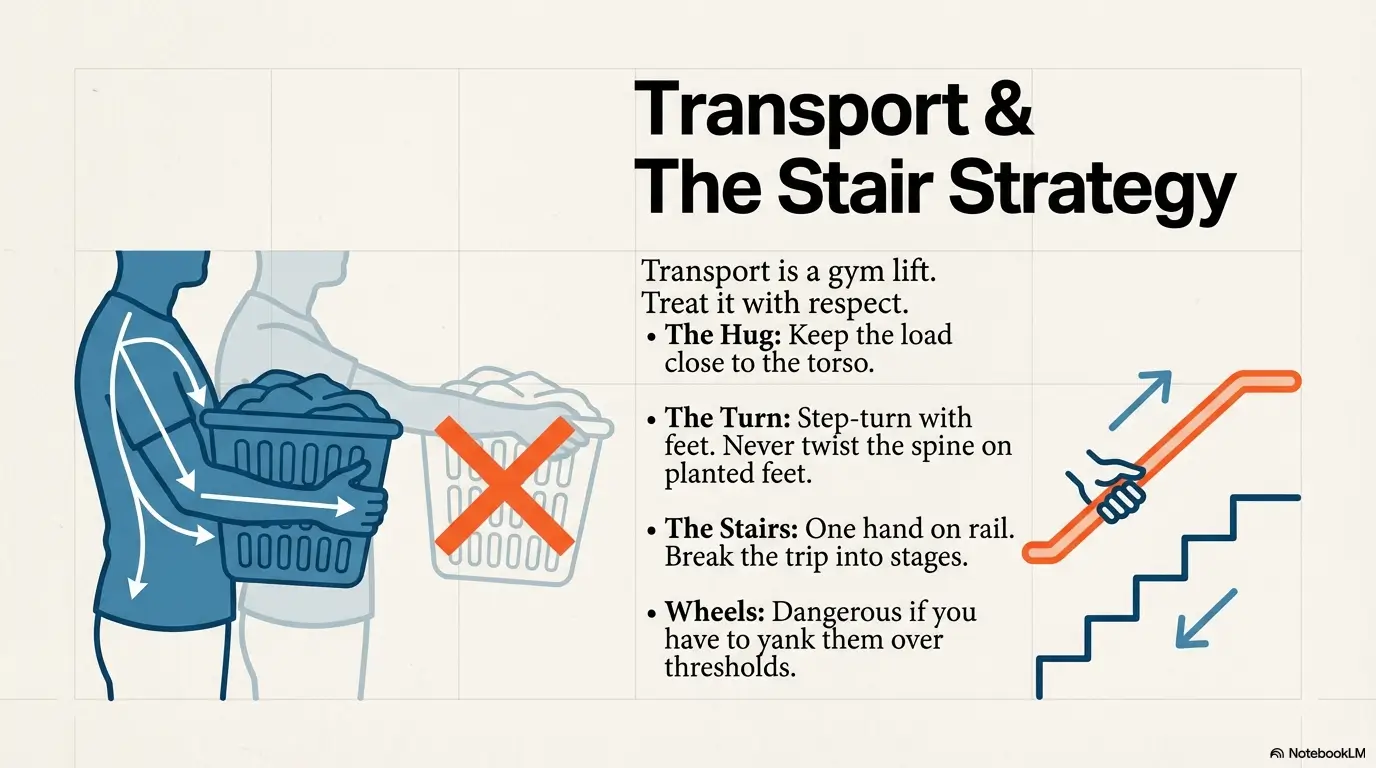
The rule is boring and effective: keep the load close, break the trip, and don’t rotate under load. If you want a dedicated version of this section for multi-floor homes, bookmark how to carry laundry upstairs with sciatica.
Wheels help—when they actually reduce load
A wheeled basket can be great if your floors are smooth and your path is clear. But if you’re yanking it over thresholds, you may trade carrying load for jerking load.
- Good wheel scenario: flat hallways, minimal thresholds, short turns
- Bad wheel scenario: thick rugs, stairs, frequent lifting anyway
If you must lift: no twist + smaller batches
If your basket is heavy enough to make you grimace, it’s heavy enough to justify two trips. Two trips is not failure; it’s strategy. (If you like having a number instead of vibes, you may find a grocery bag weight limit for sciatica surprisingly useful as a “load reality check.”)
- Hug the basket close to your torso (no “arms extended” carries).
- Turn with your feet (step-turn), not your spine.
- Use smaller batches: towels separated, clothes separated—less awkward shifting.
Stair rule: one hand on rail, basket hugged close, break the trip
Stairs are where people forget every rule because they’re focused on not tripping. Give yourself permission to slow down. If stairs are part of your weekly routine, it’s worth pairing this with a safer vacuuming-on-stairs strategy—because laundry isn’t the only “hidden lifting” that shows up there.
- One hand on the rail whenever possible.
- Basket close to the body; don’t let it swing.
- Break the trip: set it down at the top/bottom if you need to reset.
- Wheels help on smooth paths, not on stairs
- Two trips beat one flare
- Step-turns prevent loaded twisting
Apply in 60 seconds: Decide your carry plan before you lift: wheels, two trips, or a staged reset spot.
Safety / Disclaimer + when to seek help (don’t push through)
This guide is general ergonomics education, not diagnosis or treatment. If your symptoms are changing fast, don’t try to “optimize” your way through it. You deserve real medical guidance.
Stop and seek urgent care for red flags
- New or worsening weakness in the leg/foot
- Saddle numbness (numbness in the groin area)
- Bowel or bladder changes (new incontinence or retention)
- Rapidly escalating symptoms that don’t match your usual pattern
Major medical institutions like the Mayo Clinic and Cleveland Clinic describe sciatica as pain that can radiate down the leg, and they emphasize taking neurological red flags seriously. The point here isn’t fear—it’s clarity. Ergonomics helps many people, but it is not a substitute for evaluation when symptoms suggest something urgent. If you want a plain-language “what counts as urgent” checklist, see low back pain emergency signs.
FAQ
What is the best table height for folding laundry with sciatica?
A practical target is 2–4 inches below your standing elbow height. It keeps your hands working without forcing a shrug (too high) or a forward bend (too low). If you’re between two heights, choose the one that keeps your shoulders quiet and your ribs stacked.
How can I fold laundry without bending over?
Raise the basket to waist height (chair, stool, dryer top), and fold on a surface set to elbow − 2–4″. Put stacks in front of you and within forearm reach. Most bending comes from “diving” into a low basket, not from folding itself.
Is it better to fold laundry sitting or standing with sciatica?
It depends on what your symptoms tolerate that day. Standing works well if you can keep a neutral spine and shift weight frequently. Sitting can work if your hips are supported, feet are grounded, and the work is raised so you’re not rounding forward. Choose the option that stays steady for 5–10 minutes with resets.
Why does my sciatica flare the day after chores?
Often it’s accumulation: repeated bending, twisting, and time in a position can trigger next-day stiffness and sensitivity. Day 1 can feel okay because exposure is short or your body “tolerates” it temporarily. When the pattern repeats, the nervous system becomes more reactive. Reducing the bend-twist-time combo typically reduces next-day spikes.
Can I fold laundry on the bed if I have sciatica?
You can, but it’s a common flare trigger because beds encourage prolonged flexion. If you must use a bed, raise the work onto a firm board or suitcase so you’re not curling forward, keep the basket waist-high, and keep stacks in front. Use micro-dosing (timer) so you don’t stay folded over. If sleep gets worse after flare weeks, you may want a practical reset plan for how to sleep with sciatica—and if your bed itself feels like the problem, this is the most useful rabbit hole: mattress firmness for sciatica.
How often should I take breaks when folding laundry with back pain?
Instead of vague “breaks,” use a micro-dose rule: for example, 3 minutes fold, 3 breaths reset, then continue. This prevents you from accidentally staying in one posture for 20–30 minutes. If symptoms spike quickly, shorten the work window and reduce load size. Pairing this with a simple daily movement baseline (like McGill Big 3 in 10 minutes) can make the “resets” feel less like guesswork.
What’s the safest way to carry a laundry basket with sciatica?
Keep the basket close to your body, avoid twisting under load, and break the trip into smaller batches if needed. On stairs, use a handrail when possible and consider staging the basket at the top/bottom for a reset. Wheels help on smooth floors, but they don’t eliminate the need for safe turning and thresholds. For a step-by-step upstairs plan, see carry laundry upstairs with sciatica.
Conclusion: the 15-minute pilot that proves this works
Let’s close the loop on the sneaky stuff: Day 1 feels fine because you can tolerate a little chaos. Day 3 bites because the chaos repeats—especially the “tiny reach behind you” and the “I’ll just finish” spiral.
The antidote isn’t perfection. It’s a small pilot that changes the mechanics. Give yourself 15 minutes and run this exact sequence:
- 2 minutes: set surface height (elbow − 2–4″) and raise the basket to waist height
- 2 minutes: build the station (basket same-side → fold center → stacks in front)
- 9 minutes: three cycles of the 3-3-3 rule (timer on)
- 2 minutes: note what improved (less bending? less twisting? fewer “brace moments”?)
If you notice even a 10% reduction in tension, keep the system for a week. If you notice a symptom spike or new neurological signs, stop and get medical guidance rather than bargaining with your body. If your symptoms keep returning despite solid mechanics, it may be time to explore a broader plan like physical therapy for sciatica, and to clarify what you’re dealing with (for example, sciatica vs herniated disc can change what “safe” feels like).
Your next step is simple and doable: pick one surface, set your basket up high, and fold five items with stacks in front. The goal isn’t to win laundry forever—it’s to make one load stop feeling like a punishment.
And if you’re in a season where you need accommodations—not motivation—there are practical ways to make that official (including an ADA accommodation letter for back pain).
Last reviewed: 2026-01.