

Master the Driveway: A Workflow to Save Your Back
Snow isn’t the problem. The motion is—and most backs get hurt in the same three moves: lift, twist, and “just one last heavy scoop.”
Choosing between a snow pusher and a scoop shovel isn’t about the tool; it’s about picking a workflow. You either keep your hips square and loads small, or you turn a 20-minute chore into a two-day flare-up.
This repeatable driveway-first method is built for the days your form collapses: wet snow, ice crust, and plow-heavy chaos. Read this before you suit up.
The Plan
- Pick your pile zone.
- Decide your first pass.
- Action over willpower.
The Strategy
- Push: Clear big surfaces fast.
- Stage: Break down heavy berms.
- Finish: Square hips, short throws.
Stop guessing. Start clearing with a plan that protects your nervous system.
If you have back pain or sciatica, a snow pusher usually wins for driveways because it reduces repeated lifting—if you keep pushes short and avoid twisting. A scoop shovel can flare sciatica when loads get heavy or you lift-and-twist. Use the driveway-first method: push to “row” snow into lanes, then scoop only for berms, stairs, and tight edges—small loads, square hips.
Table of Contents
The “driveway-first” question competitors skip: are you pushing, lifting, or twisting?
Most advice starts with the tool. That’s backwards. Your back doesn’t care what the receipt says—your back cares what you did for 20 minutes. The real choice is motion: push, lift, and the sneaky third one, twist.
Sciatica is especially cranky about two things: repeated heavy loads and rotation under load. The Mayo Clinic and Cleveland Clinic both describe sciatica as nerve pain that often travels down the leg; it’s not “just soreness,” and it can be sensitive to the wrong kind of stress. (If you want a clean, plain-English explainer of what that nerve pain actually feels like in real life, see sciatica nerve pain patterns and triggers.) That’s why “I’m fine lifting” can still turn into “Why is my calf on fire?” the next morning.
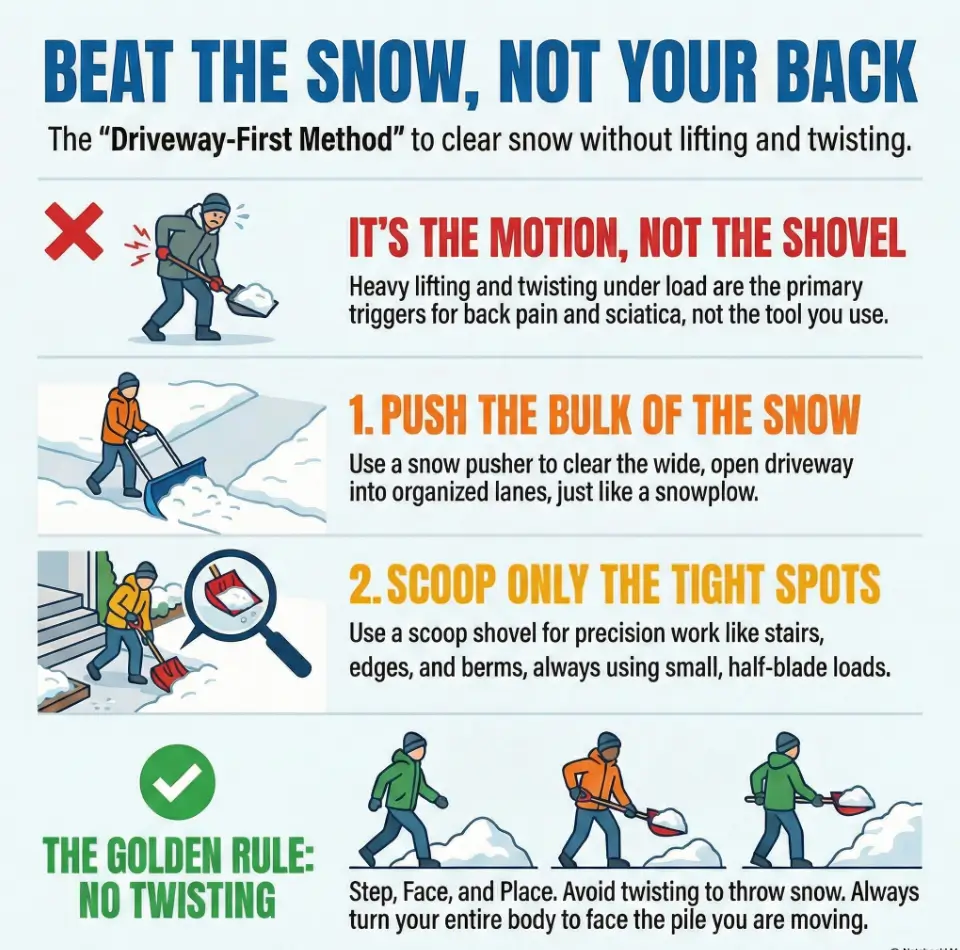
The 3 motions that decide your pain outcome (push / lift / twist)
- Push: lower peak strain, but it can become a long grind if you push too far per pass.
- Lift: higher peak strain, especially when snow is wet or the scoop is full.
- Twist: the multiplier—rotation is where “reasonable” becomes “regret.” (This same twist-under-load problem shows up in everyday chores too, like mopping with sciatica when you pivot and reach instead of stepping.)
The surprise villain: “just one quick toss” turns into rotation
The common trap is thinking, “It’s only one throw.” Then you do it 60 times. Your body remembers the pattern even if your brain doesn’t. I once tried to “save time” by tossing across the driveway instead of stepping to the pile. It worked—right up until I stood up straight and felt that electric tug down the back of my thigh. Lesson learned. Loudly.
Quick self-check: which motion lights up your symptoms fastest?
Try this simple decision test next time (no heroics): if pushing feels okay but lifting sparks leg pain, start with a pusher. If pushing triggers pain (especially on slopes), you may need shorter pushes, more breaks, or a different approach entirely.
- Pick tools by motion, not marketing.
- Twist under load is the flare-up multiplier.
- Short, repeatable passes beat one long grind.
Apply in 60 seconds: Decide your “no-twist rule” before you start: step to face the pile every time.
Driveway-first method: clear like a plow, not a weightlifter
Here’s the mental shift: you’re not “shoveling snow.” You’re managing where the snow goes with the least number of moves. That’s why driveways behave differently than steps or decks. Driveways are wide. Wide surfaces reward pushing and staging.
Step 1: Rowing lanes (why lanes beat “random pushing”)
Picture two or three long “lanes” down your driveway. Your goal is to row snow into lanes like you’re organizing a messy desk into neat piles. This prevents the classic mistake: pushing snow in circles and re-moving the same snow three times.
- Start down the center and push to one side in short passes.
- Then row the next lane into that same side pile.
- Keep the piles consistent so you don’t create new obstacles.
Step 2: Stage piles (where to put snow so you don’t re-move it)
“Staging” means choosing pile zones early: corners, edges, and places that won’t block visibility or refreeze into a bump you’ll trip on later. If you live where the plow comes through, leave room near the street for the inevitable berm (we’ll handle that later).
Step 3: Finish edges last (the order that saves your back)
Edges are fiddly. Fiddly equals twisting and awkward angles. So don’t start there. Do the big, clean pushes first. Then come back with a scoop for tight spots like the steps, the mailbox path, and the “car pockets” beside your tires. (If stairs are a recurring “tight-angle” pain trigger for you, the same logic applies beyond snow season—see the technique cues in vacuuming stairs with sciatica for step-by-step no-twist positioning.)
Micro-rule: “short pushes, frequent resets” (your spine will notice)
Your body loves predictable work. Keep pushes short—think 10–20 feet—then reset. It feels slower, but it prevents the form collapse that costs you a day of pain. This is where time-poor readers win: you trade “one exhausting session” for “a clean rhythm.”
- Big surface first, fussy edges last.
- Pick pile zones early and commit.
- Short passes protect form and nerves.
Apply in 60 seconds: Before the first push, pick your pile zone and your first lane. Don’t improvise.
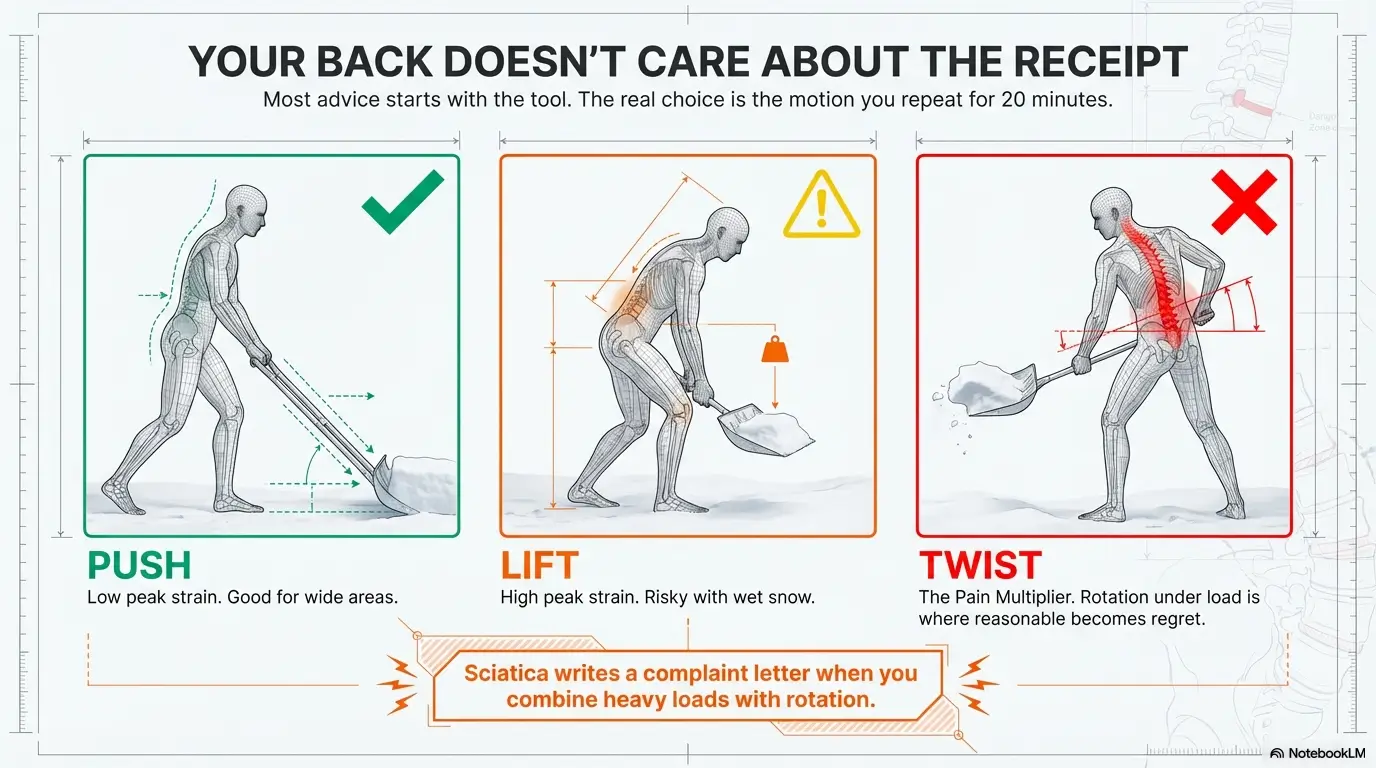
Snow pusher wins when… (and the one scenario it backfires)
A snow pusher is basically a human-powered plow. When it works, it feels unfair—in a good way. On a wide driveway with light-to-medium snow, it’s the easiest path to fewer lifts, fewer throws, and fewer chances to twist.
Best-fit: wide, flat driveways + light-to-medium snowfall
If your driveway is wide and mostly flat, the pusher can handle most of the work. You’ll still need a scoop for stairs and tight edges, but the big win is that your “main movement” becomes pushing, not lifting.
The backfire: wet/heavy snow that “glues” to the pavement
Wet snow is a different creature. It sticks, compresses, and turns your pusher into a resistance sled. If you try to plow too much at once, you’ll lean, hunch, and muscle it—exactly the posture your back hates.
Let’s be honest… the pusher fails when you try to do too much per pass
This is the quiet truth: most “pusher failures” are workload failures. The tool is fine. The pass is too ambitious. I’ve done the “one last push” thing—loaded the blade, leaned in, and felt my lower back bargain with my life choices. Don’t negotiate with a driveway.
Pusher technique that protects sciatica: hips square, hands low, tiny steps
- Square your hips to the direction of travel. No twisting to steer.
- Hands low to reduce shrugging and spinal compression.
- Tiny steps instead of long lunges. Keep your center of mass stable.
- Reset often: if you catch yourself holding your breath, you’re pushing too much.
One more practical note: traction matters. If your boots slip, your back compensates. That’s how a “fine push” turns into a sloppy torque. (If you’ve ever noticed your pain spikes on days your footing feels sketchy, it’s worth treating traction like equipment—see sciatica-friendly walking shoes that prioritize stability and grip for the logic behind “less slip, less spine drama.”)
Scoop shovel wins when… (and why sciatica hates the default technique)
A scoop shovel is a precision tool. It’s excellent when you need control: steps, decks, narrow paths, tight corners, and those annoying “car pockets” where the pusher can’t fit without banging into your bumper.
Best-fit: berms, stairs, decks, tight walkways, and car “pockets”
If you have a small walkway, a porch, or areas where you must lift and place snow somewhere specific, a scoop is useful. It’s also what you’ll reach for when the pusher leaves a thin layer you want to clean up for traction.
Why lifting + distance throws spike nerve irritation
The default move is scoop → twist → throw. That’s the pain recipe. Even if the scoop is “light,” the snow often isn’t. And the farther you throw, the more rotation you add. Rotation under load is exactly where sciatica can get loud.
The sciatica-safe scoop: small loads + set down, don’t launch
- Half-blade loads are not weakness; they’re strategy.
- Step to face the pile, then set snow down instead of launching it.
- Keep the throw short—ideally a place-and-slide, not a toss.
Here’s what no one tells you… the throw distance matters more than shovel weight
People obsess over “lightweight shovels.” That helps a bit. But the bigger lever is distance. A short set-down keeps your spine stacked; a long throw invites twist, jerk, and overreach.
If you want a real-life test: notice how your breathing changes when you throw farther. If you’re grunting (even silently), your body is telling you the load is too big.
“Lighter shovel” can feel worse: blade size, handle shape, and hidden load
This section is where most buying guides get cute and unhelpful. Weight matters, yes. But the hidden problem is that a “light shovel” can still carry a heavy load if the blade is wide and the snow is wet. Your back doesn’t lift plastic. It lifts snow.
Blade width vs load weight: the math your back ends up doing
A wider blade can be faster in powder. In wet snow, it becomes a trap: more blade = more snow = heavier lift. If you deal with wet snow often, a slightly smaller blade can save your back over the course of a winter.
Ergonomic handles (D-grip, bent shaft): when they help, when they don’t
Ergonomic designs can reduce bending if the length fits your height and you use them correctly. But no handle can fix twisting. If you still twist to toss, the handle becomes a fancy accessory to the same problem.
Shaft length: why “too short” forces a hinge you can’t sustain
A too-short handle makes you hinge forward. You can “get away with it” for 5 minutes. Then your low back starts recruiting muscles like it’s assembling an emergency committee. Aim for a handle length that lets you keep your chest more upright.
Material choice: poly vs metal (slip vs stick vs effort)
Poly blades often slide more easily on smooth surfaces and can reduce the “stick-and-jerk” effect. Metal edges can bite into packed snow, but they may catch and jar you if you’re moving fast. Your best material is the one that keeps your motion smooth.
Show me the nerdy details
Think of each scoop as a “rep.” A wide blade increases the average load per rep, and wet snow increases it again. Your risk rises with both load and repetition. The driveway-first method reduces reps by moving snow in lanes, and the half-blade rule reduces load per rep. That’s why technique often beats gear.
Wet snow, ice crust, and plow berms: the three pain multipliers
If you want fewer flare-ups, treat these three conditions like red flags. They’re not “hard mode.” They’re “injury mode.” The American Heart Association regularly warns that snow shoveling can be strenuous. Add wet snow or a berm, and your body pays interest.
Wet snow strategy: remove early, remove often (before it becomes concrete)
Wet snow gets heavier as it compacts. Waiting sounds efficient. It often isn’t. A 10-minute early pass can save you 30 minutes later—and, more importantly, it can save your back from heavy lifts.
Ice crust: when a scraper is safer than brute force
Ice crust turns shoveling into prying. Prying invites sudden jerks. Jerks invite that “lightning” nerve sensation. If there’s crust, consider a scraper or breaking the surface gently instead of trying to peel it in huge sheets.
Plow berms: “chip and carry” beats “deadlift and toss”
Berms are dense, messy, and positioned in the worst possible place: right where you want to walk and drive. The temptation is to hoist a monster chunk and throw it. That’s the moment sciatica writes a complaint letter.
The berm plan: break → stage → clear (in that order)
- Break: chip the berm into smaller pieces.
- Stage: move chunks to a nearby staging area (short distance).
- Clear: scoop and place in a final pile once it’s manageable.
A small confession: I used to treat berms like a personal challenge. “I’ll just get it done.” That pride cost me a stiff day. Now I treat berms like paperwork: annoying, but best handled in small, boring steps. (That “carry without paying interest” mindset translates to other flare-up traps too—especially carrying laundry upstairs with sciatica, where distance and fatigue quietly rewrite your form.)
- Early passes prevent compaction and heavy lifts.
- Scrape or break crust to avoid jerks.
- For berms: break → stage → clear.
Apply in 60 seconds: If you see a berm, commit to “chip and carry,” not “lift and launch.”
Don’t do this: the “one giant scoop” trap (most common flare-up pattern)
This is the most common moment your back gets betrayed by your brain: you’re almost done, you’re cold, and you want to finish. So you take the biggest scoop of the day. Your body immediately starts compensating. That’s where pain shows up later.
The overload cycle: one big scoop → protective spasm → worse form → worse pain
The overload cycle is sneaky. The big scoop doesn’t always hurt instantly. It often hurts later—after your muscles tighten to protect you, after your form collapses, after you start twisting without noticing.
The fix: cap your load (a “half-blade” rule that actually works)
The half-blade rule is simple: if the snow is wet or packed, don’t fill the shovel. Use half a blade, maybe less. You’ll feel “slower” for a minute. Then you’ll realize you’re still moving continuously—because you’re not stopping to recover from each lift.
Don’t throw across the driveway (rotation + distance = spike risk)
Throwing across the driveway combines two problems: rotation and distance. If you must move snow far, stage it closer first. Yes, it’s two steps. That’s the point. Two safe steps beat one dramatic mistake.
Don’t chase perfection: “good enough clearance” keeps you consistent
If you’re time-poor, “perfect” is a trap. Clear the safe path. Leave the cosmetic stuff for later, or let the sun handle it. The goal is traction and access—not winning an invisible award.
Common mistakes that quietly wreck your back (even with the right tool)
You can buy the right tool and still have a miserable morning. These mistakes are small, common, and expensive—like tiny fees your body charges for bad decisions. The good news: they’re fixable.
Mistake #1: Long continuous pushes until form collapses
Long pushes turn into leaning. Leaning turns into back strain. If you catch yourself pushing with your shoulders instead of your legs, reset.
Mistake #2: Twisting to toss (instead of stepping to face the pile)
If you remember one thing, make it this: Step, face, place. Twisting is the shortcut that steals your next day.
Mistake #3: Working cold (no warm-up, no micro-breaks)
I’m not asking for a yoga class. I’m asking for 60 seconds: march in place, loosen hips, do a few easy hinges. Your first five minutes set the tone for your whole session. (If you want a simple “default warm-up” you can repeat without thinking, the McGill Big 3 in 10 minutes is an easy reference point for spine-friendly bracing and control.)
Mistake #4: Clearing at the worst time (after compaction and refreeze)
When snow refreezes or gets packed down, it’s harder to move and more likely to jerk your body. If possible, do a quick pass earlier. Your future self will be annoyingly grateful.
Mistake #5: Wearing the wrong boots (traction changes your spine mechanics)
Slipping forces your back to stabilize you. Stabilizing under awkward movement is tiring fast. Good traction is not a luxury; it’s a safety feature. (If you’re choosing footwear with flare-ups in mind, use the same “stability first” lens as sciatica-friendly walking shoes—less slip means less emergency bracing.)
- Short passes keep form intact.
- Step to face the pile—no twist tossing.
- Warm up for 60 seconds and take micro-breaks.
Apply in 60 seconds: Set a timer for a 30-second break every 6–8 minutes on heavy snow days.
- Yes/No: Is your driveway mostly flat and wide? (Yes = start with pusher lanes.)
- Yes/No: Does lifting trigger leg pain faster than pushing? (Yes = minimize scoop loads.)
- Yes/No: Is the snow wet/heavy or refrozen? (Yes = shorter passes + half-blade rule.)
Apply in 60 seconds: Answer the three questions and pick your “primary motion” (push or small-lift) for the first pass.
Neutral action: Write your choice on a sticky note (“PUSH FIRST” or “SMALL SCOOPS ONLY”) and put it by the door.
Who this is for / not for
This is practical guidance for ordinary driveways. It’s not medical advice. If your body is sending loud signals, listen to them. Time-poor doesn’t mean you have to be pain-rich.
This is for you if…
- You clear a driveway/walkway and want fewer flare-ups.
- You notice sciatica worsens with lifting or twisting.
- You want a simple “first pass” method you can repeat every storm.
Not for you (or use extra caution) if…
- Pain is severe, progressive, or includes new weakness, numbness, or balance issues.
- You’ve had recent spine surgery, a new injury, or you’re unsure what’s causing your symptoms.
- You need to clear steep inclines or large areas alone in deep, heavy snow.
One of my least favorite lessons: sometimes the smartest move is stopping early. It feels lazy. It’s actually protective. If symptoms escalate—especially leg weakness—consider getting medical guidance. Institutions like Mayo Clinic and Cleveland Clinic describe warning signs that warrant evaluation, and it’s not worth gambling with your mobility. (If you’re unsure whether what you’re feeling is “normal sore” or “stop now,” keep a bookmark for low back pain emergency red flags—the goal is clarity, not panic.)
Short Story: The morning I tried to “beat the plow” (120–180 words) …
A few winters ago, I heard the plow coming and panicked. I sprinted outside like I was defending a castle gate. My plan was simple: clear everything fast, before the berm arrived. My execution was… enthusiastic. I used a scoop shovel, filled it like a trophy, and threw snow farther and farther because “distance equals progress,” apparently.
Ten minutes in, my back felt tight. Fifteen minutes in, I started twisting without stepping—because I was cold and impatient. The plow arrived anyway, dropped a berm like a final boss, and I tried to deadlift it out of spite. I “won” the driveway and lost the next two days. Now, I let the plow do its thing, then handle berms with break → stage → clear. It’s slower for 8 minutes and faster for the rest of my week.
Next step: your 60-second tool pick + first-pass plan
If you want fewer flare-ups, don’t rely on willpower in the cold. Make a plan when you’re warm, calm, and wearing socks. Here’s the quick pick—and a tiny “do it now” step you can complete in 15 minutes.
If your driveway is wide/flat: start with a snow pusher + lane-row method
Do the first pass with the pusher in short lanes, stage piles, and leave detail work for later. You’re trying to reduce lifting reps to near-zero at the start.
If you have berms/stairs/tight edges: add a scoop shovel for small-load cleanup
Use the scoop for what it’s good at: tight spots and controlled placement. Keep loads small and avoid long throws. If you find yourself “launching,” you’re back in twist territory.
One concrete action today: set up a “lane + stage” route before the next snowfall
- Pick your pile zone (corner/edge) where visibility and refreeze risk are lowest.
- Decide your first lane (center to left, or center to right).
- Commit to one rule: no twist tossing.
- Choose a snow pusher when you have a wide driveway and lifting triggers pain faster than pushing.
- Choose a scoop shovel when you mostly clear steps, decks, tight paths, or berm chunks (small loads).
- Use both when you want the pusher for volume and the scoop for precision—driveway first, edges last.
Apply in 60 seconds: Circle one choice (PUSH / SCOOP / BOTH) and decide your first 10 minutes of work.
Neutral action: Put your primary tool by the door and your secondary tool near the garage—so you don’t default to the wrong one.
- Input 1: Snow type (powder vs wet/heavy).
- Input 2: Driveway length (approx.).
- Input 3: Your “tolerable push” distance before form slips.
Apply in 60 seconds: Use the tool below once, then follow the plan—no recalculating in the cold.
Mini Calculator: Breaks & pass length (rough, practical)
Plan ~4 short passes per lane. Take a 30-second reset every 8 minutes.
Neutral action: Screenshot your result and stop thinking about it—just follow the plan outside. (If you like having a structured rhythm you can reuse elsewhere, a simple sit-stand schedule for desk-job sciatica flare-ups works on the same principle: pre-decide your resets so you don’t “improvise” your way into pain.)
FAQ
Is a snow pusher better than a scoop shovel for sciatica?
Often, yes—for driveways. A pusher reduces lifting and throwing, which can reduce flare-ups when lifting and twisting trigger symptoms. The key is short pushes and no twisting. If pushing on a slope aggravates pain, shorten passes and consider help or alternatives.
What shovel is best for lower back pain when clearing a driveway?
For most driveways, a pusher + small scoop combo works best: push the bulk into lanes, then scoop tight areas with half-blade loads. Blade size matters more than tool weight when snow is wet.
Can pushing snow make sciatica worse?
It can if you push too far per pass, lean hard, or work on slippery footing. If pushing triggers pain, reduce resistance (smaller bites), take more resets, and avoid hunching. Pain that escalates or changes in a concerning way is a reason to stop and seek guidance.
How heavy is “too heavy” for a scoop shovel load?
There’s no universal number because snow density varies wildly. A good rule is behavioral: if you hold your breath, grunt, or twist to move it, the load is too heavy. Use the half-blade rule in wet snow and stage piles closer instead of throwing far. (If you like a practical, real-world way to think about “safe loads” in daily life, the logic in grocery bag weight limits with sciatica maps surprisingly well to shovel loads: smaller bites, shorter carries, fewer flare-ups.)
Should I use an ergonomic bent-handle shovel for back pain?
It can help some people reduce bending, especially if the length fits your height. But it won’t protect you from twisting or oversized loads. Technique still decides most outcomes: step to face the pile, keep loads small, and avoid long throws.
Is a snow pusher harder on your back than shoveling?
It depends on conditions. In light-to-medium snow on flat pavement, pushing can be easier than repeated lifting. In wet snow or on steep slopes, pushing can become strenuous—short passes and frequent resets become non-negotiable.
What’s the safest way to deal with plow berms at the end of the driveway?
Treat berms as a separate job: break → stage → clear. Chip into manageable chunks, move them a short distance, then scoop lightly. Avoid deadlifting big blocks and throwing them far.
When should I stop shoveling if my leg pain starts?
Stop if pain is sharp, escalating, or accompanied by new weakness, numbness, or balance changes. Those are not “push through” signals. If symptoms persist or worsen, consider medical evaluation—organizations like Mayo Clinic and Cleveland Clinic describe warning signs that warrant attention. (If you’re weighing next steps beyond “rest and hope,” a grounded starting point is physical therapy for sciatica, especially when movement patterns are the trigger.)
Is it safer to shovel during the storm or after it stops?
Often safer to do short early passes, especially in wet snow, because compaction increases effort and jerk risk. Even one early “lane pass” can reduce the workload later.
Does using a snow blower reduce sciatica flare-ups vs shoveling?
It can reduce lifting, but it introduces pushing and vibration, and you still need to handle berms and tight edges. If you have frequent flare-ups, a blower (or hiring help) can be worth considering—especially for heavy-snow regions.
Wrap-up: close the loop and make it easy next time
Let’s close the curiosity loop from the top: the real choice isn’t “pusher vs scoop.” It’s whether you’ll clear your driveway by pushing and staging (low lift, low twist) or by lifting and throwing (high lift, high twist). The driveway-first method wins because it reduces the two things that most often spike sciatica: heavy repetition and rotation under load.
If you remember one picture, make it this: your driveway is a set of lanes. You row snow into piles. Then you do detail work with small scoops. It’s not dramatic. It’s not heroic. It’s the kind of boring that keeps your week intact.
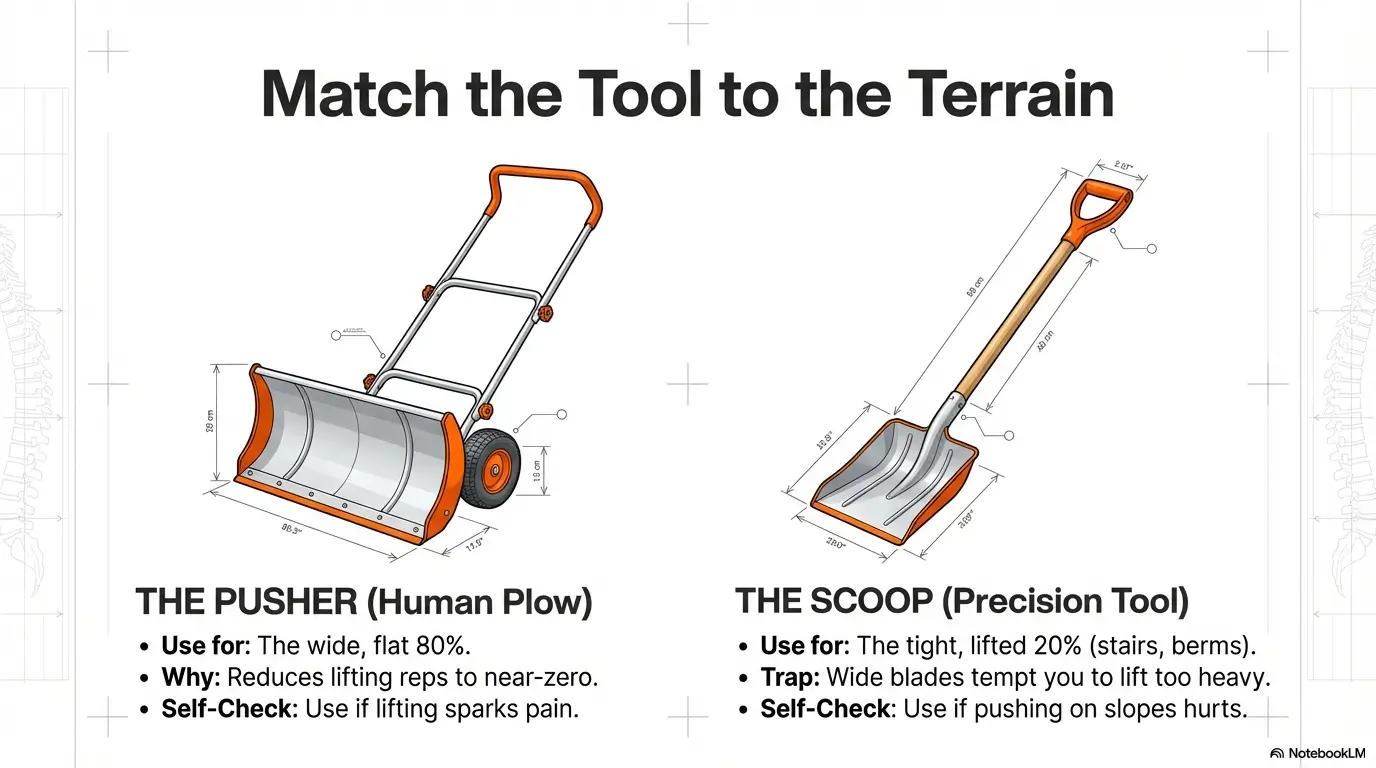
Infographic: Driveway-First Method (Back & Sciatica Friendly)
- Driveway width/length and slope (flat vs incline).
- Your “problem zones” list: berms, stairs, deck, tight edges, car pockets.
- Typical snow type where you live: powder vs wet/heavy; frequent refreeze or not.
Apply in 60 seconds: Take a quick driveway photo and note your problem zones on it.
Neutral action: Use your photo and notes to choose a pusher size and a manageable scoop blade—then commit to the lane route.
Final 15-minute next step: put your primary tool by the door, pick your pile zone, and promise yourself one thing: no twist tossing. You’ll clear more efficiently, and you’ll keep your back out of the aftermath.
Last reviewed: 2026-01